Companion to West Virginia v. Snap — What OpenAI’s Published GPT-4 Limits Prove About Snap’s Knowledge Before the My AI Rollout | State Attorneys General Sue Snap, Not OpenAI, Over My AI — West Virginia Cites OpenAI’s Published GPT-4 Limits to Allege Notice Before the Public Rollout
Executive Summary
Core insight. Snap is the first defendant sued under both state enforcement templates at once, and most of what the states seek sits outside insurance. The social-platform template from the Meta litigation targets design, time limits and age assurance. The chatbot template from the OpenAI and Character.AI cases targets companion design, sycophancy and safety marketing, and My AI is where the two meet.
On November 5, 2026, West Virginia sued Snap over My AI. Three weeks earlier the same attorney general had sued OpenAI. Against OpenAI, the state says the company hid ChatGPT’s risks. Against Snap, it says OpenAI published those risks and so put Snap on notice.
Thesis. The docket favors a negotiated resolution over a ruling, and the order of resolutions decides how much of the chatbot theory survives. Meta’s August 2026 agreement turned Snap’s teen controls into a condition for each framework state’s full benefits. Insurance then decides who pays: penalties and injunctions stay with Snap, while private suits, shareholder claims and defense costs reach carriers.
The notice paradox. Every fact that proves Snap knew the risk before launch also supports a carrier’s defense that the injury was expected. A defense built on Snap’s response rather than its ignorance is the one position that answers the states and preserves coverage at once.
Who pays. Penalties and injunctions stay with Snap, because most states bar insuring civil penalties and liability forms cover damages rather than compliance. Private suits, shareholder claims and defense costs reach carriers, and the December 10 duty-to-defend ruling decides whether carriers fund any of it. Four insurance forecasts carry snapshot odds: no duty to defend for part of the youth-harm suits at 60%, an audit or insurance term in any framework-state resolution at 70%, a shareholder suit at 40% and a recovery action against a model supplier at 10%.
Why the case reaches beyond Snap. Every company deploying a third-party model to minors, every carrier writing those companies and every state office copying a complaint faces the questions Snap faces first. The questions are what a supplier’s warning proves, which deal other states accept and which policy still pays.
What distinguishes the MindCast approach. Litigation commentary reads Snap’s eight cases one docket at a time. MindCast reads them as one negotiation with several clocks, set inside two coalitions that grow by copying complaints. It then traces each exposure to the policy that answers it.
MindCast AI applies Predictive Behavioral Economics + Dynamic Game Theory through MindCast AI Proprietary Cognitive Digital Twin Foresight Simulations (MP CDT FS). Behavioral Economics supplies the decision rules. Game Theory supplies the payoff structure. Predictive simulations emerge from the combination.
What the paper does. The paper maps the eight cases, places them inside the state campaigns against AI companies and reads five open questions from the public record. It then sets out Snap’s strategic options, ranks the exposures, traces where insured loss lands and carries the MindCast Foresight Simulation Predictions with their windows and falsifiers.
🏛 Policymakers. California’s companion chatbot statute already writes the safety baseline that state enforcement is trying to reach case by case.
💼 Executives. Any company deploying a third-party model to minors faces the supplier-notice theory West Virginia is testing first, and its carrier reads the same facts as an expected-injury defense.
⚖ Counsel. Meta’s agreement names no auditor, and its selection process will decide what counts as compliance for every Core Industry Member. Coverage counsel reads the same notice facts as an expected-injury defense, so the December 10 duty-to-defend ruling sets the defense budget.
📊 Investors. Resolution before the August 2027 trials is the likeliest path, and insured loss concentrates in the private and shareholder suits that follow it.
Takeaway. The question shifts from whether Snap resolves to which state resolves first, what the first deal says about My AI and which policy pays for what follows.
I. The Governing Equilibrium: Two Templates, One Chatbot
The governing equilibrium of Snap’s exposure is a negotiation between two enforcement templates over one product. Predictive Behavioral Economics + Dynamic Game Theory explains why resolution is likelier than a ruling. Game theory supplies the payoff structure: Meta’s August 2026 agreement ties each framework state’s full benefits to Snap’s teen controls. Behavioral economics supplies the decision rules: attorneys general facing an August 2027 trial calendar favor visible safety wins over uncertain verdicts.
Seven of Snap’s eight state complaints plead My AI facts. The chatbot allegations give states a second theory to press, while the platform allegations give them a benchmark to copy from Meta’s terms.
West Virginia’s contradiction shows the structure in miniature. The same office argues concealment against the supplier and publication against the deployer. MindCast’s parent paper maps the eight cases behind that contradiction, and the companion paper tests the notice theory.
Takeaway. Teen safety controls that Snap can verify serve users first and carry litigation value second.
II. Eight Cases, One Product
Snap’s state docket looks like eight separate fights but behaves as one negotiation with several clocks. Nevada pleads no My AI facts and sits inside Meta’s framework, which makes it the natural venue for a platform-only resolution. New Mexico won its own Meta judgment, stayed outside the framework and holds the strongest incentive to try its case.
Nevada · Clark County · My AI pleaded: No. Writ denied Feb. 2026; trial set for August 2027. Likeliest first resolution.
New Mexico · Santa Fe County · My AI pleaded: Yes, ¶¶194–201. Dismissal denied April 2025; trial set for August 2027. Likeliest holdout.
Utah · Salt Lake County · My AI pleaded: Yes. Snap’s federal suit dismissed March 2026. Likeliest venue for the first express My AI ruling.
Texas · Collin County · My AI pleaded: Yes (facts). Inside Meta’s framework through its own parallel judgment. Sued OpenAI Oct. 23, 2026.
Florida · Santa Rosa County · My AI pleaded: Yes, ¶¶106–111. Back in state court Oct. 14, 2026. Declined the framework. Sued OpenAI June 1, 2026.
Arkansas · Removed to E.D. Ark. · My AI pleaded: Yes. Remand granted, then vacated Sept. 18; motion pending. Sued OpenAI Oct. 14, 2026.
Pennsylvania · Removed to E.D. Pa. · My AI pleaded: Yes, incl. Count III ¶163. Removed Sept. 23, 2026; no remand ruling at the evidence cutoff. Only state naming My AI inside a count.
West Virginia · Kanawha County · My AI pleaded: Yes. Filed Nov. 5, 2026. Pleads OpenAI’s published GPT-4 limits as notice to Snap. Sued OpenAI Oct. 14, 2026.
Utah carries the sharpest legal risk. Snap lost its federal bid to stop the case, and the state has reasons to seek an express ruling on My AI. An adverse ruling there would travel to all seven My AI states as persuasive authority.
Takeaway. Nevada sets the commercial template, while Utah sets the legal one.
III. The Federal and Statutory Flank
Snap’s exposure extends past the eight complaints. In January 2025 the Federal Trade Commission (FTC) referred a non-public My AI complaint to the Department of Justice (DOJ). The referral grew out of compliance reviews under Snap’s 2014 consent order, and MindCast has found no filing since.
The FTC opened a second front in September 2025. Seven operators received orders in its companion-chatbot study, Snap among them. Snap’s answers now form a fixed baseline against which later statements in court will be read.
California added a statutory front on January 1, 2026. Senate Bill 243 covers companion chatbots that sustain human-like social interaction. The operator owns compliance and cannot hand it to the model provider, and users hold a private right of action at $1,000 per violation.
Annual reports to the Office of Suicide Prevention begin July 1, 2027. My AI’s “personal sidekick” positioning and its place in the chat list make coverage a live question. MindCast’s Who Sets the Agentic Standard of Care — Common Law, State Legislation and Federal Coordination maps how statutes like California’s set the deployer’s standard of care.
Two more pressures shape the negotiation. Snap resolved the claims of all four Los Angeles bellwether plaintiffs set for trial, the latest on November 2, 2026. States read that pattern as a resolution habit.
Snap’s coverage suit against its carriers faces a duty-to-defend hearing set for December 10, 2026, and Hartford Casualty v. Instagram found no duty to defend Meta in February 2026. Section X traces what the coverage fight means for who pays.
MindCast’s How Plaintiffs Turn Insurer AI Governance Standards Into Evidence shows how carriers’ AI governance standards become plaintiffs’ evidence. MindCast’s Agentic AI Liability and Insurance Exclusions — How Coverage Redirects Who Gets Sued shows how exclusions steer plaintiffs toward particular defendants.
Takeaway. The federal flank stays quiet today, but each piece can turn loud without warning.
IV. How the State Coalitions Line Up
State attorneys general now treat general consumer-protection law as sufficient for AI products. Two coalitions formed in 2026, one around Meta and one around OpenAI. Snap’s eight plaintiff states sit in different positions inside both, and those positions predict how each office behaves toward Snap. MindCast’s AI Enforcement and Litigation Tracker follows every state, federal and private AI action in one view.
The OpenAI campaign runs on two pleading templates. Eight states filed coordinated consumer-protection suits on October 14, 2026, and at least seven of those filings share outside counsel. Florida and Texas filed separately, named Sam Altman personally and sought pre-release oversight.
California opened a third template on November 16, 2026, pleading public nuisance over agent intrusions and seeking abatement over OpenAI’s testing itself. MindCast’s California Sues OpenAI Over Rogue AI Agents, and Public Nuisance Becomes the Third Pleading Template Against a Frontier Lab reads the filing as the first conduct template against a frontier lab, with OpenAI’s own release process as the remedy.
The second template matters most for future conduct terms. Pre-release oversight is forward-looking relief, so it reaches future launches rather than the 2023 window. Against a deployer, it would require clearance before every new launch, including each change of model supplier such as the September 2024 move to Gemini.
Arkansas, Texas and West Virginia form the bloc most likely to press for chatbot terms. All three sit inside Meta’s framework and run active OpenAI cases, so their staff already know the chatbot theories. Expect each to demand My AI provisions alongside platform controls, with the chatbot terms the contested part of any deal.
Nevada, Utah and Pennsylvania run the platform template. “Template” here means where a case came from, not whether it pleads My AI facts: Utah and Pennsylvania both plead My AI. If Utah or New Mexico sues OpenAI, its Snap complaint will likely pick up the chatbot theories within a year.
Florida is the outlier in both campaigns. Florida declined Meta’s framework, sued OpenAI first and named Altman personally. Florida’s April 2025 complaint relies on HB 3, the state’s 2024 minors’ social media law. A state defending a new statute wants a court to enforce it.
New Mexico is the holdout with its own playbook. New Mexico won a separate judgment against Meta and stayed outside the framework. New Mexico’s August 2027 trial date gives the office every reason to try the case.
Six OpenAI plaintiffs have no Snap case yet. Arizona, Idaho, Iowa, Kansas, Montana and Nebraska have built chatbot theories against OpenAI. MindCast’s State Attorney General Coalitions — How Lead States Set the Template and Why Other States Copy the Complaint shows how lead offices write the first complaint and shared counsel carries its text to the next filer.
Snap cannot stop the coalition from growing, but a resolution can lower what each office commits. MindCast’s Multistate Enforcement Against AI and Platform Companies — How Defendants Contain State Attorney General Coalitions and Write the Standard Their Rivals Inherit shows that Meta’s agreement drew more states than any complaint against Meta had, while each signing office spent far less than a litigating one. The Interactive State Attorney General Coalition War Gaming companion lets readers play the defendant and state moves from both coalition papers.
MindCast has published OpenAI’s position at comparable depth: the containment paper classifies OpenAI as holding until the first ruling, and the California analysis maps its options at the demurrer fork. West Virginia’s notice theory makes Snap’s case the first state enforcement test of supplier-warning notice. MindCast’s Interactive OpenAI Liability War Gaming lets readers run the state and OpenAI moves against each other.
Takeaway. Snap faces three blocs with three different incentives, and no single negotiating posture fits all of them.
V. Five Readings From the Public Record
The two earlier Snap papers answer public questions about notice and resolution. Five further readings follow from the same public filings.
New Mexico left an express ruling for later. Snap’s motion there left the My AI paragraphs untouched, so the April 2025 denial reached them without deciding them. A state is likely to force an express ruling, with Utah the likeliest venue.
Nevada will likely resolve first on platform terms. Nevada pleads no chatbot facts, so its resolution would turn on platform controls alone. Nevada’s trial clock makes it the likeliest first resolver, while Utah carries more strategic weight.
The launch-window evidence starts with what is already public. Utah’s complaint, partly unredacted after a subpoena, quotes senior engineering managers who called the rollout reckless over insufficient testing. The UK Information Commissioner’s May 2024 conclusion found that Snap’s original risk assessment fell short before launch. The same conclusion accepted Snap’s revised risk assessment as compliant and took no enforcement action.
The remaining questions turn on what Snap received from OpenAI, who reviewed it and what changed before April 19, 2023. The Washington Post published its test of My AI on March 14, 2023, and Snap’s April 4 post on new moderation tools shows a response. Discovery will test whether the response matched the warning. The same evidence decides coverage, because facts that prove notice also support a carrier’s expected-injury defense.
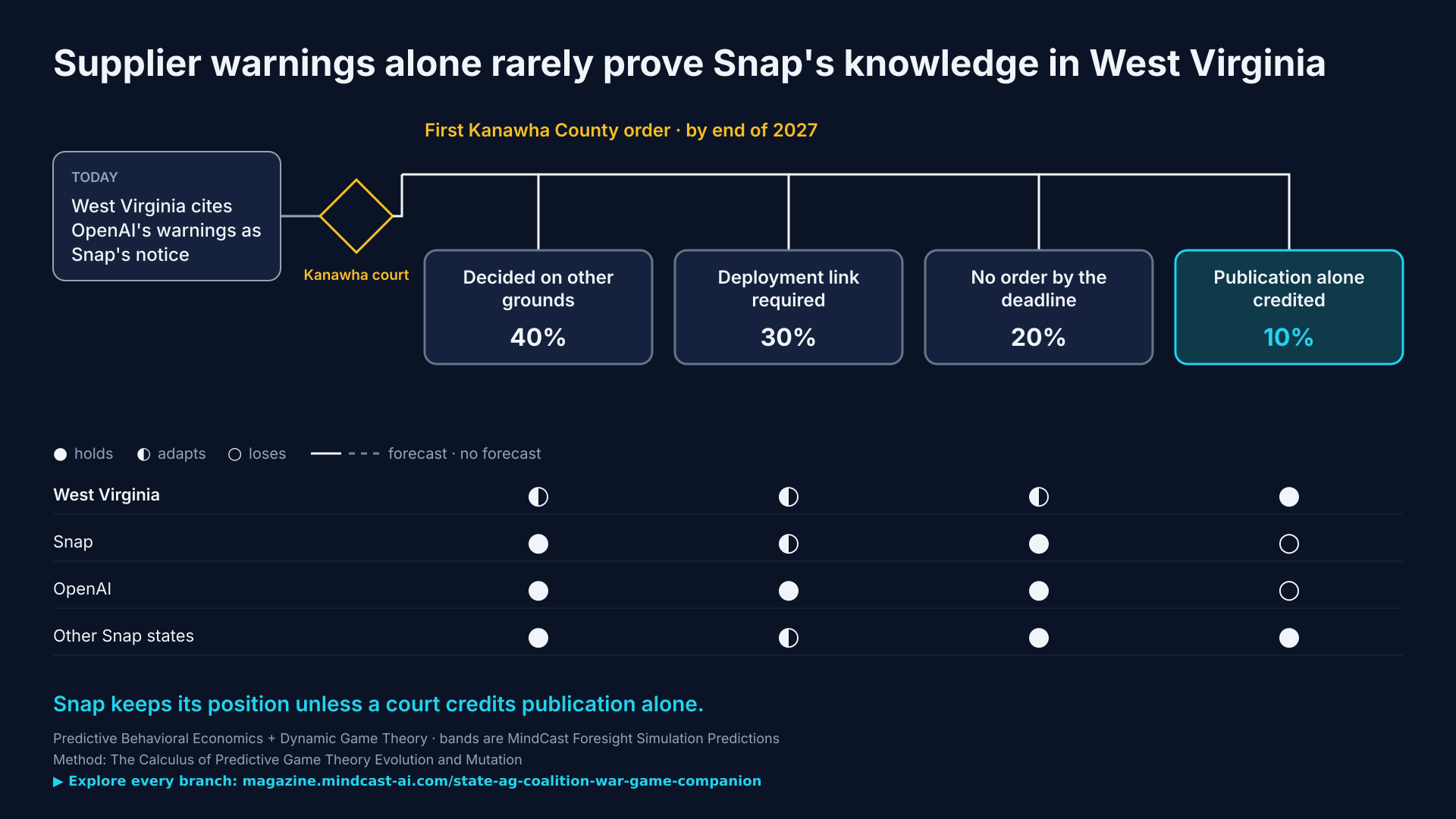
Model identity cuts both ways. OpenAI’s March 2023 limitations describe GPT-4, while Snap launched My AI on February 27, 2023 on a customized OpenAI model before GPT-4’s public release. Google’s Gemini has also powered My AI since September 2024. Alphabet therefore supplies the chatbot while YouTube sits beside Snap as a Core Industry Member under Meta’s agreement.
Supplier incentives diverge from Snap’s. OpenAI’s defense in its own overlapping state cases improves if deployers carry the duty to protect minors. A revision of developer terms assigning minors’ safety testing to deployers would move the coalition’s aim downstream.
Takeaway. Snap’s own documents will matter more than OpenAI’s.
VI. Meta’s Agreement Sets the Terms Snap Inherits
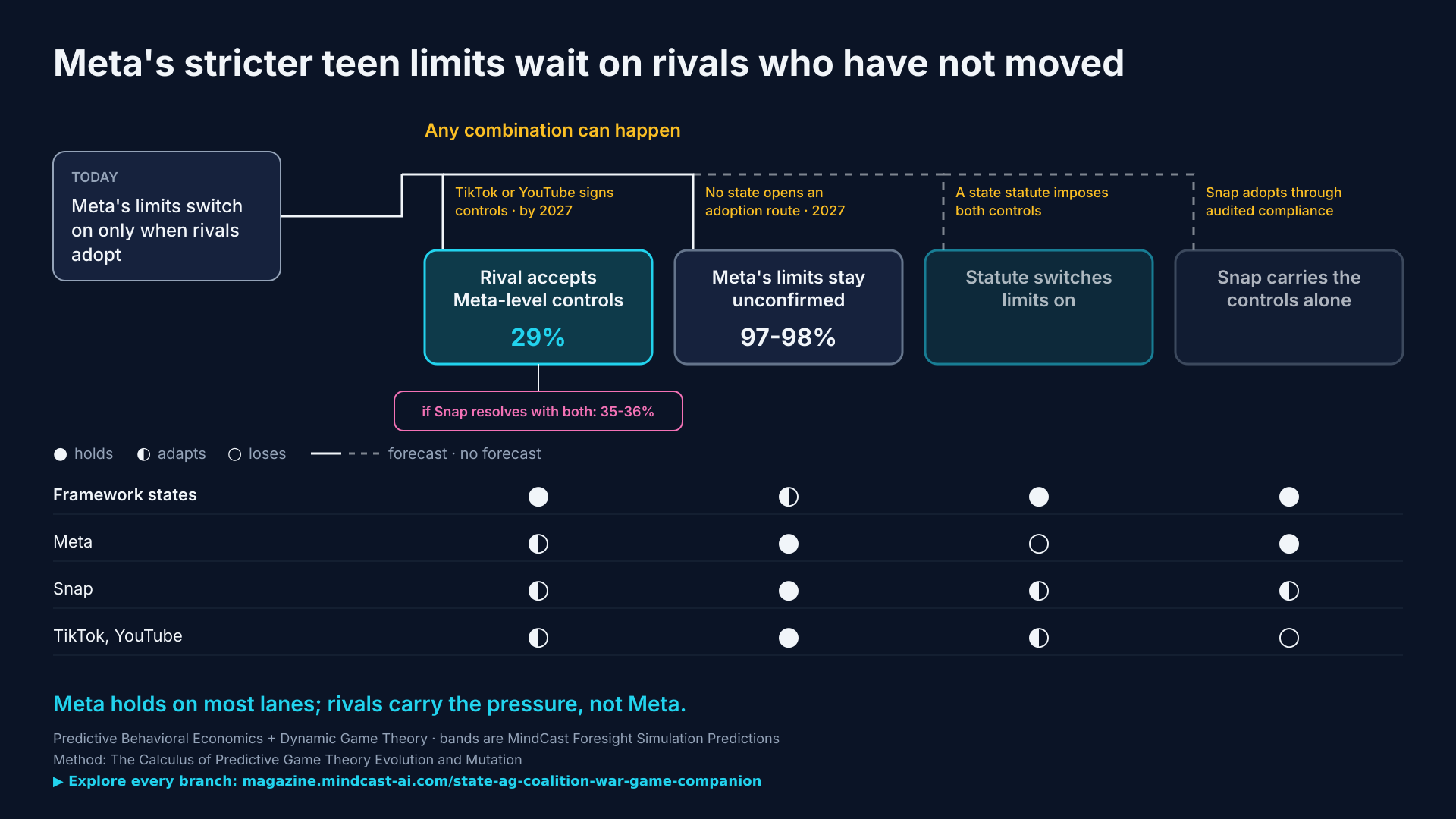
Meta’s agreement converts Snap’s teen controls into one of three gates in every framework state. The filed text (§ I.DD) recognizes three routes for a Core Industry Member: a binding commitment with a state, an applicable statute or verified voluntary compliance. The voluntary route requires an independent third-party auditor to certify implementation, a five-year minimum audit term and binding age assurance for users aged 13 to 17.
The agreement names no auditor, though it sets a selection and dispute process. The selection process will shape what counts as compliance for every Core Industry Member.
The auditor also takes on exposure of its own. MindCast’s Common Law and Legislative AI Liability Cybernetic Diffusion and Evolution shows how an auditor that certifies AI controls makes an undertaking third parties can rely on, and how that undertaking becomes a claim when the controls fail.
Adoption counts state by state and control by control. Meta’s tighter Phase II controls are the 10 p.m. to 7 a.m. teen access bar and the daily limits of 60 minutes per app. Each switches on in a state only after Snap, TikTok, YouTube and any applicable new entrant adopt that control there. Meta’s contingent payments (§ I.U) need the same adoption plus payment obligations from members with more than $10 billion in annual profit, so Snap’s cash counts toward none of them.
The containment paper adds two constraints. Section V.D gives Meta a right to seek comparable relief wherever a state grants a covered rival softer terms, so framework states have reason to resist offering Snap less than Meta accepted. The same paper puts the chance that no participating state publicly confirms both Phase II controls operative through 2027 at 97-98%.
MindCast’s Consent Order Remedies at Meta, Boeing, Starling and Wells Fargo — Verified Correction Versus Recurrence compares remedies built on verified correction with remedies that let violations recur. MindCast’s Meta and Bank of America Foresight-to-Duty Conversion: Revenue-Funded Versus Cost-Funded Deferral explains why revenue-funded deferral resists remediation longer than cost-funded deferral.
Takeaway. Snap’s controls carry value through penalty and injunctive effects long before they switch on any of Meta’s terms.
VII. Snap’s Strategic Options
Snap’s options fall into seven moves, each with a mechanism and a trade-off. The paper classifies them; it does not estimate Snap’s internal costs.
Verified controls paired with recognized terms. A nationwide, audited rollout of Meta-aligned teen controls satisfies the voluntary route without a decree or an admission. The controls end the period in which a state can count ongoing violations, including West Virginia’s repeated-and-willful penalty of up to $5,000 per violation. The controls also narrow the injunctive relief states can demand. A rollout made before any resolution hands framework states that contribution with nothing recognized in return.
The controls do not answer the notice question, which asks what Snap did between March and April 2023. Their engagement cost remains the main trade-off.
Competitor adoption as a public variable. TikTok and YouTube hold the other gates in every framework state. Their adoption can only be read from public filings and announcements, and the containment paper flags antitrust limits on any coordination among Core Industry Members.
A published chatbot safety baseline. California’s statute already requires AI disclosure to known minors and break reminders every three hours. The statute also requires safeguards against sexual content with minors, suicide-ideation protocols and a published safety protocol. A My AI baseline built on that standard would answer the deception theory directly.
A supplier-disclosure log. The notice theory asks whether a warning named the harm and the users, and whether someone with launch authority received it, assessed it and let the assessment shape the launch. A logged review still proves knowledge, so a log narrows the dispute only when each entry pairs with a dated product decision. MindCast’s The Foresight-to-Duty Conversion — Measured Governance Debt Becomes Evidence When Institutions Keep the Gap They Found and Meta Foresight-to-Duty Conversion Across Privacy, Child Safety and Scam Ads trace how a gap an institution measures and keeps becomes evidence against it. Carriers read the same log, and a dated decision trail shows a response to a known risk rather than its acceptance.
The four states’ contradictory positions. Four states argue that OpenAI concealed ChatGPT’s risks while one argues that OpenAI published them as notice to Snap. The tension falls short of formal estoppel because the defendants differ. MindCast’s Agentic Foreseeability and the Modern Duty of Care for AI Agents sets out the duty-of-care framework the notice theory draws on.
One consistent fact narrative. FTC study answers, public safety statements, court filings and statutory disclosures will be read side by side. Inconsistency among them is the easiest impeachment a state can find.
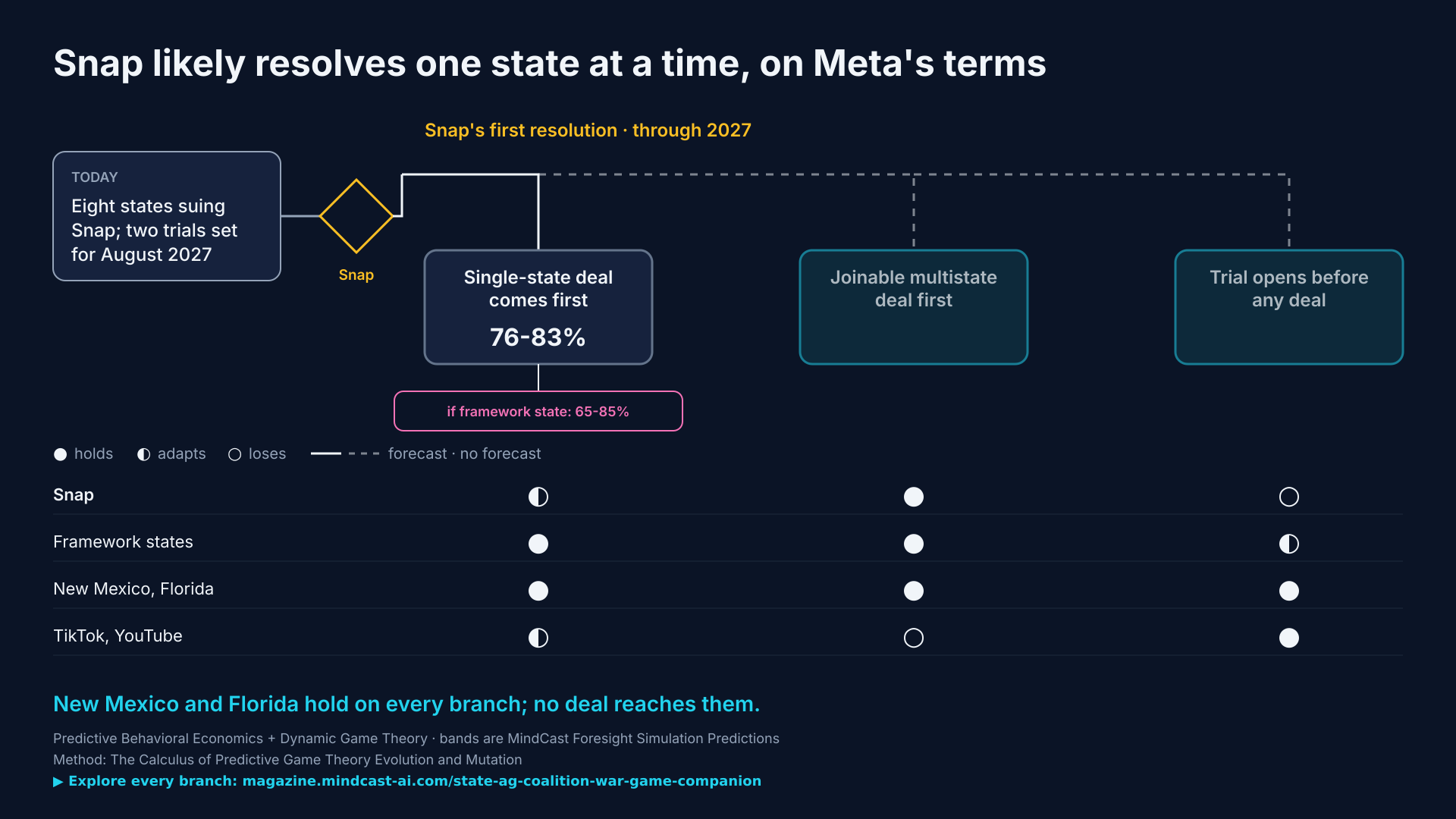
A resolution other offices can sign. Snap cannot reduce the number of states, but a joinable resolution converts litigating offices into signing ones. The containment paper puts a single-state Snap deal before any joinable deal at 76-83%, so the joinder decision likely follows the first resolution.
The California analysis supplies the test for whether any decree can contain a template. A template is containable when one joinable decree lowers every current and prospective filer’s remaining remedy. Snap’s platform template passes, as Meta’s agreement showed, and the chatbot template passes while it stays on deception and disclosure.
The chatbot template fails the test once a state turns it into a conduct claim that seeks supervised launch review, because every concession about Snap’s release process then becomes evidence in the other forums. A verified, published My AI safety baseline keeps the chatbot template on the containable side. A state whose own My AI harm facts arise inside its borders also sits beyond any joinable offer, since its case needs no copied complaint.
Takeaway. Verified controls and documented responses carry more weight than arguments in every option.
VIII. The Resolution Sequence the Docket Favors
The docket favors a strategy that prioritizes Utah, lets Nevada resolve first on its own clock and leaves the overlap bloc for last. Utah sits inside Meta’s framework, runs the platform template with no OpenAI case and is the likeliest court to rule first if any court rules expressly on My AI. A Utah resolution would remove the likeliest source of an adverse ruling while drawing less pressure for chatbot terms than the overlap bloc would bring.
Utah has reasons to prefer a ruling, and Snap sued the state in federal court and lost. A Utah resolution therefore depends on terms worth more to Utah than a ruling would be. Snap’s verified controls complete one of the gates for Utah’s Phase II protections, though the gate opens only if TikTok and YouTube adopt too. Utah would also avoid trial and appeal risk, and an enforceable My AI safety baseline would give it the first chatbot provision in any state case against Snap.
Nevada will likely resolve on its own trial clock with a platform-only term sheet. Arkansas, Texas and West Virginia obtain My AI-specific terms only 40% of the time on the snapshot odds. Florida and New Mexico stay outside any template: Florida as a statute defender, New Mexico as a trial-seeking office.
MindCast’s Who Writes AI Insurance Coverage Conditions — Procurement, Enforcement Decrees, Partner Terms and the Two-Axis Condition explains how enforcement decrees become insurers’ coverage conditions, so resolution terms will shape Snap’s insurability too. Section X sets out which of those costs insurance reaches.
Takeaway. The first resolution decides whether the My AI theory reaches a court.
IX. Exposures, Ranked
Snap’s exposures cluster around three questions: whether a court rules first, what discovery reveals and how fast the chatbot template migrates. The list ranks them by expected impact and pairs each with its probability and the trigger that would confirm it.
Express adverse My AI ruling that sister courts cite (30% before August 2027). Watch: dispositive briefing in Utah; Snap’s response in West Virginia. Reduced by: a Utah resolution before briefing closes.
Launch-window discovery into Feb.–Apr. 2023 supplier communications and testing (near certain once discovery opens). Watch: discovery orders in New Mexico and Utah. Reduced by: a complete, dated decision trail.
Chatbot theories migrating into amended Snap complaints (60% by Nov. 30, 2027). Watch: amended pleadings; shared outside counsel. Reduced by: a published chatbot baseline before amendments land.
California’s companion chatbot law covering My AI, opening private suits (70% that a court treats My AI as covered). Watch: first such complaint naming a major platform. Reduced by: documented compliance with the statute.
New Mexico holding for trial (30%). Watch: trial-preparation filings. Reduced by: offers tied to New Mexico’s own Meta outcome.
Coverage loss in the carrier suit (60% that the first ruling finds no duty to defend for at least part of the youth-harm suits, by Mar. 31, 2027). Watch: duty-to-defend ruling; January to March 2027 renewals. Reduced by: a response-based notice defense that keeps the expected-injury exclusion out of reach.
Federal revival by DOJ filing or FTC study findings (not modeled). Watch: FTC report; any DOJ filing. Reduced by: a consistent fact narrative.
Suppliers shifting deployer duties onto Snap (50% by Dec. 31, 2027). Watch: developer-terms revisions; OpenAI briefs. Reduced by: indemnity and testing allocation in supplier contracts.
A new state suing Snap over My AI (30% by Dec. 31, 2027). Watch: new OpenAI filings; coalition announcements. Reduced by: a path for later offices to sign rather than litigate.
Shareholder suits reaching directors and officers cover (40% that a securities or derivative suit over youth-safety or My AI disclosures is filed by Dec. 31, 2027). Watch: disclosure suits after the first resolution or ruling. Reduced by: board records that document the launch response.
Takeaway. Snap controls the bottom of the list completely and the top of the list partially, through what it builds and documents before the trials.
X. Where My AI Loss Lands: The Insurance Layer
Insurance decides who pays for Snap’s My AI exposure, and most of the attorney general exposure falls outside it. The insured loss concentrates in private suits, shareholder claims and defense costs. Penalties and injunctions stay with Snap, and five layers of the liability chain each answer to a different policy.
Most Attorney General Exposure Is Uninsured
The eight states seek civil penalties and injunctions. Many states bar insuring civil penalties as a matter of public policy, and most liability forms cover damages rather than the cost of complying with an injunction. Defense costs are the main insured item in an attorney general case, and Snap’s coverage suit puts even those in dispute.
Private plaintiffs carry the insured loss. California’s companion chatbot statute gives users $1,000 per violation, and the Los Angeles youth-harm cases already test Snap’s bodily-injury coverage. Private claims reach the policies the attorney general cases cannot.
Notice Proves the State’s Case and the Carrier’s Defense
West Virginia’s theory has a second audience. Standard liability forms exclude injury the insured expected or intended, and every fact that proves Snap knew the risk before launch also supports that exclusion. Snap’s carriers already rely on Hartford Casualty v. Instagram, which found no duty to defend Meta in the addiction suits.
A defense built on Snap’s response rather than its ignorance is therefore the one position that answers the state and preserves coverage at once. The April 4, 2023 moderation changes and the launch decision trail carry both arguments.
Carriers face their own version of the problem. MindCast’s How Insurers Defend AI Claims Decisions When Their Own Governance Standards Become Evidence shows how a carrier’s AI governance standards become evidence once it denies a claim, and Who Answers for AI Claims Decisions — Insurers, Consultants and Auditors in the Second Seat explains why reviewer capacity, not written policy, decides which of those denials hold.
Exclusions Already Reach New Claims
Insurance Services Office endorsement CG 40 47 became available in January 2026 and removes coverage for injury and damage arising from generative AI. Policies renewed with that endorsement or an equivalent leave new My AI claims outside general liability. The coverage suit concerns older forms, so its outcome governs past claims more than future ones.
The January to March 2027 renewals are the next decision point. MindCast’s California analysis puts language on agent access to third-party systems entering standard forms in that cohort at 50%. The Snap complaints give every carrier writing a minors-facing chatbot a dated set of known circumstances.
Five Layers, Five Policies
Model suppliers (OpenAI, Google). Supply My AI’s models; no state names them in a Snap case. Policy: Technology errors and omissions; cyber. Developer terms push minors’ safety duties toward deployers.
Snap as deployer. Defendant in eight state cases. Policy: General liability with AI exclusions; cyber. Stays with Snap once exclusions apply.
Snap’s board and officers. Approved the launch and the safety statements. Policy: Directors and officers cover. Disclosure suits typically follow enforcement.
Snap’s carriers. Defending under older forms. Policy: Primary and excess liability. The duty-to-defend ruling sets the cost.
Reinsurers. Back the carriers’ capacity. Policy: Treaty reinsurance. One model’s failure can reach many deployers, so aggregation terms tighten at renewal.
MindCast’s Who Absorbs Correlated AI Loss — Reinsurance Aggregation, Industry Pools, the Public Backstop and the Liability Shield traces where correlated loss comes to rest once one model’s failure reaches many deployers, from treaty aggregation terms to public backstops.
Plaintiffs Follow the Policy That Still Pays
MindCast’s Agentic Liability and Insurance Exclusions Interactive War Gaming publishes a 60% chance that plaintiffs above all reachable limits add governance or professional allegations, in cases filed through 2028. For Snap, those allegations point at the board’s oversight of the My AI launch and reach directors and officers cover. Utah’s quotes from senior engineering managers make that amendment easier to plead.
MindCast’s When AI Agent Liability Meets Common Law and Statute — Predictable Doctrines, Unsettled Allocation traces how renewal cohorts set coverage terms before courts allocate the loss. The Agentic Insurance Exclusions War Gaming Companion carries the full conditions and falsifiers behind the exclusions forecasts. The Agentic Claims Liability Interactive War Gaming adds the tender and vendor-recovery moves that would carry a My AI claim from Snap toward its model suppliers.
The Duty to Settle Turns Resolution Habits Into Carrier Exposure
California’s duty to settle, running from Comunale v. Traders & General Insurance Co. (1958), makes a carrier that refuses a reasonable within-limits demand answer for the excess judgment. Snap resolved all four Los Angeles bellwethers before verdict, the pattern in which within-limits demands decide who funds a resolution. MindCast’s exclusions work treats duty-to-settle exposure as a finding: it attaches to any liability insurer whose policy responds, before any exclusion ruling.
The duty-to-defend ruling decides whether that pressure ever reaches Snap’s carriers. MindCast’s snapshot odds put a first ruling that finds no duty to defend for at least part of the youth-harm suits at 60%, by March 31, 2027. A carrier with no duty to defend owes no duty to settle, so a loss there leaves Snap funding every resolution alone.
Only a Paying Insurer Holds a Claim Against the Model Supplier
Vendor recovery follows payment. The exclusions forecasts put the first vendor recovery action with the deployer when no carrier has paid, at 70% by the end of 2028, and a carrier subrogation suit against an AI vendor at 12% by March 31, 2027.
Snap sits on the deployer branch. No carrier has paid on a My AI claim, and Snap’s supply relationships with OpenAI and Google make a recovery suit costly. MindCast’s snapshot odds put any indemnity, contribution or subrogation action by Snap or a paying carrier against either supplier at 10% by the end of 2027.
Resolution Terms Become Underwriting Conditions
Enforcement decrees write the conditions carriers later require. A Utah resolution carrying audited teen controls and a published safety baseline gives Snap’s carriers a verified standard to underwrite against. The same terms give every deployer’s carrier a benchmark for what a minors-facing chatbot should have in place. MindCast’s The Cybernetics of AI Liability Across the Common Law and Legislative Systems places carriers inside one feedback system with courts, legislatures and attorneys general, which is why resolution terms travel into coverage terms.
The coverage conditions paper puts an attorney general decree requiring an independent audit or an insurance term at 17-62% by the end of 2027. For Snap the odds run higher, because Meta’s voluntary route already requires an independent auditor. MindCast’s snapshot odds put an audit or insurance term in any framework-state resolution with Snap at 70%.
Takeaway. Insurance pays for the private and shareholder claims that follow enforcement, not for the enforcement itself, and the duty-to-defend ruling and Snap’s notice defense together decide whether even those stay covered.
XI. MindCast Foresight Simulation Predictions
The paper carries two tiers of probability. MindCast Foresight Simulation Predictions cleared the full validation threshold in the Foresight Simulations behind the published Snap and coalition papers, so they carry bands. Snapshot odds come from a Foresight Simulation run on November 8, 2026. Snapshot odds cover claims where it is too early for an equilibrium to form, and they round to the nearest 10%.
Simulation Predictions
60-80% · At least one attorney general action against Snap resolves before the first trial, now set for August 2027. Two trial dates hold, Snap resolved all four Los Angeles bellwethers before verdict and Meta’s terms give every state a benchmark. Falsifier: the first trial opens with no resolution in any state. Source: parent paper.
65-85% · If a framework state resolves with Snap by Dec. 31, 2027, the resolution includes age assurance and a teen time-limit default. Meta’s agreement makes those controls the condition for each framework state’s full benefits. Falsifier: a framework-state resolution omits either term. Source: parent paper.
90% · No Kanawha County order treats OpenAI’s publication alone as proof of Snap’s knowledge, by Dec. 31, 2027. Publication alone shows neither receipt nor review, and the state’s own OpenAI case argues concealment. Falsifier: such an order issues. Source: companion paper.
76-83% · Snap’s first single-state resolution comes before any joinable resolution, through 2027. Snap can close a near-term trial without buying agreement from every office. Falsifier: a joinable resolution comes first. Source: containment paper.
97-98% · No participating state publicly confirms both of Meta’s Phase II controls operative, through 2027. No state has opened an adoption route, and peers must align once one opens. Falsifier: an eligible filing confirms both controls in one state. Source: containment paper.
29%; 35-36% if Snap resolves with both controls · TikTok or YouTube accepts a Meta-level teen control in a binding resolution by Dec. 31, 2027. Rivals adopt only under compulsion. Falsifier: a qualifying TikTok or YouTube resolution. Source: containment paper.
Snapshot Odds
50% · Nevada resolves with Snap first, before August 2027. Nevada pleads no chatbot facts and carries a trial date. Falsifier: another state resolves first.
40% · Arkansas, Texas or West Virginia obtains My AI-specific terms in its first resolution. Staff know the chatbot theories, but Snap holds chatbot terms to disclosures in simulated talks. Falsifier: the first such resolution carries My AI-specific terms beyond disclosures (yes) or omits them (no).
70% · Florida is the overlap state least likely to resolve with Snap by Aug. 31, 2027. Florida stands outside Meta’s framework, wants HB 3 enforced and faces no trial date. Falsifier: Florida resolves before Arkansas, Texas or West Virginia.
80% · The hid-the-risks versus published-the-risks tension surfaces in briefing once Snap answers in West Virginia. West Virginia argues both positions in two live cases. Falsifier: Snap’s answer and the state’s reply omit the tension.
60% · If Utah or New Mexico sues OpenAI, its Snap complaint picks up chatbot theories within a year. Shared staff and counsel move allegations across cases. Falsifier: no amended Snap complaint adds them within a year of the OpenAI filing.
30% · New Mexico holds its case for trial in August 2027. New Mexico’s own Meta judgment sets an outside option above likely offers. Falsifier: New Mexico resolves before trial.
60% · If a state court rules expressly on My AI before August 2027, Utah rules first. Utah’s My AI counts are live in state court and Snap’s federal exit has closed. Falsifier: another court rules first.
30% · An express adverse My AI ruling that sister courts cite issues before August 2027. Most cases look headed for resolution, but Utah and New Mexico can force a ruling. Falsifier: no such ruling by the first trial.
60% · An amended Snap complaint adds sycophancy or companion-design allegations by Nov. 30, 2027. Shared counsel and identical text already move allegations across the OpenAI cases. Falsifier: no amended complaint adds them.
70% · A court treats My AI as a companion chatbot under California’s statute. Positioning and chat-list placement fit the statutory definition. Falsifier: the first ruling holds My AI outside the definition.
50% · OpenAI revises developer terms to assign minors’ safety testing to deployers by Dec. 31, 2027. Shifting duty to deployers helps OpenAI in its own state cases. Falsifier: no such revision.
30% · A state not now suing Snap files a My AI action by Dec. 31, 2027. The OpenAI coalition keeps growing, but no new Snap investigation is public. Falsifier: no new filing.
60% · By Mar. 31, 2027, the first ruling on duty to defend in Snap’s coverage suit finds no duty to defend for at least part of the youth-harm suits. Hartford Casualty v. Instagram found no duty to defend Meta on similar claims. Falsifier: the first ruling finds a duty to defend on every suit at issue.
70% · If Snap resolves with a framework state by Dec. 31, 2027, the resolution requires an independent audit or an insurance term. Meta’s voluntary route already requires an independent auditor. Falsifier: a framework-state resolution with neither term.
40% · By Dec. 31, 2027, a securities or derivative suit names Snap or its directors over youth-safety or My AI disclosures. Disclosure suits typically follow enforcement, but none over My AI is public. Falsifier: no such filing.
10% · By Dec. 31, 2027, Snap or a carrier paying on its behalf files an indemnity, contribution or subrogation action against OpenAI or Google over My AI. No carrier has paid, and Snap depends on both suppliers. Falsifier: no such filing.
80% · A new Snap filer pleads My AI with allegations drawn from existing complaints. Shared counsel and identical text already move allegations. Falsifier: a new complaint pleads a materially new theory.
The prediction set holds six Simulation Predictions carried from published MindCast work and seventeen snapshot odds new to the paper, four of them on the insurance layer. Each resolves against the state court docket or official statement named in its claim.
Takeaway. The Simulation Predictions point to resolution, and the snapshot odds locate where that resolution stays contested.
XII. Stakeholder Strategy and Risk Mitigation
Each stakeholder holds a different lever on the Snap board. The entries list exposure in a unit the stakeholder controls, the actions within its reach and the exposure that remains.
Attorneys general in framework states. Exposure: a Snap resolution softer than Meta’s terms, which Section V.D lets Meta cite. Actions: a resolution that tracks Meta’s controls and adds a verified My AI safety baseline captures both templates in one instrument. Residual: Phase II stays dormant until TikTok and YouTube adopt.
Attorneys general outside the framework. Exposure: trial cost against a defendant resolving elsewhere. Actions: New Mexico’s trial posture and Florida’s statute give each a distinct outcome no template supplies. Residual: other states’ resolutions set the benchmark a court will see.
Companies deploying third-party models to minors. Exposure: the supplier-notice theory, measured in releases shipped to minors after a supplier safety publication without a dated product decision. Actions: a log that pairs each supplier publication with a dated decision narrows the dispute to the quality of the response. Residual: a logged review still proves knowledge.
Model providers. Exposure: deployer suits that cite supplier publications. Actions: developer terms that allocate minors’ safety testing shift the coalition’s aim downstream. Residual: states may treat the shift as notice of the risk itself.
Liability carriers. Exposure: defense costs on older forms and the private suits that follow enforcement. Actions: renewals conditioned on verified controls rather than cash reserves, with the Snap complaints treated as known circumstances for any minors-facing chatbot. Residual: no court has yet addressed coverage for the eight Snap attorney general cases.
Brokers. Exposure: clients placed on renewals that carry AI exclusions without an affirmative AI policy behind them. Actions: a coverage map for each deployer client that names which layer answers a chatbot claim. Residual: affirmative AI capacity stays thin before the first paid agent claim.
Reinsurers. Exposure: one model’s failure reaching many deployers at once. Actions: aggregation terms at the January 2027 treaty renewals. Residual: aggregation wording untested in any chatbot claim.
Investors. Exposure: valuations committed before the dated forks. Actions: valuation reviews at the Utah briefing schedule, the first resolution and the August 2027 trials. Residual: one reasoned adverse ruling can move many dockets at once.
🏛 Policymakers. Codified chatbot baselines reach every deployer at once.
💼 Executives. A dated decision trail matters more than any single safety feature.
⚖ Counsel. The auditor selection process under § I.DD decides what verified compliance means, and a response-based notice defense protects coverage.
📊 Investors. The first resolution’s chatbot terms carry the most information about Snap’s remaining exposure.
Takeaway. Every stakeholder’s best move follows from where it sits relative to the two templates and Meta’s adoption gates.
XIII. What to Watch: Dated Signals Through August 2027
Fourteen signals tell whether the resolution path holds or the legal fork opens. Undated signals can arrive any week.
Dec. 10, 2026: Duty-to-defend ruling. Defense funding and how courts read notice for coverage.
Undated: Utah’s dispositive briefing schedule. Sets the deadline for a Utah resolution.
Undated: West Virginia’s service on Snap. Starts the newest case’s clock.
Undated: Remand rulings in Arkansas and Pennsylvania. Returns two My AI cases to state court.
Undated: Any Utah ruling on the My AI counts. Opens the legal fork.
Undated: TikTok or YouTube publicly adopting Meta controls in any state. Changes how many gates remain closed.
Undated: OpenAI developer-terms revisions. Moves deployer duties toward Snap.
Undated: A new state suing OpenAI, led by Utah or Tennessee. Adds chatbot staff to a platform-template Snap case.
Undated: A ruling on HB 3’s constitutionality. Changes what a Florida resolution would require.
January 2027: New attorneys general take office. Adds offices whose priorities are not yet set.
January to March 2027: Commercial and treaty renewals. Shows whether chatbot and agent language enters standard forms.
March 2027: Next Los Angeles bellwether settings. Tests Snap’s resolution pattern again.
July 1, 2027: First annual reports under California’s statute. Creates a public document the states will read.
August 2027: Nevada and New Mexico trial dates. Closes the window for resolution before trial.
Takeaway. The Utah briefing schedule and the first resolution carry the most weight, because each decides whether a court ever reaches My AI.
Conclusion
West Virginia filed two complaints three weeks apart and told two incompatible stories about one warning. Against OpenAI, the warning was hidden. Against Snap, the warning was public enough to prove notice. Snap’s exposure turns on which story a court believes, and on whether any court is asked before a deal closes the question.
The governing equilibrium is resolution without a ruling. Framework states gain more from Meta-tracking controls than from a verdict, and Snap gains more from a deal than from discovery. Carriers gain most from a record showing that Snap responded to what it knew. Only New Mexico and Florida sit outside that equilibrium: one already beat Meta at trial, and the other wants its own statute enforced.
Three dated events will show whether the equilibrium holds. Utah’s briefing schedule decides whether a court reaches My AI before a deal does. The December 10 coverage ruling shows how a court reads notice when an insurer is paying. The January to March 2027 renewals show whether carriers write chatbot risk out of standard forms before any court allocates it.
The forward test is Utah. If Snap resolves Utah before a ruling, the chatbot theory stays a pleading and the industry inherits a disclosure standard. If Utah rules first and its reasoning travels, every company deploying a third-party model to minors inherits a notice standard written for Snap, and a carrier reading the same facts as an expected injury.
Working With MindCast
Every party in the Snap cases faces a dated decision before August 2027, and each decision depends on how the other parties move. A public paper classifies those positions. A commissioned Foresight Simulation runs them against one organization’s own dockets, contracts and policies.
What MindCast delivers, by seat:
Companies deploying third-party models to minors. Before the next launch: a notice map that pairs each supplier safety publication with a dated product decision, tested against West Virginia’s four questions.
Carriers and brokers. Before the January to March 2027 renewals: where a chatbot claim lands across the five policy layers, and which wording moves it. The Agentic Liability and Insurance Exclusions Value Proposition sets out the insurer engagement.
Reinsurers. Before the January 2027 treaty renewals: aggregation exposure when one model’s failure reaches many deployers at once.
State offices. After the first Snap resolution posts: whether to sign its terms, copy its complaint or keep litigating.
Investors. At each dated fork: which positions survive a resolution, a ruling or a trial.
How it works. MindCast builds Cognitive Digital Twins (CDTs) of the counterparties that decide a client’s outcome: attorney general offices, courts, suppliers and insurers. The MP CDT FS runs their likely moves against the live docket. The client’s team then plays its own moves in private war gaming and sees which positions hold on every branch.
First step. A complimentary pilot on one decision the client names, built from public information and delivered as one briefing. Retained work proceeds under a nondisclosure agreement. Contact mcai@mindcast-ai.com · www.mindcast-ai-simulation.com · All MindCast war gaming: www.mindcast-ai-simulation.com/live-fire-intelligence
MindCast Works
MindCast AI Enforcement and Litigation Tracker. Federal, state and private AI actions in one view.
State Attorneys General Sue Snap, Not OpenAI, Over My AI — West Virginia Cites OpenAI’s Published GPT-4 Limits to Allege Notice Before the Public Rollout. The eight-state Snap map and the published Snap bands.
West Virginia v. Snap — What OpenAI’s Published GPT-4 Limits Prove About Snap’s Knowledge Before the My AI Rollout. The supplier-notice test and the launch-window chronology.
Multistate Enforcement Against AI and Platform Companies — How Defendants Contain State Attorney General Coalitions and Write the Standard Their Rivals Inherit. Commitment timing and Meta’s adoption mechanics.
State Attorney General Coalitions — How Lead States Set the Template and Why Other States Copy the Complaint. How one complaint spreads across states.
Interactive State Attorney General Coalition War Gaming. Defendant timing and state copying in playable form.
Interactive OpenAI Liability War Gaming. The state campaign against OpenAI in playable form.
OpenAI State Attorney General Lawsuits — Two Pleading Templates Across Ten State Courts Decide Which Game Theory Evolution Arrives First. The two OpenAI templates and the coalition forecasts.
California Sues OpenAI Over Rogue AI Agents, and Public Nuisance Becomes the Third Pleading Template Against a Frontier Lab. The third OpenAI template and the buy-down test for whether one decree can contain a coalition.
Agentic Foreseeability and the Modern Duty of Care for AI Agents. The duty-of-care framework behind the notice theory.
The Foresight-to-Duty Conversion — Measured Governance Debt Becomes Evidence When Institutions Keep the Gap They Found. How measured gaps become evidence.
Meta Foresight-to-Duty Conversion Across Privacy, Child Safety and Scam Ads. The same conversion across Meta’s child safety cases.
Consent Order Remedies at Meta, Boeing, Starling and Wells Fargo — Verified Correction Versus Recurrence. Which remedies hold.
Meta and Bank of America Foresight-to-Duty Conversion: Revenue-Funded Versus Cost-Funded Deferral. Why revenue-funded deferral resists remediation.
Who Sets the Agentic Standard of Care — Common Law, State Legislation and Federal Coordination. How statutes set the deployer’s standard of care.
Who Writes AI Insurance Coverage Conditions — Procurement, Enforcement Decrees, Partner Terms and the Two-Axis Condition. How decrees become coverage conditions.
How Plaintiffs Turn Insurer AI Governance Standards Into Evidence. Carrier standards as plaintiffs’ evidence.
Agentic AI Liability and Insurance Exclusions — How Coverage Redirects Who Gets Sued. Exclusions and defendant selection.
Agentic Liability and Insurance Exclusions Interactive War Gaming. Where agentic loss lands after AI exclusions, in playable form.
When AI Agent Liability Meets Common Law and Statute — Predictable Doctrines, Unsettled Allocation. How renewal cohorts set coverage terms before courts allocate loss.
Agentic Insurance Exclusions War Gaming Companion. Conditions and falsifiers behind the exclusions forecasts.
Agentic Claims Liability Interactive War Gaming. Tender and vendor-recovery moves in playable form.
Who Answers for AI Claims Decisions — Insurers, Consultants and Auditors in the Second Seat. The carrier’s two seats as underwriter and AI deployer.
How Insurers Defend AI Claims Decisions When Their Own Governance Standards Become Evidence. Carrier governance standards as evidence in coverage disputes.
Common Law and Legislative AI Liability Cybernetic Diffusion and Evolution. Auditor undertakings, defense substitution and which policy responds as doctrine shifts.
The Cybernetics of AI Liability Across the Common Law and Legislative Systems. Courts, legislatures, attorneys general and carriers as one feedback system.
Who Absorbs Correlated AI Loss — Reinsurance Aggregation, Industry Pools, the Public Backstop and the Liability Shield. Where correlated AI loss comes to rest.
Agentic Liability and Insurance Exclusions Value Proposition. MindCast’s engagement for insurers, brokers and reinsurers.
Sources
Meta agreement with state attorneys general, filed text (Massachusetts copy). Adoption, Phase II and payment terms.
Troutman Pepper Locke, Eight State AGs Sue OpenAI (Oct. 16, 2026). The October 14 filings and their shared counsel.
Kelley Drye, Florida Sues Snap Using New Social Media Law (Apr. 25, 2025). Florida’s HB 3 complaint.
Utah complaint, previously redacted details. Engineering managers’ statements on the rollout.
UK Information Commissioner, Snap My AI investigation conclusion (May 2024). Risk assessment findings.
Insurance Business, ISO’s generative AI exclusion is already on thousands of CGL policies (Sept. 16, 2026). Endorsement CG 40 47 availability and carrier adoption.
W. Va. Code § 46A-7-111. Repeated-and-willful penalty.
E.D. Pa. docket, No. 2:26-cv-07313. Pennsylvania removal status.
Evidence through November 9, 2026, plus California’s November 16 filing against OpenAI. MindCast represents no party in these cases.