

Companion to FIFA World Cup Final Foresight Simulation — Spain vs Argentina — Spain Owns Recurrence, Argentina Owns Recovery 🇪🇸 🇦🇷
🎯 I. Executive Summary
Billions in reported trading volume, a supercomputer running 25,000 simulations, a video game with four straight correct champion calls, and two editorial panels weighed in on Sunday’s World Cup final. Nearly all of them picked Spain.
Six of the seven never said what would prove their reasoning wrong.
Being wrong is not the problem, and Spain may well lose. A losing pick is trivially checkable — EA said Spain, and Argentina winning settles that. The problem is that a champion pick carries no claim about why, so a checked pick teaches nobody anything about the method that produced it.
Opta updates daily by design, so Monday’s page carries Monday’s number — and the semifinal call giving France 34%, two days before France was eliminated, stands as a snapshot nobody scores. A market price settles cleanly but was never a research commitment. EA named a champion and attached no probability, so “Spain” can be checked and never calibrated. An editorial pick costs nothing in either direction.
MindCast published a 54% forecast on July 16 and locked it — the lowest Spain trophy probability among the quantitative venues. Published alongside it: eleven separately scored predictions, a map of what would change the number and by how much, and the exact branch where the forecast breaks. Validation Report VII grades every line on July 19, win or lose.
Roughly four points separate MindCast from the consensus, and the gap is not a disagreement about who is better. The gap is a disagreement about which minutes decide — sharpest in the states the match reaches only after ninety minutes, and visible in the market’s own prices before kickoff.
Check the claim against the field’s own prices, and check it before kickoff. Every sportsbook line carries a built-in house margin, so backing that margin out — de-vigging, in betting terms — recovers the probability the price implies.
FanDuel’s 90-minute line, de-vigged, gives Spain 42.1%. FanDuel’s trophy line, stripped the same way, gives Spain 57.7%. Solve for the difference and the books imply Spain at roughly 49% once the match passes regulation — a coin flip. MindCast’s replacement tree prices that same state at Argentina 55%, and Argentina 61% level after extra time.
Sportsbook pricing is therefore consistent with the late-state thesis, without anyone having printed the thesis. The conditional gap runs 4.4 points, and Section X does the weighting that shows how much of the headline gap it actually carries. The inference is not proof either way — two lines pulled minutes apart, or two different ways of stripping the margin, would move the answer.
The consensus prices the match. MindCast prices the clock. Spain owns recurrence and wins the ordinary game; Argentina owns recovery and wins the game Spain fails to finish. Every number below descends from that sentence.
Few events in 2026 have activated the entire arc at once, and this final did. Signal at Bleacher Report. Belief at Kalshi and Polymarket. Position in retail order flow, capital in Susquehanna’s facility, flow at FanDuel, control at the CFTC. Every layer of the prediction-market arc fired on a single object inside 48 hours. MindCast mapped that arc in March and made two structural predictions about where it was heading. Both resolved before the ball was kicked.
MindCast is not a seventh forecaster in this field. MindCast is the layer that maps the field. Sections II through IV establish the field, place it, and name who pays for it. Sections V through IX establish what MindCast is and what it can be held to. Sections X and XI put the number where a reader can check it.
⚽ II. Five Quantitative Venues Cluster Within Four and a Half Points, and They Share Inputs
Seven venue classes published a World Cup final forecast this week, and the numbers among them run tighter than anything else in the tournament. Reading that agreement correctly requires knowing where each number came from.
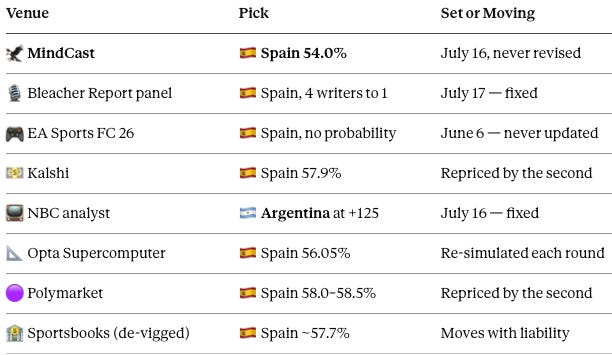
Five quantitative venues cluster within four and a half points, and the venues are not answering identical questions. Opta and MindCast publish a research probability. Kalshi and Polymarket publish a tradable price. Sportsbooks publish an odds line carrying margin.
Agreement across those objects looks like independent confirmation, and independence is exactly what it lacks. Opta’s own published methodology discloses two inputs: Opta Power Rankings and betting-market odds. A market-informed simulation that ingests the books’ prices, then gets cited by the media as confirmation of the books, has closed a loop rather than opened a second window. Kalshi and Polymarket arbitrage against each other and against those same books until the spread collapses to a fraction of a point.
One venue in the field publishes a rule against the loop, and the rule is architectural rather than rhetorical. Prediction-market prices never enter the MindCast engine, and serve only as external benchmarks. Predictive Game Theory Meets the Era of AI — Operationalizing Fudenberg’s Research Agenda with Cognitive Digital Twins. Opta ingests the books by disclosed design; MindCast excludes them by disclosed design. Whatever else separates 54 from 56.05, the two numbers do not share an input.
Correlation is the reason the 54% exists at all, and MindCast named the mechanism before this final. Every public method consumes the same statistics, the same narratives, the same injury reports. MindCast Predictive Game Theory + Behavioral Economics Cognitive Digital Twin Foresight Simulations in the World Cup and Super Bowl. Aggregating them produces shared bias rather than error cancellation. Breaking that correlation takes a method looking at something else entirely — not the stats, not the ratings, not the story, but how each team decides under pressure.
Confidence that the public quantitative numbers are substantially correlated rather than independent: 88–93%. Opta’s own methodology disclosure drives that band, not MindCast’s disagreement with the result.
Four numbers drawn from the same well are closer to one number with four bylines than to four independent reads. Shared inputs are a reason to discount the agreement as confirmation. Shared inputs are not, by themselves, proof the consensus price is wrong. The rest of this analysis asks what each byline is structurally built to produce, and the answer comes from a framework published four months before the final.
🗺️ III. Arc Position, Not Model Quality, Determines What Each Venue Produces
Forecasters look like peers when a table lists them side by side, and the appearance misleads. MindCast mapped the system that turns information into belief into capital into control, and gave every actor class a position and a governing economic logic. The Full Arc of Prediction Markets: From Truth-Seeking to Strategic Exploitation to Behavioral Extraction. Position determines output.
Six layers run in the order money and information actually move. Each one has a plain meaning, and the piece states all six once here rather than assuming them.
Signal is where the takes get made. Bleacher Report, NBC, EA Sports and Opta all sit here, in a layer that pays for attention rather than accuracy. Belief is where a take becomes a price: Kalshi and Polymarket let anyone buy or sell a contract on Spain, and the market’s bids, asks and executed trades produce a continuously updated implied probability. Position is ordinary fans with money on the line.
Capital is where professionals trade against those fans — Susquehanna sits here and publishes nothing. Flow borrows the betting industry’s own word for money in motion: DraftKings and FanDuel make wagering frictionless and take a cut of everything passing through. Control is where the CFTC and the Third Circuit decide what any of it is allowed to be.
MindCast sits above all six and inside none of them. “Meta-layer” means exactly that and nothing fancier: a vantage point grading the system rather than competing inside it.
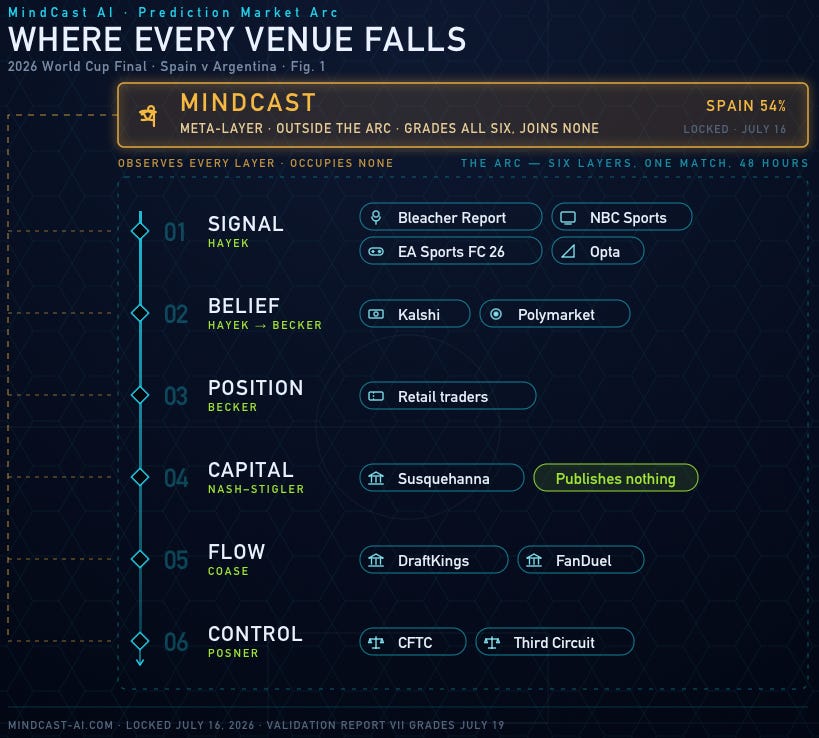
Figure 1. Where every venue falls: the prediction market arc, 2026 World Cup final. Each venue’s layer determines what it is built to produce. MindCast operates as the meta-layer — outside the arc it maps.
Layer position, not model quality, explains the table below. A venue built to be cited behaves differently from a venue built to be traded, whatever the machinery underneath.
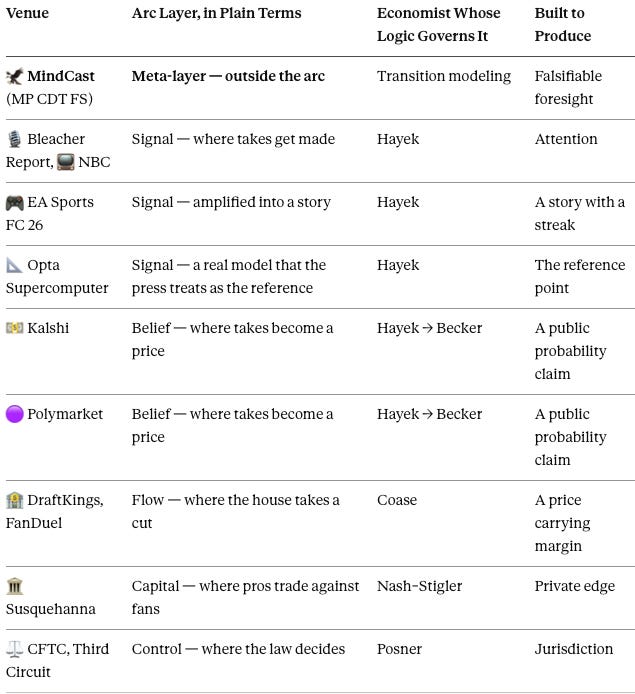
Sportsbooks deserve precision, because most readers read a line as a forecast. A line is a price. Books combine an expected-outcome estimate with market information, exposure management, and margin. A line can therefore move on news, on money, or on neither, and the resulting number is a commercial quote rather than a published probability. De-vigging recovers an estimate from that quote — an inference about the book’s pricing, not a claim the book has made.
Arc position describes function rather than quality, and Opta shows why the distinction matters. Opta runs a genuine statistical simulation across 25,000 iterations and updates it as results arrive — a legitimate forecasting product, and a better one than most outlets could build.
Opta also functions, inside the arc, as the reference point every article reaches for. Amplification is a role, not a verdict on the machinery producing it. EA occupies the same layer with far less under the hood. EA publishes no probability at all, so nothing EA says can be scored. Opta publishes probabilities that anyone could evaluate across repeated forecasts — nobody does, because Opta publishes no calibration record and the press cites only the latest number.
One football match activated all six arc layers inside 48 hours, on a single object, which few events in any year manage. Signal, belief, position, capital, flow, control — and MindCast has published on every layer of it. The layer most readers never see is the one holding the most money, and Section IV goes there.
Contact mcai@mindcast-ai.com to partner with us on Predictive Game Theory AI in Law and Behavioral Economics. We specialize in predictive simulations for Complex Litigation, Legacy Innovation, Innovation Economics and Geopolitical Risk Intelligence.
To test our predictive simulation AI system, in 2026 we simulated the Super Bowl and the World Cup. See Super Bowl LX — AI Simulation vs. Reality | Predictive Game Theory + Behavioral Economics Simulations in the World Cup | The World Cup Is the First Mass-Market Stress Test for Prediction Markets | Susquehanna Is Building the Institutional Market the CFTC Does Not Require — but Still Needs
Other recent projects: How the CFTC’s Missing “Gaming” Definition Is Losing the Kalshi Prediction-Market Preemption War | Prediction Markets and the Dual Nash-Stigler Trap — Kalshi, the CFTC, and the Prediction-Market Harm Clearinghouse
To deep dive on MindCast works upload the URL of this publication into any LLM (preferably Google AI mode) and prompt ‘reconstruct MindCast framework with three degrees of cited sub links.’ See Live-Fire Game Theory Simulators, Runtime Predictive Infrastructure.
For fun, upload the URL for this publication to Google AI during the World Cup final, then prompt Google AI to adjust the simulations with real time data.
🎟️ IV. Eight Stakeholders Bear the Consequences of a Number They Never Publish
Forecasters argue about a number. Other people live with it. Every venue in Section III sits inside an ecosystem of parties who never publish a probability and absorb the consequences anyway, and naming them changes what the World Cup final actually is.
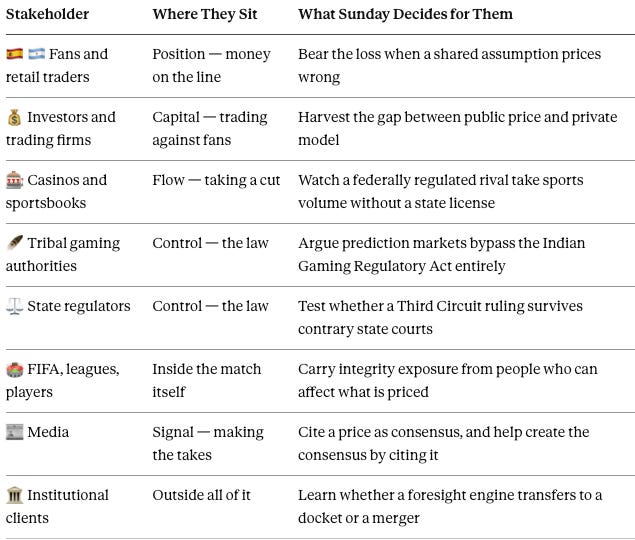
Three rows in that table carry live legal conflict rather than theory. Three California tribes argue that sports prediction markets violate the Indian Gaming Regulatory Act and the state’s sports-betting ban. Arizona pursued criminal charges against Kalshi until a federal judge blocked the state, with appeals unexhausted. A Massachusetts court held in January that Kalshi’s sports contracts fall under state gaming law. The Third Circuit held in April that they do not. The split runs through the exact contract class priced on Sunday’s final.
Casinos deserve a closer look, because Flow is where the money actually moves. The Congressional Research Service reported roughly 87% of Kalshi’s $39.7 billion trailing-twelve-month volume through early 2026 came from sports. Every dollar of it moves outside the state licensing regime commercial and tribal operators paid to enter. A federally regulated exchange offering the same economic exposure without the state license is not a competitor on price. A federally regulated exchange is a competitor on jurisdiction.
Fans occupy the most exposed position and the least represented one. Ordinary traders read Kalshi’s 58% in a Yahoo article, treat the figure as consensus, and buy — without a framework for recognizing that the price and the article are quoting each other. Nobody in the ecosystem is paid to tell them when a price has stopped measuring the match and started measuring the coverage of the match.
Stakeholders explain why a football final is worth a paper. Eight parties with money, licenses, sovereignty, or credibility at stake sit downstream of a number that eight venues published and one venue can be graded on. Section V starts with the party that published nothing at all.
🏛️ V. Susquehanna Deployed $500M and Published No Number, Exactly as the Arc Predicted
Susquehanna International Group built a $500M facility around this World Cup and printed no number. Silence there is architecture, not modesty, and the arc explains why.
The arc separates two activities that share the word “prediction.” Public belief exchanges — Kalshi, Polymarket — socialize the belief layer. Each broadcasts a price as a public probability estimate, invites retail participation, and monetizes the aggregation. Proprietary probability engines — Susquehanna, Jane Street, Citadel Securities — privatize it: they run continuous probability estimation, keep the output internal, and monetize by trading against counterparties who lack it.
Structurally opposed strategies, not two flavors of the same thing. A public exchange needs belief diversity to function at all. A private engine needs informational advantage over everyone else. One claims to tell the world what will happen. The other claims only to price it faster.
Regulatory controversy tracks the claim rather than the machinery. Kalshi faces state enforcement, an April Third Circuit ruling on federal preemption, and a live CFTC rulemaking, because Kalshi makes a public claim to truth and exposes ordinary traders to it. Susquehanna models the same World Cup and draws no scrutiny whatsoever, because Susquehanna makes no claim to the commons and offers no public interface for a regulator to classify.
Readers should hold that asymmetry against the matrix: the venue likely holding the most sophisticated private information is the venue with an empty cell. Migration of high-quality forecasting into private systems is not an accident of this tournament — MindCast predicted it in March, and Section VI grades the prediction.
✅ VI. Two Arc Predictions From March Resolved Before the Final Kicked Off
Foresight earns the name only when the prediction precedes the evidence and survives contact with it. The arc made structural calls on March 26, about no particular match, and this final walked into two of them.
Prediction one: prediction markets concentrate in high-engagement domains, because engagement — not accuracy — is the attractor. The Congressional Research Service reported that roughly 87% of Kalshi’s $39.7 billion trailing-twelve-month volume through early 2026 came from sports. Polymarket’s World Cup winner market alone has cleared $4.2 billion, the largest sports prediction market ever assembled. Resolves in favor: 85–92%.
Prediction two: high-quality forecasting migrates toward private institutional systems, widening the gap between public probability estimates and the private beliefs of well-informed actors. Susquehanna deployed $500M and published nothing, while every public venue in the matrix published a number nobody can score. Resolves in favor: 80–88%.
Foresight of that kind was derived from the arc’s internal logic eleven weeks earlier, tuned to no particular match. A framework predicting where a market is heading should also say what state the market occupies now, and Section VII runs that test on the market MindCast is dissenting from.
🔬 VII. The World Cup Market Is Liquid and Honest, and Its Belief Independence Is Under Pressure
MindCast’s framework asks one question of any betting market: is the price still telling you about the match, or has it started telling you about the coverage of the match? A market in the first state is worth reading as a probability. A market in the second is worth reading as a mood. Applying that question to a market you disagree with is where the framework either proves itself or exposes itself, so the classification runs here in full.
Three conditions must hold at once for a market to keep telling the truth. Traders must be forming views independently, so that one person’s optimism cancels another’s pessimism instead of piling on. Cheating must stay unprofitable. And enough money must be in the market to attract people who actually know something. Lose any one condition and the price starts reflecting what traders are doing rather than what is likely to happen.
Applied to Polymarket’s World Cup winner market, every indicator below comes from public evidence. None of the three depends on what MindCast happens to believe about Spain.
Liquidity — holds. Polymarket’s World Cup winner market shows roughly $4.28 billion in cumulative volume, with the contract actively two-sided. Informed participants have not exited.
Manipulation unprofitable — holds. No public evidence identifies a trader materially distorting this market.
Belief independence — under pressure. Yahoo Sports, ESPN, and CBS all cite Kalshi’s price as a consensus probability inside the same articles that repeat Spain’s 37-match unbeaten narrative. Opta’s model ingests betting-market odds by its own disclosure, the books watch the exchanges, and the exchanges arbitrage to a fraction of a point. The arc names amplifier citation of platform prices as authoritative consensus as a diagnostic indicator of drift, and the indicator is firing in print, today.
One condition under pressure is a warning, not a verdict. A market failing all three would be a broken market, and the World Cup market is plainly not broken. Liquidity is enormous and prices track news cleanly: France traded at 40.1% before the semifinal and vanished; Spain moved from 21.2% to 58.1% on a single result. Both moves reflect information, exactly as a healthy belief aggregator should behave.
Belief correlation is the pressure point, and the correlated belief has legible content: Spain has not lost in 37, Spain throttled France, Argentina got lucky twice. Every venue repeats it. A market aggregating a shared prior produces a price encoding that prior rather than the underlying probability, and no mechanism inside the market can detect the error, because the error sits identically inside every participant.
MindCast’s 54% therefore makes no claim to out-forecast $4.2 billion. The 54% applies the arc’s own operational rule— read a belief-correlated price for what it encodes, not as a forward probability estimate.
The guardrail, stated plainly, because the argument dies without it. Regime classification must rest on structural indicators and never on the fact of disagreement. A framework classifying a market as strategic because the market disagrees with the framework has proven nothing and can never be wrong. The three indicators above — documented amplifier citation, Opta’s disclosed use of market odds, and the CRS sports-concentration figure — all exist independently of MindCast’s number, and none mentions it. The regime read publishes as interpretive confidence, excluded from scoring, under the finals simulation’s firewall. Confidence that belief correlation materially inflates Spain’s price: 55–70%— a judgment, not a measurement, and the reason the read carries no score.
Publishing a read that cannot be scored, next to a number that can, is only defensible if the line between them holds under pressure. Section VIII states the method that produced the number, and what drawing that line cost.
🦅 VIII. Dynamic Predictive Game Theory Builds the 54%, and Six Validation Reports Rebuilt the Rules
MindCast is the only venue in this comparison that publicly documented methodological changes forced by its own grading. Understanding the 54% requires understanding both halves of that sentence. Six parts follow in order: what the engine runs, how the 54% was actually made, and what the engine caught in Dallas and Atlanta. Then what Report VI proved was still broken, what the rebuild cost, and what the sequence left behind.
VIII.A — The Engine: Adaptive Agents, Not Ratings
Ratings models ask which team is stronger. Dynamic Predictive Game Theory (DPGT) asks a different question — what each side does when the score state punishes its preference. The difference is why the tree can favor Spain at minute 30 and Argentina at minute 100 without contradicting itself.
DPGT models each side as a thinking opponent rather than a rating. Coaches respond to what the other side just did rather than running a fixed script. The forecast resolves through a replacement tree: a branch for every scoreline the match could reach, each branch carrying its own probability. Spain leading 1–0 at minute 55 is not the same game as Spain trailing 1–0 at minute 80, so each gets priced separately.
Behavioral Economics supplies what the tree runs on: loss aversion, urgency, emotional reserve, installed habit, and the way a deficit converts patient circulation into hurried terminal action. CDTs carry both, modeling decision architecture and named failure conditions instead of compiling a statistical profile of outputs.
All three run inside one engine with one name. The MindCast AI Proprietary Cognitive Digital Twin Foresight Simulation (MP CDT FS) is patent pending. The April 18, 2026 filing claims the ordered combination the pipeline executes: causal validation upstream, adaptive model governance during the run, dual-equilibrium prediction at closure. Every number in this article is an output of MP CDT FS. Provisional Patent Application on Multi-Agent Institutional Simulation Architecture.
Equilibrium survives the move but relocates. Nash equilibrium holds when no player improves by deviating inside a fixed game, and stays the right concept for fixed games. Adaptive Coherence Equilibrium (ACE) holds when an actor’s decision architecture preserves coherence across successive game replacements faster than rivals can exploit the transition.
Coherence stability replaces strategy stability, which is why the finals simulation reports Spain at an ACE of 95 rather than a rating. Coherence is not rigidity: an actor at ACE changes strategy whenever the game changes and remains recognizably itself while doing so.
An engine built on those parts produces a forecast shaped like time rather than like quality. Shaped like time is precisely what the rest of the field never printed.
VIII.B — How the 54% Was Made: Seven Stages, Outcome Last
Outcome sits last on purpose. A model starting from the winner and reasoning backward will always find a mechanism to justify the number it already liked. MP CDT FS runs the other way: seven stages, each an output of the stage above it, with the championship probability arriving only at the end.
One — the causal gate. Candidate causal relationships enter as directed graphs and get tested for consistency and contradiction before reaching the engine, so unsupported inferences get filtered rather than propagated downstream. One category never enters at all: prediction-market prices. Kalshi and Polymarket serve as external benchmarks and never as inputs, which is why 54 and 58.5 disagree on evidence rather than on arithmetic.
Two — the CDTs. Each side gets built as a Cognitive Digital Twin (CDT) — a behavioral model of how that team decides, assembled from public record only, with every entry requiring a cited observation: tempo preference, adaptation velocity, pressure tolerance, identity coherence, collapse resistance. 🇪🇸 Spain resolves as Recursive Pressure — distributed creation, recovery and replacement that keep recreating Spain’s preferred game. 🇦🇷 Argentina resolves as Tempo Governance — event volume compressed until Argentina chooses the acceleration.
Three — the Vision Functions. Ten functions interrogate the CDTs from different angles, and all ten read the same underlying portraits. Agreement among them is coherence, not ten independent confirmations, and the piece says so rather than counting the agreement as evidence.
Four — the replacement tree. Every scoreline the match could reach gets its own branch and its own number. Argentina escaping the counterpress twice before halftime moves Argentina to 54%. Spain scoring first before minute 60 moves Spain to 69%. Level after minute 70 gives Argentina 53%, level after regulation 55%, level after extra time 61%.
Five — does the edge survive? Each branch carries a coherence value — how well a team still functions in a state it did not choose — and the Mechanism Survival Index asks whether each side’s advantage survives contact with the other. Spain reads 92 against Argentina’s 93 — the smallest mortality gap of the tournament, and the reason the final could not be resolved by asking which edge dies.
Six — integration. Branches fold into a single championship number, weighted by how often each state arrives. Spain 54%, Argentina 46%.
Seven — closure. Nothing releases until behavioral equilibrium and institutional sufficiency converge. Section IX takes up what happens next, and what it costs.
Seven stages produce one number and eleven separately scored predictions. Opta’s published pipeline runs Power Rankings plus betting-market odds through 25,000 simulations, which is a real method honestly disclosed — and a method whose second input is the thing MindCast’s first stage refuses.
VIII.C — The Machinery in the Field: Dallas and Atlanta
Frameworks justify themselves on paper and earn themselves on grass. Two knockout matches this tournament show the engine doing work no ratings model could have done, and both are checkable against the public record.
In Dallas, France produced 0.30 expected goals and zero big chances while Spain held only 51% of the ball. Possession models saw a coin flip. The CDT saw behavioral control. Spain was suppressing France without the possession signature every conventional model treats as suppression’s proxy, and the gap exposed a measurement contract rather than a modeling error.
In Atlanta, the Argentina CDT had priced the one-goal chase state at 73–79 on fatigue grounds. Argentina conceded first, stayed coherent, and scored at 85 and 90+2. Fatigue lost to habit, and the CDT took a permanent upward correction to 94–97 under an explicit habit override.
Dallas and Atlanta validated the operating systems. Neither match rescued the numbers hung on them, and Report VI was about to make that distinction in the harshest terms available.
VIII.D — The Failure: A −0.434 Skill Score, Self-Published
Six validation reports graded this series round by round, and Report VI graded the semifinal slate at a Brier score of 0.359 against a baseline of 0.250. A Brier score measures how far a probability forecast lands from what actually happened, and lower is better. A coin-flip guess scores 0.250, so anything above that loses to guessing.
Scoring 0.359 meant the slate lost to a coin flip by 43%. Five of seven lines published at 75% or higher failed. The same round’s match-level advancement calls scored 0.207 and beat their baseline.
Read those two results together and the diagnosis writes itself. The mechanism reads graded two-for-two. The probabilities hung on those reads returned −0.434. The CDTs were right and the numbers attached to them were wrong — a failure of publication discipline rather than a failure of the model.
A firm that wrote the same diagnosis and then published the same slate again would have learned nothing. The final therefore runs under a different rulebook.
VIII.E — The Rebuild: Three Constraints, Six Corrections
Report VI closed with three constraints governing what may carry a number at all. The finals simulation is the first to run under every one of them, and tightens one further.
Structural mechanism claims now publish as reads rather than scored probabilities. Numbers attach only where settlement is objective, the provider is named, and the measurement window freezes at commitment. No event probability publishes above 75% — a new prospective cap extended across every category rather than confined to one, because the five failures crossed structural, route, margin, possession and coherence lines alike.
Six operational corrections followed, and every one traces to a named semifinal failure rather than to a preference. Route now begins at the first decisive replacement instead of each side’s strongest phase, because both semifinal routes anchored to the strongest phase and both matches resolved before reaching it. Active-regime control receives the definition it previously lacked: FIFA first-half possession, measured at halftime, and nothing else.
Every trigger now carries a consequence. The semifinal committed that Argentina’s number would weaken under first-hour sterility, the condition fired, and the forecast never said how far. Recognition and causation now grade on separate lines, and the Mechanism Survival Index publishes without pricing anything.
One distinction fixes the rest. Event probability names an observable event, settles through a named provider, and scores with the Brier score. Interpretive confidence states confidence in a structural read and never enters the aggregate. The finals simulation therefore carries eleven predictions that always score, plus two that score only if their trigger fires. Fewer numbers than the semifinals published, and far fewer than a fresh read would have offered. Publishing fewer numbers is the correction, not a symptom of reduced conviction.
VIII.F — The Signature: Confidence That Narrows Under Better Opposition
Watch one number across four rounds and the entire method becomes visible without reading a single rule. Spain’s advancement call is that number.
Spain’s advancement call has fallen every round — 70 in the Round of 16, 60 in the quarterfinal, 55 in the semifinal, 54 today — and cleared every time it was graded. Argentina’s fell alongside it: 67, then 60, then 54, and 46 now. Neither CDT grew stronger on paper. The bands narrowed because the opposition improved, and MindCast published its shrinking confidence instead of hiding behind a pre-tournament ranking that had named Argentina first and Spain fourth.
Confidence that visibly contracts under better opposition is the signature of a model being graded. Confidence that never moves is the signature of a model that cannot be.
The CDTs barely changed across four knockout rounds; the rules governing what a CDT may claim changed a great deal. No other venue in this matrix has a Report VI. Opta re-simulates and never grades, EA cites a streak and scores nothing, the exchanges settle and move on. Section IX shows what the absence costs them.
⚖️ IX. Only MindCast Keeps a Prediction Ledger Anyone Can Audit
Numbers are cheap, and every venue in this field has one. Accountability is the product, and the columns below separate the field far more sharply than any probability does — starting with the fact that the venues are not selling the same object.
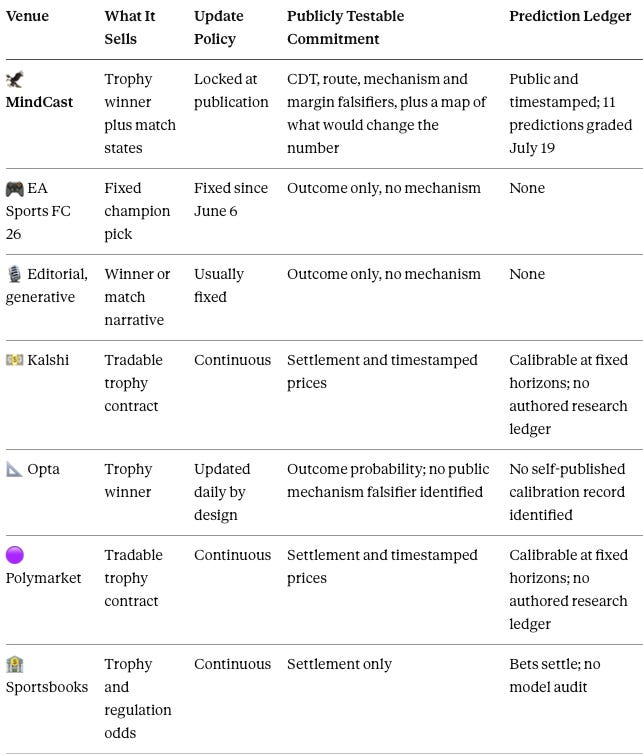
One ranking belongs above this table, and candor requires stating it before any column. Markets outrank every other comparator here. Editorial risks nothing on its narratives, EA simulates without stakes, and Opta answers to citation rather than capital. Markets alone punish error with money, which makes the closing line the only baseline whose defeat carries commercial meaning. Beating a video game proves category difference; beating the close proves alpha.
MindCast competes with none of them for the same job. MindCast issues no contracts, takes no positions, and prices no events. What MindCast borrows is the discipline — timestamped, falsifiable, publicly scored forecasts — without entering the prediction-market business.
Columns four and five carry the whole table, and the distinction inside column four matters. Every venue here can be checked against the outcome — Spain wins or Argentina wins, and EA’s pick is right or wrong. Opta’s probabilities could be calibrated across many forecasts by anyone willing to archive them. Nobody except MindCast published a test of the reasoning: what observation would prove the mechanism wrong, independent of who lifts the trophy.
Stating in advance what would falsify your reasoning, then publishing the statement where anyone can hold you to it, is the line between data science and marketing. A forecaster who names his falsifier before kickoff cannot claim afterward that he knew all along, and cannot quietly move the number when the trigger fires. A forecaster who names only a winner survives any post-mortem, because the only available verdict is a coin flip he already called.
Column three requires a distinction the field usually blurs, because updating is not evasion. Opta re-simulating each round is a legitimate forecasting feature, and arguably better practice than freezing, since new evidence genuinely should move a number. Adaptability and auditability are separate virtues, and the gap between them is narrow and decisive. Opta updates without preserving an earlier commitment as a scored object, so the 34% it gave France two days before France went out remains a snapshot nobody grades.
MindCast goes the other way, logging post-publication shocks as evidence rather than revisions. The cost is real: a number set on Thursday is worse-informed by Sunday than a live one. The payoff is that a continuously updated forecast has to be archived at fixed horizons before anyone can grade it consistently, and nobody archives Opta.
Column five is where the critique of markets has to stay honest. Prediction markets are not unscorable. Contracts settle, price histories persist, and a researcher can assemble a calibration record across many markets. What a market price is not is a research commitment. Polymarket’s midpoint moved from roughly 16% at open in July 2025 to 58.5% today, and no point on that path was ever offered as a claim its author would defend. Money disciplines a market. Money does not make a market self-auditing.
One objection lands hard enough to answer directly: MindCast grades MindCast, which is grading your own homework. True — and the ledger, rather than the grader, is what makes it work.
The slate is public, timestamped, and locked before kickoff. The scoring rule is named in advance and the arithmetic is ordinary. Anyone can pull the eleven predictions on Sunday morning, score them independently, and check Monday’s report against their own numbers. Self-grading against a moving target is worthless. Self-grading against a public ledger is just doing the arithmetic first, in the open, where being wrong costs something.
EA earns its own line, because the venue with four straight correct champions is 1-for-2 on everything checkable. EA simulated all 104 fixtures in The World’s Game and named Spain on June 6, extending a run of correct calls since 2010. The record has one hole nobody mentions: EA’s first attempt, in 2006, picked the Czech Republic, who failed to escape the group.
EA has never published a probability, so “Spain” can be checked and never calibrated. The same June simulation made two claims that can be graded. EA called the United States out in the round of 16, and the United States went out in the round of 16. EA called Lamine Yamal the tournament’s top scorer, and Yamal enters the final well behind Messi and Mbappé, who sit joint-top on eight. Confidence that call fails: 85–90%.
What sits on the line runs against MindCast, and the asymmetry deserves saying plainly. EA risks a marketing line. Opta risks a citation. The exchanges risk capital they have already priced for.
MindCast risks the credibility of MP CDT FS, an engine sold into complex litigation, legacy innovation, innovation economics, and geopolitical risk — four practice areas where clients commit real money years before any outcome settles. Every venue here is playing for its own scoreboard. MindCast is playing for whether the method transfers.
One column belongs on MindCast alone, and leaving it out would make this a sales sheet. MP CDT FS rests on CDT construction and fails when a CDT is built wrong, because no downstream arithmetic rescues a misclassified operating system.
Two receipts sit in the public record. Report VI killed five high-confidence lines in a single round.
The Super Bowl called Seattle by four to ten points with a one-score game entering the fourth quarter. Reality delivered a sixteen-point win, with separation arriving earlier and larger than the model specified. Direction held, magnitude and timing missed, and the miss was scored and published. Super Bowl LX — AI Simulation vs. Reality. No comparator in this matrix can write an equivalent sentence, because no comparator pre-committed to anything a miss could be scored against.
A champion pick with no probability attached is an outcome check wearing the costume of a calibration record. Betting AI helps you pick a number, foresight AI helps you pick a future, and Section X puts the future on the clock.
⏱️ X. The Sharpest Disagreement Appears After Regulation
Every venue answered who. Two described when, and Polymarket now lists minute-specific contracts on the final. No comparator priced the conditional inversion — the state in which the advantage changes sides — and pricing that inversion is the whole product.
Recover the field’s own view first. Sportsbooks post two markets on the same match, and the pair reveals what the books believe about extra time. FanDuel’s 90-minute three-way reads Spain +125, draw +200, Argentina +260. Stripped of margin: Spain 42.1%, draw 31.6%, Argentina 26.3%. FanDuel’s trophy market, stripped the same way, reads Spain 57.7%.
Solve for the difference and the books imply Spain at roughly 49.4% once the match passes regulation — a coin flip. MindCast prices that same state at 45%, and at 39% level after extra time. Penalties tilt further Argentine still, because the collective advantage of Spanish recursion dissolves once the contest becomes a sequence of isolated executions.
Do the weighting honestly, because the headline gap is 3.7 points and the extended state does not cover it. A 4.4-point conditional difference, multiplied by the market’s own 31.6% draw probability, contributes 1.4 points — roughly 37% of the gap. The extended state is where the two forecasts disagree most sharply, not where the whole disagreement lives.
Where does the other 2.3 points come from? Arithmetic answers plainly. Backing 54% into the market’s own partition implies MindCast prices Spain’s regulation win near 39.8%, against the market’s 42.1%. MindCast is more bearish on Spain before 90 minutes and more bearish after it. Spain can be the likeliest single regulation winner at 39.8% and still be overrated by the market at 42.1% — both statements hold at once. Confidence in the arithmetic: 85–90%, varying with de-vig method and book selection.
Independent readers reached the same shape from three directions, and the convergence is the section’s real finding. None of the three shares a model with MindCast, and none of the three attached a number to what they saw.
Statistical convergence. Yahoo’s handicapper takes under 0.5 first-half goals at +156, noting that none of Spain’s last four first halves exceeded 1.2 expected goals and none of Argentina’s four knockout first halves exceeded 0.9 non-penalty expected goals. SportsLine’s Martin Green leans under 2.5 total goals. Both arrived at a sterile first hour and a late decision through pure statistics — no CDTs, no tree, no arc.
Route convergence. Bleacher Report’s five staff picks — Spain 2–1 twice, Spain 1–0 twice, Argentina 2–1 after extra time once — reproduce MindCast’s published four-route hierarchy exactly, and every one of the five lands inside MindCast’s regulation-margin line of zero or one. Five writers with no shared model recreated the route tree and none of them attached a probability to it.
Temporal convergence. NBC’s analyst, timestamped July 16 at 3:09 p.m. ET, described Spain scoring inside the first 70, Argentina equalizing in the final 20, and Argentina winning in extra time or penalties — then selected Argentina at +125. MindCast’s simulation carries the earlier timestamp and quantifies the same inversion. One human analyst reached the thesis in prose; MindCast reached it with a number, a tree, and a falsifier.
Divergence exists too, and it is testable Sunday. Kalshi’s correct-score market ranks 1–1 the modal regulation result at 17%, ahead of Spain 1–0 at 13%, 0–0 at 11%, Spain 2–1 at 10%, and Argentina 2–1 at 8%. MindCast ranks Spain 2–1 first and carries 1–1 with Argentina advancing third. Two route hierarchies, same match, resolving in 90 minutes.
MindCast disagrees with the market about the single likeliest scoreline and agrees with the statistical readers, the scoreline readers, and one analyst who saw the same late shift. Only MindCast put a number on the shift itself. Sunday says who was closest. Section XI says what Sunday can and cannot settle.
📒 XI. Sunday Cannot Separate the Forecasters, and Grades the Method Anyway 🇪🇸 🇦🇷
Ninety minutes at MetLife settle a trophy. Settling which forecaster was right is a different problem. The honest answer arrives in five parts: what Sunday cannot decide, what it does decide, why a football match carries the test, what the record already shows, and the one question nobody priced.
XI.A — What Sunday Cannot Settle: Two Hundredths of a Brier Score
Nothing in the Section II table can separate anyone. Saying so before the result, rather than after it, is the last piece of discipline the piece owes its readers.
Run the arithmetic both ways, using the Brier score — the standard measure of how far a probability lands from the truth, where lower is better. If 🇪🇸 Spain wins, MindCast scores 0.212, Opta 0.193, Polymarket 0.172. If 🇦🇷 Argentina wins, MindCast scores 0.292, Opta 0.314, Polymarket 0.342. Two to five hundredths separate them, either way.
A single match cannot distinguish 54 from 58.5. A validation report claiming victory on a 0.02 edge would earn exactly the criticism Report VI administered to itself last week. Any venue spending Monday citing the result as proof of method is selling something.
XI.B — What Sunday Does Settle: Eleven Units and a Route Hierarchy
The championship number is not where the framework demonstrates anything. Eleven separately scored predictions are. The map of what would change the number is. The ranked list of likely scorelines, standing against Kalshi’s correct-score market, is. The claim about the last twenty minutes in Section X is.
Validation Report VII grades all of them on July 19 against a stated baseline and publishes the result whether the number holds or not. Grading runs on separate registers — outcome, mechanism, route, margin — because a directional win that got the mechanism wrong is a miss the doctrine refuses to launder.
XI.C — Why a Football Match Carries the Test: Velocity, Not Boundedness
Sunday grades something larger than a match, and naming it plainly is fairer to the reader than leaving it implied. MindCast built MP CDT FS for complex litigation, innovation economics, legacy innovation, and geopolitical risk — domains where clients commit capital years before any outcome settles and no scoreboard arrives on time.
Velocity, not boundedness, is why sports carry the laboratory. A merger thesis waits three years for its scoring event and a docket waits five, while a knockout match scores its forecast in ninety minutes. Feedback that fast is the one property no institutional vertical can replicate, and the reason the sports corpus exists at all.
Three questions resolve before dinner. Whether the CDTs were built right, whether the tree priced the clock, and whether Report VI’s corrections actually corrected anything — MP CDT FS answers all three in public, on a ninety-minute clock.
XI.D — The Record Already Written: Four Institutional Forecasts That Resolved
Transfer is not a promise the piece makes for the first time, and the record is already partly written. Four MP CDT FS forecasts in the institutional verticals have already resolved, each dated before the event that settled it.
NVIDIA’s NVQLink architecture was predicted to five metrics: sub-5-microsecond latency, 300+ Gb/s throughput, six to eight national laboratories, twelve to fifteen quantum vendors. The October 2025 announcement confirmed all five within or beyond the forecast bands. MindCast AI’s NVIDIA NVQLink Validation.
Microsoft was named as the first hyperscaler to sign a behind-the-meter firm-power co-location deal, in ERCOT, with gas as the bridge fuel. Project Kilby cleared the January 2026 forecast two quarters early. How the Chevron–Microsoft Project Kilby Agreement Validated MindCast’s Firm-Power Forecast and Signals a Capacity Race Decided by Institutional Throughput, Not Model Capability.
The migration of frontier-AI value from capability to authorization was confirmed by the June 2026 trusted-partner allowlist, which restored the stronger model first, to vetted institutions, on a revocable government roster. The NSA–Anthropic Mythos Shock Led to the Commerce Allowlist MindCast Predicted.
A federal court then operationalized the federal-state allocation MindCast had specified in advance: authority over the trade does not displace authority over the activity. Section IV’s tribal claims, the Massachusetts ruling and the Third Circuit split all run through that distinction. Kalshi Loses Federal Forum — The Washington Remand Order.
Sunday adds a data point to the record rather than opening it. Four resolved forecasts across four verticals is not proof the method always transfers, and it is more than any comparator in this matrix has published.
XI.E — The Question No Comparator Priced: Spain Has Never Chased ⚽
One open question arrives at the final in its sharpest available form, and no comparator has put a number on it. 🇪🇸 No opponent has made Spain chase. 🇦🇷 Argentina has been made to chase twice, and won both.
On Sunday one of those two facts stops being true. Or neither does, the match goes the distance, and the result lands in the states where MindCast and the market disagree most.
Every venue in this matrix will still be here Monday, and several will be able to say they called it. Only one will have published a self-authored, multi-metric validation report against a locked slate, naming its own failures at the same size as its wins. Validation remains the objective, and calibration remains the discipline.
📚 Appendix — Cited Works
Every MindCast entry below carries a note saying what a reader would actually find there. A reader can decide what to open rather than opening everything, which is the point of a citation list nobody has to read.
The Engine and Its Theory
Provisional Patent Application on Multi-Agent Institutional Simulation Architecture — Filed April 18, 2026. Read it for the two rules that bracket every forecast: a gate that throws out causal claims the evidence cannot support before they reach the simulation, and a closing rule that refuses to release a number until the modeled actors and the institutional constraints both stop moving.
Predictive Game Theory Meets the Era of AI — Operationalizing Fudenberg’s Research Agenda with Cognitive Digital Twins — The source of the firewall in Section II: market prices are benchmarks and never inputs. Also where MindCast answers the six questions Drew Fudenberg posed to game theory in 2011 and names the equilibrium concept for games that rewrite themselves mid-play.
Dynamic Predictive Game Theory From the 2026 Super Bowl and World Cup — The framework paper. Read it for how one behavioral engine gets tuned to two sports at opposite ends of the tactical spectrum, and why validating across both tests whether the method generalizes at all.
Cybernetic Game Theory — Why a team that adapts faster beats a team that reasons better. The principle underneath the minute-70 inversion in Section X.
How MindCast Evolves the Structural Gaps in Classical Nash Game Theory — Why a fixed-game equilibrium cannot price a match that keeps replacing itself, and what replaces equilibrium when the rules move during play.
The Computational Era Operationalizes Cybernetics and Predictive Game Theory — The argument that cybernetics and predictive game theory were both correct decades before any machine could run them, and that the 2020s finally supplied the missing hardware.
The MindCast AI Dynamic Predictive Game Theory Collection — The whole collection rendered visually, for readers who want the architecture without reading eight papers.
Live-Fire Game Theory Simulators, Runtime Predictive Infrastructure — Paste a MindCast URL into an LLM and reconstruct the public layer of the framework yourself. The instructions are the point.
The Prediction Market Series
The Full Arc of Prediction Markets: From Truth-Seeking to Strategic Exploitation to Behavioral Extraction — The source of Section III’s six layers and Section VII’s three market states. Read it for the distinction that puts Susquehanna where it sits: a public exchange broadcasts a price and invites regulation, a private firm keeps the number and invites none.
Susquehanna Is Building the Institutional Market the CFTC Does Not Require — Why a $500M World Cup facility makes more sense as a legal argument than as a hedge.
The World Cup Is the First Mass-Market Stress Test for Prediction Markets — Why the biggest sports market ever assembled, rather than an election, is where the arc’s sports prediction gets tested in public.
MCAI Lex Vision: Defining “Gaming” Under the Commodity Exchange Act — The Rule 40.11 Gap Driving the Nationwide Kalshi Litigation Web — MindCast’s comment to the CFTC on the definitional gap that decides whether Sunday’s contract is a swap or a bet. The gap is why Massachusetts and the Third Circuit reached opposite answers.
Resolved Institutional Forecasts Cited in Section XI
MindCast AI’s NVIDIA NVQLink Validation — Five technical metrics of quantum-AI interconnection, published before NVIDIA announced any of them, and all five confirmed.
How the Chevron–Microsoft Project Kilby Agreement Validated MindCast’s Firm-Power Forecast and Signals a Capacity Race Decided by Institutional Throughput, Not Model Capability — Which company, which state, which fuel — all three named in January 2026 and all three cleared by June, two quarters ahead of the forecast window.
The NSA–Anthropic Mythos Shock Led to the Commerce Allowlist MindCast Predicted — The call that frontier-AI value would shift from who builds the best model to who is allowed to use it, confirmed by the order in which access was restored.
Kalshi Loses Federal Forum — The Washington Remand Order — A federal court drawing the exact line MindCast had drawn first: federal authority over the trade does not displace state authority over the activity. The line every fight in Section IV runs through.
The Sports Laboratory and the Scored Record
MindCast Predictive Game Theory + Behavioral Economics Cognitive Digital Twin Foresight Simulations in the World Cup and Super Bowl — Why sports and not markets serve as the proving ground, plus the finding driving Section II: every public forecaster reads the same box scores, so their agreement compounds bias instead of cancelling it.
Betting AI vs. Foresight AI — The distinction under this entire matrix. Betting AI helps you pick a number; foresight AI helps you pick a future.
FIFA World Cup Final Foresight Simulation — Spain vs Argentina — The forecast this article compares against everyone else’s: the 54%, the branch for every scoreline, the ranked list of likely results, the falsifiers, and the eleven predictions Report VII will score.
World Cup Championship Index 2026 — The June 14 tournament prior that ranked Argentina first and Spain fourth. Argentina reached the final exactly as projected, which is why the prior still stands while the field’s most-cited model watched its favorite go out in the semis.
World Cup 2026 Validation Report III — Where MindCast wrote the rule that a correct call arriving through a broken mechanism counts as a miss, immediately after that happened.
World Cup 2026 Validation Report IV — Round of 16 Complete, Calibration Review, and Quarterfinal Method — Eight of eight on how matches would be decided, three of eight on who would advance, published side by side without softening either number.
World Cup 2026 Validation Report VI — Semifinals — The round that lost to a coin flip by 43%, and the three publication rules that failure forced onto the final.
Super Bowl LX — AI Simulation vs. Reality — The other self-charged miss. Seattle won as predicted, by twelve points more than the model allowed, and the report says so.
Academic Foundations
Fudenberg, D. (2011). “Predictive Game Theory.” SSRN Working Paper No. 1889146.
Fudenberg, D., & Levine, D. K. (1998). The Theory of Learning in Games. MIT Press.
Camerer, C. F., Ho, T.-H., & Chong, J.-K. (2004). “A Cognitive Hierarchy Model of Games.” Quarterly Journal of Economics 119(3): 861–898.
Kahneman, D., & Tversky, A. (1979). “Prospect Theory: An Analysis of Decision under Risk.” Econometrica47(2): 263–291.
Marden, J. R., & Shamma, J. S. (2018). “Game Theory and Control.” Annual Review of Control, Robotics, and Autonomous Systems 1: 105–134.
Shamma, J. S. (2020). “Game Theory, Learning, and Control Systems.” National Science Review 7(7): 1118–1119.
Field Sources
Opta Analyst — 2026 World Cup final probabilities across 25,000 simulations
Opta Analyst — model methodology, disclosing Power Rankings plus betting-market odds
FanDuel Research — Spain vs. Argentina final odds and prediction
Congressional Research Service — prediction markets, policy issues for Congress
Skadden — Third Circuit affirms Kalshi’s preliminary injunction
Prepared July 17, 2026. Market and sportsbook prices are snapshots taken July 17, 2026, 2:00 p.m. PT, and move continuously; re-pull before publication. Percentages derived from sportsbook odds are normalized estimates after removing the bookmaker margin.
Every confidence band in this analysis is analyst judgment rather than a computed statistic, and none enters the Brier aggregate.
“No mechanism falsifier” means none was identified in the cited published methodology; the phrase does not claim a venue lacks private testing.
🇪🇸 🇦🇷 Validation Report VII grades this slate and closes the 2026 World Cup series on July 19–21.