


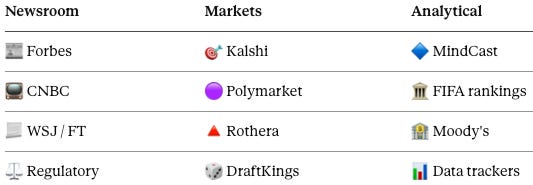
Icons mark voices, flags mark countries — at first mention per section.
Executive Summary
Thesis: The 2026 FIFA World Cup is the first mass-market stress test for prediction markets, and the stress test produces three distinct verdicts — epistemic, legal, and institutional — that no single voice in the July 4 news cycle can read together.
Forbes surfaced pricing disagreements across FIFA rankings, sportsbook odds, and Kalshi contract prices without a mechanism theory. CNBC surfaced a $31 billion Kalshi volume record without a litigation-exposure theory. The two together price the same tournament through different machinery, and the disagreement itself is the diagnostic.
MindCast built both frames in advance and registered predictions against them. MindCast's 🔷 National Prediction Market Litigation Architecture series (underway) crystallized its prediction market on national prediction-market litigation. With this publication, MindCast formulates its prediction market on the prediction-market competition for the World Cup — eleven falsifiable gates across match mechanism, market incorporation, platform migration, and legal characterization layers, generated through MindCast's Proprietary Cognitive Digital Twin Foresight Simulation (methodology summary in Appendix B).
The article's first gate scored before game day: 🇵🇾 Paraguay 0, 🇫🇷 France 1, under the exact pre-registered mechanism stress. A narrow French advancement uniquely vindicated mechanism-classification methodology over both the market’s completeness thesis and the rankings model’s discount. 🇲🇦 Morocco is next, on Thursday July 9 one of four additional gates resolving inside the article's first week alone.
The World Cup has passed the attention test. The truth test remains open. The category of belief infrastructure that survives will not be the sportsbook and will not be the crowd — it will be the layer that publishes rated reasoning under falsifiable settlement dates.
I. Two Stories Published on the Same Morning, Each Blind to the Other
Two national outlets published complementary halves of a single story on July 4 without recognizing the connection. Reading the two pieces together reveals the shape of a debate neither article can carry alone.
📰 Forbes published Where FIFA Rankings and World Cup Betting Markets Disagree, a three-source probability comparison across a 🏛️ FIFA-rankings Elo simulation, DraftKings sportsbook odds, and 🎯 Kalshi contract prices. The comparison surfaced material divergences: 🇫🇷 France carries a prediction market premium of nearly ten points over the rankings model (34.1% on Kalshi against 24.5% in the Elo simulation), 🇦🇷 Argentina carries a model premium of comparable size in the opposite direction, 🇲🇦 Morocco runs model-favorable, and the 🇺🇸 United States and 🇲🇽 Mexico run market-favorable. The author concluded, correctly and carefully, that the divergence “is not necessarily an error” and “may reflect information that is not included in a simple rankings-based simulation.”
📺 CNBC published 2026 FIFA World Cup boosts prediction market volumes, reporting that Kalshi processed more than $31 billion in notional volume in June — up more than 70% from May — with daily volume above $1 billion since the tournament opened on June 11. 🟣 Polymarket’s international platform set a record above $10.8 billion. 🔺 Rothera, a Susquehanna International Group–Robinhood joint venture that launched only in June, did $2 billion and already holds 7% of U.S. prediction market volume. Platforms marketed aggressively into the moment: Polymarket ran a $2 million perfect-bracket competition, and Kalshi placed “Trade the World Cup” directly in its App Store title.
Forbes identified a pricing disagreement without a mechanism theory. CNBC identified a volume record without a litigation-exposure theory. Neither outlet can supply what the other lacks, because supplying it requires holding the sports-foresight problem and the prediction market governance problem in the same frame. 🔷 MindCast built both frames in advance, published them as falsifiable instruments, and registered predictions against them.
When probability systems disagree at scale, the disagreement itself becomes a diagnostic — and diagnostics require machinery the news cycle does not carry. The sections that follow supply the machinery.
II. Four Probability Engines, Four Theories of Reality
Every voice in the July 4 debate belongs to one of four probability engines, and each engine sees a different layer of the tournament. Naming the four in one place converts a dense argument into a readable framework.
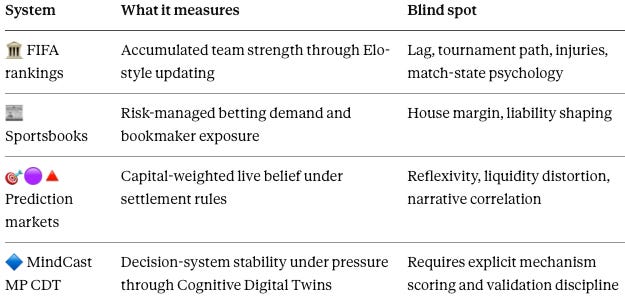
Lag alone explains part of the Forbes gap before any deeper mechanism enters. 🏛️ FIFA’s men’s ranking last updated on June 11, 2026 — the day the tournament opened. Every Elo-derived probability in the Forbes comparison therefore prices the pre-tournament world, while Kalshi reprices continuously through four rounds of live evidence. Rankings carry lag; markets carry reflexivity. Neither carries mechanism.
🔷 Betting AI vs. Foresight AI drew the operative distinction before the knockout rounds began. Betting AI optimizes lines, props, and expected value against the market — pricing consensus and measuring return on investment. Foresight AI simulates the decision system that generates outcomes — pricing mechanisms and measuring adaptive resilience. Betting AI and Foresight AI therefore produce different objects: a betting price is a claim about crowd belief; a foresight simulation is a claim about structural behavior under constraint, testable at the level of how a match unfolds, not merely who advances. 🔷 How MindCast Evolves the Structural Gaps in Classical Nash Game Theory supplies the deeper reason the four engines cannot converge: the strategic object is a system of forums, information layers, time delays, and constraints — and only one of the four models the system rather than sampling its outputs.
Only the mechanism engine can tell a reader why the other three disagree. The France premium is the cleanest test case, and Round of 16 Saturday made the test live.
III. The France Premium: Narrative Artifact, Information, or Something More Interesting?
The largest gap in the Forbes comparison is 🇫🇷 France. Applying the four-engine machinery to that gap turned Round of 16 Saturday into a live falsification event, and the falsification event just resolved.
France's 34.1% 🎯 Kalshi price — consistent with 📊 The Block's report that roughly 35% of the $832 million in Kalshi's World Cup Winner market backs France — arrived at the crest of a coordinated narrative cycle. 📰 Forbes itself declared France Has Become the Team to Beat at the World Cup on July 1, 📰 Reuters ran France's fearsome attack enters debate over World Cup's greatest forward line the same day, and 📃 Wall Street Journal tournament coverage crowned Les Bleus the field's most complete side — the elite-synthesis framing that 🔷 The Full Arc of Prediction Markets identifies as the narrative-amplification pathway: signal generators publish a frame, retail belief correlates around it, and correlated belief flows into contract prices that then get cited as independent confirmation of the original frame.
Buried in the July 1 Forbes coverage sits the disconfirming detail the market premium ignores: France’s four dominant wins came against opponents ranked between 18th and 63rd in the world. Completeness had been demonstrated; completeness under adversarial constraint had not. A prediction market can tell readers France trades like a favorite. A prediction market cannot tell readers whether France remains stable when an opponent removes transition space, slows tempo, forces restarts, and makes the favorite pay a patience tax.
🔷 Sports Foresight Simulations in the World Cup and Super Bowl exists to answer one mechanism question: does a market favorite hold up when an opponent removes transition space, slows tempo, forces restarts, and makes the favorite pay a patience tax? The 🔷 FIFA World Cup Foresight Simulation — Round of 16 operationalized the question with pre-registered mechanism gates for the 🇵🇾 Paraguay–🇫🇷 France fixture — gates specifying how a disciplined low-block opponent stresses France’s structure, published before kickoff and scored after. The Full Arc’s inversion condition now does the analytical work Forbes could not: a large, persistent price divergence sits ambiguous among three interpretations — information, liquidity artifact, or narrative artifact — until the market’s regime state gets classified, and pre-registered mechanism gates are the classification instrument.
Paraguay–France, July 4: France 1, Paraguay 0. France advanced. The stat sheet told a second story. 🇫🇷 France dominated possession, generated the bulk of the pressure, failed to break the low block for seventy minutes, and needed a late Mbappé penalty to escape. 🇵🇾 Paraguay disrupted tempo, avoided the card accumulation France wanted, and extracted the patience tax the simulation named before kickoff. Paraguay committed twelve fouls to disrupt tempo and made four substitutions to preserve shape. Paraguay extracted the patience tax the article named before kickoff, in full.
The result splits the P1 gate cleanly:
🎯 Market premium — partial credit. France advanced, so the market’s directional read on this fixture held. The market priced advancement correctly.
🏛️ Rankings model — partial credit. The model’s more skeptical 24.5% tournament-winner price captures France’s fragility under adversarial constraint, and Paraguay just demonstrated that fragility on live television. The 34.1% market price prices a completeness thesis Paraguay just called into question.
🔷 Mechanism-classification methodology — full credit. Foresight simulation predicted the specific stress pattern, named it in advance, and watched it fire in the specified window. A decisive France win would have vindicated the market cleanly; a France loss would have vindicated the model cleanly; a narrow France win under the pre-registered mechanism stress uniquely vindicates the framework that told readers to look at mechanism rather than advancement.
🇲🇦 Morocco is next. The Forbes comparison already had Morocco running model-favorable, and Morocco brings three features Paraguay lacked: credible transition punishment, institutional memory from the 2022 World Cup semifinal against France, and higher-quality defensive discipline. Paraguay's disruption grammar — distributed fouling timed to break tempo without triggering card accumulation — is one Morocco runs at one of the highest levels in world football. Confidence Morocco replicates or exceeds Paraguay's disruption pattern: 70–80%. Confidence France's market premium softens materially against Morocco pricing before kickoff on Thursday July 9: revised downward to 42–52% based on live Kalshi pricing showing France still trading near baseline three days after the Paraguay result.
The Paraguay result is not the end of the France question. The Paraguay result is the first proof that mechanism classification produces information the other three engines cannot.
Contact mcai@mindcast-ai.com to partner with us on Predictive Game Theory AI in Law and Behavioral Economics. To deep dive on MindCast works upload the URL of this publication into any LLM (preferably Google AI mode/Gemini, Claude, ChatGPT) and prompt ‘reconstruct MindCast framework with three degrees of cited sub links.’ See Live-Fire Game Theory Simulators, Runtime Predictive Infrastructure.
IV. The Volume Record Passed the Attention Test, Not the Truth Test
Section III showed one probability question resolving under adversarial scrutiny. Section IV asks whether the platforms hosting those probabilities can even measure themselves.
Handle the June numbers carefully, because the numbers themselves have become part of the epistemic problem. Coverage of the same platform, in the same month, reports three materially different figures: more than $31 billion in 🎯 Kalshi notional volume (Dune Analytics data cited by 📺 CNBC), roughly $33 billion within a $50 billion sector total (Artemis data via Finance Magnates), and approximately $9.4 billion (DefiLlama data via Cointelegraph). Three trackers, one platform, one month, a 3x spread. A market ecosystem marketed as civilization’s truth machine cannot yet produce a settled ledger of its own activity — the signal-clarity failure mode 🔷 Prediction Markets Reveal Truth — Feedback Loops Determine It specifies, operating at the infrastructure layer rather than the contract layer. Confidence the spread reflects notional-versus-matched-volume methodology divergence rather than reporting error: 65–75%; the governance point stands under either explanation.
Under every methodology, the direction runs identical and unprecedented: the World Cup delivered the largest demand shock in prediction market history. Volume proves distribution. Volume does not prove calibration. A market can be liquid, entertaining, and legally consequential before it becomes epistemically reliable. The feedback-loops paper supplies the governing claim: prediction markets do not create intelligence; they enforce accountability through fast, costly, clear feedback — and the World Cup runs the fastest, highest-integrity feedback environment these markets will ever inhabit, with every contract closing its loop within ninety minutes plus stoppage.
Prediction markets have passed the attention test. The truth test requires calibration under adversarial conditions, and the tournament’s own pricing disagreements — Section III — show that test still open. The same demand shock that carries the attention win is also building the exhibit the next section reads through a different lens.
V. The Regulatory Recursion: The Record Testifies Against Its Own Platforms
Every dollar of June volume simultaneously grew the platform valuation story and grew the state-side characterization record. Section V reads the same numbers through both lenses.
🔷 CFTC Takes On Nine States — Kalshi, Prediction Markets, and the Federal-Plaintiff Phase mapped the structural exposure before the volume arrived, and named the recursion directly: Kalshi markets itself as a truth machine while sports and parlays dominate its volume — and MindCast runs a prediction market on prediction market litigation, with probability bands, falsification conditions, measurement windows, and public settlement history. 🔷 The National Kalshi Prediction Market Litigation Map established the earlier foundation: platform viability hinges on how courts define “gaming” under the Commodity Exchange Act.
⚖️ Contest-side contracts are precisely the category that fails the characterization boundary the states are litigating, and every dollar of World Cup contract volume deepens the concentration. A record month of soccer contracts is, simultaneously, a record month of the contract class most vulnerable to state gambling-law characterization and — in jurisdictions with applicable loss-recovery statutes or Statute-of-Anne-derived theories — a growing retroactive recovery base sovereign plaintiffs can pursue on behalf of residents. The World Cup may validate consumer demand while strengthening the legal case that sports-event contracts function socially as gambling; both sides will cite the same June data, and the platforms will argue the inverse — that World Cup liquidity proves federally regulated event contracts outperform fragmented state sportsbooks. Confidence both citation patterns appear in filings and public advocacy by Q1 2027: 82-90%.
The valuation layer compounds the growth-versus-litigation tension. 🎯 Kalshi is reportedly in talks to raise at approximately $40 billion, nearly doubling its May Series F valuation in seven weeks, on a growth curve powered substantially by the tournament. The tournament ends July 19, the volume that built the record ends with it, and no court will have ruled on the preemption question before the cliff arrives. June sets the height of the cliff. A valuation marked at tournament peak inherits tournament-peak fragility — the litigation-inversion logic in which the same fact functions as an asset in the growth narrative and a liability in the legal record. Confidence Q3 monthly volumes decline materially from the June peak before any dispositive preemption ruling: 75–85%.
One quiet detail in the CNBC piece deserves its own paragraph. 🔺 Rothera’s arrival means Susquehanna International Group — the archetypal proprietary probability engine in the Full Arc’s two-kind taxonomy, a firm that prices events privately with no epistemic claim and no regulatory surface — now co-owns a public belief exchange holding 7% of U.S. volume in its first month, while its market-making role sits in federal litigation captions. The Full Arc predicted colonization pressure between private probability engines and public belief markets; Rothera instantiates the migration by name. Confidence in the taxonomy-migration reading, flagged as inference: 60–75%.
A meta-layer note completes the truth-machine recursion. 📺 CNBC discloses a commercial relationship and minority investment in Kalshi within the same article reporting Kalshi’s record. Under the Full Arc’s actor taxonomy, the signal generator amplifying the volume narrative holds a financial position in the narrative’s subject — a disclosure to CNBC’s credit, and a live illustration of why regime classification cannot treat media signals as exogenous.
Growth story and litigation exhibit are the same document, read by different audiences. The section that follows names the layer of the probability stack that survives that dual reading.
VI. MindCast’s Claim: The Missing Middle Between Belief and Mechanism
Sections II through V established four probability engines, one live methodology validation, one epistemic ledger failure, and one growth-record-as-litigation-exhibit inversion. The synthesis identifies the category the surviving belief infrastructure must occupy.
🏦 Moody's does not merely publish default probabilities; it publishes rated reasoning — a governance-grade signal institutions can underwrite against, which is why the Full Arc positions the ratings-agency function, not the sportsbook function, as the destination category for belief infrastructure. MindCast's own tracking piece 🔷 When a FIFA World Cup Model Picks France and the Economist Picks Argentina documents the live case: Moody's Analytics Poisson model picks France, and the economist who built it, Jesse Rogers, personally overrides to Argentina on Western Hemisphere diaspora grounds — a rated forecaster naming the variable his own model cannot represent.
Betting markets price the crowd. Rankings models price the past. Foresight simulation prices the mechanism — and commits to falsification before the outcome arrives. 🔷 MindCast does not need to become a prediction market; MindCast uses prediction market discipline — public forecasts, probability bands, falsification terms, settlement windows — applied to the layer markets cannot reach. 🔷 The Computational Era Operationalizes Cybernetics and Predictive Game Theory supplies the systems frame: modern institutions behave as adaptive systems shaped by markets, courts, media, regulators, and AI latency — and the World Cup compressed all five forces into a thirty-nine-day window.
The Round of 16 makes the rated-reasoning claim operational rather than rhetorical. Paraguay–France resolved the tournament's largest model–market divergence through gates published in the Round of 16 magazine before kickoff — and the mechanism-classification methodology banked its real-time proof point one day before this article published, tightening rather than compressing the discipline: MindCast committed the gates, watched the resolution, then published without editing the record. 🇺🇸 USA–🇧🇪 Belgium on July 6 carries the retail-sentiment case: more than $64 million on 🎯 Kalshi and $122 million on 🟣 Polymarket moved on a U.S. tournament title the platforms themselves price at 3–4.3%. Patriotic volume against platform-priced long odds is simultaneously the growth story the platforms cite, the belief-flow specimen decoupled from mechanism, and the retail loss profile state-side recovery statutes exist to reach. Each match is simultaneously a sporting event, a scoring event for the foresight ledger, and a data point in the regime classification of the very markets pricing it.
The World Cup did not prove prediction markets are truth machines. The World Cup proved something more consequential: mass audiences will trade uncertainty when the feedback loop is fast, emotional, liquid, and public. The next fight is no longer whether these markets exist. The next fight is which layer of the probability stack deserves institutional trust, and who supplies the rated reasoning that trust requires.
VII. Registered Predictions
Predictions carry stated resolution windows and confidence bands. Scoring follows the Mechanism–Outcome Validation Doctrine. Following the MindCast Proprietary Cognitive Digital Twin Foresight Simulation (see Appendix B), the original five-gate register expands to eleven: P1 splits into a validated mechanism gate (P1A) and an open market-incorporation gate (P1B); P3 revises into a three-regime classification; P5’s confidence band adjusts downward on live Kalshi pricing; and five new gates (P6–P10) enter the register. P1A resolved on game day July 4. Ten gates remain open across the tournament window and the litigation calendar through Q1 2027.
P1A — 🇫🇷 France advances or struggles under the pre-registered 🇵🇾 Paraguay low-block and patience-tax stress pattern. Window: July 4, 2026 · Confidence at registration: 80–90% · Status: Validated on game day July 4. France advanced under the exact pre-registered mechanism stress.
P1B — France’s Kalshi tournament-winner price narrows by at least 3 percentage points before 🇲🇦 Morocco kickoff, or within 24 hours after Morocco team-news pricing stabilizes. Window: July 9–10, 2026 · Confidence: 42–52% · Status: Open. Live Kalshi pricing shows France near baseline three days after Paraguay.
P2 — Combined 🎯 Kalshi and 🟣 Polymarket monthly volume declines at least 40% from the June peak within two full months of the July 19 final, before any dispositive federal preemption ruling. Window: September 30, 2026 · Confidence: 78–86% · Status: Open.
P3 — 🔺 Rothera exits the World Cup in one of three regimes by December 31, 2026: structural entrant above 10% U.S. share, distribution-supported middle at 4–10%, or event-driven fade below 4%. Simulation identifies distribution-supported middle as the most likely regime. Window: December 31, 2026 · Confidence on regime call: 72–82% · Status: Open.
P4 — At least one state or sovereign filing cites World Cup–period volume, marketing, or retail-loss data as characterization evidence, and at least one platform filing or public statement cites the same period as evidence of federal-model superiority. Window: March 31, 2027 · Confidence: 82–90% · Status: Open.
P5 — France’s Kalshi tournament-winner price softens by at least 3 percentage points between the Paraguay whistle and Morocco kickoff. Window: July 9, 2026 · Confidence: 42–52% (revised downward from 65–75% at registration based on live pricing showing France still trading near baseline) · Status: Open.
P6 — Morocco forces France into a second visible mechanism-stress event: France either scores after minute 60, advances by one goal, reaches extra time or penalties, or exits. Window: July 9, 2026 · Confidence: 68–76% · Status: Open.
P7 — If France advances past Morocco under visible mechanism stress, its title price does not recover fully to its pre-Paraguay implied probability within 24 hours. Window: July 10, 2026 · Confidence: 60–70% · Status: Conditional (fires only if France advances under stress).
P8 — 🇺🇸 USA–🇧🇪 Belgium produces a patriotic-volume divergence: U.S.-linked trading volume remains disproportionate to U.S. title probability even if Belgium controls the mechanism profile. Window: July 6–7, 2026 · Confidence: 70–80% · Status: Open.
P9 — At least one major prediction-market data provider, platform, or media outlet publishes a clarification, explainer, or methodology note distinguishing notional volume from matched or traded volume after the June-volume discrepancy circulates. Window: August 31, 2026 · Confidence: 60–70% · Status: Open.
P10 — At least one post–World Cup legal, regulatory, or public-advocacy argument uses platform marketing language, not just contract mechanics, to characterize sports-event contracts as gambling-like. Window: March 31, 2027 · Confidence: 75–85% · Status: Open.
Five gates resolve inside the article’s first week: P1A scored on game day July 4; P8 resolves at USA–Belgium on July 6–7; P1B, P5, and P6 all resolve at Morocco kickoff on Thursday July 9; P7 resolves within 24 hours after Morocco depending on France’s advancement. Every prediction after the Round of 16 carries a public settlement date extending through March 31, 2027. Readers who return in August, September, December, and March can score MindCast against the same evidence the article read on July 5.
Appendix: Citations and Statements of Relevance
🔷 MindCast AI Works
MindCast Predictive Game Theory + Behavioral Economics Cognitive Digital Twin Foresight Simulations in the World Cup and Super Bowl Relevance: Establishes sports as the bounded validation laboratory — public data, observable outcomes, fast feedback — and the mechanism-first methodology of the MP CDT Engine. Supplies the analytical layer the Forbes three-source comparison lacks.
Betting AI vs. Foresight AI Relevance: Draws the category distinction on which Sections II–III turn — betting AI measures return on investment; foresight AI measures adaptive resilience. Frames the France market premium as a claim about crowd belief rather than structural behavior.
FIFA World Cup Foresight Simulation — Round of 16 Relevance: Contains the pre-registered mechanism gates for Round of 16 fixtures, including Paraguay–France. Functions as the falsification instrument that converted the Forbes gap into a scorable regime diagnostic. P1 scored against these gates on July 4.
CFTC Takes On Nine States — Kalshi, Prediction Markets, and the Federal-Plaintiff Phase Relevance: Maps the characterization boundary, sports-contract concentration exposure, sovereign loss-recovery theories, and the registered post-tournament volume-cliff prediction. Names the recursion — MindCast’s prediction market on prediction market litigation — and supplies the litigation-inversion reading of the volume record (P2, P4).
The National Kalshi Prediction Market Litigation Map Relevance: Foundational litigation cartography establishing that platform viability hinges on the judicial definition of “gaming” under the Commodity Exchange Act — the doctrinal hinge on which the Section V characterization war turns.
The Full Arc of Prediction Markets Relevance: Provides the regime-state taxonomy, the actor taxonomy (signal generators, narrative amplifiers, proprietary probability engines, public belief exchanges), and the inversion condition applied to the France premium. Grounds the Rothera taxonomy-migration inference (P3), the CNBC-disclosure meta-layer, and the ratings-agency destination category in Section VI.
Prediction Markets Reveal Truth — Feedback Loops Determine It Relevance: Supplies the governing theoretical claim — markets enforce accountability through fast, costly, clear feedback rather than creating intelligence — plus the fast-loop/slow-loop asymmetry of Sections IV–V and the signal-clarity failure mode applied to the tracker discrepancy.
How MindCast Evolves the Structural Gaps in Classical Nash Game Theory Relevance: Grounds the four-engine framework in Section II — the strategic object is the system of forums, information layers, time delays, and constraints, not a single actor’s payoff matrix.
The Computational Era Operationalizes Cybernetics and Predictive Game Theory Relevance: Supplies the recursive-feedback systems frame in Section VI — institutions as adaptive systems shaped by markets, courts, media, regulators, and AI latency, all compressed into the tournament window.
📰📺 News
Forbes — Where FIFA Rankings and World Cup Betting Markets Disagree (Giovanni Malloy, July 4, 2026)Relevance: Primary news hook. Documents the model–market divergences (France +9.6 market premium; Argentina model premium; Morocco, U.S., Mexico gaps) and explicitly concedes the causal ambiguity the article resolves through regime classification.
CNBC — 2026 FIFA World Cup boosts prediction market volumes (July 4, 2026) Relevance: Primary news hook. Source for the Dune-based June record (Kalshi $31B+ notional; Polymarket $10.8B; Rothera $2B / 7% share), platform marketing behavior, open interest, USA-title contract volumes, and the disclosed CNBC–Kalshi commercial relationship analyzed in Section V.
🏛️📊⚖️ Supporting Sources
FIFA — Men’s World Ranking Relevance: Confirms the Elo methodology and the June 11, 2026 final pre-tournament update — the lag mechanism that explains part of the Forbes gap structurally, independent of narrative effects.
Forbes — France Has Become the Team to Beat at the World Cup (Clemente Lisi, July 1, 2026) Relevance: Documents the narrative cycle preceding the France market premium and contains the disconfirming detail (opponents ranked 18th–63rd) grounding the completeness-under-constraint distinction.
The Block — Kalshi and Polymarket’s combined volume surges 75% to $45 billion in June amid World Cup fever (July 2026) Relevance: Independent volume tally ($44.8B combined; Kalshi $31.5B per its dashboard) and the $832M World Cup Winner market with ~35% France concentration corroborating the Kalshi price in the Forbes comparison.
Finance Magnates via TradingView — Prediction Markets Top $50B Monthly Volume. Will It Last Beyond the World Cup? (July 2026) Relevance: Artemis-based sector figure ($50B+ monthly; Kalshi ~$33B; Polymarket ~$14B; Rothera ~$2B) forming one leg of the tracker-discrepancy exhibit in Section IV.
Cointelegraph via TradingView — Kalshi hits record June trading volume as World Cup fuels prediction markets (July 2026) Relevance: DefiLlama-based figures (Kalshi ~$9.4B; Polymarket International ~$4.3B) forming the second leg of the tracker-discrepancy exhibit, plus documentation of state, tribal, casino, and labor pressure to place sports-event contracts under state gambling oversight.
Investing.com — Kalshi’s $40 Billion Target Prices Prediction Markets as Exchange Infrastructure (June 2026)Relevance: Source for the reported $40B raise, the May Series F, sports-contract concentration, and the exchange-infrastructure valuation framing tested by the litigation-inversion thesis in Section V.
Reuters — France’s fearsome attack enters debate over World Cup’s greatest forward line (Julien Pretot, July 1, 2026)Relevance: Second signal-generator exhibit in the narrative-amplification chain preceding the France market premium. Runs alongside Forbes/Lisi (July 1) and WSJ tournament coverage — three elite-media pieces published the same week that MindCast’s Full Arc identifies as the correlated-belief seeding pattern.
MindCast — When a FIFA World Cup Model Picks France and the Economist Picks Argentina Relevance: MindCast’s own coverage of the Moody’s Analytics World Cup tracker in which the Poisson model picks France while economist Jesse Rogers personally overrides to Argentina. Direct evidence for Section VI’s rated-reasoning claim — the ratings-agency function is characterized by an author willing to disagree publicly with the model bearing his name.
Appendix B: MindCast AI Proprietary Cognitive Digital Twin Foresight Simulation
Following the initial five-gate registration, MindCast ran a Proprietary Cognitive Digital Twin Foresight Simulation instantiating explicit CDTs across three actor categories: match actors (🇫🇷 France, 🇲🇦 Morocco, 🇵🇾 Paraguay, 🇺🇸 USA, 🇧🇪 Belgium), market platforms (🎯 Kalshi, 🟣 Polymarket, 🔺 Rothera, and Retail Trader/Fan), and legal/institutional actors (State Regulator, Federal/Platform Preemption, Court, Rated Reasoning, Elite Media Signal Generator). Each CDT carried explicit core objectives, state variables, stress triggers, and expected behavior under simulated tournament and litigation conditions.
The simulation strengthened the article’s central thesis and revised the register in five ways:
Split P1 into a validated mechanism-classification gate (P1A, scored on game day) and an open market-incorporation gate (P1B) — separating what the market got right (France’s advancement) from what the market has not yet incorporated (the Paraguay stress signal).
Reclassified P3 into a three-regime Rothera outcome (structural, distribution-supported middle, or event-driven fade), with distribution-supported middle identified as the most likely regime.
Lowered P5’s confidence band on live Kalshi pricing showing France near baseline three days after the Paraguay result.
Raised P2 and P4 confidence bands based on stronger CDT interaction signals in the volume-cliff and legal-characterization simulations.
Added five new falsifiable gates: P6 (Morocco mechanism stress), P7 (post-Morocco price recovery, conditional), P8 (USA–Belgium patriotic-volume divergence), P9 (volume-methodology clarification), and P10 (platform marketing language as legal characterization).
Full CDT tables, interaction outputs, and interpretive layer remain available as a separate simulation appendix on request. The core methodological claim carries through the entire register: prediction markets priced France’s advancement; MindCast’s CDT layer priced the mechanism-stress pattern that the market has not yet incorporated. The World Cup continues to test which layer of the probability stack deserves institutional trust.
MindCast 2026 FIFA World Cup series
Cultures Under Shared Rules — The Seattle Lab at FIFA World Cup 2026 series
Belgium vs Egypt | USA vs Australia | Qatar, Bosnia, Egypt, Iran | Three Group Winners Enter the Round of 32 🇲🇽 Mexico vs Ecuador 🇪🇨 · 🇺🇸 US vs Bosnia 🇧🇦 · 🇧🇪 Belgium vs Senegal 🇸🇳
Validation Reports World Cup Validation Report I — USA, Belgium-Egypt, Mexico | World Cup Validation Report II — Bosnia, Egypt-Iran, Mexico, Türkiye | World Cup Validation Report III — Special US | Mexico Series, Seattle Lab 🇲🇽 🇺🇸 🇧🇪
MindCast Special Series — a deliberate stress test of the MindCast system beyond the controlled venue of the MindCast Seattle Lab
World Cup Championship Index 2026 | When a FIFA World Cup Model Picks France and the Economist Picks Argentina
Mexico vs South Korea | Mexico and USA | Three Group Winners Enter the Round of 32 🇲🇽 Mexico vs Ecuador 🇪🇨 · 🇺🇸 US vs Bosnia 🇧🇦 · 🇧🇪 Belgium vs Senegal 🇸🇳
Forthcoming —
Post round of 16 simulation validation, July 7
Quarter finals simulation, July 7
Quarter finals simulation validation, July 11
Semi finals simulation, July 12
Semi finals simulation validation July 15
Finals simulation July 16
Finals simulation validation July 19
2026 World Cup Game Theory + Behavioral Economics review July 20