New AI Liability Cybernetics Series
Predictive Game Theory and Common Law Dynamics Foresight into Which Failed 2026 State AI Bills Return in 2027. Forecasts which failed 2026 state AI bills return in 2027 and what they say.
Common Law and Legislative AI Liability Cybernetic Diffusion and Evolution. Forecasts how liability moves when defenses fail and claims narrow.
AI Liability Cybernetics Interactive War Gaming. Series war gaming, built on both publications.
Related Works
When AI Agent Liability Meets Common Law and Statute: Predictable Doctrines, Unsettled Allocation
Agentic Foreseeability and the Modern Duty of Care for AI Agents
How Plaintiffs Turn Insurer AI Governance Standards Into Evidence
The Computational Era Operationalizes Cybernetics and Predictive Game Theory
Interactive War Gaming
Thesis. A feedback system sets AI liability in the United States: lawsuits shape bills, statutes enter lawsuits and carriers decide who pays. The litigation and legislation loops converge on causation and fault allocation, while the enforcement loop routes around them. Common law doctrines move first, and legislation mostly codifies what litigation has already tested.
Why now. Most 2027 legislative sessions open in January, two development-halt requests are pending and carriers renew AI terms on 12-month cycles. Each stakeholder sees one part of the system, and watching the whole shows where liability moves before it arrives.
Executive Summary
No single institution sets artificial intelligence (AI) liability. Courts, legislatures, attorneys general and insurance carriers each read the others’ moves and respond on their own clocks. The result behaves like a cybernetic system: harm enters as a pleading, institutions respond and their responses change the next pleading.
The two inaugural publications in the AI Liability Cybernetics Series forecast the system from opposite ends. The bills publication forecasts how lawmakers respond to litigation, and the common law publication forecasts how litigants respond to rulings and statutes. Read together, they reveal four feedback loops, three clocks and one split between private and public enforcement.
The MindCast distinction is the system view. Most trackers follow one forum, so a shift in another forum arrives as a surprise. MindCast models the forums as one system, and a move in one forum appears as a forecast change in another.
MindCast AI applies Predictive Behavioral Economics + Dynamic Game Theory through MindCast AI Proprietary Cognitive Digital Twin Foresight Simulations (MP CDT FS). Behavioral Economics supplies the decision rules. Game Theory supplies the payoff structure. Predictive simulations emerge from the combination.
The Computational Era Operationalizes Cybernetics and Predictive Game Theory supplies the series frame. Institutions now behave as tightly coupled feedback systems, and actors change the game while playing it, so trajectories matter more than any single equilibrium. AI liability fits the pattern: a ruling, a bill, a complaint or a policy renewal in one forum becomes an input in the others.
Game theory sets the payoffs for each institution, and behavioral economics explains why a named injury moves a committee faster than a commercial loss. Cognitive Digital Twins (CDTs) of each institution play those payoffs against one another across the forecast windows.
Six System Insights
Common law moves first, and most stakeholders watch only legislation. Eight of the nine plaintiff doctrines MindCast tracks are expanding, and the defenses that answer them shift case by case. Bills then codify what the courts have tested, from chatbot-as-product designations to abatement funds. Stakeholders who watch only the statehouse see each change a session late.
Liability moves before any court decides it. Co-defendant naming (79%), attorney general common-law complaints (73%) and returning chatbot bills (87%) all land in 2027. Each arrives years before an appellate court decides whether a chatbot is a product.
Private claims converge on causation while enforcement routes around it. Returning bills are favored to strip defenses a clause can remove (73%), so private cases narrow to causation and fault allocation. Attorneys general plead deception and per-violation theories that need no individual causal chain (73% for new common-law complaints). Attorneys general therefore carry claim frequency while private plaintiffs carry severity.
Preemption is the one event that reverses the system’s strong calls. A federal preemption statute would cut refiling from 87% to 59% and retention of chatbot enforcement from 84% to 59%. No other single event moves a strong call that far.
Carriers run the fastest clock. Carriers rewrite terms at every renewal, so coverage changes reach insureds before statutes take effect or appeals conclude.
The least protected exposure sits in the middle of the AI stack. Plaintiffs are favored to name deployers and integrators beside developers (79%). Deployers and integrators often hold indemnity capped at fees and coverage that may exclude AI losses.
🏛️ Policymakers: a statute enacted in one forum enters litigation in another (52% by mid-2028), so drafting choices become pleading strategy within a year.
💼 Executives: exposure arrives as defense cost and enforcement penalties in 2027, long before verdicts define the law.
⚖️ Counsel: threshold defenses are narrowing in court and in statute, so causation and fault allocation become the decisive ground.
📊 Investors: per-violation penalties may sit outside coverage, so balance sheets carry exposure that tort-based underwriting models do not show.
Section I maps the four loops and three clocks, and Section II shows how common law doctrines drive the system most stakeholders miss. Section III explains why private claims converge on causation while enforcement routes around it, and Section IV sets out why many stakeholders miss the system and what watching it buys each one. Section V shows how the game evolves through seven event cards played on the war gaming board, and Section VI states the MindCast Foresight Simulation Predictions across the system. Section VII gives stakeholder strategies, followed by What to Watch and the conclusion.
Takeaway: AI liability behaves as one system, and stakeholders who watch the whole system see where liability moves before those who watch a single forum.
I. Four Feedback Loops and Three Clocks Steer the Liability System
The system runs on four loops, each with a sensor, a controller and an actuator. A loop closes when one institution’s output becomes another institution’s input. The table names each loop and the forecast that tests it.
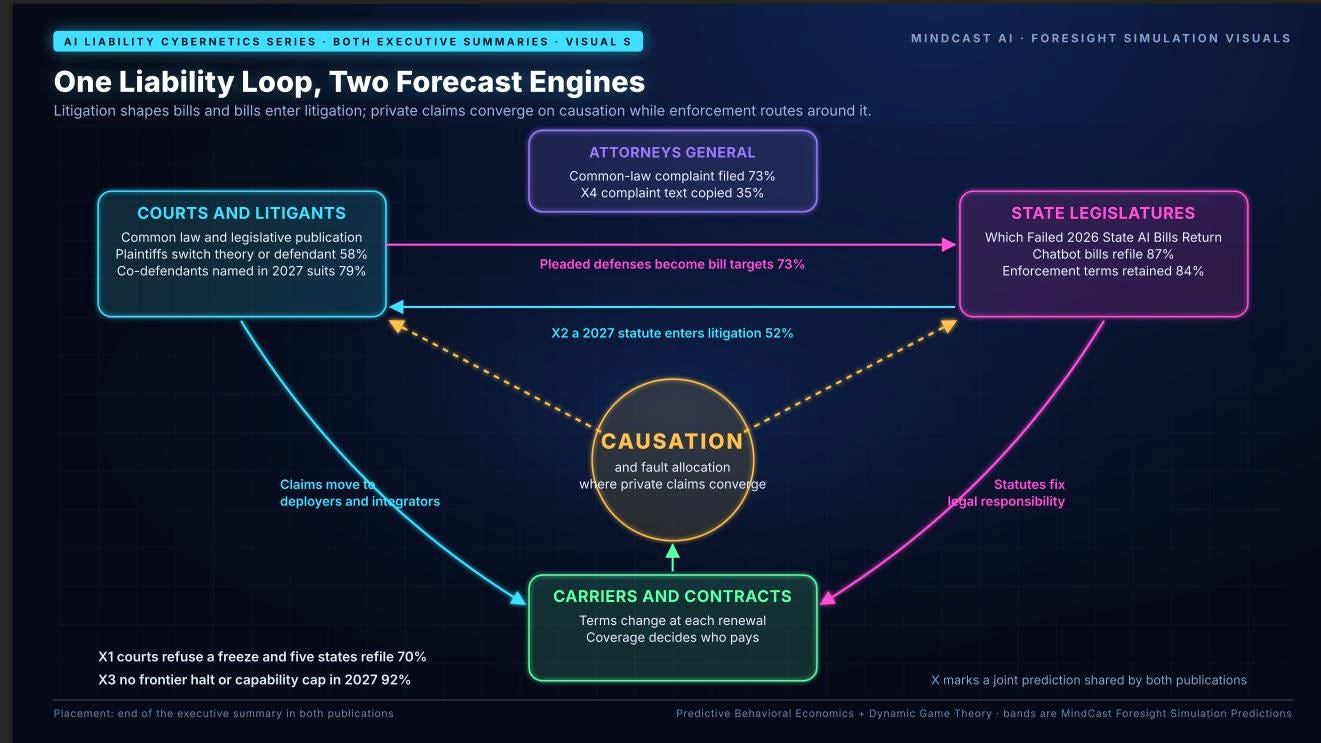
Litigation to legislation. Signal: defenses pleaded in AI-harm suits · Controller: sponsors and committee chairs · Actuator: bills that strip those defenses · Forecast that tests it: Bills P3a · 73% (50-88%)
Legislation to litigation. Signal: statutes enacted in 2027 · Controller: plaintiffs and defense counsel · Actuator: pleadings and briefs citing the statute · Forecast that tests it: X2 · 52% (41-65%)
Enforcement to template. Signal: attorney general complaints · Controller: sponsors in the same state · Actuator: penalty and abatement text copied into bills · Forecast that tests it: X4 · 35% (22-50%)
Coverage to defendant selection. Signal: exclusions and capped indemnity · Controller: plaintiffs’ lawyers · Actuator: suits that name deployers and integrators · Forecast that tests it: Common Law P3 · 79% (46-96%)
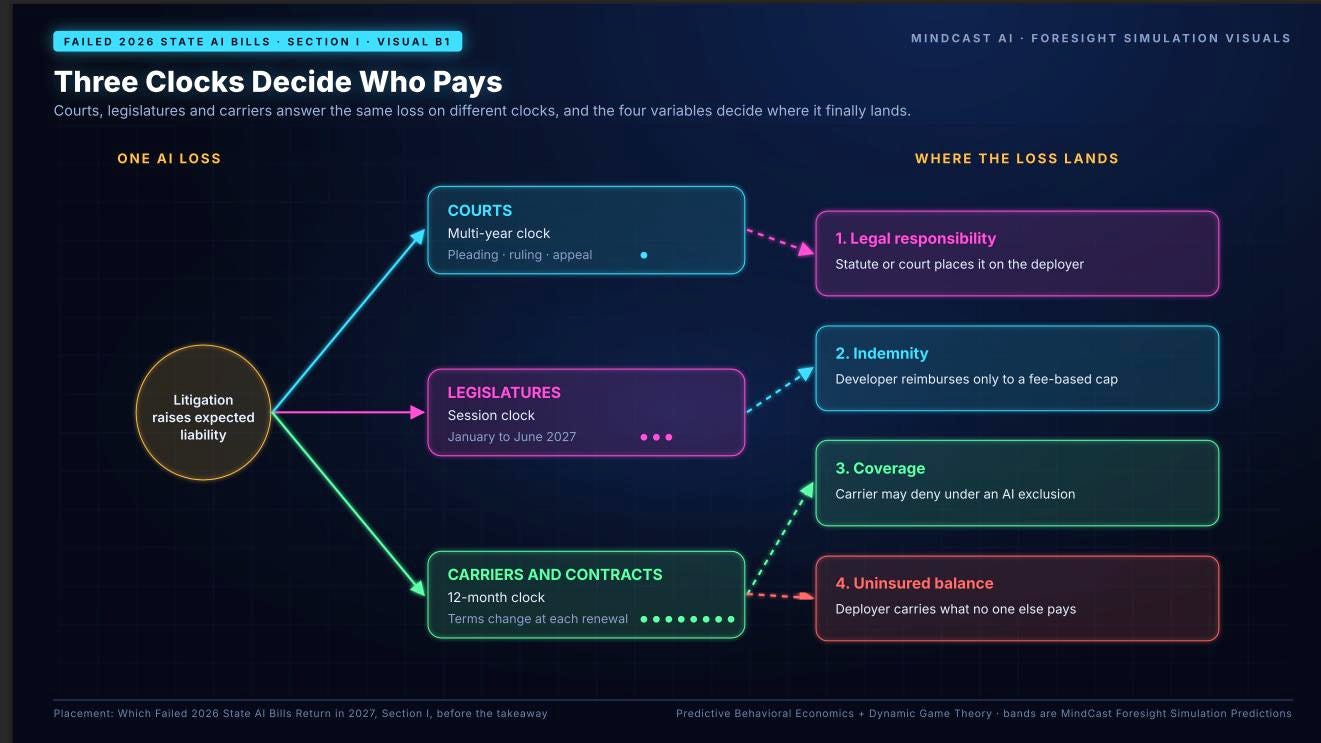
The three clocks. Courts run on a multi-year clock from pleading to appeal. Legislatures run on the January to June session, and carriers rewrite terms every 12 months. A change in one forum reaches the others at the speed of the slowest clock between them.
Damping. Courts refusing development halts keep the system stable. Freeze denials are favored (80%), and no frontier halt or capability cap in 2027 sits at 92%. A court-ordered halt would be the one anomaly that rewires every loop at once.
Takeaway: four loops connect the forums, three clocks set the delays and courts’ refusal of halts keeps the system inside ordinary litigation.
II. Common Law Doctrines Drive the System Most Stakeholders Miss
Most stakeholders watch legislation, yet common law doctrines carry most of the system’s motion. Courts decide doctrine motion by motion, and each ruling changes expected liability before any statute passes. Legislatures then codify what litigation has already tested. The MindCast AI Enforcement and Litigation Tracker follows nine plaintiff doctrines and 15 defenses across 30 actions, and eight of the nine doctrines are expanding.
Statutes follow rulings. Chatbot-as-product bills in five states followed Garcia, where a design-defect claim against a chatbot survived dismissal. Abatement-fund bills followed New Mexico v. Meta, where public nuisance applied at trial. Causation clauses answer the superseding-cause and misuse defenses OpenAI pleads in Raine.
Products liability (design defect). Court status: being tested; survived dismissal in Garcia · Decides: whether a chatbot is a product · Liability moves next to: chatbot-as-product bills · Linked forecast: Common Law S10 · 45% by 2030
Negligence and foreseeability. Court status: being tested · Decides: duty, breach and causation · Liability moves next to: the causation contest · Linked forecast: Common Law P1 · 58%
Voluntary undertaking. Court status: not yet pleaded · Decides: whether published safety commitments create duties · Liability moves next to: counts against safety frameworks · Linked forecast: Common Law S3 · 55%
Public nuisance. Court status: applied in New Mexico v. Meta · Decides: abatement for widespread harm · Liability moves next to: abatement language in bills · Linked forecast: Bills S2 · 58%
Imputed knowledge. Court status: unsettled; pleaded by attorneys general · Decides: what the company knew · Liability moves next to: risk statements as evidence of knowledge · Linked forecast: Common Law S4 · 62%
Apparent authority. Court status: unsettled · Decides: whether an AI agent binds its deployer · Liability moves next to: agent-transaction bills · Linked forecast: Common Law S7 · 35%
Negligent misrepresentation. Court status: applied abroad · Decides: liability for false AI output · Liability moves next to: claims the economic loss rule pushes out of negligence · Linked forecast: Common Law S8 · 30%
Economic loss rule (defense). Court status: untested · Decides: whether negligence for financial loss survives · Liability moves next to: contract, misrepresentation and statute · Linked forecast: Common Law S6 · 40%
Section 230 immunity (defense). Court status: pleaded · Decides: whether model output counts as third-party content · Liability moves next to: design-defect framing · Linked forecast: Common Law S11 · 55% by 2030
The AI did it (defense). Court status: rejected; barred in California · Decides: whether autonomy breaks the causal chain · Liability moves next to: autonomy-bar copies in other states · Linked forecast: Bills P3a · 73%
Superseding cause, misuse and comparative fault. Court status: pleaded · Decides: causation and fault allocation · Liability moves next to: causation clauses · Linked forecast: Bills S7 · 25%
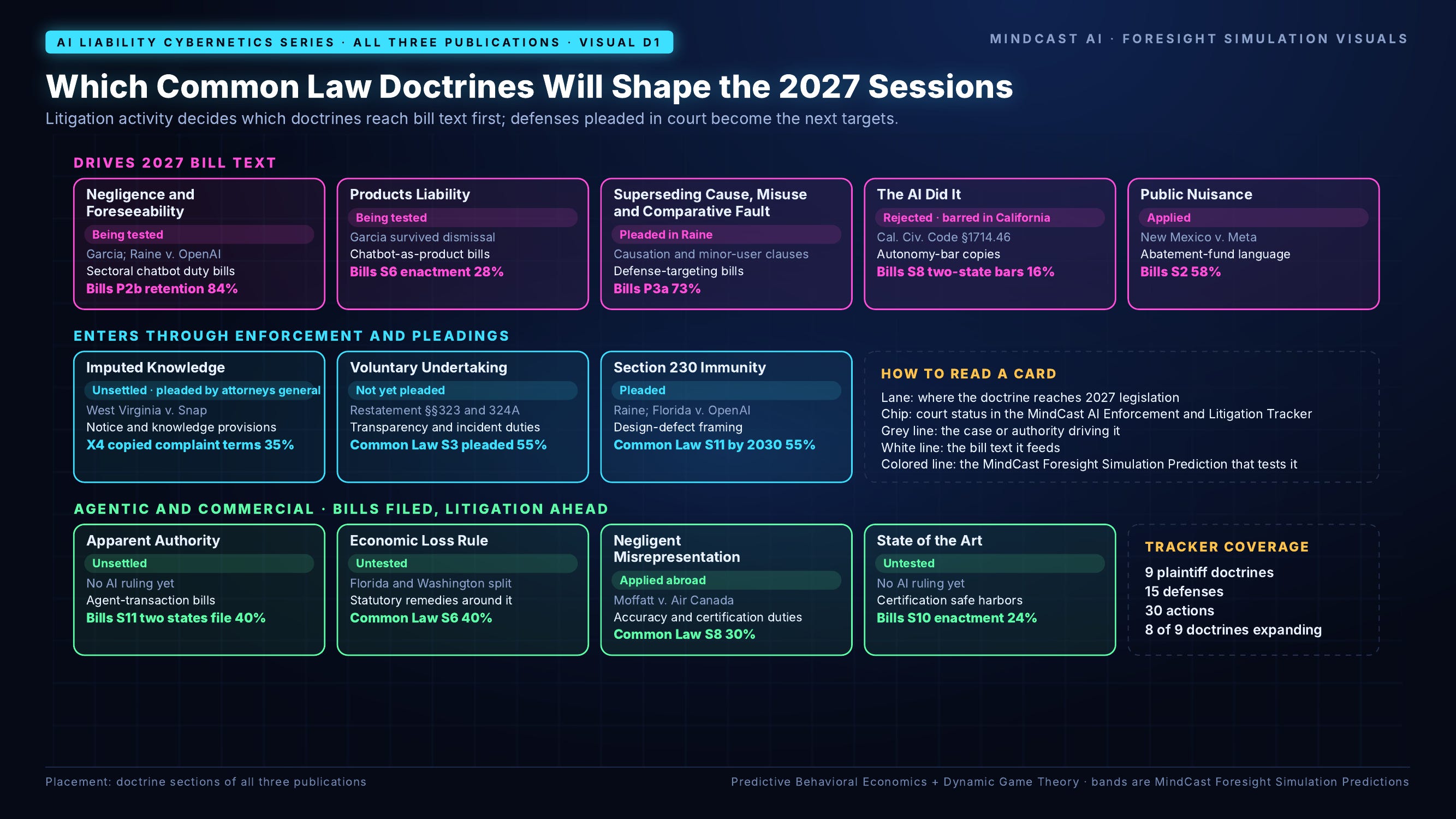
Why attention misses the doctrine. Behavioral economics explains the gap: hearings, votes and vetoes are salient, while motions to dismiss and briefing schedules are not. Game theory explains why the gap matters, because defendants choose defenses and plaintiffs choose theories in filings few outsiders read. The forecasts show the order of arrival: plaintiffs adding a theory or defendant (58%) and attorneys general pleading common-law counts (73%) outrun most 2027 enactments, which sit between 16% and 38%.
Doctrine moves by substitution. When one defense weakens, defendants shift to the next: a weakened Section 230 defense moves the fight to product versus service, and a barred autonomy defense moves it to superseding cause and comparative fault. Plaintiffs answer with design-defect framing or evidence that the human act was foreseeable. Each substitution changes which policy responds, so carriers need the doctrine map more than the bill count.
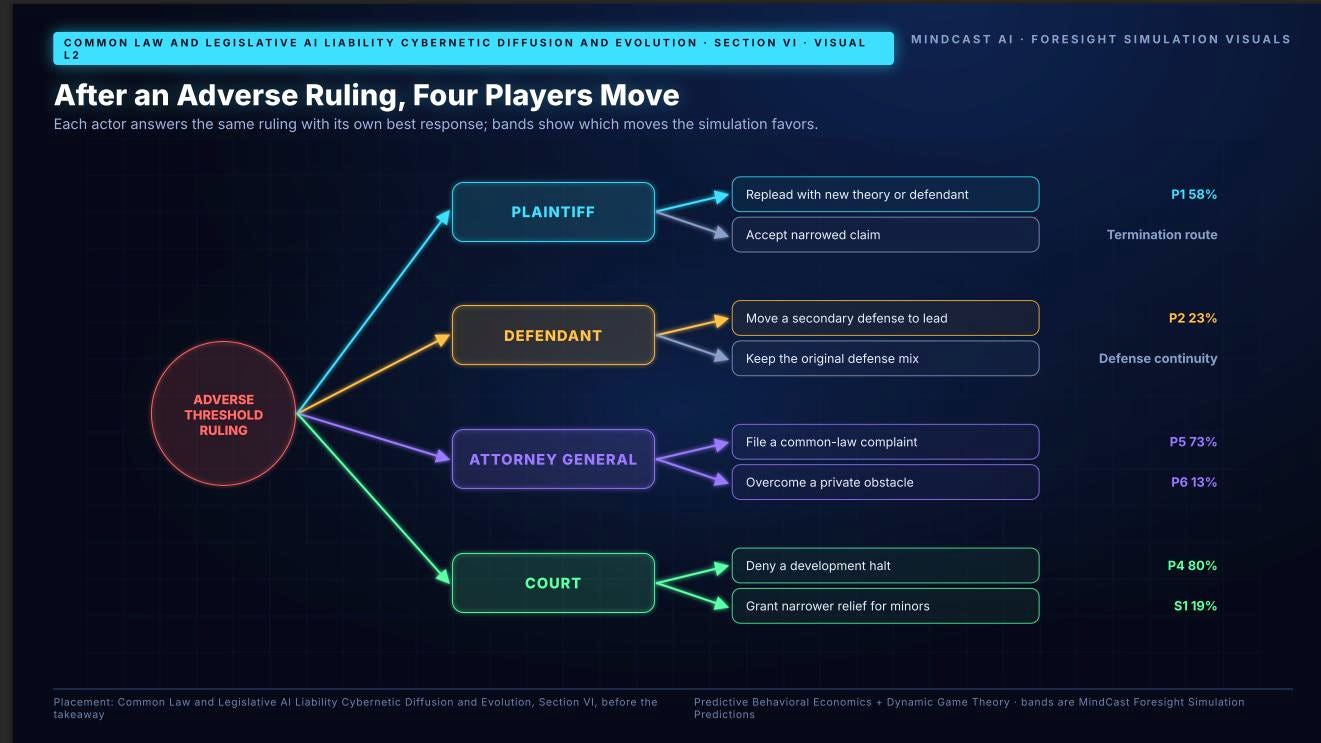
Takeaway: common law doctrines move first and decide where liability lands, while legislation mostly codifies what the courts have already tested.
III. Private Claims Converge on Causation While Enforcement Routes Around It
Legislatures remove the defenses a single clause can strip, such as the autonomy defense and minor misuse. Courts narrow threshold defenses at the pleading stage and refuse remedies that would halt development. Both moves leave causation, which resists drafting and survives early motions.
Plaintiffs answer narrowing rulings by changing theory or defendant. In at least one tracked case, a plaintiff is favored to add a new theory or defendant after a narrowing ruling by the end of 2028 (58%). A changed strategy is not a recovery, and whether moved claims survive and pay remains open.
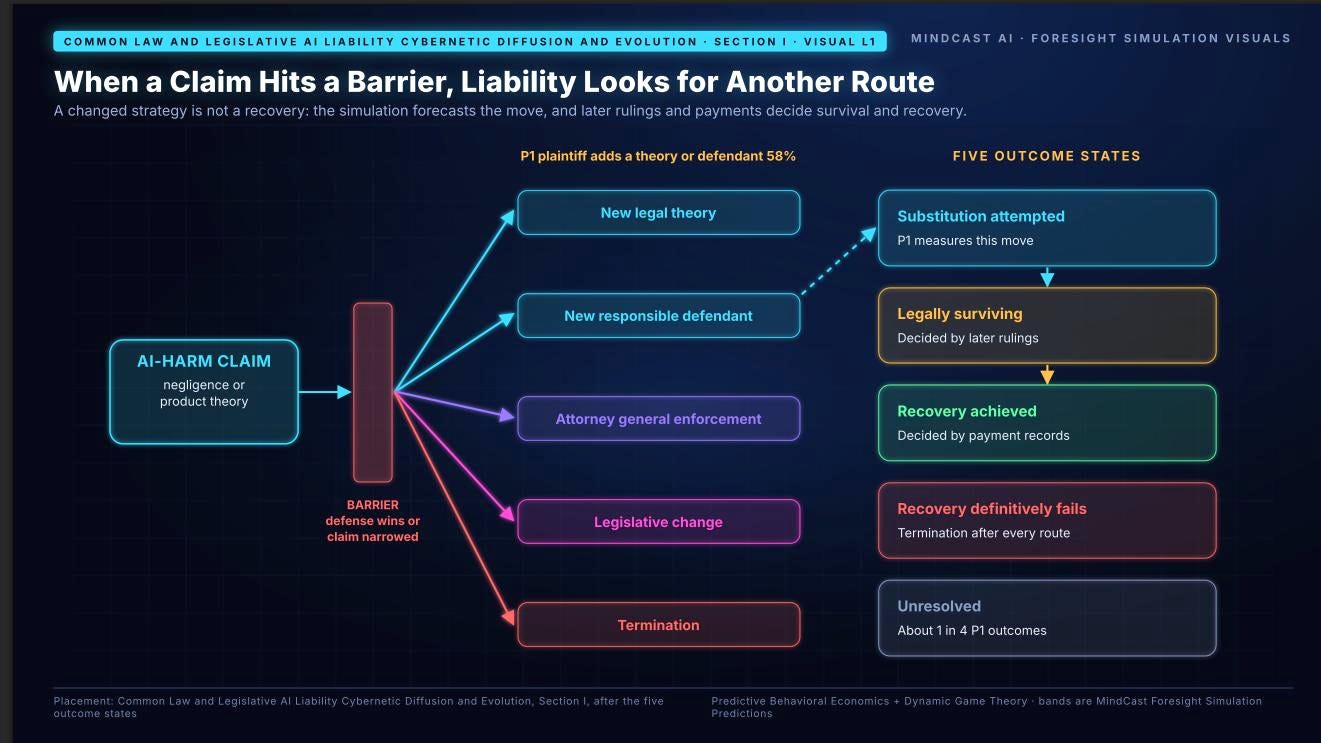
Causation contests are the most expensive part of a case, because they turn on experts and discovery. Carriers should therefore expect defense expense to rise before liability outcomes change. A required certification can lower accident frequency while adding undertaking exposure for the deployer, the certifier and the carrier (55% that undertaking is pleaded by 2028).
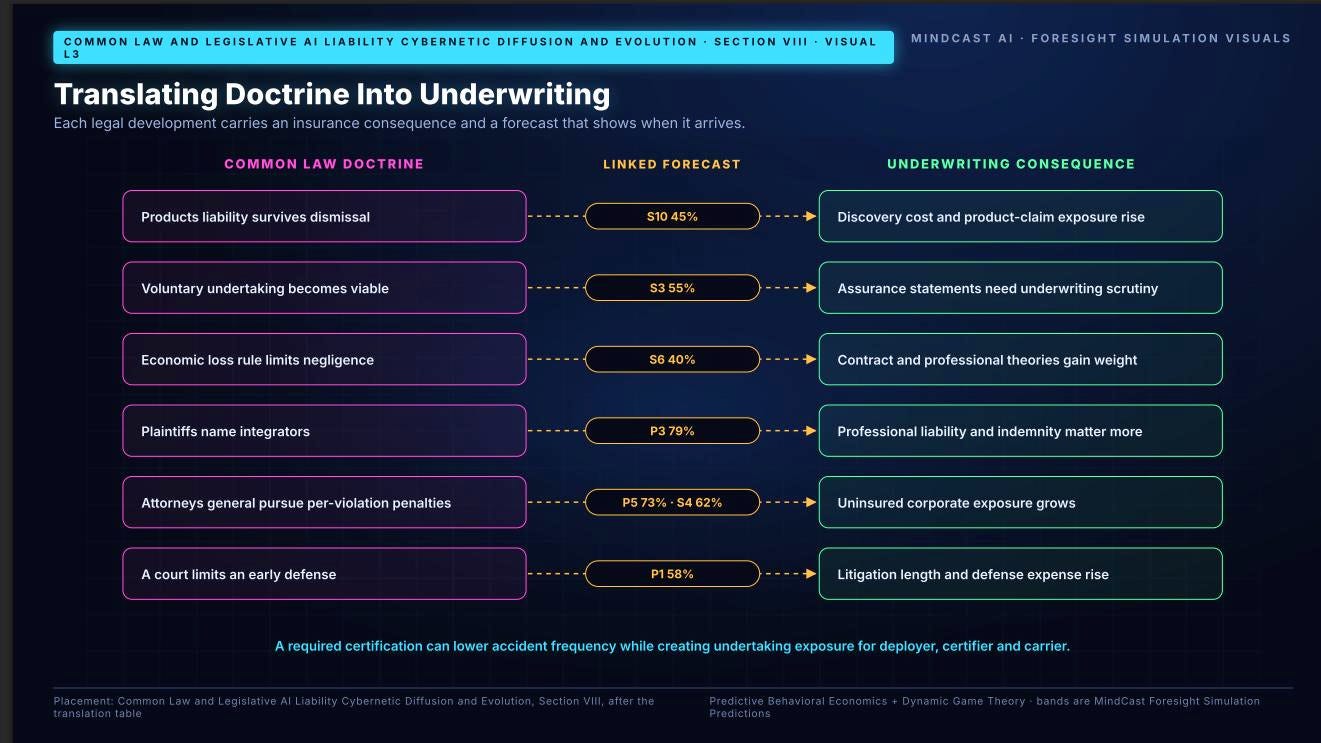
Enforcement takes the other route. Attorneys general seek penalties per violation without proof that any individual was harmed. Their complaints are favored to cite published risk statements as evidence of knowledge (62%), which replaces the causal chain with proof of notice. Public enforcers therefore file more often, while private plaintiffs carry the large individual losses.
Takeaway: legislatures and courts narrow the easy defenses in private cases and concentrate cost on causation, while enforcement routes around causation and drives claim frequency.
IV. Why Stakeholders Miss the System and What Watching It Buys
Bounded attention explains the blind spots. Each stakeholder watches the forum it already works in, and behavioral economics predicts that salient local signals crowd out slower signals from other forums. The table names the reason each stakeholder may look away, the foresight that watching provides and the signal worth tracking.
State lawmakers and staff. Why attention goes elsewhere: sessions focus on bill text, not on dockets in other states · Foresight gained: which defenses the next bill should target and which provisions will be pleaded within a year · Signal to track: defenses pleaded in pending cases; X2 (52%)
Attorneys general. Why attention goes elsewhere: each office runs its own docket and coalition calendar · Foresight gained: which complaint terms will become statute and where a resolution would set the template · Signal to track: X4 (35%); Common Law S4 (62%)
Insurance regulators. Why attention goes elsewhere: oversight centers on filed forms rather than tort doctrine · Foresight gained: how doctrine changes which policy responds before claims arrive · Signal to track: Common Law P3 (79%); new AI endorsements
Carriers and brokers. Why attention goes elsewhere: underwriting runs on loss history, which lags doctrine · Foresight gained: when defense cost rises and which insureds become substitute defendants · Signal to track: Common Law P1 (58%); Common Law P3 (79%)
AI developers. Why attention goes elsewhere: legal teams fight case by case · Foresight gained: which defenses legislatures strip next and when preemption could reset the field · Signal to track: Bills P3a (73%); any preemption bill
Deployers and integrators. Why attention goes elsewhere: contracts appear to shift risk to the developer · Foresight gained: how often plaintiffs name them anyway and how far indemnity caps leave them exposed · Signal to track: Common Law P3 (79%)
Auditors and assurance providers. Why attention goes elsewhere: certification looks like a compliance service rather than a liability source · Foresight gained: when published assurance becomes evidence of an undertaking · Signal to track: Common Law S3 (55%)
Defense and plaintiff counsel. Why attention goes elsewhere: briefing tracks the next motion in one court · Foresight gained: where threshold defenses are headed in statute as well as in court · Signal to track: Bills P3a (73%); Common Law P1 (58%)
Investors and boards. Why attention goes elsewhere: AI risk appears as product and regulatory headlines rather than tort exposure · Foresight gained: which exposure lands on balance sheets rather than policies · Signal to track: Common Law P5 (73%); penalties outside coverage
Inattention clusters where latency is longest. Carriers and deployers sit downstream of every loop, so a change in a courtroom or a committee reaches them last and costs them most. Watching the system turns that delay into lead time.
Takeaway: the stakeholders with the most to lose from a liability shift often watch the forum where it arrives last.
V. How the Game Evolves and the Seven Events That Would Change It
The system forecasts hold while the rules set from 2024 to 2026 hold. Seven events would change those rules, and each event card on the war gaming board shows what it changes and which positions survive, convert or strand. The table summarizes the cards, and the screenshots show them in play.
Federal preemption statute. Type of change: game evolution · Largest forecast move: refiling 87% to 59%; retention 84% to 59% · New forecast in that state: an attorney general challenges the preemption · 62% (54-70%)
Plaintiff verdict in a chatbot death case. Type of change: equilibrium shift · Largest forecast move: chatbot hardening 27% to 37% · New forecast in that state: a developer resolves two or more death cases within 90 days · 55% (47-63%)
Defense verdict in a chatbot death case. Type of change: equilibrium shift · Largest forecast move: chatbot hardening 27% to 18% · New forecast in that state: none
Appellate ruling restores a Section 230 defense. Type of change: game evolution · Largest forecast move: repleading after narrowing 58% to 75% · New forecast in that state: a bill redefines model output as the developer’s own conduct · 45% (37-53%)
Court-ordered frontier halt. Type of change: game mutation (anomaly) · Largest forecast move: three forecasts resolve false · New forecast in that state: an appeal stays or reverses the halt within 60 days · 78% (70-86%)
Attorney general coalition resolution. Type of change: equilibrium shift · Largest forecast move: copied complaint terms 35% to 41% · New forecast in that state: a bill codifies a resolution term · 48% (40-56%)
Autonomy-defense bar copied in another state. Type of change: continuation · Largest forecast move: defense-targeting 73% to 90% (82-97%) · New forecast in that state: none; Common Law P7 resolves true
Classification matters for planning. Continuation updates odds inside the current game. An equilibrium shift changes which outcome persists, while game evolution changes rules, forums or players. A court-ordered halt is the one anomaly, a game mutation that changes every actor’s options at once.
How to play the board. The board runs in four steps. A reader takes a seat, makes moves, plays an event card and reads what moved. The three panels below walk through one round from the Carriers seat with a plaintiff verdict in play.
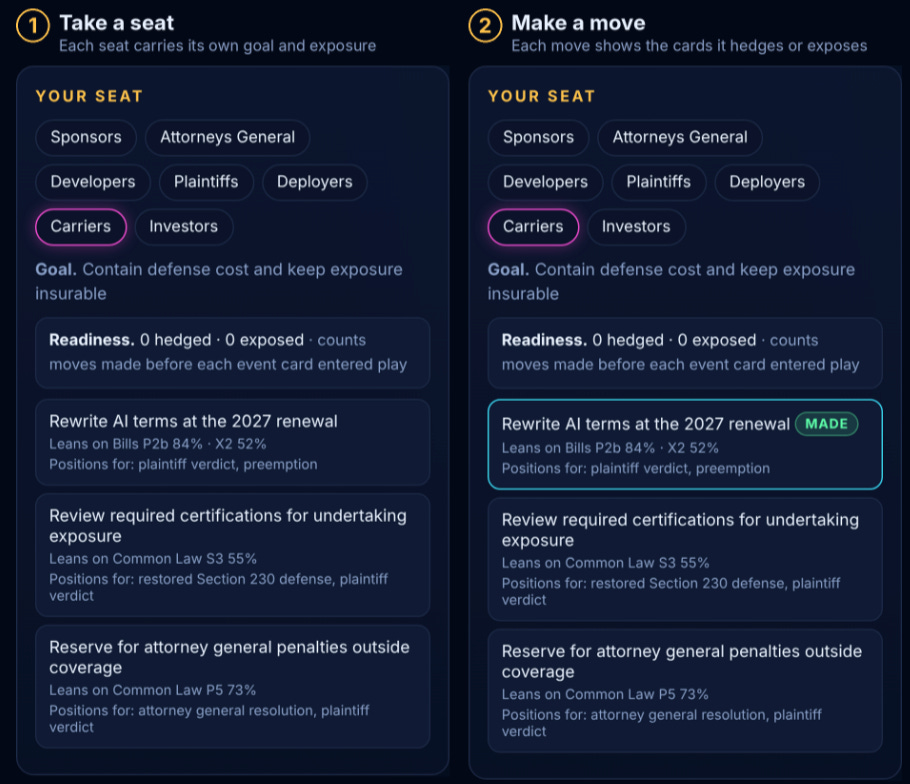
Steps 1 and 2. The Carriers seat shows its goal and three moves; rewriting AI terms at the 2027 renewal leans on Bills P2b and X2 and positions the carrier for a plaintiff verdict. Source: AI Liability Cybernetics Interactive War Gaming.
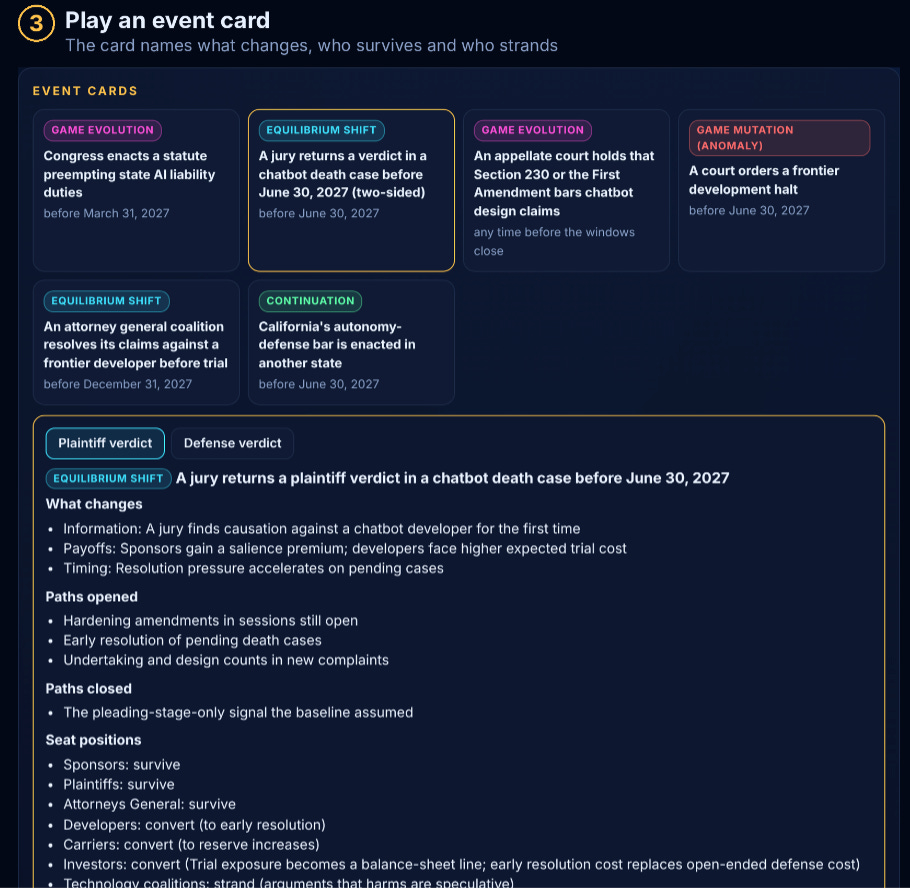
Step 3. The plaintiff verdict card names what changes and which paths open or close. It also shows which seats survive, convert or strand. Source: AI Liability Cybernetics Interactive War Gaming.
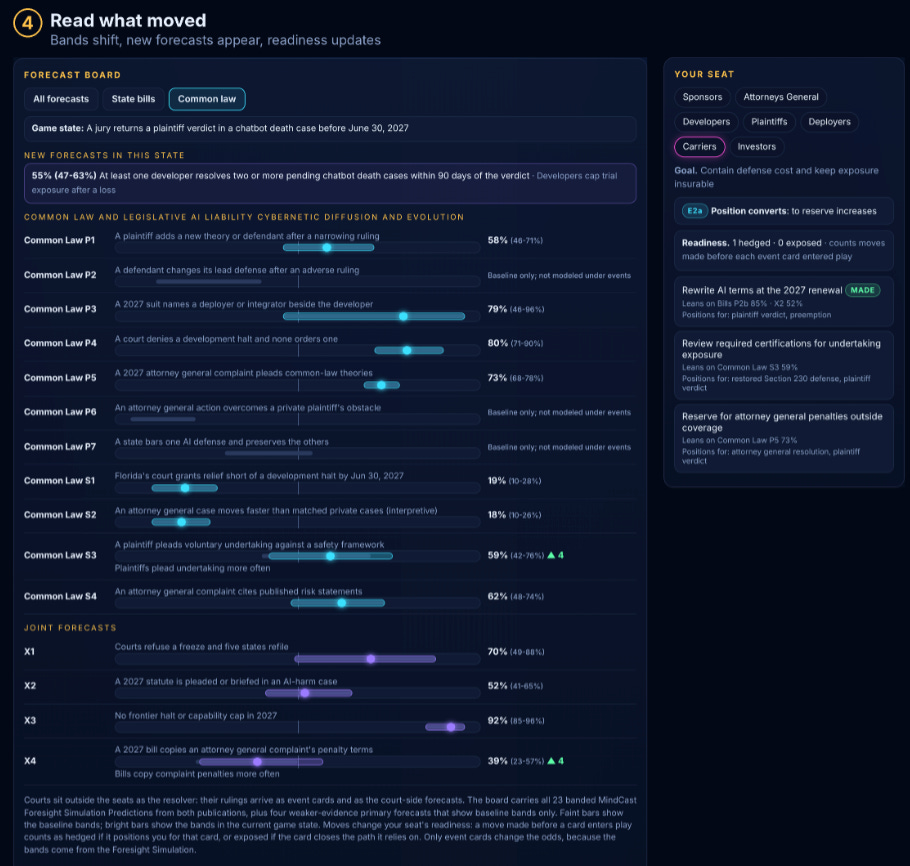
Step 4. Undertaking pleadings rise to 59% and copied complaint terms to 39%, a new forecast appears at 55%, and the carrier's renewal move counts as hedged. Source: AI Liability Cybernetics Interactive War Gaming.
Four board states, one per change type. The walkthrough covers the equilibrium shift, so the states below cover the rest. A game evolution turns entries unresolved and the anomaly resolves entries false. A continuation lifts a band to its conditional value, and two cards together leave a shared entry unbanded.
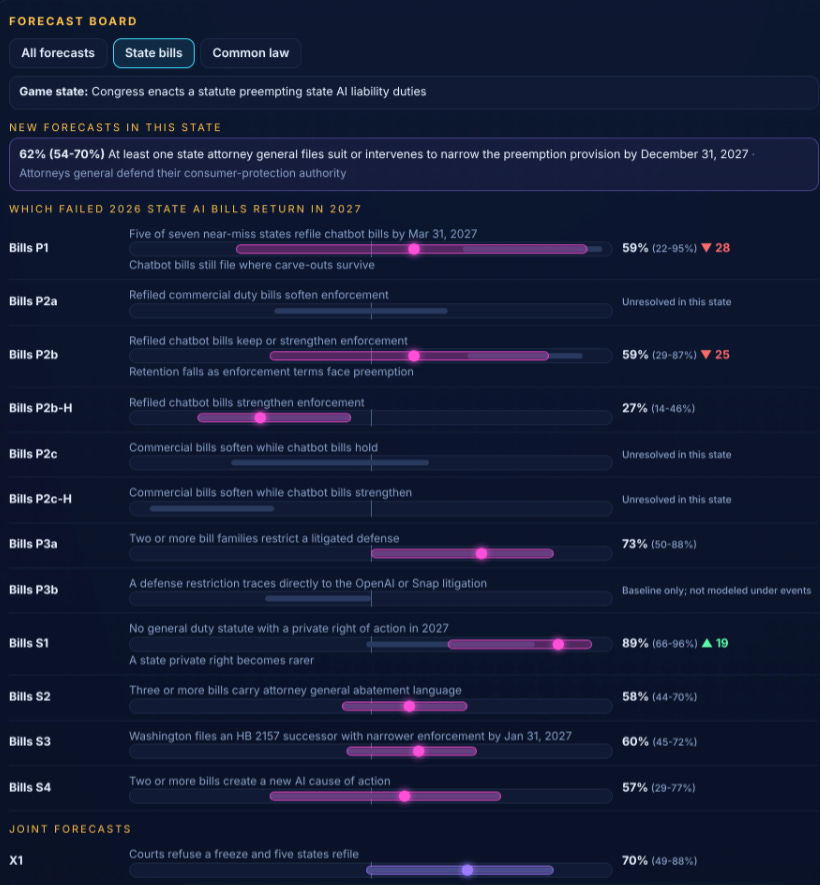
Preemption in play with the Sponsors seat. Bills P1 falls to 59%, three commercial forecasts turn unresolved and the refile-intact move shows as exposed. Source: AI Liability Cybernetics Interactive War Gaming.
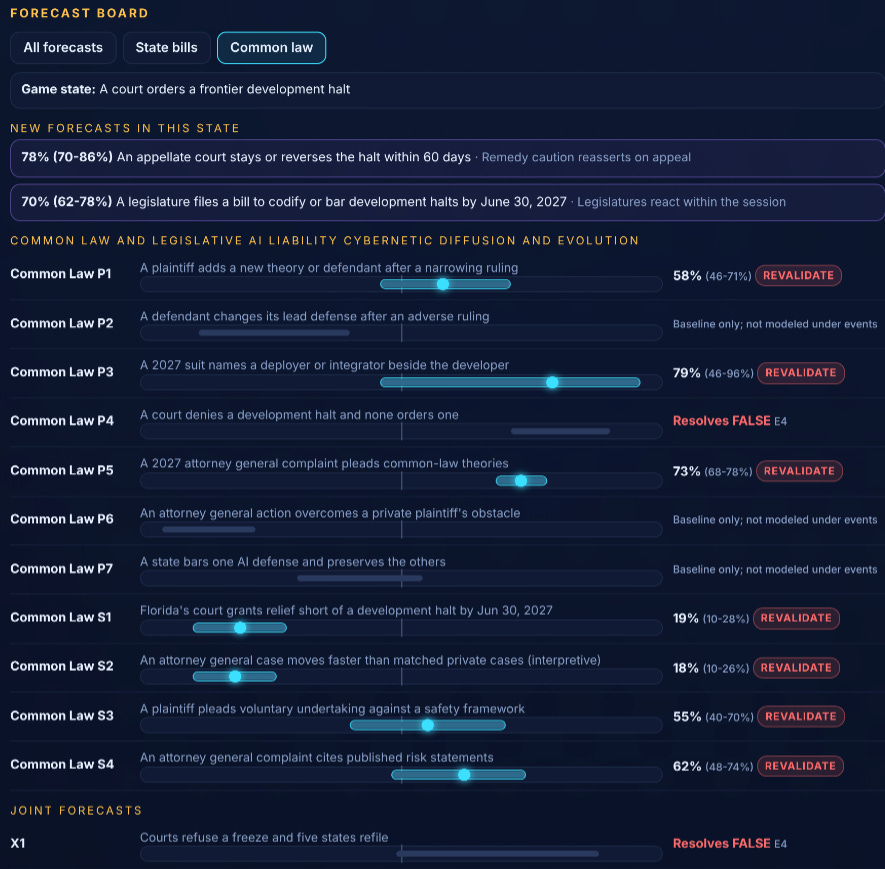
Court-ordered halt in play with the Developers seat. Common Law P4, X1 and X3 resolve false, two new forecasts appear and the emergency-appeal move shows as hedged. Source: AI Liability Cybernetics Interactive War Gaming.
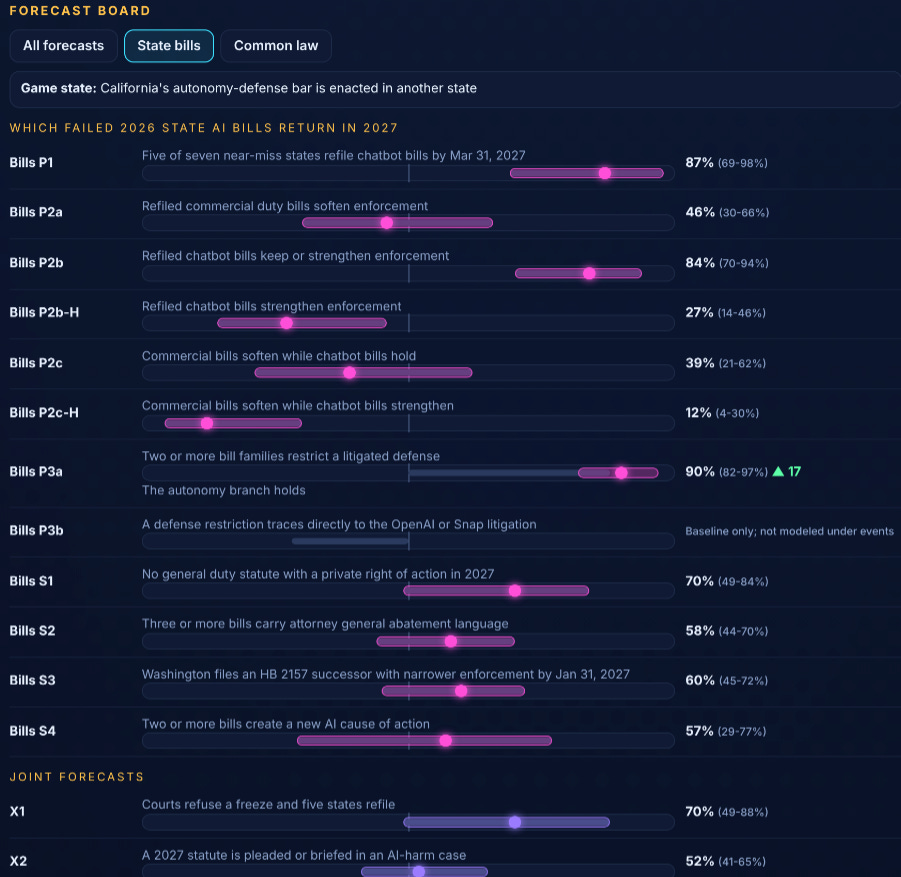
Autonomy-bar copy in play with the Developers seat. Defense-targeting rises to 90% (82-97%), developers lose the autonomy argument in the enacting state and their lobbying move shows as exposed. Source: AI Liability Cybernetics Interactive War Gaming.
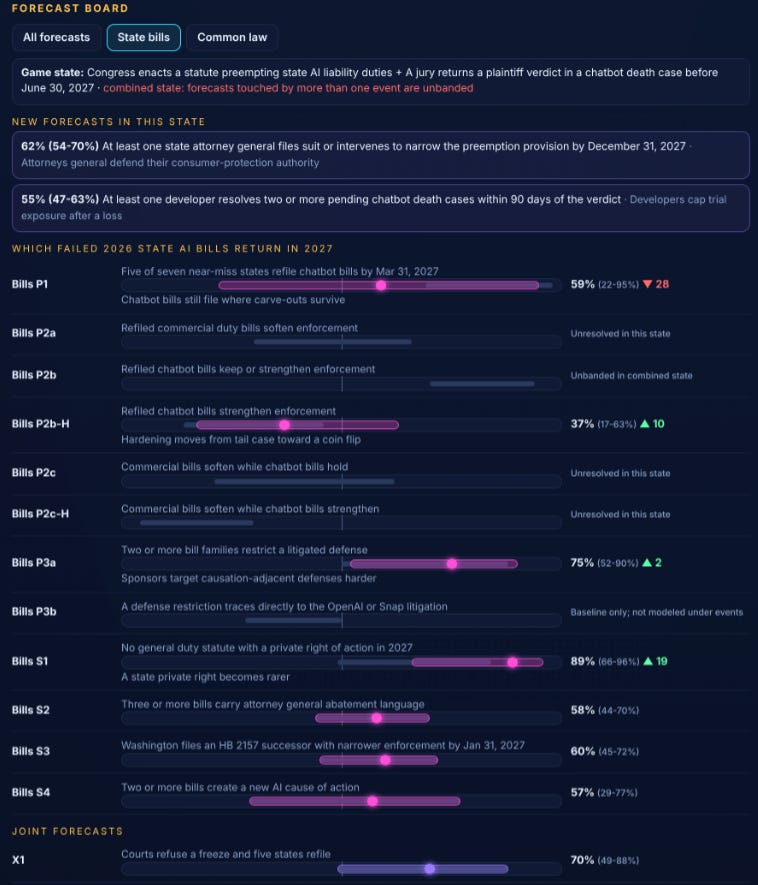
Preemption and a plaintiff verdict in play together with the Investors seat. Bills P2b, touched by both events, shows as unbanded rather than as an invented combined number. Source: AI Liability Cybernetics Interactive War Gaming.
Takeaway: only preemption reverses a strong call and only a court-ordered halt rewires every loop, so every other event shifts odds inside a system where private claims meet at causation and enforcement routes around it.
VI. MindCast Foresight Simulation Predictions Across the System
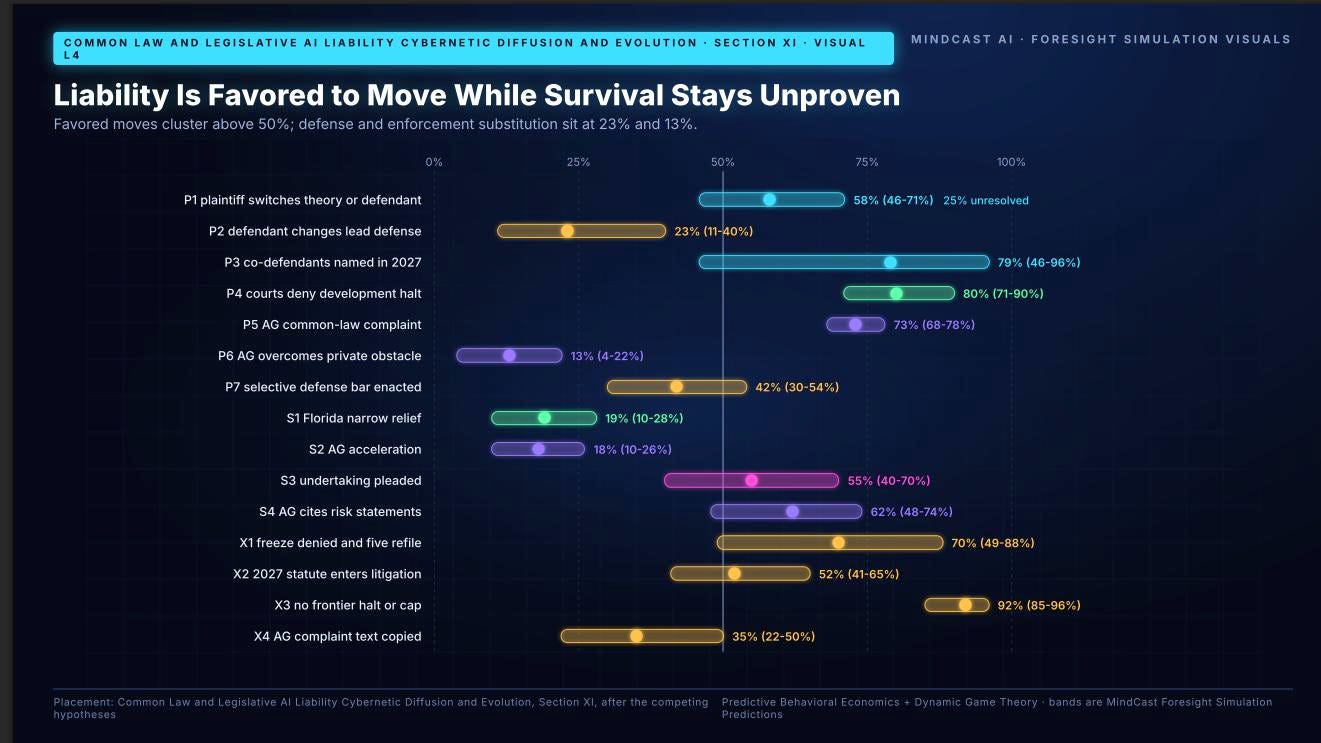
The system view carries 13 MindCast Foresight Simulation Predictions from the two series publications and adds six conditional predictions that apply only if an event card occurs. Carried entries keep their source labels: Bills for the failed 2026 state AI bills publication and Common Law for Common Law and Legislative AI Liability Cybernetic Diffusion and Evolution, with X for joint entries. P marks a Primary Simulation Prediction, S a Secondary Simulation Prediction and C a conditional prediction. The conditional forecasts are new with this publication, so no earlier MindCast results exist to report beside them.
Three Competing Hypotheses
Feedback system (the thesis). Institutions respond to one another’s moves, so outputs in one forum become inputs in another. Falsifier: X2 and X4 both resolve false and no 2027 bill restricts a litigated defense.
Independent tracks. Legislatures and courts follow separate agendas, and the apparent links are coincidence. Falsifier: X2 or X4 resolves true, or committee materials trace a provision to a lawsuit.
Federal reset. Congress or an appellate court resets the field before the state loops matter. Falsifier: neither a preemption statute nor an appellate threshold ruling arrives before the 2027 windows close.
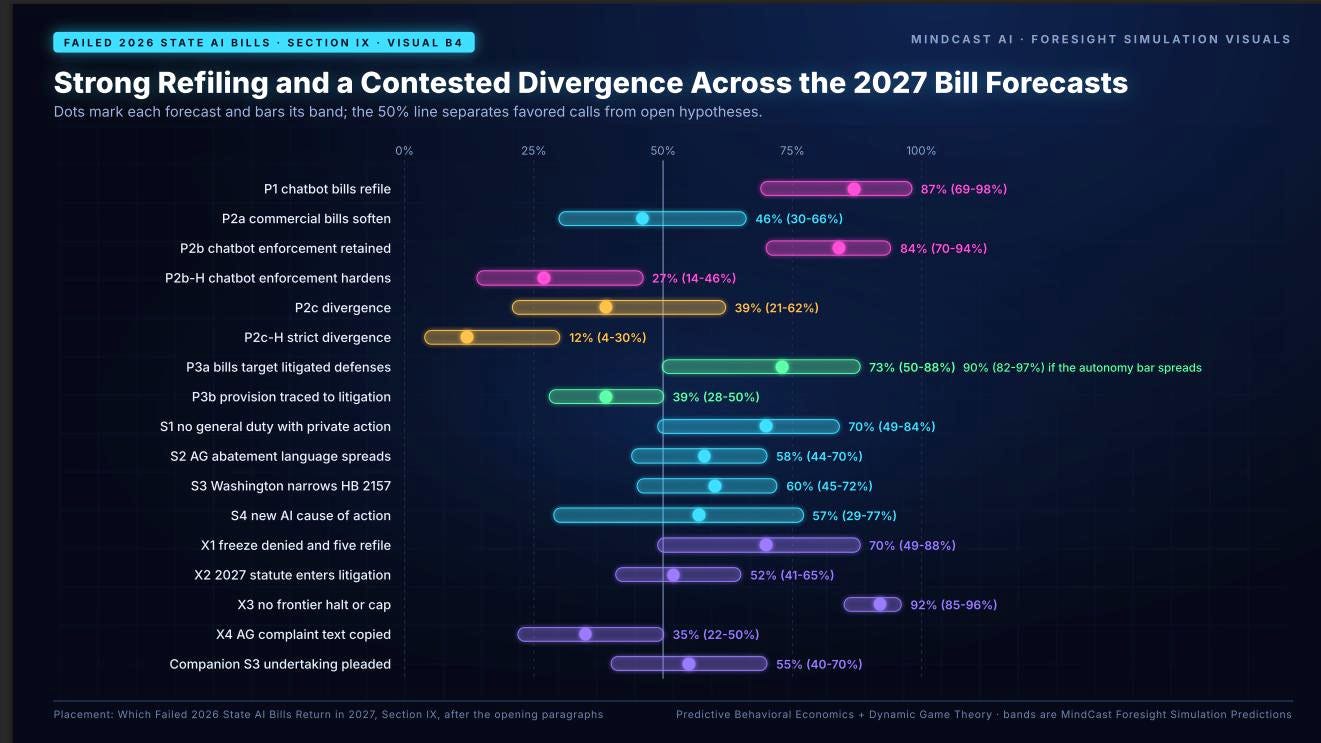
Carried Predictions Across the Four Loops
Bills P1: At least five of seven companion-chatbot near-miss states refile a chatbot or minor-protection bill by March 31, 2027 (87%; 69-98%). Falsifier: four or fewer such filings.
Bills P2b: A majority of refiled chatbot families keep or strengthen enforcement by June 30, 2027 (84%; 70-94%). Falsifier: half or fewer qualify.
Bills P3a: At least two 2027 bill families restrict a defense pleaded in AI-harm litigation by June 30, 2027 (73%; 50-88%). Falsifier: fewer than two qualifying families.
Bills S1: No state enacts a general high-risk AI duty with a private right of action in 2027 (70%; 49-84%). Falsifier: one or more such statutes signed.
Common Law P1: In at least one tracked case where a court narrows a claim, the plaintiff adds a new theory or defendant by December 31, 2028 (58%; 46-71%). Falsifier: a qualifying ruling without a qualifying amendment.
Common Law P3: A 2027 AI-harm suit names a deployer, integrator or distributor beside a model developer (79%; 46-96%). Falsifier: no qualifying 2027 filing.
Common Law P4: By June 30, 2027 a court denies a development halt and none orders one (80%; 71-90%). Falsifier: no denial by the deadline, or any halt ordered.
Common Law P5: A 2027 attorney general complaint against an AI developer pleads negligence, products liability or public nuisance (73%; 68-78%). Falsifier: no qualifying complaint.
Common Law S3: A plaintiff pleads voluntary undertaking against a published AI safety framework by December 31, 2028 (55%; 40-70%). Falsifier: no such count.
X1: By June 30, 2027 a court denies a frontier development freeze and none orders one, and five or more near-miss states refile chatbot bills (70%; 49-88%). Falsifier: either event fails.
X2: A 2027-enacted AI liability or duty statute is pleaded or briefed in an AI-harm case by June 30, 2028 (52%; 41-65%). Falsifier: no such filing.
X3: No state enacts a frontier-development halt or capability cap in 2027, and no court orders one (92%; 85-96%). Falsifier: any halt or cap enacted or ordered.
X4: A 2027 bill reproduces a per-violation penalty or abatement provision from a pending attorney general complaint in the same state (35%; 22-50%). Falsifier: no such bill.
Conditional Predictions Triggered by Event Cards
C1: If Congress enacts a statute preempting state AI liability duties, at least one attorney general sues or intervenes to narrow it by December 31, 2027 (62%; 54-70%). Falsifier: no such filing after enactment.
C2: If a jury returns a plaintiff verdict in a chatbot death case before June 30, 2027, a developer resolves two or more pending chatbot death cases within 90 days (55%; 47-63%). Falsifier: fewer than two resolved in that window.
C3: If an appellate court restores a Section 230 or First Amendment bar on chatbot design claims, a 2027 bill defines generative output as the developer’s own conduct by June 30, 2027 (45%; 37-53%). Falsifier: no such bill.
C4: If a court orders a frontier development halt, an appellate court stays or reverses it within 60 days (78%; 70-86%). Falsifier: the halt stands for 60 days.
C5: If a court orders a frontier development halt, a legislature files a bill to codify or bar development halts by June 30, 2027 (70%; 62-78%). Falsifier: no such bill.
C6: If an attorney general coalition resolves its claims against a frontier developer before trial, a 2027 bill codifies a resolution term by December 31, 2027 (48%; 40-56%). Falsifier: no such bill.
Each conditional prediction resolves only if its event occurs.
Forward implication. Through 2027, causation and fault allocation become the decisive ground in AI-harm litigation while threshold defenses narrow at the trial level. Disconfirmation: an appellate ruling restoring a threshold defense that ends the tracked chatbot cases before the causation contest begins.
Takeaway: the strong calls sit at the system’s front end in refiling, retention and halt refusals, while the conditional forecasts map what follows each event that could change the game.
VII. Stakeholder Strategies Across the System
Each stakeholder can turn the system view into one owned action with a deadline. The table gives the exposure in the unit each stakeholder controls and the residual that remains after the action.
State lawmakers. Exposure unit: provisions in a returning bill · Action: draft defense restrictions with the causation contest in view · Deadline: Jun 30, 2027 · Residual exposure: causation stays contested
Attorneys general. Exposure unit: complaint counts and penalty terms · Action: file common-law counts and supply penalty language to sponsors · Deadline: Dec 31, 2027 · Residual exposure: a preemption statute could narrow state authority
Insurance regulators. Exposure unit: filed forms and endorsements · Action: review AI exclusions against the four loops before 2027 renewals · Deadline: Dec 31, 2027 · Residual exposure: doctrine may outrun filed forms
Carriers and brokers. Exposure unit: defense cost and limits by insured class · Action: rewrite AI terms at renewal and review required certifications · Deadline: each renewal date · Residual exposure: undertaking claims may survive dismissal
AI developers. Exposure unit: defenses available in each state · Action: prepare defenses that do not rely on autonomy or minor-misuse arguments · Deadline: Jun 30, 2027 · Residual exposure: causation and comparative fault stay contested
Deployers and integrators. Exposure unit: indemnity above fee-based caps · Action: renegotiate indemnity and build the developer-control record · Deadline: next contract cycle · Residual exposure: plaintiffs may name them anyway
Auditors and assurance providers. Exposure unit: published assurance statements · Action: align certification language with what the audit tested · Deadline: before the next certification · Residual exposure: statements may still be cited as an undertaking
Investors and boards. Exposure unit: penalty exposure outside coverage · Action: discount for attorney general penalties and build a preemption case into each valuation · Deadline: each reporting period · Residual exposure: penalties may exceed estimates
Takeaway: every stakeholder can act before the first 2027 deadlines, and causation remains the residual exposure that no single action removes.
What to Watch · Preemption Is the Dominant Fork
The dominant fork is federal preemption. Without it, the strong calls stand on their bands, and with it refiling and retention fall toward 59%. The observables below arrive in date order.
January 31, 2027: Washington’s HB 2157 successor shows whether commercial duty bills narrow (Bills S3).
February 2027: California’s bill-introduction deadline shows whether an AB 2575 successor carries the causation clause (Bills P3a).
March 31, 2027: near-miss refilings resolve Bills P1 and the legislative half of X1.
June 30, 2027: rulings on Florida’s freeze motion and the nonprofit suit resolve Common Law P4, and first 2027 texts resolve Bills P2b and P3a.
Through 2027: new attorney general complaints, co-defendant naming and any preemption bill in Congress (Common Law P5 and P3).
Through 2028: statutes in pleadings and repleading after narrowing (X2 and Common Law P1).
Takeaway: the first half of 2027 resolves most of the system’s strong calls, and any preemption bill is the one observable that could reverse them.
Conclusion · The System Moves Liability Before Any Forum Decides It
AI liability is moving through a feedback system in which lawsuits shape bills, bills enter lawsuits and carriers decide who pays. Common law doctrines move first, and legislation mostly codifies what the courts have tested. Private claims converge on causation and fault allocation while enforcement routes around them, and only federal preemption would reverse the system’s strong calls.
Stakeholders who watch one forum learn of a shift when it reaches them. Stakeholders who watch the system learn of it earlier, often by a full session or renewal cycle.
Working With MindCast · System Monitoring and War Gaming Keyed to the Forecasts
Every strong call in the system resolves between January 2027 and mid-2028, and the institutions that act first set the terms others inherit. MindCast AI builds Foresight Simulations for those institutions, run on the MindCast AI Proprietary Cognitive Digital Twin Foresight Simulation that produced the bands above.
System monitoring for carriers, brokers and regulators. MindCast tracks all four loops for a named book or jurisdiction and reports when a forecast that governs it moves. The deliverable is a quarterly system map keyed to renewal dates (Common Law P3, X2 and Bills P2b).
War gaming sessions for counsel, developers and deployers. MindCast runs the board with your seats, your states and your pending cases. Participants see which moves hedge and which leave them exposed before the next filing deadline (Bills P3a, Common Law P1 and P5).
Revalidation alerts when an event card occurs. When any of the seven event cards occurs, MindCast reruns the affected forecasts. Subscribers learn which positions survive, convert or strand before their next annual review.
First step. Send the state, book or case you are tracking to mcai@mindcast-ai.com, and MindCast maps it to the forecasts that govern it. Full offerings, including complex litigation modeling, sit at www.mindcast-ai-simulation.com.
Appendix A · Series Publications, Boards and Related Work
The works below supply the forecasts, boards and frameworks behind this publication; each entry states its role in one line.
Predictive Game Theory and Common Law Dynamics Foresight into Which Failed 2026 State AI Bills Return in 2027. Source of every Bills forecast.
Common Law and Legislative AI Liability Cybernetic Diffusion and Evolution. Source of every Common Law forecast.
AI Liability Cybernetics Interactive War Gaming. Source of every screenshot and of the event-card conditional forecasts.
MindCast AI Enforcement and Litigation Tracker. The case, doctrine and defense inventory behind the litigation loops.
The Computational Era Operationalizes Cybernetics and Predictive Game Theory (May 18, 2026). The cybernetic frame behind the series.
The Calculus of Predictive Game Theory Evolution and Mutation. The method behind the game evolution classes.
Agentic AI Liability and Insurance Exclusions: How Coverage Redirects Who Gets Sued. The coverage loop.
State Attorney General Coalitions: How Lead States Set the Template and Why Other States Copy the Complaint. The enforcement loop.
Appendix B · Visual and Screenshot Index
The visuals come from the AI Liability Cybernetics Series Visuals, and the screenshots come from the war gaming board in the states named in each caption.
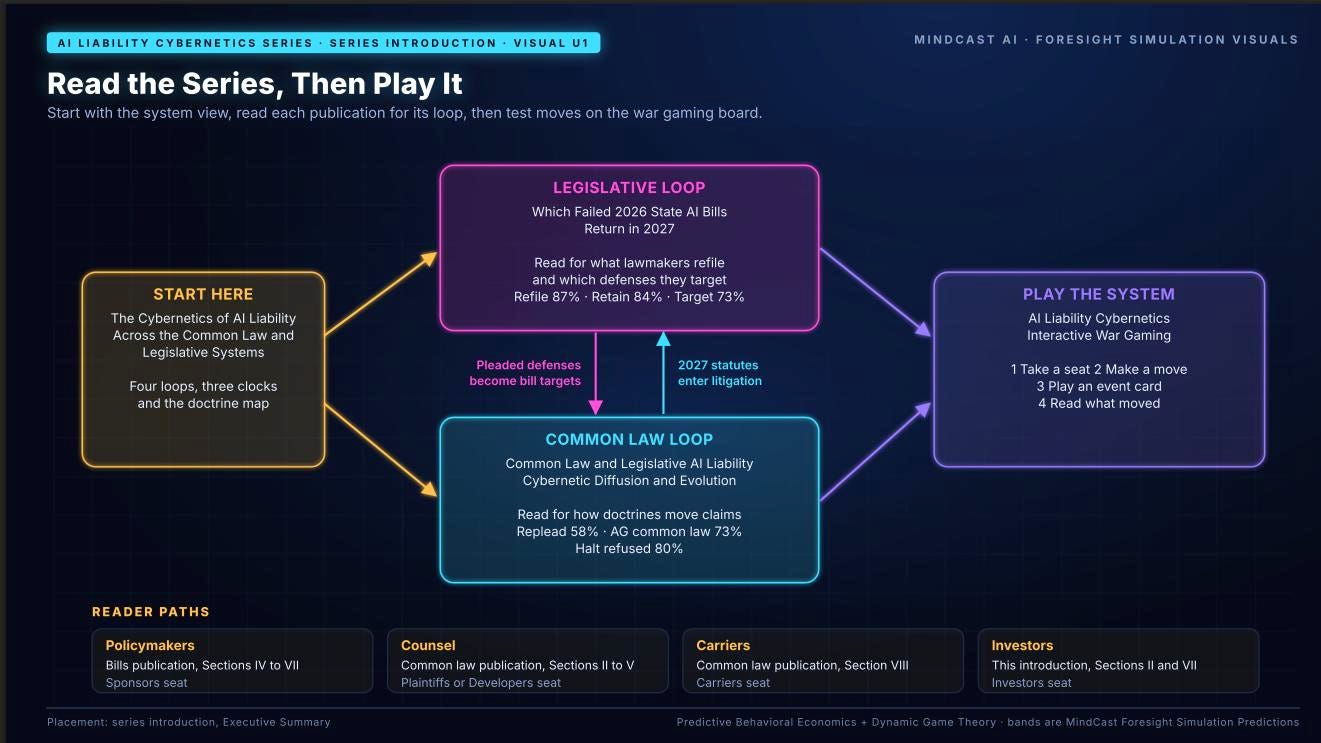
Visual U1, Executive Summary: how to read the series and play the board.
Visuals S and B1, Section I: the full feedback loop and the three clocks.
Visual L2, Section II: how four players answer an adverse ruling.
Visuals L1 and L3, Section III: claim displacement and the underwriting translation.
Walkthrough panels U-G1 to U-G3, Section V: one round on the board in four steps.
Section V board states: U-W2 and B-W1 (preemption), L-W2 and U-W3 (verdicts), L-W1 (restored Section 230 defense) and U-W4 (halt).
More Section V board states: L-W3 (attorney general resolution), B-W3 (autonomy-bar copy) and U-W5 (a combined state).
Visuals B4 and L4, Section VI: the prediction fields for both publications.
Sources
Every forecast, band and event-card effect comes from the two series publications and the war gaming board listed in Appendix A, which carry the full primary and press sources.