Thesis. MindCast proposes that lawsuits against OpenAI and Snap shape which failed 2026 state AI bills return in 2027 and what they say. Chatbot and minor-protection bills are favored to return with their enforcement intact (84%), and returning bills are favored to target defenses the companies plead in court (73%). Whether the litigation caused those choices is the mechanism the 2027 sessions test.
Why now. Most 2027 legislative sessions open in January. Lawmakers, carriers, counsel and investors set positions before the first committee hearing.
Series introduction: The Cybernetics of AI Liability Across the Common Law and Legislative Systems. Companion publication. Common Law AI Liability Cybernetic Diffusion and Evolution predicts how litigants change liability doctrine. Interactive war game. AI Liability Cybernetics Interactive War Gaming, built on both publications.
Related MindCast work.
When AI Agent Liability Meets Common Law and Statute: Predictable Doctrines, Unsettled Allocation
Agentic Foreseeability and the Modern Duty of Care for AI Agents
How Plaintiffs Turn Insurer AI Governance Standards Into Evidence
The Computational Era Operationalizes Cybernetics and Predictive Game Theory
Interactive war gaming. Play the moves these forecasts describe:
Executive Summary
The new wave of artificial intelligence (AI) litigation is the leading candidate to explain which failed 2026 state bills come back in 2027 and what they look like when they return. Ninety-two liability-relevant bill families moved through state legislatures in 2026, and 24 became law. Of the rest, the bills most likely to return first sit closest to the OpenAI and Snap cases, and the strongest returns are favored to carry provisions aimed at the defenses those defendants plead.
The MindCast Foresight Simulation makes the return of the companion-chatbot bills strongly favored (87%) and the retention of their enforcement terms likely (84%). Returning bills are also favored to restrict defenses OpenAI and Snap now plead (73%), while direct tracing of a provision to a lawsuit sits at 39%. The sharper thesis is a divergence between harder consumer-harm bills and softer commercial duty bills; commercial softening sits at 46% and the full divergence at 39%, so the divergence is the hypothesis the 2027 sessions test. The MindCast AI Enforcement and Litigation Tracker supplies the litigation side of the forecast, since it rates every doctrine and defense by court status.
The MindCast distinction is the transmission mechanism. Most legislative trackers count bills by topic, and most litigation trackers count cases. The MindCast State AI Liability and Insurance Legislation Tracker captures every 2026 bill’s death venue and coalition, which is the information needed to predict its return form. Joining the two shows how a ruling or complaint changes expected liability, how legislatures and insurance markets each respond, and where the loss finally lands.
MindCast AI applies Predictive Behavioral Economics + Dynamic Game Theory through MindCast AI Proprietary Cognitive Digital Twin Foresight Simulations (MP CDT FS). Behavioral Economics supplies the decision rules. Game Theory supplies the payoff structure. Predictive simulations emerge from the combination.
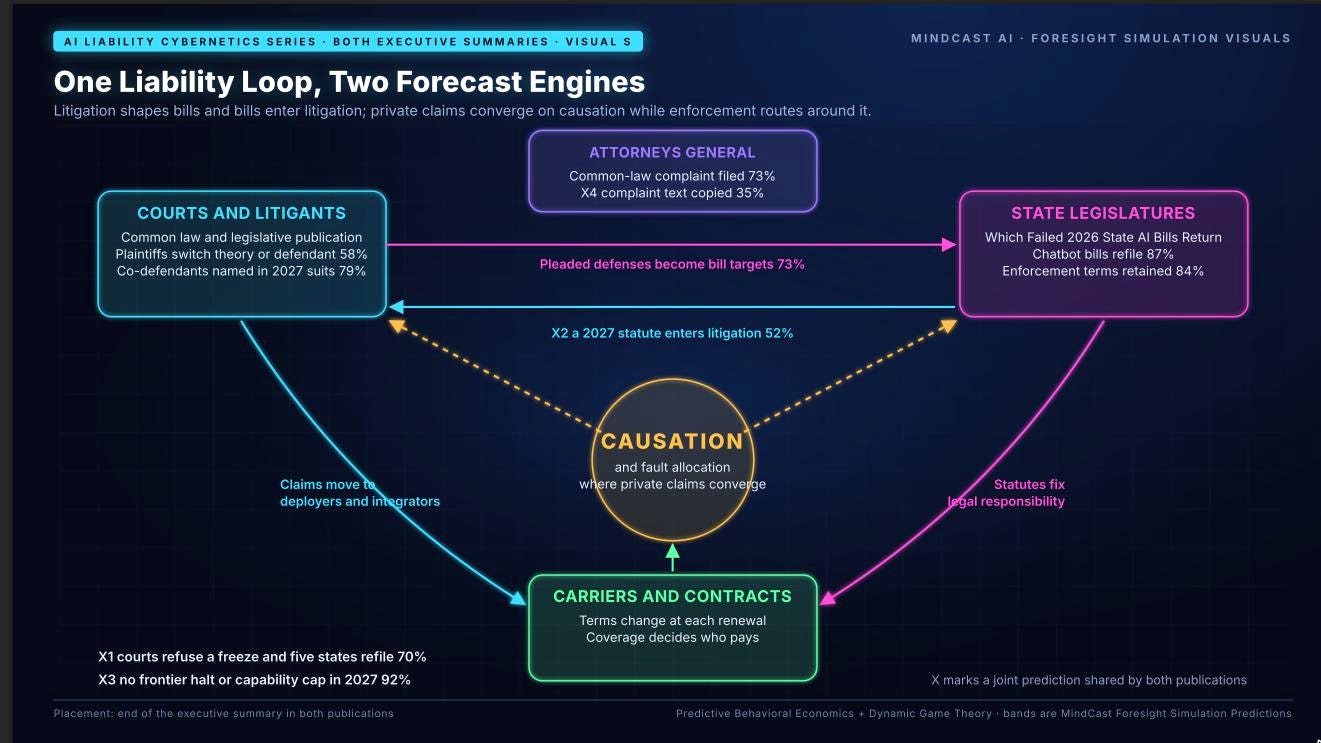
The Computational Era Operationalizes Cybernetics and Predictive Game Theory supplies the series frame. Institutions now behave as tightly coupled feedback systems, and actors change the game while playing it, so trajectories matter more than any single equilibrium. AI liability fits the pattern: a ruling, a bill, a complaint or a policy renewal in one forum becomes an input in the others.
Game theory sets the payoffs for sponsors, attorneys general and opponents in the reintroduction contest, and behavioral economics explains why a wrongful-death filing moves a committee faster than a commercial dispute. The paper draws its examples from many states, Washington and Maryland among them. The framework applies in any state with a failed 2026 bill and an active AI docket.
Five Insights the Forecasts Reveal
2027 is a re-pass year, not an escalation year. Retention of chatbot enforcement (84%) far outruns strict hardening (27%), so lawmakers are favored to re-pass what nearly passed rather than escalate. Headlines expecting a chatbot crackdown overstate the change in text, though not the change in volume (87%).
Lawmakers strip the defenses they can see and leave causation to the courts. Defense-targeting provisions (73%) aim at autonomy and minor-misuse arguments, which a single clause can remove. Causation resists drafting, so litigation effort concentrates on the most expert-intensive question in each case. Carriers should expect defense expense to rise before liability outcomes change.
One filing in one state moves the defense-targeting forecast more than any other event. California’s own provisions carry most of that forecast. A single verified copy of California’s autonomy-defense bar in another state would move it to 90% (82-97%).
Policy wording is likelier than statute to change AI insurance first. Carriers rewrite terms at every renewal, while bills wait for sessions and governors. Renewal cycles make 2027 policy terms, not 2027 enactments, the first place insureds are likely to see the new regime.
The firmest call forecasts what will not happen. No state or court imposes a frontier halt or capability cap in 2027 (92%), and no general duty statute with a private right of action is enacted (70%). AI liability in 2027 travels through ordinary bills, enforcement and pleadings rather than sweeping statutes or court orders.
Sections I through III set out the transmission mechanism and read the OpenAI and Snap litigation and its doctrines. Sections IV through VII state the reintroduction rule, identify the bills most likely to return, map doctrine to provision and trace the insurance consequences. Section VIII explains how the reintroduction game evolved and what would change it. Section IX states 22 MindCast Foresight Simulation Predictions across the short and long horizons plus four shared with the companion paper, and Section X gives six stakeholder strategies.
🏛️ Policymakers: the companion-chatbot bills that died in conference, on appropriations tables or on the calendar in 2026 are the lowest-cost wins of 2027; expect them to arrive with attorney general complaint language attached.
💼 Executives: returning bills will target the defenses your litigation counsel is pleading today, so a defense strategy built on misuse or superseding cause has a shorter shelf life than the case schedule suggests.
⚖️ Counsel: watch the attorney general complaints against OpenAI and Snap as drafting sources; their theories of per-violation penalties and corporate knowledge are the likeliest text in 2027 bills.
📊 Investors: consumer-harm exposure is returning intact while commercial-duty exposure is contested, which separates the companion-chatbot class from enterprise AI deployers in any 2027 underwriting or diligence view.
Takeaway: litigation is the leading candidate to explain which bills return first, and returning bills are favored to carry text aimed at the defenses now pleaded in court.
I. The Transmission Mechanism · How Litigation Becomes Legislation and Coverage Terms
Litigation changes the expected cost of AI liability, and three institutions respond to that change on different clocks. Legislatures respond by reintroducing, hardening or softening bills. Insurance carriers respond by rewriting coverage terms at each renewal. Developers, deployers, service providers and auditors respond by renegotiating contracts and assurance terms.
1. Litigation event. What happens: a complaint is filed, a defense is pleaded or a ruling issues · Observable: docket entries in the OpenAI, Snap, Character.AI and Meta matters
2. Expected liability shifts. What happens: plaintiffs, attorneys general and defendants update the value of claims · Observable: coverage counsel letters, reserve changes, new filings that copy a complaint
3. Public response. What happens: legislators reintroduce, harden or soften a bill · Observable: filed 2027 text compared against the 2026 version
4. Private response. What happens: carriers revise forms; vendors revise indemnities and caps · Observable: policy forms issued; revised published vendor terms
5. Countermoves. What happens: each side reacts to the other’s response · Observable: amendments, exclusion filings, indemnity refusals
6. New allocation. What happens: legal, contractual, insured and final loss settle into a new pattern · Observable: who pays when the next claim resolves
A single AI loss can produce four different outcomes at once, which is why the transmission mechanism matters. Legal responsibility can sit with the deployer while the developer owes reimbursement only up to a fee-based cap. The deployer’s carrier can deny coverage under an AI exclusion. The deployer then bears the uninsured balance.
Legal responsibility. Example outcome on one agent failure: the deployer remains liable to the claimant
Contractual reimbursement. Example outcome: the developer owes indemnity only up to a cap of twelve months of fees
Insurance coverage. Example outcome: the carrier denies indemnity under a generative AI exclusion
Final economic loss. Example outcome: the deployer bears the uninsured balance
A statute alone cannot predict who pays, because insurance and contracts sit between legal responsibility and payment. A statute that fixes legal responsibility on the deployer changes the first variable only. Whether the deployer actually pays depends on what its vendor contract and its policy say.
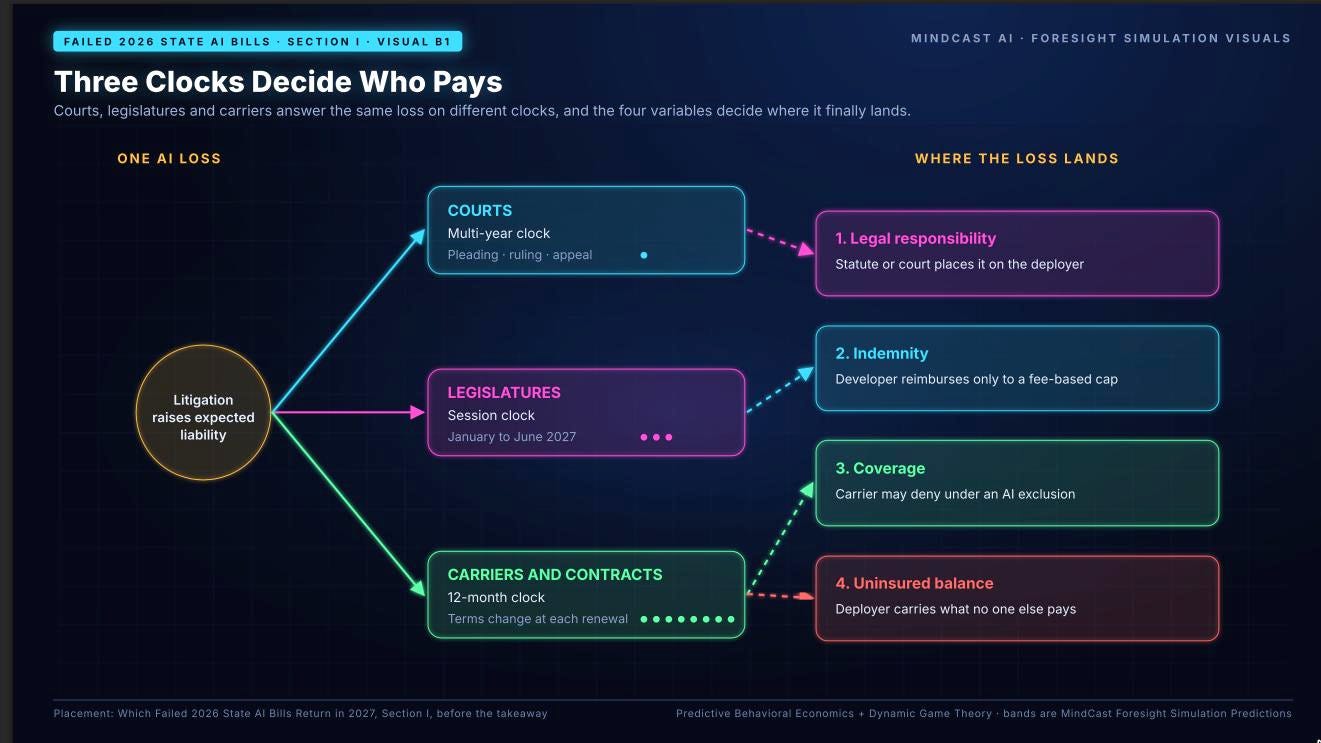
Takeaway: litigation raises expected liability, legislatures and markets respond on different clocks, and the four variables decide who finally pays.
II. The Litigation Wave · OpenAI, Snap and the Cases Around Them
Two defendants anchor the 2026 litigation wave, and they face different tracks. OpenAI defends a private wrongful-death suit and a multistate government campaign at once. Snap faces a mostly government-led docket built on what the company knew before launching its chatbot.
OpenAI: the private track. In Raine v. OpenAI the defense rests on superseding cause, misuse and comparative fault alongside Section 230. The choice concedes the duty question in practice and contests causation and the sharing of fault. Cases fought on those grounds resolve through negotiation or trial rather than dismissal.
OpenAI: the government track. Ten states are suing OpenAI, and New York served a subpoena as part of a 42-state investigation. The Federal Trade Commission served demands on two AI labs on October 14 after confirming a Section 5 probe on September 30. OpenAI removed Florida v. OpenAI to federal court in July 2026, seeking a forum friendlier to Section 230 arguments, but the court remanded the case to Highlands County Circuit Court on September 8.
Snap: the corporate-knowledge track. The tracker flags West Virginia v. Snap as the case to watch for Imputed Knowledge, and the Snap My AI referral to the Department of Justice remains unresolved. Imputed Knowledge asks what employees knew, not what the chatbot did. Nevada v. Snap is set for trial in 2027.
The cases around them. Garcia v. Character Technologies weakened the product-versus-service and First Amendment defenses at the motion-to-dismiss stage before resolving in January 2026. Kentucky v. Character.AI is the first state suit against a chatbot company. New Mexico v. Meta produced a $567 million abatement fund and a $375 million consumer-law verdict, and Texas seeks up to $10,000 per violation in its own action.
Government suits bypass the causation defenses that private plaintiffs must overcome. Consumer-protection statutes impose penalties per violation without proof that any individual was harmed. Exposure therefore scales with users rather than injuries, and superseding cause has nothing to grip.
Game theory explains why private plaintiffs and attorneys general split the work. Private plaintiffs bring severity and must win causation. Attorneys general bring frequency and need not, and each track makes the other’s threat more credible.
Takeaway: OpenAI’s docket shows the causation fight returning bills will target, and Snap’s shows the corporate-knowledge theory returning bills will codify.
III. Doctrines and Defenses on the Table
A defense’s status in one proceeding is not the same as its status in the law. The map below separates four things: the status in the proceeding, the procedural posture, the reach of the authority and the path from ruling to statute.
Products Liability; Product Versus Service. Status: expanding; defense weakened · Posture and reach: Garcia, district court ruling on a motion to dismiss, persuasive only, resolved January 2026 · Path to statute: chatbot-as-product bills in Louisiana; Illinois; Maryland; Kansas; New York
Negligence and Foreseeability. Status: being tested · Posture and reach: Garcia; Cal. Civ. Code §1714.46 (statute, January 2026) · Path to statute: sectoral chatbot duty bills in 15 enacted states and the 2026 near-misses
The AI Did It. Status: defense rejected · Posture and reach: Cal. Civ. Code §1714.46 is the U.S. anchor; Moffatt v. Air Canada is a Canadian tribunal decision and comparative only · Path to statute: autonomy-defense bars modeled on California AB 316
Superseding Cause; Misuse; Comparative Fault. Status: pleaded; unresolved · Posture and reach: Raine v. OpenAI, pending; no ruling yet · Path to statute: causation clauses (California AB 2575, vetoed) and defense-stripping for minor users
Public Nuisance. Status: applied · Posture and reach: New Mexico v. Meta, state trial outcome under existing law; persuasive in other states · Path to statute: abatement-fund bills (Maryland HB 715)
Imputed Knowledge. Status: pleaded by attorneys general; unsettled · Posture and reach: West Virginia v. Snap at the pleading stage; United States v. Bank of New England (1st Cir. 1987) as doctrinal anchor · Path to statute: notice and knowledge provisions in attorney general enforcement bills
Section 230 Immunity. Status: pleaded · Posture and reach: Raine; Florida v. OpenAI (removed, then remanded to state court on September 8, 2026) · Path to statute: design-defect and product framing that routes around the immunity
Unauthorized Access; User-Not-Developer Access. Status: narrowing; defense win · Posture and reach: Amazon v. Perplexity, Ninth Circuit, preliminary-injunction stage, binding in the circuit on the access question only · Path to statute: none expected; agent-transaction allocation moves to contract and consumer law
Voluntary Undertaking. Status: not yet pleaded · Posture and reach: no AI ruling; Restatement (Second) of Torts §§323, 324A · Path to statute: frontier transparency and incident-reporting duties
State of the Art; Sophisticated Intermediary; Subsequent Remedial Measures. Status: untested · Posture and reach: no AI ruling · Path to statute: industry safe harbors (Utah SB 292, California SB 813, Texas HB 149)
Forecasts must track a ruling’s reach, not just its result. A ruling at the pleading stage in one district changes plaintiffs’ expectations but does not bind other courts. A legislature’s incentive to codify depends on whether the ruling helps a constituency it already serves. The forecast in Section V therefore rests on the observable path, not on the ruling alone.
In Amazon v. Perplexity the Ninth Circuit held at the preliminary-injunction stage that the user directing an agent, not the agent maker, accesses the site under the Computer Fraud and Abuse Act (CFAA) and its California analogue. The ruling decides an access-attribution question only. Who bears losses from unauthorized agent transactions remains open between contract, consumer law and tort.
The doctrine map below ranks each doctrine by how directly its litigation is feeding 2027 bill text.
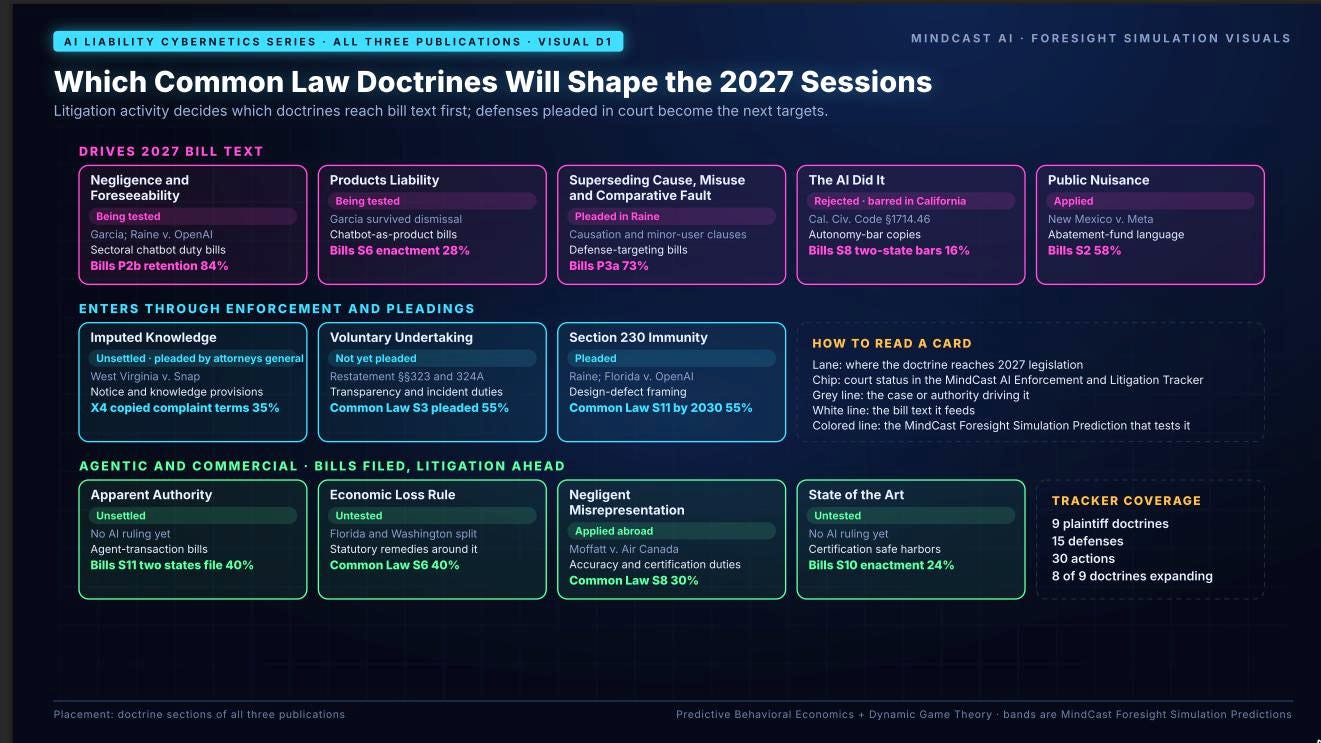
Takeaway: the gateway defenses have weakened at the pleading stage, the causation defenses remain live in Raine, and returning bills will aim at both.
IV. The Reintroduction Rule
Four variables predict different parts of a failed bill’s return, and none predicts all of it. Death venue predicts whether and when a bill returns. The provision its strongest opponent targeted predicts the direction of revision, and litigation salience predicts urgency. Coalition durability predicts whether the returning bill can advance.
Death venue. Predicts: probability and timing of reintroduction · Evidence required: bill history; votes; cutoff dates; sponsor continuity
Opponent’s targeted provision. Predicts: direction of textual revision · Evidence required: committee testimony; amendments; veto messages
Litigation salience. Predicts: relative urgency and political support · Evidence required: dated litigation events; sponsor statements; hearing agendas
Coalition durability. Predicts: whether the bill can advance · Evidence required: leadership; committee composition; organizational support
Death venue. A procedural death after committee or chamber approval signals a coalition that ran out of calendar, so the bill tends to return early. A death in a first or fiscal committee signals opposition, cost or low priority, and the procedural outcome alone cannot say which. Sponsors may also amend a bill that cleared one chamber to win the second, so death venue predicts timing rather than motive.
The subtraction rule. Enacted law in 2026 tended to equal the prior failed bill minus the provision its strongest opponent named. Colorado’s SB 26-189 dropped the reasonable-care duty from SB 24-205, and California’s SB 947 dropped the human-review mandate that drew the 2025 veto of SB 7. The targeted provision predicts which way returning text moves, and the evidence sits in testimony, amendments and veto messages.
Litigation salience and timing. Bills on companion chatbots and minors sit directly under the Raine and Character.AI cases and the Snap track, while general high-risk duty bills do not. A lawsuit filed after a bill died cannot explain the 2026 failure, but it can explain the 2027 return and any change in text. Raine (filed August 2025) predates the 2026 sessions, while several attorney general actions against OpenAI and Snap arrived during or after them.
Coalition durability. A returning bill advances only if its sponsor, its committee chair and its outside supporters return with it. Leadership changes cut both ways: Florida SB 482’s passage turns on the incoming House Speaker. Durability separates bills that merely refile from bills that can pass.
Behavioral economics supplies the decision rules behind the salience channel. Legislators respond to vivid, attributable harm more than to diffuse commercial risk, and a named teenager outweighs a statistical one. Game theory supplies the template channel: attorney general complaints lower drafting costs and political risk, so sponsors borrow their theories. Predictive behavior emerges from the combination, and the combination produces the divergence.
Four Competing Hypotheses and the Causal Test
Four hypotheses compete to explain how failed 2026 bills return. Each carries its own falsifier, and the predictions show which one the bands favor.
Litigation divergence (the thesis). Litigation salience keeps or hardens enforcement in consumer-harm bills while commercial duty bills soften to pass. Falsifier: chatbot families fail to retain enforcement (P2b false), or commercial families hold firm (P2a false).
Procedural persistence. Most bills return essentially unchanged because sponsorship, chamber control and committee calendars outweigh litigation salience. Falsifier: committee materials trace a new defense restriction to the OpenAI or Snap litigation (P3b true). Defense-targeting text alone (P3a) cannot separate the two, because a returning sponsor could keep an existing agenda and add a restriction independently.
Uniform softening. Consumer and commercial bills alike lose enforcement terms to secure passage despite rising litigation pressure. Falsifier: a majority of refiled chatbot families retain or strengthen enforcement (P2b true).
Selective hardening. Only a few highly salient consumer bills strengthen, while others keep their 2026 text or fail again. Falsifier: a majority of refiled chatbot families strengthen (P2b-H true).
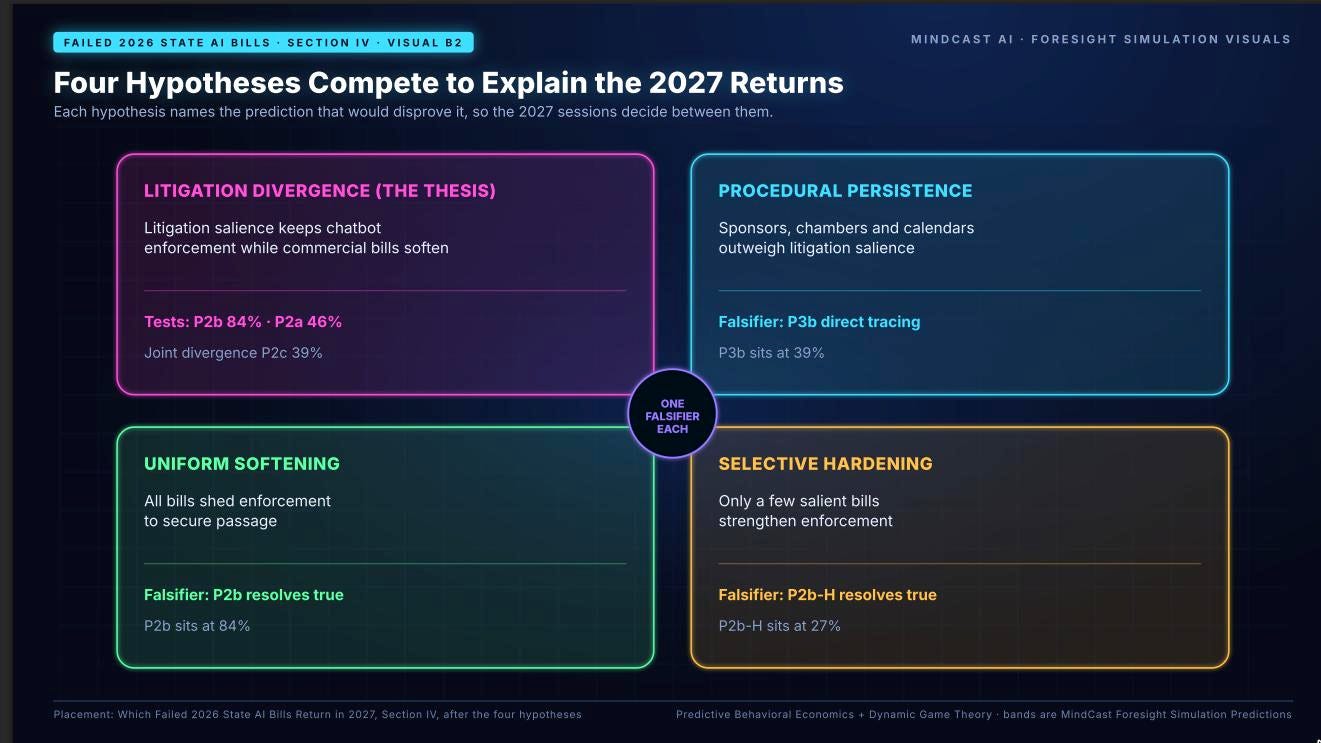
Persistence is the baseline against which litigation earns causal credit. Sponsors refile many bills simply because the session ended. The causal test therefore matches similar failed bills that faced different litigation salience, such as a companion-chatbot bill in a state suing a chatbot company against a comparable bill in a state that is not. Litigation earns credit only where the high-salience bill changes more or moves faster than its match.
Filing and enactment are separate outcomes. A rise in hard-line consumer bill introductions does not show that legislatures will enact stronger provisions. The predictions resolve the two separately.
Whether litigation salience speeds enactment remains a hypothesis with a defined test. Fifteen companion-chatbot statutes passed in 2026, and the matched comparison that would measure each enactment against dated litigation events in its state has not yet run. Until that measurement exists, the paper treats salience timing as a mechanism to test.
Takeaway: death venue predicts timing, the opponent’s provision predicts direction, salience predicts urgency and durability predicts passage; litigation earns causal credit only against the persistence baseline.
V. The Failed 2026 Bills Most Likely to Return
The 2026 census on the legislation tracker’s 2026 Legislation tab rates each failed bill’s reintroduction likelihood. The lists below group the strongest candidates by family and name the litigation driver behind each. Census tiers are classifications from the census, not simulation bands, and the rule that assigns them follows the lists.
Companion Chatbots and Minors · The Salience Channel
Maine LD 2162. 2026 death venue: both chambers adopted the committee amendment; died on the appropriations table · Litigation driver: Raine; Character.AI suits · Expected 2027 form: committee amendment text with attorney general penalties and suits by minors · Census tier: High
Hawaii HB 1782 / SB 2788. Death venue: passed both chambers; died in conference · Driver: Raine; Character.AI suits · Expected 2027 form: conference draft with per-day civil penalties · Tier: High
Oklahoma SB 1521. Death venue: passed both chambers in different versions; differences never resolved · Driver: OpenAI attorney general suits · Expected 2027 form: second-chamber text with attorney general enforcement · Tier: High
South Carolina S 896. Death venue: reported from committee; died on the calendar · Driver: Snap attorney general track; Kentucky v. Character.AI · Expected 2027 form: amended S 896 with attorney general penalties up to $50,000 · Tier: High
Kentucky HB 455. Death venue: passed the House 88-7; died in a Senate committee · Driver: Character.AI suits; Kentucky v. Character.AI · Expected 2027 form: same AI therapy text in a 30-day session · Tier: High
Missouri HB 2032 and SB 1444. Death venue: reported from committee; died on the calendar · Driver: Raine; Character.AI suits · Expected 2027 form: mental-health AI bill leads; age verification follows · Tier: High
Florida SB 482. Death venue: passed the Senate twice; refused by House leadership · Driver: OpenAI attorney general suits; Florida v. OpenAI · Expected 2027 form: same text; passage turns on the incoming Speaker · Tier: High
Illinois SB 3384 and companions. Death venue: re-referred to Assignments · Driver: Raine; Character.AI suits · Expected 2027 form: one consolidated companion-chatbot bill · Tier: Moderate
Louisiana HB 791. Death venue: never heard · Driver: Garcia · Expected 2027 form: chatbot-as-product clause with attorney general and user suits · Tier: Moderate
Kansas HB 2772 and SB 405. Death venue: died in committee · Driver: Raine · Expected 2027 form: provider liability for chatbot-caused injury; suicide-encouragement liability · Tier: Moderate
Wisconsin AB 965. Death venue: failed at the end of the floor period · Driver: Character.AI suits · Expected 2027 form: child-relationship ban with suits by harmed children · Tier: Moderate
Michigan SB 760 (passed the Senate 20-17) and Pennsylvania HB 2006 (passed the House 133-70) remain live in their 2026 sessions. New Jersey’s A 4732 and A 2710 remain live through January 2028. Each becomes a 2027 refiling only if its session ends without action.
Attorney General Enforcement · The Template Channel
Pennsylvania SB 1090. Death venue: passed the Senate 49-1; live through November 30 · Driver: OpenAI attorney general suits · Expected 2027 form: attorney general duties on AI; refiled if the House does not act · Tier: High
Missouri SB 1324. Death venue: reported from committee; died on the calendar · Driver: Snap attorney general track · Expected 2027 form: AI transparency with attorney general civil penalties · Tier: Moderate
Illinois SB 2995 / HB 3021. Death venue: re-referred to Assignments and Rules · Driver: OpenAI attorney general suits · Expected 2027 form: Consumer Fraud Act amendments naming AI · Tier: Moderate
Maryland HB 715 / SB 602. Death venue: died in House Appropriations · Driver: New Mexico v. Meta · Expected 2027 form: Algorithmic Addiction Fund modeled on abatement · Tier: Moderate
Arizona HB 4098. Death venue: never heard · Driver: OpenAI attorney general suits · Expected 2027 form: attorney general civil penalties with risk assessments · Tier: Low
Liability and Causation · The Defense Channel
California AB 2575. Death venue: vetoed September 30, 2026 · Driver: Raine causation defenses · Expected 2027 form: causation clause revised to answer the veto message · Tier: High
New York S 7263 / A 6545-C. Death venue: Assembly third reading with no vote · Driver: Raine; Character.AI suits · Expected 2027 form: liability for chatbots impersonating licensed professionals · Tier: High
Maryland HB 1250 / SB 827 and HB 712. Death venue: died in committee · Driver: Garcia · Expected 2027 form: chatbot product liability with attorney general enforcement · Tier: Moderate
Minnesota HF 4544 / SF 4636. Death venue: died at sine die · Driver: Raine causation defenses · Expected 2027 form: liability presumption · Tier: Moderate
Illinois SB 3590 family. Death venue: re-referred to Assignments · Driver: Garcia · Expected 2027 form: AI product liability act · Tier: Moderate
Missouri HB 1746 / HB 1769. Death venue: reported from committee; died on the calendar · Driver: defense-side response to the wave · Expected 2027 form: deployer-first allocation with a developer defect carve-out · Tier: High
General High-Risk Duties · The Subtraction Channel
Maryland HB 952. Death venue: passed the House 123-4; died in Senate Finance · Driver: none direct · Expected 2027 form: same text; Senate Finance decides · Tier: High
New York S 1169-B / A 8884. Death venue: passed the Senate twice; died in the Assembly · Driver: none direct · Expected 2027 form: audit cost and private action negotiated toward attorney-general-only · Tier: High
Washington HB 2157 / SB 6120. Death venue: House Rules · Driver: none direct · Expected 2027 form: successor with attorney-general-only or cure-gated enforcement and a Title 48 insurance exemption · Tier: High
Washington SB 6284 / HB 2667. Death venue: Senate Ways and Means · Driver: none direct · Expected 2027 form: Senate companion to the House successor · Tier: High
California AB 1018. Death venue: died on the Senate floor at the deadline · Driver: none direct · Expected 2027 form: two-year bill with an employment carve-out after SB 947 · Tier: High
California SB 1106. Death venue: held at Appropriations suspense · Driver: agentic-AI exposure · Expected 2027 form: first agentic-AI duty bill, refiled · Tier: Moderate
Virginia HB 999 and HB 1514. Death venue: tabled in House Appropriations · Driver: none direct · Expected 2027 form: scaled-back successor in a 30-day session · Tier: Moderate
Connecticut SB 435. Death venue: tabled on the Senate calendar · Driver: none direct · Expected 2027 form: employment ADS successor in the long session · Tier: Moderate
Consumer-harm and commercial-duty bills already diverge in the lists. Consumer-harm bills sit under named litigation drivers, and most carry high tiers with procedural rather than political deaths. Commercial-duty bills carry no direct litigation driver, and their expected return forms shed enforcement terms.
How Census Tiers Are Assigned
A repeatable rule assigns each tier. High means the bill cleared at least one committee before a procedural death. Procedural deaths include a floor calendar or appropriations table, a conference committee and the second chamber; session deadlines and vetoes count too. Moderate means the bill died in a first or fiscal committee, was re-referred, or was never heard while carrying a named litigation driver.
Low means the bill was never heard and carries no named driver. Companion families take the tier of their most advanced member. A bill family groups companions and successors under one entry, and the 92-family count is checked against companion treatment and unresolved 2026 sessions.
The tier rule reproduces the census tier for all but five families. It would raise Wisconsin AB 965, Missouri SB 1324 and Connecticut SB 435 to High and Arizona HB 4098 to Moderate. It would lower Washington SB 6284 / HB 2667 to Moderate unless HB 2667 advanced further than the census shows.
Five Legislative Cohorts
The families fall into five cohorts, and each cohort faces a different strategic contest. A single generic legislature would flatten the institutional differences that make the forecast predictive. The forecasts therefore rest on representative jurisdictions from each cohort, combined under fixed counting rules.
Near-passage consumer bills. Primary strategic contest: preserving coalitions and clearing the final procedural obstacle · Representative jurisdictions: Maine; Hawaii; Oklahoma
Committee or calendar consumer bills. Contest: establishing salience and agenda priority · Jurisdictions: Missouri; Illinois; Kansas
Attorney general enforcement bills. Contest: setting remedies, enforcement authority and coalition support · Jurisdictions: Pennsylvania; Maryland
Liability and causation bills. Contest: overcoming doctrinal, industry and gubernatorial objections · Jurisdictions: California; New York; Minnesota
General commercial-duty bills. Contest: negotiating scope, compliance costs and private enforcement · Jurisdictions: Washington; Maryland; New York
Appendix C converts the representative families into a bill-family transition table. Each row pairs the 2026 outcome with its decisive opposition, its litigation trigger and the expected 2027 strategy and counterstrategy.
Measuring Hardening and Softening
Every refiled bill is classified provision by provision against its comparable 2026 version. Five dimensions carry the classification, and each is reported separately. A bill can strengthen penalties while narrowing scope, so mixed outcomes stay mixed rather than netting into a composite.
Enforcement. Hardening: expanded private or attorney general enforcement · Softening: narrower enforcement authority
Remedies. Hardening: greater recoverable damages or penalties · Softening: reduced remedies or caps
Duties. Hardening: broader covered conduct or stricter requirements · Softening: narrower scope or added exemptions
Defenses. Hardening: removal or limitation of defenses · Softening: new safe harbors or affirmative defenses
Compliance. Hardening: shorter cure periods or stronger audit duties · Softening: longer cure periods or delayed effective dates
Two denominators answer different questions. The share of refiled bills that soften measures how returning bills change. The share of all original candidate families that return softened measures how the whole 2026 class fares, and Section IX reports both.
Takeaway: the companion-chatbot near-misses are favored to return first with enforcement intact (strict hardening sits at 27%), the commercial-duty bills return slower with softening near a coin flip, and the liability bills are favored to target the defenses OpenAI is pleading.
VI. From Doctrine to Provision
Each doctrine induces a specific provision type, and the induced provisions are now visible in the returning bills. The map below pairs each doctrine with its provision, its 2026 precedent and its 2027 candidate states. The same mapping lives on the legislation tracker’s Model Agentic Liability Code tab.
The AI Did It. Provision it induces: statutory bar on the autonomy defense · 2026 precedent: California AB 316 (2025); Connecticut SB 5; Tennessee SB 837 · 2027 candidate states: Missouri; Hawaii; Wisconsin; Ohio; New York
Product Versus Service; Products Liability. Provision: chatbot designated a product for liability purposes · Precedent: Louisiana HB 791; Illinois SB 3590; Maryland HB 1250; Kansas HB 2772; New York A 8833 · Candidates: Illinois; Maryland; New York; Louisiana; New Jersey
Superseding Cause; Misuse; Comparative Fault. Provision: causation codification; defense-stripping where a minor is the user · Precedent: California AB 2575 (vetoed); Minnesota HF 4544 · Candidates: California; Minnesota; New York; Washington
Imputed Knowledge. Provision: notice and knowledge provisions in enforcement bills · Precedent: none enacted · Candidates: states with attorney general actions against Snap or Character.AI
Public Nuisance. Provision: attorney general abatement funds · Precedent: Maryland HB 715 · Candidates: Maryland; Pennsylvania; Oklahoma; Kentucky
Apparent Authority. Provision: liability allocation for agent-initiated transactions · Precedent: none filed · Candidates: Washington; California; New York; Illinois
Negligence and Foreseeability. Provision: sectoral chatbot duty · Precedent: 15 enacted statutes · Candidates: Maine; Hawaii; Oklahoma; South Carolina; Kentucky; Missouri
Voluntary Undertaking. Provision: frontier transparency and incident reporting · Precedent: New York RAISE amendment; Illinois SB 315; Tennessee HB 1898 · Candidates: Tennessee; Nebraska; Louisiana; Michigan
State of the Art and related defenses. Provision: certification safe harbors, damage caps, compliance defenses · Precedent: Utah SB 292; California SB 813; Texas HB 149 · Candidates: Texas; Florida; Utah; Tennessee; Arizona
Two provision types have no 2026 precedent and track the litigation wave closely. Defense-stripping for minor users answers the Raine posture: once a defendant argues a teenager misused the product, sponsors remove the argument for that class of user. Notice and knowledge provisions answer the Snap track by writing an imputed-knowledge standard into the enforcement statute itself.
Three Levels of Transmission
Similarity between a complaint and a bill does not prove the complaint caused the provision. Each litigation-signature provision is classified at one of three levels.
Direct transmission. Sponsor testimony, bill findings, drafting materials or committee discussion names the litigation or its specific theory.
Supported inference. The provision follows the case in time and is distinctive to the dispute, and the relevant lawmakers demonstrably respond to it.
Parallel development. The provision resembles a litigation argument but has an independent policy history.
Outcome and mechanism resolve separately. A forecast could name the statutory language correctly while misidentifying the mechanism that produced it. P3 therefore splits into an outcome test and a transmission test.
Takeaway: every live doctrine already has a provision waiting for it, and the two provisions with no precedent are the clearest signatures of the OpenAI and Snap cases, once their transmission is shown.
VII. Where the Loss Lands · Insurance, Contracts and the Race to Set Terms
Insurance responds to returning bills and then reshapes them. Litigation changes the anticipated liability regime, and carriers and contracting parties adapt faster than legislatures. Their adaptations then shape legislative bargaining and the final distribution of loss. Courts, legislatures and private parties form three regimes that compete to allocate AI liability.
The five links. AI loss travels through five links, and the four variables from Section I can come apart at each one.
Developer to deployer. Mechanism to test: indemnification, limitation of liability and allocation of control · What can break the chain: fee-based liability caps; developer retains control of the model
Deployer to service provider or integrator. Mechanism: implementation fault, delegated control and indemnification · Break: customer-directed configuration; narrow statements of work
Service provider to auditor. Mechanism: reliance on assurance, contractual scope and negligent services · Break: limited-assurance engagement terms; independence limits
Insured to carrier. Mechanism: insuring agreement, exclusions, defense obligations and allocation · Break: generative AI exclusions in general liability forms; allocation across concurrent causes
Carrier to reinsurer. Mechanism: aggregation, treaty terms and ceded exposure · Break: correlated-loss and event-definition clauses
An exclusion does not move a legal obligation onto another defendant. It changes which defendant a plaintiff’s lawyer pursues, because counsel follows collectible coverage. An indemnity reimburses, but the indemnified party remains liable to the injured person if the indemnitor cannot pay.
Loss types. Each category of AI loss reaches different defendants and meets different coverage barriers.
Bodily injury (companion chatbot self-harm). Likely defendants: operator; model developer · Coverage forms in play: general liability, products and technology errors and omissions · Limits that bite: generative AI exclusions; expected-or-intended injury
Pure economic loss (agent transaction error). Defendants: deployer; integrator; financial institution · Forms: technology errors and omissions, cyber and crime · Limits: economic loss rule; fee caps; contractual-liability exclusions
Consumer-protection penalties (attorney general suits). Defendants: operator; developer · Forms: directors and officers; errors and omissions · Limits: fines-and-penalties exclusions; definition of damages; state limits on insuring penalties
Defense costs. Defendants: all named defendants · Forms: general liability; errors and omissions; directors and officers · Limits: depends on policy wording and the governing state’s coverage law
Professional negligence (integrators and auditors). Defendants: consultants; auditors; managed-service operators · Forms: professional liability · Limits: assumed-duty and contractual-liability exclusions
Defense obligations depend on policy wording and the governing coverage law. In many states a duty to defend attaches when any claim is potentially covered, but the rule varies. Imputed Knowledge can reach general liability, errors and omissions and directors and officers lines; it raises directors and officers and securities-disclosure exposure most directly.
Attorney general money may sit outside coverage. Abatement funds and per-violation penalties often fall outside what a liability policy treats as damages because of bodily injury or property damage. Insurers prevailed on that question in many of the opioid public-nuisance coverage cases. Expect the same contest over AI abatement awards.
Defining the first move. Statutes already moved first on companion-chatbot duties. California and New York led, and more than a dozen other states enacted binding obligations in 2025 and 2026.
The open contest. Which event will first materially change the insurance treatment of third-party AI liability in each state? Comprehensive cross-sector statutory liability is a separate question.
A change counts as material only when it binds conduct. Qualifying events are a statute in effect, an insurance regulator’s order or rule, or an AI-specific term in policies actually issued. Advisory guidance, filed forms and introduced bills are leading indicators only.
Washington prefers its insurance regulator. Washington’s 2026 substitute HB 2157 proposed to exempt insurers regulated under the state’s insurance code and to preserve the Insurance Commissioner’s exclusive oversight of the business of insurance. The bill never became law, but the carve-out shows a legislature preferring to leave insurance governance with its regulator. Utah SB 292, California SB 813 and Texas HB 149 show the opposite move, writing defense-side terms directly into statute.
Second-order interactions. Five interactions can produce new equilibria.
Carrier competition. One carrier excludes AI losses while a competitor offers affirmative cover, which caps how far exclusions can spread before buyers switch.
Legislative substitution. Lawmakers decline new duties but expand consumer-protection remedies, moving the fight from duty to enforcement.
Regulatory response. Exclusions threaten availability or create inconsistent disclosures, and regulators respond with disclosure rules rather than restrictions.
Auditor coordination. Insurers require incompatible certification standards, and auditors narrow scope until no certification protects anyone.
Developer resistance. Upstream vendors refuse the indemnities enterprise customers demand, pushing deployers toward carriers or legislatures for relief.
Game theory explains why carriers can move first: they rewrite terms at each renewal, while a bill must clear two chambers. Behavioral economics explains why insurance regulators tend toward disclosure rather than restriction. Regulators weigh the visible cost of lost availability more heavily than diffuse uncovered losses.
Link to the reintroduction forecasts. Each insurance consequence traces to a returning bill. Chatbot-as-product and autonomy-bar statutes (S6 and S8) move liability onto insured deployers, which tests whether carriers answer with exclusions or affirmative cover (S9). Attorney-general-only enforcement in softened commercial bills (P2a) shifts exposure toward penalties that policies often exclude.
Takeaway: returning bills fix legal responsibility, but carriers and contracts decide who pays, and their responses feed back into the next round of bargaining.
VIII. How the Reintroduction Game Evolved and Why Its Rules Hold Through 2027
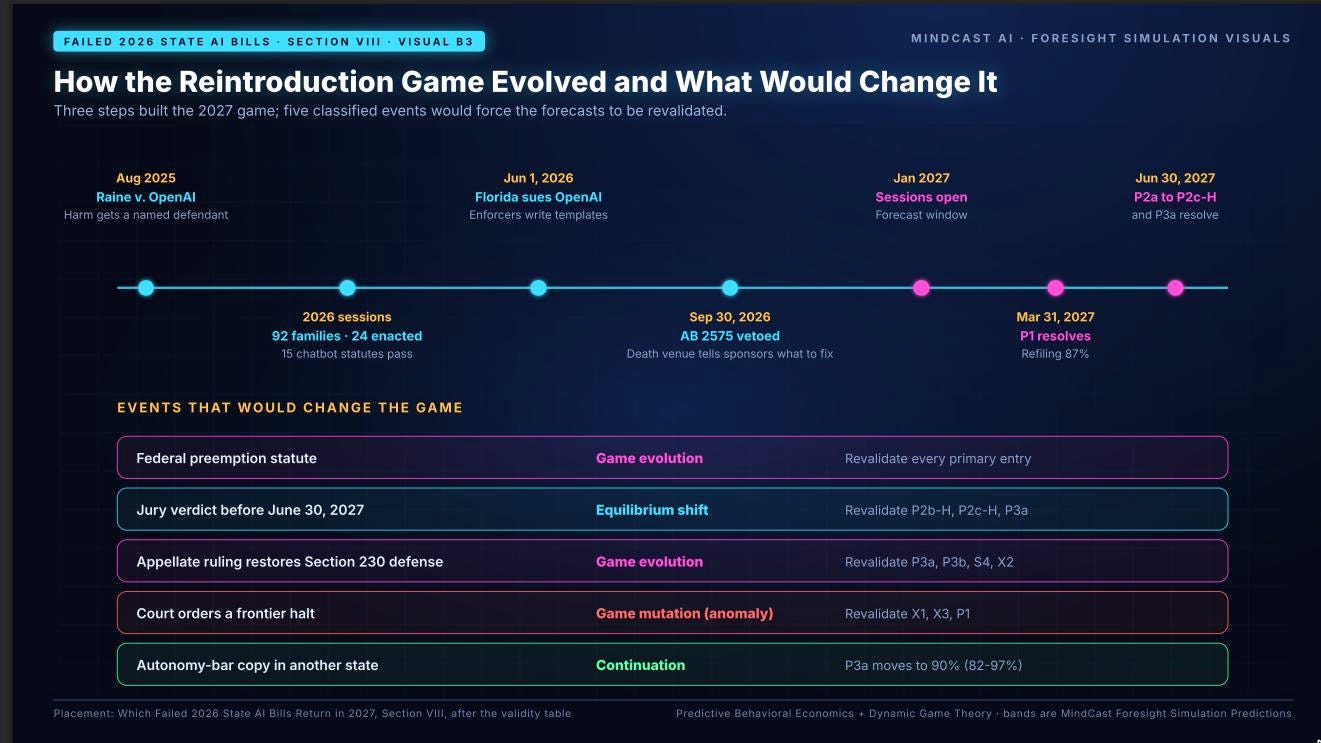
The 2027 reintroduction forecasts hold only while the rules set in 2025 and 2026 hold. The game took its current form in three steps between August 2025 and November 2026. Session calendars and returning coalitions fix its remaining rules through June 2027, and the list at the end names the events that would change the game.
Harm became attributable. Raine v. OpenAI in August 2025 and the Character.AI suits turned chatbot harm from a diffuse risk into named injuries with named defendants. Sponsors gained a salience channel they lacked when most 2026 bills were drafted. Opponents lost the argument that the harms were speculative.
The 2026 sessions sorted the bills. Ninety-two liability-relevant families moved, 24 became law and 15 companion-chatbot statutes passed. The rest died in identifiable venues: appropriations tables, conference committees, floor calendars and one veto. Governor Newsom’s September 30 veto of California AB 2575 is the clearest case, and each death venue now tells a sponsor what to fix.
Enforcers wrote the templates. Attorney general suits against OpenAI and Snap during 2026, including Florida’s June 1 complaint, gave drafters tested theories of per-violation penalties and corporate knowledge. California’s autonomy-defense bar showed that a legislature can strike one litigated defense while preserving the rest. The game entering 2027 therefore has known players, known death venues and borrowed text.
Why the rules hold. Session calendars and bill-introduction deadlines are set, and most 2026 sponsors and committee chairs return. Congress has not enacted a statute preempting state AI liability bills. The forecasts assume that no tracked chatbot case reaches a jury verdict before June 30, 2027, which keeps the litigation signal at the level of pleadings and threshold rulings.
Commitments that hold through the window. Sponsors of the 2026 near-misses have staked public positions on their bills, and attorneys general have filed complaints they cannot quietly withdraw. OpenAI and Snap have pleaded their defenses on public dockets, which shows drafters exactly what a clause can target. Governors’ 2026 veto messages tell sponsors which objections a successor bill must answer.
Congress enacts a statute preempting state AI liability bills. Type of change: game evolution · What it changes: removes state legislatures as the forum for most returning duties · Predictions to revalidate: every primary entry; S1 to S4; X2 and X4
A jury verdict in a chatbot death case before June 30, 2027. Type: equilibrium shift · Changes: raises salience beyond the pleading-stage signal the forecasts assume · Revalidate: P2b-H and P2c-H; P3a
An appellate court holds that Section 230 or the First Amendment bars chatbot design claims. Type: game evolution · Changes: restores a threshold defense and moves sponsors from defense-stripping toward new causes of action · Revalidate: P3a and P3b; S4; X2
A court orders a frontier development halt. Type: game mutation (anomaly) · Changes: gives every actor a remedy that courts have so far refused · Revalidate: X1 and X3; P1
California’s autonomy-defense bar is enacted in another state. Type: continuation · Changes: updates odds within the current game · Revalidate: P3a moves to 90% (82-97%); S8 can resolve
The list classifies each event. Continuation updates odds inside the current game, and an equilibrium shift changes which outcome persists without replacing the game. Game evolution changes the rules, forums or participants, and every forecast it touches needs revalidation. A court-ordered halt is the one anomaly in the set: a game mutation that changes every actor’s options at once.
The AI Liability Cybernetics Interactive War Gaming board plays every event in the list above. Three board states follow, each showing the forecasts that move and the seat that gains or loses. Event values cover the core forecasts; weaker-evidence and long-horizon entries keep their baseline bands on the board and need revalidation when an event occurs.
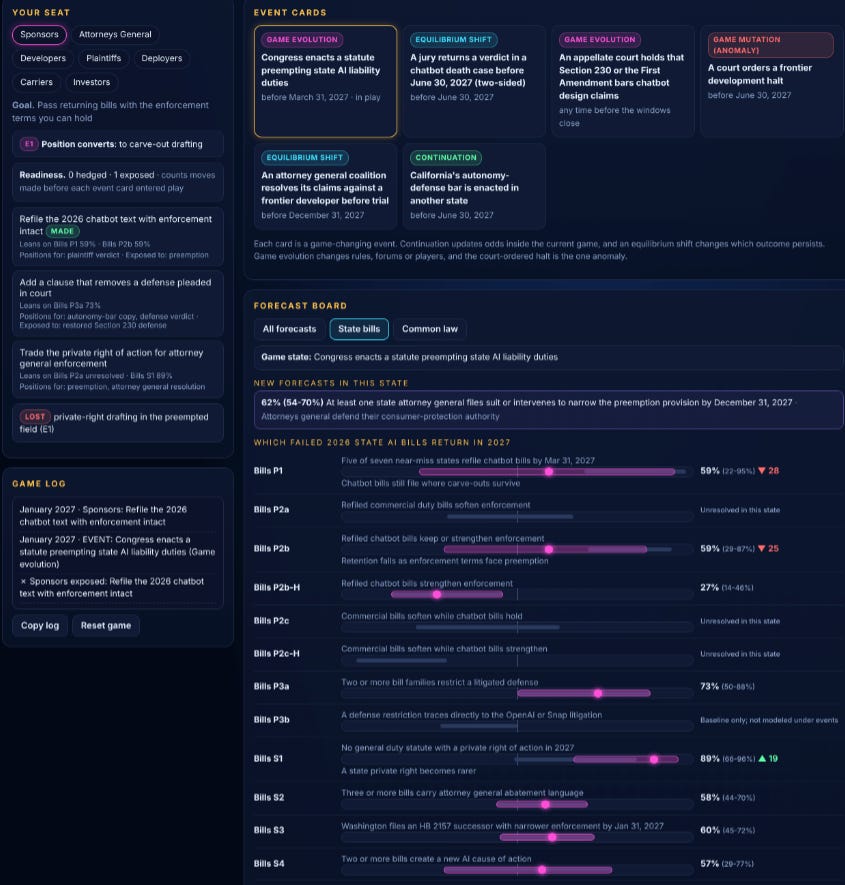
Preemption card in play with the Sponsors seat. Bills P1 falls to 59%, Bills P2a, P2c and P2c-H turn unresolved and the sponsor’s refile-intact move shows as exposed. Source: AI Liability Cybernetics Interactive War Gaming.
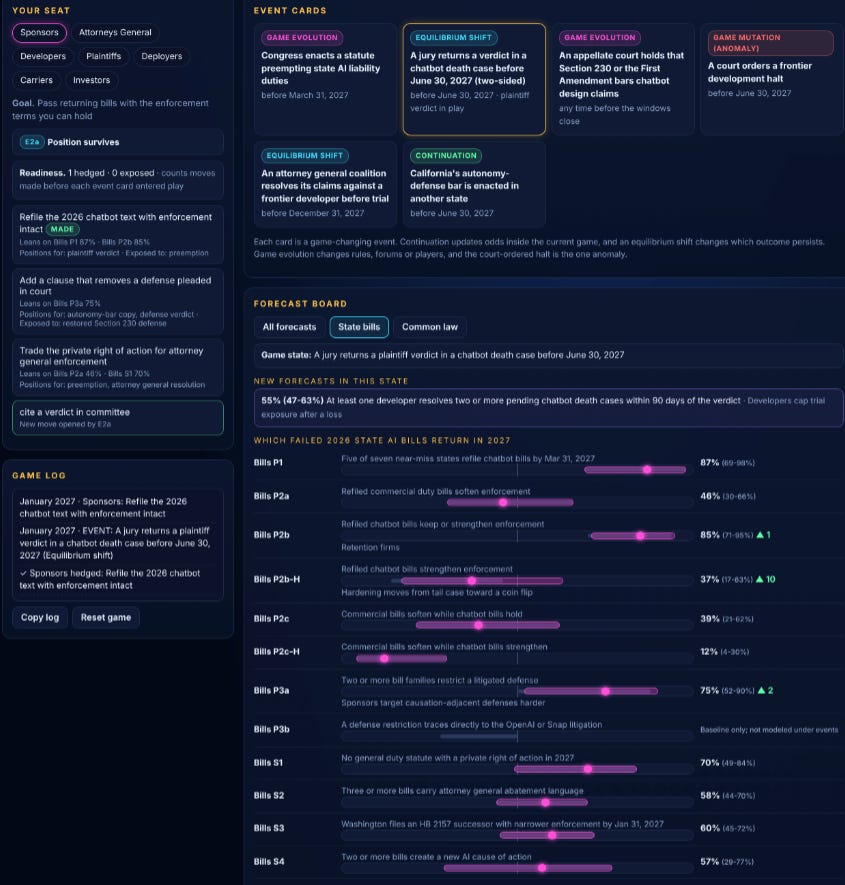
Plaintiff verdict card in play. Hardening (Bills P2b-H) rises to 37% and stays below even, while the sponsor’s refile move shows as hedged. Source: AI Liability Cybernetics Interactive War Gaming.
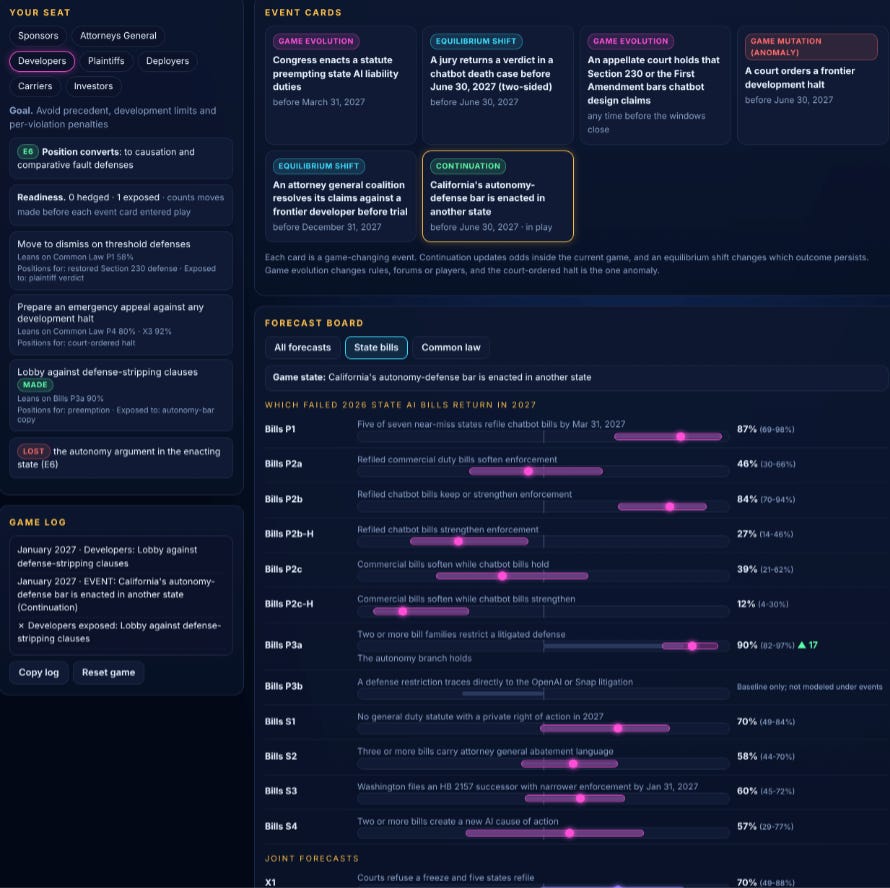
Autonomy-bar copy card in play with the Developers seat. Bills P3a rises to 90% (82-97%), developers lose the autonomy argument in the enacting state and their lobbying move shows as exposed. Source: AI Liability Cybernetics Interactive War Gaming.
Takeaway: the forecasts hold while legislatures remain the forum, litigation stays at the pleading stage and no court orders a halt; any of those changes requires revalidation rather than adjustment.
IX. MindCast Foresight Simulation Predictions
The MindCast AI Proprietary Cognitive Digital Twin Foresight Simulation states 22 MindCast Foresight Simulation Predictions with probability bands for this paper. Eleven are core forecasts and two run on the long horizon through 2030. Nine rest on thinner evidence: primary P3b and secondary S5 to S12. Four joint predictions shared with the companion paper and one carried from it add five more.
P marks a Primary Simulation Prediction, S a Secondary Simulation Prediction and X a joint prediction that resolves the same way in both papers.
The forecasts open a new series on this question, so no earlier MindCast results exist to report beside them.
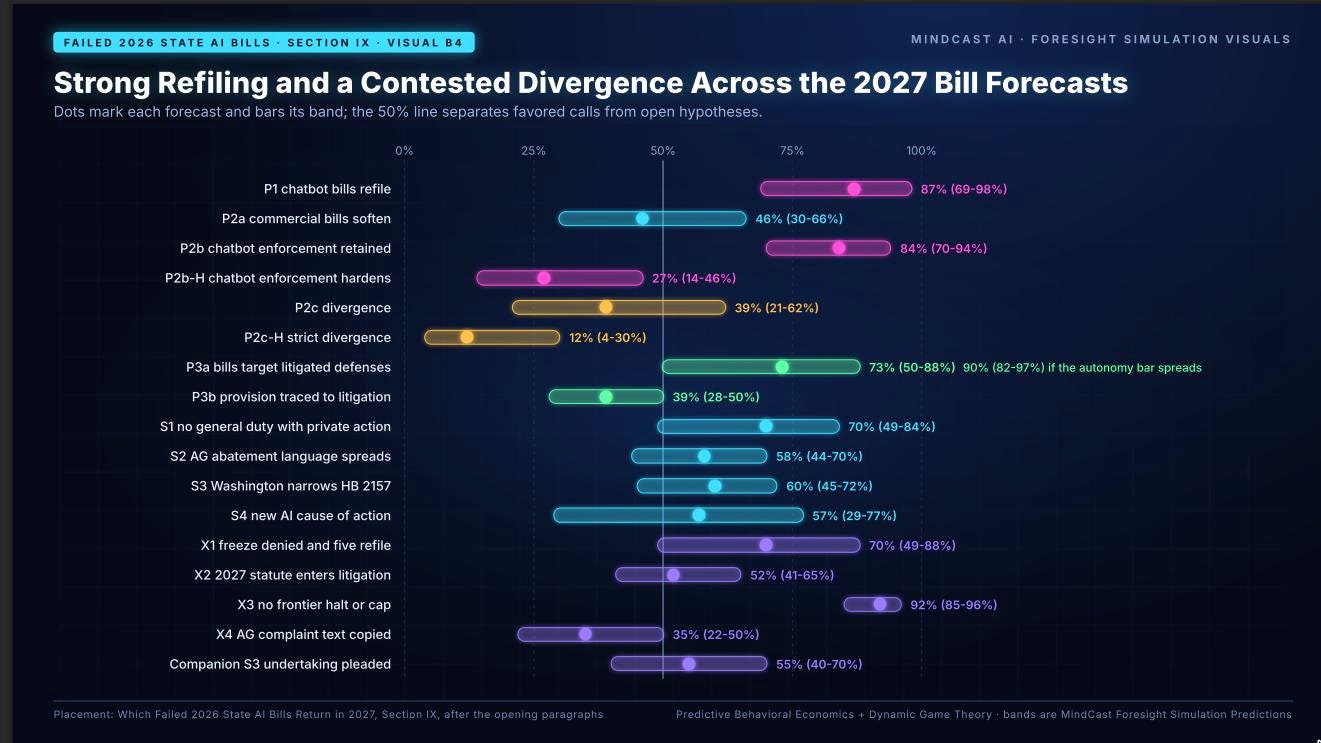
Refiling and retention are the strong calls. Strict hardening, commercial softening and the divergence as one event all sit below even, so the divergence remains the hypothesis the 2027 sessions test. Defense-targeting text is the call most consistent with a litigation effect (73%), while direct tracing to the lawsuits sits at 39% (P3b).
Primary · Seven Near-Miss States Refile Their Chatbot Bills
P1: At least five of the seven companion-chatbot near-miss states file a chatbot or minor-protection bill by March 31, 2027 (87%; 69-98%). The seven are Maine, Hawaii and Oklahoma with South Carolina and Kentucky plus Missouri and Florida. One bill family counts per state. Falsifier: four or fewer such filings.
Primary · Chatbot Bills Keep Their Enforcement While Commercial Bills Split
A family counts as refiled when a 2027 bill carries its sponsor or its core duty, compared in its first 2027 text against the 2026 version. Each entry below needs at least three refiled families to resolve, and a tie counts as not qualifying. The commercial set spans Washington, Maryland and New York plus California, Virginia and Connecticut.
P2a: A majority of refiled general high-risk duty families soften enforcement or remedies by June 30, 2027 (46%; 30-66%). Washington and Virginia lean toward softening, while New York and California are likely to hold their private actions. Falsifier: half or fewer soften.
P2b: A majority of refiled companion-chatbot families retain or strengthen enforcement and remedies by June 30, 2027 (84%; 70-94%). The families come from the salience list in Section V, and mixed-direction texts do not qualify. Falsifier: half or fewer qualify.
P2b-H: A majority of the same chatbot families strengthen enforcement or remedies by June 30, 2027 (27%; 14-46%). Unchanged text does not count, and neither dimension may soften. Falsifier: half or fewer strengthen.
P2c: Commercial families soften while chatbot families retain or strengthen, with P2a and P2b both true (39%; 21-62%). Falsifier: either half fails, and the failing half is reported by name.
P2c-H: Commercial families soften while chatbot families strengthen, with P2a and P2b-H both true (12%; 4-30%). Falsifier: either half fails.
Primary · Returning Bills Target the Defenses OpenAI and Snap Plead
P3a: At least two separate 2027 bill families filed by June 30, 2027 restrict a defense pleaded in AI-harm litigation (73%; 50-88%). Qualifying defenses are the autonomy defense and the human-override superseding-cause defense, plus comparative fault and minor-user misuse. New duties, offenses and causes of action do not qualify. Falsifier: fewer than two qualifying families.
California’s AB 2575 successor and minor defense-stripping clauses carry most of the forecast on their own. The remainder depends on whether California’s autonomy-defense bar spreads to other states, which no filing has yet confirmed.
P3b: At least one P3a provision traces directly to the OpenAI or Snap litigation in sponsor testimony, findings or committee materials (39%; 28-50%). The band rests on whether sponsors cite the litigation publicly. Falsifier: every qualifying provision rests on supported inference or parallel development.
Secondary · Commercial Duties Stall While Enforcement Language Spreads
S1: No state enacts a general high-risk AI duty with a private right of action in 2027 (70%; 49-84%). Falsifier: one or more such statutes signed.
S2: Three or more 2027 bill families carry attorney general abatement or AI-specific consumer-enforcement language (58%; 44-70%). Falsifier: two or fewer.
S3: Washington files an HB 2157 successor with narrower enforcement than the 2026 substitute by January 31, 2027 (60%; 45-72%). Falsifier: no successor, or no narrowing.
S4: At least two 2027 bill families create a new AI cause of action or liability presumption by June 30, 2027 (57%; 29-77%). Falsifier: fewer than two.
Weaker-evidence forecasts. Eight secondary entries carry bands from the same run but rest on thinner evidence. Coded 2027 vote counts and leadership positions would firm up S5 to S10:
S5: a state whose attorney general sued OpenAI, Snap or Character.AI enacts an AI-specific consumer-protection amendment in 2027 (38%; 27-48%).
S6: a state enacts a chatbot-as-product provision in 2027 (28%; 19-38%).
S7: California enacts a causation clause that keeps the operative AB 2575 language in 2027 (25%; 16-34%).
S8: two or more states enact bars on the autonomy defense in 2027 (16%; 5-28%).
S9: a carrier files an affirmative third-party AI liability endorsement for deployers in a state that enacts S6 or S8 text by December 31, 2027 (12%; 3-22%).
S10: a state enacts a certification safe harbor in 2027 (24%; 14-34%).
A second verified agentic duty bill would firm up S11 and S12:
S11: two or more states file bills allocating liability for agent-initiated transactions in 2027 (40%; 29-51%).
S12: two or more states file incident-reporting duties for agent operators in 2027 (45%; 34-56%).
Long Horizon · Attribution and Coverage Rules Through 2030
Two entries run on the long horizon, where diffusion across states decides the outcome rather than any single session.
S13: A state enacts a general AI liability coverage or financial-responsibility mandate outside autonomous vehicles by December 31, 2030 (16%; 7-25%). Falsifier: no such mandate by the deadline.
S14: At least 26 states hold a statutory attribution rule by December 31, 2030 (12%; 2-21%). A qualifying rule bars the autonomy defense in civil actions generally or deems AI output the act of a developer or deployer. Falsifier: 25 or fewer states.
Shared With the Companion Paper · Courts Refuse Halts While New Statutes Enter Litigation
X1: By June 30, 2027 a court denies a frontier development freeze and none orders one, and five or more near-miss states refile chatbot bills (70%; 49-88%). The entry joins two events and makes no causal claim. Falsifier: either event fails.
X2: A 2027-enacted AI liability or duty statute is pleaded or briefed in an AI-harm case by June 30, 2028 (52%; 41-65%). Falsifier: no such filing.
X3: No state enacts a frontier-development halt or capability cap in 2027, and no court orders one (92%; 85-96%). Falsifier: any halt or cap enacted or ordered.
X4: A 2027 bill reproduces a per-violation penalty or abatement provision from a pending attorney general complaint in the same state (35%; 22-50%). Falsifier: no such bill.
Companion S3: A plaintiff pleads voluntary undertaking against an AI developer’s published safety framework by December 31, 2028 (55%; 40-70%). The entry belongs to the companion paper’s set. Falsifier: no such count.
Forward implication. As of November 14 no state holds a general high-risk AI duty statute with a private right of action. By December 31, 2027 at most one state will have enacted one. Disconfirmation: two or more such statutes signed by the end of 2027.
Takeaway: refiling and retention are the strong calls, defense-targeting text is the call most consistent with a litigation effect, and the hardening-versus-softening divergence is the hypothesis the 2027 sessions test.
X. Six Stakeholder Strategies
Six stakeholders each face one decision in 2027, listed with its available actions and likely countermove. Each entry also names the constraint and the decision window. Severity and probability are separate axes; probability comes from the linked Simulation Predictions. Entries describe unilateral moves and are not legal, investment or fiduciary advice.
1. State lawmakers and committee staff. 🏛️
Decision: whether to refile a 2026 near-miss in its final negotiated form or in a narrower version.
Linked Simulation Predictions: P1; P2a; P2b; S1.
Exposure: one more full session calendar without a remedy for the harms the 2026 bill addressed (severity moderate · the bill returns at 87%; a remedy enacted in 2027 sits at 25-38% across S5 to S7).
Actions: sponsors refile the conference or committee-amendment text during prefiling; staff request fiscal notes before referral rather than after; chairs schedule a hearing before the house-of-origin cutoff; sponsors identify which concessions, such as cure periods or delayed effective dates, preserve the core remedy and which defeat it.
Likely countermove: industry coalitions seek attorney-general-only enforcement and delayed effective dates.
Constraint and window: short sessions in Kentucky and Virginia compress the window to 30 days.
Residual exposure: attorney-general-only enforcement leaves individual harm uncompensated.
2. State insurance regulators. 🏛️
Decision: whether to treat AI exclusions as a form-review matter, a disclosure matter or a market-availability matter.
Linked Simulation Predictions: S13, S10.
Exposure: gaps in coverage for deployers in states with new chatbot duties, measured as the share of commercial policies carrying AI exclusions (severity moderate · probability 12% for an affirmative endorsement in an enacting state, S9).
Actions: form-review staff log AI exclusion filings by line during the 2027 filing cycle; market-conduct staff add AI questions to scheduled examinations; the regulator separates oversight of insurers’ own AI use from review of exclusions in policies covering third-party AI losses.
Likely countermove: carriers argue actuarial necessity and availability.
Constraint and window: most regulators have advisory guidance on insurers’ own AI use but no authority to mandate affirmative AI cover. Form disapproval and market-conduct examination are the powers in hand, and each needs filed-form and complaint evidence.
Residual exposure: exclusions filed before review standards exist remain in force through their policy terms.
3. Commercial liability carriers. 📊
Decision: whether to exclude AI losses, offer affirmative endorsements or tier underwriting by documented controls.
Linked Simulation Predictions: S6; S8; S9; S13.
Exposure: basis points of loss ratio on technology errors and omissions and general liability books as chatbot-as-product and autonomy-bar statutes move liability onto insured deployers (severity high · probability 28% for a chatbot-as-product statute and 16% for two autonomy bars, S6 and S8).
Actions: the chief underwriting officer flags deployer accounts in states with refiled chatbot bills at 2027 renewals; actuarial reruns loss estimates for agent-related claims by the third quarter; product teams pair any exclusion with an affirmative endorsement option; finance tests the profitability and market-share effect of excluding versus affirmatively covering AI before the 2027 filing cycle.
Likely countermove: competitors offer affirmative cover and win the accounts the excluding carrier sheds.
Constraint and window: form approvals lag filings, so terms take effect a renewal cycle after the decision.
Residual exposure: silent AI exposure remains in policies already issued.
4. AI developers and deployers. 💼 ⚖️
Decision: whether to keep defending on misuse and superseding cause or to build defenses that survive defense-stripping statutes.
Linked Simulation Predictions: P3a, S6, S7.
Split incentives: upstream developers favor deployer-first allocation, while enterprise deployers favor developer-defect carve-outs; Missouri HB 1746 writes both into one bill.
Exposure: higher per-claim values once misuse and comparative fault are unavailable for minor-user claims, and design-defect discovery once chatbots are products (severity high · probability 73% that defense-targeting provisions are filed).
Actions: product teams enforce age assurance and minor-mode defaults by September 30, 2027; engineering assembles a risk-utility file documenting design alternatives by June 30, 2027; litigation counsel builds causation defenses that do not depend on misuse.
Likely countermove: plaintiffs plead design defect and voluntary undertaking against the documented safety program.
Constraint and window: the 2027 filing deadlines in Section V fall before most pending cases resolve.
Residual exposure: claims by minors who evade age assurance, and published safety statements that remain pleadable.
5. AI service providers and integrators. 💼
Decision: whether to accept indemnities that enterprise customers demand after their own carriers exclude AI losses.
Linked Simulation Predictions: S11, S8, P2a.
Exposure: professional-negligence and indemnity exposure for implementation choices the integrator controls (severity moderate · probability 46% that commercial duties return softened).
Actions: contracts teams define the boundary between customer-directed configuration and integrator control in every 2027 statement of work; the insurance buyer confirms professional liability cover for AI implementation at renewal; delivery leads log configuration decisions by owner; counsel maps each refiled bill’s implementation duties to the statements of work they touch.
Likely countermove: customers shift compliance duties and seek broader indemnities when developers refuse them.
Constraint and window: indemnity terms reset at each contract renewal.
Residual exposure: liability to injured third parties does not follow contractual allocation.
6. Independent auditors and assurance providers. ⚖️
Decision: whether to offer AI certification that carriers and safe-harbor statutes can rely on.
Linked Simulation Predictions: S10, companion S3.
Exposure: negligent-service and reliance exposure when a certified control fails (severity moderate · probability 55% that undertaking is pleaded by 2028).
Actions: engagement partners define assurance scope and reliance limits in every AI engagement letter; quality teams separate independent assurance standards from statutory safe-harbor eligibility, which only a statute confers, and map criteria to the Utah and California conditions; counsel reviews certification statements before release.
Likely countermove: carriers demand broader assurance while plaintiffs attack certification reliability.
Constraint and window: incompatible carrier standards can fragment the market before any statute recognizes a certification.
Residual exposure: certification can become evidence of knowledge when a control fails.
Attorneys general enter as a seventh actor wherever a returning bill depends on attorney general enforcement. Their complaints against OpenAI, Snap and Character.AI are the drafting source the template channel predicts.
The map below gives each banded prediction a resolution date and a severity if it resolves true. It also names the stakeholder most exposed, one action and the exposure that remains.
P1 (87%). Resolves by: Mar 31, 2027 · Severity: moderate · Most exposed: lawmakers and chatbot operators · Action: engage sponsors on drafting before introduction · Residual exposure: text still moves in committee
P2a (46%). Resolves by: Jun 30, 2027 · Severity: moderate · Most exposed: commercial deployers · Action: plan for both a softened and an intact private action · Residual: a near coin flip until first texts appear
P2b (84%). Resolves by: Jun 30, 2027 · Severity: high · Most exposed: chatbot operators · Action: budget for enforcement terms at 2026 strength · Residual: per-violation penalty exposure
P2b-H (27%). Resolves by: Jun 30, 2027 · Severity: high · Most exposed: chatbot operators and carriers · Action: model stronger enforcement as a tail scenario · Residual: the tail case stays possible
P2c and P2c-H (39%; 12%). Resolves by: Jun 30, 2027 · Severity: moderate · Most exposed: investors and carriers · Action: treat the divergence as unconfirmed until June 2027 texts · Residual: sector exposure estimates may diverge
P3a (73%). Resolves by: Jun 30, 2027 · Severity: high · Most exposed: developers and defense counsel · Action: build defenses that do not rely on autonomy or minor-misuse arguments · Residual: causation and comparative fault stay contested
S1 (70%). Resolves by: Dec 31, 2027 · Severity: moderate · Most exposed: commercial deployers · Action: plan against agency and attorney general enforcement rather than private suits · Residual: one state could still enact a private right
S2 (58%). Resolves by: Dec 31, 2027 · Severity: high · Most exposed: developers and carriers · Action: counsel reviews abatement terms in each refiled family by June 30, 2027 · Residual: abatement funds may sit outside coverage
S3 (60%). Resolves by: Jan 31, 2027 · Severity: moderate · Most exposed: Washington deployers · Action: review the HB 2157 successor text in January · Residual: narrower enforcement may still reach deployers
S4 (57%). Resolves by: Jun 30, 2027 · Severity: high · Most exposed: carriers and counsel · Action: review policy wording against new statutory causes of action · Residual: new presumptions shift burdens of proof
X1 (70%). Resolves by: Jun 30, 2027 · Severity: moderate · Most exposed: investors · Action: plan for refiling without court-ordered halts · Residual: either half can fail
X2 (52%). Resolves by: Jun 30, 2028 · Severity: high · Most exposed: counsel and carriers · Action: map 2027 statutes to pending claims · Residual: statutes may enter litigation after mid-2028
X3 (92%). Resolves by: Dec 31, 2027 · Severity: low · Most exposed: developers and investors · Action: plan on no frontier halt in 2027 · Residual: a halt would change the game
X4 (35%). Resolves by: Dec 31, 2027 · Severity: high · Most exposed: defendants in attorney general suits · Action: defense counsel compares each 2027 bill with pending complaint terms within 30 days of filing · Residual: copied penalties raise per-violation exposure
Companion S3 (55%). Resolves by: Dec 31, 2028 · Severity: high · Most exposed: developers and auditors · Action: review published safety frameworks for undertaking language · Residual: undertaking claims may survive dismissal
Takeaway: each stakeholder faces one decision in 2027, and each decision turns on whether returning bills arrive harder or softer than their 2026 versions.
What to Watch · Washington’s January Filing Opens the Divergence Test
The dominant fork is commercial softening. If refiled commercial duty families soften while chatbot families hold, the divergence resolves true; if commercial families hold firm, persistence explains more of 2027 than litigation does. The observables below arrive in date order.
January 31, 2027: Washington’s HB 2157 successor shows whether the first commercial family narrows its enforcement (S3; P2a).
February 2027: California’s bill-introduction deadline shows whether an AB 2575 successor carries the causation clause (P3a; S7).
March 31, 2027: filings in the seven near-miss states resolve P1 and the legislative half of X1.
June 30, 2027: first 2027 texts resolve P2a through P2c-H and P3a, and the freeze rulings resolve the court half of X1.
Any date: a verified copy of California’s autonomy-defense bar in another state moves P3a to 90% (82-97%).
Takeaway: the first four months of 2027 resolve most of this paper’s primary entries, and Washington’s filing gives the first reading on the divergence.
Conclusion · Litigation Sets the Return Order and Bill Text Follows the Defenses
Failed 2026 chatbot bills are strongly favored to return, and their enforcement terms are likely to survive. Returning bills are favored to target the defenses OpenAI and Snap now plead (73%), though a returning sponsor could add such a provision for reasons apart from the lawsuits. Whether commercial duty bills soften while chatbot bills hold is the open question, and Washington’s January filing gives the first answer. Institutions that act before January 2027 negotiate over draft text; institutions that wait inherit enacted law.
Working With MindCast · Four Commissions Keyed to the 2027 Forecasts
Every primary forecast in this paper resolves between January and June 2027. Institutions that act before the first committee hearing negotiate over draft text, while institutions that wait inherit enacted law. MindCast AI builds Foresight Simulations for the first group, run on the MindCast AI Proprietary Cognitive Digital Twin Foresight Simulation that produced the bands above.
State bill war gaming for carriers and brokers. Before January 2027, MindCast simulates how a named state’s returning chatbot and commercial duty bills move through committee and which defenses they strip. Each version is traced to the loss it shifts onto insured deployers (P2a, P2b and P3a). The deliverable is a state-by-state exposure map ready for renewal season.
Defense-targeting watch for developers and defense counsel. MindCast flags every 2027 bill that restricts a defense now pleaded in AI-harm litigation. War gaming then shows how each clause moves the case toward causation and fault allocation (P3a and S4). Counsel see the new burden before the bill reaches a floor vote.
Drafting and testimony support for lawmakers and attorneys general. MindCast models how a proposed provision will be pleaded, defended and insured before it is filed. Sponsors learn whether a defense restriction survives the causation contest it creates (P3a, S2 and X4).
Revalidation alerts when the game changes. When one of the five events in Section VIII’s validity list occurs, MindCast reruns the affected forecasts. Subscribers learn which positions survive, convert or strand before their next annual review.
First step. Send the state, bill family or case you are tracking to mcai@mindcast-ai.com, and MindCast maps it to the forecasts that govern it. Full offerings, including complex litigation modeling, sit at www.mindcast-ai-simulation.com.
Appendix A · MindCast Works Cited in the Litigation Tracker
The litigation tracker carries 20 linked MindCast works in three groups. Each entry gives the work, its date and the part of this paper it supports.
Insurance and Remedies (9)
Agentic AI Liability and Insurance Exclusions: How Coverage Redirects Who Gets Sued (Nov 5, 2026). Holds that an exclusion redirects a claim toward the defendant whose coverage remains; anchors Section VII.
Who Answers for AI Claims Decisions: Insurers, Consultants and Auditors in the Second Seat (Nov 4, 2026). Series introduction behind the carrier and auditor strategies in Section X.
How Plaintiffs Turn Insurer AI Governance Standards Into Evidence (Nov 4, 2026). Supports the Voluntary Undertaking reading in Sections III and IX.
How Insurers Defend AI Claim Decisions When Their Own Governance Standards Become Evidence (Nov 4, 2026). The defense-side companion to the safety-work tension.
How Consulting and Audit Firms Become Liable for the AI Agents They Run for Clients (Nov 4, 2026). Supports the integrator and auditor strategies in Section X.
Who Writes AI Insurance Coverage Conditions: Procurement, Enforcement Decrees, Partner Terms and the Two-Axis Condition (Oct 30, 2026). Coverage-condition design that statutory safe harbors can anchor.
Who Absorbs Correlated AI Loss: Reinsurance Aggregation, Industry Pools, the Public Backstop and the Liability Shield (Oct 30, 2026). Context for Simulation Prediction S13.
Consent Order Remedies at Meta, Boeing, Starling and Wells Fargo: Verified Correction Versus Recurrence (Oct 24, 2026). Durability test for remedies; informs the abatement-fund reading.
Meta Foresight-to-Duty Conversion Across Privacy, Child Safety and Scam Ads (Oct 24, 2026). Background to New Mexico v. Meta.
Agentic Liability Doctrine (3)
When AI Agent Liability Meets Common Law and Statute: Predictable Doctrines, Unsettled Allocation (Nov 3, 2026). The closest prior treatment of the court-to-statute link this paper formalizes.
Who Sets the Agentic Standard of Care: Common Law, State Legislation and Federal Coordination (Oct 30, 2026). Models which institution sets the agent standard first.
Agentic Foreseeability and the Modern Duty of Care for AI Agents (Oct 29, 2026). Duty-of-care framework behind the Negligence and Foreseeability and Apparent Authority readings.
State Attorney General and Federal Enforcement (8)
Multistate Enforcement Against AI and Platform Companies: How Defendants Contain State Attorney General Coalitions and Write the Standard Their Rivals Inherit (Nov 10, 2026). Defense-side coalition strategy behind the template channel.
State Attorney General Coalitions: How Lead States Set the Template and Why Other States Copy the Complaint (Nov 10, 2026). The complaint-copying mechanism that parallels bill copying in Section IV.
State Attorneys General Sue Snap, Not OpenAI, Over My AI: West Virginia Cites OpenAI’s Published GPT-4 Limits (Nov 8, 2026). The Snap enforcement map behind Section II.
West Virginia v. Snap: What OpenAI’s Published GPT-4 Limits Prove About Snap’s Knowledge Before the My AI Rollout (Nov 8, 2026). The Imputed Knowledge case Section II reads.
OpenAI Liability War Game (Oct 31, 2026). Interactive board seating the OpenAI enforcement actors.
OpenAI State Attorney General Lawsuits: Two Pleading Templates Across Ten State Courts Decide Which Game Theory Evolution Arrives First (Oct 30, 2026). The ten-state OpenAI docket Section II summarizes.
How State Attorney General Coalitions Form, Grow, and Hold (Sep 5, 2026). Coalition propagation model behind the template channel.
State AG Coalitions in the Landscape of Emerging Federalism (Sep 4, 2026). Federalism frame for state-led AI enforcement.
Appendix B · Instruments, Methods and War Gaming Boards
The instruments and war gaming boards below supply the data and the interactive models behind the forecasts.
The Cybernetics of AI Liability Across the Common Law and Legislative Systems (series introduction). The system view that joins both publications.
Common Law and Legislative AI Liability Cybernetic Diffusion and Evolution (companion publication). Forecasts how litigants change liability doctrine.
AI Liability Cybernetics Interactive War Gaming. Series war gaming board built on both publications; source of every screenshot.
The Computational Era Operationalizes Cybernetics and Predictive Game Theory (May 18, 2026). The cybernetic frame behind the series.
MindCast AI Enforcement and Litigation Tracker. Thirty actions, nine plaintiff doctrines and fifteen defenses; the litigation input to every section.
MindCast State AI Liability and Insurance Legislation Tracker. The tracker’s tabs cover Enacted Law, Introduced Legislation and the Model Agentic Liability Code, plus the 2026 Legislation census.
The Calculus of Predictive Game Theory Evolution and Mutation, with Short Horizon Games Branch Wide and Resolve Shallow and Long Horizon Games Resolve Deep Because Their Branches Hold. The horizon method behind the forecast hierarchy in Section IX.
Agentic Claims Liability Interactive War Game and Agentic Insurance Exclusions Legal Exposure Interactive War Game. Boards for the insurance consequences in Section VII.
AG Coalition Dynamics Interactive War Game. Board for the template channel.
Appendix C · Bill-Family Transition Table by Cohort
The list sets out one representative bill family per entry, with the opposition, litigation trigger and strategy each family carries into 2027. Items marked “to review” need primary legislative evidence, such as testimony or floor materials. Litigation timing matters because a later lawsuit can explain a return but not an earlier failure.
Maine LD 2162. Cohort: near-passage consumer · 2026 outcome: appropriations table after both chambers adopted the amendment · Decisive opposition and evidence source: attorney general staffing cost; fiscal note · Litigation trigger and timing: Raine (Aug 2025) and Character.AI suits; both predate the death · Expected 2027 strategy: refile the committee amendment with funded enforcement · Likely counterstrategy: narrow private suits to attorney general enforcement
Hawaii HB 1782 / SB 2788. Cohort: near-passage consumer · Outcome: died in conference · Opposition: chamber versions never resolved; conference materials to review · Trigger: Raine and Character.AI suits · Strategy: refile the conference draft early · Counterstrategy: seek longer cure periods
Missouri HB 2032. Cohort: committee or calendar consumer · Outcome: died on the calendar · Opposition: floor priority; leadership choices to review · Trigger: Raine and Character.AI suits · Strategy: lead with the mental-health AI bill · Counterstrategy: split age verification into a separate fight
Illinois SB 3384. Cohort: committee or calendar consumer · Outcome: re-referred to Assignments · Opposition: leadership priority and companion overlap; to review · Trigger: Raine and Character.AI suits · Strategy: one consolidated bill · Counterstrategy: industry safe-harbor amendments
Pennsylvania SB 1090. Cohort: attorney general enforcement · Outcome: passed the Senate 49-1; House action pending · Opposition: House calendar; confirm at session end · Trigger: OpenAI attorney general suits during 2026 · Strategy: refile if the House does not act · Counterstrategy: limits on attorney general rulemaking
Maryland HB 715 / SB 602. Cohort: attorney general enforcement · Outcome: died in House Appropriations · Opposition: fund cost; fiscal note · Trigger: New Mexico v. Meta abatement outcome · Strategy: abatement fund with narrower scope · Counterstrategy: attack the fund as a disguised penalty
California AB 2575. Cohort: liability and causation · Outcome: vetoed September 30, 2026 · Opposition: Governor’s veto message · Trigger: Raine causation defenses, still pending · Strategy: causation clause revised to answer the veto · Counterstrategy: renewed veto pressure; federal preemption arguments
New York S 7263 / A 6545-C. Cohort: liability and causation · Outcome: Assembly third reading with no vote · Opposition: Assembly leadership priority; to review · Trigger: Raine and Character.AI suits · Strategy: same professional-impersonation text · Counterstrategy: narrow to licensed-profession claims
Washington HB 2157. Cohort: general commercial duty · Outcome: returned to House Rules on February 19 · Opposition: enforcement scope and compliance cost; testimony to review · Trigger: none direct · Strategy: attorney-general-only or cure-gated successor · Counterstrategy: delayed effective date; broader exemptions
Maryland HB 952. Cohort: general commercial duty · Outcome: passed the House 123-4; died in Senate Finance · Opposition: Senate Finance objections; testimony to review · Trigger: none direct · Strategy: same text; Senate Finance decides · Counterstrategy: safe harbors through Senate amendments
New York S 1169-B / A 8884. Cohort: general commercial duty · Outcome: passed the Senate twice; died in the Assembly · Opposition: audit cost and private action · Trigger: none direct · Strategy: negotiate toward attorney-general-only · Counterstrategy: hold in Assembly committee
Sources
Doctrine and defense statuses, case anchors and enforcement figures come from the MindCast AI Enforcement and Litigation Tracker as read on November 13, 2026. State bill statuses and death venues come from the legislation tracker, verified against AI Laws by State on the same date. The opioid public-nuisance coverage comparison in Section VII reflects a MindCast reading of the coverage case law.
Florida remand: Mealey’s report on the September 8, 2026 order returning Florida v. OpenAI to the Highlands County Circuit Court.
Washington illustration in Section VII: Substitute House Bill 2157.
Ninth Circuit authority for Section III: Amazon.com Services v. Perplexity AI, No. 26-1444 (9th Cir. Aug. 4, 2026).
MindCast works cited in the body: the MindCast AI Enforcement and Litigation Tracker supplies the doctrine and defense statuses this paper converts into bill forecasts. The MindCast State AI Liability and Insurance Legislation Tracker supplies the 2026 census of death venues and coalitions. The MindCast AI Proprietary Cognitive Digital Twin Foresight Simulation describes the Foresight Simulation method.