Thesis. In at least one tracked AI-harm case where a court narrows a claim, the plaintiff is favored to add a new theory or defendant by the end of 2028 (58%), and attorneys general are favored to keep suing on common-law theories (73%). A new route is not a recovery, and whether a moved claim survives and pays remains open. Insurers that track only exposures miss the legal route that decides which policy pays.
Why now. Florida’s freeze motion and the November 12 nonprofit suit are pending now. Carriers, counsel, executives and policymakers set positions before the first rulings arrive.
Series introduction: The Cybernetics of AI Liability Across the Common Law and Legislative Systems. Companion publication. Predictive Game Theory and Common Law Dynamics Foresight into Which Failed 2026 State AI Bills Return in 2027 predicts how lawmakers change liability rules. AI Liability Cybernetics Interactive War Gaming, built on both publications.
Related MindCast work.
When AI Agent Liability Meets Common Law and Statute: Predictable Doctrines, Unsettled Allocation
Agentic Foreseeability and the Modern Duty of Care for AI Agents
How Plaintiffs Turn Insurer AI Governance Standards Into Evidence
The Computational Era Operationalizes Cybernetics and Predictive Game Theory
Interactive war gaming. Play the moves these forecasts describe:
Executive Summary
A doctrine’s success or failure in court rarely decides whether an artificial intelligence (AI) liability disappears. When a defense fails, the defendant can reach for the next one. When a claim fails, the injured party can change theories or name another defendant. Some turn to an attorney general, and others wait for a statute.
Liability often moves, but a changed strategy is not a recovery. The questions that matter are where liability moves, whether the new route survives in court and whether anyone actually pays.
The thesis is doctrinal displacement. Plaintiffs and defendants in AI litigation adapt to adverse rulings, and their adaptations change what attorneys general can enforce and what legislatures have reason to codify. The interventions then force the litigants to adapt again.
Early signs of adaptation appear in the cases against OpenAI and Snap, as they do in the Character.AI and Meta matters. As threshold defenses narrow at the pleading stage, causation, misuse and comparative fault are positioned to carry more of the defense. No tracked case yet shows a defendant changing its lead defense after an adverse ruling. Florida’s June 2026 suit made a state attorney general a common-law plaintiff against OpenAI, and two separate suits now ask courts to halt frontier development itself.
The MindCast distinction is that it models doctrine as a moving strategy rather than a fixed rule. Most litigation trackers report a ruling and stop.
MindCast builds a Cognitive Digital Twin (CDT) for each plaintiff class and defendant class, and for each attorney general coalition and legislature. The simulation then tests how each responds when a doctrine strengthens or weakens. Doctrinal adaptation is an underappreciated causal mechanism in liability, and the simulation system exists to make it visible.
Insurance underwriting misses doctrinal adaptation most sharply. The agentic AI insurance market assesses risks, controls and coverage. Common law decides how those risks become liability, and it moves without waiting for a statute. The companion paper tells carriers which statutory duties may arrive; this paper tells them how existing insureds become liable under law already in force.
MindCast AI applies Predictive Behavioral Economics + Dynamic Game Theory through MindCast AI Proprietary Cognitive Digital Twin Foresight Simulations (MP CDT FS). Behavioral Economics supplies the decision rules. Game Theory supplies the payoff structure. Predictive simulations emerge from the combination.
The Computational Era Operationalizes Cybernetics and Predictive Game Theory supplies the series frame. Institutions now behave as tightly coupled feedback systems, and actors change the game while playing it, so trajectories matter more than any single equilibrium. AI liability fits the pattern: a ruling, a bill, a complaint or a policy renewal in one forum becomes an input in the others.
In AI litigation, game theory explains which defense a defendant selects once another fails and which defendant a plaintiff pursues once coverage shifts. Behavioral economics explains why defendants pay to avoid adverse precedent in salient cases and why legislators move on allegations before judgments.
The companion paper predicts how lawmakers change liability rules. The present paper predicts how litigants change liability doctrine, and the two papers feed each other. New statutes remove defenses and add duties, which forces litigants to adapt. New litigation strategies create demand for statutes, which the companion publication uses to forecast bill text.
Five Insights the Forecasts Reveal
Exposure arrives as defense cost and penalties long before verdicts. Co-defendant naming (79%), attorney general common-law counts (73%) and citations to published risk statements (62%) all land at the pleading stage. Carriers will fund defense and face penalty-coverage disputes years before an appellate court decides whether a chatbot is a product.
The middle of the AI stack carries the least protected exposure. Plaintiffs are favored to name deployers and integrators beside developers (79%). Vendor indemnity for those firms is often capped at fees, and their policies may exclude AI losses. The gap between legal responsibility and collectible coverage widens fastest there, which is where affirmative cover has the most room to grow.
Safety statements cut both ways. Published frameworks support a reasonableness defense, yet they also supply evidence of an undertaking (55%) and of corporate knowledge in attorney general complaints (62%). Insurer-required certifications add a certifier to the same exposure, so a control that lowers accident frequency can widen the set of defendants after an accident.
Attorney general penalties move risk from policies to balance sheets. Abatement funds and per-violation penalties may sit outside coverage. Investors therefore carry exposure that underwriting models built on tort losses do not show.
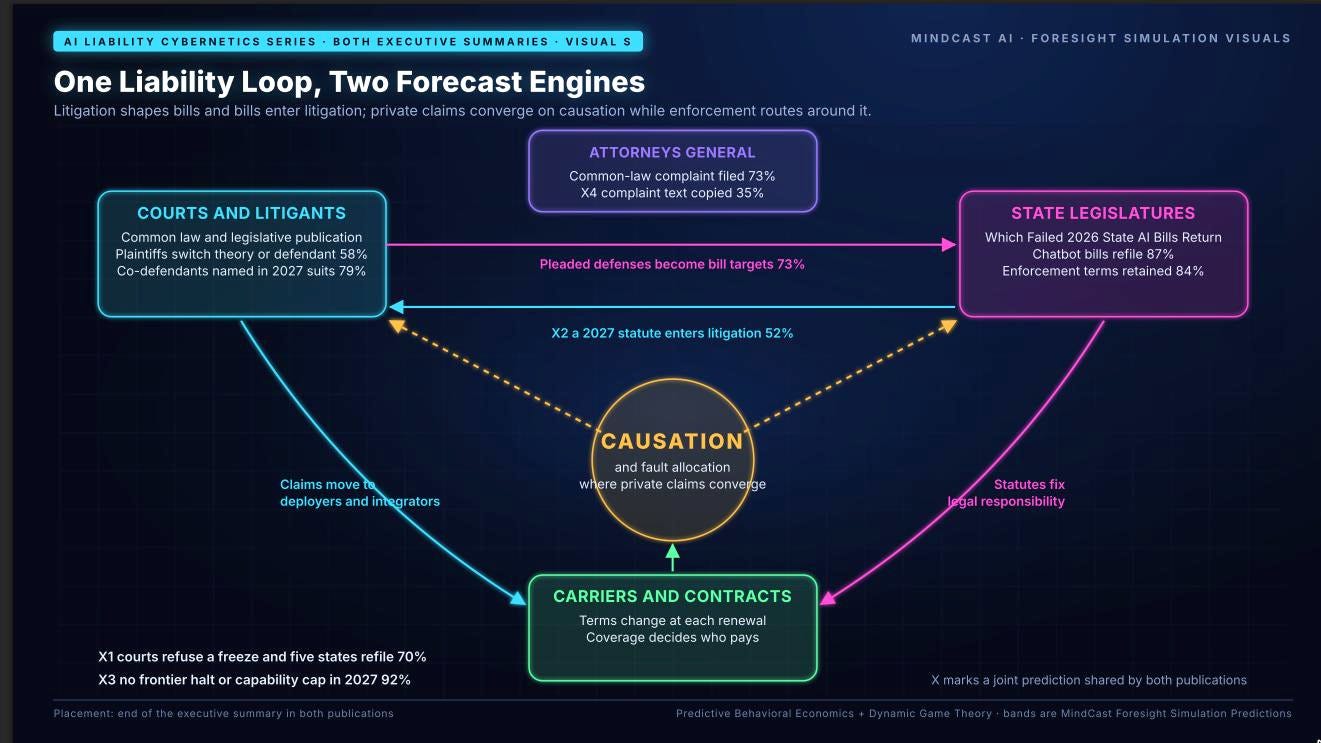
Refused halts keep developers operating and the contest in ordinary litigation. Freeze denials are favored (80%), and no halt or capability cap in 2027 sits at 92%. Business continuity holds, and liability stays in tort claims, enforcement actions and coverage disputes. Whether those losses are insurable still turns on policy terms, governing law and market capacity.
Sections I through IV set out the displacement mechanism and map plaintiff theories, with emphasis on voluntary undertaking and the agentic commercial triangle. Sections V through VIII map defense substitution and attorney general enforcement, then legislative power and insurance transmission. Section IX tests a second explanation for the legislative divergence, and Section X explains how the liability game evolved and what would change it. Section XI states 19 MindCast Foresight Simulation Predictions across the short and long horizons plus four shared with the companion paper, and Section XII gives six stakeholder strategies.
🏛️ Policymakers: eliminating one defense does not end the contest; California’s autonomy-defense bar preserved causation, foreseeability and comparative fault, and those preserved defenses now stand ready to carry the contest.
💼 Executives: a published safety program helps prove reasonable care and also helps prove a voluntary undertaking, so the same document can cut both ways in one case.
⚖️ Counsel: when the economic loss rule blocks a negligence claim against an AI vendor, expect amended pleadings in misrepresentation, contract or a consumer statute rather than a dismissed case.
📊 Investors: exposure reduced under one doctrine often reappears under another doctrine or against another defendant, and a carrier’s own control requirements can create new theories of liability, so headline defense wins overstate how much risk leaves the balance sheet.
Takeaway: plaintiffs are favored to answer narrowing rulings by moving liability elsewhere, so carriers, counsel and policymakers should track where it moves and whether it survives.
I. The Displacement Mechanism · Why Losing a Defense Does Not End Liability
Liability in AI cases follows a recursive cycle rather than a straight line. A court ruling changes the available strategies. Plaintiffs and defendants adapt, attorneys general and legislatures respond, and insurers and contracting parties adjust. Their adjustments feed back into which plaintiff sues whom on what theory.
1. Common-law litigation. What happens: plaintiffs plead theories; defendants plead defenses; courts rule · Observable: complaints, motions and orders in tracked AI cases
2. Doctrinal adaptation. What happens: defendants substitute defenses; plaintiffs substitute theories or defendants · Observable: amended pleadings; briefing that shifts emphasis
3A. Attorney general action. What happens: investigations, complaints and remedies use the litigation evidence · Observable: new state complaints copying private theories
3B. Legislation. What happens: statutes add duties, remove defenses or create safe harbors · Observable: filed and enacted bill text
4. Insurance and contract adaptation. What happens: coverage, indemnity and certification terms shift · Observable: policy forms; vendor terms; certification criteria
5. Next cycle. What happens: new plaintiffs choose theories and defendants under the new terms · Observable: the next wave of complaints
The liability cycle runs in any order. Attorneys general can sue before any private ruling, and legislators can act on allegations alone. Insurance contracts can set operating terms before either institution moves. The simulation’s task is to determine which channel moves first, how the others respond and whether each change survives.
Four displacement routes and a fifth outcome. When a claim meets a barrier, the underlying harm can migrate in four ways. A fifth outcome must stay live: some injuries find no viable remedy at all.
Cause-of-action substitution. What changes: the plaintiff changes the legal theory · Example: negligence barred by the economic loss rule becomes negligent misrepresentation
Defendant substitution. What changes: the claimant pursues another responsible party · Example: a deployer is named when the developer’s terms cap liability
Enforcement substitution. What changes: an attorney general action replaces or supplements private litigation · Example: a consumer-protection suit avoids individual causation
Statutory substitution. What changes: a legislature creates or changes the right, duty, defense or remedy · Example: California bars the autonomy defense by statute
No substitution. What changes: the harm goes uncompensated · Example: a small economic loss with no reliance and no statutory remedy
Five outcome states. A substituted claim is not a recovery. A newly named defendant may owe nothing, and an attorney general proceeding may win a public remedy without compensating the original plaintiff. Every displacement is therefore assessed in five states, which stay distinct and never merge into one success measure.
Substitution attempted. Observable result: amended complaint; new defendant; changed defense emphasis; new attorney general proceeding · Establishes: an actor changed strategy
Legally surviving. Observable result: claim survives a material judicial challenge; court recognizes a duty; statutory remedy applies · Establishes: the alternative remains viable
Recovery achieved. Observable result: judgment; resolution payment; covered defense obligation; enforceable public remedy · Establishes: exposure or relief materially changed
Recovery definitively fails. Observable result: final disposition against the claim; exhausted remedy; unsuccessful enforcement proceeding · Establishes: the pathway closed
Unresolved. Observable result: viable pathway open without final relief · Establishes: exposure persists as pending risk
Liability terminates only when every attempted route reaches a final disposition against the claim or exhausts its remedy. A surviving claim with no recovery yet stays unresolved, not terminated, and no substitution remains a genuine terminal branch. Defense expenses and settlement pressure count as economic outcomes that arise before any final liability.
A dismissed claim can still prompt statutory or regulatory intervention, so termination in court does not end the analysis. The simulation asks when displacement occurs, which route it follows and when liability ends instead of migrating.
Expected cost versus established liability. A doctrine need not produce a plaintiff verdict to change insurance economics. A claim that survives a motion to dismiss expands discovery, defense costs, expected resolution costs and underwriting scrutiny. The simulation tracks changes in expected claim cost separately from changes in legally established liability.
Three levels of status. A pleaded theory, a ruling on that theory and an enforceable statute carry different weight. A pleaded theory shows strategy. A ruling shows what one court accepted at one procedural stage, and a statute changes the rule for every later case in the state.
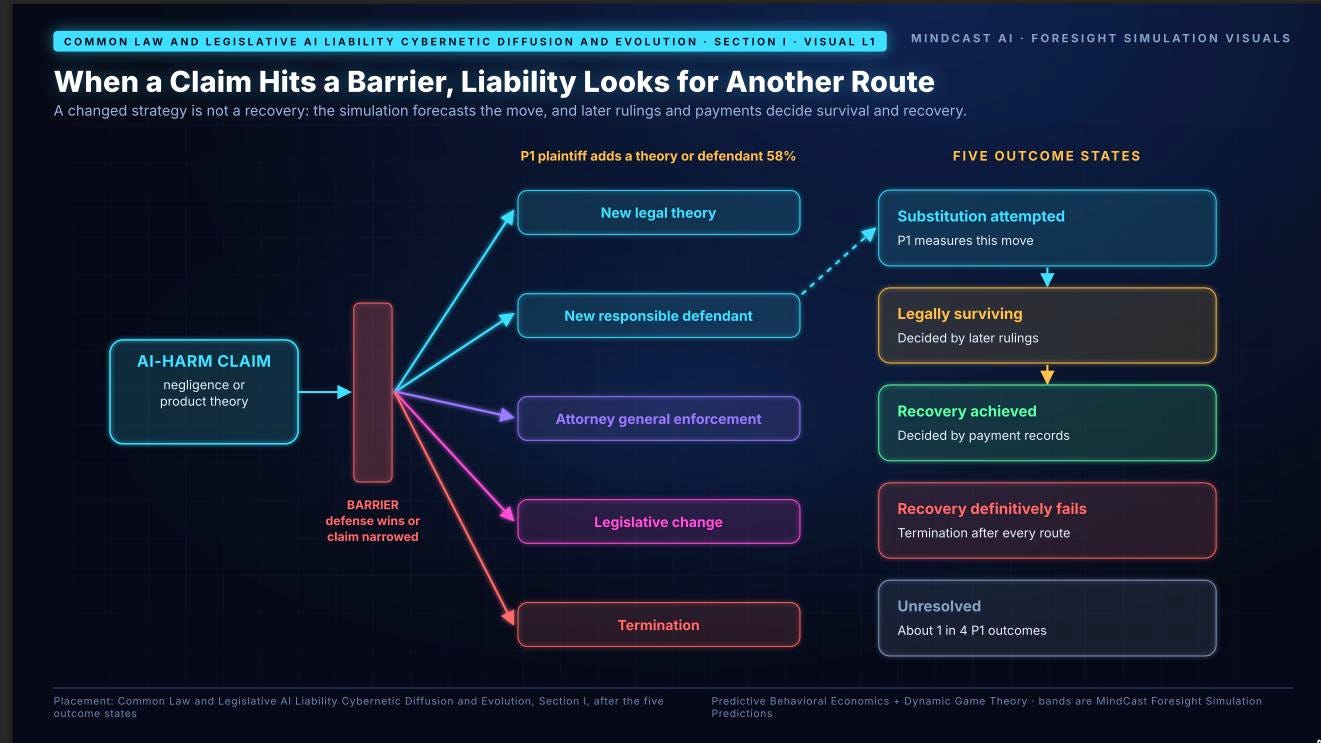
Takeaway: a failed defense or claim can redirect liability through four routes, and exposure has truly moved only when the new route survives in court and produces a recovery.
II. The Plaintiff Cause-of-Action Map
Each plaintiff theory fits particular facts, harms and defendants. The map below lists the source of authority for each theory, because the source decides who can change it. It also separates the current status from the procedural stage that produced it.
Design defect. Facts and harms it fits: unsafe default behavior; missing safeguards for minors · Defendant classes: model developers; chatbot operators · Source of authority: state common law, often modified by product statutes · Current status and stage: survived a motion to dismiss in Garcia; pleaded by Florida
Failure to warn. Fits: known risks undisclosed to users or parents · Defendants: operators; developers · Source: state common law and product statutes · Status: pleaded in chatbot injury cases; untested on the merits
Manufacturing defect. Fits: a deviation from the intended design · Defendants: rarely fits AI output · Source: state common law · Status: low relevance; output variance is usually a design question
Negligence. Fits: foreseeable harm from design, deployment or monitoring · Defendants: developers; deployers; integrators · Source: state common law · Status: being tested; duty and causation contested
Voluntary undertaking. Fits: a published safety commitment performed negligently · Defendants: developers with safety frameworks; auditors · Source: state common law (Restatement (Second) of Torts §§323, 324A) · Status: not yet pleaded against an AI developer
Negligent misrepresentation. Fits: false information supplied for business guidance · Defendants: vendors; deployers; certifiers · Source: state common law (Restatement (Second) of Torts §552) · Status: comparative support only (Moffatt v. Air Canada, Canada)
Apparent authority. Fits: an agent appears authorized to act for a principal · Defendants: deployers of transacting agents · Source: state agency law (Restatement (Third) of Agency §2.03) · Status: untested for AI agents
Public nuisance. Fits: widespread harm to a public right · Defendants: platforms; operators · Source: state common law and statutes · Status: applied in New Mexico v. Meta at trial
Consumer protection. Fits: deceptive or unfair practices · Defendants: operators; developers · Source: state statutes · Status: pleaded by many attorneys general; New Mexico verdict
Imputed knowledge. Fits: what employees knew becomes what the company knew · Defendants: any corporate defendant · Source: attribution principle, not a cause of action · Status: pleaded in West Virginia v. Snap
Res ipsa loquitur. Fits: the harm ordinarily implies negligence · Defendants: operators with exclusive control · Source: state common law evidence rule · Status: lower priority; useful when logs are withheld
Two corrections sharpen the map. Imputed knowledge attributes facts to a defendant under some other claim; it supplies no claim of its own. Public nuisance and consumer protection overlap in remedy but differ in elements, since nuisance needs interference with a public right while consumer statutes need a deceptive or unfair act.
Products liability subdivides in ways the legislation debate tends to blur. Design defect fits AI best, because harmful output usually reflects design choices about safeguards. Failure to warn fits where a company knew of a risk and told no one. Manufacturing defect rarely fits, since a model producing variable output is working as designed.
Negligence remains the default theory, and its elements carry the contest. Duty asks whether the defendant owed care to this plaintiff, breach asks whether it fell short, and causation asks whether the shortfall caused the harm. Foreseeability runs through all three, which is why internal warnings and incident histories become central evidence.
Takeaway: plaintiffs hold more theories than the chatbot litigation has used so far, and the unused ones fit enterprise and agentic disputes best.
III. Voluntary Undertaking · The Principal Emerging Plaintiff Theory
Voluntary undertaking is the most valuable plaintiff theory not yet pleaded against an AI developer. The doctrine imposes liability on one who undertakes to render services for the protection of others and performs them negligently. AI developers publish safety frameworks, model cards and usage policies that describe protective services in detail.
A published safety statement does not automatically create a tort duty. Three questions decide the claim. First, did the company actually undertake to render protective services, or did it only describe aspirations? Second, did the undertaking run to an identifiable plaintiff or class, such as minor users of a consumer product?
Third, did the plaintiff establish a liability pathway? Section 323 protects the person the undertaking serves where negligent performance increased the risk of harm or induced reliance. Section 324A reaches third parties through three routes: increased risk, an undertaking of a duty owed by someone else, or reliance by the other party or the third person.
A parent who chose a chatbot because its operator promised age-appropriate safeguards fits the reliance route. A user who never read the framework may still plead increased risk, or argue that the developer undertook a duty the operator owed. Elements vary by jurisdiction, so the Foresight Simulation analyzes the doctrine by state and by the plaintiff’s relationship to the undertaking.
The safety-program paradox. A safety program strengthens the defendant’s argument that its conduct was reasonable. The same program supplies evidence of an undertaking and of knowledge of foreseeable risk. Defendants therefore face a choice between documenting safety work and limiting what a plaintiff can plead, and neither option removes exposure.
Game theory explains why developers keep publishing safety commitments despite the paradox. Each developer gains from publishing safety commitments that win customers and regulators, while the litigation cost arrives later and falls on whichever developer is sued first. Behavioral economics explains the delay: plaintiffs’ lawyers adopt new theories after a salient success elsewhere, not when the theory first becomes available.
The extension to insurers and auditors. Carriers that publish AI governance standards and auditors that certify AI controls make undertakings of their own. A certification relied on by a third party can support both voluntary undertaking and negligent misrepresentation. The MindCast series on insurers and auditors in the second seat develops how governance standards become evidence against the institutions that wrote them.
A third theory: safety coordination as restraint. A consumer class action filed September 18, 2026 in the Northern District of California accuses four frontier developers of agreeing to slow capability development in violation of the Sherman Act. The theory is a conditional branch, relevant only if the complaint survives dismissal. Independent narrowing of a safety commitment is not evidence of antitrust liability; coordinated narrowing could be.
Risk statements already work as evidence in a fourth setting. Both suits seeking to halt frontier development, described in Section VI, rely on defendants’ own public warnings about AI risk as proof of knowledge. A developer therefore cannot reduce exposure simply by speaking less, because past statements remain available as evidence.
Takeaway: voluntary undertaking turns published safety commitments into potential duties, and the same documents that prove reasonable care can prove the undertaking.
IV. Apparent Authority, Negligent Misrepresentation and the Economic Loss Rule · The Agentic Commercial Triangle
Three doctrines govern agentic commercial disputes, and they interact as a triangle. Apparent authority decides whether an AI agent’s act binds the business that deployed it. Negligent misrepresentation decides whether false AI output supports recovery for economic harm. The economic loss rule decides whether a negligence claim for purely financial loss survives at all.
Apparent authority. Agency law binds a principal when a third party reasonably believes an agent acts with authority and that belief traces to the principal’s conduct. A business that deploys an agent to negotiate, book or purchase creates that appearance, if agency law applies at all.
Whether an autonomous software system counts as an agent is a threshold question. The Restatement (Third) of Agency treats a computer program as an instrument of the person using it rather than as an agent. The Uniform Electronic Transactions Act, adopted in most states, separately binds parties to contracts formed by their electronic agents. The Foresight Simulation therefore models AI agent authority as a contested classification with three branches: agency law, statutory attribution under electronic-transaction law and contract allocation.
The Ninth Circuit’s preliminary-injunction ruling in Amazon v. Perplexity attributed computer access to the user directing the agent, not to the agent’s maker. The ruling decides an access question under the Computer Fraud and Abuse Act (CFAA) and leaves transaction allocation to agency, contract and consumer law.
Negligent misrepresentation. The doctrine reaches those who supply false information for the guidance of others in business transactions. Moffatt v. Air Canada, a Canadian tribunal decision, held an airline responsible for its chatbot’s inaccurate refund guidance on a negligent-misrepresentation theory.
U.S. courts have not yet applied the doctrine to AI output, so Moffatt serves only as comparative support. The theory fits vendors’ accuracy claims, deployers’ customer-facing agents and certifiers whose reports third parties rely on.
The economic loss rule. Many states bar negligence recovery for purely financial loss between parties who could have allocated the risk by contract. The Restatement (Third) of Torts: Liability for Economic Harm states the modern version. Enterprise AI disputes are mostly economic losses between contracting parties, so the rule may block the default negligence theory in exactly the cases where agent errors cost the most.
The economic loss rule varies sharply by state, and no national version exists. Florida confined the rule to products-liability cases in Tiara Condominium Association v. Marsh & McLennan (2013). Washington recast it as an independent duty doctrine in Eastwood v. Horse Harbor Foundation (2010), asking whether the defendant breached a duty arising outside the contract.
Florida’s narrower rule does not by itself keep commercial AI negligence claims alive, because Tiara still requires an independent tort rather than a repackaged contract claim. The analysis therefore compares actual claims and the independent duties alleged in at least two contrasting regimes, not the label each state gives its rule.
How the triangle displaces liability. Suppose the economic loss rule defeats a negligence claim against an AI service provider. The customer can turn to contract or negligent misrepresentation, which many states exempt from the rule.
A state attorney general can pursue a deceptive-practices theory where a consumer was harmed. A legislature can create an express remedy for unauthorized agent transactions, which is what agent-transaction allocation bills propose.
Takeaway: in agentic commerce the economic loss rule can push claims toward misrepresentation, contract and statute, but its reach varies by state and agent authority remains a contested classification.
V. The Defense Availability and Substitution Map
Defendants select defenses in sequence, and each defense answers particular theories at particular procedural stages. The map lists the source of authority for each defense and what a state legislature can do about it. A state can modify its own tort rules but cannot override federal statutes or the Constitution through ordinary legislation.
No duty owed. Answers: negligence; undertaking · Stage: motion to dismiss; summary judgment · Source of authority: state common law · State legislative power: can impose or limit duties
Product versus service. Answers: strict products liability · Stage: motion to dismiss · Source: state common law and product statutes · Legislative power: can define AI as a product
Section 230 immunity. Answers: claims treating the defendant as publisher of third-party content · Stage: motion to dismiss · Source: federal statute (47 U.S.C. §230) · Legislative power: none directly; can reframe claims toward design conduct
First Amendment. Answers: claims premised on expression · Stage: motion to dismiss; appeal · Source: U.S. Constitution · Legislative power: none; can target conduct rather than speech
Autonomy defense (“the AI did it”). Answers: negligence; product claims · Stage: any stage · Source: state common law · Legislative power: can bar it (Cal. Civ. Code §1714.46)
Superseding cause. Answers: causation element · Stage: summary judgment; trial · Source: state common law · Legislative power: can limit it for protected classes
Misuse. Answers: product claims · Stage: summary judgment; trial · Source: state common law · Legislative power: can limit it for foreseeable interactions or minors
Comparative fault. Answers: damages allocation · Stage: trial · Source: state statute or common law · Legislative power: can modify allocation rules
Economic loss rule. Answers: negligence for financial loss · Stage: motion to dismiss · Source: state common law · Legislative power: can create statutory remedies around it
Contractual limits. Answers: contract and some tort claims · Stage: motion to dismiss; summary judgment · Source: contract law; unconscionability limits · Legislative power: can void caps for certain harms
Sophisticated intermediary. Answers: failure to warn · Stage: summary judgment · Source: state common law · Legislative power: can allocate warning duties
Substantial modification. Answers: product claims against original maker · Stage: summary judgment · Source: state common law and product statutes · Legislative power: can define modification for AI
State of the art. Answers: design defect · Stage: trial · Source: state common law; some statutes · Legislative power: can convert evidence into a safe harbor
Unauthorized access. Answers: CFAA and state analogues · Stage: preliminary injunction; merits · Source: federal and state statutes · Legislative power: can amend the state analogue only
Three distinctions decide which threshold defense applies. Section 230 bars claims that treat a defendant as the publisher of someone else’s content, not claims about the defendant’s own conduct. Lemmon v. Snap (9th Cir. 2021) allowed a negligent-design claim over Snap’s speed filter for that reason, and Anderson v. TikTok (3d Cir. 2024) treated algorithmic curation as the platform’s own expression. Generative output adds a further question, since the model produces the content rather than hosting it.
The First Amendment protects expression, not every product behavior. Garcia declined at the pleading stage to hold that chatbot output is protected speech. State of the art is evidence of reasonable design in most states; only a statute converts it into an immunity or defense.
Defense adaptation, not a fixed sequence. Defendants usually plead alternative defenses together, and many defenses answer independent questions. A later causation motion does not prove that an earlier duty argument was abandoned. The paper therefore models adaptation as state-dependent: available defenses meet a court disposition, which changes defense emphasis or availability and prompts plaintiff adaptation.
A true substitution requires an observable change. Qualifying evidence is a defense that becomes newly unavailable, a defense that becomes newly advantageous or a material shift in strategic emphasis. A defense preserved and argued earlier does not count when it reappears. The list below gives candidate adaptations rather than a universal order.
If Section 230 weakens. Defendants may shift emphasis toward: product-versus-service; First Amendment · Plaintiffs may answer with: design-defect framing
If product versus service weakens. Defendants: no duty; causation · Plaintiffs: negligence with foreseeability evidence
If the autonomy defense is barred by statute. Defendants: superseding cause; foreseeability; comparative fault · Plaintiffs: evidence that the human act was foreseeable
If superseding cause weakens. Defendants: misuse; comparative fault · Plaintiffs: minor-user status; foreseeable interaction
If the economic loss rule fails. Defendants: contractual caps; disclaimers · Plaintiffs: unconscionability; misrepresentation
If developer liability weakens. Defendants: substantial modification; sophisticated intermediary · Plaintiffs: naming the integrator or deployer
California shows the sequence in statute. Section 1714.46 prohibits a defendant from arguing that AI autonomy itself caused the harm. The statute expressly preserves defenses on causation, foreseeability and comparative fault.
The preserved defenses remain legally available, but whether defendants actually shift toward them after the statute is a hypothesis. The question stays open until post-statute filings can be compared with a matched pre-statute baseline.
The next round of bills targets causation, foreseeability and comparative fault, as California AB 2575’s causation clause did before its veto.
Raine v. OpenAI shows the sequence in litigation. OpenAI pleads superseding cause, misuse and comparative fault alongside Section 230. Because OpenAI pleaded those defenses together from the outset, a later emphasis on causation counts as substitution only if a ruling removes Section 230 and the briefing shifts accordingly. Contests decided on causation and fault cost more and resolve through negotiation or trial rather than dismissal.
Takeaway: defendants plead defenses together, a substitution counts only when a ruling or statute changes availability or emphasis, and legislatures can target only the state-law defenses.
VI. Attorneys General as Doctrinal Developers
Attorneys general do not merely take over after private plaintiffs struggle. Attorneys general act as common-law plaintiffs, statutory enforcers and legislative advocates at once. Their investigative powers and public remedies let them advance theories that individual plaintiffs find hard to carry.
Florida’s June 1, 2026 complaint against OpenAI shows the range. The complaint pleads ten counts and names Sam Altman personally. Four counts allege deceptive practices; the rest plead negligence (two), products liability (two), fraudulent misrepresentation and public nuisance. OpenAI removed the case to federal court in July, and the federal court remanded it to Highlands County Circuit Court on September 8, 2026.
The counts remain allegations. The pleading still matters, because a sovereign plaintiff now carries the products and negligence theories alongside private plaintiffs.
Enforcement substitution. Consumer-protection statutes impose penalties per violation without proof that any individual was harmed. Where private litigation meets causation or attribution barriers, attorneys general can pursue the same conduct through statutory claims. New Mexico v. Meta produced a $375 million consumer-law verdict and a $567 million abatement fund, and Texas seeks up to $10,000 per violation in its own action.
Imputed knowledge as an enforcement tool. West Virginia v. Snap cites OpenAI’s published GPT-4 limitations as evidence of what Snap knew before launching My AI. Organizational knowledge then supports statutory knowledge or intent elements. The MindCast analysis of West Virginia v. Snap traces how a supplier’s published warnings become a deployer’s notice.
How each doctrine shapes attorney general strategy and legislative response:
Negligence and foreseeability. Attorney general strategy: use internal warnings and incident histories to show foreseeable harm · Potential legislative response: codify duties or standards of care
Products liability. Strategy: plead design or warning theories where authorized · Response: define covered AI products
Imputed knowledge. Strategy: use organizational communications to prove knowledge or intent · Response: define notice and disclosure duties
Voluntary undertaking. Strategy: investigate gaps between safety commitments and performance · Response: make safety commitments enforceable
Negligent misrepresentation. Strategy: use inaccurate product claims in deception proceedings · Response: codify prohibited AI representations
Apparent authority. Strategy: investigate misleading claims about agent authorization · Response: allocate agent-transaction responsibility
Superseding cause and comparative fault. Strategy: pursue deception theories that need no individual causal chain · Response: limit defenses for protected user classes
Economic loss rule. Strategy: prefer statutory remedies where negligence recovery is barred · Response: create remedies for AI economic injury
Public nuisance. Strategy: seek abatement where authorized · Response: establish abatement funds
Game theory explains why attorney general coalitions accelerate doctrine. A lead state bears the cost of developing a theory, and following states copy the complaint at a fraction of the cost. The MindCast analysis of lead states in attorney general coalitions shows the same copying mechanism that drives bill diffusion in the companion paper.
Three Attorney General Mechanisms
Attorney general action changes doctrine through three distinct mechanisms, and each resolves on different evidence. Treating them as interchangeable overstates how much liability migrates.
Parallel enforcement. Attorneys general and private plaintiffs pursue overlapping theories on the same conduct. Florida’s counts mirror private chatbot pleadings and sit here by default. Parallel enforcement adds a sovereign plaintiff and a template for other states, but it does not show that liability migrated.
Enforcement substitution. The attorney general uses a pathway unavailable or uneconomical for private plaintiffs. Substitution requires a documented private obstacle such as a causation or Section 230 ruling. It also requires an attorney general pathway that overcomes the obstacle, such as per-violation penalties.
Doctrinal acceleration. Attorney general resources and strategy bring a legal issue to a significant ruling earlier than private litigation would have. Florida’s remand win and its injunction motion are the first observable steps. Proof requires comparison with matched private cases, because a faster ruling alone does not show that attorney-general-specific powers caused it.
Two Tracks Toward Development Itself
Public nuisance has moved from abating injuries toward halting development. On September 28, 2026 Florida asked its state court for a temporary injunction barring OpenAI from releasing new models without third-party safety approval, among six requested prohibitions. On November 12, 2026 four nonprofits sued five frontier developers in San Francisco Superior Court on a single Unfair Competition Law claim premised on public nuisance. The five are Anthropic, Google and Meta plus OpenAI and SpaceX’s AI entities.
Florida’s motion and the nonprofit suit share a public nuisance theory but differ in plaintiff, remedy and forum. The same alleged systemic harm drives a sovereign request for an injunction and a private public-interest suit, which is the displacement mechanism in miniature. Neither court has ruled, and standing and remedy scope will decide whether either track survives.
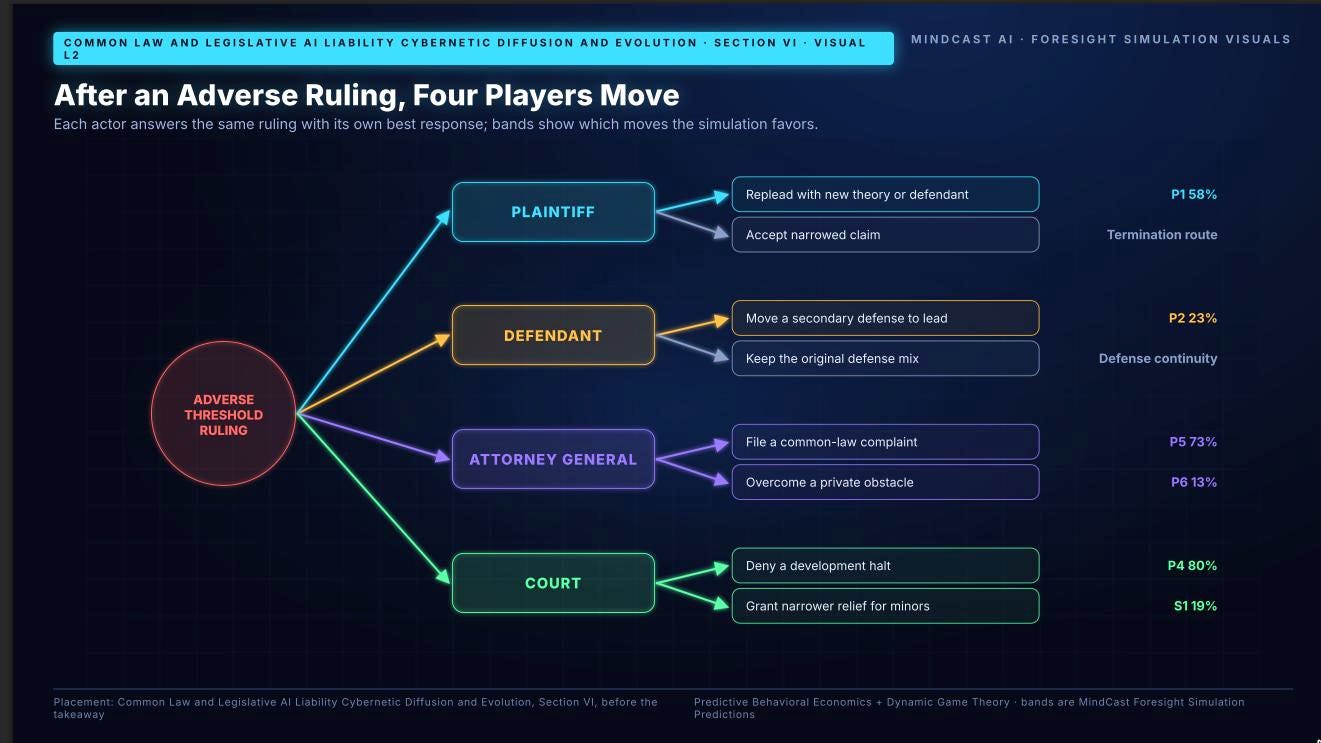
Takeaway: attorneys general can run parallel to private plaintiffs, substitute for them or accelerate doctrine, and only the last two show that public action changed where liability lands.
VII. Legislative Intervention · What States Can and Cannot Change
Legislatures change doctrine in three ways. Lawmakers codify emerging judicial standards, reverse disfavored rules or create safe harbors that counter expanding liability. Each intervention changes the available strategies and starts the next contest.
The source of authority sets the limit. A state legislature can define AI as a product, bar the autonomy defense, limit misuse for minor users or create remedies around the economic loss rule. It cannot override Section 230 or the First Amendment. A statute on chatbot design can reframe future claims toward conduct without removing an otherwise applicable federal defense.
Selective defense elimination. Legislatures can remove one defense without creating a new cause of action. California’s autonomy bar is the model, and returning 2027 bills follow it with causation clauses and defense-stripping for minor users. The companion paper maps each doctrine to the provision it induces and forecasts which states file them.
Autonomy defense. Provision it induces: statutory bar · 2026 precedent: Cal. Civ. Code §1714.46
Product versus service. Provision: chatbot designated a product · Precedent: Louisiana HB 791; Illinois SB 3590 (failed)
Superseding cause; misuse. Provision: causation clause; defense-stripping for minors · Precedent: California AB 2575 (vetoed)
Imputed knowledge. Provision: notice and knowledge standards · Precedent: none enacted
Apparent authority; economic loss. Provision: agent-transaction allocation · Precedent: none filed
Voluntary undertaking. Provision: transparency and incident reporting · Precedent: New York RAISE amendment
State of the art. Provision: certification safe harbors · Precedent: Utah SB 292; Texas HB 149
The MindCast analysis of AI agent liability under common law and statute treats the same boundary between judge-made and enacted allocation. The present paper adds the adaptive step: every enacted provision changes which defenses defendants select next.
Legislative Substitution and the Counterfactual Test
A statute removing a defense shows intervention, not that doctrine caused it. Legislative substitution requires three links: a doctrine or litigation event, an identified actor who sought the change and a provision that alters the available legal strategy. California’s autonomy bar meets the third link, and the Foresight Simulation tests the first two through bill findings and testimony.
Three counterfactuals test whether institutions changed the trajectory. Without the attorney general proceeding, would private litigation have developed the same doctrine? Without the statute, would courts have resolved the question anyway? Without the coverage change, would plaintiffs have named the additional defendant?
If the same outcome would have arrived on the same schedule without the intervention, the intervention adds no incremental causal influence. If the outcome would not have occurred, or would have arrived materially later, the intervention holds the stronger causal claim. Attorney general influence breaks into four dimensions assessed separately: timing, available remedies, defendant selection and eventual recovery.
The doctrine map below ranks each doctrine by how directly its litigation is feeding 2027 bill text.
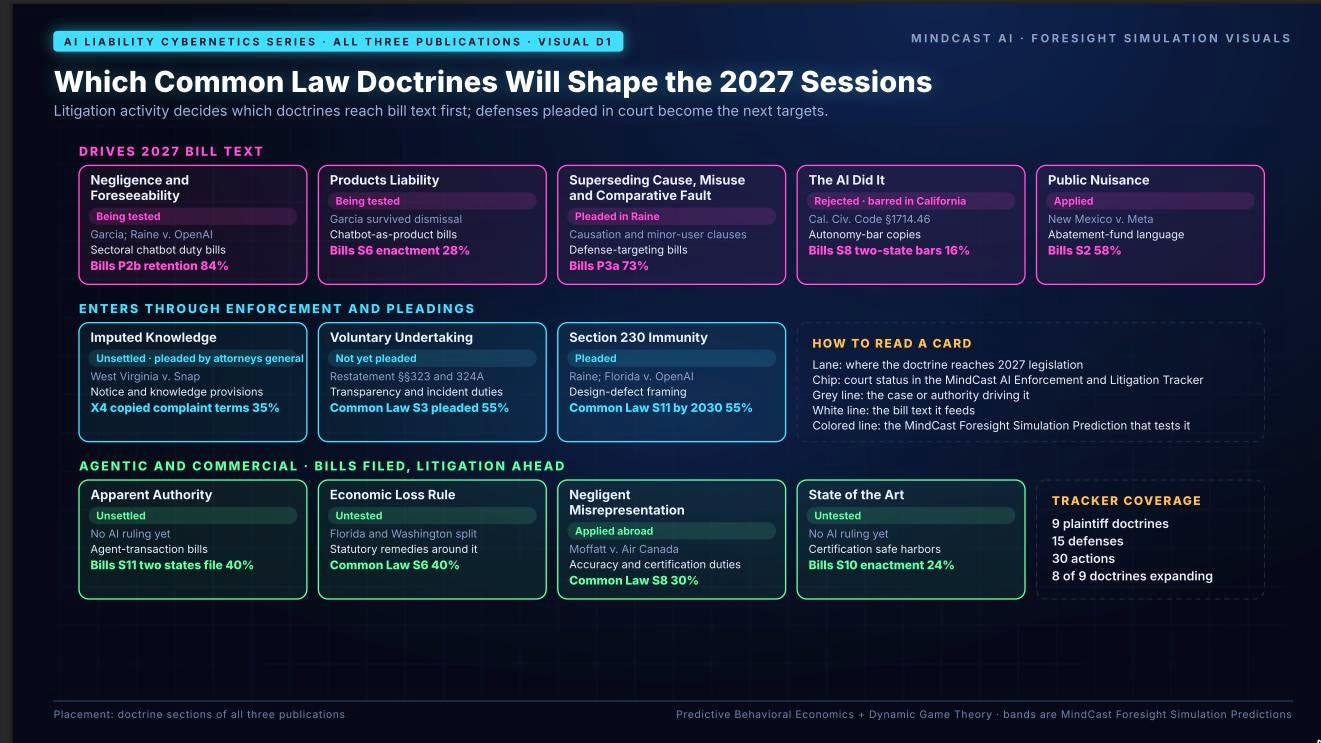
Takeaway: legislatures can rewrite state tort rules and remove defenses one at a time, but intervention counts as substitution only when a traceable doctrine and actor produced it.
VIII. Insurance Transmission · How Doctrine Shifts Which Policy Responds
Doctrinal change alters the probability that a claim triggers a particular coverage grant, exclusion, defense obligation or indemnity obligation. Coverage still turns on policy wording and the allegations, governing law, exclusions and insured status. A design-defect claim tends toward products coverage, a negligent-misrepresentation claim toward errors and omissions, and an attorney general penalty may reach no coverage at all.
Design defect; failure to warn. Coverage line in play: general liability; products · Barrier that bites: generative AI exclusions; expected-injury exclusions · Effect on defendant selection: plaintiffs favor operators with products coverage
Negligence. Coverage line: general liability; technology errors and omissions · Barrier: professional-services exclusions · Effect: plaintiffs name integrators with professional cover
Negligent misrepresentation. Coverage line: errors and omissions · Barrier: contractual-liability exclusions · Effect: certifiers and vendors become targets
Voluntary undertaking. Coverage line: general liability; errors and omissions · Barrier: assumed-duty exclusions · Effect: developers and auditors with published standards
Apparent authority. Coverage line: errors and omissions; crime; cyber · Barrier: unauthorized-transaction definitions · Effect: deployers absorb agent errors
Consumer protection; nuisance. Coverage line: directors and officers; errors and omissions · Barrier: fines-and-penalties exclusions; damages definitions · Effect: abatement and penalties often fall outside cover
Imputed knowledge. Coverage line: directors and officers · Barrier: prior-knowledge and conduct exclusions · Effect: raises disclosure and securities exposure most
Plaintiffs’ lawyers follow collectible coverage, so an exclusion changes who gets sued rather than whether anyone does. The MindCast analysis of agentic insurance exclusions develops the redirection. Doctrinal change compounds the effect, since a new theory can reach a policy that an old theory could not.
Defense obligations follow policy wording and the governing coverage law. A duty to defend attaches in many states when any claim is potentially covered, so one covered theory can carry defense costs for an entire suit. Plaintiffs who add a covered theory change the defense economics even when the theory is weak.
Carriers may respond to surviving theories before any merits ruling. A claim that survives dismissal raises defense costs and underwriting scrutiny at once, so exclusion filings and coverage actions can track pleading-stage outcomes rather than judgments.
The Translation Gap Between Underwriting and Doctrine
The agentic AI insurance market thinks in exposures, controls and coverage, while common law decides how those exposures become legal liability. Underwriters assess loss frequency, severity, exclusions and claims experience. Lawyers assess causes of action, elements, defenses and procedural posture. Both describe the same risk in vocabularies that have not yet converged.
A policy can cover a risk without anticipating the legal theory through which it materializes. A carrier may know that a chatbot can give harmful advice. Depending on the facts and the state, the same event can support negligence or design defect, negligent misrepresentation or voluntary undertaking.
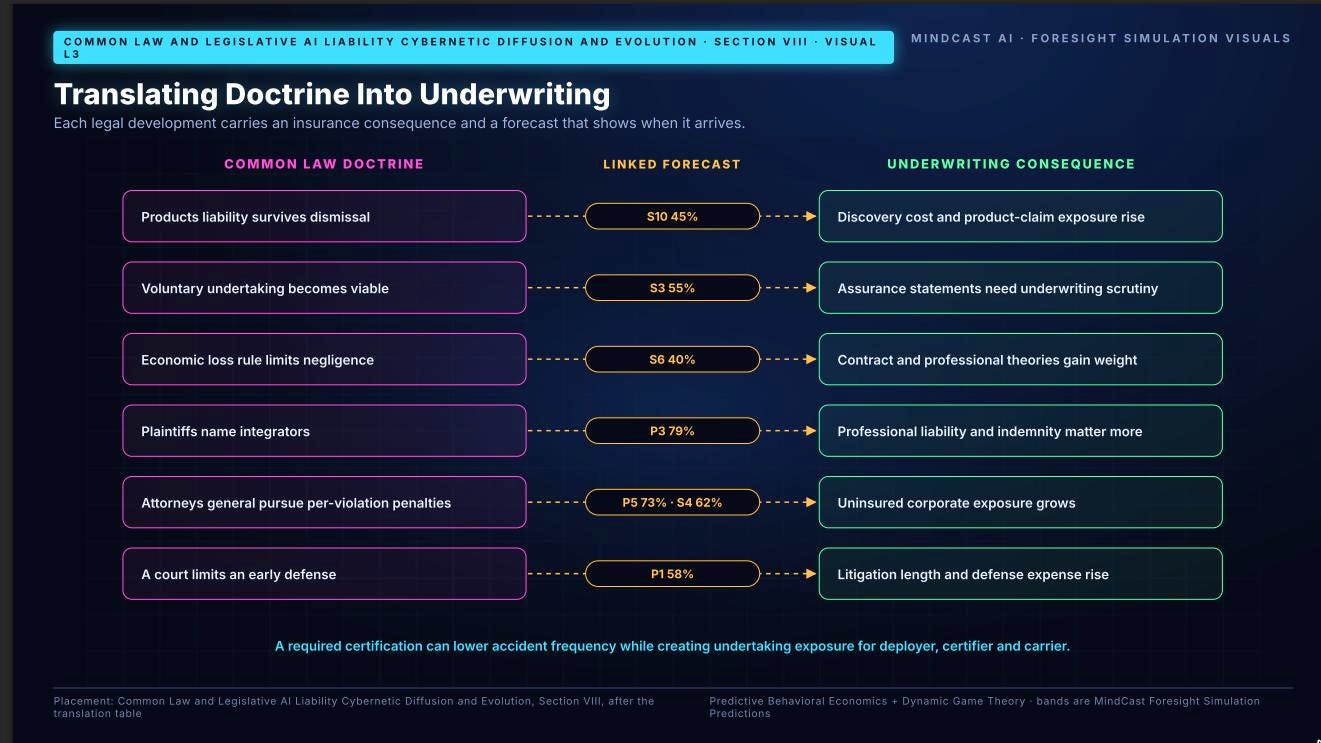
Common law also moves without waiting for statutes. Courts extend existing doctrine to AI conduct case by case, and each step changes defense costs, resolution leverage and which policy responds. The list below translates the doctrinal developments in this paper into the decisions carriers and commissioners make.
Products liability survives dismissal. Insurance consequence: greater discovery cost and product-related claim exposure · Linked prediction: S10 (45%)
Voluntary undertaking becomes viable. Consequence: governance and assurance statements need underwriting scrutiny · Linked: S3 (55%); S12 (20%)
Economic loss rule limits negligence. Consequence: contract and professional-liability theories gain weight · Linked: S6 (40%)
Plaintiffs name integrators. Consequence: professional liability and indemnity terms become consequential · Linked: P3 (79%)
Attorneys general pursue per-violation penalties. Consequence: potentially uninsured corporate exposure grows apart from individual tort recoveries · Linked: P5 (73%); S4 (62%)
A court limits an early defense. Consequence: expected litigation length and defense expense rise · Linked: P1 (58%); P2 (23%)
Each entry’s linked prediction shows when the development arrives, so a carrier can watch the forecast instead of waiting for the claim.
When a Risk Control Creates Liability
Carriers offering affirmative agentic AI cover increasingly require independent AI safety certification. The requirement can reduce accidents. It can also create new representations, reliance relationships and undertakings. A later failure may then implicate the deployer or the certifier, the integrator or the carrier, each under a different theory.
A control can therefore lower the likelihood of an accident while changing the legal exposure attached to the accidents that still occur. An actuary, a lawyer and an underwriter each see one part of that mechanism, and few underwriting processes bring the three together. MindCast’s Foresight Simulations exist to make the translation predictive rather than descriptive.
Takeaway: doctrine shifts the odds that a given policy responds, and a risk control can lower accident frequency while creating the legal theories that decide who pays for the accidents that remain.
IX. Five Litigation Environments and the Second Divergence Hypothesis
The companion paper predicts that consumer-harm bills return harder while commercial-duty bills return softer. Doctrine supplies a second explanation alongside salience. Legislators can target specific defenses in identifiable injury cases, while commercial AI liability is spread across contracts, intermediaries and several causes of action.
Companion chatbot injury. Plaintiff strategy: negligence; design defect; foreseeable harm · Defense response: misuse; comparative fault; superseding cause · Potential legislative response: minor-specific protections; causation clauses
AI safety representations. Plaintiff strategy: voluntary undertaking; misrepresentation · Defense: no undertaking; no reliance; reasonable care · Legislative response: transparency standards; certification safe harbors
Agentic transactions. Plaintiff strategy: apparent authority; negligent implementation · Defense: economic loss rule; contractual limits; unauthorized use · Legislative response: transaction allocation; consumer remedies
Enterprise AI deployment. Plaintiff strategy: professional negligence; contract · Defense: sophisticated intermediary; substantial modification · Legislative response: narrowed developer duties; deployer obligations
Consumer-protection enforcement. Plaintiff strategy: deceptive representations; statutory violations · Defense: statutory interpretation; constitutional defenses · Legislative response: AI-specific definitions and penalties
The five-environment list states expected patterns, not observed outcomes, and each pattern can be tested. In a companion-chatbot case the defense is visible, attributable and easy to name in a bill, so a legislator can strip misuse for minor users in one clause.
In an enterprise dispute the liability sits in an indemnity cap, a statement of work and an economic loss ruling. No single clause reaches it, and the parties already allocated the risk by contract. Legislators therefore face higher drafting costs and weaker constituencies, and commercial-duty bills soften.
Behavioral economics adds the salience channel: a named injured teenager outweighs a diffuse commercial loss. Game theory adds the targeting channel: a defense that appears in one famous case gives sponsors a precise target with a visible payoff. The targeting channel remains a hypothesis until the matched comparison runs.
Takeaway: consumer-harm bills may harden because their defenses are targetable, and commercial bills may soften because their liability already lives in contracts.
X. How the Liability Game Evolved and Why Its Rules Hold Through 2028
The liability forecasts hold only while the threshold rules of 2024 to 2026 hold. The game reached its current form through three moves between 2024 and November 2026. Appellate courts move slower than the forecast windows, so the remaining rules hold, and the list at the end names the events that would change the game.
Threshold defenses narrowed. Anderson v. TikTok in 2024 limited Section 230 where a platform’s own recommendations cause harm, and Garcia declined at the pleading stage to treat chatbot output as protected speech. Plaintiffs gained a path past dismissal, and causation, misuse and comparative fault became the defenses most likely to decide cases. California’s autonomy-defense bar then struck one defense by statute while preserving the rest.
Enforcers became common-law plaintiffs. Florida’s June 2026 complaint pleaded common-law theories against OpenAI, and the federal court’s September 8 remand kept the case in state court. Florida then moved on September 28 to halt frontier development itself, and four nonprofits pressed a similar demand on November 12. A single attorney general office can now sue, enforce statutes and seek new legislation in the same dispute.
Commercial doctrine split by state. Florida and Washington now apply the economic loss rule in opposite ways, so the same agent dispute can survive in one state and fail in the other. The Ninth Circuit’s Perplexity ruling attributed computer access to the user directing an agent rather than to the agent’s maker. Agent disputes therefore enter a patchwork rather than a single rule.
Why the rules hold. Appellate courts have not yet ruled on whether a chatbot is a product or whether Section 230 covers what a model generates. The forecasts assume three conditions through their windows: trial courts keep ruling at the threshold, carriers renew terms annually and attorneys general proceed in state courts on their own calendars.
Commitments that hold through the window. Defendants have pleaded their defenses in pending cases, so any later change in lead defense shows on the docket. Florida has filed a ten-count complaint and a halt motion it must now defend. Carriers renew on annual cycles, so terms written for 2027 run a full policy year, and each actor starts 2027 from a known position.
An appellate court holds that Section 230 or the First Amendment bars chatbot design claims. Type of change: game evolution · What it changes: restores a threshold defense and ends cases before the causation contest · Predictions to revalidate: P1 to P3; S3; X2
A court orders a frontier development halt. Type: game mutation (anomaly) · Changes: gives every actor a remedy that courts have so far refused · Revalidate: P4; S1; X1 and X3
Congress enacts a federal safe harbor or preemption statute for AI liability. Type: game evolution · Changes: moves the forum from state courts and legislatures to a federal standard · Revalidate: P5 to P7; S4; X2 and X4
An attorney general coalition resolves its claims against a frontier developer before trial. Type: equilibrium shift · Changes: removes the leading public plaintiff and its common-law theories · Revalidate: P5 and P6; S2 and S4
California’s autonomy-defense bar is enacted in another state. Type: continuation · Changes: updates odds within the current game · Revalidate: P7 can resolve; the companion paper’s defense-targeting forecast rises
The list classifies each event. Continuation updates odds inside the current game, and an equilibrium shift changes which outcome persists without replacing the game. Game evolution changes the rules, forums or participants, and every forecast it touches needs revalidation. A court-ordered halt is the one anomaly in the set: a game mutation that changes every actor’s options at once.
The AI Liability Cybernetics Interactive War Gaming board plays every event in the list above. Three board states follow, each showing the forecasts that move and the seat that gains or loses. Event values cover the core forecasts; weaker-evidence and long-horizon entries keep their baseline bands on the board and need revalidation when an event occurs.
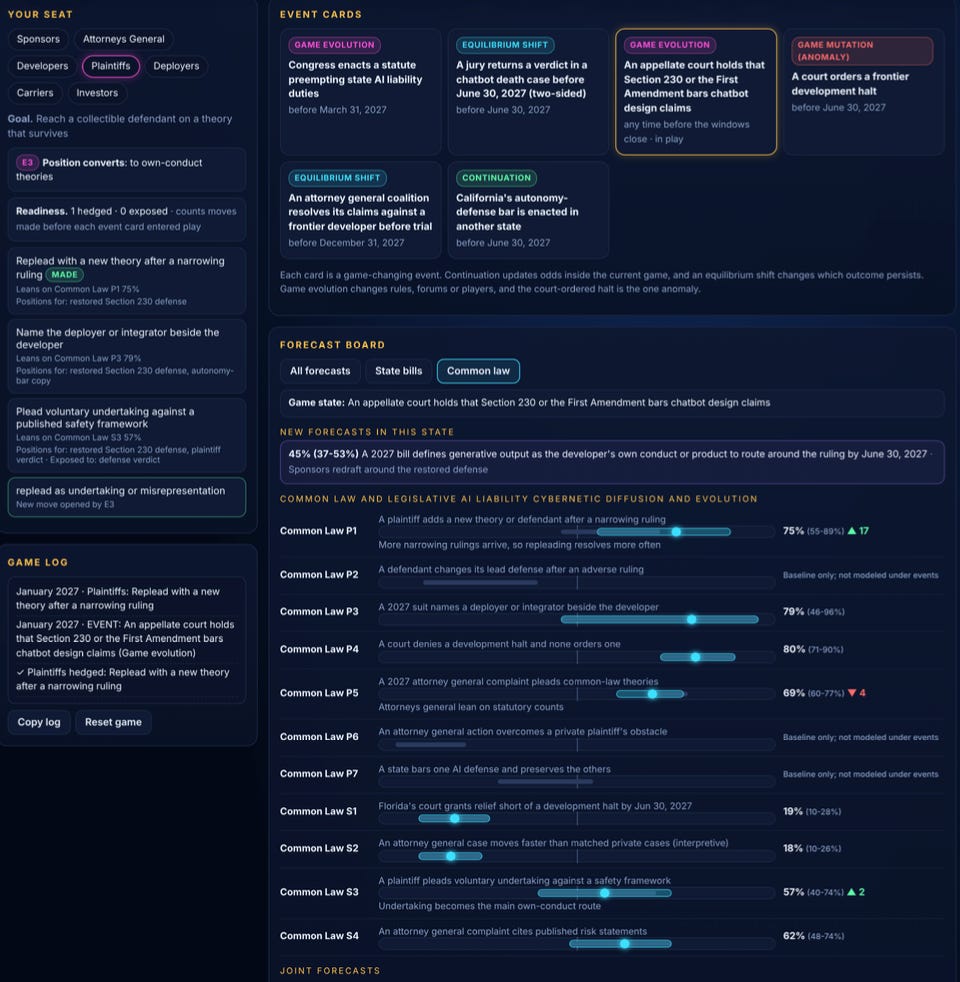
Restored Section 230 defense in play with the Plaintiffs seat. Common Law P1 rises to 75% as more narrowing rulings arrive, and the repleading move shows as hedged. Source: AI Liability Cybernetics Interactive War Gaming.
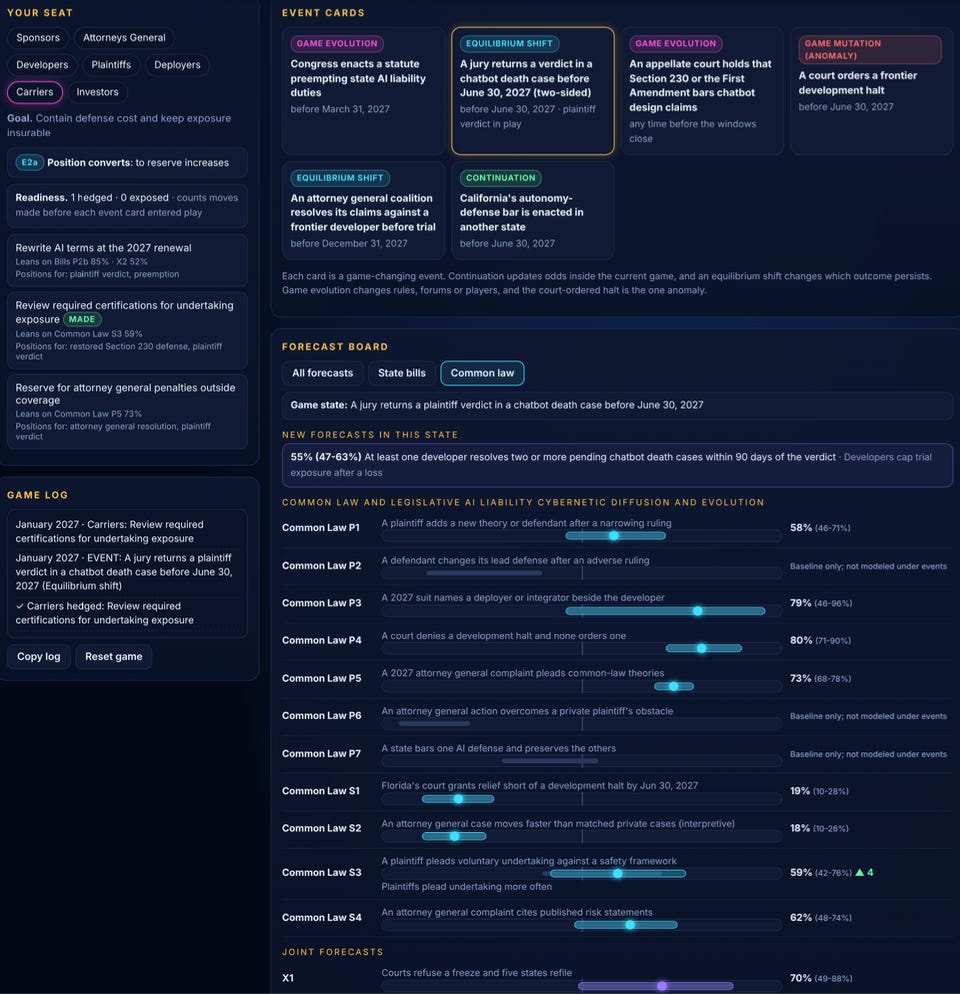
Plaintiff verdict card in play with the Carriers seat. Undertaking pleadings (Common Law S3) rise to 59%, and the certification review shows as hedged. Source: AI Liability Cybernetics Interactive War Gaming.
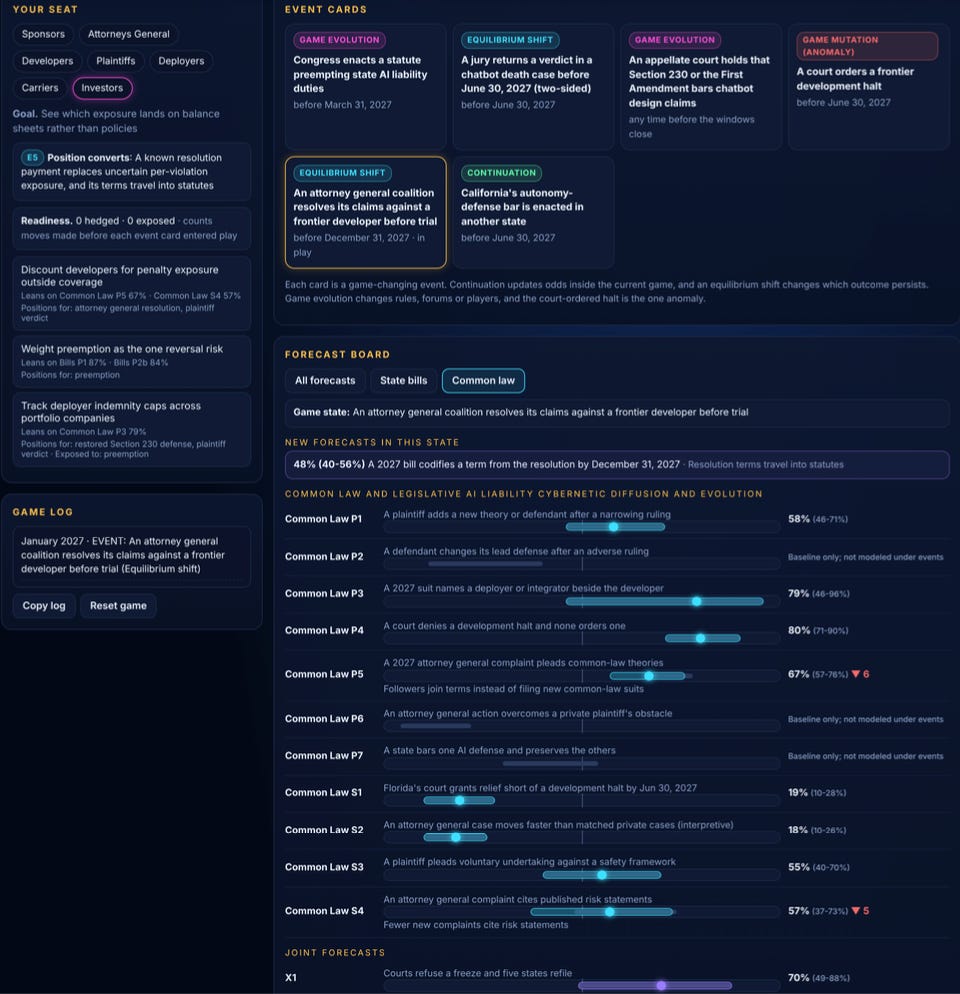
Attorney general resolution in play with the Investors seat. New common-law complaints (Common Law P5) fall to 67% while copied complaint terms (X4) rise to 41%. Source: AI Liability Cybernetics Interactive War Gaming.
Takeaway: the forecasts hold while appellate courts stay silent, state forums stay open and no court orders a halt; any of those events requires revalidation rather than adjustment.
XI. MindCast Foresight Simulation Predictions
The MindCast AI Proprietary Cognitive Digital Twin Foresight Simulation states 19 MindCast Foresight Simulation Predictions with probability bands for this paper and four joint predictions shared with the companion paper. Eight are core forecasts and three run on the long horizon through 2030. Eight rest on thinner evidence: primary P2, P6 and P7 and secondary S5 to S9. P marks a Primary Simulation Prediction, S a Secondary Simulation Prediction and X a joint prediction that resolves the same way in both papers.
The forecasts open a new series on this question, so no earlier MindCast results exist to report beside them.
Five Competing Hypotheses
Displacement (the thesis). Plaintiffs answer a narrowing ruling by adding a distinct theory or defendant, and enforcers act where private claims fail. Falsifier: qualifying narrowing rulings occur and no qualifying amendment follows (P1 false).
Termination dominance. A narrowed claim usually ends the dispute, because plaintiffs lack the facts or resources to replead. Falsifier: P1 resolves true.
Defense continuity. Defendants plead their full defense mix from the start, so adverse rulings change nothing in later briefing. Falsifier: P2 resolves true.
Independent enforcement. Attorneys general sue on their own schedule whatever happens to private claims. Falsifier: P6 resolves true.
Federal reset. An appellate ruling on Section 230 or the First Amendment ends the contest before substitution matters. Falsifier: the tracked chatbot cases reach the causation contest without such a ruling.
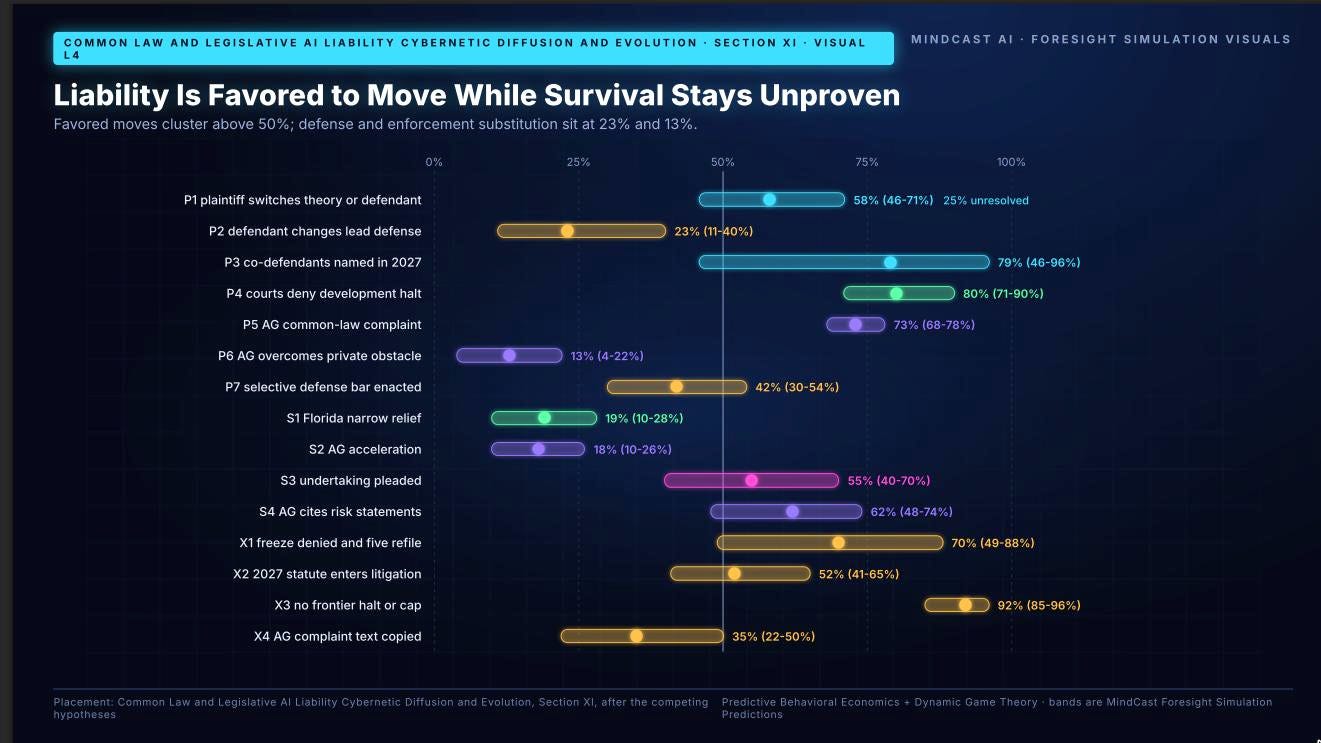
The bands favor displacement at the strategic stage. In at least one tracked case, a plaintiff is favored to change theory or defendant after a narrowing ruling by the end of 2028 (58%). Courts are strongly favored to refuse development freezes (80%), and attorneys general are favored to keep pleading common-law theories (73%). Defense substitution sits at 23% and enforcement substitution at 13%, so both remain open tests.
Primary · Plaintiffs Change Theories and Defendants While Courts Refuse Halts
P1: In at least one tracked AI-harm case where a court dismisses or narrows a negligence or product claim, the plaintiff adds a legally distinct theory or a new responsible defendant by December 31, 2028 (58%; 46-71%). Relabeling the same claim does not count. About one outcome in four stays unresolved because no qualifying ruling arrives in the window. Falsifier: a qualifying ruling occurs and no qualifying amendment follows.
P2: In two or more tracked cases, an adverse threshold ruling produces a defense absent from earlier briefing or moves a secondary defense to lead by December 31, 2028 (23%; 11-40%). The band combines the chance that two tracked cases draw qualifying rulings with the chance each defendant then changes its lead defense. The width reflects a baseline drawn from only two partly coded cases. Falsifier: post-ruling briefing repeats the earlier defense mix.
P3: A new U.S. AI-harm suit filed in 2027 names a deployer, integrator or app distributor alongside a model developer (79%; 46-96%). Co-defendants named at filing count, so the entry measures spread exposure rather than adaptation. The width reflects an uncounted filing rate. Falsifier: no qualifying 2027 filing.
P4: By June 30, 2027 at least one court denies a development-stage halt, and no court orders one (80%; 71-90%). The motions in play are Florida’s September 28 motion and the November 12 nonprofit suit. Narrower relief for minors is not a halt. Falsifier: no denial by the deadline, or any halt ordered.
P5: A new state attorney general complaint filed in 2027 against a generative AI developer or operator pleads negligence, strict products liability or public nuisance (73%; 68-78%). Florida’s 2026 complaint is the baseline and does not count. Falsifier: no qualifying complaint.
P6: A 2027 attorney general action overcomes a documented private obstacle with a claim that does not depend on the failed element (13%; 4-22%). A qualifying obstacle is a written order dismissing, narrowing or compelling arbitration of a private claim. The low band reflects how few private dismissals have yet met an attorney general filing in the same state. Falsifier: no such action.
P7: A state enacts a statute in 2027 that names an eliminated AI defense and expressly preserves at least one other (42%; 30-54%). A verified copy of California’s autonomy-defense bar in another state would push the band higher. Falsifier: no such statute.
Secondary · Enforcers Turn Developers’ Own Safety Statements Into Evidence
S1: Florida’s court grants at least one prohibition short of a development halt by June 30, 2027 (19%; 10-28%). Qualifying terms cover minors’ access, age assurance or safety representations. Falsifier: no such term granted.
S2: An attorney general case reaches fixed milestones sooner than matched private cases because of an attorney-general-specific feature by December 31, 2028 (18%; 10-26%). The entry is interpretive. Falsifier: equal or slower pace, or no attorney-general-specific feature.
S3: A plaintiff pleads voluntary undertaking against an AI developer’s published safety framework by December 31, 2028 (55%; 40-70%). The companion paper carries the same entry. Falsifier: no such count.
S4: A 2027 attorney general deceptive-practices complaint cites a supplier’s or the defendant’s published risk statements as evidence of knowledge (62%; 48-74%). Falsifier: no such complaint.
Weaker-evidence forecasts. Five secondary entries rest on thinner evidence, and each resolves by December 31, 2028:
S5: a P7 enactment traces to a named litigation event (22%; 12-32%).
S6: a court applies the economic loss rule to an AI agent claim (40%; 25-55%).
S7: a plaintiff pleads apparent authority against a deployer (35%; 22-50%).
S8: a court rules on negligent misrepresentation over AI output (30%; 18-44%).
S9: a carrier files a declaratory judgment action contesting coverage for a claim alleging harm from AI output or an AI agent by December 31, 2028 (40%; 29-51%).
Long Horizon · Appellate Doctrine Through 2030
Three entries run on the long horizon, where appellate courts rather than trial dockets decide the outcome.
S10: A state appellate court holds a generative AI chatbot to be a product for strict liability by December 31, 2030 (45%; 30-60%). Falsifier: no published opinion so holding.
S11: A federal court of appeals decides whether Section 230 reaches model-generated content by December 31, 2030 (55%; 40-70%). Falsifier: no published appellate decision on the question.
S12: A voluntary undertaking claim against an AI developer survives summary judgment by December 31, 2030 (20%; 10-32%). The entry requires S3 first. Falsifier: no such claim survives.
Shared With the Companion Paper · Courts Refuse Halts While New Statutes Enter Litigation
X1: By June 30, 2027 a court denies a frontier development freeze and none orders one, and five or more near-miss states refile chatbot bills (70%; 49-88%). The entry joins two events and makes no causal claim. Falsifier: either event fails.
X2: A 2027-enacted AI liability or duty statute is pleaded or briefed in an AI-harm case by June 30, 2028 (52%; 41-65%). Falsifier: no such filing.
X3: No state enacts a frontier-development halt or capability cap in 2027, and no court orders one (92%; 85-96%). Falsifier: any halt or cap enacted or ordered.
X4: A 2027 bill reproduces a per-violation penalty or abatement provision from a pending attorney general complaint in the same state (35%; 22-50%). Falsifier: no such bill.
Forward implication. No U.S. appellate court has yet held a generative chatbot to be a product or decided Section 230’s reach over model-generated content. Through 2027, threshold defenses will narrow at the trial level while causation and fault allocation become the decisive ground. Disconfirmation: an appellate ruling restoring a threshold defense that ends the tracked chatbot cases before the causation contest begins.
Takeaway: liability is favored to move through new theories, new defendants and public enforcers rather than court-ordered halts, and whether it survives those moves is the question the next evidence answers.
XII. Six Stakeholder Strategies
Six stakeholders each face one liability decision, listed with its available actions and likely countermove. Each entry also names the constraint and the decision window. Severity and probability are separate axes; probability comes from the linked Simulation Predictions. Entries describe unilateral moves and are not legal, investment or fiduciary advice.
1. State lawmakers and committee staff. 🏛️
Decision: where common law already supplies a workable remedy and where a statute adds value without merely relocating the contest.
Linked Simulation Predictions: P7; S5; S3; S10.
Exposure: a statute that removes one defense while leaving its substitute in place, producing the same outcomes at higher litigation cost (severity moderate · probability 42% for a selective defense bar in 2027, P7).
Actions: staff map each proposed defense limit against the substitute defense it leaves open; sponsors draft preserved-defense clauses deliberately rather than by default; committees take testimony from both plaintiff and defense bars.
Likely countermove: industry seeks safe harbors that convert state-of-the-art evidence into a defense.
Constraint and window: federal immunity and constitutional limits survive any state statute.
Residual exposure: harms outside state tort law remain beyond reach.
2. State insurance regulators. 🏛️
Decision: whether to treat doctrinal change as a change in substantive liability, in coverage or in both.
Linked Simulation Predictions: S9; X2; S10.
Exposure: coverage gaps that widen as new theories reach policies drafted for old ones (severity moderate · probability 52% that a 2027 statute enters litigation by mid-2028).
Actions: form-review staff classify AI exclusions by the doctrine they answer; market-conduct staff ask carriers which AI theories they reserve on; the regulator separates frequency effects from severity effects in rate review; staff model regulatory responses to liability change separately from responses to carrier coverage practices.
Likely countermove: carriers argue that new theories justify broader exclusions.
Constraint and window: regulators review forms but cannot change tort doctrine.
Residual exposure: declaratory-judgment outcomes set coverage before regulators act.
3. Commercial liability carriers. 📊
Decision: which doctrines to underwrite, exclude or build into deployer and integrator accounts.
Linked Simulation Predictions: P1; P3; S9.
Exposure: defense costs from duty-to-defend obligations triggered by any covered theory in a mixed complaint (severity high · probability 79% that a 2027 suit names a co-defendant beside the developer).
Actions: claims leadership tags open AI matters by theory pleaded; actuarial models defendant-substitution scenarios in which deployers and integrators replace developers; product teams align exclusions with the doctrines they intend to answer; reserving teams test how defense substitution and claims surviving dismissal change severity and defense expense.
Likely countermove: plaintiffs add a covered theory to reach defense coverage.
Constraint and window: policy terms reset only at renewal.
Residual exposure: silent AI exposure in issued policies.
4. AI developers. 💼 ⚖️
Decision: whether to defend on causation, narrow published safety commitments, indemnify deployers or seek statutory safe harbors.
Linked Simulation Predictions: P2; S3; S4; S12.
Exposure: undertaking and knowledge claims built from published frameworks and internal warnings (severity high · probability 55% that undertaking is pleaded by 2028).
Actions: counsel distinguishes protective commitments from aspirational statements in every published framework; litigation teams prepare causation and fault files before threshold rulings issue; product teams document design alternatives considered and rejected.
Likely countermove: plaintiffs plead undertaking against the documented program, and nuisance plaintiffs cite past risk statements as proof of knowledge.
Constraint and window: commitments made to regulators and customers cannot be withdrawn without notice.
Residual exposure: reliance by users who acted on earlier commitments.
5. Deployers, integrators and service providers. 💼
Decision: how to allocate responsibility for agent conduct and model modification in contracts.
Linked Simulation Predictions: P1; P3; S6; S7.
Exposure: apparent-authority liability for agent transactions and substitution as defendant when developers invoke substantial modification (severity high · probability 79% for co-defendant naming; 35% for an apparent-authority pleading against a deployer, S7).
Actions: contracts teams define the limits of agent authority in customer-facing terms and choose whether agency, electronic-transaction or contract rules govern; delivery leads log configuration changes that could count as modification; insurance buyers confirm professional and crime cover for agent transactions.
Likely countermove: developers shift responsibility downstream through modification and intermediary defenses.
Constraint and window: the economic loss rule varies by state, so contract terms carry most of the protection.
Residual exposure: liability to third parties does not follow contractual allocation.
6. Independent auditors and assurance providers. ⚖️
Decision: what scope and reliance limits to place on AI certifications.
Linked Simulation Predictions: S3; S8.
Exposure: negligent misrepresentation and undertaking claims by third parties who relied on a certification (severity moderate · probability 55% that undertaking is pleaded by 2028).
Actions: engagement partners state reliance limits and intended users in every report; quality teams separate assurance standards from statutory safe-harbor eligibility; counsel reviews public statements about certified controls and separates evidence of knowledge from actionable reliance and from an actual undertaking.
Likely countermove: plaintiffs name certifiers when developers and deployers are judgment-proof or capped.
Constraint and window: limited-assurance terms do not bind third parties who never agreed to them.
Residual exposure: certification can become evidence of knowledge when a control fails.
Courts and attorneys general act throughout as the institutions that resolve each contest. Their choices are forecast in the predictions rather than addressed as stakeholder strategies.
The map below gives each banded prediction a resolution date and a severity if it resolves true. It also names the stakeholder most exposed, one action and the exposure that remains.
P1 (58%). Resolves by: Dec 31, 2028 · Severity: high · Most exposed: developers and carriers · Action: plan for a repleaded claim after each narrowing win · Residual exposure: the substitute claim may still fail
P3 (79%). Resolves by: Dec 31, 2027 · Severity: high · Most exposed: deployers and integrators · Action: review indemnity and additional-insured terms · Residual: professional liability exposure grows
P4 (80%). Resolves by: Jun 30, 2027 · Severity: low · Most exposed: developers and investors · Action: plan on no court-ordered halt through mid-2027 · Residual: narrower relief for minors stays possible
P5 (73%). Resolves by: Dec 31, 2027 · Severity: high · Most exposed: developers and carriers · Action: prepare for common-law counts in 2027 attorney general complaints · Residual: penalties may sit outside coverage
S1 (19%). Resolves by: Jun 30, 2027 · Severity: moderate · Most exposed: operators serving Florida minors · Action: prepare age-assurance controls as a contingency · Residual: low but real injunction risk
S2 (18%). Resolves by: Dec 31, 2028 · Severity: low · Most exposed: defense counsel · Action: do not assume attorney general cases move faster · Residual: the timing advantage stays unproven
S3 (55%). Resolves by: Dec 31, 2028 · Severity: high · Most exposed: developers and auditors · Action: review safety frameworks for undertaking language · Residual: undertaking claims may survive dismissal
S4 (62%). Resolves by: Dec 31, 2027 · Severity: high · Most exposed: developers and suppliers · Action: align published risk statements with internal practice · Residual: statements become evidence of knowledge
X1 (70%). Resolves by: Jun 30, 2027 · Severity: moderate · Most exposed: investors · Action: plan for refiling without court-ordered halts · Residual: either half can fail
X2 (52%). Resolves by: Jun 30, 2028 · Severity: high · Most exposed: counsel and carriers · Action: map 2027 statutes to pending claims · Residual: statutes may enter litigation after mid-2028
X3 (92%). Resolves by: Dec 31, 2027 · Severity: low · Most exposed: developers and investors · Action: plan on no frontier halt in 2027 · Residual: a halt would change the game
X4 (35%). Resolves by: Dec 31, 2027 · Severity: high · Most exposed: defendants in attorney general suits · Action: defense counsel compares each 2027 bill with pending complaint terms within 30 days of filing · Residual: copied penalties raise per-violation exposure
Takeaway: each stakeholder’s exposure moves when a doctrine shifts, and reducing it under one doctrine can raise it under another.
What to Watch · Whether Redirected Claims Survive and Pay
The dominant fork is plaintiff recovery: whether a substituted theory or defendant survives its first dispositive ruling and then pays. P1 measures the move, and the survival rate decides whether the move matters to a carrier. The observables below arrive in date order.
By June 30, 2027: rulings on Florida’s freeze motion and the nonprofit suit resolve P4, S1 and the court half of X1.
Through 2027: new attorney general complaints show whether enforcers plead common-law counts (P5) and cite developers’ risk statements (S4).
Through 2027: new AI-harm suits show how often plaintiffs name deployers and integrators beside developers (P3).
After each adverse threshold ruling: the next dispositive brief shows whether defendants change their lead defense (P2).
Through December 31, 2028: amended complaints after narrowing rulings resolve P1, and new counts resolve S3.
Takeaway: the 2027 filings resolve where liability moves, and the 2028 rulings begin to resolve whether it pays.
Conclusion · Plaintiffs Are Favored to Move Liability, but Recovery Is Unproven
In the tracked cases, a narrowing ruling is favored to prompt at least one move to another theory or defendant by 2028 (58%), and attorneys general are favored to keep pleading common-law theories (73%). Courts are favored to refuse development halts, so the contest stays inside ordinary tort, enforcement and coverage. Carriers that read doctrine as well as exposure will see which policy responds before the claim arrives. Whether redirected claims survive and pay is the question the next two years answer.
Working With MindCast · Four Commissions Keyed to the Liability Forecasts
AI liability exposure now moves at the pleading stage, years before any verdict. Most carriers and counsel see the move only when a claim arrives. MindCast AI builds Foresight Simulations that show where a claim goes next, run on the MindCast AI Proprietary Cognitive Digital Twin Foresight Simulation that produced the bands above.
Doctrine-to-underwriting translation for carriers and brokers. MindCast turns the translation list in Section VIII into a book-specific view. It shows which insureds sit in the middle of the AI stack (P3), which published statements create undertaking exposure (S3 and S4) and which attorney general penalties may fall outside coverage (P5). The deliverable is an exposure map by insured class before the next renewal.
Adverse-ruling war gaming for developers and defense counsel. Before a threshold ruling lands, MindCast simulates which theory and defendant the plaintiff adds next. The same run shows how attorneys general respond where the private claim fails (P1, P5 and P6). Counsel see the substitute claim before it is filed.
Safety-statement review for developers, deployers and auditors. MindCast tests published frameworks, model cards and certifications against the undertaking and corporate-knowledge theories now entering complaints (S3 and S4). The review separates statements that strengthen a reasonableness defense from statements that supply a plaintiff’s evidence.
Revalidation alerts when the game changes. When one of the five events in Section X’s validity list occurs, MindCast reruns the affected forecasts. Subscribers learn which positions survive, convert or strand before their next annual review.
First step. Send the state, bill family or case you are tracking to mcai@mindcast-ai.com, and MindCast maps it to the forecasts that govern it. Full offerings, including complex litigation modeling, sit at www.mindcast-ai-simulation.com.
Appendix A · Companion Paper and MindCast Works
The companion paper, trackers and MindCast works below supply the evidence and frameworks behind this paper; each entry states its role in one line.
Predictive Game Theory and Common Law Dynamics Foresight into Which Failed 2026 State AI Bills Return in 2027 (companion publication). Forecasts the legislative side of the feedback loop.
The Cybernetics of AI Liability Across the Common Law and Legislative Systems (series introduction). The system view that joins both publications.
AI Liability Cybernetics Interactive War Gaming. Series war gaming board built on both publications; source of every screenshot.
MindCast AI Enforcement and Litigation Tracker. The case, doctrine and defense inventory behind Sections II through VI.
The Computational Era Operationalizes Cybernetics and Predictive Game Theory (May 18, 2026). The cybernetic frame behind the series.
MindCast State AI Liability and Insurance Legislation Tracker. The enacted and failed provisions behind Section VII, including the Model Agentic Liability Code tab.
Agentic Foreseeability and the Modern Duty of Care for AI Agents (Oct 29, 2026). The duty framework behind the negligence analysis.
When AI Agent Liability Meets Common Law and Statute (Nov 3, 2026). The closest prior treatment of the judge-made and enacted boundary.
Who Sets the Agentic Standard of Care (Oct 30, 2026). Which institution sets the agent standard first.
Who Answers for AI Claims Decisions: Insurers, Consultants and Auditors in the Second Seat (Nov 4, 2026). Governance standards as evidence; supports Section III.
How Plaintiffs Turn Insurer AI Governance Standards Into Evidence (Nov 4, 2026). The undertaking theory applied to carriers.
How Consulting and Audit Firms Become Liable for the AI Agents They Run for Clients (Nov 4, 2026). Integrator and auditor exposure.
Agentic AI Liability and Insurance Exclusions (Nov 5, 2026). Exclusions redirect claims; supports Section VIII.
West Virginia v. Snap: What OpenAI’s Published GPT-4 Limits Prove About Snap’s Knowledge (Nov 8, 2026). Imputed knowledge through a supplier’s warnings.
State Attorney General Coalitions: How Lead States Set the Template (Nov 10, 2026). The complaint-copying mechanism.
OpenAI State Attorney General Lawsuits: Two Pleading Templates Across Ten State Courts (Oct 30, 2026). The OpenAI enforcement docket.
The Calculus of Predictive Game Theory Evolution and Mutation. The method for modeling strategy change across horizons.
Agentic Claims Liability Interactive War Game and OpenAI Liability War Game. Boards for the plaintiff and defense contests.
Appendix B · Cognitive Digital Twin Roster, Decisive Forks and Evidence Still Needed
The roster, forks and contrary routes below define the game the Foresight Simulation modeled. The final list names the evidence that would firm up each weaker band.
Governing question. Which legal barriers redirect AI liability claims toward other theories or defendants, attorney general enforcement or legislation as courts and litigants adapt through 2030? Under what conditions do those substitutions produce enforceable liability rather than failed recovery?
Cognitive Digital Twin Roster
Private AI injury plaintiffs and counsel. Principal decision: which theories and defendants to plead
Commercial and economic-loss plaintiffs. Tort, contract, misrepresentation or statute
Frontier model developers. Defense mix, safety commitments and indemnities
Deployers and integrators. Which implementation responsibilities to accept or contest
Independent auditors. Scope, reliance limits and certification terms
Commercial liability carriers. Coverage, defense, reserves and exclusions
State attorneys general. Common-law counts, statutory counts and coalition strategy
Courts. Whether a theory survives a given stage
Legislatures. Whether to codify, reverse, create a safe harbor or wait
Nonprofit public-interest plaintiffs (conditional). Whether to seek injunctions against development itself
Decisive Forks
Defense adaptation. Branch A: substantive shift after a ruling · Branch B: defense mix pleaded from the start continues · Outcome state tested: substitution attempted
Plaintiff recovery (dominant). Branch A: substituted theory or defendant survives, then pays · Branch B: recovery definitively fails, or the claim stays unresolved · Outcome states tested: surviving; recovery achieved; recovery fails; unresolved
Public enforcement. Branch A: substitution or acceleration · Branch B: parallel enforcement only · Outcome states tested: all five
Legislative intervention. Branch A: codification, reversal or safe harbor tied to a litigation event · Branch B: continued judicial development · Outcome state tested: recovery achieved (remedial)
Five contrary routes stay active: termination dominance, independent attorney general parallelism and defense continuity, plus legislative stasis or protection and a federal reset on Section 230 or the First Amendment.
Hypotheses Under Test
Survival is thin. Resolves true when: fewer than half of resolved substituted claims in a fixed cohort survive their first dispositive ruling, at claim and case level
First-to-ruling. The first post-pleading ruling on a products or nuisance theory against a generative AI developer arises in an attorney general case
Causal acceleration. An attorney general case reaches fixed milestones sooner than matched private cases, on an attorney-general-specific feature
California defense shift. Post-statute defendants elevate causation, foreseeability or comparative fault above a matched pre-statute baseline
Economic-loss regimes. Florida and Washington commercial AI pleadings diverge on a matched claim set
Safety frameworks as counts. A complaint pleads undertaking or negligent misrepresentation premised on a published safety framework
Antitrust branch (conditional). After the September 18 class action survives dismissal, a coordinated safety commitment narrows or a second complaint follows
Carrier response. A dated carrier response follows the first surviving AI claim within 12 months
Evidence That Would Firm Up the Weaker Bands
Post-ruling defense filings compared with the pre-ruling baseline in at least two tracked cases. Firms up: P2 (defense substitution)
Dated inventory of private dismissals alongside attorney general filings. Firms up: P6 (enforcement substitution)
Coded 2027 vote counts and leadership positions. Firms up: P7 and S5 (enactment)
A verified copy of California’s autonomy-defense bar enacted outside California. Firms up: P7; raises the companion paper’s defense-targeting forecast
A counted 2026–2027 AI-harm filing rate with named defendants. Narrows P3
A transacting-agent docket and a count of AI coverage filings. Firms up: S6 to S9
Sources
Case statuses, defenses and enforcement figures come from the MindCast AI Enforcement and Litigation Tracker as read on November 13, 2026. Statutory provisions come from the MindCast State AI Liability and Insurance Legislation Tracker. Florida v. OpenAI: complaint (June 1, 2026); count structure; remand (September 8, 2026); injunction motion (September 28, 2026).
Nonprofit suit to freeze frontier development (November 12, 2026): Reuters via Yahoo; Just Security. Consumer antitrust class action (September 18, 2026): Daily Journal.
Doctrinal authorities: Restatement (Second) of Torts §§323, 324A and 552; Restatement (Third) of Torts: Products Liability §2; Restatement (Third) of Torts: Liability for Economic Harm; Restatement (Third) of Agency §2.03; Uniform Electronic Transactions Act; Cal. Civ. Code §1714.46; 47 U.S.C. §230.
Cases: Lemmon v. Snap, 995 F.3d 1085 (9th Cir. 2021).
Additional cases: Anderson v. TikTok (3d Cir. 2024); Amazon.com Services v. Perplexity AI, No. 26-1444 (9th Cir. Aug. 4, 2026); Garcia v. Character Technologies (M.D. Fla.); Moffatt v. Air Canada, 2024 BCCRT 149 (comparative only); United States v. Bank of New England, 821 F.2d 844 (1st Cir. 1987); Tiara Condominium Association v. Marsh & McLennan, 110 So. 3d 399 (Fla. 2013); Eastwood v. Horse Harbor Foundation, 241 P.3d 1256 (Wash. 2010); Affiliated FM Insurance v. LTK Consulting, 243 P.3d 521 (Wash. 2010).