
AI Repricing Series. Companion frameworks: AI Repricing Cycle 2026 · Escape from the AI Repricing Cycle · AI Data Center Credit Risk · AI Data Center Authorization Bargaining Power. The full foundation set appears in the appendix.
Executive Summary
Demand did not break in July. The financing and permission system began charging for the cost of meeting it. Four hyperscaler earnings reports in nine days showed the market paying for one thing: conversion evidence relative to incremental capital.
The backdrop is the June 2026 repricing, when markets cut AI infrastructure valuations on doubts that the buildout would pay. Firms that register their own economics re-rate, and the re-rating is the registration dividend. Firms that leave the market’s question unanswered reprice.
The July reactions split against every simple story. Microsoft rose about 15 percent and Amazon nearly 14 percent despite Amazon crossing into negative free cash flow. Alphabet fell roughly 7 percent despite a $514 billion cloud backlog, and Meta fell about 9 to 10 percent as free cash flow collapsed 91 percent.
The thesis follows directly. The market no longer asks whether demand exists. The market asks whether contracted demand can convert through six gates: customer performance → authorization → energization → utilization → revenue → free cash flow.
A hierarchy came with the question. Capital guidance without demand loses. Backlog without sufficient conversion coverage may still lose, and registered conversion relative to incremental capital earns the premium.
MindCast approaches the question differently from narrative research. AI Repricing Cycle 2026: Microsoft, Nvidia, Oracle, Meta and the Validation Tests Every AI Layer Now Faces (hereafter AI Repricing Cycle) published a crossing calendar and a scored prediction register before events resolved. Microsoft, Oracle, Amazon and the Escape from the AI Repricing Cycle (hereafter Escape) converted the diagnosis into registration-lag doctrine.
Every claim carries a falsifier, a checkpoint and a settlement source fixed in advance. A multi-party cognitive digital twin foresight simulation generates the probability bands, and cognitive digital twins (CDTs) model the actors inside it.
The paper proceeds in three movements. Sections I and II state the July evidence and score the prior register against it. Sections III through V develop the conversion mechanism and revise the crossing calendar, and Sections VI and VII follow the repricing into credit markets and statehouses.
Seven AIRC-IV predictions test the conversion layer. They cover backlog deceleration; the Meta and Alphabet free-cash-flow crossings; firm-specific credit differentiation; authorization disclosure; conversion reporting; and Meta’s external-compute strategy. Section IX states their checkpoints, falsifiers and settlement sources.
🏛️ Policymakers: Authorization is now a priced input to the buildout. Pause power converts into bargaining power denominated in developer financing terms.
💼 Executives: Conversion disclosure outperforms commitment disclosure. Publish metrics that sit deep in the conversion chain before the market demands them.
⚖️ Counsel: A published backlog is a representation surface. The conversion telemetry behind it is the exhibit the next securities complaint requests.
📊 Investors: Price the gates, not the backlog. Dispersion across issuers is the investable signal in equity and credit alike.
I. What July Registered
Four earnings reports in nine days supplied the cycle’s first full comparative test, with each firm exposing a different capital-conversion configuration.
Microsoft reported fiscal fourth-quarter revenue of $90.0 billion on July 29, up 18 percent. Conversion evidence carried the day. Azure growth accelerated to 43 percent and Azure crossed $100 billion in annual revenue within total Microsoft Cloud revenue above $214 billion. Commercial remaining performance obligations (RPO) rose 84 percent to $678 billion.
Adoption and efficiency registered beside the demand. Copilot paid seats expanded from the prior quarter’s more than 20 million to more than 30 million, with quarterly net additions more than doubling. Management quantified up to 40 percent better performance per watt from its own silicon and application-level GPU-cost reductions of 84 to 89 percent. Calendar-2026 capital expectations stayed economically unchanged at approximately $175 billion after lease reclassification, and the stock rose approximately 15 percent.
Amazon reported the next day and crossed on schedule. Revenue reached $200.6 billion, up 20 percent, while Amazon Web Services (AWS) grew 37 percent at a 39 percent operating margin. The AI and custom-chip businesses each passed a $25 billion annual run-rate.
Trailing-twelve-month free cash flow printed negative $7.6 billion, the exact crossing AI Repricing Cycle dated to this window. Management raised capital guidance to $220 billion and cited a $496 billion AWS backlog on the call, and the stock rose nearly 14 percent.
Alphabet reported July 22 and supplied the decisive counterexample. Google Cloud grew 82 percent to $24.8 billion at a 35.6 percent operating margin, and the cloud backlog reached $514 billion.
Free cash flow still turned negative for the first quarter in company history as capital spending doubled to $44.9 billion. Guidance rose to $195–205 billion in the second upward revision of the year, and shares fell roughly 7 percent. Registered backlog and measurable monetization did not offset a cash crossing paired with another capital increase.
Meta reported strong advertising and fell hardest. Revenue reached $60.8 billion with ads up 27 percent. Quarterly capital expenditure of $31.1 billion consumed roughly 98 percent of operating cash flow, and free cash flow fell 91 percent to $784 million.
Full-year guidance rose to $130–145 billion, and management publicly outlined an external-compute opportunity without attaching a quantitative metric. The stock fell about 9 to 10 percent.
The four reports isolate the variable. Microsoft and Amazon connected spending to adoption, margins and efficiency. Both re-rated.
Alphabet published the commitment metric without the cash pairing and repriced. Meta published the spending without comparable conversion evidence and repriced harder.
II. The First Scoring Cycle
Prior installments registered fourteen predictions with falsifiers, checkpoints and settlement sources fixed in advance. The table scores them against the July record. Statuses are Settled, Open, Trigger Review or Untriggered.
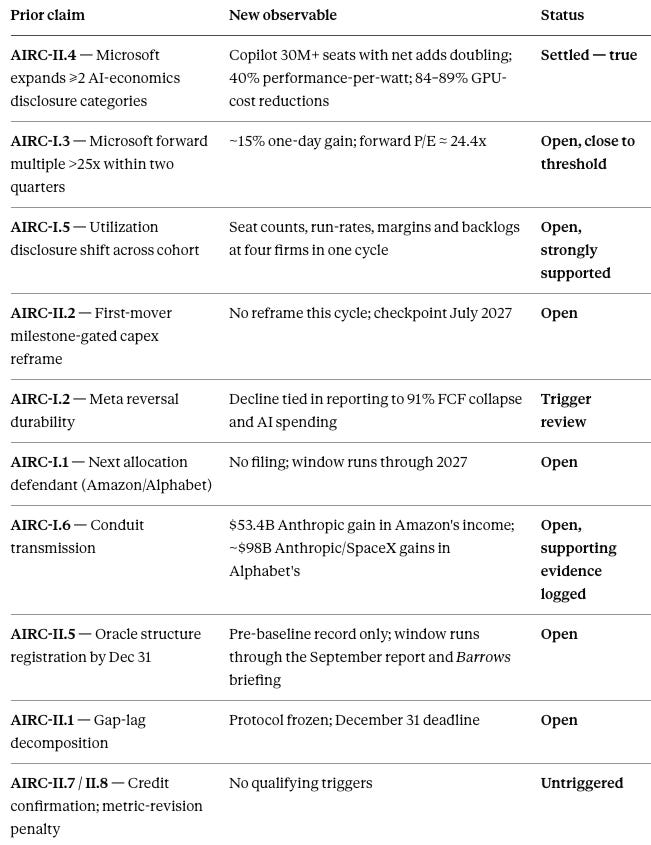
AIRC-II.4 settles true because Microsoft added qualifying adoption and capital-efficiency disclosures. AIRC-I.2 enters trigger review because reporting linked Meta’s decline to its free-cash-flow collapse and AI spending, with the review publishing alongside the December scoring note.
AIRC-I.6 remains open because the investment gains demonstrate conduit exposure but not the stress transmission required for settlement. All other entries retain their published checkpoints.
AIRC-II.4 settles true. AIRC-I.5 has accumulated strong supporting evidence, while the remaining entries await their registered triggers and checkpoints.
III. Conversion, Not Commitment, Earned the Premium
Escape staked AIRC-II.2 on a first mover reframing capital guidance as milestone-gated. No firm pulled the lever this cycle, and the entry stays open to its July 2027 checkpoint. What the quarter revealed is which registration the market pays for: firms earned the premium by connecting spending to conversion.
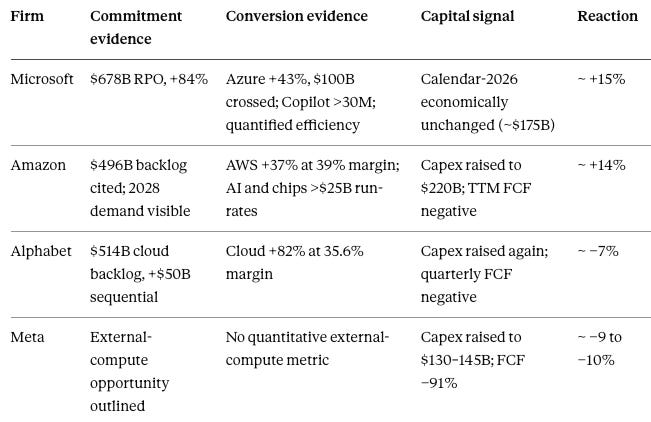
Two structural readings fall out of the rows. First, the market accepted a cash-flow crossing when conversion stood beside it and rejected a crossing paired with an unmatched capital increase. The crossing itself is not the corrective event; the crossing without conversion evidence is.
Second, commitment metrics rank below conversion metrics but above bare spending. Alphabet’s backlog cushioned a fall Meta took at full force.
One ratio organizes the market’s response to each new capital increase:
Marginal Conversion Coverage = Δ Expected Cash Conversion ÷ Δ AI Capital Commitment
Marginal Conversion Coverage measures whether newly registered conversion economics justify the latest increase in capital. Microsoft and Amazon registered stronger coverage in July. Alphabet registered exceptional cloud conversion but weaker consolidated coverage relative to another capital increase, and Meta registered the capital before publishing a quantitative external-compute conversion metric. The ratio remains a working construct until simulation tests its calibration.
Game theory supplies the payoff structure. Conditionality shrinks the strategy set and signals surrender inside the Nash capex trap AI Repricing Cycle mapped, while disclosure changes only the market’s information. Predictive Game Theory Meets the Era of AI — Operationalizing Fudenberg’s Research Agenda with Cognitive Digital Twins supplies the formal result: belief-updating moves weakly dominate strategy-shrinking moves in a mutating game, which is why no firm gated.
Behavioral economics supplies the salience rule. Markets punish the most visible unmatched number and reward the metric closest to cash. Predictive behavior emerges from the combination: the premium tracks how deep in the conversion chain the disclosed variable sits.
💼 Executives should read the table as a disclosure playbook. The next earnings cycle rewards gate-depth metrics, not larger commitment figures.
IV. Financeable Backlog: The Conversion Gates
Every escape instrument becomes the next cycle’s exposure, and the quarter’s instrument is no exception. Three cohort firms now carry published forward-commitment metrics measured in the hundreds of billions of dollars. Escape‘s metric-substitution finding warned that institutions stabilize around a measurable proxy after the market changes the outcome it wants measured, and named backlog and orders as the hazard class. Alphabet’s quarter shows the market already discounting the proxy.
The mechanism states cleanly. Registered backlog becomes valuable only to the extent that the six gates make it convertible. One working construct organizes the gates:
Financeable Backlogₜ = Contracted Demand × P(Customer Performance ∩ Authorization ∩ Energization ∩ Utilization by t) × Cash-Conversion Margin × Discount Factorₜ
The joint probability preserves dependence among the gates, and the discount factor prices the cost of waiting for them to clear. The time horizon distinguishes backlog expected to convert within two years from an equivalent nominal commitment requiring ten. The construct routes the CDTs and awaits simulation before any calibration attaches. Financeable Authorization Coverage in AI Data Center Credit Risk — Permitting, Curtailment, and the Cost of Capital(hereafter Data Center Credit Risk) measures the authorization gate at project level; Financeable Backlog is the firm-level analog running the full chain to cash.
Representation surface grows with each published figure. A $678 billion or $514 billion number is a statement every subsequent quarter can contradict, and the contradiction now carries the weight the market assigned the metric on the way up. Deceleration, cancellation or counterparty concentration each qualify as candidate corrective events. The discoverable-knowledge problem in The Duty to Foresee — AI Deployment Readiness as Prospective Governance, and the Arrival of Agentic Duty of Care applies in full: whatever internal conversion telemetry sits behind a published backlog is the exhibit the next complaint requests.
Counterparty concentration sharpens the hazard. Oracle carries $638 billion of RPO with roughly $300 billion concentrated in one counterparty, against a BBB− rating. The diligence question updates accordingly: for every published backlog, ask what share one counterparty carries and which gates stand between the contract and the megawatts.
⚖️ Counsel should treat every published backlog as a litigable representation. 📊 Investors should demand the recognition schedule behind it.
Contact mcai@mindcast-ai.com to partner with us on Predictive Game Theory AI in Law and Behavioral Economics. We specialize in predictive simulations for Complex Litigation, Innovation Economics, Geopolitical Risk Intelligence and Legacy Innovation. See more about MindCast series at our new website MindCast Corporate.
To test our predictive simulation AI system, in 2026 we simulated the Super Bowl and the World Cup. See 🏈 Super Bowl LX — AI Simulation vs. Reality | ⚽ The 2026 World Cup Final Simulation Validation
To deep dive on MindCast works upload the URL of this publication into any LLM (preferably Google AI mode) and prompt ‘reconstruct MindCast framework with three degrees of cited sub links.’ See Live-Fire Game Theory Simulators, Runtime Predictive Infrastructure, MindCast Foresight Prediction Simulations, Synthesizing Behavioral Economics + Game Theory.
Working With MindCast
MindCast runs two service lines on one method. Market foresight intelligence grades earnings disclosures, crossings and credit events against the conversion-gate map. Disclosure exposure intelligence maps the representation surfaces beneath them: backlog, guidance and conversion metrics, the seams where investor relations ends and securities exposure begins.
The foresight simulation predictions in this paper are the market line applied to the conversion layer now pricing across equity and credit. Every engagement below runs on the same methodology.
💼 CFO, treasury and investor-relations teams can commission a conversion-disclosure audit: the current disclosure set scored against the six gates and the gaps between it and what Microsoft and Amazon registered in July. The audit prices Marginal Conversion Coverage on the next capital increase and times issuance against the crossing calendar.
📊 Investors and lenders can commission a crossing-and-coverage screen across a named portfolio: where each holding sits on the crossing calendar, what Financeable Backlog implies by gate probability, and which issuers carry spread-differentiation exposure under AIRC-IV.4. The screen states what each firm’s next report must register to hold its multiple.
⚖️ Securities counsel can commission a representation-surface review: published backlog and conversion claims mapped against the telemetry discovery would reach, corrective-event scenarios keyed to the AIRC-IV.1 deceleration trigger, and disclosure posture ahead of the crossing quarter.
🏦 Credit analysts and rating teams can commission an issuance-differentiation screen: cohort debt mapped against the matched-benchmark spread test, an authorization-risk language audit keyed to AIRC-IV.5’s disclosure baseline, and the collateral assumptions behind GPU-backed financing channels.
Entries move only when the public record moves, and engagements buy application of the map rather than revision of it. Engagements run as CDT simulations with dated, falsifiable outputs.
V. The Crossing Calendar Accelerated
The crossing calendar dates each firm’s arrival at the point where AI capital spending pushes free cash flow negative. The quarter scored the calendar in both directions. One projection landed inside its stated window, one arrived early, and the full cohort now sits closer to the line than the published schedule assumed.
Oracle already crossed. Fiscal 2026 free cash flow ran negative $23.7 billion, the calendar’s anchor. Oracle now meets its registration test carrying an S&P downgrade to BBB− and a $45–50 billion raise plan, with Barrows v. Oracle, the securities action over its AI disclosures, in motion-to-dismiss briefing through December.
Amazon crossed on trailing free cash flow, on schedule. Trailing free cash flow printed negative $7.6 billion for the period ended June 30, the exact window AI Repricing Cycle published from Epoch AI’s filings-based model. The market’s response supported the conversion reading: the crossing arrived beside registered conversion and re-rated upward.
Alphabet crossed quarterly, ahead of schedule. The inherited projection read approximately Q1 2027, and Alphabet posted the first negative quarter in company history in July. Trailing free cash flow remains positive at $53.3 billion. AIRC-IV.3 tests whether the quarterly crossing becomes a trailing one, and Section VI carries the funding stack behind the spend.
Meta reached the threshold zone. Quarterly free cash flow of $784 million against $31.1 billion of capital expenditure puts the inherited crossing date two to three quarters early on straight-line arithmetic. AIRC-IV.2 registers the pull-forward. The compressed window also shortens the clock on converting the outlined external-compute opportunity into a registered metric.
Microsoft anchors the cohort. The cohort’s latest projected crossing belongs to the firm that just cleared its validation appointment with calendar-year capital economically unchanged. Microsoft did not cross, registered conversion anyway and re-rated.
The takeaway is structural. Crossings arrive early because capital guidance keeps rising faster than the prior models assumed, and every upward revision pulls the crossing date toward the present unless conversion improves fast enough to offset it.
VI. Credit Markets Reprice the Buildout
Credit spreads on hyperscaler debt activated this month as the deciding signal AI Repricing Cycle named. Data Center Credit Risk established on August 11 that lenders now weigh permitting readiness and community standing directly in credit assessment. The translation applies at cohort scale: authorization uncertainty becomes a credit spread when uncertainty changes the timing, probability or recoverability of the cash flows supporting capital.
The absorption numbers arrived first. AI hyperscaler debt issuance reached $220 billion through August 10. Technology spreads reached 89 basis points, nine wider than the overall investment-grade market, and Amazon’s $25 billion offering required roughly 120 basis points over Treasuries. Debt already funds roughly a third of hyperscaler capital expenditure and is heading toward 35 percent against $1.14 trillion of projected 2027 spending.
Alphabet’s funding stack tells the story from the issuer side. The company carries $98.2 billion of long-term debt after raising more than $85 billion over the prior year. The $84.75 billion equity package includes a potential $40 billion at-the-market program rather than cash fully received. Capital markets increasingly supplement retained earnings in financing the buildout; what changed is the scale and the price.
One cohort rating action has already landed. S&P downgraded Oracle to BBB− against $638 billion of RPO, negative free cash flow and a $43 billion debt year. Meta’s Hyperion vehicle raised approximately $29.5 billion in the largest non-merger high-grade bond sale on record, distributing financing outward while retaining contractual exposure.
NVIDIA extends the channel furthest. Six financial institutions signed memorandums of understanding to mobilize more than $500 billion of GPU-backed financing for buyers without the rating or cash to purchase silicon outright. NVIDIA’s five-year credit default swap spread roughly doubled since late May.
Two collateral assumptions sit underneath the channel: authorization holds and GPUs retain value over a debt tenor. Neither is settled, and Data Center Credit Risk carries the residual-value test as entry P16 of its own project-level prediction register.
Discrimination, not distress, is the signal worth reading. Recent investment-grade corporate offerings continue to clear, but at increasingly differentiated cost and one downgrade in.
The credit market is performing Section III’s conversion analysis with a longer memory. Volume rises and velocity falls. Dispersion widens, and only dispersion is investable. AIRC-IV.4 registers the event-form test at cohort level, and AIRC-II.7 stays untriggered because no qualifying equity drawdown has demanded credit confirmation.
📊 Investors should track issuance spreads by name, not by sector. The dispersion is where the repricing becomes tradable.
VII. Authorization Delay Accrues Against Borrowed Capital
States joined the repricing in the same three weeks credit did, and the coincidence is the mechanism. Texas paused a 474-gigawatt interconnection queue for audit on August 3. The Electric Reliability Council of Texas (ERCOT) targets completion by December, and the Public Utility Commission of Texas (PUCT) will seek expanded statutory authority when the legislature convenes in January.
Pennsylvania followed on August 18. Executive Order 2026-05 conditions state permits on binding Governor’s Responsible Infrastructure Development (GRID) commitments and prior local approval. The order removes data centers from fast-track permitting, bans state nondisclosure agreements with developers and ties tax exemptions to compliance.
Two of the largest hosting states repriced authorization in one month. Neither event settles an entry in the companion series’ bargaining-power register (MC-BP); both supply new evidence for the mechanism.
Authorization delay accrues against drawn money as Expected Delay Carry, and sufficiently irreversible committed capital lowers a sponsor’s ability to wait. Corporate capital carries interest regardless of whether the infrastructure program it supports clears authorization on schedule. Every month of authorization delay after capital is drawn carries financing cost, which converts the state’s pause power into bargaining power denominated in the developer’s own financing terms.
Authorization is also an early gate in Section IV’s conversion chain. A backlog whose megawatts cannot clear authorization is contracted demand with a conversion probability the market has begun pricing at the state line. The feedback loop closes the system:
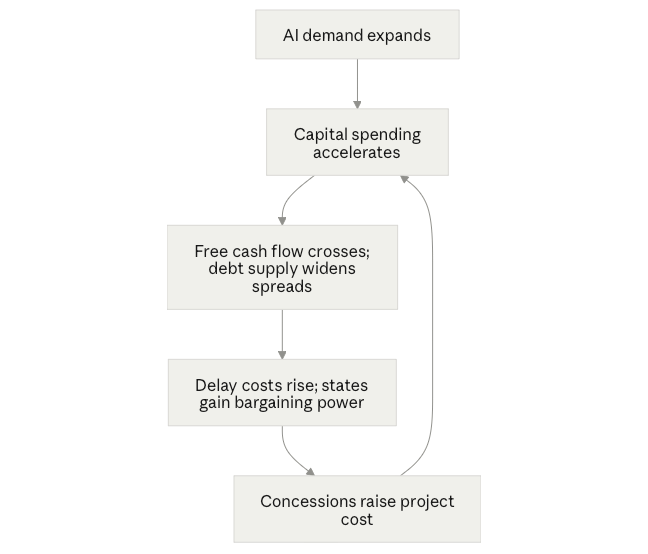
Higher financing costs raise the price of delay, and a higher price of delay increases the developer’s willingness to concede. Concessions raise project cost and feed the next round of capital requirements. The loop continues until one of four conditions arrives: demand weakens; financing conditions ration marginal projects; conversion improves enough to restore coverage; or authorization supply expands. AIRC-IV.5 tests for the first documentary evidence of the coupling: authorization risk named in the corporate financing record.
🏛️ Policymakers hold a strengthening negotiating position and should price it deliberately. Concession terms set now become the template the next legislature inherits.
VIII. Open Predictions and Unsettled Tests
Four appointments structure the remainder of 2026. NVIDIA reports in late August and tests AIRC-I.4, the registered claim that NVIDIA reprices through customer financing limits rather than its own execution. Every major customer just raised or maintained enormous capital programs, so any drawdown on the print is correspondingly diagnostic.
Oracle reports its fiscal first quarter in September, the first reporting window that can score AIRC-II.5, the registered claim that Oracle’s financing materials will distinguish ownership from obligation by December 31. The Barrows briefing prices escalation lag in a courtroom over the same months.
Meta’s next two quarters test AIRC-IV.2 and the external-compute registration clock together. Two scoring documents publish by December 31: the AIRC-II.1 decomposition separating June’s disclosure-gap losses from timing effects, and the AIRC-I.2 review determining whether Meta’s decline qualifies as a corrective disclosure.
IX. Predictions Registry: Conversion Layer
AIRC-IV designates the fourth block of the AI Repricing Cycle registry and tests the conversion layer. AIRC-III remains assigned to the regulatory-repricing installment, and AIRC-IV contains six primary predictions and one conditional extension.
Cohort means Microsoft, Amazon, Alphabet and Meta. Oracle serves as an adjacent comparator and does not count toward cohort settlement thresholds. Probability bands publish from the simulation and appear beside each prediction.
📐 AIRC-IV.1: The registered backlog becomes the exposure. Following publication, the first cohort firm to report year-over-year growth in a consistently defined RPO or backlog metric at less than half the average of its prior four reported year-over-year growth rates produces a two-trading-day excess return against the Nasdaq-100 tracking fund (QQQ) worse than the median QQQ-excess return of the other three cohort firms over the same window. Metric redefinitions do not trigger the entry, and firms lacking four comparable prior observations are ineligible to trigger settlement.
Event-triggered through December 31, 2027. Falsifier: the first qualifying deceleration produces a QQQ-excess return at or better than the other-firm median. Settlement: earnings materials and market data.
📉 AIRC-IV.2: Meta’s crossing pulls forward. Meta reports negative trailing-twelve-month free cash flow in its Q4 2026 or Q1 2027 results. Checkpoint: Meta’s Q1 2027 earnings. Falsifier: trailing free cash flow remains positive through the Q1 2027 report. Settlement: Meta earnings releases.
🌀 AIRC-IV.3: Alphabet’s trailing crossing follows its quarterly one. Alphabet reports negative trailing-twelve-month free cash flow by its Q2 2027 results. Falsifier: trailing free cash flow remains positive through the Q2 2027 report. Settlement: Alphabet earnings releases.
🏦 AIRC-IV.4: Credit differentiation becomes firm-specific. Following publication, at least two cohort issuers price qualifying corporate debt with matched-benchmark-adjusted issuance spreads differing by at least 50 basis points by June 30, 2027. The comparison controls for currency, seniority and duration, and the adjusted spread is each issue’s spread minus the same-day spread of a named investment-grade technology benchmark at comparable duration. Qualifying issuance is corporate debt priced after publication and expressly tied by the issuer to AI infrastructure, with the benchmark and data source named in the settlement note.
Falsifier: no qualifying adjusted differential appears by the checkpoint. Settlement: offering documents, pricing supplements and benchmark curves. Concordance: the entry tests the dispersion read from Data Center Credit Risk at event level; the two settle independently with no shared credit.
🗺️ AIRC-IV.5: Authorization risk enters the cohort financing record. Following publication, at least one cohort issuer newly adds or materially expands an explicit permitting, interconnection or authorization-delay risk in a corporate debt offering document or rating publication by June 30, 2027. The disclosure must connect the risk to AI infrastructure returns, cash flow, capital requirements or credit quality. Generic regulatory language without that connection does not qualify, and settlement runs against a baseline audit of cohort disclosures dated through publication.
Falsifier: no qualifying disclosure appears by the checkpoint. Settlement: corporate prospectuses and rating publications. Concordance: cohort corporate instruments only; project-finance documents settle the project-level register of Data Center Credit Risk (P1 through P3), and no single observable settles both registers.
🔄 AIRC-IV.6: Conversion disclosure arrives. Following publication, at least two cohort firms newly disclose a backlog-conversion or consumption metric beyond the standard twelve-month RPO split by December 31, 2027. Qualifying metrics include recognition schedules, consumption rates, cancellation or deferral rates and counterparty concentration. Qualitative statements that demand remains strong do not qualify.
Falsifier: fewer than two firms publish qualifying metrics by the checkpoint. Settlement: earnings materials and SEC filings.
Extended tier. ☁️ AIRC-IV.7: Meta’s external compute registers before the crossing. Conditional on AIRC-IV.2’s crossing arriving, Meta publishes a quantitative external-compute metric before or concurrently with the earnings release that first reports the crossing. Qualifying metrics include revenue, contracted capacity or named-customer commitments, and the band reports as P(IV.7 given IV.2) so readers do not mistake a conditional band for an unconditional forecast.
Falsifier: the crossing arrives with no qualifying metric published. Settlement: Meta earnings materials and company disclosures.
Dated checkpoints: NVIDIA earnings in late August 2026; the Oracle fiscal Q1 report in September 2026; the Barrows v. Oracle briefing through December 2026; the AIRC-II.1 decomposition and AIRC-I.2 trigger review by December 31, 2026; Meta’s Q4 2026 and Q1 2027 reports; Texas audit completion targeted for December 2026; the Texas and Washington legislative sessions convening January 2027.
X. Conclusion
AI Repricing Cycle ended on the twin law: the crossing date you never watched governs your multiple. Escape added the agency clause: the lag you never measured governs your drawdown. The scored quarter appends the conversion clause, and the hierarchy came with it.
Capital guidance without demand loses. Backlog without sufficient conversion coverage may still lose. Registered conversion relative to incremental capital earns the premium.
Backlog is no longer the endpoint but an upstream claim on the gates: customer performance → permission → power → utilization → cash conversion. Financeable Backlog prices whether those gates clear and when. Marginal Conversion Coverage prices whether the resulting economics justify the next dollar of capital.
The next repricing begins when one conversion gate fails, or when capital markets start charging materially more for the probability that it will. Equity, credit and authorization now operate as one linked system, and the AIRC-IV register tests where the linkage becomes observable next.
Engagements
MindCast runs two service lines on one method. Capital-markets foresight intelligence grades earnings disclosures, crossings and credit events against the conversion-gate map. Infrastructure exposure intelligence maps the gate surfaces beneath them: authorization, energization and utilization. The seams sit where contracted demand must become deliverable megawatts.
The foresight simulation predictions in this paper are the capital-markets line applied to the conversion layer now pricing across equity, credit and statehouses. Every engagement below runs on the same methodology.
💼 Hyperscaler and developer finance teams can commission a conversion-disclosure audit: the current disclosure set scored against the six gates and the gaps between it and what Microsoft and Amazon registered in July. The audit prices Marginal Conversion Coverage on the next capital increase and sequences new metrics to the earnings calendar.
📊 Investors and lenders can commission a crossing-and-coverage screen across a named portfolio: where each holding sits on the crossing calendar, what Financeable Backlog implies by gate probability, and which issuers carry spread-differentiation exposure under AIRC-IV.4. The screen states what each firm’s next report must register to hold its multiple.
⚖️ Counsel can commission a representation-surface review: published backlog and conversion claims mapped against the telemetry discovery would reach, corrective-event scenarios keyed to the AIRC-IV.1 deceleration trigger, and disclosure posture ahead of the crossing quarter.
🏛️ State offices and legislative staff can commission an authorization-leverage assessment: where the Texas and Pennsylvania templates migrate next, what concessions are worth when priced against developer financing cost, and a session-ready sequence for January 2027.
Entries move only when the public record moves, and engagements buy application of the map rather than revision of it. Engagements run as CDT simulations with dated, falsifiable outputs.
Appendix — MindCast Foundations
AI Repricing Cycle 2026: Microsoft, Nvidia, Oracle, Meta and the Validation Tests Every AI Layer Now Faces. Supplies the validation regime and the crossing calendar Section V scores, plus the AIRC-I register scored in Section II.
Microsoft, Oracle, Amazon and the Escape from the AI Repricing Cycle. Supplies the registration-lag doctrine Section I refines to conversion depth and the metric-substitution finding Section IV extends to published backlogs.
Agent Governance Equilibrium. Supplies the resilience instrumentation behind the recovery readings: firms re-registered economics faster than markets could harden June’s gaps into class periods.
The Dual Nash-Stigler Equilibrium Architecture. Names the two exits from the capex trap and explains why disclosure moves escape the trap’s penalty without changing the strategy set.
The Duty to Foresee — AI Deployment Readiness as Prospective Governance, and the Arrival of Agentic Duty of Care. Supplies the discoverable-knowledge problem Section IV applies to published backlogs.
Predictive Game Theory Meets the Era of AI — Operationalizing Fudenberg’s Research Agenda with Cognitive Digital Twins. Supplies the mutating-game result under which Section III’s refinement is legible: belief-updating moves weakly dominate strategy-shrinking moves.
AI Data Center Credit Risk — Permitting, Curtailment, and the Cost of Capital. Supplies Section VI’s translation from authorization uncertainty to credit spread, plus Expected Delay Carry and the dispersion read AIRC-IV.4 tests. Project-layer wagers stay in its P register.
The AI Data Center Authorization Bargaining Power ratings. Supplies the authorization-market structure Section VII couples to financing cost, read here as new mechanism evidence without settlement credit.
Appendix — Source Note
Primary records reviewed run through August 21, 2026. They include the four firms’ earnings materials and SEC filings. Amazon’s $496 billion backlog is management’s earnings-call figure.
Alphabet’s financing description follows its second-quarter call and June 2 securities filing, which distinguishes completed underwritten offerings from the potential at-the-market component.
Pennsylvania’s description follows Executive Order 2026-05 and the Governor’s implementation summary.
Credit-market figures use contemporaneous Reuters reporting. Oracle, Meta Hyperion, NVIDIA financing and residual-value figures retain the source record published in Data Center Credit Risk.
Appendix — Acronyms
AIRC: AI Repricing Cycle, the series’ running prediction registry.
AWS: Amazon Web Services, Amazon’s cloud infrastructure division.
ERCOT: Electric Reliability Council of Texas, the grid operator conducting the interconnection audit.
GRID: Governor’s Responsible Infrastructure Development, Pennsylvania’s data center standards made binding August 18.
MC-BP: the bargaining-power prediction register of the companion authorization series.
CDT: cognitive digital twin, the actor model inside the multi-party foresight simulation that generates the series’ probability bands.
PUCT: Public Utility Commission of Texas, the regulator partnered on the audit and seeking expanded 2027 authority.
QQQ: the Nasdaq-100 tracking fund, the market benchmark in AIRC-IV.1.
RPO: Remaining Performance Obligations, contracted revenue not yet recognized.