

Validation of MindCast Anthropic, Mythos, and the NSA, The First Sovereign Governance-Scarcity Event
Related works: Anthropic, Alibaba, and the Runtime Theft Problem — How Attribution Cost Moves Frontier-AI Distillation Enforcement From the Courtroom to the Statute | When AI Promises Meet the Courts
Executive Summary
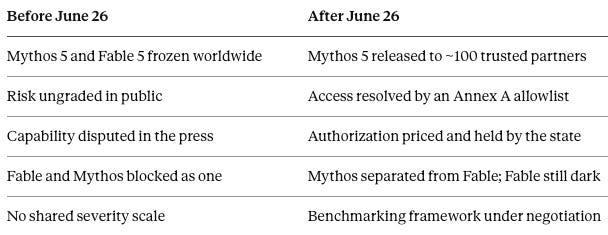
Fourteen days after the freeze, Commerce reversed course in the shape the scarcity thesis required, and the reversal validates the architecture rather than the headline. On June 26 Secretary Lutnick wrote Anthropic’s chief compute officer, Tom Brown, that appropriate safeguards now permit “certain trusted partners” to access Claude Mythos 5, lifting the license requirement for roughly one hundred named entities and their foreign-national employees. Fable 5 stayed dark. The model came back capability-intact, gated by who sits on a list, and the breach narrative that dominated the press did not become the operative public basis for the resolution. The state’s own word for the risk it addressed — diversion — names the access tier the original piece insisted was the real object, not the autonomous-compromise tier a senator had broadcast.
In brief:
The resolution — A government allowlist now decides which firms may run a frontier model, license-free, while everyone else waits behind an export gate, and the Secretary reserved the right to alter the roster at any time. Authorization, not capability, is the scarce good, and the state owns the gate.
The one-word proof — Commerce found “diversion risks” addressed, not a breach proven. Diversion grades where capability may go, never what it did. Governance resolved access and deferred capability.
The inversion — The stronger model returned first, to vetted institutions, while the weaker consumer model stayed offline. Trust-of-recipient set the order, not power-of-model — the authorization thesis proving itself on the sequence.
The honest flank — A two-week reversal stresses the magnitude claim, because a correction sized to a misread is not a correction sized to accumulated debt. The scarcity thesis survives; debt-proportionality is the exposed edge.
The prediction ledger — Five dated MindCast forecasts, rescored against the June 26 record, with one confidence band lowered and one falsification condition tightened.
Snapshot: Before and After June 26
The month’s facts compress into a single contrast, and the contrast makes the validation legible before any theory does the work.
Validation Overview
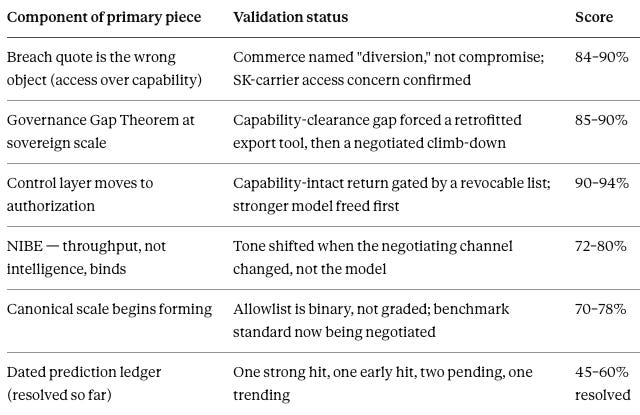
Six components of the primary piece carry the thesis, and the resolution scores each on its own evidence rather than as a single verdict.
I. The Resolution, Stated Precisely
Disaggregation comes first, because “the models are back” collapses three different facts into one and makes the analysis impossible. Hold them apart and the structure becomes legible: a strong model restored to a closed list, a consumer model still suspended, and an instrument the issuing authority can revise at will.
Commerce restored Mythos 5 — described by Anthropic as its strongest cybersecurity model, and previously its most-restricted — to about one hundred named institutions, many of them Fortune 500 firms and critical-infrastructure operators already inside Anthropic’s Project Glasswing program. A license is no longer required to export, reexport, or transfer Mythos 5 to the Annex A entities, their foreign-national staff, or Anthropic’s own foreign nationals; restrictions remain for everyone off the list. Fable 5, the public-facing model, drew no permission and no date.
Two structural features carry the rest of the argument. Lutnick reserved the right to amend the approved list at any timeand to readjust license scope should circumstances change, which converts authorization from a one-time clearance into a discretionary, revocable, sovereign-held instrument. The letter also operationalizes the deemed-export theory directly — by exempting named foreign nationals from the license requirement, Commerce resolves, roster by roster, the unsettled question of what counts as an export when the controlled item is a model rather than a machine.
II. The One-Word Vindication
Anchoring on whether Mythos “really” breached the NSA was always the wrong move, and the resolution settles why. Commerce graded the risk it cared about, and the word it used decides the case.
Commerce addressed “diversion risks” and judged safeguards adequate — language that grades where a capability can travel, never what the capability did. No Tier III autonomous-compromise finding appears anywhere in the operative determination. The breach line the Senate relayed, already walked back by the editor who published it, survived as rumor and died as a basis for policy.
The access concern even resolved to a named entity. Days before the freeze, the White House asked Anthropic to revoke South Korean carrier SK Telecom’s access to Mythos, a dispute WIRED first reported, over its parent group’s China-proximate semiconductor and energy interests; the company complied at once, with no export controls threatened then. A foreign-proximity concern routed through an allied carrier — the Tier II account the original piece held apart from the breach rumor — turned out to be a distinct, well-documented driver, not a footnote. Confidence the resolution confirms the access-over-capability thesis rather than merely failing to contradict it: 84–90%.
III. The Control Layer, Confirmed at the Authorization Tier
Value migrated exactly where Runtime Geometry placed it — to whoever governs deployment — and the remediation proves the location by what it did not touch.
The remediation cut no capability. Anthropic called Mythos “our strongest cybersecurity model” and described redeploying it to organizations that defend critical infrastructure, and reporters found no disclosed safeguard detail or performance cut. The fix lived in who may run the model, encoded as Annex A — the control layer collecting its toll one jurisdiction higher than a firm or a market, at the sovereign-authorization tier.
The sequence proves the mechanism better than any single quote. A government facing a genuine capability-shock restores the weaker model first and holds the stronger one back; Commerce did the opposite. The most capable model returned first, to the most trusted hands, while the consumer model — the one whose guardrail was the demonstrated jailbreak vector — stayed dark. Restoration order tracked recipient trust, not model power, which is the authorization-over-capability thesis written onto the timeline. Confidence the control layer resolved at the authorization tier as predicted: 90–94%.
A correction to the original cohort model rides with that proof, and a falsifiable practice pays it openly. The first piece sequenced access by individual nationality; the resolution gated by institution, admitting Annex A entities and their foreign nationals together. The governing axis is institutional trust, not a nationality ladder — the thesis strengthens while the specific sequence was wrong. Confidence the institutional-trust axis is the durable mechanism: 75–82%.
Contact mcai@mindcast-ai.com to partner with us on Cybernetic Predictive Game Theory AI in Law and Behavioral Economics. To deep dive on MindCast works upload the URL of this publication into any LLM (Google AI mode/Gemini, Claude, ChatGPT) and prompt ‘reconstruct MindCast framework with three degrees of cited sub links.’ See Live-Fire Game Theory Simulators, Runtime Predictive Infrastructure.
Recent works: Governance Scarcity: The AI Economy’s Missing Unit of Account | Agent Governance Equilibrium | Foresight Before Disclosure | Foresight for Confident AI Adoption | What Goethe’s Faust Reveals About the AI Alignment Problem | Agent Governance Equilibrium | Why AI Commoditizes Raw Prediction, Why Governance Stays Scarce, and How MindCast Prices the Gap Between Them | The Duty to Foresee — AI Deployment Readiness as Prospective Governance, and the Arrival of Agentic Duty of Care
IV. Throughput Moved When the Channel Moved
National Innovation Behavioral Economics predicts that institutional throughput, not model intelligence, binds the outcome, and the resolution supplies a clean human-layer instance. The variable that moved was a person, not a parameter.
Anthropic’s footing with the administration improved sharply after the company shifted its negotiating channel from the CEO to co-founder and chief compute officer Tom Brown, recasting the standoff as a technical problem to be worked rather than a policy fight to be won. The President softened within days. Capability never changed across that window; the interface did. Temporal Drag eased when the channel shifted register — throughput as the binding constraint, observed in personnel rather than code. Confidence this corroborates the throughput reading: 72–80%.
V. The Scale Is Still Missing — and Now Sits on a Table
The canonical-scale question was the hardest open problem in Governance Scarcity, and the resolution sharpens it on both sides at once: the instrument the state reached for is not a scale, and the scale the state lacks is now being built in plain view.
A binary allowlist is not a severity scale. An entity is on Annex A or off it, and nothing in the instrument grades how severe an incident was or how far a safeguard was bypassed. The state reached for an on/off switch precisely because no graded measure exists — which confirms, harder than scale-formation would, the original claim that the absence of the scale is the story.
The scale is nonetheless forming, and the new record locates the venue. Reporting places the active negotiation on benchmarks for grading AI jailbreak incidents — standardized ways to measure how badly a bypass goes — explicitly framed as a foundation for export-control and security policy. A separate cybersecurity executive order sets an August deadline for federal agencies to build a formal process for assessing models’ cyber capability. The unit the original piece said was being minted under duress now has a date and a table. The same week, the precedent traveled across providers when OpenAI released GPT-5.6 to a government-approved short list under the same staggered logic. Confidence a reusable tiered standard emerges and reaches a second provider within the original twelve-month window: 70–78%, rested on the benchmark negotiation rather than the allowlist.
VI. The Magnitude Flank, Named
A falsifiable practice partitions its own thesis into what an outcome strengthens and what it stresses, and the two-week climb-down does both. Naming the exposed edge is the discipline, not a concession.
A fourteen-day reversal feeds a competing read: the original freeze overreacted to a Tier I event. The read strengthens the narrow-account prediction. The same read dents the magnitude claim — that the correction was sized to governance debt accruing across an unmanaged gap, the mechanism Agent Governance Equilibrium models. A correction sized to an error is not a correction sized to a debt.
The split is clean, and only one half is exposed. The scarcity-and-no-scale thesis holds under either reading, because a correction priced without a scale is the phenomenon regardless of what triggered it. The debt-proportionality mechanism is the vulnerable claim, and the next sovereign incident — its size measured against its trigger — is the test that confirms or embarrasses it.
VII. The Thesis Under Every Reading
Four explanations of the June event still circulate, and the thesis survives all four — the strongest test a structural claim can pass, since its validity stops depending on which version of the facts wins.
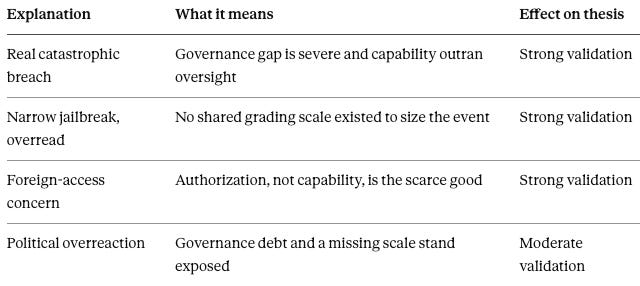
No surviving reading returns the analysis to a world where capability is scarce, oversight is graded, and authorization is free. Every branch lands on the same structural floor, which is why the catalyst can fade without taking the field with it.
VIII. The Ledger, Rescored
Each call carries its original band, the revised band, and the condition that would prove it wrong. The table scores direction and confidence; the falsification conditions beneath it keep the calls hard rather than hedged.
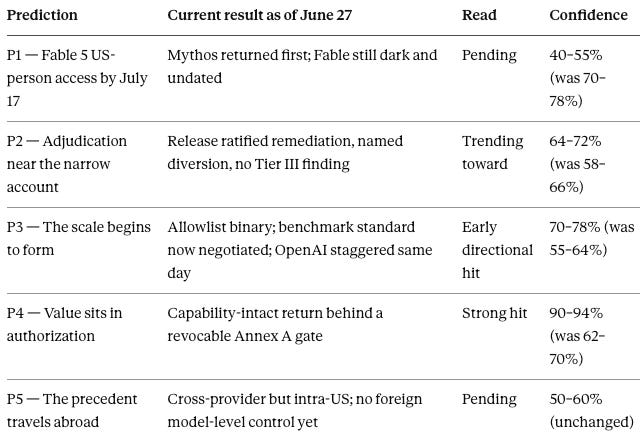
Falsification conditions. P1 is falsified if US-person access to Fable 5 remains unavailable on July 18, 2026 — clean date, the prior “absent a fresh directive” escape clause removed. P2 is falsified if a published official finding classifies the event as autonomous system compromise. P3 is falsified if no reusable tiered standard is published, or it stays a one-off, by June 2027; an access allowlist alone does not satisfy it, a graded severity instrument does. P4 is falsified if Anthropic states a capability reduction as the primary remediation, or a named benchmark shows a material drop against the pre-suspension baseline. P5 is falsified if no comparable foreign model-level control appears by December 2027.
IX. What to Watch
Four signals will move the ledger next, and each maps to an open call. Fable’s terms will test P1 and, by their shape, P4 — capability-intact-but-gated versus capability-reduced. Annex A’s selection criteria remain undisclosed, and a free-expression counsel has already named the gap: no one knows how the firms were picked or why the rest are excluded. The August cybersecurity-executive-order process is where a graded scale either forms or fails to, the live test of P3. Finally, the first foreign model-level control, if it comes, scores P5 and turns sovereign-tier scarcity from a US event into a global regime.
X. Placement and Lineage
The report sits in the validation tier. It scores Anthropic, Mythos, and the NSA against the resolving record, instantiates Governance Scarcity and Agent Governance Equilibrium at the moment the gap was priced without a scale, and reads tempo through National Innovation Behavioral Economics. The breach quote stayed an exhibit. The theorem stayed the thesis. The allowlist is the proof the gap was real, the negotiating table is the proof the scale was missing, and the word diversion is the proof the access tier — not the capability tier — was the object all along.
The catalyst will fade and the field will not. An allowlist, a benchmark fight, and a one-word determination are this month’s evidence; the governance scarcity they expose predates them and will outlast them.