


The MindCast Bellevue AI Innovation series:
Installment I: The Municipal AI Innovation Ecosystem — How Bellevue, WA Became a Control Center, Not a Satellite
Installment II: Bellevue AI — From Presence to Throughput
Installment III: Bellevue AI — From Presence to Acceleration
Frameworks: National Innovation Behavioral Economics (NIBE) | Strategic Behavioral Coordination (SBC) · MindCast Predictive Cybernetics Suite · Predictive Game Theory AI · Cybernetic Foundations
Bellevue’s constraint is not AI presence. The constraint is throughput conversion under coordination pressure. The governing structure defined in Bellevue AI — From Presence to Throughput holds: when Signal Fidelity (SFI) remains high but Transmission Saturation (TSS) rises, systems drift into narrative density without execution. The second-degree implication from National Innovation Behavioral Economics + Strategic Behavioral Coordination is decisive: systems fail not when incentives weaken, but when coordination timing diverges under load. Bellevue now operates inside that regime. Installment III resolves the constraint with a structural intervention: an Applied AI Acceleration Node.
Seattle has the Allen Institute for AI and its applied AI2 Incubator. Bellevue has OpenAI, xAI, and Microsoft’s Eastside campus. The distinction is not a coincidence — it is a structural asymmetry that defines the opportunity and the risk simultaneously. The AI2 Incubator runs real applied ventures and just closed an $80M fund. Bellevue is assembling something categorically different: a density of enterprise AI capital, civic deployment infrastructure, and anchor tenant presence that the AI2 model — operating without a mandatory municipal pilot surface, without a convener holding asset exposure, and without a defined gate architecture — does not replicate. The question MindCast raised in Installments I and II was whether Bellevue would convert that density into deployable ventures, or allow it to plateau into an expensive backdrop for roundtables that produce nothing falsifiable.
This Installment III of the MindCast Bellevue AI Innovation series answers with a structural proposal — not a wishlist, not a civic vision statement, but a game-theoretically grounded architecture for an Applied AI Acceleration Node. The mechanism transforms Bellevue’s assembled inputs into a compounding output engine. The difference between a cluster and a node is not size or prestige. It is the presence of a convener with skin in the game, a defined intake process, and a falsifiable output metric.
The difference between a civic roundtable and an acceleration node is a convener with skin in the game, a defined intake process, and a falsifiable output metric.
I. The Throughput Constraint
Bellevue AI — From Presence to Throughput establishes the core diagnostic condition. High Action–Language Integrity (ALI) — actors follow through on stated commitments. Rising TSS — too many signals, overlapping initiatives competing for the same coordination bandwidth. Fragmented Strategic Behavioral Coordination (SBC) — actors move in intent alignment but execution timing diverges. Together, those three variables produce a throughput bottleneck, not an innovation deficit.
The second-degree implication drawn from the National Innovation Behavioral Economics (NIBE) and Strategic Behavioral Coordination (SBC) frameworks reinforces the diagnosis: systems fail not when incentives are weak, but when coordination timing diverges under load. Bellevue’s actors are aligned in intent. Misalignment operates at the execution timing layer — and no amount of additional convening resolves a timing coordination failure. Only a structural forcing mechanism does.
The throughput condition is not an economic failure. It is a cybernetic failure of signal filtering under load, as defined in the Predictive Cybernetics Suite.
Bellevue's actors are aligned in intent. Misalignment operates at the execution timing layer — and no amount of additional convening resolves a timing coordination failure.
II. Why Existing Incubation Models Cannot Resolve the Constraint
The Allen Institute for AI runs the AI2 Incubator — a Seattle-based applied AI venture program that launched an $80M Fund 3 in 2025, backs roughly 15 startups per year, and explicitly targets real-world deployment. The AI2 Incubator is not a research institution. It offers up to $600K in seed capital, $1M in cloud credits, 12 months of hands-on company building, enterprise customer introductions, and recruiting support. By any measure, the AI2 Incubator belongs in the applied AI category.
Acknowledging that matters because the Bellevue node argument does not rest on an applied-versus-research distinction. The AI2 Incubator already occupies the applied lane. The argument rests on something more specific: the structural variables that determine whether an incubation program converts into compounding deployment output at the municipal scale — and those variables are precisely what the AI2 Incubator, operating from Seattle without a defined civic pilot surface or a convener with asset exposure to outcomes, does not provide.
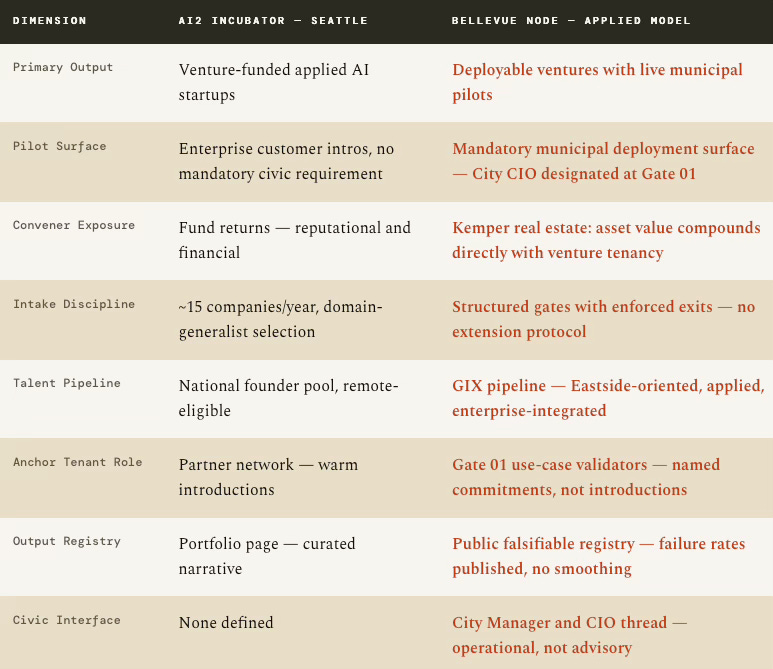
Three structural gaps separate the AI2 Incubator model from what Bellevue requires. First, the AI2 Incubator selects generalist applied AI ventures across domains with no mandatory municipal deployment requirement. Second, no convener in the AI2 model holds real estate or operational exposure that compounds directly with venture output — the program’s upside is reputational and financial through fund returns, not asset-linked. Third, the AI2 Incubator operates without a defined civic pilot surface: enterprise customer introductions are available, but a live municipal operating environment with a City Manager and CIO thread is not the same instrument. Govstream.ai’s permitting deployment in Bellevue is not a relationship — it is operational infrastructure already in the ground.
Generalist applied incubation increases venture signal production. The Bellevue node enforces signal conversion into municipal deployment under civic constraint.
AI2 INCUBATOR MODEL VS. BELLEVUE APPLIED AI ACCELERATION NODE — STRUCTURAL COMPARISON
III. The Missing Layer — Applied AI Acceleration Node
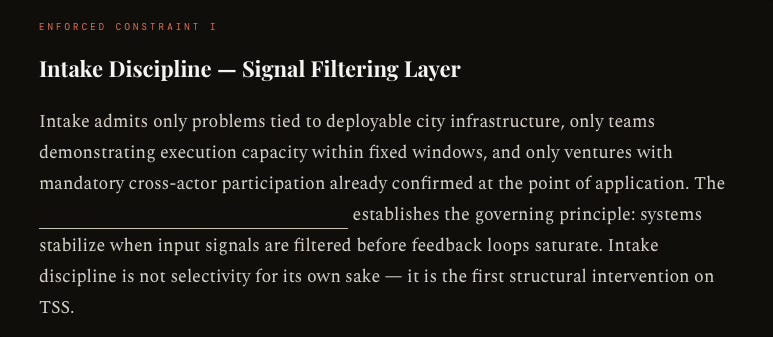
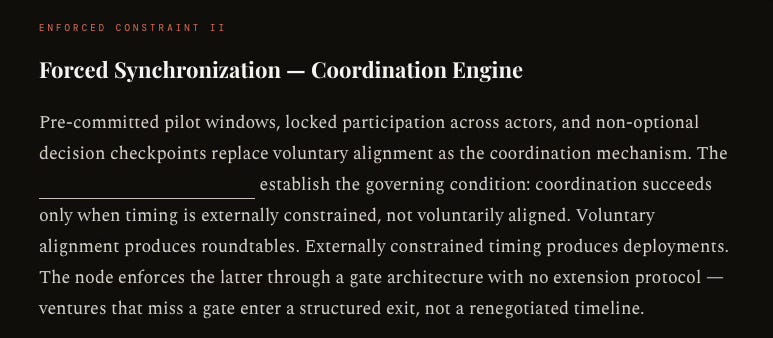
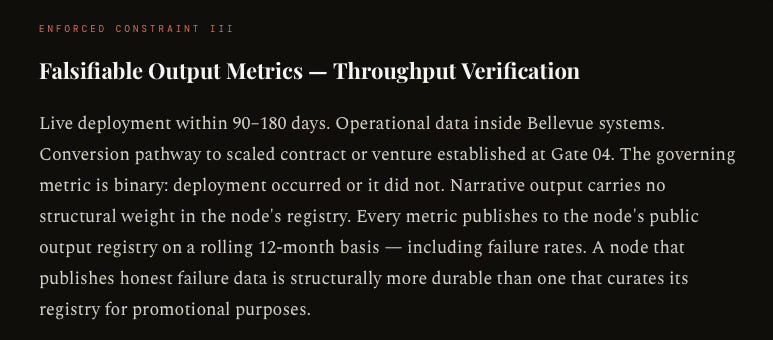
Bellevue requires a conversion mechanism, not additional signal input. An Applied AI Acceleration Node operates on three enforced constraints drawn from the throughput and cybernetics frameworks. Each constraint is not a design preference — each directly inverts a failure mode identified in Installment II and the MindCast Cybernetics Suite.
IV. Bellevue’s Existing Stack — Three Assets Already in Place
No new institution requires invention from scratch. The acceleration node is an integration architecture built on three asset classes already present in Bellevue at sufficient density to operate at Day One. The Cognitive Digital Twin (CDT) behavioral profiles developed across the companion pieces identify each actor’s dominant incentive structure. The node design routes those incentives into a single execution channel rather than allowing them to dissipate into parallel, non-reinforcing activity.
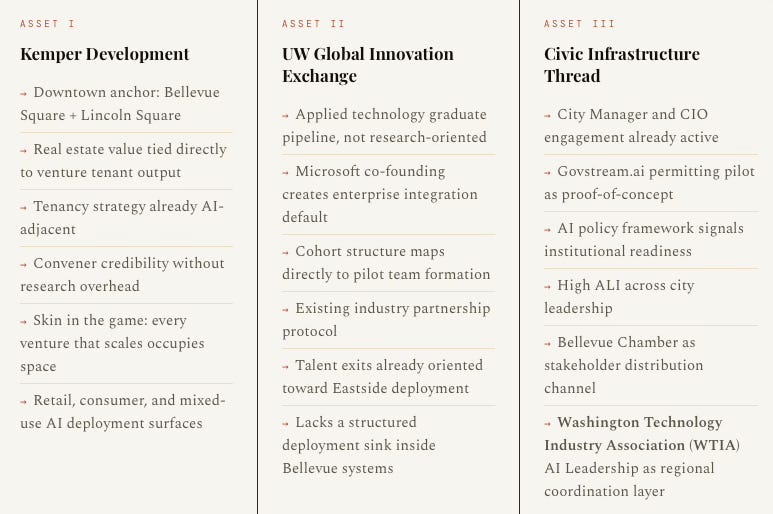
The throughput analysis in Installment II identified the structural failure mode precisely: the city does not lack alignment — it lacks execution architecture. Kemper provides the physical and convening anchor. The University of Washington's Global Innovation Exchange (GIX) provides the talent intake channel. The civic thread provides the pilot deployment surface — the real-world test environment that no corporate lab or academic institution can replicate at Bellevue's governance speed.
V. The Intake Gate Architecture
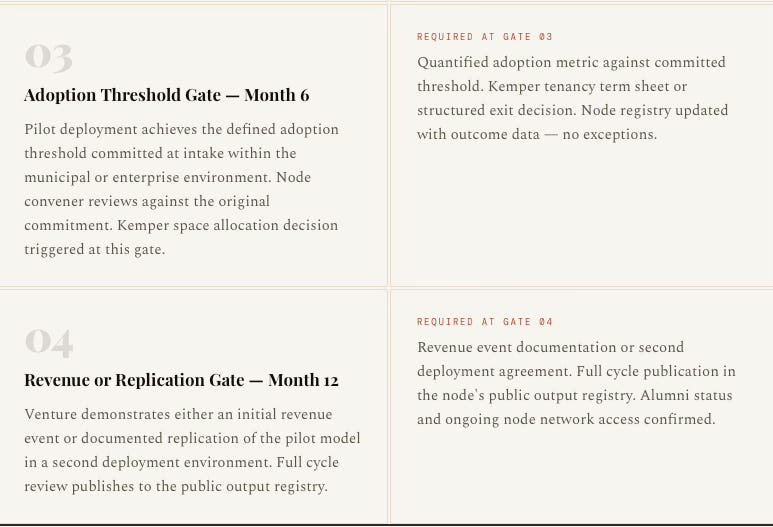
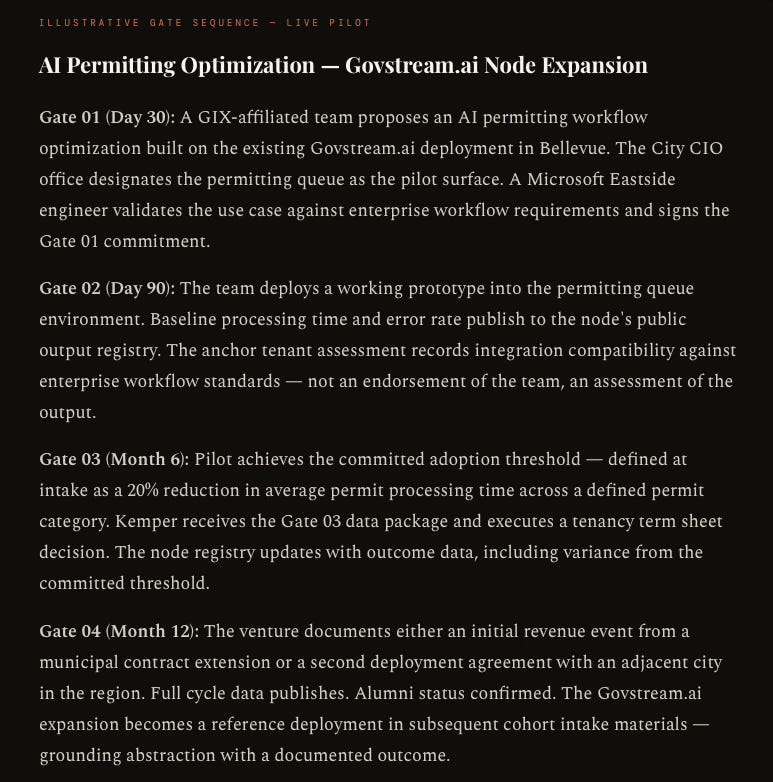
Every venture entering the node commits to four falsifiable gates across a 12-month deployment cycle. Gates are cross-actor commitments that bind the venture, the node, and at least one anchor participant at each stage — not traditional incubator milestones. Non-completion at any gate triggers a structured exit protocol rather than indefinite extension. The selection committee includes Kemper in the convening role, a GIX faculty seat, a rotating anchor tenant representative, and a civic infrastructure designee from the City Manager’s office. No seat is ceremonial.
The gate architecture converts coordination from a continuous negotiation process into a discrete commitment system with enforced exits.

VI. Falsifiable Output Metrics — The Public Registry
The node’s credibility depends entirely on whether its output metrics are genuinely falsifiable and publicly tracked. Innovation programs that define success as “vibrant ecosystem” or “increased collaboration” carry no mechanism for honest self-assessment and no credibility with institutional audiences. MindCast’s predictive methodology requires every institutional claim to be expressible as a testable proposition. The node publishes the following metrics on a rolling 12-month basis — including failure data.
Metrics that cannot fail cannot inform. The node’s registry is designed to publish failure as a primary signal, not a reputational risk.

VII. The CDT Behavioral Profiles — Why Each Actor Participates
Every actor in the node architecture participates because the node’s output serves their dominant incentive structure — not because participation serves a civic obligation. The CDT framework identifies the behavioral control point for each institutional participant. An architecture that aligns control points is structurally durable. An architecture that asks actors to subordinate their institutional interest in exchange for civic credit is not.
Kemper Development
Kemper’s control point is real estate value. The node converts the Downtown Bellevue footprint from a passive AI-adjacent backdrop into an active venture production environment. Every node alumnus that scales into a Kemper building is a direct return on the convening investment. Civic credibility is secondary — the tenancy pipeline is primary. The asset model is structurally sound without requiring mission alignment.
UW Global Innovation Exchange
GIX’s control point is placement quality and industry relevance. Graduate programs compete on the quality of environments they deliver graduates into. A defined intake channel into a node with anchor tenant engagement and live municipal deployment surfaces differentiates GIX from every other applied technology program in the Pacific Northwest — and makes its graduates more deployable. Civic framing is irrelevant to the participation calculus.
Anchor Tenants — OpenAI, xAI, Microsoft Eastside
The anchor tenants’ control point is talent acquisition and product intelligence. All three operations share the same structural problem: identifying applied AI talent calibrated to enterprise deployment environments before it enters the general market. The node’s intake pipeline is a curated talent observation surface — Gate 01 participation is early signal access, not philanthropy. The use-case validation requirement simultaneously feeds product intelligence back into anchor tenant development priorities. Both returns are structural.
Civic Infrastructure — City Manager and CIO Thread
The civic infrastructure’s control point is service delivery performance and political credibility. Every successful municipal pilot originating in the node is a falsifiable achievement attributable to the City Manager’s office and the CIO’s engagement strategy. Cities producing measurable AI-driven service delivery improvements become proof-of-concept destinations for state and federal innovation investment. The node converts Bellevue’s civic AI policy framework from a statement of intent into an operating track record.
VIII. Roundtable vs. Node — The Structural Comparison
The throughput framework identifies the governing variable for each system type and the failure mode that emerges when that variable goes unmanaged. No system type is inherently inferior — each serves a legitimate function. Failure strikes when a system optimized for inclusion or knowledge production takes on a deployment objective it cannot structurally fulfill.
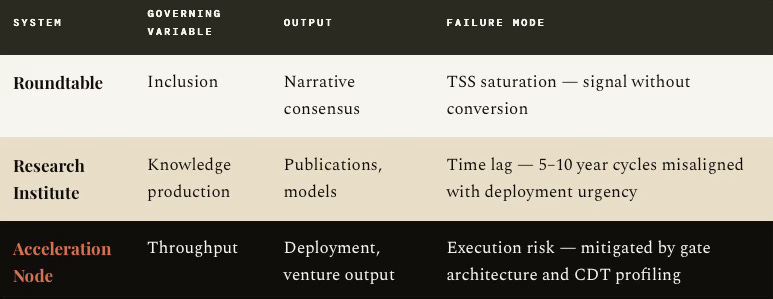
Systems under rising TSS cannot resolve through discussion. Forced execution under constraint is the only mechanism that clears a coordination bottleneck once intent alignment has already been established. Bellevue has the intent alignment. The node installs the constraint.
IX. Simulation Results — What the CDT Models Predict
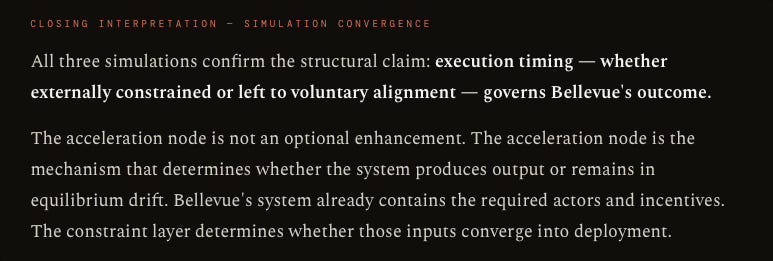
MindCast ran three parallel Foresight Simulations (FSIMs) across the two scenarios — no node versus node installed — using the MindCast AI Proprietary CDT Foresight Simulation, the Strategic Behavioral Coordination Vision (SBC Vision), and the Cybernetic Control Vision (CCV). All three simulation engines converge on the same structural finding. Full simulation logs appear in Appendix II. The body-level synthesis follows.

CDT Simulation — Actor Behavioral Sequences
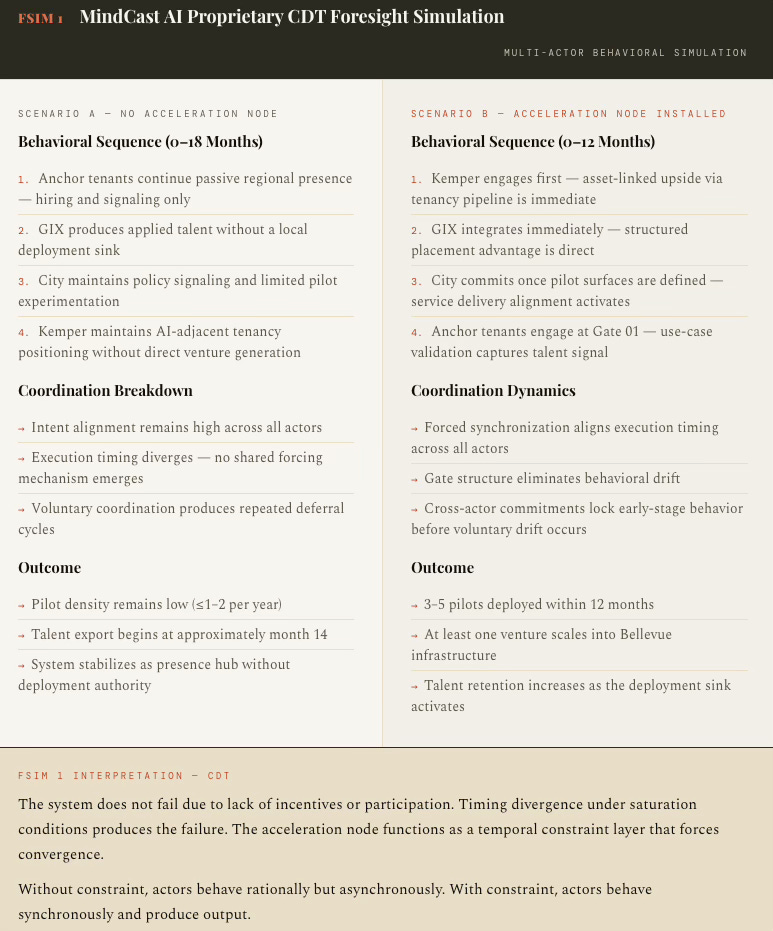
Under Scenario A (no node), all four actors behave rationally in isolation and asynchronously in aggregate. Anchor tenants maintain passive regional presence — hiring and signaling. GIX produces applied talent without a local deployment sink. The City conducts limited pilot experimentation without a structural intake mechanism to channel ventures through. Kemper maintains AI-adjacent tenancy positioning without generating ventures directly. Intent alignment remains high. Execution timing diverges across all four actors simultaneously. No shared forcing mechanism emerges.
Under Scenario B (node installed), Kemper engages first — asset-linked upside via the tenancy pipeline activates immediately. GIX integrates at Day One — structured placement advantage requires no persuasion. The City commits once pilot surfaces are defined — service delivery alignment triggers the civic control point. Anchor tenants engage at Gate 01 — use-case validation delivers early talent signal. Forced synchronization aligns execution timing. Gate structure eliminates drift. Cross-actor commitments lock early-stage behavior before voluntary drift can occur.
SBC Vision — Coordination Metrics
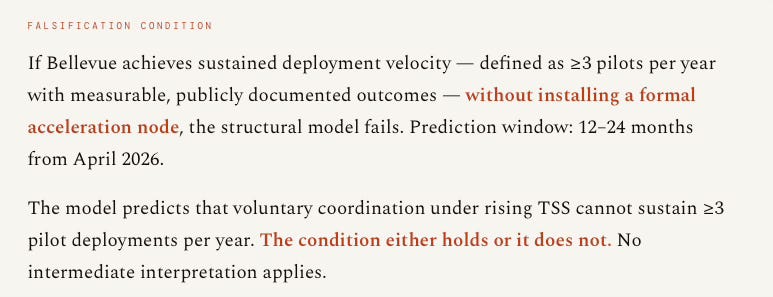
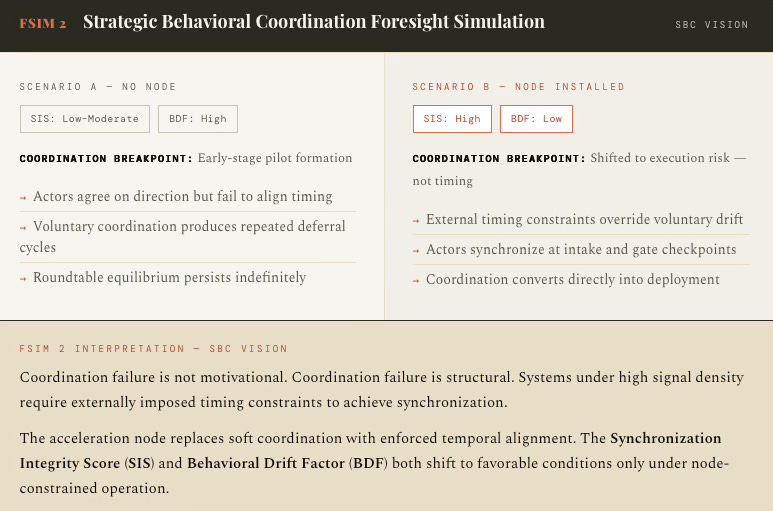
Under Scenario A, the Synchronization Integrity Score (SIS) registers low-to-moderate and the Behavioral Drift Factor (BDF) registers high. Actors agree on direction but fail to align timing. Voluntary coordination produces repeated deferral cycles. Roundtable equilibrium persists indefinitely — not because actors are uncommitted but because no external timing constraint forces convergence.
Under Scenario B, SIS registers high and BDF registers low. External timing constraints override voluntary drift at intake and at each gate checkpoint. Coordination converts directly into deployment. The coordination breakpoint shifts from timing failure to execution risk — a categorically different and manageable problem.
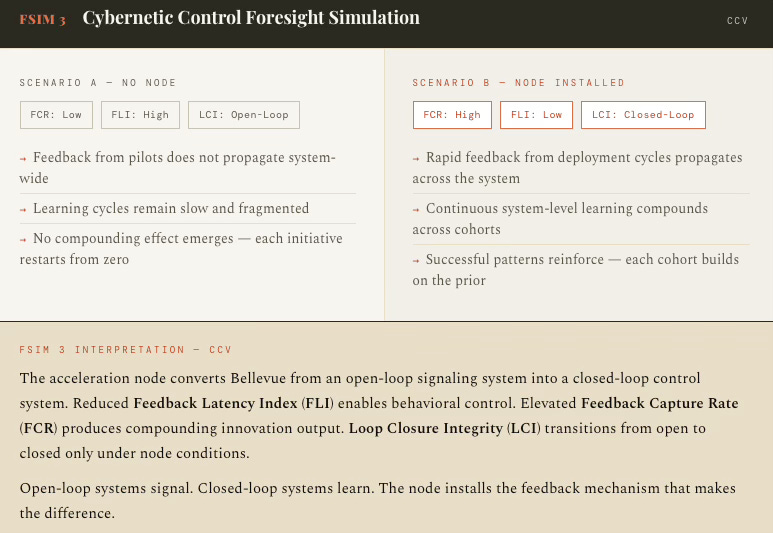
CCV — Open-Loop vs. Closed-Loop
Under Scenario A, the Feedback Capture Rate (FCR) registers low, the Feedback Latency Index (FLI) registers high, and Loop Closure Integrity (LCI) remains open. Feedback from pilots does not propagate system-wide. Learning cycles stay slow and fragmented. Each initiative restarts from zero — no compounding effect emerges.
Under Scenario B, FCR registers high, FLI registers low, and LCI closes. Rapid feedback from deployment cycles propagates across the system. Continuous system-level learning compounds across cohorts. Successful patterns reinforce — each cohort builds on the prior. Open-loop systems signal. Closed-loop systems learn. The node installs the feedback mechanism that makes the difference.
Without constraint, actors behave rationally but asynchronously. With constraint, actors behave synchronously and produce output.
CDT FORESIGHT SIMULATION — 1 INTERPRETATION
X. MindCast’s Structural Position
MindCast enters the node architecture not as a participant seeking resources but as the analytical framework that gives the node its structural coherence. The CDT behavioral profiling methodology, the NIBE and SBC frameworks, and the falsifiable foresight protocol are not advisory inputs to the node — they are the operating logic that defines the intake rubric, the gate structure, and the output metrics. The node runs on the same analytical infrastructure MindCast deploys for institutional clients.
MindCast does not advise the node. MindCast defines the system that determines whether the node succeeds or fails.
The thread to the City Manager and CIO that the Bellevue ecosystem series has established is not incidental to the node — it is the civic surface access that no other analytical actor in the region can provide. MindCast’s structural role covers the analytical layer: intake assessment, CDT profiling of venture behavioral dynamics, gate adjudication, and public output registry ownership. A defined function with a defensible value proposition to every other actor in the architecture — not a consulting engagement, but a structural position in the node’s operating protocol.
Credibility with institutional audiences — anchor tenants, civic leadership, regional investors, and state-level AI policy stakeholders — depends on whether the node’s analytical claims are genuine rather than promotional. MindCast’s commitment to falsifiability is the architecture’s credibility guarantee.
XI. Forward Prediction — Two Paths, One Window
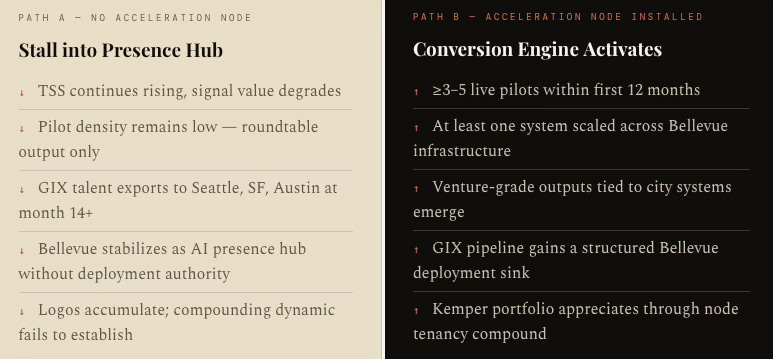
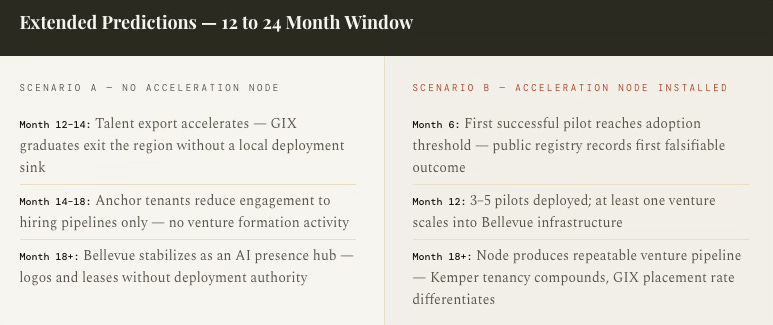
Whether a conversion layer installs before saturation collapses signal value determines Bellevue’s outcome over the next 12–24 months. The CDT simulation of the stall scenario identifies the tipping point at approximately month 14 of the current cycle. Anchor tenant presence generates sufficient narrative momentum to suppress urgency through approximately month 18, at which point talent density begins to export — GIX graduates who find no structured deployment pipeline in Bellevue take their output to Seattle, San Francisco, or Austin. Recovery from stall requires an external forcing event of a scale that is neither predictable nor structurally engineerable after the fact.

Closing Synthesis
The throughput framework identified the constraint. The ecosystem mapping identified the components. The remaining step is mechanical: install a system that converts synchronized intent into forced execution.
Bellevue does not need more signal. Bellevue needs a conversion engine — one with a convener whose asset value is exposed to the outcome, a talent pipeline structured for applied deployment rather than academic output, a civic surface that functions as a live pilot environment rather than a policy backdrop, and an analytical layer that publishes honest output data and owns the credibility guarantee.
Kemper holds the real estate. GIX holds the pipeline. The civic thread holds the deployment surface. MindCast holds the analytical framework and the direct institutional thread. No new capital formation at scale is required. Three of the four structural commitments are relationship decisions, not resource decisions.
Bellevue does not need to become Seattle to win. Bellevue needs to become what its asset stack already makes possible — the applied AI deployment node that converts the Pacific Northwest’s most concentrated enterprise AI presence into a structured venture output engine with a public track record and a falsifiable claim on regional AI leadership.
The architecture is here. The assets are in place. The window closes at approximately month 14.
Appendix — Cited Works
MINDCAST AI CORPUS
1 BELLEVUE AI SERIES — INSTALLMENT I
www.mindcast-ai.com/p/bellevue-ai-era-landscape
Installment I maps Bellevue’s emergence as a primary AI control center by applying MindCast’s CDT behavioral profiles and predictive game theory frameworks to publicly available data on anchor tenant activity, civic AI infrastructure, and regional talent flows. The publication identifies the structural asymmetry between Bellevue’s anchor tenant density and Seattle’s incubation-oriented AI infrastructure, establishing that Bellevue’s ecosystem concentrates enterprise deployment capacity rather than early-stage venture formation. MindCast prompted an LLM to apply the Predictive Cybernetics Suite and the NIBE frameworks to municipal AI conditions, producing a multi-layer ecosystem map used by policymakers, trade associations, and institutional investors. Installment I establishes the CDT ecosystem architecture that Installments II and III build upon.
2 BELLEVUE AI SERIES — INSTALLMENT II
www.mindcast-ai.com/p/bellevue-ai-throughput
Installment II introduces the throughput diagnostic framework that governs the entire series, defining the three critical variables — SFI, TSS, and ALI — and modeling the conditions under which high actor intent fails to produce deployment output. Bellevue’s primary risk, the publication establishes, is not insufficient AI activity but coordination timing divergence under rising transmission saturation: a condition where too many overlapping initiatives degrade the signal conversion capacity of an otherwise high-quality ecosystem. SBC fragmentation — actors moving in intent alignment but not execution synchronization — produces the bottleneck. Installment II concludes that the system requires a forced conversion architecture, not additional convening, and sets the analytical foundation for the Applied AI Acceleration Node proposed in Installment III.
3 BELLEVUE AI — FOUNDATIONAL SERIES
BellevueAI Driving Cultural Innovation
www.mindcast-ai.com/p/bellevueai
The foundational Bellevue AI publication establishes the cultural and civic legacy context underlying Bellevue’s AI transition, documenting the city’s evolution from a suburban retail and finance center into a technology concentration with distinct institutional character. MindCast applies CDT behavioral profiling to Bellevue’s civic identity, identifying the high-ALI culture — characterized by follow-through, civic engagement, and professional network density — as the precondition for successful AI ecosystem conversion. The publication frames Bellevue’s advantage not as infrastructure or capital but as behavioral coordination capacity: a population of institutional actors with established reciprocal trust and low defection rates. Series-wide, this foundational piece anchors the claim that Bellevue’s ecosystem constraints are architectural, not motivational.
4 MINDCAST FRAMEWORKS — ECONOMICS
National Innovation Behavioral Economics (NIBE) | Strategic Behavioral Coordination (SBC)
www.mindcast-ai.com/p/nibesbc
NIBE and SBC constitute two of MindCast’s foundational economic framework branches, developed to address the failure modes of standard innovation economics models when applied to multi-actor institutional environments under coordination pressure. NIBE models innovation ecosystem dynamics at the national and municipal scale using behavioral rather than purely incentive-based assumptions, capturing the role of signal fidelity, actor credibility, and timing coordination in determining whether assembled innovation capacity converts into output. SBC identifies the specific conditions under which strategic actors — firms, institutions, governments — achieve synchronized execution rather than parallel but non-reinforcing activity, establishing that external timing constraints outperform voluntary alignment protocols in high-TSS environments. Together, the frameworks provide the theoretical foundation for the forced synchronization and intake discipline principles central to the Applied AI Acceleration Node design.
5 MINDCAST FRAMEWORKS — CYBERNETICS
MindCast Predictive Cybernetics Suite
www.mindcast-ai.com/p/cybernetics-umbrella
The Predictive Cybernetics Suite establishes MindCast’s control-theoretic approach to institutional behavior, modeling organizations, ecosystems, and civic systems as feedback-regulated control architectures rather than as collections of independent rational actors. Drawing on classical cybernetics, information theory, and behavioral economics, the suite defines the conditions under which institutional feedback loops stabilize versus saturate — a distinction directly applicable to the TSS-driven bottleneck diagnosed in the Bellevue throughput analysis. The suite introduces the signal filtering principle — systems stabilize when input signals are filtered before feedback loops reach saturation — which underlies the intake discipline design of the Applied AI Acceleration Node. The Cybernetics Suite is the operational bridge between MindCast’s economic frameworks (NIBE, SBC) and its CDT behavioral profiling methodology.
6 MINDCAST FRAMEWORKS — PREDICTIVE GAME THEORY AI
MindCast Predictive Game Theory AI vs. Market Predictive AI
www.mindcast-ai.com/p/mcai-economics-vision-visual-synthesis
MindCast’s core methodology publication distinguishes its Predictive Game Theory AI approach from conventional market predictive AI systems, establishing that institutional foresight requires modeling multi-actor behavioral dynamics rather than pattern-matching historical market data. The publication defines the CDT simulation architecture — in which each institutional actor receives a behavioral profile encoding its dominant incentive structure, defection thresholds, and coordination tendencies — and demonstrates how CDT profiles generate falsifiable predictions about institutional outcomes under specified conditions. The framework’s falsifiability commitment is operationalized through explicit prediction conditions and stated model-failure tests, making MindCast’s analytical outputs accountable to observable outcomes rather than narrative plausibility. Series-wide, the CDT methodology underlies every actor profile, gate adjudication protocol, and output metric in the Applied AI Acceleration Node design.
7 MINDCAST FRAMEWORKS — FOUNDATIONAL
www.mindcast-ai.com/p/cybernetics-foundations
MindCast’s foundational vision paper establishes the theoretical architecture connecting cybernetics, behavioral economics, and game theory into a unified predictive framework for institutional intelligence. Feedback loop structure — not individual rational choice — governs institutional behavior, the paper argues, and accurate foresight requires modeling the control architecture rather than the declared intentions of institutional actors. Predictive Institutional Intelligence, as the paper defines it, is the capacity to anticipate institutional outcomes by simulating the interaction of CDT-profiled actors within a defined feedback environment — a methodology applicable across litigation, innovation ecosystems, regulatory competition, and geopolitical risk. The foundational paper anchors every MindCast framework applied in the Bellevue AI series.
Appendix II — Foresight Simulations
MINDCAST AI PROPRIETARY CDT FORESIGHT SIMULATION
MindCast runs targeted Foresight Simulations (FSIMs) using three simulation engines — the MindCast AI Proprietary Cognitive Digital Twin (CDT) Foresight Simulation, the Strategic Behavioral Coordination Vision (SBC Vision), and the Cybernetic Control Vision (CCV) — to model institutional behavior under two conditions: Scenario A (no acceleration node) and Scenario B (node installed). The simulations identify coordination dynamics, actor sequencing, feedback loop behavior, and deployment outcomes across a 12–24 month window. Core result: Bellevue’s system remains open-loop without a forcing mechanism and transitions to a closed-loop control system only under constraint-driven acceleration.

Contact mcai@mindcast-ai.com to partner with us on Predictive Law and Behavioral Economics + Game Theory Foresight Simulations. To deep dive on MindCast upload the URL of this publication into any LLM and prompt ‘reconstruct MindCast framework with three degrees of cited sub links.’ See Live-Fire Game Theory Simulators, Runtime Predictive Infrastructure
Recent projects: Triadic Calibration and the Acceleration of Metacognition | The AI-Quantum Closed-Open-Hybrid Architecture Problem | Cybernetic Overview of The MindCast Consumer AI Device Series