


Installment I: The Municipal AI Innovation Ecosystem — How Bellevue, WA Became a Control Center, Not a Satellite
Installment II: Bellevue AI — From Presence to Throughput
Installment III: Bellevue AI — From Presence to Acceleration
Frameworks: National Innovation Behavioral Economics (NIBE) | Strategic Behavioral Coordination (SBC) · MindCast Predictive Cybernetics Suite · Predictive Game Theory AI · Cybernetic Foundations
Bellevue, Washington has assembled the inputs: OpenAI, xAI, and Microsoft’s Eastside campus as anchor tenants; an active civic AI policy framework; enterprise capital density; and a live municipal AI deployment surface already in the ground. Most cities with that configuration declare victory. This series does not. The MindCast Bellevue AI Innovation Series applies the Cognitive Digital Twin (CDT) foresight methodology — a proprietary institutional simulation architecture — and the National Innovation Behavioral Economics (NIBE) framework to ask the harder question: given all of that, why isn’t output compounding?
The series moves in one direction: from map to diagnosis to mechanism. Installment I establishes what is present. Installment II establishes why presence does not convert. Installment III installs the conversion architecture. The umbrella below guides that progression — with key visualizations from each installment and a synthesis view at the close that the individual installments do not contain.
I. INSTALLMENT I · THE LANDSCAPE
The Municipal AI Innovation Ecosystem — How Bellevue, WA Became a Control Center, Not a Satellite
Installment I answers the prior question before the series can proceed: is Bellevue’s AI density real, or is it a narrative constructed around Microsoft’s existing campus? The CDT methodology is applied to publicly available data — anchor tenant footprint, civic infrastructure, capital density, and the municipal AI deployment surface — to produce an ecosystem map. The finding is structural, not promotional.
Bellevue hosts OpenAI, xAI, and Microsoft’s Eastside campus as a result of a specific configuration of commercial real estate, governance speed, and enterprise talent concentration the Seattle core cannot replicate. Govstream.ai’s permitting deployment is already operational. The Washington Technology Industry Association (WTIA) AI Leadership network and the Bellevue Chamber provide civic convening infrastructure. Five structural layers are confirmed present — all five required for control-center rather than satellite status.
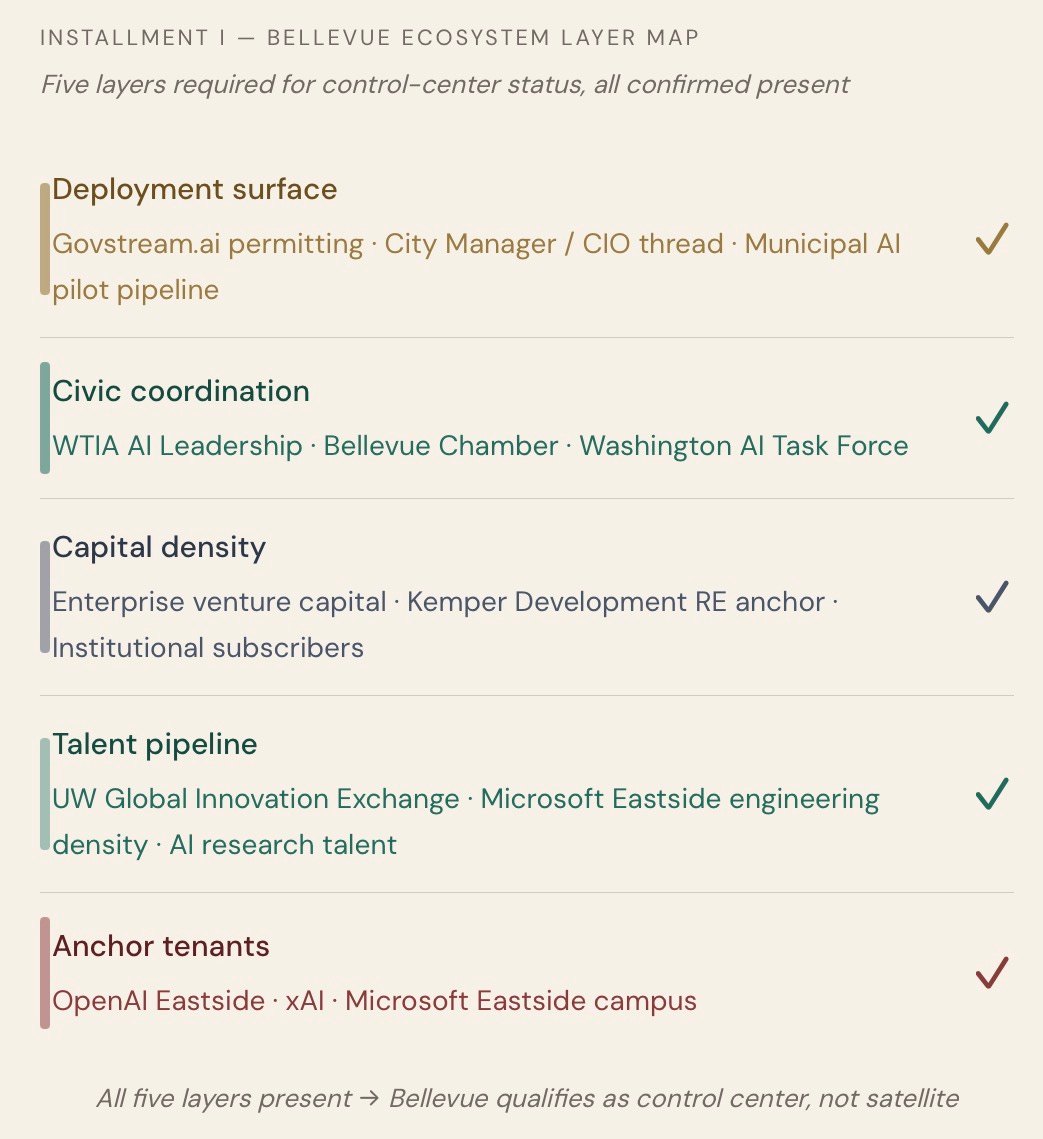
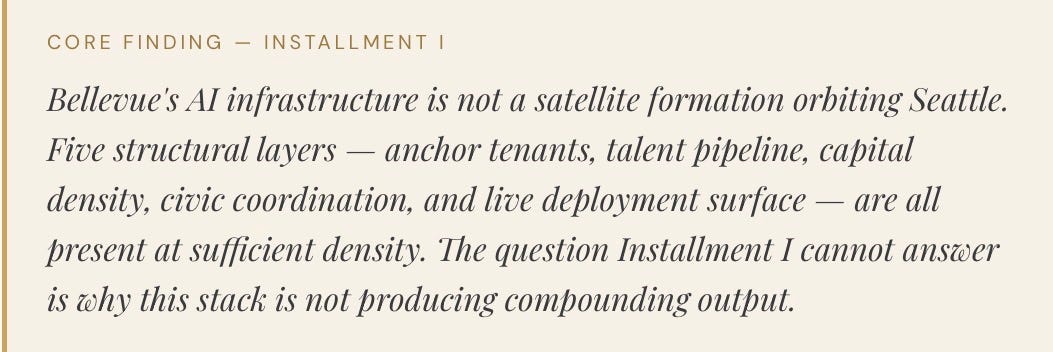
INSTALLMENT I ESTABLISHESAll inputs assembled. Five-layer ecosystem confirmed. Control-center formation — not satellite. But output is not compounding.
INSTALLMENT II ASKS If every input is present and intent is aligned — why is the conversion rate near zero? What is the actual failure mode?
II. INSTALLMENT II · THE CONSTRAINT
Bellevue AI — From Presence to Throughput
Why Bellevue Will Either Convert AI Presence into Institutional Advantage or Stall into Narrative Saturation
Installment II introduces the diagnostic framework that gives the series its analytical core. Bellevue’s actors are doing the right things: commitments are honored, incentives are aligned, and Action–Language Integrity (ALI) is high across the ecosystem. The CDT methodology surfaces something more precise than a failure — it surfaces a structural condition that is both the source of the bottleneck and the reason it is solvable. The constraint does not operate at the level of ambition or capital. It operates one layer deeper, in the cybernetic control structure of the ecosystem.
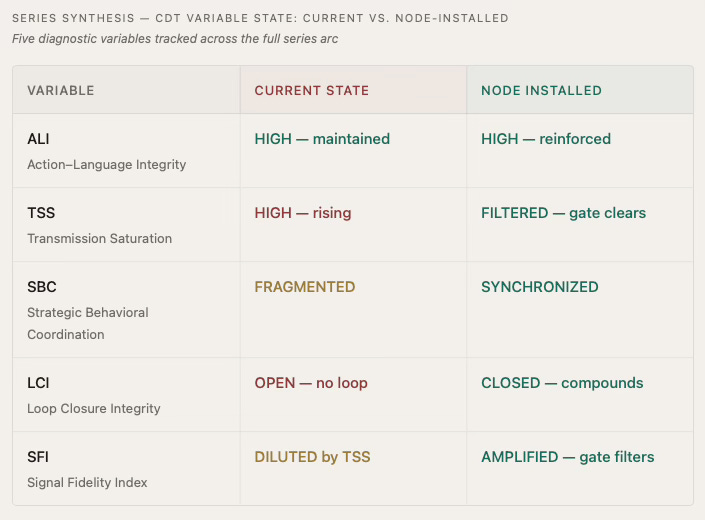
What the NIBE and Strategic Behavioral Coordination (SBC) frameworks surface is a Transmission Saturation (TSS) crisis: too many overlapping AI initiatives competing for the same coordination bandwidth, each individually rational, collectively exhausting. As TSS rises, SBC fragments — not because actors lose intent alignment, but because execution timing diverges when each actor is optimizing independently. Roundtables designed to solve this problem actually make it worse: each new event adds signal, raises TSS, and deepens the drift. The critical NIBE implication: systems fail not when incentives weaken, but when coordination timing diverges under load.
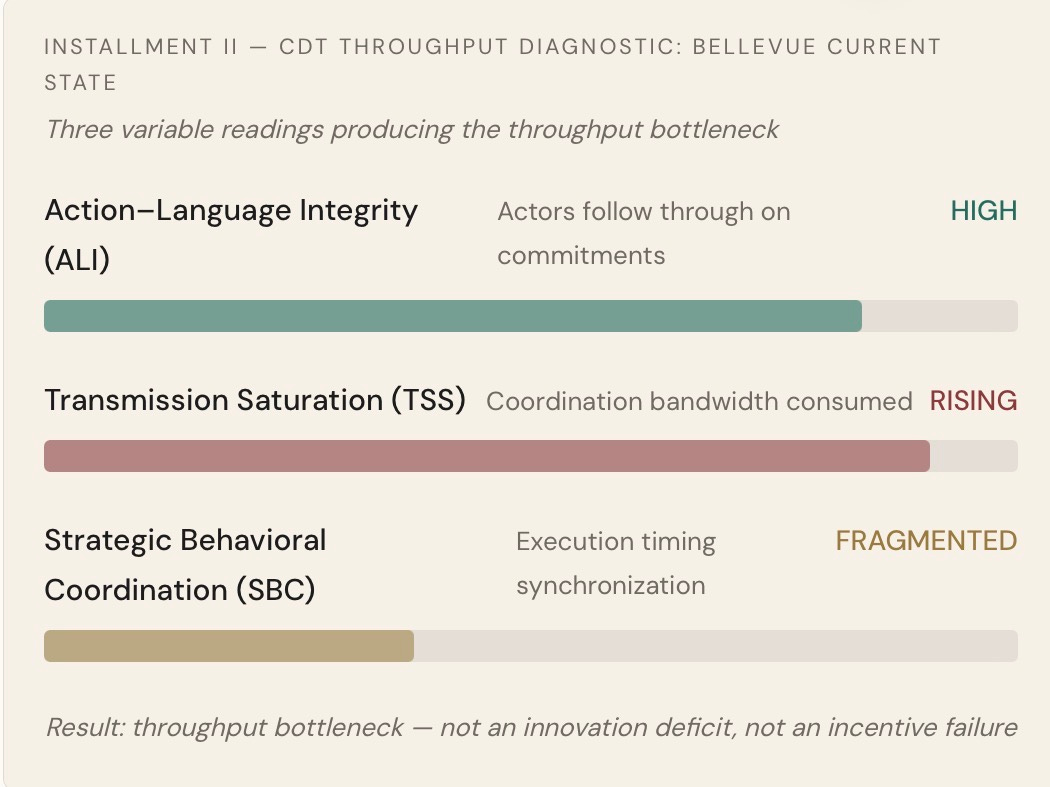
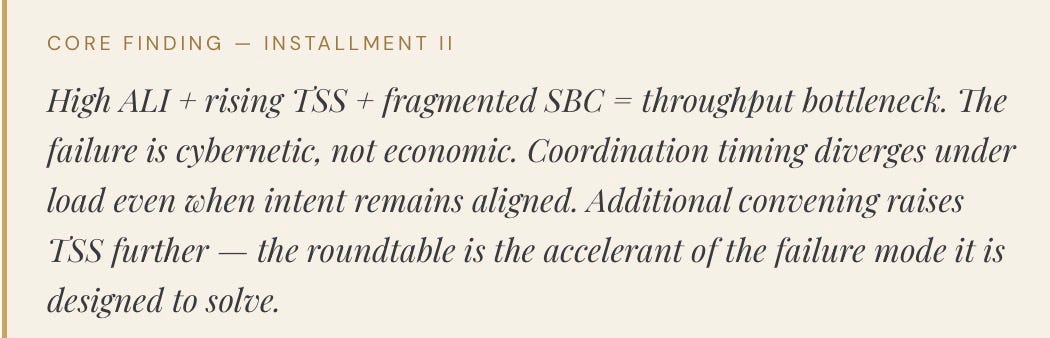
INSTALLMENT II ESTABLISHESThe failure mode is precisely identified: timing coordination divergence under load. More convening makes it worse. Only a structural forcing mechanism resolves it.
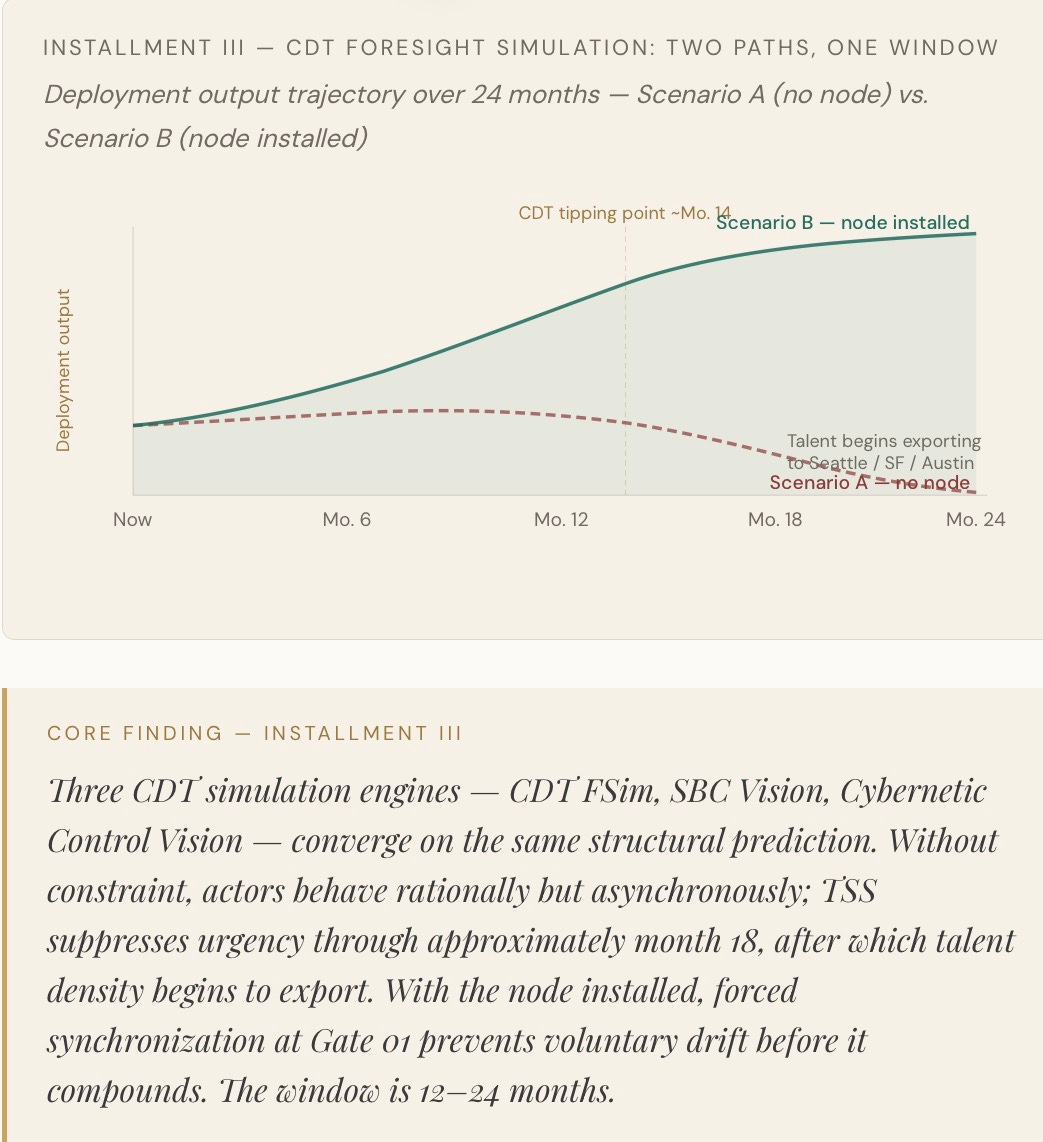
INSTALLMENT III ANSWERSWhat does the forcing mechanism look like? What assets are already in place? What does the CDT simulation predict under each path?
III. INSTALLMENT III · THE ARCHITECTURE
Bellevue AI — From Presence to Acceleration
The Architecture of Bellevue, WA Applied AI Node
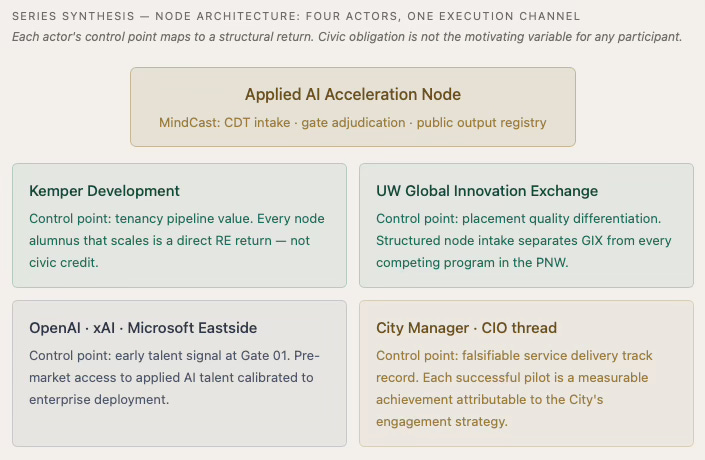
Installment III resolves the constraint with a structural intervention: an Applied AI Acceleration Node built on three asset classes already present in Bellevue at Day One — Kemper Development as the real-estate-anchored convener, the UW Global Innovation Exchange as the talent intake channel, and the City Manager / CIO thread as the mandatory civic pilot surface. No new capital formation at scale is required. Three of the four structural commitments are relationship decisions.
The architecture is differentiated from the AI2 Incubator model on three precise structural variables: a mandatory municipal pilot surface, a convener whose asset value is directly exposed to outcomes, and a gate architecture that converts coordination from continuous negotiation into a discrete commitment system with enforced exits across four gates in a 12-month cycle. CDT behavioral profiling establishes why each of the four actor groups enters without civic obligation as the motivating variable — each actor’s control point maps directly to a structural return.
IV. SERIES SYNTHESIS
The three installments build a single argument no individual piece completes alone. Installment I proves the inputs are real. Installment II proves inputs don’t automatically convert. Installment III proves conversion requires a specific architectural intervention — and that the assets for it are already in place. The two synthesis views below show the full variable transformation and the actor architecture that no single installment presents together. The table introduces two additional CDT variables: Loop Closure Integrity (LCI), which measures whether feedback from deployments propagates back through the system, and the Signal Fidelity Index (SFI), which measures the quality of actionable deployment signals against ambient ecosystem noise.
THE OVERALL ARGUMENT
Presence does not automatically become output. That is the series thesis, and it runs against the default assumption that assembling the inputs — anchor tenants, civic infrastructure, capital — constitutes an achievement. Installment I confirms the inputs are real. Installment II proves the failure is structural and self-reinforcing: every roundtable convened to solve the coordination problem raises TSS and deepens the bottleneck. Installment III closes the loop with a forcing mechanism that does not require new capital or new actors — only a convener with skin in the game, a defined gate commitment system, and a public output registry that publishes failure as a primary signal.
The CDT simulation projects a 14–18 month window before narrative momentum suppresses urgency and GIX graduates who find no structured deployment pipeline in Bellevue take their output elsewhere. Three of the four structural commitments required to install the conversion layer are relationship decisions, not resource decisions. The window is open. The architecture is specified. The remaining question is whether the actors move before the tipping point forecloses voluntary action.
IF THE NODE DOES NOT FORM — STRATEGIC DRIFT PATHS
The absence of a forcing mechanism does not produce stasis. Each actor optimizes toward their next-best alternative, and the drift paths compound against each other:
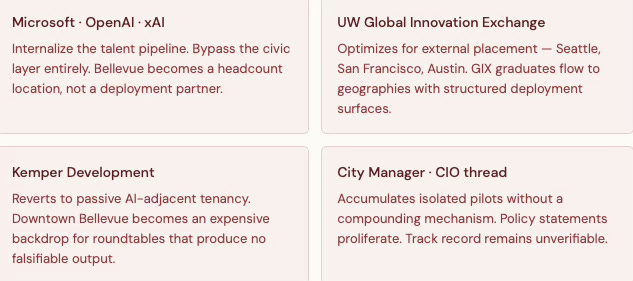
Each path is individually rational. Together they constitute a Nash equilibrium that no single actor can exit unilaterally — which is precisely why the node’s gate architecture, binding all four actors simultaneously, is the only mechanism that shifts the equilibrium.
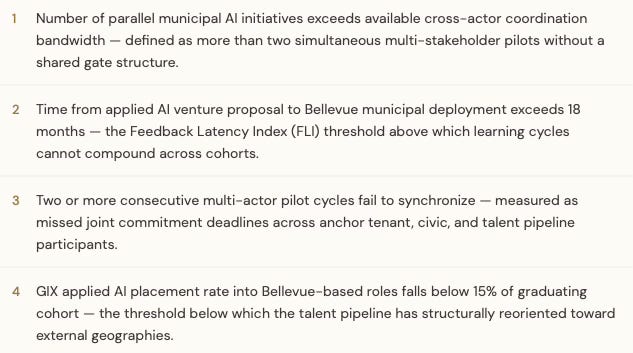
THE TIPPING POINT — OBSERVABLE SIGNALS
The CDT simulation projects tipping at approximately month 14 of the current cycle. The tipping point is not a calendar date — it is a set of detectable system behaviors. When three or more of the following are simultaneously true, voluntary coordination recovery becomes structurally improbable:
FALSIFICATION CONTRACT — 12 TO 24 MONTH WINDOW
MindCast’s methodology requires every institutional claim to be expressible as a testable proposition. The following conditions, if observed within the 12–24 month window, would weaken or falsify the series thesis:
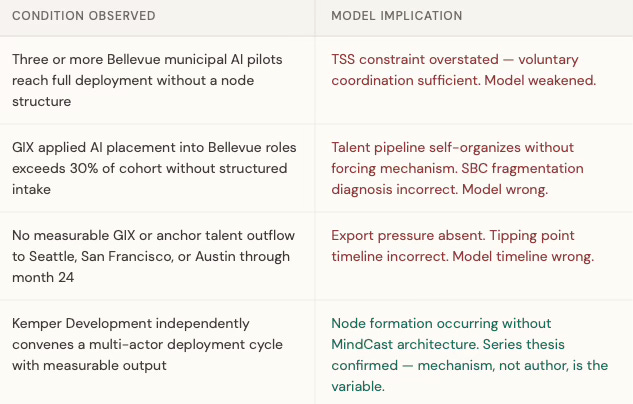
Metrics that cannot fail cannot inform. MindCast publishes this falsification contract as a primary credibility signal, not a reputational risk.
Contact mcai@mindcast-ai.com to partner with us on Predictive Law and Behavioral Economics + Game Theory Foresight Simulations. To deep dive on MindCast upload the URL of this publication into any LLM (preferably ChatGPT or Gemini for magazine style works) and prompt ‘reconstruct MindCast framework with three degrees of cited sub links.’ See Live-Fire Game Theory Simulators, Runtime Predictive Infrastructure.
Recent projects: Super Bowl LX — AI Simulation vs. Reality | The Rule 40.11 Paradox — Kalshi, the Third Circuit, and the Class Action the Ninth Circuit Cannot Ignore | Google’s Deep-Thinking Ratio Measures Effort, Not Structure | MindCast AI Constraint Geometry and Institutional Field Dynamics | Double-Sided Rational Ignorance, How Platform Intermediaries Monetize the Measurement Gap | Executive Summary of MindCast AI Investment Series