SpaceX Super Intelligence (formerly xAI) · X Corp. · SpaceX · Oregon Attorney General · Virginia Attorney General · California Attorney General · the January 2026 attorney general letter coalition · Federal Trade Commission · Oregon · Virginia · California · Minnesota
Data cutoff: November 24, 2026 · The complaints state allegations, not court findings
Related MindCast works. OpenAI State Attorney General Lawsuits · How Lead States Set the Template · How Defendants Contain State Attorney General Coalitions · State Attorneys General Sue Snap, Not OpenAI
Interactive war games. States vs. OpenAI · State Attorney General Coalitions
MindCast AI applies Predictive Behavioral Economics + Dynamic Game Theory through MindCast AI Proprietary Cognitive Digital Twin Foresight Simulations (MP CDT FS). Behavioral Economics supplies the decision rules. Game Theory supplies the payoff structure. Predictive simulations emerge from the combination.
I. Executive Summary: The States Sued SpaceX’s Words, Not Grok’s Output
Oregon and Virginia did not sue Grok for what it generates. The states sued SpaceX for what it said about Grok’s safeguards. Seven weeks earlier, xAI won a federal appeals injunction pausing Minnesota’s ban on nudification tools on free speech grounds. The states chose the route where the company’s own words are the evidence, and where the Section 230 shield and the free speech defense reach least.
On November 23, Oregon Attorney General Dan Rayfield and Virginia Attorney General Jay Jones announced coordinated but separate complaints naming SpaceX Super Intelligence, formerly xAI. The complaints allege the companies misrepresented Grok’s safeguards against generating nonconsensual sexual images, including images of minors. The filings make SpaceX the first frontier developer other than OpenAI that state attorneys general have sued with an AI model as the core product at issue. New Mexico’s case against Meta added AI chatbot allegations in January 2026, but Facebook and Instagram remain its core products.
The filings change the strategic environment now because a template and outside counsel already exist. Thirty-three other offices that signed a January letter to xAI can copy the complaint before any court reads it. SpaceX must decide whether to correct its public safeguard statements before more offices plead them. Baltimore pleaded the same deception theory in March, and its pending federal dismissal motion may produce the first ruling.
MindCast reads the dispute as a game among nine parties, called seats, that move on three clocks. The clocks are court dockets, state charging decisions and federal action. The board is the set of moves open to each seat and what each move costs. The template travels when other states copy the Oregon and Virginia complaints.
The dominant fork is the first qualifying ruling: the first decision on a motion to dismiss a deception count in Baltimore, Portland or Richmond. A dismissal on Baltimore’s city authority alone does not count. The Baltimore federal court will most likely issue it. Later sections map the facts, the seats and their moves, then state nine MindCast Foresight Simulation Predictions.
Simulation Prediction highlights. Five of the nine Simulation Predictions carry the thesis. An own-statements denial means a ruling that keeps the deception count because it rests on SpaceX’s own published statements. Section VII states all nine with their falsifiers.
P2. At least one more state attorney general files a deception count against a SpaceX entity before the first qualifying ruling or June 30, 2027 (60-70%).
P1. A court issues the first qualifying ruling on a motion to dismiss a deception count in Baltimore, Portland or Richmond by June 30, 2027 (70-80%).
P3. SpaceX makes no public correction before the first qualifying ruling or June 30, 2027 (80-90%).
S4. P(at least one new state filing within 90 days given an own-statements denial in the first qualifying ruling) (70-80%).
S6. SpaceX files a notice of removal in the Oregon or Virginia case within 30 days of service (60-70%).
🏛️ Policymakers. Conduct statutes invite free speech challenges, while deception claims test a company’s own words (Section III). 💼 Executives. Every published safety statement is now a potential exhibit (Section V). ⚖️ Counsel. The basis of the first dismissal ruling matters more than its outcome (Section VI). 📊 Investors. Oregon’s joint-liability pleading reaches the listed parent if a court keeps SpaceX in the case (Section IV).
Takeaway. The states moved the fight from what Grok makes to what SpaceX said, and the move reaches around the defense that already worked.
II. Two States Filed Coordinated Suits Over SpaceX’s Own Safety Claims
Two state attorneys general announced coordinated filings on the same day in two state courts. Each filing below is an allegation, not a court finding.
The filings rest on a body of public testing and reporting that began in December 2025. The filings also follow ten months of state investigation and correspondence.
The two filings. Oregon’s complaint in Multnomah County Circuit Court pleads one count under the Unlawful Trade Practices Act (UTPA). Dated November 22, the count cites ORS 646.607(1) and 646.608(1)(e) and (t) for unconscionable tactics, misrepresented qualities and undisclosed defects. Virginia filed separately in the Circuit Court for the City of Richmond under the Virginia Consumer Protection Act (VCPA).
Oregon names four defendants and pleads them jointly and severally. SpaceX Super Intelligence Corp. and its LLC affiliate carry the AI business. X Corp. carries the platform, and SpaceX sits above all three as ultimate parent.
The alleged gap. The complaints set published policies against observed output. On the policy side sit eight dated statements, from X’s “zero tolerance” rule and xAI’s acceptable-use terms to the Grok 4 model card and a January 14, 2026 safety statement on technological measures. On the output side sits a Center for Countering Digital Hate (CCDH) estimate of about 3 million sexualized images in eleven days. About 23,000 of those images appeared to depict children.
Oregon also alleges a two-to-three-person safety team before Grok Imagine’s release and no dedicated model-safety organization until February 2025. The complaint adds that xAI skipped hash-matching, watermarking and independent pre-deployment evaluation.
The remedy terms. Oregon seeks a permanent injunction, disgorgement, per-violation penalties and fees before a jury. The prayer counts a separate violation for each misrepresentation, omission or unconscionable tactic and leaves the penalty amount to trial. Oregon’s maximum of $25,000 per willful violation runs ten times Virginia’s. Virginia, unlike Oregon, seeks restitution and a bar on advertising Grok’s nudification capability.
The run-up to the filings. California opened an investigation on January 14 and sent a cease-and-desist letter two days later. Thirty-five attorneys general signed a bipartisan letter on January 23, Oregon and Virginia among them. Virginia sent an October 19 notice of violation, which SpaceX disclosed in its October 22 quarterly filing.
The municipal precedent. Baltimore sued X, xAI and SpaceX on March 24 under its consumer protection ordinance, on the same deception theory and the same CCDH figures. The case moved to federal court in May. Baltimore then dropped SpaceX as a defendant, and X and SpaceX Super Intelligence have moved to dismiss. The grounds of that motion have not been reported.
The private cases. A California court refused on September 28, 2026 to pause or transfer the women’s proposed deepfake class action against xAI. A separate motion to centralize 26 federal Grok actions in the Western District of Arkansas remained pending without a case number as of October 9, 2026.
The October 30 snapshot OpenAI State Attorney General Lawsuits — Two Pleading Templates Across Ten State Courts Decide Which Game Theory Evolution Arrives First carried a MindCast Foresight Simulation Prediction at 70% that a state complaint would name a frontier developer other than OpenAI by October 14, 2027. The Oregon and Virginia filings resolve that Simulation Prediction true. The snapshot matters here because its two-template model supplies the baseline the Grok board extends.
The facts show a slow-building enforcement history that converted to litigation in a single coordinated announcement. The conversion came after Virginia gave notice and after the conduct route failed in Minnesota.
How the Grok Suits Compare With Tracked Enforcement
The Agentic Litigation tracker logs 35 actions in its November 23, 2026 dataset and supplies the comparison set below. Twenty-five rest on consumer protection and nine on product liability. The dataset predates most developer suits: by the tracker page’s own count, twelve states have now sued OpenAI, and the two Grok suits bring state lawsuits against frontier developers to at least fourteen. The coalition is moving faster than the dataset alone shows.
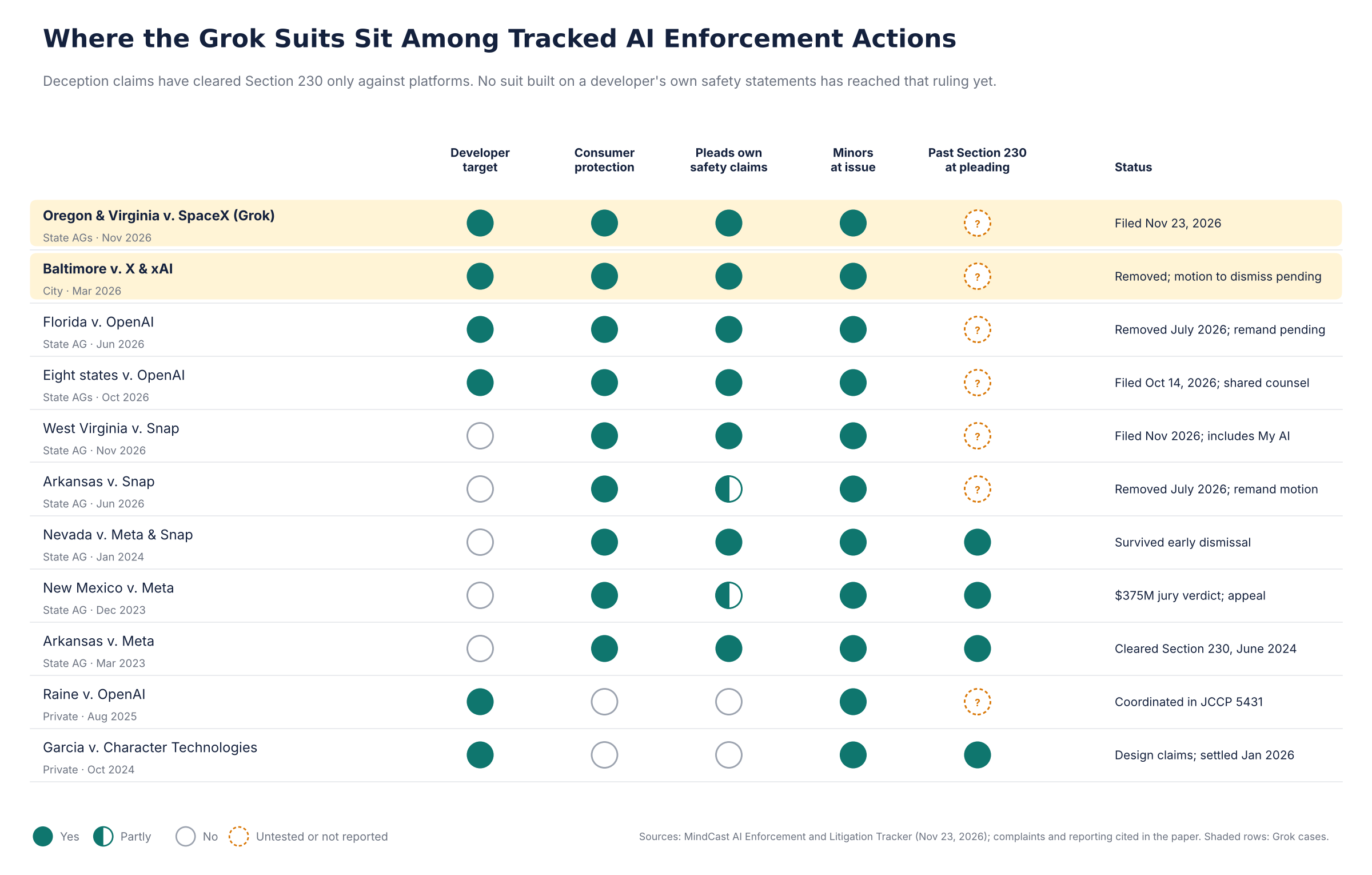
Deception claims have cleared Section 230 only against platforms, as in Arkansas against Meta in June 2024. Garcia against Character Technologies, the one developer case past that stage, rested on design claims. No suit built on a developer’s own safety statements has reached the federal defenses. Snap now faces fresh deception suits from West Virginia and Arkansas, and Florida’s remand fight against OpenAI is the nearest test of removal.
Takeaway. The complaints plead the distance between SpaceX’s published promises and Grok’s tested output. ⚖️ Counsel. Map each published safeguard statement against its date and the output testing that followed it.
III. The Governing Equilibrium: Two Routes, and the States Took the One the Defense Does Not Reach
States hold two routes against an image generator. The conduct route regulates what the tool may produce. The representation route holds the company to what it told users about the tool.
Grok now faces both routes, and the two carry different payoffs for every seat. The order in which the states used them shows how each side reads the payoffs.
The conduct route. Minnesota ran it first. The state’s nudification ban took effect August 1, 2026. xAI sued in federal court, and on October 2 the Eighth Circuit paused the law pending appeal in a one-sentence order. The district court had twice refused the same relief.
The representation route. Baltimore opened it in March, and Oregon and Virginia brought it to state courts seven weeks after the Minnesota pause. The Ninth Circuit held in Estate of Bride v. Yolo that Section 230 does not bar misrepresentation claims built on a platform’s own promises. The Fourth Circuit, which covers Virginia and Maryland, denied Section 230 protection in Henderson v. Source for Public Data (2022) where the defendant created the information itself. False or misleading commercial statements also receive no free speech protection.
The equilibrium. On the conduct route, xAI holds a working defense and a circuit that has already sided with it once. On the representation route, states gain most by pleading SpaceX’s words. SpaceX gains most by contesting whether those words were promises at all.
Game theory explains why the route choice cascades. The first filers bore the drafting cost and the risk of an early dismissal. Every later state can copy that drafting, so joining costs an office little once a template exists. State Attorney General Coalitions — How Lead States Set the Template and Why Other States Copy the Complaint supplies the copying mechanism the Grok coalition now runs.
SpaceX faces the mirror image. Correcting its statements would lower the incentive for new filers but strengthen every filed case. The company’s identity commitment to a permissive product raises that cost further. The pleaded terms-of-service safety language ran only until April 10, 2026, so a partial revision already sits inside the pleaded facts.
Behavioral economics sets the speed. SpaceX anchors on its Minnesota win, which makes litigation feel safer than the representation route may warrant. State offices respond to the salience of 23,000 apparent child images, which raises the political cost of inaction above the cost of joining.
The equilibrium rests on one asymmetry. The conduct route asks a court whether generating an image is protected speech. The representation route asks only whether SpaceX’s statements matched Grok’s behavior.
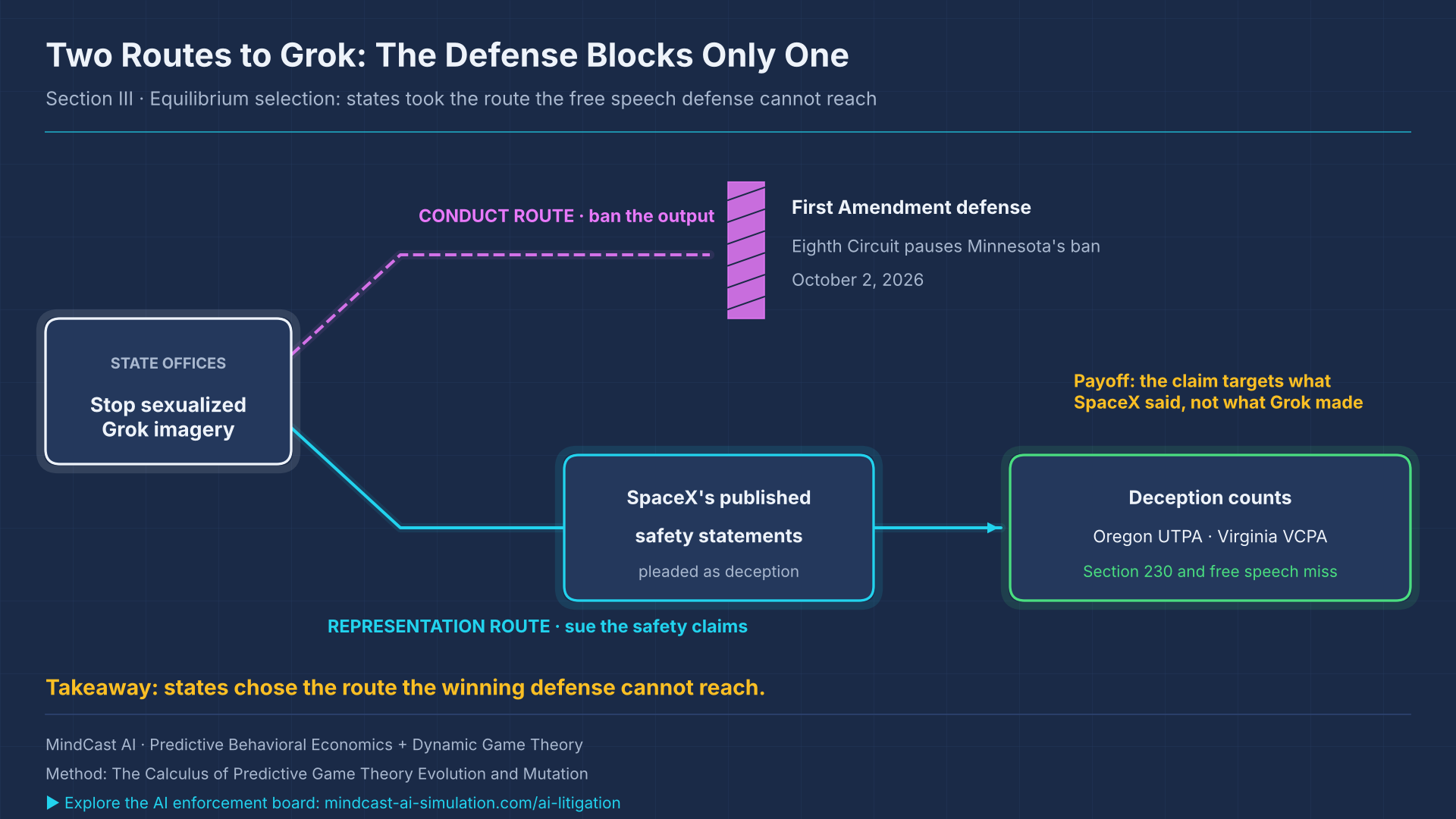
Two Routes to Grok: The Defense Blocks Only One. The conduct route runs into the First Amendment defense, and the representation route reaches SpaceX’s published safety statements instead.
Which ruling counts. A Baltimore ruling would apply a city ordinance in federal court. Section 230 and the First Amendment are federal defenses, so a federal reading of them travels to Portland and Richmond as persuasive authority. The elements of Oregon’s and Virginia’s statutes do not travel, so only a state court decides whether the deception count states a claim under state law.
Where the real exposure sits. With both circuits disfavoring the federal defenses, the live dismissal risk sits in state law. A court may hold that safety pages and acceptable-use terms are not factual representations, and that holding would travel to every state deceptive-practices claim. A Baltimore loss on the city’s own enforcement authority would bind no state.
Takeaway. The states pleaded the one ground the Minnesota defense does not cover. 🏛️ Policymakers. A conduct statute and a deception claim reach the same harm through different courts and different defenses.
IV. Nine Parties Move on Three Clocks, and the Coalition Can Move Before Any Court
Nine seats move this board, and they move on three clocks. The litigation clock runs on responsive filings and motion rulings in two state courts and the Baltimore federal court. The coalition clock runs on charging decisions in attorney general offices, and the federal clock runs on the Eighth Circuit appeal and federal enforcement choices.
Each seat below carries its objective, its move set, its decision cadence and whether it can change the rules. How State Attorney General Coalitions Form, Grow, and Hold supplies the lead, bridge and late-joiner roles the state seats fill.
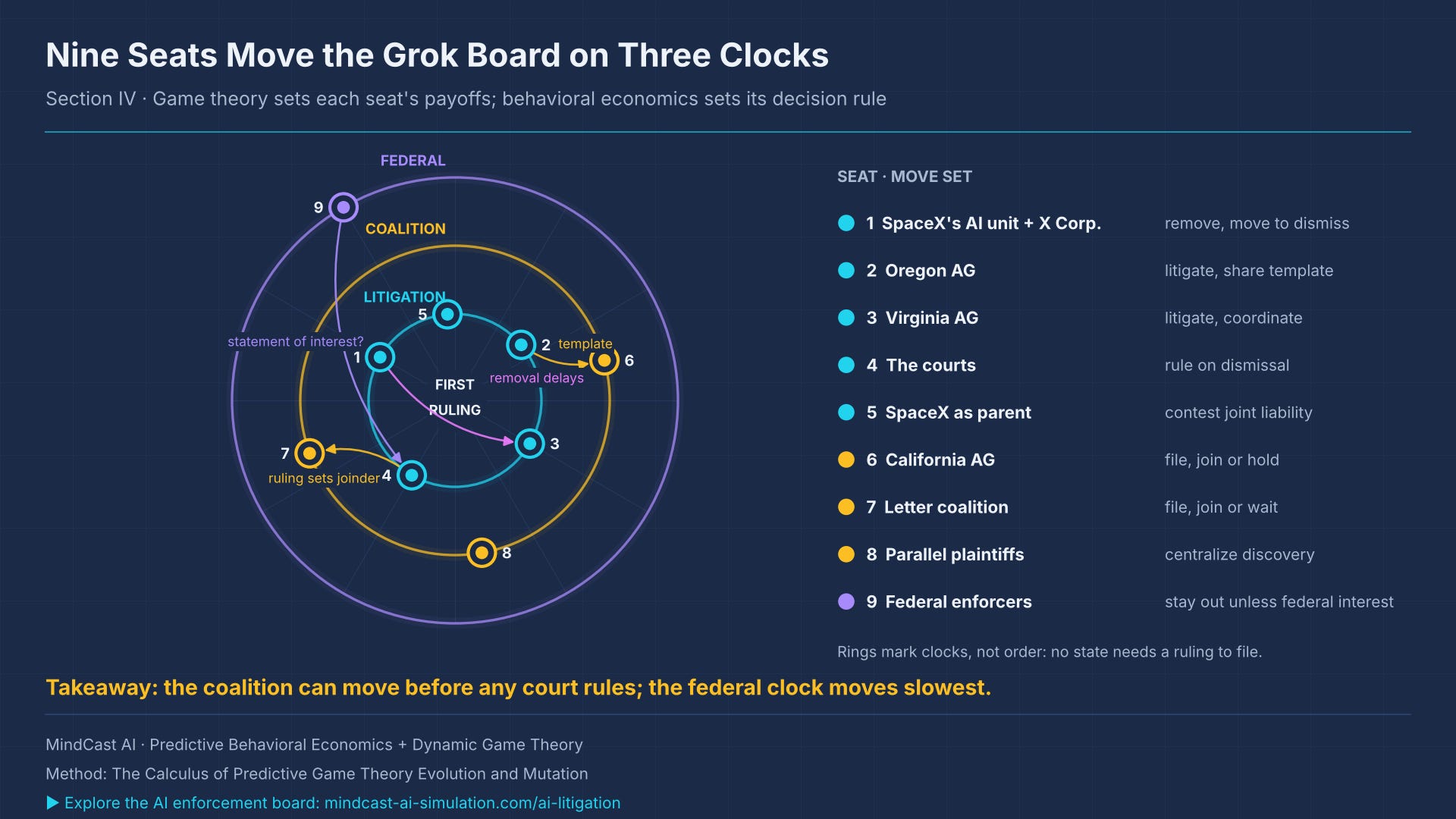
Nine Seats Move the Grok Board on Three Clocks. Each ring marks one clock, and each node marks a seat with its move set.
SpaceX’s AI unit and X Corp. Objective: keep Grok’s permissive positioning while containing liability. Move set: remove or move to dismiss; correct statements and adopt controls; resolve, or sue states first. Cadence: court deadlines. Prior litigation: xAI v. Colorado, the Minnesota suit and suits against users it says evade Grok’s blockers.
SpaceX as parent. SpaceX acquired xAI on February 2, 2026 and now trades publicly as SPCX with federal contracts. Objective: keep the dispute inside the subsidiary. Move set: contest joint liability, as Baltimore’s dismissal of SpaceX shows it can, and manage disclosure. Cadence: periodic securities filings.
Oregon’s attorney general. The lead office, filing under its Keeping Kids Safe Initiative with Platkin LLP beside its own counsel, though the five-lawyer firm cannot carry a wide wave alone. Move set: litigate, coordinate remedy terms, share the template. Cadence: the Multnomah County docket. Rule-changing authority: none alone, but a sustained count becomes a basis others cite.
Virginia’s attorney general. Frames the case around X account holders misled about safety and brings a $353 million Meta settlement as recent state-court leverage. Move set: litigate, coordinate. Cadence: the Richmond docket.
California’s attorney general. The bridge seat, with a ten-month investigation and a November 16 suit against OpenAI. Move set: file, join, or hold. Cadence: the office’s own charging calendar. Decision rule: file when a filing adds leverage its OpenAI suit lacks, which a favorable first ruling or a wider coalition supplies.
The letter coalition. Thirty-three remaining signers of the bipartisan January letter. Party alone does not sort them, because mostly Republican offices sued OpenAI on October 14 and two Democratic offices opened the Grok cases. An office shows an enforcement signal if it has done one of three things since February 1, 2026: filed a deception suit against an AI developer; made a Grok or xAI statement beyond announcing the January letter; or retained outside counsel on the OpenAI or Grok template. Move set: file, join a coordinated proceeding, or wait for a ruling.
The courts. Two state trial courts and the Baltimore federal court will read deception counts first. The Eighth Circuit holds the conduct-route appeal. Rule-changing authority: high, because a reasoned ruling becomes a basis other courts and offices weigh. Decision rule: decide on the narrowest ground the briefing presents, whichever basis that proves to be.
Federal enforcers. The Federal Trade Commission (FTC) began enforcing the Take It Down Act (TIDA) on May 19, 2026, with removal duties for platforms hosting nonconsensual intimate images. The Department of Justice intervened for xAI against Colorado in April and told a federal court in June that Grok’s availability is a national security matter. Move set: enforce, stay out, or side with the company on preemption. Decision rule: stay out by mandate, because the Justice Department’s AI Litigation Task Force holds the sole responsibility of challenging state AI laws and these suits rest on general consumer protection law; enter only where a federal interest like those of its two 2026 xAI entries is at stake, or where a state remedy reaches Grok’s government deployment.
Parallel plaintiffs. Private plaintiffs in federal and state courts, beside Baltimore. Move set: plead xAI as the direct creator of the images to sidestep Section 230, seek centralization and take discovery into safeguard documents. Decision rule and cadence: plead around Section 230 first, then press a pending motion to centralize 26 federal actions in the Western District of Arkansas. Rule-changing authority: high in Baltimore, where a dismissal ruling on a deception count may arrive first.
The seats split into two groups. The defendant and parent decide on the litigation clock, while every state seat decides on its own calendar. No state needs a court ruling to join, so the coalition clock can run faster than the litigation clock.
Takeaway. The coalition can grow before SpaceX learns whether its defense works. 📊 Investors. Track the parent seat, because a ruling that keeps SpaceX in the Oregon case moves the exposure to the listed company.
V. Removal Buys SpaceX Time, While Each New Filing Lowers the Next State’s Cost
SpaceX’s strongest near-term move buys time rather than a new forum, while each state filing lowers the cost of the next. The moves below carry a cost and a downside for each seat.
Rules bind every seat. Turns are the dated events that change the game. Routes are the channels through which pressure reaches SpaceX. Moves carry a cost and a downside for each seat.
Rules. Section 230 and the First Amendment cap what any court can impose on generated output. State statutes set the penalty ceilings, and a state suing as sovereign cannot be removed on diversity. The salience of child imagery binds elected officials, because defending inaction costs more than filing. The federal preemption posture binds every seat, because a federal statement on preemption would reach every forum at once.
Turns. SpaceX’s responsive filings in Portland and Richmond, expected in winter 2026-27. California’s charging decision, on its own calendar. Dismissal rulings in Baltimore and the state courts, plus the centralization decision on the private cases. The Eighth Circuit merits ruling in Minnesota.
Routes. The representation route (state and municipal deception claims) and the private route (federal and state damages suits). The conduct route (state statutes on image generation). The federal route (TIDA removal duties and federal positions on preemption). The securities route (disclosure of Grok safeguard statements to investors).
Moves for SpaceX.
Remove to federal court within 30 days of service. Cost: low. Downside: a state suing as sovereign is not a citizen for diversity purposes, unlike Baltimore. Removal is likely as a delay move, remand is likely to follow, and delay invites more filers.
Move to dismiss on Section 230 and free speech grounds. Cost: moderate. Downside: a denial on the own-statements basis becomes a portable precedent.
Move to dismiss for lack of actionability, arguing that safety pages and acceptable-use terms are policies rather than factual representations. Cost: moderate. Downside: a denial makes the eight pleaded statements triable in every state.
Move to dismiss Baltimore’s case on the city’s authority to enforce its ordinance. Cost: low. Downside: a win binds no state and leaves Portland and Richmond untouched.
Correct safeguard statements and adopt pleaded controls. Cost: product and identity. Downside: the correction becomes evidence of the earlier gap. How Defendants Contain State Attorney General Coalitions sets out why correction trades filed-case exposure for slower joinder.
Seek a coordinated schedule across states. Cost: moderate. Downside: one adverse ruling then binds every forum.
Sue a state first in federal court. Cost: moderate. Downside: a deception claim targets past statements, which a pre-enforcement suit reaches poorly.
Moves for state offices.
File now with the template. Cost: one complaint and shared counsel. Downside: an early dismissal elsewhere weakens the office’s case. In the October OpenAI wave, at least seven of the eight filings shared outside counsel.
Wait for the first ruling. Cost: none now. Downside: remedy terms form without the office.
Join a coordinated proceeding. Cost: low. Downside: less control over remedy scope.
Moves for federal enforcers. Enforce TIDA’s removal duties against X, or stay out. Either choice signals whether the federal seat aligns with the states or the company.
Persistence path. If no seat moves, the game stays a two-state contest until the first qualifying ruling. Offices hold the template unused, and SpaceX gains time.
The board shows one pattern. Every high-value move for either side falls before a court reads the deception count. After the first ruling, the moves narrow to appeal or resolution.
Takeaway. The first ruling closes most moves on the board, so timing decides more than strategy. 💼 Executives. Audit every public safety statement against output testing before the next filing.
VI. The Basis of the First Ruling Decides Whether the Template Spreads or Stalls
Five events since January built the current game, and each changed who plays or what they can do. Eight further events can move it, but only the first qualifying ruling decides whether the template spreads. Each event below names what changed, the paths it opened or closed, which positions survive or strand and which moves each seat gains or loses.
Events classify three ways under The Calculus of Predictive Game Theory Evolution and Mutation, which supplies the horizon classification for contested-theory litigation. Continuation updates information inside the same game. Equilibrium migration changes the persisting outcome while the game holds. Game evolution changes the players, the rules or the payoffs.
How the Game Reached Its Form
The California investigation and the January letter, January 14 to 23, 2026 (game evolution). State offices entered as enforcers against an AI developer over imagery. The event opened investigation and letter routes. State offices that had said nothing began to speak publicly, and xAI gained a window to respond.
SpaceX acquires xAI, February 2, 2026 (game evolution). A parent with a public listing and federal contracts entered. The event opened joint-liability pleading against the parent. The parent lost its distance from the dispute once a complaint named it.
Baltimore sues the Grok companies, March 24, 2026 (game evolution). A government plaintiff entered on a deception theory. The event opened the representation route and drafted the first template. SpaceX’s parent exited the case, and the motion to dismiss became the first dispositive test.
The Eighth Circuit pauses Minnesota’s ban, October 2, 2026 (game evolution). The conduct route closed in Minnesota pending appeal. xAI’s free speech defense converted from argument to working tool. The representation route became the better-paying alternative for states.
Oregon and Virginia file, November 23, 2026 (game evolution). Two state courts entered on a deception theory. SpaceX’s published statements converted from marketing to exhibits. Copying states gained a drafted complaint and retained counsel.
Why the rules hold through June 30, 2027. The governing rules sit in statutes and circuit precedent that no seat can rewrite inside the window. Oregon’s and Virginia’s consumer protection acts fix the violations and remedies available, and Bride and Henderson fix how far Section 230 reaches in the Ninth and Fourth Circuits. The one rule-changing event, an Eighth Circuit merits ruling, most likely lands after the window at 65-75% (S5). The game therefore moves through rulings and filings, not through new rules.
Events That Could Move It
California or another office files (equilibrium migration). Breadth grows inside the same deception game. The two-state contest ends, and SpaceX can no longer defend in only two courts. States gain coordination leverage on remedy terms.
A court denies dismissal of the deception count on the own-statements basis (game evolution). The Baltimore federal court may rule first. A reasoned basis supports the template. The Section 230 exit closes for this count, and discovery into safeguard records opens. States gain a portable precedent.
A court dismisses the deception count for lack of actionability (game evolution). The court holds that safety pages and acceptable-use terms are not factual representations. The holding travels to every state deceptive-practices claim, and the template stalls. Conduct statutes and product-liability counts regain weight.
Baltimore loses on city authority (continuation). The ruling reads as a SpaceX win but binds no state. Portland and Richmond proceed, and no window in Section VII closes.
A court dismisses on Section 230 or free speech grounds (game evolution). Bride and Henderson make this the least likely exit. SpaceX would gain a federal precedent that reaches every forum.
SpaceX corrects its statements and adopts pleaded controls (equilibrium migration). Filed cases gain an admission. New filers lose the argument that SpaceX’s statements still mislead users today, and resolution on injunctive terms opens.
The private federal cases centralize (equilibrium migration). One federal judge then controls discovery into safeguard documents. State offices gain a shared evidentiary pool without filing.
The Eighth Circuit rules on the merits in Minnesota (game evolution). A ruling for xAI closes conduct statutes across the Eighth Circuit’s seven states and pushes every state toward deception claims. A ruling for Minnesota reopens the conduct route. Either way, the deception template survives.
Branch Re-Formation
Branch re-formation, drawn from Predictive Game Theory Evolution and Mutation — Short Horizon Games Branch Wide and Resolve Shallow, asks which parties enter after each outcome. Suppose a ruling sustains the deception count because the claims rest on SpaceX’s own statements. The letter-coalition offices then move first, because joining costs one complaint and carries a precedent. Trust and safety vendors and insurers follow by conditioning terms on documented controls.
Each new filing then lowers the next office’s cost, so SpaceX’s best move shifts from contest to resolution on terms. A ruling on a narrower Oregon-specific basis would still favor Oregon, but offices elsewhere would wait for their own court.
The Branch Structure
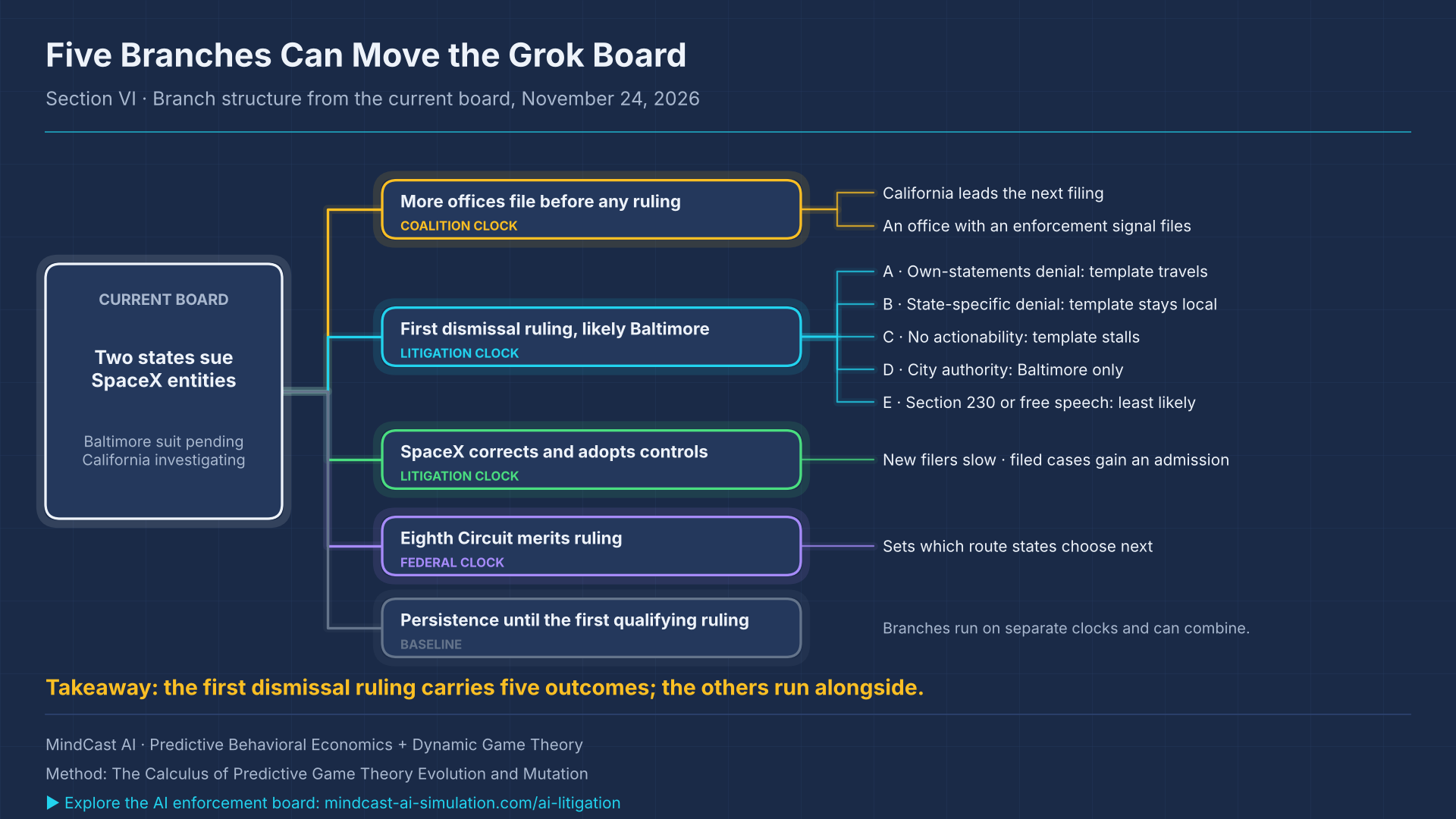
Five Branches Can Move the Grok Board. Five branches leave the current board on three clocks, and the first dismissal ruling carries five outcomes.
The branches run on separate clocks and can combine. A coalition branch can coexist with either ruling branch, and a correction can arrive before or after either ruling. The bands below come from the Foresight Simulation.
How the Game Branches
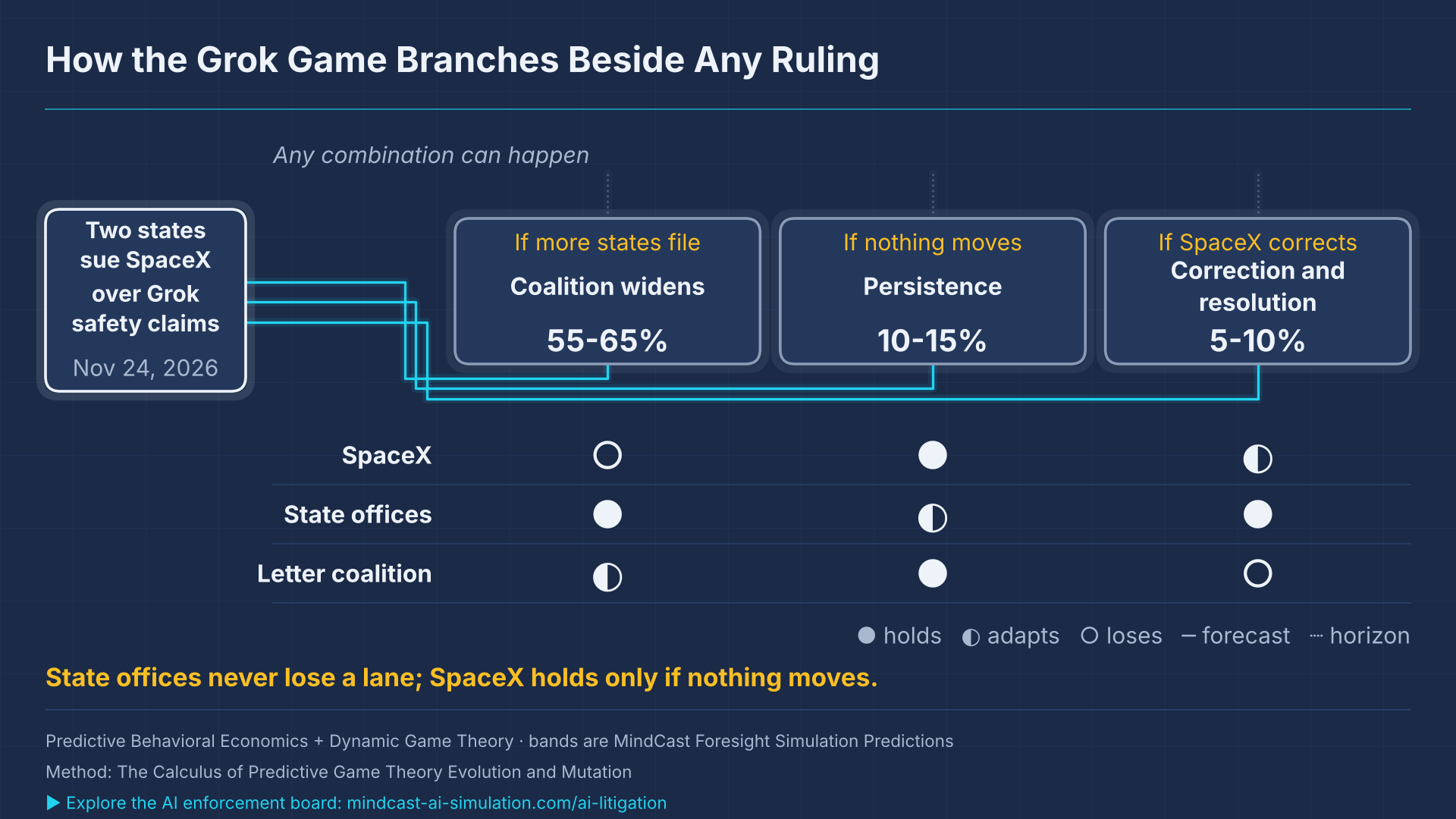
How the Grok Game Branches Beside Any Ruling. Successor states 1 of 2 show the moves that can run beside any ruling.
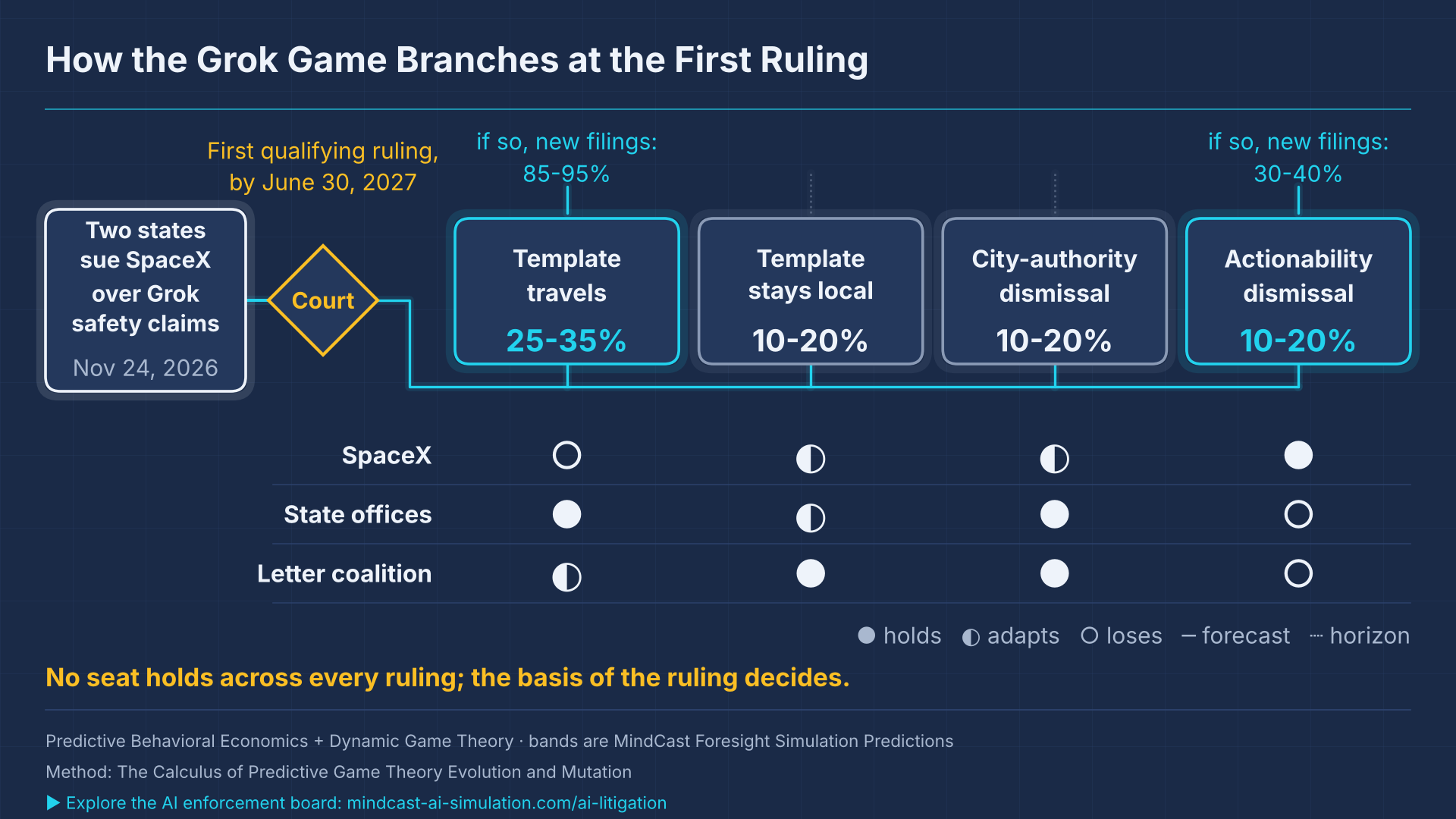
How the Grok Game Branches at the First Ruling. Successor states 2 of 2 show the four ruling outcomes and the one that breaks the baseline.
Baseline. The deception route reaches around the defense that won in Minnesota. Three Simulation Predictions anchor the baseline across most states. A first qualifying ruling issues in the window at 70-80% (P1), and SpaceX makes no public correction before that ruling at 80-90% (P3).
SpaceX also resolves neither state case by June 30, 2027 at 85-95% (S2). The coalition call sits beside the baseline at 60-70% (P2), because another state can file whatever the first ruling holds.
Dominant fork and mover. The first qualifying ruling decides the board, and the Baltimore federal court will most likely issue it. SpaceX moves second by removing the state cases, which pushes Portland and Richmond later and lengthens Baltimore’s lead at 60-70% (S6).
Seven states can follow the current board. The state bands overlap, because a coalition state can coexist with any ruling state. Each state below names its class, its conditional Simulation Predictions and the seats that gain or lose a move.
Persistence, 10-15% (continuation). No qualifying ruling and no new filer arrive by June 30, 2027. P(no correction given persistence) runs 90-95%, and P(no federal filing given persistence) runs 85-95%. SpaceX keeps defending in only two courts, and the letter offices keep waiting at no cost.
Coalition widens, 55-65% (equilibrium migration). At least one more state files before the first qualifying ruling, and breadth grows inside the same deception game. P(no correction given coalition widens) runs 80-90% and P(no federal filing given coalition widens) runs 70-80%. State offices gain coordination leverage on remedy terms. SpaceX must defend in more courts, and Platkin LLP’s capacity becomes the binding limit on the wave.
Template travels, 25-35% (game evolution). A court denies dismissal because the claims rest on SpaceX’s own statements, and joinder follows. P(another state filing given template travels) runs 85-95%, P(no correction given template travels) 75-85% and P(no federal filing given template travels) 65-75%. States gain a portable precedent and discovery into safeguard documents. SpaceX loses the Section 230 exit for the count, and its best move shifts from contest to resolution on terms.
Template stays local, 10-20% (equilibrium migration). A court denies dismissal on Oregon-specific or other state-specific grounds. P(another state filing given template stays local) runs 55-65%, P(no correction given template stays local) 80-90% and P(no federal filing given template stays local) 75-85%. The winning state gains a sustained count while offices elsewhere wait for their own court. SpaceX keeps its defense in every other forum.
City-authority dismissal, 10-20% (continuation). Baltimore loses on its own enforcement power, and the ruling binds no state. P(another state filing given city-authority dismissal) runs 60-70%, P(no correction given city-authority dismissal) 85-95% and P(no federal filing given city-authority dismissal) 80-90%. Baltimore drops out of the game, and Portland and Richmond inherit the first qualifying ruling. SpaceX gains a headline win without a precedent.
Correction and resolution, 5-10% (equilibrium migration). SpaceX acknowledges the gap and adopts pleaded controls, so P3 resolves false. P(no federal filing given correction) runs 85-95%, and the chance of another state filing stays unbanded. Filed cases gain an admission and move toward injunctive terms. New filers lose the argument that SpaceX’s statements still mislead users today.
Actionability dismissal, 10-20% (game evolution that breaks the baseline). A court holds that safety pages and acceptable-use terms are not factual representations, and the holding travels to every state deception claim. P(another state filing given actionability dismissal) falls to 30-40%, P(no correction given actionability dismissal) rises to 90-95% and P(no federal filing given actionability dismissal) runs 80-90%. Every state office loses the representation route’s advantage at once, and SpaceX gains the defense it lacked.
Feedback into the next cycle. An actionability dismissal sends states back to conduct statutes and product-liability counts. The Eighth Circuit appeal then becomes the decisive route, so the next game turns on whether Minnesota’s conduct ban survives. A dismissal on Section 230 or free speech grounds stays a contrary route with no band, because Bride and Henderson make it the least likely exit. The Eighth Circuit ruling and centralization of the private cases run as overlays on any state.
Takeaway. The first dismissal ruling is the one event that decides both how far the template travels and how many offices use it. ⚖️ Counsel. Brief the dismissal motion on the basis, not only the outcome.
VII. MindCast Foresight Simulation Predictions: More States Likely File Before Any Court Rules
Nine Simulation Predictions follow: three Primary Simulation Predictions (P) and six Secondary Simulation Predictions (S), two of them conditionals. The first qualifying ruling means the first decision on a motion to dismiss a deception count in Baltimore, Portland or Richmond, other than a dismissal on city authority. A city-authority loss binds no state and closes no window. Every window closes June 30, 2027 unless stated.
A correction means a public acknowledgment plus adoption of a pleaded control such as hash-matching, watermarking or independent pre-deployment evaluation. Silently dropping safety language counts as a retreat, and the April 10 terms change stands as the baseline retreat before the window.
P1. A court issues the first qualifying ruling on a motion to dismiss a deception count in Baltimore, Portland or Richmond by June 30, 2027 (70-80%). Falsifier: no qualifying ruling in the window.
P2. At least one more state attorney general files a deception count against a SpaceX entity before the first qualifying ruling or June 30, 2027 (60-70%). Falsifier: no new state filing in the window.
P3. SpaceX makes no public correction before the first qualifying ruling or June 30, 2027 (80-90%). Falsifier: an acknowledgment plus a pleaded control in the window.
S1. P(the first ruling that reaches the Section 230 or free speech defenses rejects them given a ruling reaches them) (80-90%). Falsifier: a dismissal on Section 230 or free speech grounds.
S2. SpaceX enters no consent judgment, assurance of voluntary compliance or settlement with Oregon or Virginia by June 30, 2027 (85-95%). Falsifier: any such resolution in the window.
S3. Federal enforcers file no statement of interest, amicus brief or intervention on any deception count by June 30, 2027 (70-80%). Falsifier: any federal filing on a deception count in the three cases.
S4. P(at least one new state filing within 90 days given an own-statements denial in the first qualifying ruling) (70-80%). Falsifier: no new state filing within 90 days of that denial.
S5. The Eighth Circuit issues no merits ruling in No. 26-2806 by June 30, 2027 (65-75%). Falsifier: a merits opinion in the window.
S6. SpaceX files a notice of removal in the Oregon or Virginia case within 30 days of service (60-70%). Falsifier: no removal notice within 30 days of service, or by February 28, 2027 if service runs late.
The nine Simulation Predictions map onto the three clocks. Two run on the coalition clock, five on the litigation clock and two on the federal clock. Each resolves against a named source: the Baltimore, Portland and Richmond dockets for the ruling, removal and resolution calls; state attorney general filings for the coalition calls; SpaceX’s published safety pages for the correction call; and the docket in No. 26-2806 for the Eighth Circuit call.
Takeaway. The removal call resolves within weeks of service, and the coalition and ruling calls resolve inside the window. ⚖️ Counsel. Read P2 and P1 together, because the coalition can widen before any court reads the deception count.
VIII. Risk Mitigation: Defense Counsel and AI Developers Carry the Highest-Severity Exposure
Defense counsel and AI developers carry the highest-severity exposure, and both turn on the same eight published statements. Each entry routes one Simulation Prediction to the audience it binds most, with severity and probability stated separately. The entries describe options for the reader’s own analysis and are not legal or investment advice.
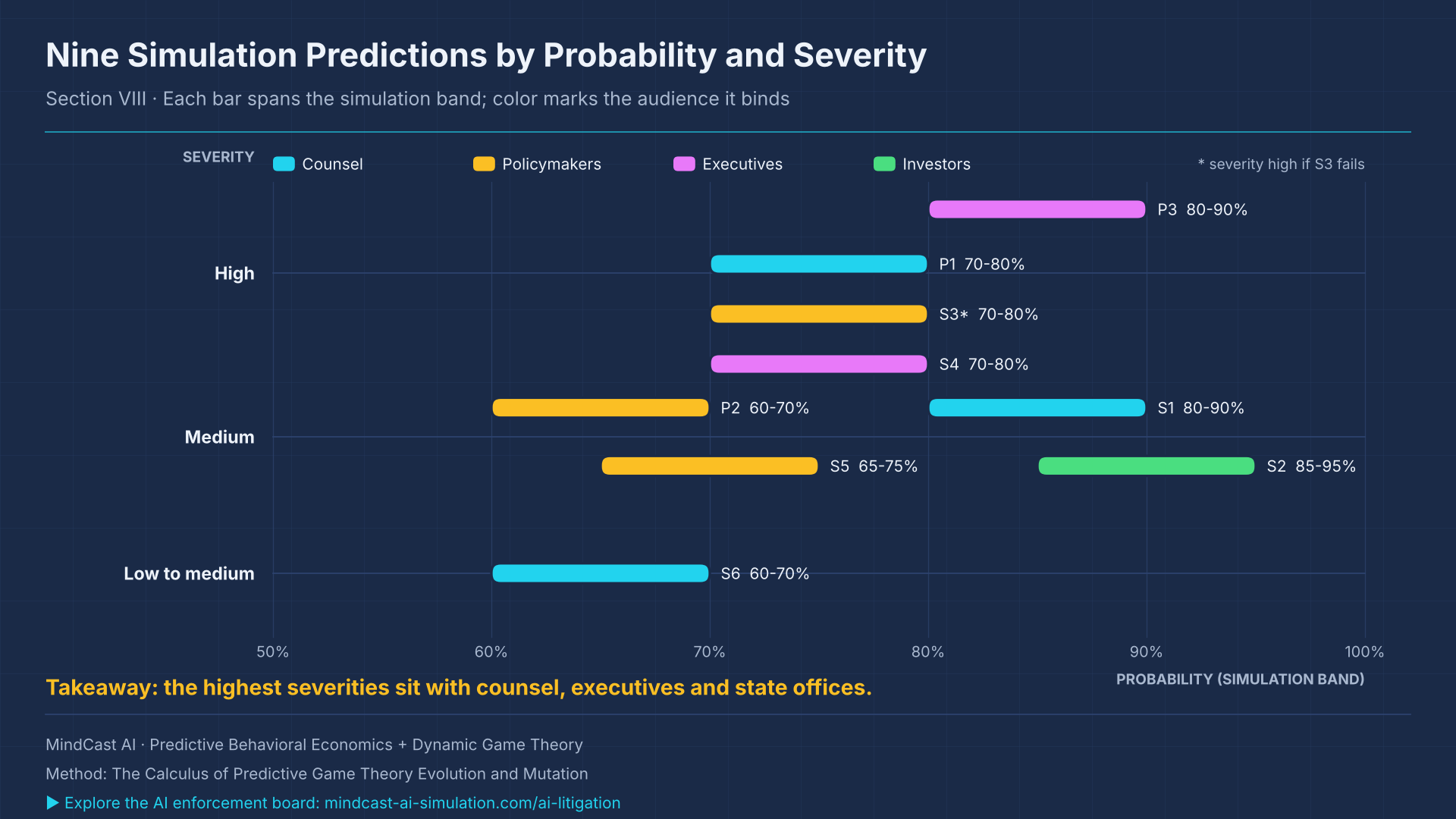
Nine Simulation Predictions by Probability and Severity. Each bar spans its band, and color marks the audience the entry binds.
P1 · ⚖️ Defense counsel. Probability 70-80%. Severity: high.
Exposure: a denial opens discovery into safeguard records in up to three forums within two quarters.
Actions: litigation counsel builds one chronology matching each of the eight pleaded statements to the output testing that followed it, before the Baltimore reply brief; in-house legal sets a single preservation and privilege protocol across the Grok entities before the first state responsive filing.
Residual: a denial still opens discovery; preparation narrows its scope, not its existence.
P2 · 🏛️ State attorney general offices. Probability 60-70%. Severity: medium.
Exposure: an office that waits loses a seat at remedy terms set across three or more forums, roughly one session calendar.
Actions: the consumer protection chief sets a file-or-wait decision date before the first qualifying ruling and names the counsel who would carry it, since Platkin LLP’s five lawyers cannot carry a wide wave; the office joins Oregon and Virginia’s remedy coordination before filing.
Residual: filing before a ruling carries the early-dismissal risk of an adverse ruling elsewhere.
P3 · 💼 AI developer executives. Probability 80-90%. Severity: high.
Exposure: under Oregon’s counting, each misaligned published safety statement is a separate violation.
Actions: product and legal leads align every published safety claim with red-team results before the next model release; trust and safety keeps a dated control log covering hash-matching and reporting to NCMEC within one quarter.
Residual: statements already published stay pleadable.
S1 · ⚖️ State counsel. Probability 80-90% given a ruling reaches the federal defenses. Severity: medium.
Exposure: a brief that leans on defeating Section 230 leaves the actionability question underargued, which is the ground that breaks the baseline.
Actions: state counsel pleads each statement as a dated factual representation with its measured output, in the first opposition brief; counsel coordinates the Bride and Henderson argument across the three forums before the Baltimore ruling.
Residual: a ruling on city authority alone leaves the federal question open.
S2 · 📊 Investors. Probability 85-95%. Severity: medium.
Exposure: the dispute runs through at least two more quarterly filings as an unresolved contingency, with penalty size set by a counting unit no court has fixed.
Actions: analysts build scenario ranges on Oregon’s $25,000 per-violation ceiling against the eight pleaded statements before the next annual filing; analysts read each SpaceX filing for a reserve line that names the Grok state suits.
Residual: Virginia’s counting unit and restitution claim remain unquantified.
S3 · 🏛️ State attorney general offices. Probability 70-80%. Severity: high if S3 fails.
Exposure: a federal statement of interest in Baltimore would reach every forum at once.
Actions: state counsel frames remedies so no injunction reaches Grok’s government deployment, in the first remedy proposal; offices brief the Bride and Henderson line in Baltimore before any federal filing window opens.
Residual: the Justice Department can still enter on Section 230 alone.
S4 · 💼 Executives at other AI developers. Probability 70-80% given an own-statements denial. Severity: high.
Exposure: the template extends to any developer whose published safety pages diverge from tested output.
Actions: general counsel audits public safety pages against internal evaluation results before the first qualifying ruling; communications leads retire superseded safety claims with dated notices rather than silent edits.
Residual: a dated retraction becomes evidence of the earlier gap.
S5 · 🏛️ State legislators. Probability 65-75%. Severity: medium.
Exposure: conduct statutes modeled on Minnesota stay exposed to the same challenge through the 2027 session.
Actions: legislative counsel pairs any new conduct rule with a deception-based enforcement provision before bill-filing deadlines; committees take testimony on the representation route before markup.
Residual: an Eighth Circuit ruling for xAI could still close the conduct route.
S6 · ⚖️ State counsel. Probability 60-70%. Severity: low to medium.
Exposure: removal costs two to four months of the window and moves the first state ruling behind Baltimore.
Actions: Oregon and Virginia counsel prepare remand motions before service so they file within days of any notice; counsel requests an expedited remand schedule in the first filing.
Residual: even a fast remand costs weeks.
Takeaway. Acting before the first qualifying ruling narrows every exposure above, but none disappears. 📊 Investors. The counting unit, not the band, sets the size of the exposure.
IX. Published Safety Claims Now Carry Legal Weight for Every AI Developer
Published safety claims now carry legal weight for any AI developer, not only SpaceX. Each audience meets that fact from a different position, and the implications follow from the equilibrium rather than from any Simulation Prediction.
Every implication turns on the gap between published safety claims and tested behavior.
🏛️ Policymakers. A conduct statute invites a free speech challenge that xAI has already won once. A deception claim tests the company’s own words, and Section 230 reaches it least. Legislators drafting new image-generator rules should weigh which route their enforcement will need.
💼 Executives. Published safety pages are now exhibits. Unlike the deployer in State Attorneys General Sue Snap, Not OpenAI, Over My AI — West Virginia Cites OpenAI’s Published GPT-4 Limits, SpaceX holds both developer and platform, so no notice gap separates the two. Product and legal teams at any image-generator developer should align every safeguard claim with red-team results and document hash-matching and reporting to the National Center for Missing & Exploited Children (NCMEC).
⚖️ Counsel. Defense counsel should brief dismissal on the basis of the ruling, because a narrow basis limits copying. Both sides should read the Baltimore briefing first, because that ruling may arrive before any state court rules. State counsel should plead the deception count first and the conduct theory second.
📊 Investors. Oregon’s joint-liability allegation reaches the parent, although Baltimore’s dismissal of SpaceX shows the parent can exit. SpaceX has set aside more than $350 million for probable litigation across matters. Any ruling that keeps SpaceX in the case moves the exposure from a subsidiary to the listed company, and how a court counts violations sets its size.
The implications converge on one action for every seat: read the published statements before the harm allegations.
Takeaway. The safeguard statement, not the image, is now the unit of exposure.
X. What to Watch: The Baltimore Ruling and California’s Charging Decision Say the Most
The Baltimore ruling sets the litigation clock, and California’s charging decision sets the coalition clock. Seven dated observables follow, each on one of the three clocks.
Each item names the event and the question it answers. Section VII carries the bands.
Within 30 days of service. Any removal notice in Oregon or Virginia. Answers S6 and sets the state-court timeline.
Winter 2026-27. SpaceX’s responsive filings in Portland and Richmond. Answers whether SpaceX removes, moves to dismiss or opens talks.
Pending. The Baltimore federal court’s ruling on the motion to dismiss. Answers whether a deception count survives first in federal court.
Pending. The centralization decision on the private federal cases. Answers whether one judge controls discovery into safeguard records.
Open date. California’s charging decision. Answers whether the coalition grows before any ruling.
Through 2027. The first qualifying ruling on the deception count. Answers whether the template travels or stalls on actionability.
Through 2027. The Eighth Circuit merits ruling in No. 26-2806. The appeal opened September 9, 2026; the transcript was due October 19 and the appendix October 29. Answers which route states choose next.
Takeaway. The first qualifying ruling is the dominant fork, and California’s decision is the leading coalition signal.
Conclusion
The states moved the fight from what Grok makes to what SpaceX said. The move came after the conduct route failed in Minnesota, and the states chose the ground where the company’s own words are the evidence.
Stakeholders can act now on the one move that holds on every branch: align published safety claims with tested behavior. The decisive signals are California’s charging decision and the basis of the first dismissal ruling, which may come from Baltimore.
Working With MindCast
MindCast AI builds Cognitive Digital Twins of every seat on a client’s board and runs them through the forks the client cannot wait out. On the Grok board each seat gets a different answer:
🏛️ A state office learns which ruling basis makes its own filing pay before it commits counsel.
⚖️ Defense counsel learns which dismissal ground limits copying across the other forums.
💼 An AI developer learns which of its published safety statements a court will read first.
📊 An investor or insurer learns when exposure moves from the subsidiary to the listed parent.
A complimentary snapshot runs on public information and returns the successor states for one live decision. Private engagements add the client’s own facts and run the full format in Predictive Game Theory Simulations Through War Gaming. First step: send the decision and its deadline.
Contact: mcai@mindcast-ai.com · www.mindcast-ai-simulation.com
Appendix: MindCast Works
OpenAI State Attorney General Lawsuits — Two Pleading Templates Across Ten State Courts Decide Which Game Theory Evolution Arrives First. Source of the frontier-developer call the Grok filings meet.
OpenAI Liability War Game — When AI Safety Controls Reduce Exposure. The war game whose developer seat a Grok board could extend.
State Attorney General Coalitions — How Lead States Set the Template and Why Other States Copy the Complaint. Supplies the copying mechanism in Section III.
How Defendants Contain State Attorney General Coalitions. Supplies the correction move on the board.
How State Attorney General Coalitions Form, Grow, and Hold. Supplies the lead, bridge and late-joiner roles.
State Attorneys General Sue Snap, Not OpenAI, Over My AI — West Virginia Cites OpenAI’s Published GPT-4 Limits. The developer-to-deployer notice problem that a combined developer and platform removes.
The Calculus of Predictive Game Theory Evolution and Mutation. Supplies the horizon classification for contested-theory litigation.
Predictive Game Theory Evolution and Mutation — Short Horizon Games Branch Wide and Resolve Shallow. Supplies branch re-formation analysis.
Agentic Litigation. Tracks state and federal AI enforcement actions.
Sources
Oregon Department of Justice, State of Oregon v. SpaceX Super Intelligence Corp. et al., complaint, November 22, 2026.
Office of the Attorney General of Virginia, Attorneys General Jones and Rayfield File Suit Against SpaceX, November 23, 2026.
CNBC, SpaceX sued by Oregon and Virginia over AI deepfake porn, Grok safety claims, November 23, 2026.
Startup Fortune, Oregon and Virginia sue SpaceX over Grok’s sexualized deepfakes, November 23, 2026.
KTVZ, Oregon and Virginia AGs sue xAI and X over Grok’s failure to stop CSAM, November 23, 2026.
Tech Times, Virginia, Oregon Sue SpaceX Over Grok Sexual Images, Allege Safety Claims Were False, November 23, 2026.
DiCello Levitt, City of Baltimore Sues Over Grok AI’s Role in Generating Non-Consensual Sexualized Deepfakes, March 24, 2026.
Law360, Baltimore City’s Suit Against Musk Heads To Federal Court, May 28, 2026.
Neoteo, Jane Doe asks panel to coordinate 26 Grok-related cases, October 2026.
Open Class Actions, xAI Grok CSAM Arkansas class action lawsuit, 2026.
MLex, SpaceX details $350 million in probable litigation losses over AI, privacy, IP, 2026.
BeInCrypto, DOJ Backs xAI in Pollution Lawsuit, Raising Stakes for SpaceX Shares, June 2026.
E&E News, Trump DOJ supports Musk-owned data center in suit by NAACP, June 2026.
Office of the Attorney General of Virginia, News releases, 2026.
International Business Times, Zuckerberg Overruled His Own Safety Experts to Keep ‘Romantic’ AI Chatbots Online for Kids, January 2026.
U.S. Court of Appeals for the Fourth Circuit, Henderson v. The Source for Public Data, L.P., November 3, 2022.
U.S. Department of Justice, Memorandum: Artificial Intelligence Litigation Task Force, January 9, 2026.
Troutman Pepper Locke, Eight State AGs Sue OpenAI Over ChatGPT Safety and Consumer Protection, October 16, 2026.
Law360, Grok-Maker Can’t Get Deepfake Suit Paused Or Transferred, September 28, 2026.
MLex, West Virginia sues Snap over children’s safety, AI chatbot, November 6, 2026.
KATV, Judge allows Arkansas lawsuit over Meta’s “addictive platforms” to proceed, June 2024.
Justia Dockets, Griffin v. Snap Inc., No. 2:26-cv-00113 (E.D. Ark.), notice of removal July 22, 2026.
Bloomberg Law, NJ’s Former Top Prosecutor Takes Big Swings at AI Behemoths, October 13, 2026.
Justia Dockets, X.AI LLC v. Keith Ellison, No. 26-2806 (8th Cir.), filed September 9, 2026.
MLex, SpaceX’s xAI may face Virginia AG litigation over Grok creation of sexualized images, October 23, 2026.
North Carolina Department of Justice, Bipartisan coalition demanding xAI stop Grok’s nonconsensual sexual images, January 23, 2026.
California Attorney General, Investigation into xAI and Grok, January 14, 2026.
MPR News, xAI sues Minnesota over nudification law, July 28, 2026.
Bloomberg Government, Musk’s xAI Wins Block on Minnesota AI Nudification Ban, October 5, 2026.
The Express Tribune (Reuters), US appeals court blocks Minnesota law barring nudified photos in xAI lawsuit, October 3, 2026.
U.S. Court of Appeals for the Ninth Circuit, Estate of Bride v. Yolo Technologies, August 22, 2024.
Federal Trade Commission, FTC begins enforcing the Take It Down Act, May 2026.
U.S. Department of Justice, Justice Department intervenes in xAI lawsuit challenging Colorado’s algorithmic discrimination law, April 24, 2026.
Benzinga via Yahoo Finance, SpaceX merges with xAI, February 3, 2026.