MCAI Lex Vision: CFTC Takes On Nine States — Kalshi, Prediction Markets, and the Federal-Plaintiff Phase
National Prediction Market Litigation Architecture: Federal Government Supplies Offensive Posture Kalshi Lost, While Tribes, Casinos, State AGs, Investors Face the Same Unresolved Boundary Question

Related work: Prediction Markets and the Dual Nash-Stigler Trap — Kalshi, the CFTC, and the Prediction-Market Harm Clearinghouse | How the CFTC’s Missing “Gaming” Definition Is Losing the Kalshi Prediction-Market Preemption War
Preface: A Prediction Market on Prediction Market Litigation
With the National Prediction Market Litigation Architecture series, MindCast is creating a prediction market on prediction market litigation. Every publication in the series lists forecasts the way an exchange lists contracts. Each prediction carries a probability band — the price. Each carries a falsification condition — the settlement term. Each carries a measurement window — the expiry. The Validation Ledger publishes settlement history, and reputation serves as margin: MindCast stakes its analytical credibility on every position, publicly and in advance.
Readers score the book. Upload the publication into any capable LLM alongside a news development, and the Runtime Module runs the registry — twenty-four tracked predictions across two namespaces, tiered by decision relevance. Positions that settle wrong get recorded, not rescued.
The recursion is deliberate. Kalshi markets itself as a truth machine while sports and parlays carry 89.6% of its volume. The series builds the instrument the marketing describes — forecasts staked, settled, and publicly auditable — on the one underlying no exchange lists: the legal fate of the prediction market industry itself.
Foundational, related works: The National Kalshi Prediction Market Litigation Map (Mar 2026) | The Prediction Markets Rule Architecture Series (May 2026) | MindCast Comment on the Prediction Markets NPRM (Jun 2026 public comment, RIN 3038-AF65) | The CFTC NPRM Is a Litigation Brief — Reading RIN 3038-AF65 as the Federal Record for the Preemption War (Jun 2026)
Executive Summary
Prediction markets have entered the federal-plaintiff phase. The central question no longer asks whether Kalshi-style event contracts resemble gambling. The sharper question asks whether federal derivatives classification can make that resemblance legally irrelevant — and which sovereign holds the power to decide.
Thesis: The CFTC’s nine-state campaign is not mere escalation. It is substitution. After the Ninth Circuit allowed state enforcement actions to proceed against prediction-market platforms, the federal government supplied the offensive posture the platforms could not reliably maintain. The result is a three-instrument federal architecture: rulemaking record, amicus intervention, and sovereign litigation. But the architecture still lacks the boundary rule that would make exclusive jurisdiction administrable — and the states’ side spent the same fifteen weeks acquiring a procedural firewall, a third sovereign, a fiscal weapon, and a private monetization engine. Both sides now hold instruments; neither holds the characterization. MindCast’s Rule Architecture specified the administrable boundary in May. The June record shows the system converging toward it through three independent channels. (MindCast: The Prediction Markets Rule Architecture)
Substitution, however, is not supremacy. Michigan proves the limit. A federal judge sent the case back to state court, and on June 29 a state judge issued the first post-remand merits injunction against Kalshi. The states upgraded on other fronts at the same time: Kentucky attacked through four instruments at once, thirty-one tribes intervened in Rhode Island, and a litigation funder built loss-recovery positions across six states. Prediction markets are no longer a niche fight over one platform’s product classification. The dispute has become a national allocation war — over sovereignty, licensing economics, compact value, retroactive liability, and institutional legitimacy. The unresolved characterization is the difference between a $40 billion exchange and a defendant. Capital has priced only one side of it.
MindCast AI Proprietary Cognitive Digital Twin Foresight Simulations (MP CDT FS) support the same conclusion: federal substitution changed litigation posture but did not cure boundary insufficiency. The simulations identify four live pressure points — state operational remedies, federal injunction timing, tribal compact displacement, and the valuation-litigation spread — that keep the system moving toward allocation rather than categorical victory. Appendix B publishes the simulation capsule.
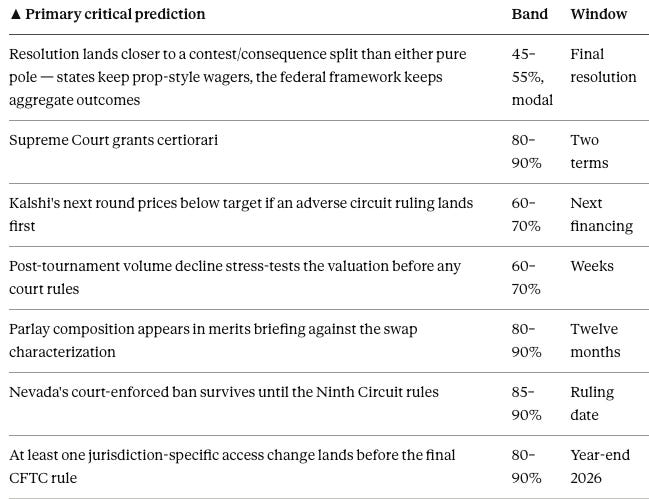
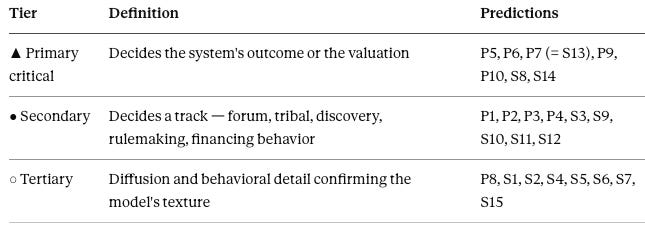
Seven primary critical predictions (▲) anchor the publication — the calls that decide the system’s outcome. Secondary (●) and tertiary (○) predictions appear in context throughout and consolidate in the Runtime Module (Appendix A) and Appendix C registries: twenty-four tracked predictions with falsifiers and windows.
MindCast’s prior litigation map identified a fragmented battlefield across states, platforms, tribes, and regulators. The Ninth Circuit stay-denial analysis then showed the procedural limit of platform-led federalization: preemption remains available as a defense, but operators cannot force every state gambling case into federal court. The CFTC NPRM analysis added the next layer: the agency began building an administrative record courts can use to evaluate event contracts after Loper Bright. The tribal seam analysis identified the federal-versus-federal conflict no preemption victory can resolve.
Sources: MindCast: The National Kalshi Prediction Market Litigation Map | Kalshi, the Ninth Circuit, and the Prediction Markets Forum Fight — Why the Stay Denials Reshape Nationwide Litigation Strategy | The CFTC NPRM Is a Litigation Brief — Reading RIN 3038-AF65 as the Federal Record for the Preemption War | CFTC v. New Mexico — Kalshi, IGRA, and the Tribal Seam in the Prediction-Markets Preemption War
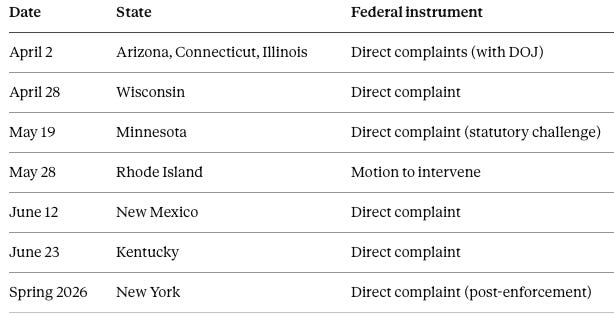
The federal-plaintiff campaign changes the map. The CFTC has filed or entered federal litigation involving nine states — Arizona, Connecticut, Illinois, New York, Wisconsin, Minnesota, New Mexico, Rhode Island, and Kentucky — sometimes alongside the Department of Justice, to enforce exclusive federal jurisdiction over prediction markets. Eight actions arrived as direct complaints; Rhode Island arrived as a motion to intervene in existing litigation. The April 2 lawsuits against Arizona, Connecticut, and Illinois launched the federal-plaintiff phase. Kentucky, filed June 23, completed the current roster.
Sources: CFTC Release 9206-26 (Arizona, Connecticut, Illinois) | CFTC Release 9218-26 (New York) | CFTC Release 9220-26 (Wisconsin) | CFTC Release 9233-26 (Minnesota) | CFTC Release 9238-26 (Rhode Island) | CFTC Release 9251-26 (New Mexico) | CFTC Release 9260-26 (Kentucky) | CNBC (Kentucky suit) | CBS News
The Boundary, Defined: The Contest | Consequence Split and the Five-Factor Test
New readers need one framework to follow everything below, and it takes ninety seconds. The Rule Architecture sorts every event contract in two steps.
Step one asks what kind of event underlies the contract. A contest is a competitive activity whose outcome depends on play for stakes — sports, awards, casino-style games. Contests fall presumptively within “gaming” under CEA § 5c(c)(5)(C) and belong to state gaming commissions and tribal compacts. A consequence is a real-world event whose outcome carries measurable economic effects independent of the contract — weather, commodity supply, interest rates, geopolitical events.
Step two applies only to consequence contracts, which must earn admission to the federal derivatives system through a five-factor functional override. The proponent bears the burden, and failure on any single factor defeats admissibility. (MindCast: A Boundary Rule with a Functional Core)
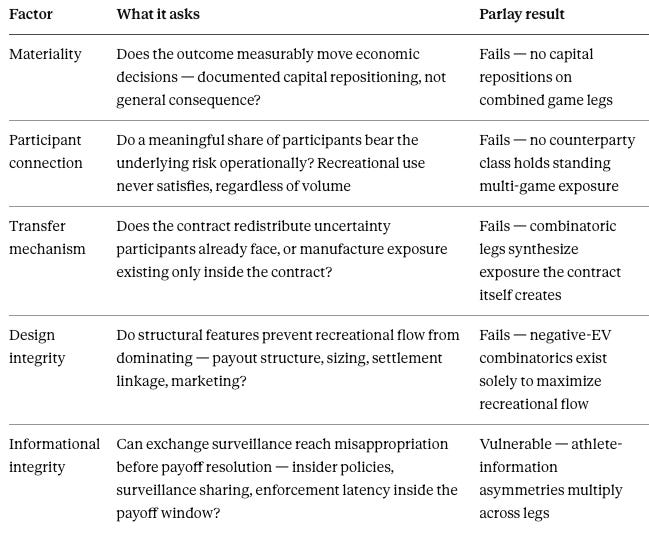
Parlays never reach the table above in the first instance: a sports parlay is a contest-based contract, excluded at step one before any factor applies. The table shows the second, independent failure — even treating parlays arguendo as consequence contracts eligible for the override, they fail four factors where one suffices. The double failure is why the 38% parlay share of Kalshi’s volume is the record’s most damaging fact: over a third of the market leader’s flow cannot survive either step of the only administrable boundary on offer.
Stakeholder Stakes: Why the Federal-Plaintiff Phase Matters
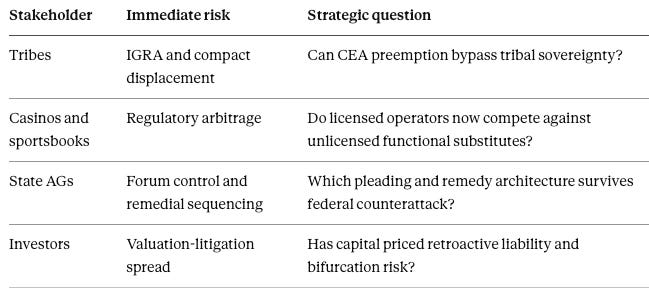
Prediction-market litigation now speaks to four audiences at once, and each occupies a different position inside the architecture.
Tribes face sovereignty displacement. The federal-plaintiff phase threatens to convert CFTC preemption into a workaround of IGRA, tribal-state compacts, and compact revenue. A Supremacy Clause argument against state law does not automatically answer a federal statutory conflict with tribal sovereignty embedded in the record.
Casinos and licensed sportsbooks face regulatory arbitrage before they face product competition. Licensed operators pay for market access through suitability review, taxation, responsible-gaming controls, and compact obligations. A federally registered venue challenges that entire bargain by offering economically similar exposure under a different legal label. The sharper competitive question asks whether existing licensees will be punished for complying with a regime their competitors seek to preempt.
State attorneys general face a procedural lesson. Removal posture, pleading design, geolocation remedies, loss-recovery statutes, and market-maker discovery now matter as much as gambling definitions.
Investors face a valuation problem. The same asset prices like national exchange infrastructure in a federal-preemption scenario and like a retroactive-liability defendant in a state-gambling scenario. A national exchange thesis can survive product-level limits. The thesis cannot survive unmanaged retroactive exposure, adverse market-maker findings, parlay concentration, and state-by-state injunctions converging before the next financing window.
I. The Forcing Event: Nine States in Twelve Weeks
Federal litigation involving the states arrived at unprecedented tempo. The official record fixes the sequence: the April 2 trio against Arizona, Connecticut, and Illinois; Wisconsin on April 28; Minnesota on May 19; the Rhode Island intervention on May 28; New Mexico on June 12; Kentucky on June 23. New York’s suit followed the state’s cease-and-desist letters and civil enforcement against CFTC-registered entities. The cadence — a new state roughly every three weeks — produced one of the most aggressive federal preemption campaigns against state gambling enforcement in modern market-regulation litigation. A Commission operating with a single commissioner executed all of it.
Two dates now govern the near term. Judge Menendez heard consolidated oral argument on the Kalshi, CFTC, and Polymarket preliminary-injunction motions in the Minnesota case on July 2, and a decision is pending — Minnesota’s felony ban takes effect August 1, and the case is positioned to reach the Eighth Circuit first. The Rhode Island TRO hearing follows on July 22.
Sources: CFTC Release 9206-26 (Arizona, Connecticut, Illinois) | Barron’s | PBS NewsHour | Next Event Horizon (Gouker) | CFTC Commissioners page
Fact: Kentucky, filed June 23, is the first state with a Republican attorney general to face federal action; every prior defendant had a Democratic AG despite red-state enforcement running just as hot. (CNBC (Kentucky suit))
Inference (60–70% confidence): Kentucky’s timing — three weeks after the New York Times “steamrolled a watchdog” reporting — supports reading the selection as deliberate record hygiene, stripping the partisan-capture narrative before any certiorari petition reaches the Supreme Court. Contemporaneous Financial Times reporting sharpened the optics environment the Kentucky selection answers: Donald Trump Jr. received a Kalshi equity stake worth roughly $300,000 without investing his own money, on a platform whose value surged under a light-touch federal posture. (CNBC (White House rule review); Financial Times (Trump Jr. windfall))
Inference (50–65% confidence): Kentucky carries a second, unstated significance. The Commonwealth’s loss-recovery statute produced the roughly $300 million PokerStars judgment — the largest gambling loss-recovery monetization in U.S. history — making Kentucky the one state where the gambling characterization has a proven nine-figure retroactive price tag. The better inference holds that this exposure factored into federal prioritization.
Fact (verified via Release 9260-26): Kentucky’s attack combined three instruments — AG enforcement suits against Kalshi and Polymarket, a new special transaction fee on CFTC-regulated designated contract markets designed to encourage platforms to exit the state, and the Wagering Consumer Protection Act (effective July 15) prohibiting licensed sports-wagering operators from contracting with the platforms. A Coalition for Fair Markets (Kalshi, Crypto.com, Polymarket US) sued Kentucky in state court over the fee before the CFTC’s federal action arrived. Economic deterrence now stands alongside enforcement, legislation, and criminal process as a fourth state modality. (CFTC Release 9260-26 (Kentucky); LEX18 (Kentucky AG suits))
Fact: New Mexico shows the maximum-tempo template — state suit against Kalshi on June 4, federal counter-suit eight days later, and Polymarket’s own federal action on July 2. Three sovereign instruments collided in one district inside a month. (Wolters Kluwer VitalLaw; SBC Americas (Polymarket v. New Mexico))
Fact: Twenty states now litigate against the platforms in some posture. The federal side has engaged fewer than half — and the selection pattern, not the count, carries the analytical weight developed in Sections III and IV. (CNBC (Kentucky suit))
Tempo tells the surface story. Selection tells the real one. The federal side is not suing every hostile state — it is building a record, one carefully chosen defendant at a time.

II. Escape from the Offensive Trap: The Federal-Plaintiff Substitution
MindCast’s Ninth Circuit analysis defined the Offensive Trap: once a state files first, the combined Younger abstention and Anti-Injunction Act (§ 2283) barriers confine operators to defensive posture in state court. Kalshi and Polymarket lost their bids to pause the Nevada and Washington enforcement actions on May 21, and the forum-control loss looked permanent. Twelve days earlier, the federal government had already begun supplying the answer — through a plaintiff not constrained by the same limits that boxed private operators into defense.
Sources: MindCast: Kalshi, the Ninth Circuit, and the Prediction Markets Forum Fight — Why the Stay Denials Reshape Nationwide Litigation Strategy | Bloomberg Law (stay denials) | The Block
Doctrine: The Anti-Injunction Act does not bar suits brought by the United States. Leiter Minerals v. United States, 352 U.S. 220 (1957), establishes the federal-sovereign exception, and Younger abstention does not constrain the federal government as it constrains private litigants. Courts retain comity, ripeness, and equitable discretion — the federal plaintiff is advantaged, not immune. (Leiter Minerals v. United States, 352 U.S. 220 (1957))
Fact: Arizona proves the mechanism. Judge Liburdi’s preliminary injunction paused the state criminal prosecution and cancelled Kalshi’s arraignment — relief Kalshi’s own preemptive suit had failed to obtain, because Liburdi had earlier declined to rule on preemption at Kalshi’s request, calling it premature. The federal plaintiff obtained in weeks what the private plaintiff could not obtain at all. (AP via Spectrum News (Arizona injunction))
Fact — the validation loop closes in Michigan: MindCast’s stay-denial analysis forecast that state courts would produce the operative merits findings. A federal judge remanded Michigan’s case to state court after finding no federal-question jurisdiction and no complete preemption. On June 29, a Michigan state judge blocked Kalshi from allowing residents to place sports bets — the first post-remand state-court merits ruling against the platform. Remand, state forum, adverse operative ruling: the forecast validated in full sequence. (Gambling Insider (weekly roundup); Reuters (Michigan injunction))
Inference (55–70% confidence): The division of labor between agency and platforms reads as deliberate. The CFTC files where government-versus-government posture strengthens the Supremacy Clause frame; platforms file where triggers run too thin for agency standing — Utah’s gubernatorial rhetoric, Iowa’s anticipated enforcement. Nothing public proves coordination, but the filing patterns display strategic complementarity — each actor’s move raises the other’s payoff — too precisely for independent alignment to be the parsimonious explanation. Discovery reaching agency-platform communications in any docket would test the inference directly. (Gambling Insider (Kalshi v. Utah); KSL)
Inference (75–85% confidence) — substitution doubles as a burn-rate subsidy: The federal-plaintiff phase socialized Kalshi’s litigation costs. Through March, the platform funded its own offensive campaign across every front; since April, the CFTC and DOJ carry nine fronts at taxpayer expense while the docket count tripled. Substitution therefore preserves Kalshi’s capital at exactly the moment its legal exposure peaked — a runway extension no funding round had to price.
Every capability the platforms lost on May 21 — federal forum, offensive posture, the power to freeze state proceedings — reappeared as a federal capability within weeks. Substitution, not escalation, is the campaign’s structural meaning. Control migrated from operators to the Executive branch exactly as the control-migration framework anticipated — and Michigan shows what happens in the forums the substitution cannot reach. MP CDT FS-1 scores the offensive posture transfer at 0.86 while scoring boundary sufficiency at only 0.42 — federal litigation supplies force; it does not supply definition.
III. One Engine, Three Chassis: The Complaint Taxonomy
Federal complaints share an identical statutory core: the swaps definition, the exclusive-jurisdiction clause of 7 U.S.C. § 2(a)(1)(A), and the fragmented-patchwork argument Congress resolved in favor of national derivatives regulation. The body of each complaint, however, is rebuilt against the state’s chosen attack modality. MindCast built this taxonomy from the primary complaint documents on cftc.gov — not from circulating AI-generated summaries, whose citation chains fail verification.
Sources: CFTC Prediction Markets FAQ (Apr. 2, 2026) | CFTC Wisconsin Complaint (Apr. 28, 2026) | Norton Rose Fulbright
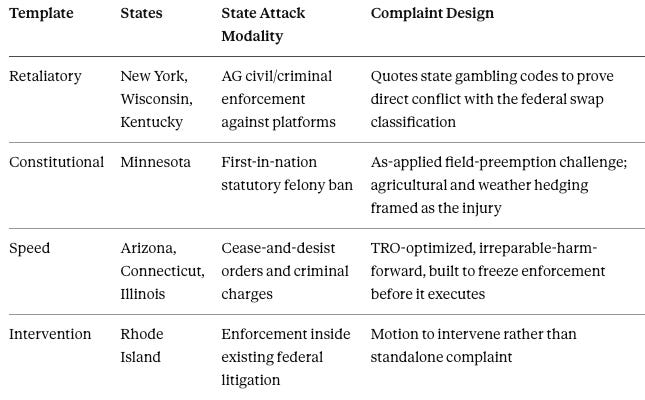
Inference (75–85% confidence, upgraded from a prior 65–75%): Minnesota reveals battlefield selection. The complaint litigates whether a state can felonize weather and crop hedging overnight — not whether sports contracts are gambling. Minnesota’s statutory overreach handed the federal side its strongest facts, and the sequencing logic follows: win Minnesota decisively on sympathetic facts, then cite the ruling as anchor precedent in the harder sports-contract cases. (CFTC Release 9233-26 (Minnesota); Sheppard Mullin)
Fact: Consolidation resistance — predicted in the March map for state-side litigation — now extends to the federal side: nine actions, four templates, zero consolidation motions. Each modality gets its own ruling, building a full-spectrum preemption map covering criminal, administrative, legislative, and litigation pathways simultaneously. (MindCast: The National Kalshi Prediction Market Litigation Map)
The complaints differ because the state attacks differ. The federal side is not fighting one state policy — the campaign aims to neutralize every state-law pathway that could turn event contracts back into gambling, one tailored complaint per pathway.
Contact mcai@mindcast-ai.com to partner with us on Predictive Game Theory AI in Law and Behavioral Economics. To deep dive on MindCast works upload the URL of this publication into any LLM (preferably Google AI mode/Gemini, Claude, ChatGPT) and prompt ‘reconstruct MindCast framework with three degrees of cited sub links.’ See Live-Fire Game Theory Simulators, Runtime Predictive Infrastructure. We stress-tested our AI system for this publication by simulating the Super Bowl and the World Cup. Super Bowl LX — AI Simulation vs. Reality | Predictive Game Theory + Behavioral Economics Cognitive Digital Twin Foresight Simulations in the World Cup
Runtime Module — How to Operate This Publication
The publication functions as a runtime module, not an archive. The publication encodes a live model of the prediction-markets preemption war: six seats, three clocks, a forcing-event calendar, and a registry of falsifiable predictions. Any capable LLM can execute the model against new developments. Upload this publication’s URL together with a news event — a ruling, a filing, a rule action, a funding round, a legislative step — and prompt:
“Using MindCast’s National Prediction Market Litigation Architecture publication as the governing model, place this development in the system map, identify which registered predictions it scores, update the probability bands with reasoning, and state consequences for each seat.”
Event routing: judicial rulings score against the ledger (Section VII) and reprice the scenario bands (Section VIII); new federal or state filings run through the complaint taxonomy (Section III) and the non-filing map (Section IV); rule-finalization steps move the preclusion clocks (Section V); funding or valuation events test the spread (Sections VI and IX); tribal and congressional developments update the counter-escalation architecture (Section V).
Prediction registry (canonical IDs for runtime scoring): See Appendix A
IV. The Non-Filing Map: Circuit Arbitrage and Washington’s Absence
Strategic non-filing constitutes the fourth complaint category, and Washington is its defining case. The federal side has filed across multiple circuits but never inside the Ninth — the circuit that denied the platforms’ stay bids, and where Judge Nelson characterized the swaps theory as “sophistry to the ‘Nth’ degree” at the April 16 Nevada argument.
Sources: Bloomberg Law (stay denials) | Ballard Spahr
Inference (65–75% confidence): Washington’s absence reflects forum calculus, not deference. Robinhood’s preemptive federal counter-suit in Tacoma already occupies the field, and any new federal filing would manufacture adverse precedent in the one circuit that has signaled hostility on both procedure and merits. Senator Cantwell’s tribal-sovereignty hearings and Washington’s compact-anchored gaming regime add genuine secondary political weight, but the primary driver is the circuit map. (Gaming America; Washington State Standard; Senate Commerce Committee (Cantwell))
Fact undermining the tribal-deference alternative: New Mexico holds constitutionally entrenched tribal gaming compacts and four active tribal suits against Kalshi — and the federal side sued anyway, because the Tenth Circuit offers clean territory. Circuit geography, not tribal politics, sorts the filing map. (Wolters Kluwer VitalLaw)
Fact: Michigan’s remand extends the firewall inland. Pure state-law pleading defeats removal, converting preemption into an affirmative defense argued before state judges — and the June 29 injunction shows what those judges do with it. Forward prediction (● secondary, 70–80% confidence): the Michigan model propagates to at least three additional states within six months. (Gambling Insider (weekly roundup); Reuters (Michigan injunction))
Forward prediction (● secondary, 70–80% confidence): No new federal offensive action against any Ninth Circuit state before Supreme Court resolution of the jurisdictional question. A single contrary filing falsifies the claim cleanly.
Where the federal side declines to file reveals as much strategy as where it files. The campaign banks Third Circuit precedent through Flaherty while starving the Ninth Circuit of new federal vehicles — circuit arbitrage engineered to shape the eventual split the Supreme Court will resolve.
V. Counter-Escalation: Tribes, Appropriations, and the Coordination Curve
States did not absorb the federal campaign passively. Fifteen weeks of counter-escalation produced structural weapons the March map’s state side lacked — and the most consequential arrived in Rhode Island, inside the federal side’s own case.
Sources: MindCast: CFTC v. New Mexico — Kalshi, IGRA, and the Tribal Seam in the Prediction-Markets Preemption War | CFTC Release 9238-26 (Rhode Island) | Gambling Insider (weekly roundup)
Fact: Thirty-one federally recognized tribes, the Indian Gaming Association, NCAI, and USET moved to brief the Rhode Island litigation, arguing the exchanges’ preemption theory would undermine tribal sovereignty under IGRA and disrupt funding for tribal governments. MindCast’s tribal seam analysis documented the dual omission — no sovereignty factor in the NPRM, no IGRA engagement in the complaints. The Rhode Island intervention defeats the routing-around from outside: the Commission can keep IGRA out of its complaints but not out of its dockets, because IGRA-versus-CEA presents a federal-versus-federal conflict the Supremacy Clause syllogism cannot answer. Forward prediction (● secondary, 65–75% confidence): at least one court in the federal actions addresses tribal sovereignty in a merits or injunction ruling by Q4 2026, despite federal silence.
Fact: Senate Democrats led by Blumenthal and Merkley asked the Appropriations Committee to block the CFTC from funding litigation against states. The one-commissioner posture does not defeat CFTC jurisdiction by itself. It does, however, create a legitimacy and requisite-variety problem: a single-member Commission — the agency’s own page lists Chairman Selig, sworn in December 22, 2025, as the sole current commissioner of a five-seat body — is attempting to govern a national collision among derivatives law, sports wagering, tribal sovereignty, state police powers, and private retroactive liability. Inference (rider passage 20–30%; pacing effect from the threat alone 50–60%): the rider need not pass to matter — a nine-front campaign run through a single commissioner has no bipartisan capital to spend defending its budget, and the funding channel targets exactly the institutional-capacity weakness the campaign’s critics identify. (CFTC Commissioners page; Next Event Horizon (Gouker))
Fact — the coordination curve: 34 state AGs joined the New Jersey amicus; 38 states filed behind Maryland and Massachusetts; 41 AGs signed the rulemaking comment asserting the contracts are indistinguishable from sports betting. The states’ coalition slope runs upward while federal institutional capacity remains fixed at one commissioner. (Action Network litigation tracker; Ballard Spahr)
The AG toolkit the June record supplies: pure state-law pleading preserves state forum; geolocation remedies convert abstract preemption disputes into operational compliance orders; market-maker allegations attack the exchange characterization factually; loss-recovery statutes convert gambling classification into retroactive monetary exposure; tribal compact harms broaden irreparable injury beyond consumer protection. The federal side now litigates as a sovereign — effective AG records show institutional displacement, not merely illegality.
Fact — the third clock: MindCast’s NPRM analysis modeled a two-clock preclusion race — state final judgments against federal rule finalization. The offensive campaign introduces a third instrument: interim federal injunctions that freeze state clocks without producing merits rulings. The race is a feedback-latency contest: whichever sovereign’s legal signal completes its loop first — final judgment, finalized rule, or standing injunction — sets the constraint every other actor must absorb. Arizona sits frozen; Washington, Nevada, and the Massachusetts SJC race; New Mexico is contested across three sovereign tracks; Michigan is remanded and already ruling. (MindCast: The CFTC NPRM Is a Litigation Brief — Reading RIN 3038-AF65 as the Federal Record for the Preemption War; CFTC Release 9219-26 (Massachusetts amicus))
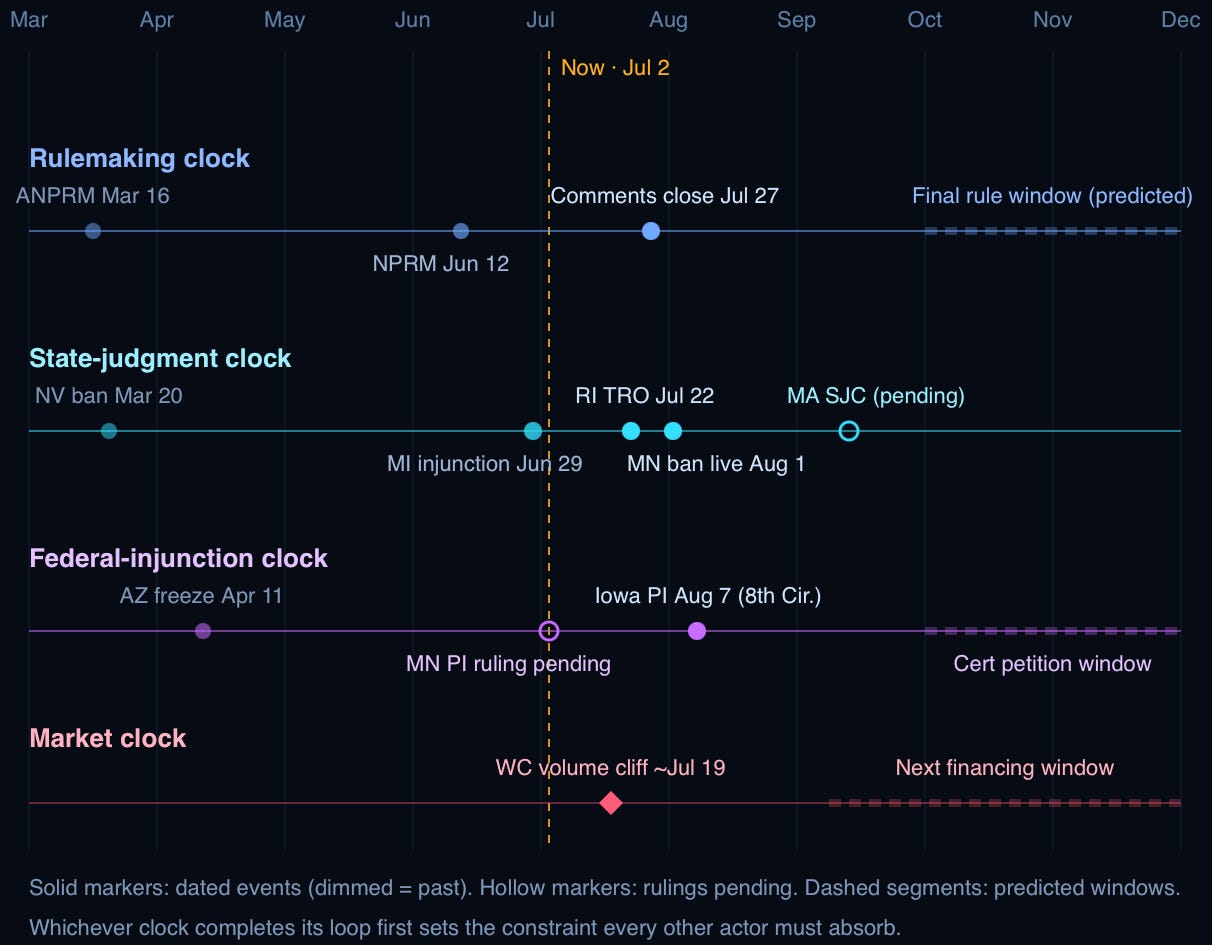
The federal campaign added instruments; the states added structure. A procedural firewall in the Ninth Circuit, a third sovereign inside the federal dockets, a fiscal weapon aimed at a one-member Commission, and a coordination curve that grows with every filing — counter-escalation is no longer reactive. It is architectural.
VI. The Private Monetization Engine: Loss-Recovery Suits and the Market-Maker Fact
Private litigation finance now holds the sixth seat at the gaming-characterization node. Every loss-recovery claim and consumer class action functions as a priced position on the same question the sovereigns are litigating — and the positions are accumulating on the states’ side of the fault line.
Sources: Bloomberg Law (Veridis) | Illinois Answers | Action Network litigation tracker
Fact (verified, multi-sourced): Veridis Management LLC — a Tampa-based litigation funder led by CEO Maximillian Amster — stands behind gambling loss-recovery suits against Kalshi and partners Robinhood and Webull across six states: Ohio, Kentucky, Illinois, South Carolina, Massachusetts, and Georgia. The suits, filed June 11–12, 2025 through uniformly named Delaware LLCs (”Ohio Gambling Recovery LLC” and counterparts, all incorporated March 18, 2025), invoke state versions of the Statute of Anne, which lets losing bettors — and after six months, any third party — sue to recover gambling losses, in some states at treble damages. University of Chicago law professor M. Todd Henderson described the strategy in Bloomberg Law as “a kind of genius: find people who lost bets and just step into their shoes.” (Bloomberg Law (Veridis); Illinois Answers; e.g., Ohio Gambling Recovery LLC v. Kalshi, Inc., N.D. Ohio, No. 25-cv-01573)
Fact — the sovereign adopts the private theory: Kentucky Attorney General Coleman’s June 2026 suits against Kalshi and Polymarket themselves plead violations of Kentucky’s Loss Recovery Act alongside the Consumer Protection Act and gambling statutes — the state now runs the litigation funder’s theory under sovereign colors, with the PokerStars precedent proving the mechanism at nine-figure scale in the same statute book. (LEX18 (Kentucky AG suits))
Inference (75–85% confidence): A litigation funder holding recovery positions across six venues constitutes the market’s distributed short position against Kalshi’s reported $40 billion valuation — and no coverage of the funding round mentions the retroactive-liability overhang. Round dynamics show informational-cascade behavior: each committed fund lowers the perceived need for independent diligence by the next. Any single final state-court judgment establishing the gambling characterization converts instantly into monetary liability across every venue with a recovery statute, with Kentucky’s sovereign adoption multiplying the exposure. (Investing.com)
Fact (verified, now in federal captions): The May 11, 2026 Kentucky class action (Roberts v. Kalshi, W.D. Ky.) names Kalshi Trading LLC and two Susquehanna entities as defendants alongside the exchange — placing the affiliate market-maker allegation in a federal complaint’s caption, not merely its prose. Washington Attorney General Brown’s complaint and the Kentucky AG’s June filing independently make the same charge: Kalshi’s own subsidiaries and affiliated market makers frequently act as counterparties to retail users, effectively putting users against the house. The allegation attacks the exchange characterization factually rather than doctrinally — a venue whose affiliate systematically supplies the other side of trades resembles a counterparty bookmaker, not a neutral exchange. Judge Roth’s Flaherty dissent (”performative sleight”) and Judge Nelson’s “sophistry” remark reached for exactly this intuition without a discovery record; three separate proceedings are now building one. Forward prediction (● secondary, 60–70% confidence): the market-maker fact pattern appears in a merits ruling against preemption within twelve months. (Bettors Insider (Roberts v. Kalshi); Washington State Standard)
Fact: Sports and parlays constitute 89.6% of Kalshi volume, with parlays alone near 38%. Run through the Rule Architecture’s two-step boundary (defined above), parlays fail twice: excluded at the contest threshold before the five factors apply, and — even arguendo under the override — failing materiality, participant connection, transfer mechanism, and design integrity independently, where failure on any single factor defeats admissibility. Parlay architecture also monetizes bounded rationality — compounding odds exploit probability-estimation errors documented across behavioral economics — which converts the contract design itself into evidence of gambling function. The architecture classifies over a third of the market leader’s flow as inadmissible on the public record’s own numbers, a conclusion the NPRM’s factor list cannot reach. Forward prediction (▲ primary, 80–90% confidence): parlay composition appears in state or tribal merits briefing against the swap characterization. (MindCast: The Prediction Markets Rule Architecture; Next Event Horizon (Gouker))
Sovereigns litigate the characterization; private capital prices it. The valuation market and the litigation-finance market have taken opposite sides of the same binary — and only one of them has read the state-court dockets. MP CDT FS-4 scores the litigation-adjusted valuation gap at 0.79: investors appear to price federal-option upside more quickly than state-law retroactivity, market-maker facts, and post-tournament volume risk.
VII. Validation Ledger: Scoring Prior Predictions Against the June Record
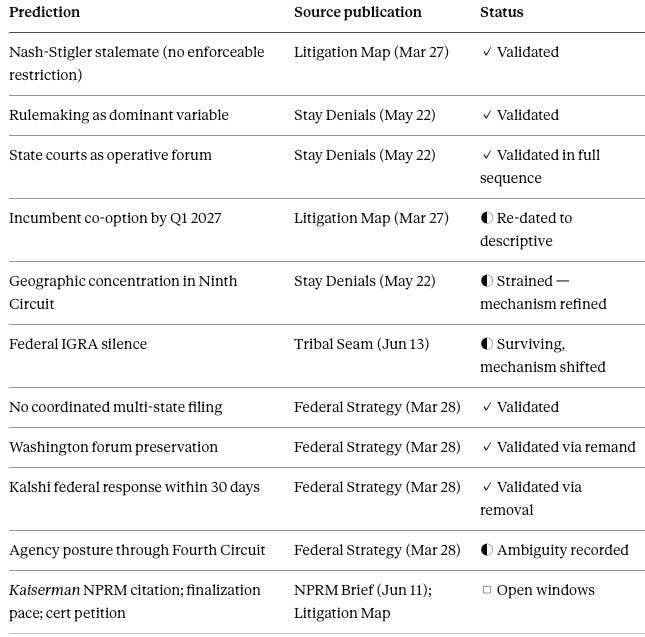
MindCast’s falsifiable-record discipline requires scoring every live prior prediction, with validations and strains reported at equal prominence. The June record supplies scoring events across six prior publications. The scorecard below carries the results; the entries that follow carry the reasoning. Glyphs throughout: ▲ primary critical, ● secondary, ○ tertiary; ✓ validated, ◐ qualified, ◻ open.
Sources: MindCast: The National Kalshi Prediction Market Litigation Map | Kalshi, the Ninth Circuit, and the Prediction Markets Forum Fight — Why the Stay Denials Reshape Nationwide Litigation Strategy | The CFTC NPRM Is a Litigation Brief — Reading RIN 3038-AF65 as the Federal Record for the Preemption War | CFTC v. New Mexico — Kalshi, IGRA, and the Tribal Seam in the Prediction-Markets Preemption War | The Prediction Markets Rule Architecture
Validated — Nash-Stigler stalemate (March map): The prediction held on its stated terms. The Commission produced a proposal, not enforceable substantive restriction; the June 12 Federal Register document opens comments through July 27 and binds nothing. Permission-shaped rulemaking under litigation pressure is exactly what the equilibrium geometry predicted. (Federal Register (June 12, 2026))
Validated — rulemaking as dominant variable (stay-denials piece): The NPRM landed inside the forecast window, three weeks after the analysis identified Commission rulemaking as the variable that would override litigation sequencing.
Re-dated to descriptive status, stated plainly — incumbent co-option (March map, Q1 2027 window):Verification against contemporaneous trade press shows FanDuel surrendered its Nevada registration and DraftKings withdrew its pending applications in November 2025 — four months before the March map published — after the Nevada Gaming Control Board declared prediction-market participation incompatible with state licensure. FanDuel Predicts (a 50/50 CME joint venture) launched in December 2025; DraftKings acquired Railbird to build DraftKings Predictions. The March map therefore described a migration already underway rather than forecasting one, and the ledger scores the entry as descriptive validation, not a predictive hit. The subsequent record extends the claim genuinely: both products now operate at scale, and the migration’s price was Nevada optionality rather than existing revenue — the NGCB forced the choice, and the incumbents chose the federal channel. (InGame (Nevada exits); SBC Americas (Nevada exits))
Validated in full sequence — state courts as operative forum (stay-denials piece): Michigan’s remand-to-injunction arc — federal remand, state forum, adverse merits ruling on June 29 — completes the validation loop for the forum-fragmentation forecast. (Reuters (Michigan injunction))
Under strain, stated plainly — geographic concentration mechanism (stay-denials piece): The sequencing forecast expected new state filings to concentrate in Ninth Circuit states; the newest significant filings — New Mexico and Kentucky — came from outside the circuit. The directional core validated while the concentration mechanism requires refinement: the federal offensive campaign changed AG initiation incentives the original model did not contain. Ninth Circuit AGs no longer need new filings — their existing cases run protected — while marginal new filers respond to local politics that outweigh counter-suit risk. Refinement over rescue (60–70% confidence).
Surviving with shifted mechanism — federal IGRA silence (tribal seam piece): Prediction one holds on its stated terms: the Commission has neither joined tribal parties nor briefed IGRA on the merits. The strategy beneath the prediction, however, is defeated — the Rhode Island tribal intervention imports the federal-versus-federal conflict into the record regardless of federal pleading conduct. The ledger scores both facts separately because both are true.
Validated — the Federal Strategy predictions (March 28) score against the June record: Three predictions from the March 28 strategic analysis now score as hits. The no-coordination prediction (P50: 81%) held — state filings stayed sequential, and the credible-commitment diagnosis explains why 41 AGs can sign one comment letter yet never synchronize a filing. The Washington forum-preservation prediction (P50: 54%, conditioned) validated through the remand channel when Judge Coughenour returned the case to state court on May 9. The Kalshi-federal-response prediction (P50: 72%) validated through removal of the King County action within the window. Cert-probability lineage now reads 73% (March 27) → 79% (March 28) → 80–90% (this publication) — a band the record has ratcheted rather than revised. One prediction requires adjudication rather than scoring: its falsification condition (”proposed rule with enforceable sports contract restrictions before the Fourth Circuit rules”) meets a June 10 proposal that restricts but binds nothing. The condition’s drafting never anticipated a non-binding proposal containing categorical prohibitions, so the ledger records the ambiguity instead of resolving it silently.
Open with checkable windows: Kaiserman citation of the NPRM (the 60-day window from Federal Register publication runs through mid-August; no citation confirmed as of this writing); rule finalization pace (comments close July 27); certiorari petition by Q4 2026 (Fourth Circuit ruling pending after the May 7 argument).
Three predictive validations, one entry re-dated from predictive hit to descriptive confirmation, one strain refined rather than rescued, one prediction surviving while its underlying strategy fails, three windows still open. A ledger that only reported the validations would read as marketing. A ledger that reports the strains — and corrects its own dating — is a methodology.
VIII. Revised Forecast: Bifurcation Enters as Co-Modal
The March model assigned P45 to fragmented persistence, P35 rising to P45 for gambling classification, and P20 to a prevailing federal framework. Fifteen weeks of record cut in both directions with unusual symmetry. The federal side gained Third Circuit merits strength, the NPRM record, nine sovereign actions, and Arizona’s frozen prosecution. The states gained the Ninth Circuit firewall, the Michigan injunction, tribal escalation, the 41-AG comment, appropriations pressure, and state-court acceleration. The revision follows, expressed in the Rule Architecture’s vocabulary so the descriptive and normative series lock together for the first time.
Sources: MindCast: The National Kalshi Prediction Market Litigation Map | The Prediction Markets Rule Architecture | CBS News
Revised outcome scenarios (mutually exclusive, resolution-stage — bands normalized to sum coherently):
Bifurcated resolution — the contest/consequence split: 45–55%, modal. Contest-side contracts (props, micro-events, player-tied wagers) return to state gaming authority; consequence-side contracts (aggregate outcomes, macro events) stay inside the federal derivatives framework. Regulatory counsel quoted in the nine-suit coverage now independently sketch this allocation as a plausible Supreme Court outcome — the boundary MindCast’s architecture specified in May, arriving through judicial speculation without the vocabulary.
Broad gambling classification prevails: 20–25%. State final judgments, the market-maker record, and parlay composition carry this path.
Federal framework prevails intact: 15–20% — carried entirely by instruments that did not exist in March.The migration of this scenario’s probability from platform litigation to federal sovereign litigation itself validates the control-migration thesis.
Fragmented persistence without resolution: 15–20%. No forcing function arrives; circuit splits and state-court judgments accumulate without national resolution.
Reconciliation against the March model: the March bands (P45 fragmented / P35–45 gambling / P20 federal) did not contain bifurcation as a distinct scenario. Introducing it as modal redistributes probability mass primarily out of the fragmented and gambling scenarios. The movement reflects fifteen weeks of record showing every channel bending toward a boundary — not a weakening of the states’ position.
Independent event probabilities (not mutually exclusive with the scenarios above):
Supreme Court grants certiorari within two terms: 80–90%.
Tribal participants reach merits briefing in at least one federal action by Q4 2026: 65–75%.
Utah’s ripeness ruling — whether gubernatorial rhetoric alone triggers preemption review — cited in another platform preemptive suit within sixty days of issuance: 60–70%.
Congressional statutory intervention before judicial resolution: 15–25%.
Federal side files new offensive actions or interventions wherever states create novel enforcement models: 70–80%.
Every new prediction registered in this publication — the forward predictions in Sections IV through VI and IX plus the scenario and event probabilities above — carries a canonical identifier, NPMLA-I.P1 through P10, in the Runtime Module’s prediction registry below, with band, falsifier, and measurement window stated for runtime scoring.
Prediction priority map — the tiering basis is decision relevance, not confidence:
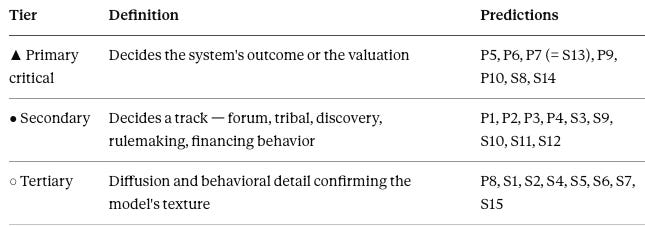
Architecture convergence: the Rule Architecture’s structure now arrives through three independent channels that never cite it. The NPRM’s proposed prohibitions on player-injury, referee-decision, and in-game micro-event contracts map category-for-category onto the architecture’s per-se exclusion layer (70–80% confidence the mapping is substantive rather than vocabulary coincidence). Practitioners sketch the contest/consequence split as a judicial outcome. And the parlay and market-maker facts apply the five-factor admissibility test empirically — every brief that makes those arguments applies design-integrity and transfer-mechanism logic whether or not it names the framework. Independent convergence validates administrability better than adoption would.
Probability mass is migrating toward the boundary. Whether the boundary arrives through the Supreme Court, Congress, or rule finalization, the June record shows every channel bending toward the same allocation — the one that gives each sovereign the category its institutional competence can actually govern.
IX. Trajectory Since the March Map: From Classification War to Allocation War
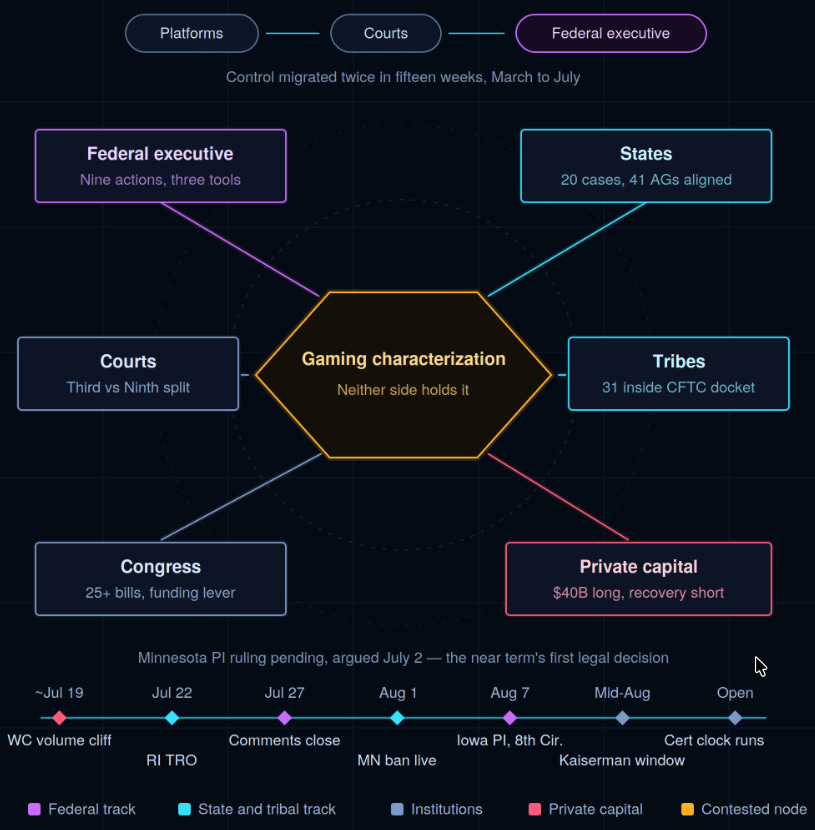
Fifteen weeks separate the March map from this update, and the trajectory runs in one direction with one large exception. Control migrated twice — from platforms to courts when the removal losses and stay denials stripped forum control by May 21, then from courts to the federal executive when nine sovereign actions reconstituted the offensive posture between April 2 and June 23.
The March map’s core geometry validated on its stated terms while the period’s biggest development occurred outside its actor model: the map treated the Commission as environment, and the Commission became the protagonist. Inference (60–70% confidence): the federal-plaintiff phase was not reasonably foreseeable from the March 27 record — the April 2 filings arrived six days after publication.
The outcome space narrowed from a binary to an allocation. March’s scenario structure asked who wins — gambling classification or federal framework. July’s structure asks where the line goes. The NPRM’s per-se exclusions, the practitioner bifurcation speculation, and the parlay and market-maker records converge on the same movement: the contested territory shrank from “are event contracts gambling” to “which event contracts belong to which sovereign.” The war escalated institutionally while narrowing doctrinally — more plaintiffs, more fronts, more sovereigns, but a smaller disputed category. Both facts hold simultaneously, and most coverage sees only the first.
Nevada plateaued, and the plateau is informative. The March map’s hottest front went quiet: the court-enforced ban held, Kalshi geofenced, and the action moved elsewhere. The first state to obtain an operative ban has kept it for over three months without federal rescue. Forward prediction (▲ primary, 85–90% confidence): Nevada’s ban survives until the Ninth Circuit merits ruling.
The valuation-litigation spread widened into the system’s largest mispricing. One non-legal forcing event tests the spread first: World Cup volume currently powers the growth narrative, and the post-tournament cliff arrives within weeks — before any court rules. Kalshi’s reported target roughly doubled while the legal floor deteriorated in every state-court forum reaching the merits, the market-maker allegation moved into federal captions, and retroactive-liability theories acquired sovereign sponsorship. Capital and courts moved in opposite directions for fifteen straight weeks. Inference (55–65% confidence): the spread reflects mispricing rather than efficient pricing of political protection — held loosely, because the political-channel variable resists probability discipline. The falsifiable spine: Kalshi’s next round prices below its current target if the first adverse circuit merits ruling arrives before close.
Time structure compressed from open-ended to calendared. March had one date that mattered. July has a forcing-event calendar: the Rhode Island TRO hearing July 22; comments closing July 27; Minnesota’s statute effective August 1 with Judge Menendez’s ruling pending; the Iowa preliminary-injunction argument August 7 in the same Eighth Circuit; the Kaiserman NPRM-citation window closing mid-August; the Fourth and Ninth Circuit rulings ripening on no schedule; and New Jersey’s certiorari clock running from Flaherty. A system whose resolution events are individually datable is approaching its convergence phase even while participants escalate.
The DETA reading closes the trajectory: the escalation loop runs undamped — each filing triggers a counter-filing with no internal brake — and behavioral escalation continues precisely because institutional resolution is near enough that every player now builds its record for the endgame rather than fighting for territory it expects to keep. Termination requires an external damper, and only three exist: the Supreme Court, Congress, or rule finalization. March described a war over classification. July describes a war over allocation, run by sovereigns rather than platforms, on a visible calendar, converging toward the boundary the Rule Architecture specified — with one unresolved discontinuity: a valuation that prices none of it. Companion publications in the National Prediction Market Litigation Architecture series extend this record through three lenses. One applies the MindCast: The Dual Nash-Stigler Equilibrium Architecture to each party’s strategy directly, auditing Kalshi, the Commission, and the coalition through paired settlement and sufficiency gates. The Nash-Stigler companion carries the capital-versus-clock question: whether Kalshi’s exuberance support fails before the institutional focal point arrives. A second companion runs the full MindCast: Chicago School Accelerated engine — Coase’s missing focal point, Becker’s measurable drift, Posner’s wicked learning environment. The series capstone closes with cybernetics and predictive game theory. Prediction-market regulation fails for want of requisite variety — force is not variety. The boundary rule must therefore operate not merely as a definition of gaming but as a shared control surface, letting federal, state, tribal, market, and capital actors update against the same signal.
Conclusion
Prediction markets have crossed into the federal-plaintiff phase. The Commission transformed a defensive platform argument into an affirmative national campaign: eight direct complaints, one intervention, a rulemaking record built for post-Loper Bright courts, and an amicus program covering the state forums the offensive actions cannot reach. The campaign resolves the question the Ninth Circuit stay denials posed — who controls the forum when operators cannot — and answers it with the federal sovereign.
Completeness of instruments, however, is not sufficiency of design. The federal architecture still lacks the one component every MindCast publication in the series has identified as load-bearing: a principled boundary defining which contracts belong inside exclusive federal jurisdiction. The states’ side spent the same fifteen weeks acquiring the procedural firewall, the third sovereign, the fiscal weapon, and the monetization engine that convert a definitional vacuum into sustained multi-front attrition.
Michigan’s June 29 injunction shows the attrition producing operative rulings; Rhode Island’s tribal intervention shows it reaching inside the federal dockets; the appropriations letter shows it reaching the campaign’s budget. Both sides now hold instruments; neither holds the characterization. Every track — nine federal actions, twenty state proceedings, tribal intervention, private recovery claims, congressional bills, and a $40 billion valuation — prices the same unanswered question.
Exclusive jurisdiction over an undefined category is not a legal position; it is an open commitment underwritten by institutional legitimacy a one-member Commission cannot currently supply. The gaming-characterization node will be answered — by the Supreme Court, by Congress, or by the slow accretion of state final judgments — and the answer will allocate not just regulatory authority but retroactive liability, tribal compact value, and the difference between a $40 billion exchange and a defendant. MindCast’s Rule Architecture specified the administrable boundary in May. The June record shows the system converging toward it through three independent channels. The war will end where the framework said it must begin: at the definition.
Sources: MindCast: The National Kalshi Prediction Market Litigation Map | Kalshi, the Ninth Circuit, and the Prediction Markets Forum Fight — Why the Stay Denials Reshape Nationwide Litigation Strategy | The CFTC NPRM Is a Litigation Brief — Reading RIN 3038-AF65 as the Federal Record for the Preemption War | CFTC v. New Mexico — Kalshi, IGRA, and the Tribal Seam in the Prediction-Markets Preemption War | The Prediction Markets Rule Architecture| CFTC Release 9206-26 (Arizona, Connecticut, Illinois) | CFTC Release 9260-26 (Kentucky)
Appendix A — Runtime Module
Runtime Module Prediction registry (canonical IDs for runtime scoring):
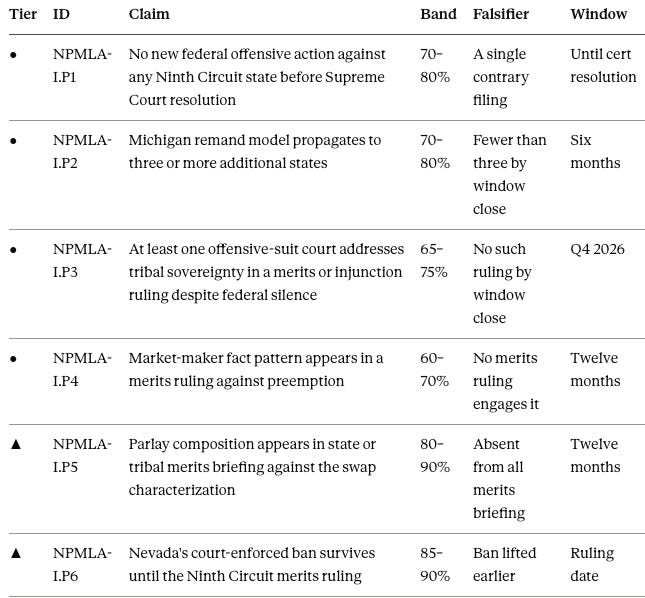
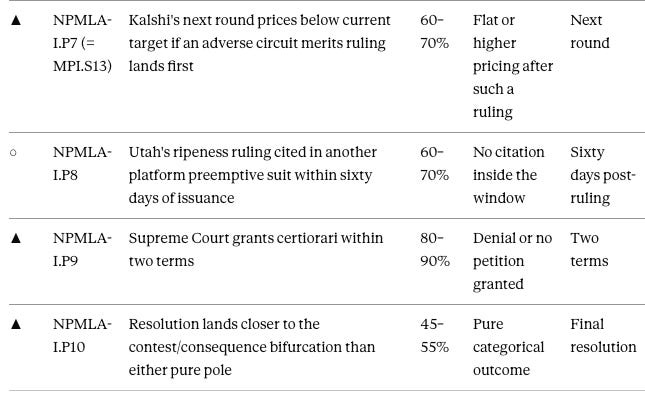
Scoring convention: a development confirms, strains, or falsifies a registered prediction; band updates require stated reasoning; strained predictions receive mechanism refinement, not rescue. A cert grant scoring NPMLA-I.P9 triggers the merits-outcome model reserved for the series capstone, where the Court is modeled as the system’s external damper.
Source weighting for runtime operation, highest tier first: primary documents (CFTC releases, Federal Register, court orders, complaints, AG releases); established wire and broadsheet reporting (Reuters, AP, CBS); trade and legal-alert coverage (Bloomberg Law, SBC Americas, Gambling Insider, firm alerts); tracker and analysis sources (Action Network, Investing.com), with the Action Network tracker’s April 9 staleness noted in-text. Claims in this publication cite the highest available tier, and runtime updates should apply the same discipline. Companion publications extend the registry under NPMLA-II, NPMLA-III, and NPMLA-IV namespaces. Appendix B carries a second registry — fifteen simulation predictions under the MPI.S namespace — scored under the same convention. MPI.S13 is consolidated into NPMLA-I.P7 and scores once under both identifiers; MPI.S14 formalizes the post-tournament volume cliff as a registered prediction; no other overlaps exist between the namespaces.
Prediction priority map — the tiering basis is decision relevance, not confidence:
Appendix B — Relevant MindCast Corpus
The publication builds on the National Prediction Market Litigation Architecture foundation corpus below; companion publications apply the Dual Nash-Stigler and Chicago School Accelerated frameworks to this record, and a capstone closes the series with cybernetics and predictive game theory on adaptive control failure.
Foundation corpus this update scores and extends
The National Kalshi Prediction Market Litigation Map — the March map of the fragmented enforcement battlefield whose Nash-Stigler, consolidation-resistance, and incumbent co-option predictions the Section VII ledger scores against the June record.
Kalshi, the Ninth Circuit, and the Prediction Markets Forum Fight — Why the Stay Denials Reshape Nationwide Litigation Strategy — defines the Offensive Trap and forum-control loss that the federal-plaintiff substitution in Section II answers.
The CFTC NPRM Is a Litigation Brief — Reading RIN 3038-AF65 as the Federal Record for the Preemption War — establishes the rulemaking-as-litigation-record thesis and the two-clock preclusion race that Section V’s third clock extends.
CFTC v. New Mexico — Kalshi, IGRA, and the Tribal Seam in the Prediction-Markets Preemption War — identifies the gaming-characterization node and the dual-omission strategy that the Rhode Island tribal intervention now defeats from outside the pleadings.
The Prediction Markets Rule Architecture — the umbrella for the normative framework whose per-se exclusion layer, contest/consequence boundary, and five-factor test the June record approaches through three independent channels.
Kalshi’s Prediction Market Litigation Architecture, the CFTC Amicus, and the Strategic Framework for State Enforcement — the March 28 strategic keystone that identified circuit-collision engineering, the amicus-to-institutional-conflict conversion the federal-plaintiff phase completes, the exclusive-jurisdiction-versus-effective-governance gap, and the AG procedural toolkit Section V extends.
Prediction Markets Litigation Stack — Federal, Private, and State Enforcement Converge — maps the four-track convergence of federal, private, state, and tribal enforcement that the federal-plaintiff phase now expands to a fifth track.
Substantive framework
The Prediction Markets Rule Architecture Series, A Boundary Rule with a Functional Core — specifies the contest-versus-consequence sort and functional override that Section VIII’s bifurcation scenario expresses as the modal resolution.
The Prediction Markets Rule Architecture Series, Competitive Federalism — supplies the sovereign-allocation terms, including the IGRA non-displacement clause, under which each sovereign retains the category its competence can govern.
Defining “Gaming” Under the Commodity Exchange Act, The Rule 40.11 Gap Driving the Nationwide Kalshi Litigation Web — the April 17 CFTC public comment proposing the definitional rulemaking, modified economic purpose test, and non-displacement clause against which the June 12 proposed rule is measured.
Litigation architecture
Kalshi Loses Federal Forum — The Washington Remand Order and the Jurisdictional Layer of the Prediction Markets Boundary Rule — documents the Coughenour remand that made Michigan’s June 29 remand-to-injunction arc the second instance of the state-forum pattern rather than the first.
The Rule 40.11 Paradox — Kalshi, the Third Circuit, and the Class Action the Ninth Circuit Cannot Ignore — establishes the 7 U.S.C. § 25(b) private-liability track that survives any preemption outcome and compounds the retroactive exposure Section VI prices.
Kalshi, Prediction Markets and the Conflict Architecture of Regulation — develops the post-Loper Bright deference stack explaining why the NPRM must function as a persuasive record rather than a binding one.
Market structure and method
Kalshi’s Institutional Push Is Building the Case Against Itself — shows the institutional infrastructure built to win capital strengthening the derivative characterization, the mirror image of the market-maker fact pattern Section VI documents.
Chicago School Accelerated — The Integrated, Modernized Framework of Chicago Law and Behavioral Economics — supplies the Coase-Becker-Posner causal engine a companion publication applies to the coordination failure, exploitation dynamics, and correction lag this record documents.
The Dual Nash-Stigler Equilibrium Architecture — defines the paired behavioral-settlement and inquiry-sufficiency gates that govern the ledger discipline above and that the companion strategy audit applies at the party level.
The Cybernetic Foundations of Predictive Institutional Intelligence — supplies the Ashby requisite-variety framework underlying the one-commissioner institutional-capacity analysis and the falsification discipline governing every forward prediction above.
Appendix C — MP CDT FS Simulation Capsule
MindCast AI ran four Proprietary Cognitive Digital Twin Foresight Simulations against the federal-plaintiff phase record. The simulations converge on one finding: litigation force has increased faster than legal administrability. High-level outputs appear below; the prediction table carries falsifiers so every simulation claim scores under the Runtime Module’s convention.
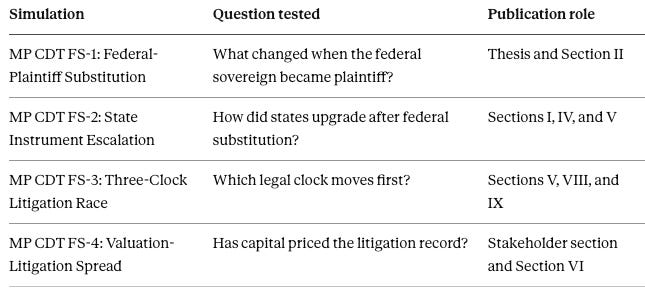
Primary outputs, all four simulations
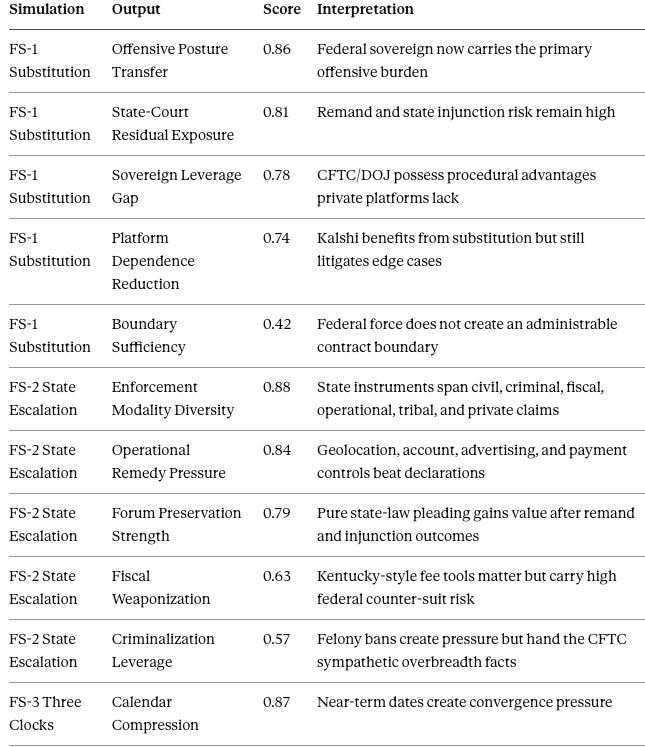
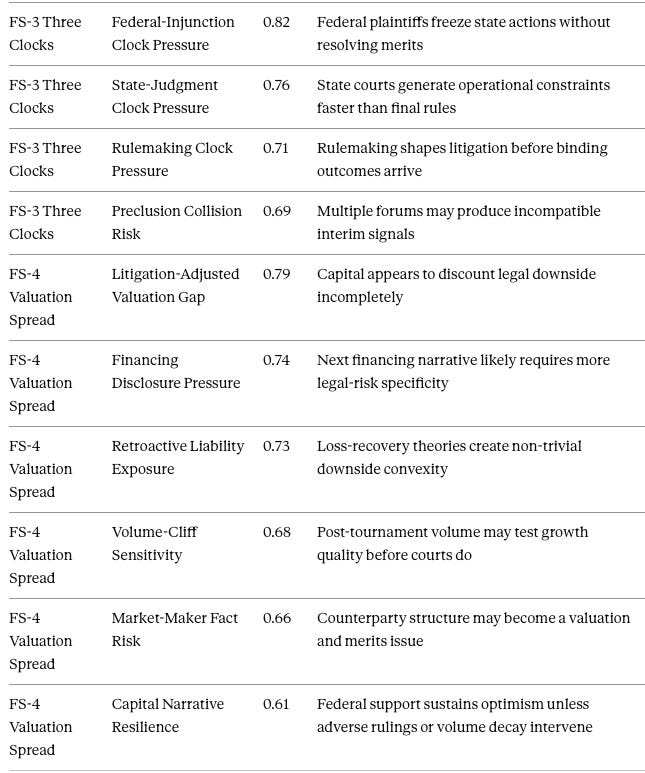
Consolidated findings
Finding 1 — federal substitution changed litigation posture but not legal sufficiency. Arizona demonstrates federal-plaintiff advantage; Michigan demonstrates state-court residual exposure. Substitution supports the thesis without ending the allocation war.
Finding 2 — state strategy has become architectural. State actors combine civil enforcement, criminal statutes, fiscal pressure, geolocation remedies, forum preservation, tribal compact harms, and private recovery claims. State-side pressure no longer depends on a single court or a single definition.
Finding 3 — time has become a control variable. The system runs through three clocks: rulemaking, state-court operational orders, and federal injunction practice. Each near-term date can shift access, leverage, and investor confidence before final resolution.
Finding 4 — capital markets appear to price federal upside faster than state-law downside. Valuation optimism rests on national exchange optionality; state injunctions, loss-recovery claims, market-maker facts, and post-tournament volume risk hold the opposite position.
Simulation prediction registry (MPI.S namespace)
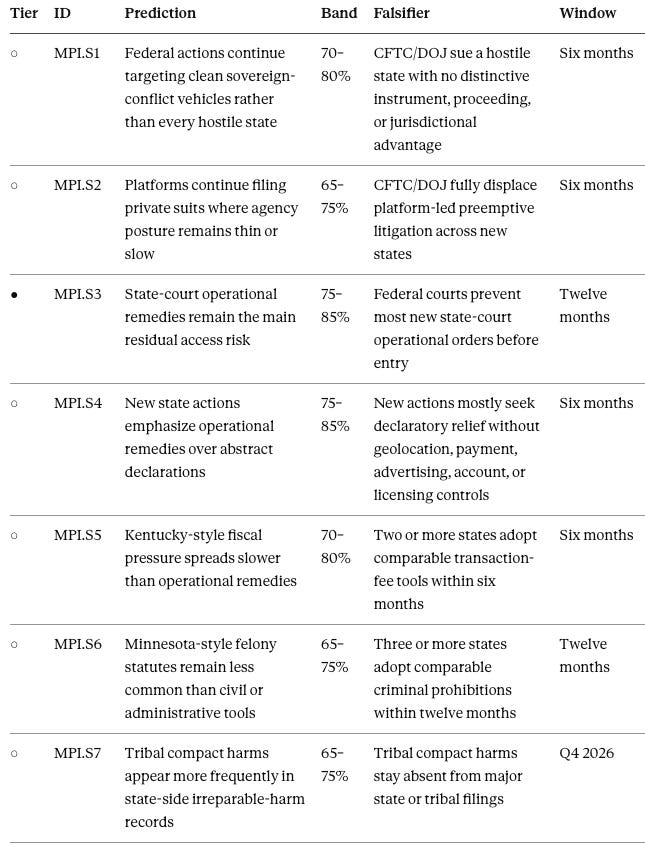
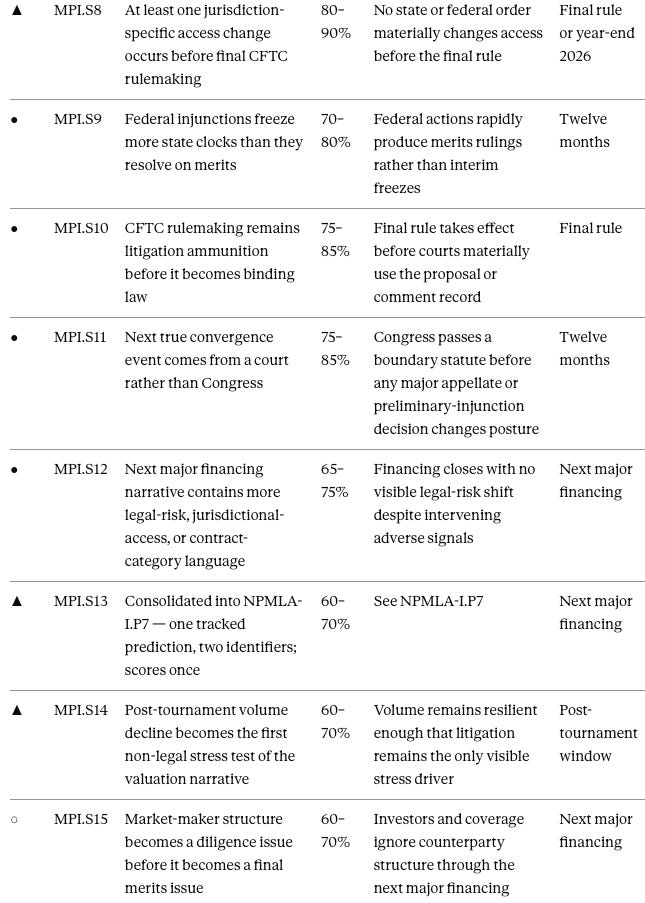
High-level MP CDT FS outputs appear here for transparency and falsifiability. Full simulation matrices, actor-state models, scenario trees, and scoring worksheets remain proprietary MindCast AI material, available through paid engagement.