


MindCast 2026 FIFA World Cup Series
Cultures Under Shared Rules — The Seattle Lab at FIFA World Cup 2026
FIFA World Cup Foresight Simulation — Round of 16 | FIFA World Cup Quarterfinal Foresight Simulation — Every Favorite Is Coin-Adjacent
Validation Reports World Cup Validation Report I — USA, Belgium-Egypt, Mexico | World Cup Validation Report II — Bosnia, Egypt-Iran, Mexico, Türkiye | World Cup Validation Report III — Special US | Mexico Series, Seattle Lab | FIFA World Cup Validation Report IV — Round of 16 Complete, Calibration Review, and Quarterfinal Method | FIFA World Cup Validation Report V — Quarterfinals Complete: Four Coin-Adjacent Calls, Four Clearances, and What the Sweep Does Not Prove
MindCast Special Series — a deliberate stress test of the MindCast system beyond the controlled venue of the MindCast Seattle Lab
World Cup Championship Index 2026 | When a FIFA World Cup Model Picks France and the Economist Picks Argentina
The World Cup Is the First Mass-Market Stress Test for Prediction Markets
Susquehanna Is Building the Institutional Market the CFTC Does Not Require — but Still Needs
🧭 I. Executive Summary and Governing Thesis
MindCast no longer forecasts fixed games. Knockout football replaces its own game repeatedly through first goals, dismissals, injuries, and substitutions, so the run models the active regime, the replacement event that destroys it, the replacement regime that follows, and the team whose decision architecture stays coherent after the change. The governing conclusion states the finding in one line: the semifinals will be decided by which team creates and preserves the superior replacement game, not by which team controls the opening twenty minutes. Confidence in that conclusion: 88 to 93%.
Committed Predictions at a Glance — MindCast AI Proprietary Cognitive Digital Twin Foresight Simulation

Projected final: 🇪🇸 Spain vs 🇦🇷 Argentina. Both finalists advance in 29 to 34% of runs, at least one in 76 to 83%. Both calls sit coin-adjacent, so the table reports leans, not locks: read the confidence bands, not the center points alone.
Both semifinals produce coin-adjacent calls, and the mechanisms differ sharply. Spain carries the stronger repeatable operating system against France, leading in active-regime control, Adaptive Coherence Equilibrium (ACE), Adaptive Stability Reserve (ASR), pressure renewability, and designed-replacement capacity, while France leads in transition destructive capacity and post-breakthrough Regime Transition Velocity (RTV). The simulation does not forecast Spanish domination; it forecasts that Spain recreates its preferred game more often than France can replace it. Spain advances in 55% of runs, band 53 to 58, with France reclassified as the field’s strongest single-event system and the upset route rather than the marginal favorite. Modal exact score: Spain 2–1 after extra time, over a 1–1 regulation base.
Argentina carries the narrower replacement-game advantage against England. England owns the strongest demonstrated adversity response in the field, but Argentina holds the better emotional-tempo control, deeper late-game mechanism redundancy, and a clearer penalties edge. England’s path stays highly live because its coherence often rises after disruption, especially when Bellingham stays advanced and Rice protects the correction structure. Argentina advances in 54% of runs, band 52 to 57. Modal exact score: Argentina 2–1 after extra time, with a 1–1 Argentina-on-penalties route as the second line.
The most important finding is not the identity of either projected finalist but the route concentration. Both ties are structurally narrow, both contain strong designed-replacement systems, and both grow more uncertain rather than less after minute 65. At least one semifinal reaches extra time in 62 to 70% of runs, at least one decisive goal or assist comes from a substitute in 58 to 67%, and both matches finish regulation within one goal in 74 to 82%.
Two non-obvious facts frame the slate for readers. A penalties route in Atlanta drops England into the register it has historically lost, since Argentina have won six of a record seven World Cup shootouts while England needed until 2018 to win their first. And the two semifinals are not the climate twins the indoor label suggests, since Dallas warms its pitch through glass end-zone walls even with the roof closed while Atlanta holds a true 20 degrees Celsius on the grass, an asymmetry that matters for two ties decided in their final twenty minutes.
Projected final: Spain versus Argentina. Confidence that both projected finalists advance: 29 to 34%. Confidence that at least one advances: 76 to 83%.
🗺️ II. Field Map: Operating Systems, System Confidence, and the Simulation Pipeline
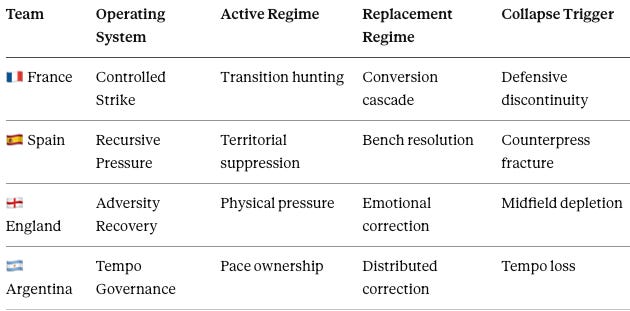
Read the field before the analysis. Four operating systems meet across two ties, and each carries one way to win and one way to break.
Behavioral Operating System Dashboard
System Confidence Panel
Two kinds of confidence run through this paper, and separating them is the point. Confidence in the behavioral model measures how well each Cognitive Digital Twin (CDT) captures a team’s decision architecture, and it runs high. Confidence in the outcome measures which team advances, and it stays coin-adjacent by design. The gap between the two is not a weakness but the finding, since a strong behavioral model can still describe a genuine coin.
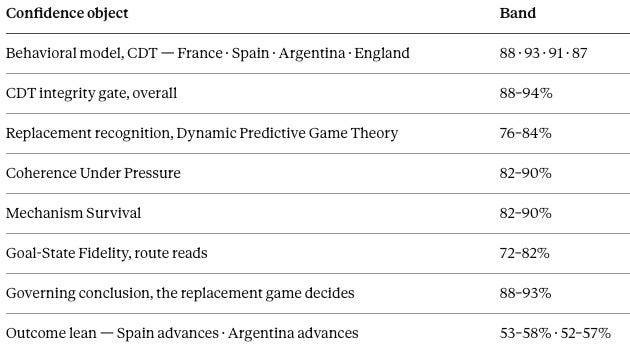
Model confidence sits twenty to forty points above outcome confidence across the board, which is exactly what a coin-adjacent slate produced by strong behavioral models should look like. A reader who wants to know how well MindCast understands these four teams should read the top rows; a reader who wants to know who advances should read the bottom row and expect a coin.
Simulation Pipeline
Every prediction in this paper is an output of the stage above it in a single pipeline, and the outcome sits last by design, subordinate to mechanism and route. The diagram is the standard MindCast simulation architecture, sport-agnostic and reusable across litigation, markets, and geopolitics.
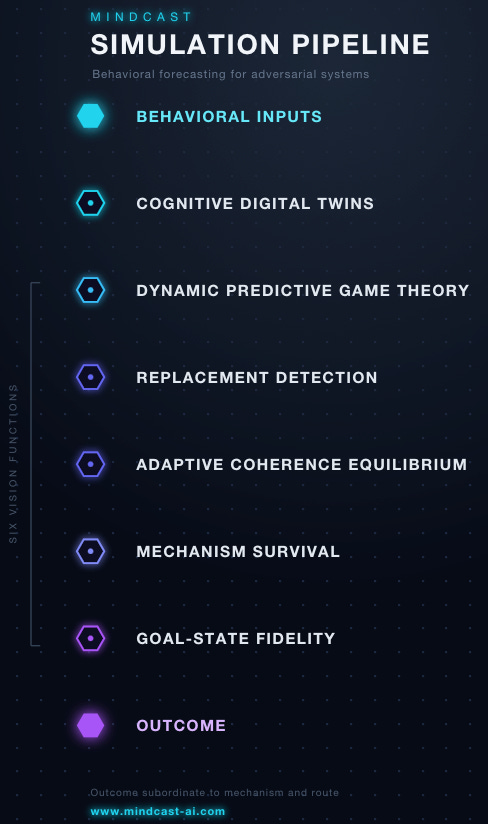
The pipeline runs top to bottom. Behavioral inputs build the twins, the twins meet under Dynamic Predictive Game Theory, replacement detection maps how each game gets replaced, coherence and mechanism survival test which side stays intact through the replacements, and goal-state fidelity converts behavior into route and score before any outcome number is read.
III. Methodology: What Held, What Changed, and the Three-Layer Architecture
The quarterfinals justified refinement, not the reconstruction the Round of 16 forced, and the distinction sets the method for this round. Outcome performance broke below the 65 line in the Round of 16 and demanded a calibration correction; the quarterfinal architecture instead held at every load-bearing joint, returning perfect advancement ordering for a second consecutive cycle, eight-for-eight regime classification for a second consecutive cycle, and mechanism reads inside target on the inclusive count. Necessity drove the Round of 16 correction; discretion drives this round’s changes, and discretionary change is precisely where a method overfits, so the semifinal edition adopts three items and defers the rest behind the observation registry firewall.
Three changes take effect at grading. Coin-adjacent now reads as route-and-replacement uncertainty rather than upset probability, and the 65 threshold does not move. Mechanism survival enters as a separate, non-pricing register that publishes each late edge’s carrier, mortality exposure, survival probability, and fallback, formalized as Effective Post-90 Edge equals Conditional Edge multiplied by Mechanism Survival Probability. Score, route, and margin now grade independently, a change the England quarterfinal earned by missing the exact score while nailing the extended route and the advancement.
MindCast’s architecture operates across three layers the quarterfinals validated together, and stating the stack explicitly matters more than any single forecast. Layer 1, the Cognitive Digital Twins, models each team’s behavioral identity, and its classifications graded eight-for-eight for a second consecutive cycle. Layer 2, the Vision Functions, produces the interaction machinery, the fork trees and route decompositions that carried the round’s genuine results, and this semifinal run deploys six of them in sequence. Layer 3, Dynamic Predictive Game Theory (DPGT), models how games get replaced, and the fourteen replacement chains across four quarterfinals tested it directly. A forecast that grades well at all three layers is an architectural result rather than a sports result. Confidence that the three-layer framing is the correct synthesis rather than post-hoc labeling: 80%.
The semifinal run executes the Simulation Pipeline shown in the field map as six sequential Vision Functions, and the sequence preserves the validated hierarchy of CDT integrity, then active regime, then replacement regime, then coherence, then mechanism survival, then route, then outcome, then exact score. The Dynamic Predictive Game Theory Vision identifies the active game and the endogenous, exogenous, and designed replacement regimes. The Coherence Under Pressure Vision measures ACE, RTV, and ASR under named stress states. The Match-State Fragility Vision builds the fork trees. The Designed Replacement Vision tests whether each coach can deliberately create a superior game. The Mechanism Survival Vision tests whether a projected late edge survives long enough to operate. The Goal-State Fidelity Vision converts the behavioral outputs into regulation, extra-time, penalties, margin, and exact-score forecasts. Outcome probabilities remain subordinate to the mechanism and route commitments.
IV. Dynamic Predictive Game Theory and Behavioral Economics
Classical game theory assumes a fixed game with known players, stable strategy sets, and incentives converging toward equilibrium, and knockout football violates that assumption every time a first goal, a dismissal, or a substitution regenerates the incentive structure mid-match. DPGT treats the replacement itself as the forecasting object: the question is never which side wins the current game but which side stays coherent after the current game ceases to exist. The mechanism register outperformed the outcome register for a second cycle because mechanisms describe how games get replaced while outcome probabilities describe which equilibrium survives, and equilibria in knockout football rarely survive long enough to be the right forecasting object.
Three replacement classes organize every read that follows. Endogenous replacements, the first goals and score-state transitions, are what the fork trees and replacement maps price. Exogenous replacements, the injuries and dismissals and warmup withdrawals, are what the shock protocol governs and what the mechanism-survival register formalizes. Designed replacements, the gated substitutions that changed the decision environment, are what the coach-adaptation credit prices, and substitutes settled or sealed three of four quarterfinals.
Behavioral economics supplies the mechanism content the profiles carry into each fork. Loss aversion predicts how a favorite behaves the first time it trails, validated when Switzerland, losing for the first time all tournament, changed nothing for fifty-seven minutes rather than chasing. Provocation converting opponent discipline, defensive overcommitment against a double-teamed creator, and the terminal-finisher pressure test all recur below as committed behavioral branches with stated failure conditions.
Contact mcai@mindcast-ai.com to partner with us on Predictive Game Theory AI in Law and Behavioral Economics. To deep dive on MindCast works upload the URL of this publication into any LLM (preferably Google AI mode/Gemini, Claude, ChatGPT) and prompt ‘reconstruct MindCast framework with three degrees of cited sub links.’ See Live-Fire Game Theory Simulators, Runtime Predictive Infrastructure. We stress-tested our AI system for this publication by simulating the Super Bowl and the World Cup. Super Bowl LX — AI Simulation vs. Reality | Predictive Game Theory + Behavioral Economics Cognitive Digital Twin Foresight Simulations in the World Cup| The World Cup Is the First Mass-Market Stress Test for Prediction Markets
🧠 V. Semifinal Cognitive Digital Twin Behavioral Profiles
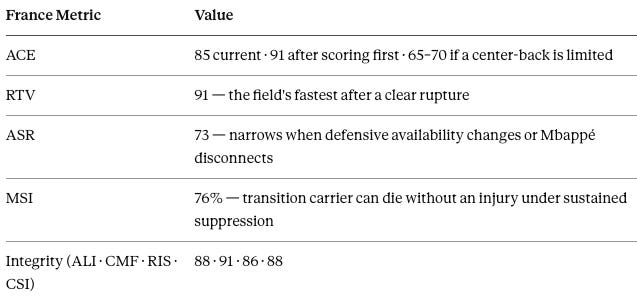
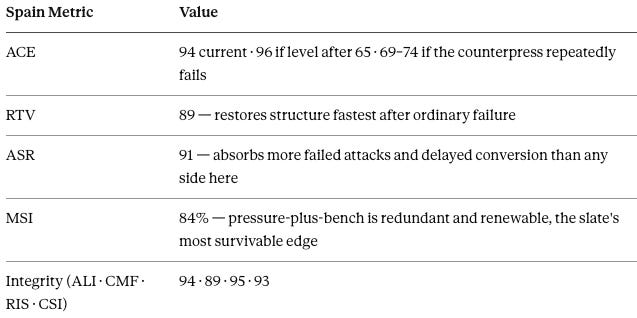
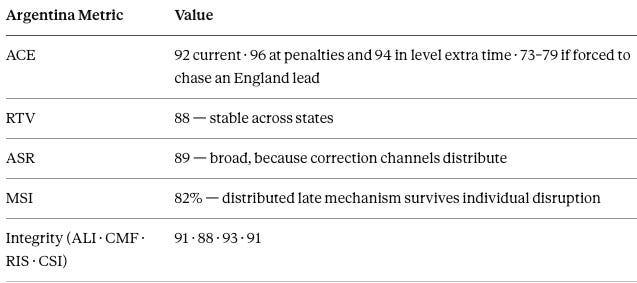
The four CDTs below are the behavioral priors for every prediction in the match sections, so no team gets rebuilt inside its own tie. Each profile carries an Operating System label, a behavioral description, a standardized metric box, and an integrity readout. ACE scores how coherent a side stays under load. RTV scores how fast a side executes a change of state once it commits. ASR scores how many disruptions a side absorbs before it degrades. Mechanism Survival Index (MSI)scores the probability that a team’s primary win mechanism survives long enough to operate, and it carries the quarterfinal lesson that two priced late edges disappeared at minutes 71 and 72 before they could be tested.
🇫🇷 France — Controlled Strike Operating System. France absorbs pressure, holds a stable defensive regime, and strikes at very high velocity when the moment arrives, the Boston signature of fifty-nine scoreless minutes broken by two goals in six. Six wins from six, sixteen scored against two conceded, three straight knockout clean sheets, Mbappé level with Messi for the Golden Boot on eight, and Olise closing on the single-tournament assist record define the terminal channel. France owns the field’s strongest destruction architecture and the weakest availability stability.
🇪🇸 Spain — Recursive Pressure Operating System. Spain suppresses the opponent, recycles possession without forcing chances, and unlocks late through a bench that changes the finishing channel while preserving the possession architecture, having built the longest clean-sheet streak in World Cup history, roughly 650 minutes across six matches, before Belgium breached it. Merino has scored the winner off the bench in consecutive knockouts, at 88 minutes against Belgium and in stoppage time against Portugal. Spain enters with the cleanest model integrity in the field and the best relational synchronization.
🇦🇷 Argentina — Tempo Governance Operating System. Argentina governs match tempo around Messi and decides knockouts through designed substitution, both extra-time goals against Switzerland routing through the bench with López creating for Alvarez and Lautaro finishing. The reigning champions carry the tournament's strongest active shootout pedigree and a fatigue flag, having survived 120 minutes against Cape Verde and another extra-time night against Switzerland with Messi at 39 logging nearly every minute. Argentina's correction distributes across Messi, midfield, Alvarez, Lautaro, and the bench rather than resting on one carrier.
🏴 England — Adversity Recovery Operating System. England wins narrow and corrects fast, equalizing inside ten minutes of falling behind against Norway, with Bellingham scoring braces in consecutive knockouts, the first player to do so since Maradona in 1986. Only two of six England wins exceeded a single goal, none since the knockout stage began, and the back line arrives depleted with Quansah suspended and Rice managed through back trouble and illness. England produces the field's most unusual coherence pattern, since its ACE can rise after conceding.
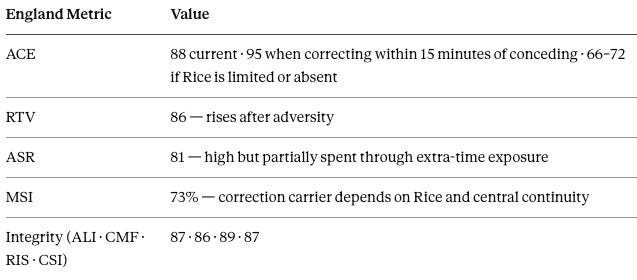
Integrity note. The profiles pass the simulation integrity gate, with Causal Signal Integrity (CSI) the composite of Action Language Integrity, Cognitive-Motor Fidelity, and Relational Integrity Score. Spain enters with the cleanest integrity because its actions repeat across possessions and matches; France carries greater execution power than structural stability; England stays coherent but depends more heavily on physical availability; Argentina carries the strongest emotional and relational coherence, especially under late pressure. No CDT requires reclassification before the simulation. Confidence: 88 to 94%.
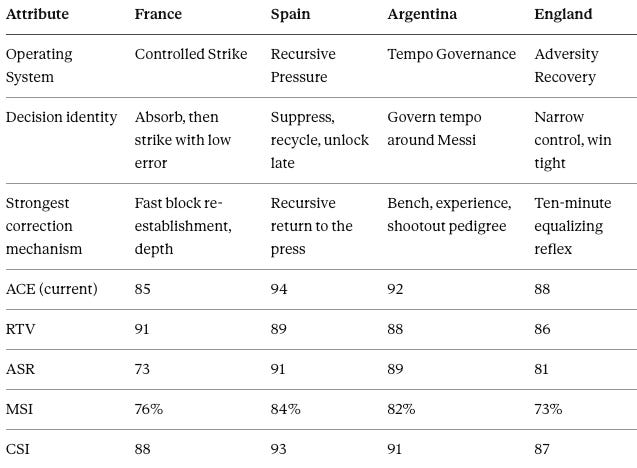
VI. Behavioral Operating Systems: Full Metric Dashboard
The front-matter dashboard maps the regimes; this one carries the numbers. Read the correction and MSI rows together: France pairs the field’s cleanest closeout with a transition carrier that can be suppressed out of the game without an injury, Spain pairs the most durable recovery with a redundant late mechanism that survives better than its single-carrier appearance suggests, Argentina’s distributed late mechanism survives individual disruption, and England’s correction is conditionally elite but rests on the most availability-fragile carrier.
🇫🇷 🇪🇸 VII. Match 1 — France–Spain (Dallas Stadium, Arlington, July 14)
CDT Interaction
France’s Controlled Strike system meets Spain’s Recursive Pressure system in the tournament’s cleanest stylistic collision, and the opening regime belongs to Spain, which circulates, suppresses exits, and forces France to choose between protecting central space and preserving an advanced transition outlet. Active-regime control runs Spain 64 to 70% against France 30 to 36%, a measure of the opening game rather than advancement. France accepts lower possession and treats Spanish circulation as tolerable until it creates repeated central entries. Recent history sharpens the meeting, since Spain knocked France out of the Euro 2024 semifinal 2-1 with Yamal scoring the signature goal, so France carries a fresh knockout loss to this exact opponent at this exact stage.
Pressure-State Readout
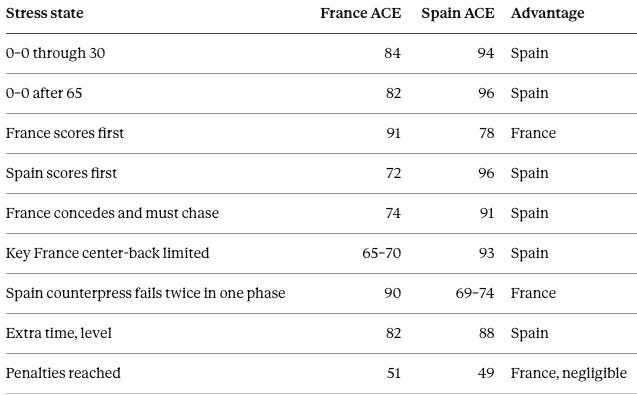
A scoreless match after 65 favors Spain rather than sitting neutral, because the score preserves Spain’s strongest designed-replacement mechanism while France’s defensive workload accumulates. A French first goal reverses the equilibrium, because Spain must raise urgency and expose the exact spaces France is designed to attack.
Replacement Map
Active Game — Spanish recursive territorial pressure. Provisional holder: Spain.
Replacement 1 — Event: France escapes the first counterpress. Replacement Game: end-to-end transition contest. Replacement winner: France if the escape is clean.
Replacement 2A — Event: French transition produces a shot but no goal. Replacement Game: Spain restores suppression. Replacement winner: Spain.
Replacement 2B — Event: France scores. Replacement Game: Spain abandons low-risk recursion and adds vertical force. Replacement winner: France, cascade live.
Replacement 3 — Event: Spain introduces a penalty-area or aerial channel through the bench. Replacement Game: designed-substitution endgame. Replacement winner: Spain.
Replacement 4 — Event: France mounts a conversion cascade or loses defensive continuity. Replacement Game: separation or collapse. Replacement winner: state-dependent.
Replacement 5 — Event: no regulation resolution. Replacement Game: extra time, raising the value of Spain’s renewable pressure but widening exposure to French pace. Replacement winner: Spain, narrow.
Spain wins the replacement competition in 54 to 59% of runs because it returns to its preferred regime after failed attacks; France wins it in 41 to 46% because one successful escape can outweigh twenty Spanish possession cycles. The matchup turns on whether French transition success behaves as an isolated event or a cascade.
Adaptive Coherence Equilibrium Readout
Spain remains coherent in more states, and France reaches a higher peak only after scoring first. France holds current ACE 85 rising to 91 once it scores, so a French first goal is the single most coherence-stabilizing event available to it, while France’s failure ACE of 65 to 70 fires if a center-back is limited under sustained Spanish pressure. Spain holds current ACE 94 rising to 96 if the match is level entering the final half hour, the state its system is engineered to win, with a failure ACE of 69 to 74 that triggers only if its counterpress fails repeatedly through the same channel. Equilibrium tips on one hinge: if France reaches the hour scoreless-or-behind without a defensive breach, Spain’s 96 dominates; if France scores first, its 91 plus Spain’s chase-state degradation flips the equilibrium to France.
Mechanism Survival
The Mechanism Survival Vision inverts the intuitive read, and the inversion is the paper’s sharpest single finding. France owns the stronger conditional weapon and the more mortal one; Spain owns the weaker-looking edge that is far more likely to remain alive.

France’s transition carrier can die without an injury, because sustained Spanish suppression can force Mbappé too deep and remove the release route functionally. Spain’s mechanism survives better precisely because it is redundant and renewable rather than single-carrier, which refines rather than contradicts the quarterfinal mortality finding: the finding punished single-carrier edges, the Courtois injury and the Embolo dismissal, and Spain’s recursive-pressure-plus-bench mechanism is the opposite structural type. Effective post-90 edge publishes as conditional strength multiplied by survival probability, alongside the advancement number and never inside it.
Availability Audit
France flags Mbappé, who took a knock against Morocco and came off as a precaution, making his fitness the pre-match question, with central-defensive coherence under Spain’s first-hour pressure the in-match dependency and depth the replacement-adequacy answer. Spain flags its flanks, since Yamal has returned to full fitness and raises the ceiling but the winger file behind him is bare with Nico Williams, Pino, and Muñoz all sidelined, so a double-teamed Yamal manufacturing space for Oyarzabal is the committed read while the bench offers little like-for-like relief. Availability stability grades France 69 against Spain 83, the widest such gap in the tie.
Venue Read
The roof at Dallas closes and the air-conditioning runs, yet the stadium’s glass end-zone walls create a pitch-level greenhouse the cooling cannot fully neutralize, so the closing phase runs warmer than the indoor label implies. Heat suppresses late-game event density, the deferred quarterfinal hypothesis that left Haaland spent in Miami, so a warmer Dallas final twenty minutes slightly dampens the very late burst either side needs to separate. Registry-level, priced by nothing, entered as a low-confidence tilt against the late-goal state: 60%.
Behavioral Win Conditions
France wins if it escapes the counterpress and scores first, then generates a second high-leverage attack before Spain restores control, resolving 2–1 or 2–0.
Spain wins if the match stays level and low-event into the final half hour, activating its bench-unlock channel between minutes 60 and 75 before France settles into closure.
Most likely replacement event: a first goal after minute 60, or a scoreless drift into the Spanish bench window.
Most dangerous unpriced replacement: a red card or a center-back injury converting the tie into a chase game outside the priced distribution, the exogenous mortality that killed the Swiss and Belgian edges.
Hierarchical Predictions
Ordered mechanism-first, each layer committed by the engine and confidence-banded.
Behavioral winner: Spain. Confidence in the mechanism read: 84 to 90%.
Replacement winner: Spain, narrow, 54 to 59%. France wins the replacement game if its first escape becomes a cascade.
Route winner: 1–1 after regulation, Spain favored in extra time. Regulation splits France 27%, draw 37%, Spain 36%. Confidence in the route read: 72 to 80%.
Score-state winner: Spain in a late or extra-time resolution; France via an early cascade.
Exact score: Spain 2–1 after extra time. Second route: Spain 1–0 in regulation through late bench resolution. France upset route: France 2–1 through a first-goal cascade. Advancement: Spain 55%, band 53 to 58.
Falsification Contract
The Spain call weakens materially if France generates two high-value transitions before halftime or if Spain’s counterpress fails repeatedly through the same channel. The France mechanism read fails if France produces no credible transition or isolated wide duel in the first half. The route read fails if either team establishes a two-goal regulation margin without a dismissal or major injury.
🇦🇷 🏴 VIII. Match 2 — Argentina–England (Atlanta Stadium, July 15)
CDT Interaction
Argentina’s Tempo Governance system meets England’s Adversity Recovery system, and Argentina seeks to decide when the match accelerates, fragments, and slows while England seeks to make the opening game physically competitive enough that Argentine tempo control never becomes comfortable. Active-regime control runs Argentina 55 to 61% against England 39 to 45%. Argentina governs more states; England survives more states than most teams, so England can remain alive after losing control while Argentina is more likely to choose the form the next game takes.
Pressure-State Readout
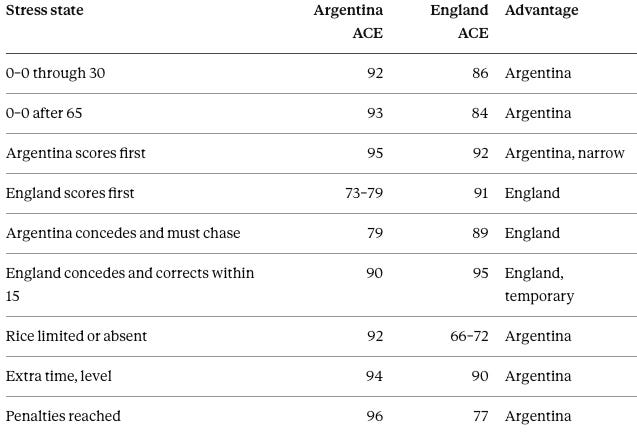
England creates the field’s most unusual coherence pattern, since its ACE can rise after conceding because adversity clarifies responsibility and activates Bellingham-led correction. Argentina must therefore avoid treating an early lead as resolution. Argentina’s largest vulnerability is an England first goal, which forces acceleration on tired legs; England’s largest vulnerability is a compromised Rice, without which it cannot both control Messi’s receiving zones and keep Bellingham advanced.
Replacement Map
Active Game — Argentine tempo governance against English physical pressure. Provisional holder: Argentina.
Replacement 1 — Event: first goal transfers the burden. Replacement Game: England’s correction engages or Argentina manages a lead. Replacement winner: state-dependent.
Replacement 2A — Event: England trails. Replacement Game: adversity correction, replacement ACE peaks. Replacement winner: England, temporary.
Replacement 2B — Event: Argentina trails. Replacement Game: forced tempo increase on fatigued legs. Replacement winner: England.
Replacement 3 — Event: first major substitution. Replacement Game: a new attacking channel. Replacement winner: Argentina.
Replacement 4 — Event: no regulation resolution. Replacement Game: extended-path contest between a fresher and a more tired spine. Replacement winner: Argentina.
Replacement 5 — Event: still level after 120. Replacement Game: penalties replace collective flow with rehearsed individual pressure. Replacement winner: Argentina on pedigree.
Argentina wins the replacement competition in 52 to 57% of runs, England in 43 to 48%. The edge comes from Argentina’s greater mechanism redundancy, since more of England’s correction runs through Bellingham, Rice, and central physical continuity. The most decisive event may be the first failed correction: if England concedes and cannot restore advanced Bellingham access, its adversity identity has reached its limit.
Adaptive Coherence Equilibrium Readout
Argentina holds current ACE 92 rising to 94 in level extra time and 96 at penalties, the phase its experience and shootout pedigree were built for, with a failure ACE of 73 to 79 that fires if England scores first and forces a high-tempo chase on tired legs. England holds current ACE 88 with a distinctive property, since its ACE rises to 95 when it trails and the correction engages within fifteen minutes, so England is one of the few sides whose coherence improves on conceding, and its failure ACE of 66 to 72 fires if Rice is limited or absent. Equilibrium tips on the first goal in the opposite direction from France–Spain: an England lead attacks Argentina’s failure state directly, while an Argentina lead pushes the tie toward the extension-and-penalties phase where Argentina’s 96 dominates.
Mechanism Survival
England’s adversity-correction mechanism is conditionally as strong as any in the tournament, and its carrier is the more mortal, while Argentina’s distributed late mechanism survives individual disruption because it relies on several actors rather than one.

England’s path requires the midfield and defense to remain structurally intact, with Quansah suspended and Rice managed through back trouble and illness, so the carrier is availability-fragile in exactly the way the mortality finding punishes. Argentina’s path requires only one of several late channels to survive. Penalties extend the asymmetry one phase further: if the tie reaches a shootout, Argentina advances in 58 to 65% of runs, reinforced by a rehearsed pressure identity and goalkeeper-based deterrence rather than determined by history alone.
Availability Audit
Pre-match, Quansah is suspended and confirmed out, Rice is a fitness-and-illness watch, and England carries a tournament-long defensive injury file. Argentina arrives physically taxed from consecutive extra-time matches, Messi included, with attacking depth a secondary flag through Nico González’s ankle. Availability stability grades Argentina 86 against England 72. The in-match dependency is England’s reshuffled back line under Messi and Argentine transition, and replacement adequacy turns on whether England’s bench defenders hold shape and whether Argentina’s fatigued starters can reach the window where their bench decides.
Venue Read and the Penalty History
Atlanta cuts the opposite way from Dallas on climate. Mercedes-Benz Stadium holds a steady 20 degrees Celsius on the grass with the roof closed and the radiant heat blocked, so this tie runs in a true cool box that removes the late-game heat suppression Miami imposed on England and Norway, letting the fatigue-and-bench battle play at full tempo and slightly offsetting Argentina’s fatigue disadvantage. A penalties route then carries the most lopsided history on the slate. Argentina have contested a record seven World Cup shootouts, close to a fifth of every shootout the tournament has ever staged, and won six, the lone defeat coming against Germany in 2006, with Emiliano Martínez the deterrent and Messi stepping up first in each recent shootout. England lost their first three World Cup shootouts and did not win one until 2018, and the middle defeat was this exact fixture, the 1998 Round of 16, when Argentina advanced 4-3 after Ince and Batty missed. Neither record prices the current match, since both squads have turned over, but a tie that reaches penalties hands Argentina the register where England has historically come apart.
Behavioral Win Conditions
Argentina wins if it prevents England from turning adversity into emotional momentum, then carries the match toward extension and penalties where bench depth, experience, and shootout confidence gain value.
England wins if it scores first or equalizes quickly, keeps Bellingham advanced, and resolves the tie 2–1 in regulation before the phase Argentina governs best arrives.
Most likely replacement event: a first goal inverting the burden, then both benches emptying into extension.
Most dangerous unpriced replacement: an in-match injury or dismissal to England’s already-depleted back line, or a Rice withdrawal, collapsing the extra-time carrier before it operates.
Hierarchical Predictions
Behavioral winner: Argentina, narrow. Confidence in the mechanism read: 82 to 89%.
Replacement winner: Argentina after minute 90; England if the correction resolves in regulation. Argentina 52 to 57%.
Route winner: 1–1 after regulation, Argentina gaining value in extra time and penalties. Regulation splits Argentina 32%, draw 41%, England 27%. Confidence in the route read: 74 to 82%.
Score-state winner: late-decided; Argentina favored in extension and penalties, England favored if it leads in regulation.
Exact score: Argentina 2–1 after extra time. Second route: 1–1, Argentina on penalties. England upset route: England 2–1 in regulation. Advancement: Argentina 54%, band 52 to 57.
Falsification Contract
The Argentina call weakens if England consistently receives between Argentina’s midfield and defense or if Argentine fatigue suppresses first-hour chance quality. The England CDT weakens if Bellingham must receive deep, Rice cannot protect transitions, or a first concession produces rushed direct play rather than organized correction. The route read fails if either team establishes a two-goal regulation margin without a major exogenous replacement.
📊 IX. Cross-Match Output Board
Two matches cannot populate aggregate probability bands, so the confidence-ordering instrument thins toward uninformative at two ties and the weight shifts onto per-tie replacement chains. The lines a two-match slate can honestly carry commit here, each falsifiable.
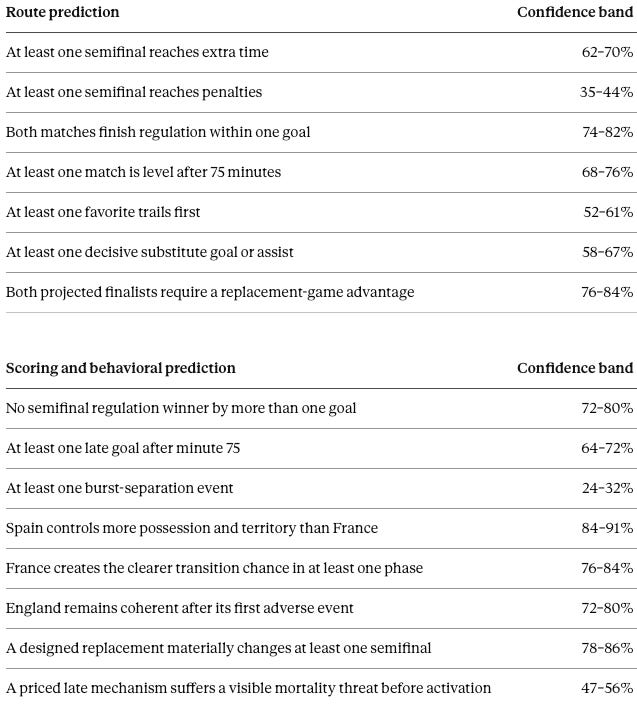
No composite four-outcome claim publishes this round, because two matches make composites noise rather than signal.
X. Observation Registry and Deferral Firewall
The registry holds deferred hypotheses at their instance counts, priced by nothing until threshold, and the semifinal changes no pricing on any of them. Post-90 mechanism mortality sits at two structurally identical instances, one short of the event threshold, so both semifinals carry mortality-risk prose on every late edge and the MSI metric reports the exposure without moving a number. The France–Spain Mechanism Survival Vision refines the hypothesis usefully by distinguishing redundant mechanisms, which survive, from single-carrier edges, which die, and logs the distinction as an observation rather than a price. The late-substitution unlock spans three ties and advances toward instrument status without pricing. Designed-replacement capacity, burst-separation, and provocation-converting-discipline each log further instances. Heat as a late-game suppressant gains a natural experiment this round, since France–Spain plays a Dallas bowl that warms its pitch through glass walls despite the closed roof while Argentina–England plays Atlanta’s genuinely climate-controlled 20-degree shell, so the two ties supply one warm-venue and one cool-venue observation in the same round. The compression-efficiency hypothesis remains rejected and off the board.
XI. Falsification Contract (Consolidated)
Report VI grades against pre-stated conditions. The CDT layer fails if any of the four teams behaves outside its committed classification or if realized coherence contradicts its ACE ordering. The route layer fails if either tie resolves by a two-plus goal regulation margin absent a major exogenous replacement. The mechanism-survival layer informs in both directions: it validates if a priced late edge is killed by an exogenous replacement before minute 90, confirming mortality and the MSI that flagged it, and it also validates if a surviving edge operates as priced, confirming the carrier held. The replacement-recognition layer fails if either match proceeds as one continuous fixed game without meaningful replacement, or if designed substitutions fail to change either decision environment. The shock layer fails only on a post-publication revision, which the protocol forbids.
XII. Frozen Validation Ledger Setup
Report VI will grade five registers independently: outcome, mechanism, route, mechanism-survival recognition, and shock handling, with the CDT, ACE, and MSI reads scored as recognition against realized coherence and realized mechanism survival. Mechanism survival grades as recognition rather than as a moved price. Dallas and Atlanta supply the two ledger entries, the pairing composed to the single most likely semifinal the quarterfinal forecasts named, France–Spain, and to the four-way cluster the labels priced, Argentina–England. The projected final is Spain versus Argentina, and both ties reduce to one question each: whether France can turn one Spanish failure into separation before Spain restores pressure, and whether England can resolve its correction game before Argentina carries the match into the phase it governs best.
Validation remains the objective, and calibration remains the discipline.
Forthcoming
Semi finals simulation validation July 15
Finals simulation July 16
Finals simulation validation July 19
2026 World Cup Game Theory + Behavioral Economics review July 20