
Part of the MindCast Prediction Markets Rule Architecture series: A Boundary Rule with a Functional Core | Competitive Federalism | Kalshi Loses Federal Forum — The Washington Remand Order and the Jurisdictional Layer of the Prediction Markets Boundary Rule
Other related works: The CFTC NPRM Is a Litigation Brief — Reading RIN 3038-AF65 as the Federal Record for the Preemption War | Prediction Markets and the Dual Nash-Stigler Trap — Kalshi, the CFTC, and the Prediction-Market Harm Clearinghouse | How the CFTC’s Missing “Gaming” Definition Is Losing the Kalshi Prediction-Market Preemption War
Executive Summary
State legislators consolidated the prediction-market war in the last week of July, and the consolidation matters more than any single lawsuit now pending. Within four days, the convergence became publicly visible: NCSL submitted its CFTC comments on July 24, and NCLGS announced its previously approved resolution on July 27. Thirteen days earlier, the Michigan conflict had already exposed the operational limit of federal exclusivity. The two developments together reset the question the entire fight turns on.
The convergence is real, and so is the split inside it. Both organizations agree on the diagnosis: prediction markets implicate gaming, federal ambiguity is exporting costs to states and tribes, and CFTC oversight cannot displace state authority.
They divide on the cure. The National Council of Legislators from Gaming States wants Congress to declare prediction markets illegal gambling outright. The National Conference of State Legislatures wants the CFTC to define the contracts as gaming and then let states regulate them like sports betting. Two remedies, one diagnosis — and a third design already sits beside them in the public debate.
The third design is the subject of this publication. MindCast filed the functional core in its April 17 CFTC comment, then published the fully developed contest-versus-consequence boundary in May: sort every contract by whether it is a contest or a consequence, route contests to the states, and admit consequence contracts to federal regulation only when they transfer real economic risk.
The categorical remedy and the absorption remedy each fail on a design flaw the functional sort avoids. Which of the three boundaries prevails, not which platform wins which appeal, is the highest-leverage open question in the system.
Earlier in July, Michigan delivered the sharpest evidence yet of the operational limit of federal exclusivity. A Michigan court ordered Kalshi to cancel specified trades; Kalshi sought emergency CFTC authority to comply; the Commission instead ordered fulfillment; and Kalshi reportedly had already unwound the positions under state-court compulsion.
Federal and state actors each controlled a different layer of the same transaction. State contempt power determined Kalshi’s immediate conduct, while the Commission preserved the federal command and its enforcement path.
The convergence carries direct evidentiary weight for the MindCast framework, because the two organizations reached four of its conclusions without citing it. Both name regulatory arbitrage as the operating dynamic, and both trace the harm to federal definitional insufficiency.
Both count the fiscal displacement borne by states and tribes. Both flag the integrity vulnerability, with the NCLGS resolution reciting the alleged UFC fight manipulation and the federal indictments of two Major League Baseball pitchers. Independent arrival at a published thesis is corroboration, not citation.
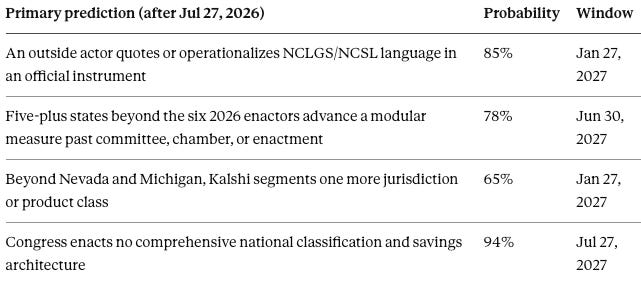
The paper’s product is a forward book. The MP CDT FS engine, run against an eleven-actor model of the system, generates twelve registered predictions on where the consolidation drives the contest next — four of them load-bearing, each with a probability, a window, and a falsifier.
The forecasts earn their weight from a registry that scores against the house. Against the July consolidation, MindCast confirmed one prior prediction only partially and withheld two others whose triggers had not fired — declining to bank near-wins it could have claimed. Full falsifiers, the remaining eight predictions, and the backward-looking ledger appear in Section VI and the appendices.
Three arguments follow, and a reader pressed for time can take them from here. First, state legislatures are now the actor class most able to convert organized opposition into operative state law and force the federal system to answer the boundary question. Second, the categorical remedy the loudest legislators favor risks defeating its sovereignty objective, while the functional boundary advances the coalition’s shared sovereignty, integrity, tribal-protection, and consumer-protection objectives without adopting either remedy.
Third, prior MindCast scenario work places recurring externalities at roughly $1–2 billion annually on 2026 volumes, of which lost tax revenue is only one component of a provisional band. The sections below develop each in turn.
I. Consolidation After Federal Exclusivity Reached Its Operational Limit
State legislators did not newly enter the prediction-market fight in July. They consolidated a position that had been building across state bills, enforcement actions, and multistate litigation for more than a year — and the consolidation became publicly visible in a single compressed week. Reading that week correctly requires separating what changed from what did not.
The sequence is straightforward. NCLGS approved its resolution at its July Executive Committee meeting in San Diego. NCSL submitted its comment letter to the CFTC on July 24. NCLGS announced its resolution publicly on July 27, the day the Commission’s comment period closed. The timing aligned both positions with the closing federal rulemaking window: NCSL submitted comments directly, while NCLGS publicly announced its resolution on the deadline.
Neither organization is a legislature, and the distinction matters. Each is a membership body that transmits a shared position through a different institutional grammar. NCSL represents every state legislature and speaks in the language of bipartisan federalism. NCLGS represents legislators from gaming states and speaks in the harder language of gaming prohibition. What consolidated was not law but a shared national position across two legislative networks — and a shared position converts into instruments faster than dispersed activity does.
The dispersed activity underneath the consolidation is already substantial. Fifteen states addressed prediction-market legislation during 2026 sessions, and six enacted measures spanning prohibition, licensing, taxation, minor protection, insider restrictions, and integrity offenses. No uniform model governs that activity, which is precisely the gap a national coalition fills.
A demonstrated conversion channel already exists as well. Thirty-eight states signed a Fourth Circuit amicus brief supporting Maryland, with Nevada and Ohio leading and major-questions doctrine supplying the grammar. The channel from policy position to appellate argument is built and tested.
The Michigan conflict earlier in July supplies the counterpoint that gives the consolidation its urgency. A Michigan court ordered Kalshi to stop offering sports contracts and to cancel trades already made by Michigan residents, and Kalshi filed an emergency rule asking the CFTC for permission to comply.
The Commission refused. On July 14 it invoked emergency authority last used for commodities like potatoes and coffee and ordered Kalshi to fulfill the trades instead. Kalshi reportedly had already voided them to obey the state court, and now faces potential federal enforcement for that compliance.
Read together, the two threads define the moment. Legislators consolidated claims to authority within weeks of state contempt power, not the federal command, determining a federal registrant’s immediate conduct. Federal actors retain the pathways to national settlement; state actors can presently control conduct inside particular jurisdictions — and the consolidation hardens the state side of exactly that divide.
II. What the Resolution and Letter Independently Corroborate
The convergence carries analytical weight beyond the politics of coalition-building, because the two organizations reached conclusions the MindCast corpus published months earlier — and reached them without citing it. Independent arrival at the same mechanisms provides meaningful external corroboration that the analysis describes the system rather than the analyst. Four mechanisms converged.
Regulatory arbitrage is the first. NCLGS names the term directly in its resolution. NCSL describes the same dynamic functionally, warning that platforms replicate state-regulated products “while bypassing state licensing and consumer protection requirements.” The Dual Nash-Stigler companion built its Harm Clearinghouse on exactly this arbitrage structure.
Federal definitional insufficiency is the second. Both documents trace the harm not to any single ruling but to the Commission’s failure to define the category it claims to govern. The CFTC Incoherence analysis made insufficiency — rather than jurisdiction — the harm generator months before either organization wrote.
Fiscal displacement is the third. NCSL counts “hundreds of millions of dollars in potential revenue” lost to states and localities. NCLGS describes erosion of the tax base that regulated gaming supports. Both assert the externality the Harm Clearinghouse priced.
Integrity vulnerability is the fourth. The NCLGS resolution recites the alleged UFC fight manipulation and the federal indictments of two MLB pitchers as evidence that prediction markets invite insider exploitation. The functional framework’s informational-integrity factor was designed around precisely this failure mode.
Four mechanisms, two independent documents, zero citations to the source that developed them. The convergence does not prove the framework correct, but it removes the easy dismissal — that the analysis describes only its author’s priors. State legislators writing for their own purposes arrived at the same map.
III. The Categorical Trap
The categorical remedy is the louder of the two legislative positions, and it contains a design flaw its own advocates should weigh before Congress acts on it. The flaw is not political but structural: the remedy defeats the sovereignty goal it is meant to serve. Naming the trap precisely matters, because a sloppy version of the argument overstates it.
NCLGS asks Congress to do two things at once — classify prediction markets as illegal gambling, and preserve state and tribal control over gaming. The two asks coexist only under a narrow condition. Unless Congress expressly protects concurrent state authority and writes in state-licensed exceptions, a federal prohibition narrows the very discretion the resolution seeks to restore. A categorical federal statute is still a federal statute, and prohibition without express savings language can preempt the state frameworks it was meant to protect.
The tension runs inside the legislative bloc, not just against it. NCSL’s own letter asks the Commission not to let a federal gaming definition displace broader state definitions — the anti-preemption instinct applied to the federal instrument itself. The bloc’s broader wing already senses the risk the categorical wing is running.
Michigan supplies the federal-side proof that the trap is real. The Commission asserted its exclusive-jurisdiction theory at maximum force and produced a registrant in what Kalshi’s own enforcement head called an “impossible position,” facing potential federal enforcement for obeying a state court.
Categorical claims to authority, asserted without administrable boundaries, manufacture the conflicts they claim to prevent — and the principle holds whichever sovereign does the asserting. The categorical federal remedy and the CFTC’s categorical exclusivity claim fail on the same design defect.
The lesson is not that the categorical remedy is wrong about the problem. It is that a categorical instrument, drafted without express concurrent-authority protection, trades away the sovereignty it means to secure. The next section describes the boundary that does not make that trade.
Contact mcai@mindcast-ai.com to partner with us on Dynamic Predictive Game Theory AI in Law and Behavioral Economics. We specialize in predictive simulations for Complex Litigation, Innovation Economics, Geopolitical Risk Intelligence and Legacy Innovation. See more about MindCast series at our new website MindCast Corporate.
To test our predictive simulation AI system, in 2026 we simulated the Super Bowl and the World Cup. See 🏈 Super Bowl LX — AI Simulation vs. Reality | ⚽ The 2026 World Cup Final Simulation Validation
To deep dive on MindCast works upload the URL of this publication into any LLM (preferably Google AI mode) and prompt ‘reconstruct MindCast framework with three degrees of cited sub links.’ See Live-Fire Game Theory Simulators, Runtime Predictive Infrastructure.
IV. The Contest-Versus-Consequence Alternative
The functional boundary advances the core sovereignty, integrity, tribal-protection, and consumer-protection objectives shared by both organizations without adopting either remedy wholesale. The sort is simple to state and administrable to apply, which is the entire point: a boundary that courts can run and legislators can draft beats a categorical declaration that generates the conflicts it claims to settle. Each organization sees its core objective met on the face of the rule, even though neither remedy is adopted as written.
A contest is a competitive activity whose outcome depends on play for stakes — sports, awards, casino games. A consequence is a real-world event with measurable economic effect independent of the contract — weather, interest rates, supply disruptions. Contests route to state and tribal authority as a presumptive matter. Consequence contracts face a functional override and enter federal derivatives regulation only when they transfer real economic risk to participants who already carry the underlying exposure.
The framework directly addresses the resolution’s stated integrity concerns without requiring a categorical statute. The per-se exclusions bar the injury props, negative-outcome contracts, and individual-targeting wagers that the resolution’s UFC and MLB recitals invoke — barred at listing, regardless of any other analysis. The categorical wing’s stated concern is met without a categorical statute.
NCSL gets its position nearly whole, because the absorption remedy it proposes is the contest side of the boundary. NCSL asks that contests be regulated by states on the sports-betting model. The functional sort routes contests to exactly that authority. The bloc’s broader wing is one administrable definition away from the framework already.
Sovereignty gets operationalized rather than asserted. The framework’s competitive-federalism architecture — dual-gate reporting, geofencing protocols, and express non-displacement of tribal compact rights — writes state and tribal authority into the rule text instead of leaving it to a preamble a court can discount. The functional boundary is not a compromise between the two legislative positions. It is an administrable design that advances each organization’s stated objectives without adopting either remedy wholesale.
V. The Fiscal Stakes Behind the Tax Clause
The resolution asserts fiscal harm without attaching a number, and prior MindCast scenario work supplies one. Quantification makes the asserted fiscal harm testable, so this section states the estimate the resolution’s tax-erosion language implies, together with what it does and does not cover.
Prior MindCast scenario work estimates recurring externalities at roughly $1–2 billion per year on 2026 volumes. The figure is a scenario band, not a point estimate, and the full band covers more than lost tax revenue alone — it aggregates displaced state and tribal revenue, consumer-protection leakage, and integrity costs. Notional prediction-market volume cannot be converted directly into sportsbook revenue or state tax loss, which is why the estimate is a band rather than a single number.
Two independent anchors support the band. The first is the American Gaming Association’s State of the States 2026, an interested-industry source whose incentives run toward a high number — a fact the estimate discloses rather than obscures. The second arrived with the consolidation itself: NCSL’s independent “hundreds of millions” figure corroborates the revenue-displacement component specifically, not the full band, from a source with no stake in the MindCast framework.
The next validation step belongs to state fiscal offices. A qualifying fiscal note that publishes volume, revenue-conversion, tax-rate, and integrity-cost assumptions would independently test the band. Until then, $1–2 billion remains an analyst scenario rather than a legislative estimate.
VI. The Forward Book — Where the Paper Places Its Weight
The paper’s real product is forward, not backward. The MP CDT FS engine, run against an eleven-actor model of the system frozen at the July 27 cutoff, produced twelve registered predictions — each with a probability, a confidence band, a named settlement source, and a falsifier. Four carry the argument; the full set and the engine discussion sit in Appendix A.
The four load-bearing predictions:
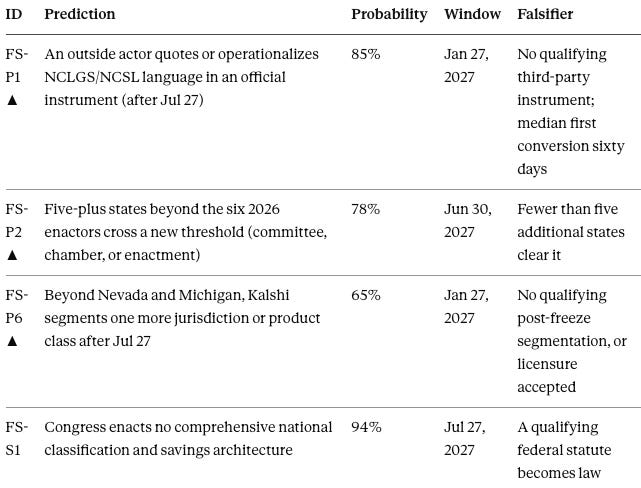
Two structural findings frame the numbers. The modal twelve-month route is continued fragmented enforcement plus modular state legislation, at 44 percent, with final CFTC action the dominant event capable of replacing the game rather than ending it. National-equilibrium timing runs nine months at the tenth percentile, twenty-four at the median, and forty-eight or more at the ninetieth — the war’s realistic clock, stated as a distribution rather than a single indefensible date.
The engine also settles the intra-bloc fork the paper turns on. Modular diffusion, not categorical uniformity, is both the observed baseline and the forecast pattern, which places NCSL’s position closer to the system’s incentive structure than NCLGS’s — and the functional boundary is the administrable expression of that modularity. Appendix A carries the full reasoning.
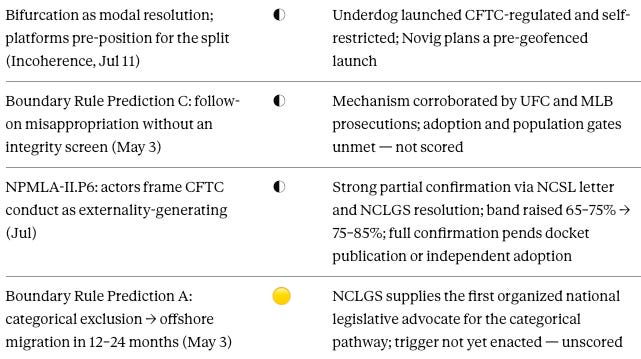
A short word on why the forward numbers deserve trust. The same registry that generates them scores its own past record against the house. Against the July consolidation it confirmed just one prior prediction, and only partially — NPMLA-II.P6, the forecast that state, tribal, or private actors would frame CFTC conduct as externality-generating, with its band raised to 75–85 percent pending a docket check.
The registry withheld two others outright. Boundary Rule Prediction C stays unscored because the misappropriation cases the resolution recites have not cleared its registered gates; Boundary Rule Prediction A stays unscored because advocacy for categorical exclusion is not enactment of it. A shop that refuses to bank two available near-wins is a shop whose 85 percent means something.
VII. What This Means for Each Stakeholder
The consolidation reads differently from each seat at the table, and the same non-binding resolution hands five actors five distinct moves. Naming them directly is the point: a legislator, an attorney general, and a platform counsel each open this analysis to learn what the declaration changes for them, not for the system in the abstract.
State legislators gain drafting cover and a starting text. A legislator weighing a 2027 bill now has two national organizations on record and a menu of fifteen states’ approaches to borrow from. The functional boundary offers the cleanest draft: contest-versus-consequence language captures sports, props, and parlays without the overbreadth that invites a preemption challenge. The move is to draft from the boundary, not from a categorical ban that a court can strike.
State attorneys general gain a federalism record they can cite. The NCLGS resolution and NCSL letter convert directly into amicus language, multistate letters, and consumer-protection theories — the conversion channel the thirty-eight-state Fourth Circuit brief already proved. The move is to fold the consolidated legislative record into the next filing, where a court reads it as reliance and federalism context.
Congress gains a hearing predicate and a coalition to manage. Both organizations asked Congress to act, and the engine puts comprehensive federal enactment at 6 percent within a year. The realistic near-term path is a narrow measure on insiders, integrity, or minors. The move for a member is to treat the savings-clause question as the live one: any categorical bill without express concurrent-authority protection reopens the trap Section IV describes.
Platforms face a narrowing operating map, not a settled one. Kalshi already geofences three states and litigates exclusivity in parallel — the selective-segmentation posture the forward book prices. The consolidation raises the cost of the categorical fight without ending it. The move is to design consequence-side products that survive a functional screen, because the boundary that emerges will reward economic function and punish contests in derivative form.
Tribes gain leverage but must assert it independently. Both documents name tribal authority, yet neither substitutes for a compact-rights claim filed in a tribe’s own name. The engine flags an independent post-freeze tribal instrument as a live event. The move is to file rather than rely on general state-sovereignty framing, because the federal record now being built weighs displacement of compacted gaming only if a tribe puts it there.
Across all five, one through-line holds: no stakeholder needs to win the national classification fight to act now. Legislators draft, attorneys general file, platforms redesign, and tribes assert — each moving on the boundary the consolidated record already draws, while the Commission’s undefined category leaves the federal center the last actor able to move.
VIII. Conclusion
The prediction-market war has run for more than a year through courts that decline to draw the boundary and a Commission that declines to define it. July supplied the actor class capable of hardening the state side of the boundary.
National settlement still requires congressional text, final CFTC action sustained on review, controlling appellate law, or material operator restructuring. But state legislatures, consolidated across two national organizations and armed with a demonstrated conversion channel, can now write the rules that force the federal system to answer.
The consolidation arrived with a warning built into it. The categorical remedy the loudest legislators favor would, absent express savings language, defeat the sovereignty it means to protect — the same design defect that put a federal registrant in an impossible position in Michigan.
The functional boundary avoids that trap. It advances each organization’s stated objectives without adopting either remedy wholesale: contests to the states, consequence contracts to federal regulation on proof of real economic function, and tribal authority written into the text rather than hoped for in a preamble.
Three boundary designs now sit in the public debate, and national settlement turns on which one an actor with lawmaking power writes into durable text. The choice among them, not the next injunction, is the thing to watch — and the registry below will score the choosing as it happens.
Appendix A — MP CDT FS Prediction Registry and Engine Discussion
The full engine output follows: six primary predictions, six secondary, the analyst-layer registrations, and the discussion of the five findings that shape the publication’s argument. Every prediction carries a settlement source and a falsifier, and conditional predictions score only after their registered trigger occurs.
Primary predictions:
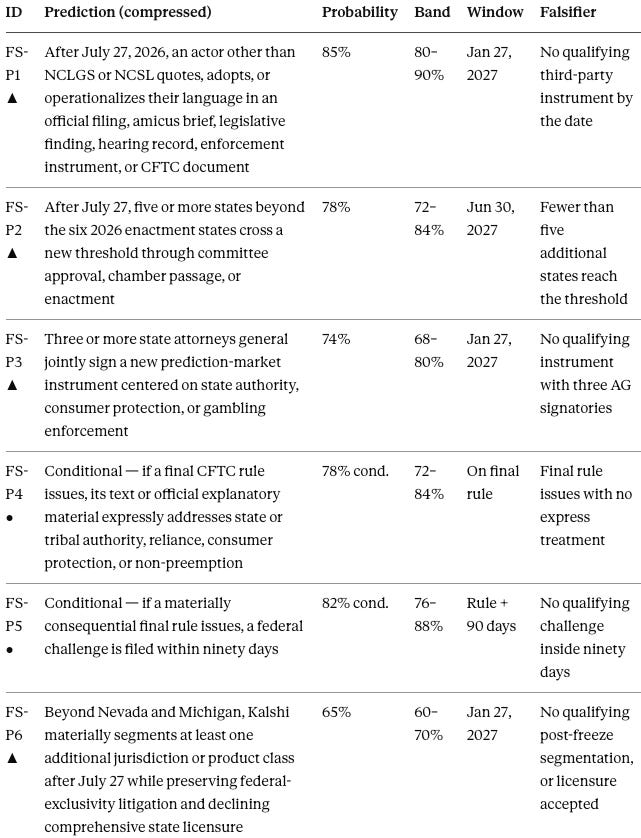
Secondary predictions:
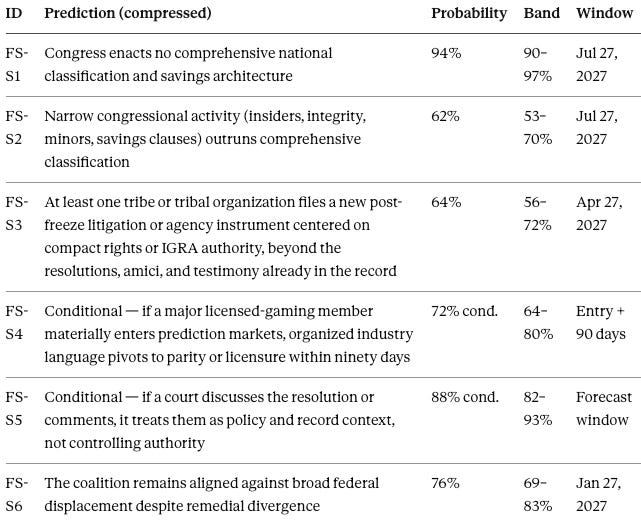
Analyst-layer registrations (calibrated judgment, not engine output): at least one introduced state bill adopts contest-versus-consequence, underlying-exposure, or functionally equivalent boundary language (55–70 percent, 2027 sessions); and any express state-authority treatment in a final rule lands in explanatory material rather than binding regulatory text (60–70 percent). The two registrations reconcile rather than conflict with FS-P4: the engine prices whether the Commission addresses state authority, the analyst layer prices where it lands.
Discussion. Five engine findings shape the publication’s argument.
First, the simulation assigns the consolidation its correct causal weight. Coalition architecture changed; governing law did not. The run’s integrity gate expressly rejects crediting the resolution with jurisdictional effect or with confirming predictions whose triggers remain unsatisfied — the same discipline the scoring audit applies.
Second, the modal twelve-month route is continued fragmented enforcement plus modular state legislation, at 44 percent. Final CFTC action is the dominant replacement event, and a final rule more likely reconstitutes the contest as an administrative-law and preemption fight than ends it, which is why FS-P5 runs at 82 percent.
Third, the engine settles the intra-bloc fork. Modular diffusion, not categorical uniformity, is both the observed and the forecast legislative pattern. NCSL’s state-choice position fits the system’s incentive structure more closely than NCLGS’s categorical demand, and the functional boundary is the administrable expression of that modularity.
Fourth, FS-P1’s 85 percent exceeds the pre-simulation analyst estimate of 65–75 percent for the same event, because the run prices the conversion network — attorneys general with a demonstrated multistate channel, regulators with enforcement instruments, fifteen legislatures with active dockets — rather than any single actor’s initiative. The median first conversion arrives in sixty days.
Fifth, FS-P6 creates a clean post-freeze test. Nevada and Michigan establish the selective-segmentation mechanism but form the excluded baseline. Settlement requires materially similar conduct in another jurisdiction or product class after July 27 — the mechanism is proven, so the prediction asks only whether it repeats.
Engine capsule. The engine executed on July 27 against the eleven-actor system at the frozen evidence cutoff. Three scenario passes — continued delay, an exclusivity-favoring final rule, and a sports-narrowing final rule — produced a stable actor sequence: state conversion first, platform and sovereign litigation next, congressional finality last. The run passed its integrity release gate at a composite of 0.8538 against a 0.75 threshold. Settlement runs only through named official sources, conditional predictions score only after registered triggers, and a later event cannot retroactively promote a claim that failed the integrity gate at freeze.
Appendix B — Index of MindCast Works
Prediction Markets Rule Architecture series (the series this paper joins):
MindCast: The Prediction Markets Rule Architecture — the system-level entry defining the three-component architecture: boundary, admissibility, and sovereign allocation under the Commodity Exchange Act. Establishes the framework this paper carries into the legislative-adoption layer.
MindCast: A Boundary Rule with a Functional Core — the doctrinal layer and the functional alternative in the three-design fork: the contest-versus-consequence sort, the five-factor override, and the per-se exclusions; source of the Boundary Rule predictions audited in the scoring note in Section VI.
MindCast: Competitive Federalism — A Field Guide for State and Tribal Regulators — the partner-facing distillation and Event Contract Decision Sheet built for the constituency the two organizations represent; the bill-drafting instrument against which Section VI’s predictions will score.
MindCast: Kalshi Loses Federal Forum — The Washington Remand Order and the Jurisdictional Layer of the Prediction Markets Boundary Rule — the jurisdictional layer of the boundary rule; establishes the state-forum posture the legislative track now runs beside.
Related works on the same contest:
MindCast: The CFTC NPRM Is a Litigation Brief — Reading RIN 3038-AF65 as the Federal Record for the Preemption War — the June proposal read by function; grounds the analyst-layer prediction that the Commission declines NCSL’s regulatory-text request, and establishes the federal record into which the NCSL comment now feeds, while the NCLGS resolution remains aligned external evidence.
MindCast: Prediction Markets and the Dual Nash-Stigler Trap — Kalshi, the CFTC, and the Prediction-Market Harm Clearinghouse — defines the Harm Clearinghouse whose externality categories the fiscal clauses independently restate; source of the P6 prediction and the $1–2 billion scenario band.
MindCast: How the CFTC’s Missing “Gaming” Definition Is Losing the Kalshi Prediction-Market Preemption War — the insufficiency thesis both documents’ ambiguity clauses converge on; documents the judicial record that made legislative consolidation rational.
MindCast: CFTC Takes On Nine States — Kalshi, Prediction Markets, and the Federal-Plaintiff Phase — the empirical record of the federal campaign both organizations answer; hosts the federal-plaintiff registry.
MindCast: Defining “Gaming” Under the Commodity Exchange Act — The Rule 40.11 Gap Driving the Nationwide Kalshi Litigation Web — the April 17 public comment on the docket both organizations now address; the definitional-gap thesis their clauses echo, filed three months earlier.
MindCast: Kalshi, the Ninth Circuit, and the Prediction Markets Forum Fight — Why the Stay Denials Reshape Nationwide Litigation Strategy — the forum architecture and preclusion race the legislative track now runs beside; source of the state-courts-first and sequencing predictions.
MindCast: The Rule 40.11 Paradox — Kalshi, the Third Circuit, and the Class Action the Ninth Circuit Cannot Ignore — the private-liability track that survives every prospective boundary choice; retrospective exposure accrues regardless of which design prevails.
Framework and methodology:
MindCast: The Dual Nash-Stigler Equilibrium Architecture — the two-gate engine explaining why no litigating actor can settle the system; legislative consolidation is a focal-point candidate the framework anticipated.
MindCast: The Stigler Equilibrium — Regulatory Capture and the Structure of Free Markets — enforcement as market infrastructure; grounds why a capacity-constrained federal enforcer produces the vacuum organized legislators now move to fill.
MindCast: Comparative Externality Costs in Antitrust Enforcement — Live Nation as Anchor, Compass–Anywhere as Validation — the externality-quantification methodology behind the scenario band the fiscal clauses assert.
MindCast: A Tirole Phase Analysis of Advocacy-Driven Antitrust Inaction — the coalition-density exit condition; a consolidated legislative bloc stacking atop the multistate attorney-general coalition extends enforcer density across branches.
MindCast: Live-Fire Game Theory Simulators, Runtime Predictive Infrastructure — how to operate MindCast publications as runtime modules against developments like the two scored here.
Appendix C — Legacy Validation Ledger and Outstanding Registry
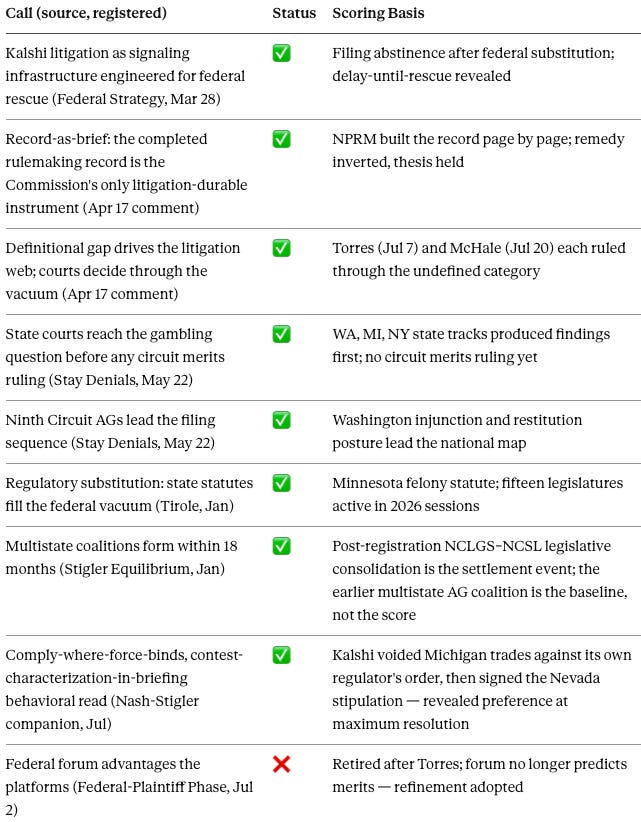
The cross-series ledger scores positions registered as far back as January against the July record. Every call dates to its public filing, not to hindsight, and the record carries one retired assumption at full prominence.
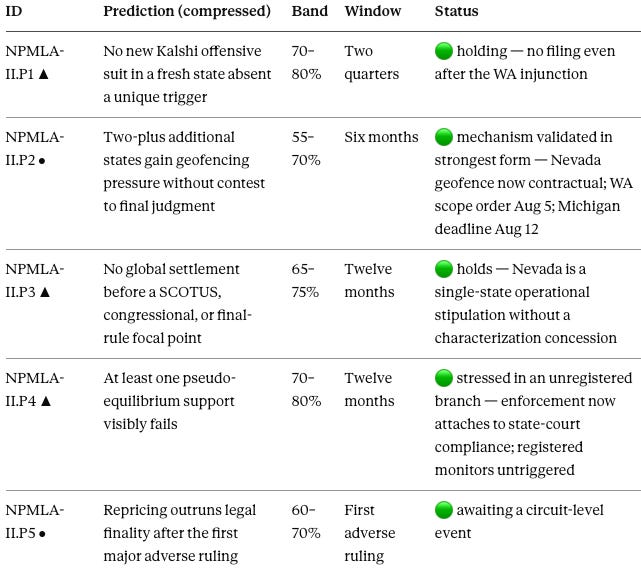
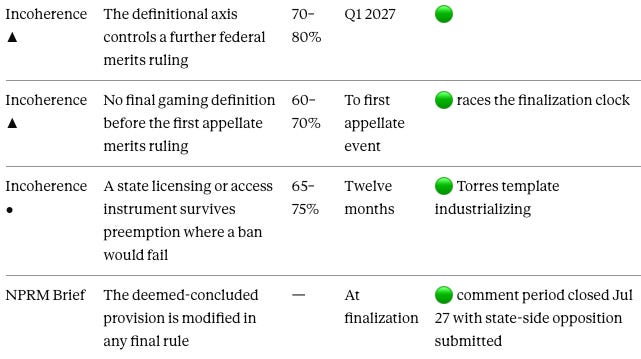
Legend: ✅ outcome consistent with the call · ◐ partial or mechanism-level corroboration · 🟢 live and developing · 🟡 trigger more probable, unscored · ❌ falsified and retired · ▲ primary · ● secondary
The Validation Record:
The Outstanding Registry (open positions the events above will score next):
Appendix D — Source Record
Primary and official sources:
NCSL comments to the CFTC, July 24, 2026 — the regulatory-absorption position, submitted on RIN 3038-AF65.
NCLGS resolution, approved at the July Executive Committee meeting and publicly announced July 27, 2026 — the categorical position.
NCSL legislative tracker — fifteen states active, six enactments in 2026.
Fourth Circuit amicus supporting Maryland, No. 25-1892 — the demonstrated multistate conversion channel.
CFTC order staying the Kalshi emergency rule and directing fulfillment of Michigan trades, July 14, 2026 — the operative federal command in the Michigan sequence.
Nessel v. KalshiEX LLC, No. 26-1087-CZ (Ingham County Circuit Court) — the Michigan temporary restraining order the CFTC order answered.
Signed Nevada joint stipulation and order, Carson City First Judicial District Court, July 24, 2026 — the operative Nevada geofence settlement.
Explanatory reporting:
Legal Sports Report on the Nevada stipulation — secondary account of the geofence deadline and penalty mechanism.
Bloomberg Law on the emergency-authority exercise — secondary account of the Michigan order.