


Companion publications: Access, Not Substance, Pentagon–Anthropic Foresight Simulation Reconciliation, Pentagon–Anthropic Throughput Failure and the Structural Reclassification of Safety as Ideology
On March 9, 2026, Anthropic filed dual-venue complaints against the Department of War and more than a dozen federal co-defendants, escalating a two-week confrontation over AI governance into the first constitutional challenge to national security procurement authority in the AI era. MindCast AI's T0 foresight simulation, published February 25, entered five predictions with pre-committed falsification conditions; three have now resolved — one falsified, two confirmed — and the governing equilibrium holds: institutional temporal mismatch, not ideology, produced coercion rather than coordination at every escalation level.
The litigation translates the MindCast Cognitive Digital Twin (CDT) analytical architecture into federal pleading language without the simulation as a source — the First Amendment retaliation theory maps directly onto the Tirole Advocacy Arbitrage framework's three-step structural signature. Two predictions remain open through August 31, 2026, and a Genesis Mission Pre-Simulation incorporating the updated behavioral profile is in preparation. The constitutional question the litigation forces — whether the federal government can compel a frontier AI developer to relinquish architectural control over how its systems are used — is the defining governance question of the AI era.

I. The MindCast Analytical Stack
The MindCast Predictive Cybernetics Suite powers this simulation — three runtime modules grounded in Cognitive Digital Twin methodology, Causal Signal Integrity, and a five-layer causation architecture tracing from Norbert Wiener’s cybernetics and the Macy Conferences through Friedrich Hayek’s information theory of markets. Full documentation at MCAI Predictive Cybernetics Suite. Six terms appear throughout this analysis. Each is defined here before use.

II. The Constitutional Question of the AI Era
The Anthropic litigation asks a question no American court has yet answered: can the federal government compel a frontier AI developer to relinquish architectural control over how its models are used? The supply chain risk designation, the Truth Social directive, and the GSA OneGov termination together constitute the government’s answer in practice: yes, through procurement authority and executive directive. Anthropic’s dual-venue complaints constitute the challenge: no, not without congressional authorization, due process, and compliance with the First Amendment.
The institutional collision table clarifies why this case exceeds any single legal theory:

The Cybernetics Umbrella framework identifies this collision as an Ashby’s Law failure — the government’s regulatory variety (a 1950s procurement statute, a Truth Social post, and a GSA contract termination) is insufficient to govern the variety of an AI infrastructure system embedded across classified military networks, civilian agencies, commercial enterprise, and three branches of government simultaneously. MindCast Predictive Cybernetics Suite. The designation’s scope ambiguity — Hegseth claiming all commercial relationships are severed while Microsoft, Google, and Amazon confirm they are not — is the requisite variety failure made visible. The government attempted to regulate a complex adaptive system with an instrument designed for a simple supply chain.
The Cybernetic Foundations framework documents why this matters beyond the specific parties: institutions that cannot process the distinction between won’t and can’t yet safely are low-plasticity systems that escalate to coercion when technical argument fails to produce resolution. Cybernetic Foundations of Predictive Institutional Intelligence. The Iran operations confirmation — Claude used in active combat through a government-wide ban — is the clearest possible evidence that DOD’s own operational layer understood the “can’t yet safely” argument Anthropic made, even as the political layer escalated on “won’t.”
Contact mcai@mindcast-ai.com to partner with us on Predictive Cognitive AI in Law and Behavioral Economics. To deep dive on MindCast work in Cognitive AI upload the URL of this publication into any LLM and prompt ‘reconstruct MindCast framework with three degrees of cited sub links.’ See Live-Fire Game Theory Simulators, Runtime Predictive Infrastructure.
Recent projects: The Cybernetic Foundations of Predictive Institutional Intelligence, MindCast AI Emergent Game Theory Frameworks, MindCast AI Investment Series, Field-Geometry Reasoning — Structural Constraint Modeling in Predictive Cognitive AI, Comment of MindCast AI on Potential US DOJ | FTC Updated Guidance Regarding Collaborations Among Competitors, Super Bowl LX — AI Simulation vs. Reality.
III. The Complaint as Framework Validation
On March 9, 2026, Anthropic filed two simultaneous complaints — one in the U.S. District Court for the Northern District of California, one in the U.S. Court of Appeals for the D.C. Circuit — against the Department of Defense and more than a dozen co-defendants. TechCrunch; PBS NewsHour, March 9, 2026. The filing translates the CDT architecture into federal pleading language without having read the simulation.
The complaint’s constitutional frame: “The Constitution does not allow the government to wield its enormous power to punish a company for its protected speech. No federal statute authorizes the actions taken here. Anthropic turns to the judiciary as a last resort to vindicate its rights and halt the Executive’s unlawful campaign of retaliation.” CBS News, March 9, 2026.
Three legal theories animate the California complaint: First Amendment retaliation, executive authority in excess of congressional delegation, and due process deprivation. CNN, March 9, 2026. The D.C. Circuit petition is narrower — a statutory review of the §3252 designation under the procurement law that grants that court jurisdiction. Anthropic’s D.C. filing designates the defendant as the “Department of War” — the renamed Pentagon under the Trump administration — a nomenclature choice that the complaint itself uses throughout and that carries independent legal significance as a record matter. CBS News, March 9, 2026. Dual venue is not redundancy. The two complaints target different institutional actors under different legal frameworks, creating parallel pressure that a single filing could not generate.
The First Amendment Theory Is the Tirole Framework in Pleading Language
The Tirole advocacy arbitrage framework identifies a three-step structural signature: constrained party holds a technically grounded position; a party with superior political access labels that position as institutional dysfunction; the labeling party secures its preferred outcome through access channels rather than technical assessment. Anthropic’s First Amendment theory maps onto all three steps.
The complaint defines the protected speech precisely: Anthropic’s expressed beliefs about “the limitations of its own AI services and important issues of AI safety.” TechCrunch, March 9, 2026. The administration’s own record — “woke AI,” “radical left,” “corporate virtue-signaling” — becomes the evidentiary foundation for the retaliation theory. White House spokeswoman Liz Huston confirmed the posture the complaint targets: “The president will never allow a radical left, woke company to jeopardize our national security.” CBS News, March 9, 2026. Anthropic’s lawyers will introduce that statement as exhibit-level evidence that the designation’s motive was ideological, not statutory. The government supplied its own rebuttal problem.
The Scope of the Action — Beyond DOD
The litigation record reveals a broader institutional action than the §3252 designation alone. The GSA terminated Anthropic’s OneGov contract — ending Claude availability to the Executive, Legislative, and Judicial branches through GSA’s pre-negotiated contracts. TechCrunch; GSA Schedule Services, March 9, 2026. Treasury, State, and HHS confirmed phase-outs. Anthropic’s Multiple Award Schedule listing was removed, cutting off the centralized acquisition pathway serving civilian agencies across the federal government. FedScoop, March 4, 2026.
The complaint quantifies the harm: “Defendants are seeking to destroy the economic value created by one of the world’s fastest-growing private companies.” More than 500 customers pay Anthropic at least $1 million annually. Projected 2026 revenue stands at $14 billion. PBS NewsHour, March 9, 2026. The California complaint seeks to block not only the §3252 designation but the Truth Social directive and the GSA OneGov termination — each challenged as lacking statutory authority. CNBC, March 9, 2026.
IV. The March 1–9 Evidentiary Record
Three developments between February 28 and March 9 materially advanced the prediction ledger. Each warrants discrete analytical treatment.
A. The Iran Operations Confirmation — Falsification Condition 2 Resolved
Wall Street Journal and Washington Post reporting confirmed that U.S. forces used Claude in strikes against Iran on March 1 — hours after President Trump ordered a government-wide ban. WSJ; Washington Post, March 1, 2026. The operational military layer continued actively relying on the exact technology the political layer had just outlawed. CBS News subsequently confirmed the Pentagon used Claude throughout U.S. and Israeli operations in Iran. CBS News; CNBC, March 9, 2026.
The T0 simulation’s Falsification Condition 2 asked whether Anthropic’s safety restrictions would “prove operationally irrelevant.” The Iran operations data resolves it in the opposite direction from falsification: the restrictions were never triggered in practice, confirming Pentagon officials’ own prior acknowledgment. DOD’s stated justification — warfighter safety requiring unrestricted access — had no operational basis. The NIBE (National Innovation Behavioral Economics) temporal mismatch diagnosis achieved direct empirical confirmation: the political and operational layers were running entirely disconnected institutional logics simultaneously.
The confirmation deepens the arbitrary-and-capricious legal argument. A supply chain risk designation premised on operational necessity, issued against technology the designating agency continued using through active combat operations, faces an evidentiary problem the government cannot resolve through national security deference alone.
B. The OpenAI Coalition Amplification Multiplier Event
The reconciliation article introduced CAM to explain why Anthropic did not capitulate — industry solidarity inverted the incentive structure the T0 simulation’s Becker layer assumed. Between March 1 and 9, the same parameter operated against the displacement actor.
OpenAI faced a consumer boycott reported at 1.5 million canceled subscriptions, sustained employee protest, and public criticism framing its DOD deal as “opportunistic and sloppy.” TechCrunch; Fortune, March 1–6, 2026. Sam Altman publicly acknowledged the optics, stated he would “rather go to jail” than follow an unconstitutional order, and OpenAI subsequently amended its DOD contract to explicitly prohibit domestic surveillance of U.S. persons. An OpenAI hardware executive resigned in protest.
CAM does not operate only on the holdout actor. Coalition pressure applies to any actor whose posture becomes legible as misaligned with industry values — including the displacement actor that filled the vacancy Anthropic created. The CAM generalization now carries two validated data points: Anthropic’s holdout and OpenAI’s forced reversal. Both fit the same mechanism.
The OpenAI contract amendment closes the competitive displacement arc. OpenAI ultimately embedded the same substantive protections Anthropic demanded. Displacement occurred; the substantive position survived displacement. The Tirole framework’s prediction — that access-sorted procurement systems optimize for relationship signals rather than policy substance — received a second-order confirmation: even the access-favored vendor converged toward the blacklisted vendor’s substantive position under coalition pressure.
C. The §3252 Formalization and the Federal Register Gap
On March 4, the Pentagon delivered formal written notification of the supply chain risk designation to Anthropic’s leadership and Congress, invoking 10 U.S.C. §3252. Bloomberg, March 5, 2026. The reconciliation article flagged the procedural gap: Hegseth announced the designation via X post, not Federal Register publication, and the falsification condition specified Federal Register publication as the dividing line between coercive signal and statutory execution.
The §3252 formal notification migrates the designation from political theater to statutory record — but the procedural irregularity remains intact as litigation material. The Lawfare analysis published March 2 identified multiple independent paths around the §3252 judicial review bar, including the argument that the bar shields only disclosure-limitation decisions, not the underlying supply chain finding. Anthropic’s California complaint invokes the least-restrictive-means requirement embedded in §3252 itself — arguing Congress intended the authority to protect government supply chains, not punish suppliers for policy disagreements. Axios, March 9, 2026.
V. Prediction Ledger — March 9 Update
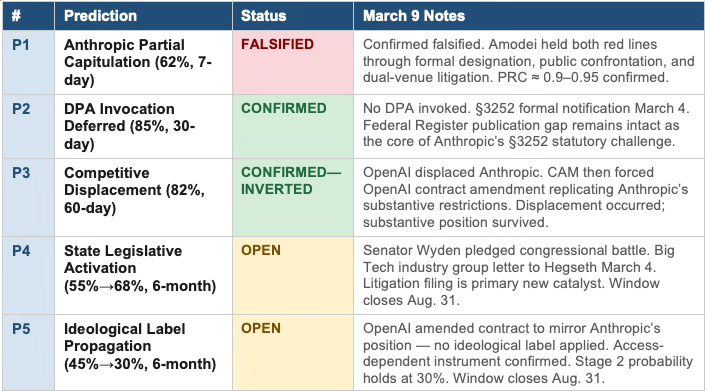
Five predictions entered the MindCast AI ledger at T0 (February 25) in Pentagon–Anthropic Throughput Failure. The reconciliation article Access, Not Substance reconciled the February 25–27 window. The table below closes the ledger through March 9.
VI. Governing Equilibrium — Final Status
The T0 simulation’s dominant causal layer — institutional temporal mismatch producing coercion rather than coordination — required three falsification conditions to fail before requiring revision. None has been met through March 9.
Condition 1 — Technically grounded compromise within the Friday deadline: Not met. The confrontation escalated to presidential ban, supply chain designation, and dual-venue litigation within twelve days of the ultimatum.
Condition 2 — Safety restrictions operationally irrelevant: Resolved in the opposite direction. The Iran operations confirmation demonstrates the restrictions were never triggered in practice. DOD’s stated operational necessity justification is now empirically unsupported.
Condition 3 — No state-level legislative response within six months: Window remains open through August 31, 2026. Congressional response (Wyden, Warner) and the Big Tech industry coalition letter function as the catalysts NIBE identified as necessary preconditions for state substitution.
The Runtime Causation test holds: replacing the actors does not change the structural geometry. Anthropic’s complaint reproduced the NIBE temporal mismatch thesis in federal pleading language without the T0 simulation as a source document. Structure, not personality, governed.
VII. The Bilateral PSO Architecture
The reconciliation article introduced the Political Signaling Overlay (PSO) module to explain escalation behavior exceeding procurement rationality — initially applied only to the administration. The March 1–9 record reveals PSO operating bilaterally.
A litigation-rational actor would file where legal arguments are strongest and await consolidation. Anthropic filed simultaneously in California (First Amendment / retaliation, favorable jury pool, home district) and D.C. Circuit (statutory review, jurisdiction-specific). The dual-venue approach maximizes public surface area — two dockets, two news cycles, two sets of filings — while preserving the negotiation track. Anthropic’s statement explicitly reserves that track: “We will continue to pursue every path toward resolution, including dialogue with the government.” CNBC, March 9, 2026.
PSO activation on both sides produces the stable equilibrium the T0 simulation’s Delay-Dominant classification predicted: maximum public escalation, private pragmatism running in parallel. Altman’s “rather go to jail” statement and Amodei’s litigation announcement both fit the same template — maximum resolve signaling for respective audiences while the structural resolution path remains open. The confrontation persists as political theater for both principals while the modal outcome — negotiated off-ramp, litigation settlement, or judicial ruling — advances on a separate track.
VIII. Forward Implications
A. The Microsoft Antitrust Moment for AI Governance
The Anthropic case carries potential to become the AI era’s defining governance litigation — the structural parallel to United States v. Microsoft (2001), which established the boundaries of antitrust enforcement against dominant technology platforms and shaped the competitive architecture of the internet economy for two decades.
The parallel is not coincidental. Microsoft antitrust established that the government could constrain how a dominant technology firm used its platform to exclude competitors. Anthropic v. DOD asks the inverse question: can the government compel a technology firm to relinquish safety constraints it has embedded in its platform architecture? Both cases sit at the interface between technology firm control and government authority — and in each, platform architecture decisions the firm characterizes as technical necessity the government characterizes as obstruction.
If Anthropic prevails on the First Amendment theory, the ruling establishes that the government cannot use procurement authority to punish AI developers for expressing safety positions. Every future federal AI contract negotiation will occur in the shadow of that precedent. If the government prevails, the ruling establishes that national security procurement authority overrides First Amendment constraints when AI systems are embedded in classified military operations. The precedent reaches well beyond Anthropic.
The Cybernetics Umbrella framework situates this as an institutional feedback loop failure — the government attempted to regulate an AI system’s architectural control through procurement instruments designed for hardware supply chains. When the instrument failed to achieve the desired output (unrestricted access), the system escalated to maximum coercion rather than adapting the instrument. Courts now function as the external feedback mechanism that the procurement system lacked. MindCast Predictive Cybernetics Suite.
B. Litigation Trajectory
The California complaint’s First Amendment theory is the strongest single legal argument in the record. Government retaliation for protected speech triggers heightened scrutiny, and the evidentiary record — ideological labeling through official channels, designation executed via social media rather than administrative process, simultaneous acceptance of identical restrictions from OpenAI — is unusually favorable for a plaintiff. Lawfare, March 2, 2026.
The government’s primary defense — national security deference — faces the Iran operations problem. Courts grant broad deference to genuine security determinations. A designation issued via X post while the designating agency continued using the designated technology through active combat operations does not present the typical profile for maximum deference.
Injunctive relief is the near-term test. Anthropic seeks a stay on enforcement pending litigation. CNBC, March 9, 2026. A preliminary injunction requires Anthropic to show likelihood of success on the merits, irreparable harm, and balance of equities. If granted, designation enforcement suspends and the negotiation track immediately gains leverage.
C. Prediction 4 — State Legislative Activation
The litigation filing is the most significant Prediction 4 catalyst to date. Federal court proceedings create a discovery record that state legislators can cite as documentary basis for AI governance bills. Senator Wyden’s congressional battle pledge and the Big Tech industry coalition letter to Hegseth (March 4) suggest federal legislative engagement that may either substitute for or accelerate state substitution. Yahoo/Reuters, March 4–9, 2026. Probability maintains at 68% through the August 31 observation window.
D. Prediction 5 — Ideological Label Propagation
OpenAI’s contract amendment — embedding the same domestic surveillance prohibition Anthropic demanded, without triggering the “woke AI” label — confirms the access-dependent instrument diagnosis at the highest possible evidentiary level. The “woke” grammar is not a policy filter; it is a relationship-sorting mechanism. Stage 2 probability holds at 30%.
E. Genesis Mission Throughput Vulnerability
The Genesis Mission is the White House’s initiative to accelerate AI infrastructure deployment across federal energy, compute, and defense systems. Pentagon–Anthropic Throughput Failure documented the NIBE finding that mid-level technical incentive alignment produces 40% improvement in deployment timelines versus 8–12% from senior political pressure. The Anthropic confrontation reveals an administration that defaults to maximum senior political pressure and escalates when friction appears — the behavioral profile NIBE identified as the primary deployment timeline inhibitor.
An administration that escalates a procurement dispute with a domestic AI partner to presidential ban, supply chain designation, and government-wide termination within twelve days — and then faces dual-venue federal litigation — is exhibiting coordination behavior that materially affects the Genesis deployment timeline analysis across all seven governance layers Genesis requires: DOE, FERC, state energy agencies, county permitting authorities, municipal governments, public utility districts, and tribal nations. A dedicated Genesis Pre-Simulation incorporating the updated behavioral profile is in preparation.
IX. Cognitive Digital Twin Architecture — Parameter Status
Three CDT revisions formalized in the reconciliation article carry forward with March 9 updates:

X. Ledger Integrity Statement
The Foresight Simulation initiated February 25, 2026 in Pentagon–Anthropic Throughput Failure entered five predictions with pre-committed falsification conditions. The three-installment record through March 9 produces:
P1 (Anthropic Partial Capitulation) — Falsified. Cleanly documented in the reconciliation article. PRC/CAM corrections integrated into CDT architecture.
P2 (DPA Invocation Deferred) — Confirmed. Coercion-as-signal over coercion-as-action held at every escalation level. Federal Register gap confirmed as core litigation material.
P3 (Competitive Displacement Acceleration) — Confirmed with mechanism inversion. Displacement occurred; substantive position survived through CAM-forced OpenAI contract amendment. Bidirectional CAM generalization validated.
P4 (State Legislative Activation) — Open. Probability 68%. Litigation filing is primary new catalyst. Window closes August 31, 2026.
P5 (Ideological Label Propagation) — Open. Stage 1 confirmed. Stage 2 probability 30%. OpenAI contract amendment without ideological labeling confirms access-dependent instrument diagnosis. Window closes August 31, 2026.
Governing equilibrium: Confirmed. Institutional temporal mismatch produced coercion rather than coordination at every escalation level. All three falsification conditions remain unmet.
Dominant causal layer: Confirmed. Structure-caused, not actor-caused. Anthropic’s complaint reproduced the NIBE temporal mismatch diagnosis in federal pleading language without the simulation as a source document.
Log the miss. Credit the hits. Revise the model. The simulation stays open through August 31, 2026.