


How to Read This Brief — and How to Activate the Full Stack Sections I–III establish the enforcement crisis, equilibrium analysis, and jurisdictional warrant. Section IV provides the harm theory and four-part diagnostic. Section V maps dated action items to the March–April 2026 window. Section VI contains falsification contracts. To go deeper on any framework invoked here: load the corresponding MindCast URL into any LLM and prompt “Develop framework with three degrees of cited MindCast works.” The three-degree prompt activates the full analytical stack — definitions, theoretical architecture, causal scaffolding — as a live simulator you can run against your own docket facts. New information you upload is training data for your MindCast runtime game theory simulation. See Live-Fire Game Theory Simulators, Runtime Predictive Infrastructure for more info.
EXECUTIVE SUMMARY
Federal antitrust enforcement has produced a documented pattern across four concurrent matters. Across Compass–Anywhere, Live Nation–Ticketmaster, HPE–Juniper, and Netflix–WBD, the public record shows a consistent divergence between career staff enforcement positions and final enforcement posture, coinciding with documented access-channel engagement above the Antitrust Division. The pattern includes personnel departures at the Division level, behavioral settlements substituted for structural remedies, and accelerated clearance timelines. Whether that divergence reflects institutional capture, policy disagreement, or structural equilibrium dynamics is a question this brief addresses analytically — not politically. What is not in dispute is the observable output: structural harm externalized to state jurisdictions that federal enforcement has not addressed.
MindCast has published extensively on each of these matters individually. This publication does something different: it maps the documented divergence and delay convergence across four dockets into a unified jurisdictional warrant for independent state enforcement, and translates that warrant into dated action items keyed to the March–April 2026 enforcement window — converting case-by-case analysis into a coordinated enforcement instrument.
Three deadlines in the next 30 days create a forcing event that requires AG enforcement posture decisions before outcomes are determined by events outside AG control. The Live Nation trial opens March 2. Congressional deadline for DOJ answers on Compass–Anywhere is March 5–6. HPE–Juniper depositions of the named off-docket intermediaries are scheduled for March 23–27. The Netflix–WBD shareholder vote precedes the expected June DOJ decision by three months. Each deadline is a point at which AG enforcement posture shapes outcomes — or cedes them.
Professor Daniel Francis’s harm-centric framework — [Antitrust Without Competition, 134 Duke L.J. 353] and [Post-Profit Antitrust (forthcoming, Yale L.J.)] — establishes that undefined “competition” produces systematic pro-defendant outcomes under Amex, Qualcomm, and Rambus. The doctrinal remedy is specifying the harm object and suppression mechanism rather than invoking undefined competitive harm. MindCast AI’s coordination infrastructure capture theory supplies that specification: welfare harm flowing from degradation of the shared routing architecture markets depend on, detectable before price effects manifest through the Behavioral Drift Factor (BDF), Incentive Alignment Index (IAI), and Grammar Persistence Index (GPI). [MindCast AI: Chicago School Accelerated] Metric definitions and the full theoretical framework are in Part IV.
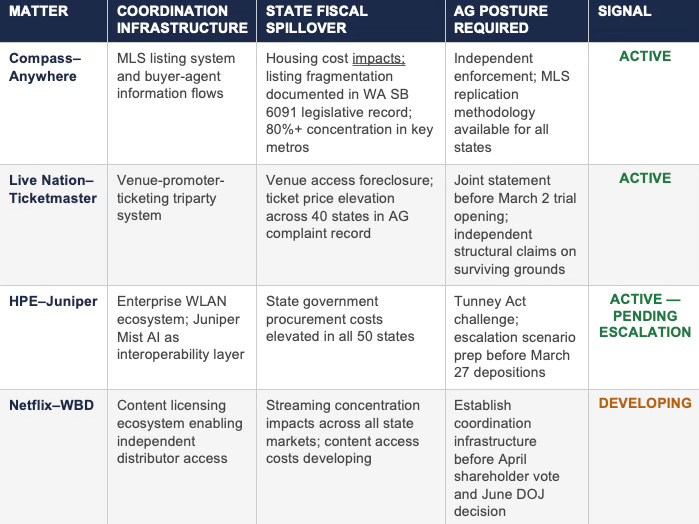
The Substitution Signal is active across all four cases: federal routing has produced measurable fiscal spillover in state jurisdictions, and the correction velocity of the capture equilibrium is misaligned with the consolidation velocity of the underlying markets. [MindCast AI: Harm Clearinghouse] Housing cost impacts in real estate markets, ticket price and venue foreclosure across 40 states, enterprise WLAN procurement costs in state government contracts, streaming concentration across all state markets — each constitutes documented externality warranting state enforcement as market-clearing response, not political duplication. [MindCast AI: Shadow DOJ / Credibility Threshold] Section III maps the jurisdictional warrant case by case and specifies what AG offices should do within the March 2026 window.
HOW THIS BRIEF EXTENDS PRIOR MINDCAST WORK
MindCast’s prior publications built the analytical system this brief operationalizes as an enforcement instrument. [MindCast AI: Chicago School Accelerated] established coordination capacity degradation as a welfare harm detectable before price effects manifest — the theoretical foundation on which the four-part diagnostic in Section IV rests. [MindCast AI: Tirole Advocacy Arbitrage] modeled how indeterminate enforcement standards incentivize access-channel substitution for market competition, explaining why the divergence pattern documented in Section I is stable rather than episodic. [MindCast AI: Harm Clearinghouse] identified how enforcement intake distortion converts structural harm into diffuse fiscal externalities across state jurisdictions — the mechanism activating the Substitution Signal in Section III. [MindCast AI: Shadow DOJ / Credibility Threshold] documented convergence across all four active federal dockets, supplying the evidentiary scaffolding on which Section I’s routing architecture claim rests. None of those publications synthesized the four matters into a unified jurisdictional warrant, activated the Substitution Signal simultaneously across all four cases, or converted the analytical findings into coalition-level action items keyed to specific March–April 2026 deadlines. That is what this brief does.
Contact mcai@mindcast-ai.com to partner with us on Law and Behavioral Economics foresight simulations. Recent projects: Competitive Federalism as Market Infrastructure , Comparative Externality Costs in Antitrust Enforcement , The Federal-State AI Infrastructure Collision , Washington State as Competitive Federalism in Operation , Chicago School Accelerated, Nineteen Senators, Seventeen Questions, How Compass Bought Its Antitrust Clearance and The Compass Commission Consolidation Strategy and Real Estate Marketing Transparency.
I: THE SINGLE ROUTING ARCHITECTURE
Four concurrent antitrust matters — spanning residential real estate, live entertainment, enterprise networking, and streaming media — exhibit documented divergence and delay convergence across their enforcement dockets. Identifying this pattern as structurally consistent, rather than four unrelated enforcement decisions, is the foundational move that makes independent state enforcement analytically required rather than merely permissible. The inference is pattern-based, not motive-based: what the record shows is convergent divergence between career staff positions and final enforcement posture, not a finding of unified intent.
The documented pattern across cases follows a convergent sequence: career staff recommends deeper review or opposing enforcement position → access-channel engagement occurs above the Division → final posture diverges from career staff position → Division leadership changes → behavioral remedy or accelerated clearance substitutes for structural enforcement. The intermediaries appear across multiple dockets — documented in the congressional record, DOJ filings, and sworn testimony. The downstream harm is bipartisan: consumers in every state pay elevated ticket prices, homebuyers face coordination-captured listing systems, and state governments bear elevated enterprise procurement costs. [MindCast AI: $22B Externality Baseline]
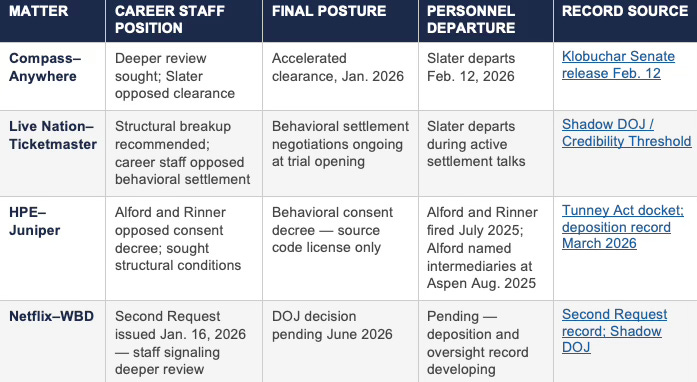
The trajectory of Antitrust Division leadership across the four cases is itself part of the documented record. Gail Slater held positions opposing or seeking deeper review in at least three of the four matters; her departure from the Division occurred February 12, 2026 — after Compass–Anywhere closed, during Live Nation settlement negotiations, and before the HPE–Juniper depositions. Sen. Klobuchar stated that Slater was “pushed out of the Justice Department just weeks prior to the Live Nation-Ticketmaster trial” and that it “raises serious questions about the DOJ’s commitment to protecting consumers and small businesses.” [Klobuchar Statement, Feb. 12, 2026] [Klobuchar Follow-Up Letter, Feb. 15, 2026]Roger Alford and Bill Rinner, senior Division officials, departed in July 2025 in connection with HPE–Juniper. Alford subsequently named specific access intermediaries in a public address at Aspen in August 2025, creating the first on-record account of the divergence mechanism from a former Division official. [MindCast AI: Shadow DOJ / Credibility Threshold] Alford’s account entered the congressional oversight file, the Tunney Act docket, and the deposition record pending March 2026 — making it simultaneously available to three independent enforcement audiences.
For AG offices, the significance of the divergence record is evidentiary, not political. Federal cases processed through the routing sequence produce an enforcement record already shaped by access-controlled narrative rather than adversarial discovery: structural evidence diverted into consumer protection silos, behavioral settlements substituted for structural unwind, courts receiving a record that omits what career staff found. [MindCast AI: Harm Clearinghouse] State AGs operating independently — not dependent on the federal enforcement record — can build from unprocessed evidence: their own state market data, direct consumer harm documentation, and independent structural analysis. The routing architecture is the reason why that independent evidentiary record matters, not just why independent authority exists.
II: EQUILIBRIUM, NOT CORRUPTION — WHY AG STRATEGY MUST ACCOUNT FOR PERSISTENCE
Congressional letters characterize the four-case pattern as corruption or improper interference. Those characterizations may be legally accurate. But they are strategically incomplete in a way that matters for AG enforcement planning. Corruption is corrected by replacing actors. Equilibria persist through actor replacement because the incentive structure rewards the same behavior regardless of who occupies enforcement positions. AG offices that plan around federal recovery — new leadership, restored Division independence, revived cooperative enforcement — are planning around an assumption that the equilibrium framework directly refutes. The harm flows to consumers, workers, and state fiscal positions regardless of the political composition of the enforcement institution.
George Stigler’s theory of economic regulation establishes why the capture equilibrium forms: concentrated firms with high-value enforcement exposure invest in access channels because the return on that investment exceeds the return on market competition when the enforcement standard is undefined. [MindCast AI: Stigler Equilibrium] John Nash’s equilibrium logic explains why it stabilizes: once behavioral settlements become the dominant enforcement output, neither enforcers nor firms can improve their outcome by deviating toward structural litigation. [MindCast AI: Nash-Stigler Equilibria] Jean Tirole’s analysis adds the informational mechanism: when off-docket access displaces adversarial advocacy, the truth-discovery function of law collapses and regulatory outcomes are shaped by access-controlled narrative. [MindCast AI: Tirole Advocacy Arbitrage] These three mechanisms — capture formation, equilibrium stability, and informational collapse — operate simultaneously and reinforce each other.
For AG strategy, the equilibrium framing produces a specific and actionable conclusion: the Substitution Signal fires not because state AGs disagree with federal enforcement policy but because the federal Harm Clearinghouse’s correction velocity is misaligned with market consolidation velocity — and the March 2026 deadlines will not wait for federal institutional lag to resolve. [MindCast AI: Harm Clearinghouse] State enforcement is the market-clearing mechanism the equilibrium structurally lacks — and it is required by the documented externality, not merely available as a political option. Professor Francis’s harm-centric standard provides the legal test for when fiscal spillover rises to cognizable welfare harm warranting enforcement. [Antitrust Without Competition] MindCast’s coordination capture theory specifies the harm object and mechanism — and combined with Francis’s legal threshold, supplies the AG with everything needed to file independently, without waiting for federal recovery that the equilibrium analysis places outside the relevant enforcement timeline.
III: JURISDICTIONAL WARRANT AND THE SUBSTITUTION SIGNAL
State attorneys general have independent enforcement authority under state antitrust statutes and as co-plaintiffs under federal antitrust law. The legal authority is not in question. What AG offices need is the analytical warrant — the specific basis on which independent enforcement is required, not merely permissible, in each of the four active matters. The Substitution Signal provides that warrant: when federal correction velocity is misaligned with market consolidation velocity, state enforcement is a payoff-matrix shift that changes incentives for firms and courts in ways that institutional lag cannot replicate from within.
Professor Francis’s harm-centric standard provides the threshold test for when fiscal spillover rises to legally cognizable welfare harm warranting enforcement action. His two-part test — welfare harm flowing from suppression of rival ability or incentive to meet demand — maps directly onto state market impacts when coordination infrastructure capture is the harm mechanism. Crucially, the harm is pleadable before downstream price effects have manifested because coordination capacity degradation is the causally prior state variable. AGs do not need to wait for prices to rise; they need to establish that the coordination infrastructure has been captured, suppressing rival ability to compete. The Behavioral Drift Factor and Incentive Alignment Index provide the quantified evidentiary proxies for the threshold determination. [MindCast AI: Chicago School Accelerated] The $22B deadweight-loss baseline across the four active matters quantifies the externality state enforcement is required to correct. [MindCast AI: $22B Externality Baseline]
The Substitution Signal status across the four active matters is summarized below. Signal active means the fiscal spillover is documented and enforcement authority is established. Signal developing means the harm trajectory is confirmed but the evidentiary record for independent enforcement requires pre-positioning before the June DOJ decision. [MindCast AI: Harm Clearinghouse]
The Tunney Act proceeding in HPE–Juniper provides a currently active additional warrant beyond the Substitution Signal. State AGs who filed Tunney Act objections have standing to challenge the consent decree as not in the public interest. If the March 23–27 depositions produce sworn testimony establishing documented divergence between Division recommendations and final posture coinciding with access-channel engagement, [MindCast AI: Shadow DOJ / Credibility Threshold] the consent decree challenge becomes viable on grounds that the decree does not reflect the considered judgment of the enforcement agency’s career staff — the Tunney Act standard the objecting AGs have already placed before the court.
IV: THE HARM THEORY — COORDINATION INFRASTRUCTURE CAPTURE
The coordination infrastructure capture theory gives AG antitrust staff a harm object, a causal mechanism, and a four-part investigation protocol that apply across all four active matters — and to any future matter involving coordination-dependent market architecture. The theory is built to survive a motion to dismiss. Defense counsel in each of these cases will deploy the same primary argument: plaintiff has not identified cognizable harm to competition. Professor Francis documents in [Antitrust Without Competition] that this argument succeeds not because it is analytically correct but because “competition” is undefined — courts apply implicit lenity when the harm object is vague, producing pro-defendant bluntness under Amex, Qualcomm, and Rambus. Coordination infrastructure capture directly defeats that defense by specifying the harm object and causal mechanism with a precision that defendants cannot rebut with the same bluntness strategy.
The harm object is coordination infrastructure capture: degradation of the shared focal points, routing architecture, and information flows that enable markets to function — suppressing rival ability and incentive to meet demand through documented mechanism rather than price-effect inference. Coordination infrastructure capture satisfies Francis’s harm-centric test and supplies the detection mechanism his framework requires but does not provide. Apply the four-part intake diagnostic below at investigation stage, before pleading decisions, in any matter involving coordination-dependent market architecture:
1. Identify the coordination infrastructure layer.
What shared architecture — routing system, information exchange, platform mechanism, interoperability standard — enables participants to discover, price, and execute transactions? Define by function (what does it coordinate?), not product substitution.
2. Determine whether conduct alters open routing into privileged routing.
Does challenged conduct shift the coordination infrastructure from open access — all participants route on equal terms — to privileged routing controlled by the dominant firm? Conduct that alters routing architecture from open to privileged is coordination capture regardless of whether prices have changed.
3. Evaluate rival incentive or ability suppression through that coordination layer.
Does privileged routing suppress rival ability or incentive to meet demand? Suppression need not produce price effects to be cognizable under Francis’s standard. Behavioral Drift Factor (BDF) above 0.70 establishes the dominant firm has crossed from efficiency competition to incentive exploitation. Incentive Alignment Index (IAI) below 0.50 establishes material misalignment sufficient to rebut a procompetitive justification. [MindCast AI: Chicago School Accelerated]
4. Assess measurable fiscal spillover in state jurisdictions.
Has coordination capture produced measurable fiscal spillover — housing costs, venue foreclosure, procurement elevation, streaming concentration — that federal routing left unpriced? Grammar Persistence Index (GPI) elevation in any federal consent decree or clearance document is the quantitative Substitution Signal trigger: it evidences that the Harm Clearinghouse processed structural harm rather than addressed it, establishing the fiscal externality state enforcement is required to correct. [MindCast AI: Harm Clearinghouse]
Satisfying all four steps establishes coordination infrastructure capture as a harm object that survives the Amex / Qualcomm bluntness defense. Each case-specific application below maps the diagnostic directly onto the active matter.
Case-Specific Harm Theory Applications
▸ COMPASS–ANYWHERE | REAL ESTATE
Coordination infrastructure is the MLS listing system and buyer-agent information flows constituting the market’s price discovery mechanism. Private Exclusives route listings through proprietary Compass channels, capturing the focal point around which rival brokers compete — what MindCast’s Three-Layer Acquisition Hierarchy identifies as the $400-800M Layer 3 premium that requires regulatory permission to exist. [MindCast AI: Compass 42-Day Multi-Vector Collapse]
Layer 1 (base operating value) and Layer 2 (scale synergies) survive transparency legislation; Layer 3 does not, and under $2.5B in post-merger debt, Layer 3 is not a strategic preference — it is a balance-sheet necessity.
The merged entity’s exposure is not a single proceeding but eight compounding vectors activating simultaneously within 42 days of close: profit deterioration, cash constraint, internal contradiction, cross-forum contradiction, multiplying legal exposure, goodwill impairment, state legislative ratchet, and reputational collapse — each feeding the evidentiary record the others draw from. WA SB 6091 (49-0, no opt-outs) is the most visible vector but not the most dangerous one. [MindCast AI: WA SB 6091]
The cross-forum contradiction — Compass arguing in federal court that restricted listing visibility harms consumers while arguing before state legislatures that it protects them — is the irresolvable structural liability. Rival suppression is directly pleadable under Francis’s standard without waiting for price effects to manifest; the MLS transaction record is self-authenticating, requires no subpoena, and is simultaneously accessible to every enforcement sovereign examining Compass right now.
The proof case is already in the public record: the Mercer Island Exhibit Transaction (MLS #2362507, $15,000,000, August 2025) records four role designations — Tere Foster as listing broker and buyer broker, Moya Skillman as co-listing broker and co-buyer broker — meaning the same two Team Foster agents who owed fiduciary duty to the seller also represented the buyer, capturing 100% of the $750,000 commission inside a single Compass-affiliated team with no outside broker participation. MLS #2392995, a $79,000,000 Lake Washington estate listed February 19, 2026 without an address, demonstrates the mechanism still operating after every one of the eight vectors activated: any buyer must contact Team Foster directly to locate the property, routing the buyer into the Compass internal network before any independent agent can compete for the buyer-side representation.
Any state AG can replicate the Seattle three-layer analysis locally: pull top-transaction MLS data for the state’s major Compass-active metros, classify each closing by commission flow category (dual-agency, cross-brand internalization, open-market split), and calculate the Layer 3 capture rate — the same methodology MindCast applied to 130 Seattle ultra-luxury transactions yields a jurisdiction-specific fiscal spillover figure that goes directly into the Substitution Signal determination and the AG’s independent enforcement record.
▸ LIVE NATION–TICKETMASTER | LIVE ENTERTAINMENT
Coordination infrastructure is the venue-promoter-ticketing triparty system enabling artists, venues, and fans to transact through competitive market mechanisms. Exclusive contracts capture each node — venue booking, artist routing, primary ticketing — creating a vertically integrated coordination architecture. Judge Subramanian’s February 19, 2026 ruling (SDNY Case 24-cv-3973) [Opinion & Order, 24-cv-3973] found “a genuine dispute of material fact as to whether Live Nation has used monopoly power to foreclose competition” — preserving federal and state claims on large amphitheater tying, Ticketmaster’s venue-facing ticketing monopolization, and surviving state-law antitrust counts, while dismissing concert promotion and fan-facing ticketing claims.
The coordination capture theory adds the mechanism the surviving tying claims alone don’t supply: the harm is not merely that individual contracts are exclusive, but that vertical integration captures the entire coordination architecture, suppressing rival ability to participate at any level without Live Nation’s permission. [MindCast AI: $22B Externality Baseline] Sen. Klobuchar stated on February 20 that fans deserve transparency and the case should move forward. [Klobuchar X post, Feb. 20, 2026] NY AG James’s stated posture of pursuing structural claims regardless of DOJ’s path is the correct application of the coordination capture theory to the surviving claims.
▸ HPE–JUNIPER NETWORKS | ENTERPRISE NETWORKING
Coordination infrastructure is the enterprise WLAN ecosystem enabling multi-vendor interoperability and competitive network management. Juniper’s Mist AI was the disruptive coordination layer — the technology enabling entrants to compete across mixed-vendor deployments through AI-driven management. The settlement’s behavioral remedy — licensing source code without defining its metes and bounds, at a value the consent decree implies may not exceed $8 million — leaves the coordination architecture intact while appearing to address competitive harm. This is GPI-elevated settlement language: legacy behavioral remedy terms masking structural preservation of coordination infrastructure capture. [MindCast AI: Harm Clearinghouse] The Tunney Act challenge, strengthened if March depositions establish documented divergence between Division recommendations and final posture, is the active enforcement vehicle.
▸ NETFLIX–WARNER BROS. DISCOVERY | STREAMING
Coordination infrastructure is the content licensing ecosystem enabling independent distributors, theaters, and producers to access premium content through competitive market mechanisms. A combined 55%+ SVOD market share with control of Warner Bros. Pictures, DC Studios, HBO, and Max eliminates the independent content licensing market as a functional coordination mechanism — the ecosystem through which content reaches diverse channels through competitive pricing rather than internal allocation. The harm is causally traceable from coordination architecture consolidation before price effects manifest. [MindCast AI: Tirole Advocacy Arbitrage] Pre-positioning now — before the April shareholder vote and June DOJ decision — is required for AGs to shape rather than react to the enforcement outcome.
V: THE MARCH 2026 ENFORCEMENT WINDOW — DATED ACTION ITEMS
The following four action items correspond to the four active deadlines in the March–April 2026 enforcement window. Each is framed as an AG-level decision with a specific date, a specific action, and a specific consequence of inaction. The window is not a metaphor — after each deadline passes, the posture opportunity it represents either closes or converts into a reactive position.
BEFORE MARCH 2 | Live Nation Trial Opening
AG co-plaintiffs should file a joint statement of independent enforcement posture establishing that state claims on surviving grounds will proceed regardless of any federal settlement. Judge Subramanian’s February 19 ruling (24-cv-3973) [Opinion & Order, 24-cv-3973] preserved three categories: federal and state claims on large amphitheater tying, Ticketmaster venue-facing ticketing monopolization, and surviving state-law antitrust counts. The court’s own language — “a genuine dispute of material fact as to whether Live Nation has used monopoly power to foreclose competition” — is the evidentiary foundation for the joint statement.
Sen. Klobuchar’s February 16 letter to DOJ demanding answers on Slater’s removal [Klobuchar Follow-Up Letter, Feb. 15, 2026] is already in the congressional record and gives AG co-plaintiffs a simultaneous legislative anchor for their independent posture. A joint statement before trial opens establishes the coordination architecture publicly, prevents DOJ from settling over state objections, and introduces coordination infrastructure capture as an independent basis for the surviving state claims — giving the court a harm theory that survives the bluntness defense that may weaken federal theories.
BEFORE MARCH 6 | Compass–Anywhere Congressional Deadline
AG offices in housing-impacted states — Washington, California, New York, Texas, Florida — should submit formal comments to the House Judiciary oversight record documenting state-level fiscal spillover from the merger clearance. Washington’s SB 6091 legislative record provides a template: it documents the Substitution Signal in real estate transparency enforcement with a full legislative history that congressional oversight staff can cite. [MindCast AI: WA SB 6091] Other state AG offices should adapt the same fiscal spillover documentation framework for their local housing markets using the MindCast three-layer MLS methodology. [MindCast AI: Compass 42-Day Multi-Vector Collapse]Adapting the fiscal spillover documentation framework for local housing markets builds the evidentiary record for independent Compass enforcement and feeds the congressional escalation that will follow DOJ’s response to the Warren 17-question letter.
BEFORE MARCH 27 | HPE–Juniper Depositions Complete
AG offices that filed Tunney Act objections should have prepared, in advance, two escalation scenarios contingent on deposition testimony. Scenario A: Davis, Schwartz, or Levi testify to documented divergence between Division recommendations and final posture coinciding with access-channel engagement — Tunney Act challenge escalates to strongest available grounds, coordination capture theory fully briefed. [MindCast AI: Shadow DOJ / Credibility Threshold] Scenario B: Deponents testify to no access-channel communications — Tunney challenge proceeds on consent decree inadequacy grounds without the divergence evidence enhancement. Preparing both scenarios before testimony concludes means AG offices can respond immediately rather than beginning analysis after the evidentiary window has closed.
BEFORE APRIL | Netflix–WBD Shareholder Vote
AG antitrust divisions should establish formal coordination infrastructure for independent Netflix–WBD review before the shareholder vote. The April vote precedes the June DOJ decision. Once shareholders approve the transaction, deal momentum makes independent structural intervention substantially harder to execute. State AGs who have not established their analytical posture and coordination network before the vote will be reacting to events rather than shaping them. The coordination infrastructure capture theory for streaming markets — the elimination of independent content licensing as a functional market mechanism — must be in institutional form before the DOJ decision, not after it. [MindCast AI: Tirole Advocacy Arbitrage] [MindCast AI: Nash-Stigler Equilibria]
VI: FALSIFICATION CONTRACTS — REGISTERED PREDICTIONS
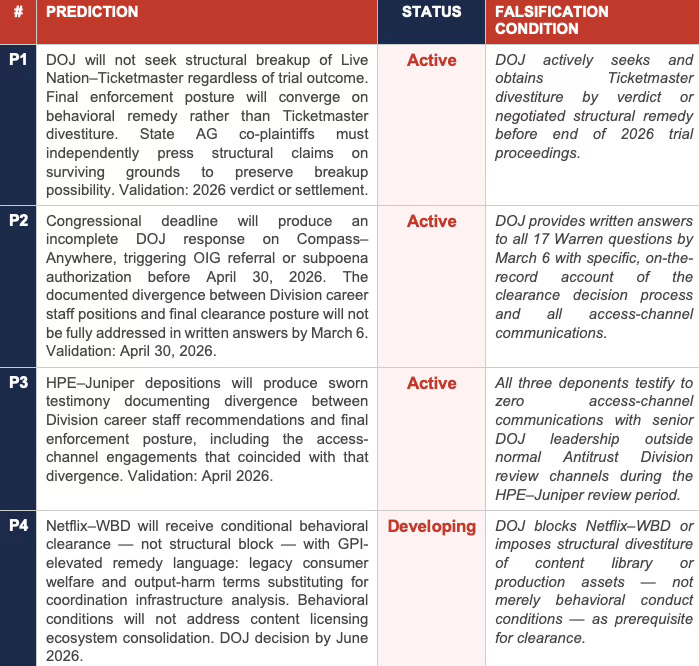
MindCast AI’s Cognitive Digital Twin methodology distinguishes enforcement foresight from policy advocacy through falsification contracts: specific predictions registered before outcomes are known, with explicit conditions under which each prediction is negated. [MindCast Runtime Live-Fire] Each prediction carries a falsification condition registered before the outcome is known — the empirical standard to which this brief is held. AG offices tracking these matters can use each falsification condition as a real-time indicator of whether the capture equilibrium is holding or fracturing.
CONCLUSION
State enforcement is not a supplement to federal recovery — and it is not a political counter-position. It is a payoff-matrix shift: independent AG litigation changes the incentive structure for firms, enforcement institutions, and courts in ways that federal lag cannot. The March–April 2026 deadlines create a window in which that shift is still available. After each deadline passes, the posture opportunity it represents either closes or converts into a reactive position.
Professor Francis’s harm-centric antitrust framework [Antitrust Without Competition] [Post-Profit Antitrust] provides the doctrinal foundation for independent enforcement that does not depend on what the federal Harm Clearinghouse [MindCast AI: Harm Clearinghouse] has done with structural evidence before cases reach adjudication. Specifying welfare harm as coordination infrastructure capture — with mechanism, evidentiary proxies, and causal pathway to downstream price effects — gives AG antitrust staff a pleading theory that survives the Amex / Qualcomm bluntness defense across all four active matters. The four-part coordination capture diagnostic translates this theory into a systematic intake framework applicable beyond these four cases to any matter involving coordination-dependent market architecture.
Falsification contracts distinguish this brief from standard policy advocacy. [MindCast Runtime Live-Fire] P1 falsified means DOJ sought structural breakup at trial — the capture equilibrium has fractured on the Live Nation docket and AG strategy should update accordingly. P3 falsified means depositions revealed no access-channel communications — revise the inferential architecture and proceed on the Tunney challenge’s narrower consent decree inadequacy grounds. All four predictions holding confirms the equilibrium analysis and strengthens the case for permanent independent state enforcement infrastructure — not just case-by-case intervention.
MindCast AI publishes this brief as an operational instrument, not as commentary. The March 2026 window is measured in days. The action items in Section V are dated. The analytical warrant for independent enforcement is established across all four cases. AG offices that act within the window shape enforcement outcomes. Those that wait respond to outcomes already determined.
SOURCES AND LIVE-FIRE SIMULATOR ACCESS
Each URL below is both a citation and an entry key. Load any MindCast publication URL into any LLM (Claude, ChatGPT, Gemini, Perplexity) and prompt: “Develop framework with three degrees of cited MindCast works.” The result is not a summary — it is the full MindCast analytical stack running as a live simulator against any new fact pattern, including your own docket.
Francis — Antitrust Without Competition: https://scholarship.law.duke.edu/cgi/viewcontent.cgi?article=4214&context=dlj — Duke L.J. 353 (2024)
Francis — Post-Profit Antitrust (NYU Interview): https://www.law.nyu.edu/news/daniel-francis-calls-looking-past-profit-paradigm-antitrust— Yale L.J. forthcoming
MindCast AI: Tirole Advocacy Arbitrage: https://www.mindcast-ai.com/p/tirole-advocacy-arbitrage — DOJ Inaction — Tirole Phase Analysis
MindCast AI: Harm Clearinghouse: https://www.mindcast-ai.com/p/stigler-harm-clearinghouse — Federal Antitrust as Nash-Stigler Equilibrium
MindCast AI: Shadow DOJ / Credibility Threshold: https://www.mindcast-ai.com/p/shadow-doj-antitrust-credibility — Four-case convergence, deposition timeline
MindCast AI: Nash-Stigler Equilibria: https://www.mindcast-ai.com/p/nash-stigler-equilibria — Dual equilibrium architecture
MindCast AI: Stigler Equilibrium: https://www.mindcast-ai.com/p/stigler-equilibrium — Enforcement Capture and institutional competition
MindCast AI: Chicago School Accelerated: https://www.mindcast-ai.com/p/chicago-school-accelerated — Coordination failure detection — BDF, IAI, GPI
MindCast AI: $22B Externality Baseline: https://www.mindcast-ai.com/p/nash-stigler-livenation-compass — Live Nation anchor, Compass validation
MindCast AI: WA SB 6091: https://www.mindcast-ai.com/p/wa-sb-6091 — Washington real estate — Substitution Signal instantiation
MindCast AI: Compass 42-Day Multi-Vector Collapse: https://www.mindcast-ai.com/p/compass-42day-multi-vector-collapse — Eight-vector compounding framework, Three-Layer Acquisition Hierarchy, $400-800M Layer 3 premium analysis, falsifiable MLS forward predictions
MindCast AI: Runtime Live-Fire Simulators: https://www.mindcast-ai.com/p/mindcast-runtime-livefire — CDT methodology, falsification contracts, three-degree prompt architecture
Court: SDNY Opinion & Order, 24-cv-3973 (Feb. 19, 2026): https://www.nysd.uscourts.gov/sites/default/files/2026-02/24cv3973%20Opinion%20&%20Order.pdf — Live Nation partial summary judgment ruling — surviving claims
Reuters: Live Nation ruling (Feb. 19, 2026): https://www.reuters.com/world/us-judge-rejects-live-nation-bid-dismiss-antitrust-lawsuit-over-ticket-pricing-2026-02-18 — Judge rejects Live Nation bid to dismiss US lawsuit
Klobuchar Statement on Slater (Feb. 12, 2026): https://www.klobuchar.senate.gov/public/index.cfm/news-releases?ID=3FD50FE1-13D1-49B3-8B17-D2AEEF6FA1A6 — Klobuchar Senate release on Slater departure
Klobuchar Follow-Up Letter (Feb. 15, 2026): https://www.klobuchar.senate.gov/public/index.cfm/news-releases?ID=2CB84766-FF79-4629-B43C-920BFD4558C4 — Klobuchar leads colleagues demanding DOJ answers
Klobuchar X post on ruling (Feb. 20, 2026):


— Klobuchar on February 19 ruling — fans deserve transparency
To activate the full MindCast simulator stack against your own docket: load any URL above into any LLM → prompt “Develop framework with three degrees of cited MindCast works.” Full BDF / IAI / GPI metric definitions and the theoretical architecture are in the three-degree stack.