


A class action complaint filed March 23, 2026 in the District of Colorado names Vail Resorts and Alterra Mountain Company as defendants in a ski-pass antitrust case. Read on its surface, the complaint targets tying and bundling — the familiar claim that linking access to destination resorts with access to regional ski areas forecloses competition. That framing is legally useful but analytically incomplete. The penalty price Vail Resorts and Alterra deployed suppresses the institutional signal, not just consumer search. The deeper architecture is something MindCast has formally theorized: a Signal Suppression Equilibrium (SSE). The firms did not merely make the bundle attractive. They made the outside option informationally useless. Once the day-ticket price stopped revealing demand and started disciplining refusal, competition moved from price discovery to architecture control.
An SSE exists when firms profit more from degrading the informational content of prices than from competing on those prices, and when that degradation simultaneously removes the signals required for entry, substitution, or regulatory correction. MindCast’s SSE framework, developed in Prestige Markets as Signal Economies, formalizes that testable condition through five variables and a governing inequality. The ski-pass architecture satisfies every element — and the complaint, read correctly, is a judicial test of whether courts can recognize suppression as an antitrust harm even when nominal choice formally survives.
A × R × F × N > S
A — Access Dependence — the degree to which consumers and rivals rely on the dominant firms for future economic opportunity
R — Reputational Retaliation Risk — the expected penalty associated with competing outside the established architecture
F — Information Fragmentation — the degree to which evidence of true pricing power remains dispersed and illegible
N — Narrative Distortion — a multiplier capturing how the “value bundle” frame reduces the perceived credibility of the penalty-price signal
S — Signal Aggregation Capacity — the ability of regulators, rivals, or markets to aggregate dispersed signals into corrective force
When the product A × R × F × N exceeds institutional signal aggregation capacity S, the equilibrium holds. Suppression is not incidental — it is the condition that makes the architecture profitable. And when the inequality holds, price ceases to function as a coordinating mechanism and instead functions as a routing mechanism.
I. The Outside Option As Disciplinary Instrument
Standard tying doctrine asks whether a seller conditions purchase of a desired product on purchase of a second product the buyer would not otherwise want. The complaint advances that theory with respect to destination resort access (tying product) and regional ski area access (tied product). That framing is correct as far as it goes.
The sharper claim runs deeper. Vail Resorts and Alterra did not simply bundle two products. Each firm deliberately degraded the informational integrity of the unbundled alternative.
In a functioning market, à la carte day-ticket prices reveal marginal willingness to pay. A $150 day ticket at a regional hill signals something real about consumer demand, competitive substitution, and resort pricing power. The Mega Pass architecture poisoned that signal. Vail Resorts’ current CEO Rob Katz confirmed the intent directly, telling The New York Times in December 2025 that lift-ticket prices had been “intentionally” aggressive — designed to push customers toward Epic Pass purchase. In a February 2026 Wall Street Journalinterview, Katz acknowledged the industry-wide effect: “I think it’s a fair point. This was an industry wide . . . transformation that happened that our company absolutely led.”
The day-ticket price no longer measures demand. It measures the cost of refusing the system.
That distinction is analytically decisive. A penalty price is not simply an expensive option — it is a deliberately irrational option, calibrated to route consumers into the bundle not because the bundle is superior but because the alternative has been rendered economically illegible. Consumers who purchase an Epic or Ikon Pass are not making a cost-conscious optimization. They are responding to a decision architecture that was engineered upstream to eliminate meaningful comparison.
Suppression operates on three channels simultaneously, not one:
Consumer signal suppression: Consumers cannot infer true destination access value from the posted day-ticket price because that price functions as a conversion tool, not a market signal.
Competitive signal suppression: Independent rivals cannot discipline the market with modular or destination-only alternatives because the benchmark price has been contaminated. Any entrant offering unbundled destination access at a competitive price faces consumers whose reference point is the distorted à la carte rate, not the underlying cost structure.
Regulatory signal suppression: External observers — regulators, journalists, investors — see a “discounted pass” rather than a distorted outside option. The exercise of market power hides inside the bundle frame. Pricing power appears to flow from product quality and consumer loyalty rather than from architectural opacity.
The third channel is the one that makes the case publication-worthy. The market does not merely coerce buyers. The market erases the evidence that would normally make coercion legible. Together, these three channels do not merely distort the market — they prevent the market from observing its own distortion.
Mapping the SSE variables to the ski-pass architecture makes the suppression condition concrete:
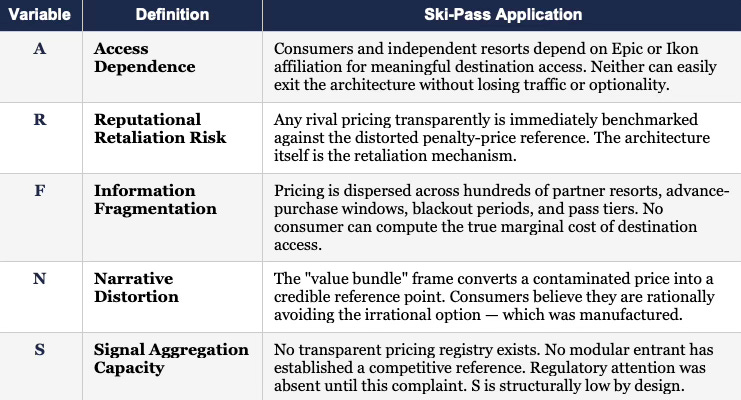
The Signal Suppression Index (SSI), computed as (A × R × F × N) / S, scores high across every variable in the ski-pass architecture. The equilibrium does not hold by accident. Each variable reinforces the others, and the architecture was designed to keep S low by eliminating the informational infrastructure that would otherwise generate it.
Consumer Impact: Choice Without Information
Consumers appear to retain choice within the Mega Pass system. Day tickets remain available, multiple resorts compete for visitation, and pass tiers create the surface appearance of segmentation. That appearance is misleading because the architecture removes the information required to make those choices meaningful.
A consumer deciding whether to ski at a destination resort faces a distorted menu. The day-ticket price does not reflect marginal cost or competitive market conditions — it reflects the cost of refusing the system. The bundle appears efficient only because the reference point has been engineered. Consumers respond rationally to that architecture, but the architecture itself has eliminated the conditions under which rational comparison is possible.
The result is not traditional consumer harm defined by overpayment relative to a competitive benchmark. The result is the absence of a benchmark altogether. Consumers cannot observe the price that would have emerged under competitive conditions because the pricing system suppresses the signal that would reveal it. Choice persists in form while collapsing in substance.
II. Nash–Stigler: Why The Equilibrium Persists Without Agreement
MindCast’s Nash-Stigler Equilibrium architecture, applied in the Live Nation/Ticketmaster antitrust analysis and formalized across the Predictive Institutional Cybernetics publication suite, identifies the conditions under which a market equilibrium becomes self-reinforcing without coordination. The ski-pass structure satisfies both layers simultaneously.
Nash Layer: No Profitable Deviation
Neither Vail Resorts nor Alterra faces a profitable unilateral deviation from the current architecture. Undercutting the bundle price risks collapsing the margin structure industry-wide and, more damagingly, training consumers to wait rather than commit in the spring purchase window. Offering unbundled destination access at a competitive price eliminates the premium that bundle opacity sustains. Competing on transparency destroys the equilibrium faster than a competitor could capture share from it.
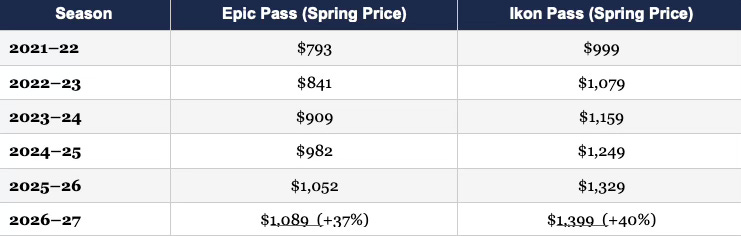
The result is parallel escalation without communication. Epic Pass prices have risen 37% since the 2021-22 season. Ikon Pass prices have risen 40% over the same period. No price-fixing agreement is required to produce that pattern — each firm observes the other’s outcomes through market data and adjusts within an architecture that rewards escalation and punishes transparency.
Holiday-period lift ticket prices at Colorado destination resorts tell the same story. Between 2019 and 2025, single-day peak prices at every major Epic and Ikon resort rose between 60% and 90% — well in excess of inflation, and consistent with penalty pricing rather than market-clearing.

Stigler Layer: No Usable Signal Survives
George Stigler’s search theory established that price discipline requires usable market information. Search collapses when the cost of comparison exceeds its benefit — and comparison cost rises sharply when the reference price has been deliberately distorted.
The Mega Pass architecture produces a Stigler failure condition not as a byproduct of complexity but as a design feature. Day-ticket prices are set at levels that make comparison irrational. Partner-resort pricing is abstracted into the bundle. Marginal resort-by-resort pricing is invisible to the consumer at the point of commitment. The spring purchase window forces commitment before the season begins, before snowfall is known, before conditions can be evaluated.
The Nash condition explains why neither firm defects. The Stigler condition explains why no usable signal survives to support defection, independent entry, or external correction. The relationship between those two layers is not merely parallel — the Nash condition holds because the Stigler condition has already been achieved. Vail Resorts degraded the informational environment first; Alterra’s rational mimicry followed because the signal destruction made deviation unprofitable before any deviation could be attempted. The equilibrium persists because behavioral and informational failure are sequentially dependent, not coincidentally concurrent — and the SSE framework is the architecture that makes that dependency legible.
Contact mcai@mindcast-ai.com to partner with us on Predictive Cognitive AI in Law and Behavioral Economics. To deep dive into MindCast AI upload the URL of any publication into any LLM and prompt ‘reconstruct MindCast framework with three degrees of cited sub links.’ See Live-Fire Game Theory Simulators, Runtime Predictive Infrastructure.
Recent projects: Chicago School Accelerated — AI Infrastructure Patent Coordination | Chicago School Accelerated — The Integrated, Modernized Framework of Chicago Law and Behavioral Economics | The Power Stack — How Energy Infrastructure Became the New AI Battleground | Why the “China Invades Taiwan by 2027” Narrative Misprices the AI Industrial Stack | Why U.S. Actions in Venezuela and Iran Reveal the Structure of the AI Supply Chain | Prestige Markets as Signal Economies, A Model of Signal Suppression and Institutional Failure | Three AIs Walk Into Super Bowl LX and Each Simulation Thinks It Knows the Ending | Prediction Markets— Legislative Regime Conversion and the Collapse of Preemption |
III. Alterra’s Entry As Equilibrium Confirmation
The most analytically important event in the complaint’s factual record is not Vail Resorts’ pricing conduct. It is Alterra’s 2018 entry decision.
Alterra entered the market with a genuine competitive choice. The firm controlled marquee destination resorts — Palisades Tahoe, Mammoth, Deer Valley, Steamboat, Winter Park — assets sufficient to anchor a differentiated product. Alterra could have offered unbundled destination access, modular regional add-ons, or a destination-only season pass at a price that competed on transparency rather than bundle opacity. Each of those strategies was theoretically available.
None of them was rational in context.
Vail Resorts had already trained consumer expectations, pricing logic, and benchmark psychology around precommitment bundles. The spring purchase window had already become industry grammar. The penalty-priced day ticket had already contaminated the reference point for what destination access should cost. Alterra’s entry decision was not ordinary imitation. It was dominated-strategy elimination under an already-installed market architecture.
Alterra’s entry did not intensify competition. It validated the equilibrium.
A competitive entrant with genuinely superior assets and genuine market ambition choosing mimicry over differentiation is not a story about corporate laziness. It is structural evidence that the incumbent had already shifted the payoff structure and the information environment enough to make deviation irrational. Alterra’s choice confirmed that the architecture had succeeded — that the market had reorganized around bundle precommitment in a way that made transparent competition unprofitable for any new entrant, regardless of asset quality.
The Arapahoe Basin trajectory makes the absorption dynamic concrete. The resort participated in the Epic Pass until 2019, when Mega Pass-driven overcrowding forced an exit. Rather than operating independently, Arapahoe Basin joined the Ikon Pass on a limited-access basis, capping days to manage visitation. Alterra acquired it outright in 2024 for $105 million and restored unlimited Ikon access for 2025-26. The arc — unlimited Epic access, constrained Ikon partnership, full acquisition with full integration — illustrates how independent nodes are absorbed over time. No explicit exclusion is required. The geometry performs the foreclosure.
IV. MindCast AI Cognitive Digital Twin Foresight Simulation: Four-Simulation Stack
MindCast routes institutional analysis through the MindCast AI Proprietary Cognitive Digital TwinForesight Simulation — the MAP CDT — described in the Cybernetic Foundations of Predictive Institutional Intelligence. MAP CDT does not describe behavior. MAP CDT routes raw signals through a structured process — signal intake and filtering, hypothesis formation, causal inference, causal signal integrity validation, Vision Function routing, dominance resolution, and recursive foresight simulation — resolving institutional behavior into equilibrium-classified, falsifiable predictive outputs. Each institutional subject is modeled as a CDT: a dynamic behavioral replica encoding the institution’s objective function, constraint stack, adaptation velocity, and feedback sensitivity. The simulation transforms that CDT into forward predictions by stress-testing it against multi-agent strategic interaction and bounded time horizons.
Four simulations run here: core routing, strategic interaction, cybernetic feedback, and structural geometry. All four converge on a single mechanism.
MAP CDT Simulation I — Core Routing
Controlling insight: The ski-pass market is organized around signal suppression. Price routes behavior rather than coordinates it.
Causal mechanism: Firms raise the cost of the outside option to eliminate its informational content. Consumers precommit before consumption. Rivals benchmark against a contaminated reference. Observers misread the bundle as value because the reference price is engineered rather than market-determined.
Predicted trajectory: Price escalation persists with annual adjustments tied to pass sales and renewals. Day-ticket prices continue to function as conversion tools rather than standalone signals. Competitive entry that relies on transparent à la carte pricing fails to scale against the contaminated benchmark.
Falsification condition: Emergence of a transparent, widely adopted destination-only price that disciplines pass pricing and is not anchored to the inflated day-ticket reference.
Simulation I establishes that signal suppression is the dominant architecture — not a side effect of bundling, not an emergent byproduct of competitive dynamics, but the governing design.
MAP CDT Simulation II — Strategic Interaction
Controlling insight: Alterra’s entry validated the incumbent’s architecture. Deviation became a dominated strategy once consumer expectations and pricing benchmarks shifted around the precommitment model.
Causal mechanism: Vail Resorts’ first-mover design trained consumers to commit early and evaluate value through bundles. Any entrant offering transparent destination pricing faces consumers anchored to a distorted reference and risks collapsing industry margins by demonstrating that the precommitment structure is optional rather than rational.
Predicted trajectory: Parallel architecture persists. Neither firm introduces true modular destination pricing at scale. Litigation does not induce preemptive deviation — both firms continue escalation during the case lifecycle. Tactical adjustments appear at the margin but preserve precommitment and bundle primacy.
Falsification condition: One firm launches and sustains a destination-only product at scale that attracts material consumer substitution without relying on the inflated reference price.
Simulation II explains why mimicry is rational and why coordination does not require communication. Strategic interaction locks in the architecture that Simulation I identified as dominant.
MAP CDT Simulation III — Cybernetic Feedback Loops
Controlling insight: The system behaves as a closed loop that stabilizes pricing through outcome observation rather than inter-firm signaling.
Causal mechanism: Firms capture feedback from pass sales, renewal rates, capacity utilization, and visitation patterns. Annual pricing cycles recalibrate product tiers against those outcomes. Consumers adapt behavior to the pass ecosystem, reinforcing the loop. No external reference price exists to interrupt the cycle.
Predicted trajectory: High retention sustains pricing power despite visible annual increases. Short-run legal shocks produce cosmetic adjustments, not structural change. Loop closure remains intact unless a new information channel — a transparent reference price, a modular entrant, or discovery-produced internal documents — breaks the feedback pattern.
Falsification condition: Sustained decline in renewal rates following transparent price disclosure or a credible modular alternative that resets consumer expectations.
Simulation III explains persistence. The equilibrium does not require ongoing managerial coordination — the feedback loop recalibrates it annually. External shocks that do not introduce a new information channel dissipate without structural effect.
MAP CDT Simulation IV — Structural Geometry
Controlling insight: The competitive landscape constrains independent resorts into four paths: join on constrained terms, operate under capacity limits, degrade toward irrelevance, or face acquisition.
Causal mechanism: Network effects and benchmark contamination reduce viable paths for independents. Affiliation increases traffic but concentrates demand; capacity constraints force limit structures; sustained independence produces declining relevance as pass-anchored consumers route to affiliated resorts. High-value independents become acquisition targets once the economics of independent operation compress below affiliation terms.
Predicted trajectory: Independent resorts either affiliate on constrained terms or face declining visitation share. High-value independents become acquisition targets once independent economics compress below affiliation terms. Structural foreclosure accumulates without any exclusionary contract being required.
Falsification condition: A durable cluster of independent destination resorts competes successfully on transparent pricing without affiliating and maintains or grows visitation share over multiple seasons.
Simulation IV explains absorption dynamics. Arapahoe Basin — tracked in Section III — is the cleanest observable proof: the geometry channeled a high-value independent through constrained affiliation into full acquisition without any exclusionary contract. The structural path did the work.
Cross-Simulation Synthesis
All four simulations converge on a single mechanism. Signal suppression establishes the environment. Strategic interaction locks in mimicry. Feedback loops stabilize outcomes against external shocks. Structural geometry channels independent actors toward integration. Causation runs in sequence, not parallel — degradation of price information precedes and enables every downstream condition. Reversing the equilibrium requires restoring a transparent reference price first. Nothing else changes the geometry.

V. The Legal Pressure Point: When Does A Formally Available Option Cease To Be A Competitive Option?
The MAP CDT simulations establish the market architecture. The legal question is whether courts can recognize that architecture as an antitrust harm. Modern tying doctrine moved away from per se treatment in part because courts became skeptical of reading coercion into situations where consumers retained formal choice. The Supreme Court’s analysis in Jefferson Parish Hospital District No. 2 v. Hyde and the subsequent evolution toward rule-of-reason tying analysis reflect judicial reluctance to condemn bundles that generate real efficiencies alongside competitive harm. Defendants will invoke that skepticism directly: passes are optional, day tickets still exist, consumers retain the formal ability to purchase lift access à la carte.
The SSE framing shifts the inquiry at exactly the point where that defense is most comfortable. The question is not whether a formal alternative existed. A formally available option ceases to be a competitive option when it no longer conveys information that can discipline the seller. The question is whether the pricing architecture degraded the informational integrity of the unbundled option so severely that a formally available choice ceased to be a competitive one.
Plaintiffs need more than “passes are cheaper than day tickets.” The complaint’s strongest move — confirmed by Katz’s own admissions — is that the day-ticket price was calibrated as a conversion tool, not a standalone product. That converts the legal question from a bundle discount analysis into an architecture-level coercion analysis. Courts have not broadly accepted that framing yet. The doctrinal space is thin. But the SSE framework provides the analytical bridge: when the outside option no longer carries usable market information, formal choice is coercive routing.
The Posner-era efficiency defense for tying bundles rests on the premise that consumers benefit when complementary products are sold together at a discount. That premise fails here because the “discount” is computed against a reference price that the defendants themselves inflated. The efficiency gain is circular: the bundle looks efficient only because the outside option was made artificially irrational. Courts following the full rule-of-reason analysis will need to ask not just whether the bundle benefited consumers relative to day tickets, but whether the day-ticket price itself reflects competitive market conditions or architectural manipulation.
Defendants will advance a genuine efficiency argument that deserves direct acknowledgment. Mega Passes reduced the effective per-day cost of destination skiing for committed participants, increased total skier participation from 60,000 Epic Pass holders in 2008 to over 2 million annually, and created precommitment pricing that benefits price-sensitive consumers who lock in before peak-season demand materializes. Those are real consumer welfare gains. The SSE analysis does not dispute them. The analytical question is narrower: whether those efficiency gains were achievable only through an architecture that simultaneously eliminated the informational substrate required for competitive discipline — or whether less restrictive alternatives, including modular destination access or transparent reference pricing, could have produced the same participation gains without suppressing the signal.
Defendants bear that burden under rule-of-reason analysis. The efficiency record answers the wrong question if it measures pass-holder welfare against penalty-priced day tickets rather than against a competitive counterfactual that never existed because the architecture prevented it from forming.
VI. Legal Trajectories
The MAP CDT simulations generate three legal trajectories, each with an activating mechanism, a trigger to monitor, and a falsification condition.
Path A: Formal Tying Compression
The court narrows the case into conventional tying doctrine and asks whether plaintiffs plausibly alleged separate products, market power in the tying product, and economic coercion. Discovery proceeds on whether day tickets and Mega Passes constitute distinct products under Jefferson Parish.
Predicted trajectory: The case survives motion to dismiss only if the court treats penalty-priced day tickets as potentially non-meaningful alternatives rather than merely expensive ones. Plaintiffs’ strongest asset is Katz’s own admission — a CEO confirming that day-ticket prices were “intentionally” aggressive as a conversion mechanism is close to direct evidence that the outside option was manufactured rather than market-determined.
Trigger to watch: Judicial language recognizing that a formally available option may lack competitive meaning when it no longer conveys information capable of disciplining the seller.
Falsification condition: Dismissal on the ground that consumers retained formal choice because à la carte day tickets remained available at all times. Courts accepting that formalism over economic substance would confirm that tying doctrine remains blind to menu-design coercion.
Path B: Architectural Coercion Recognition
The court accepts that pricing architecture can produce coercion even without explicit contractual compulsion. Discovery expands toward internal pricing design documents, pass-sales conversion modeling, outside-option calibration analyses, and executive communications about day-ticket price strategy.
Predicted trajectory: Internal documents showing that both firms modeled day-ticket prices as conversion instruments — rather than as standalone demand-reflective prices — shift the case from structural inference to direct evidence of menu-design manipulation. Aspenware becomes the evidentiary focal point. Alterra and Aspen Skiing Company acquired Aspenware in 2022; the platform processes transactions across Ikon ecosystem partners including Boyne Resorts, Powdr Corporation, and Jackson Hole Mountain Resort. A shared technology infrastructure processing pricing decisions across nominally independent competitors is not a conspiracy — but it is a coordination substrate. Parallel escalation produced through a common system, without requiring communication, is precisely the mechanism SSE predicts. Discovery into Aspenware’s pricing architecture, configuration logs, and client-facing rate-setting tools could establish whether the platform enabled convergence rather than merely processed it.
Trigger to watch: Discovery requests targeting internal conversion pricing models, outside-option calibration documents, and Aspenware configuration logs across affiliated independent partners.
Falsification condition: Court rejects architecture-level inference and limits antitrust inquiry to traditional price-fixing agreement or explicit contractual forcing. Structural evidence alone proves insufficient to establish coercion.
Path C: Equilibrium Preservation With Cosmetic Adjustment
Defendants avoid major structural change but soften litigation risk through selective marketing adjustments, limited pass segmentation, or narrow modular offerings that create apparent choice without breaking the precommitment architecture.
Predicted trajectory: Both firms preserve the spring purchase window, the penalty-priced day ticket, and the bundle as the primary consumer product. Marginal changes — a short-window destination-only pass offered at prices calibrated against the inflated day-ticket reference — satisfy courts concerned with consumer welfare optics without altering the underlying architecture. The equilibrium persists in structural form even as the surface presentation changes.
Trigger to watch: Short-window destination products priced against the inflated reference rather than an independent cost baseline — cosmetic modularity that preserves the contaminated benchmark.
Falsification condition: Genuine modular destination access emerges at scale, priced against a competitive reference rather than the distorted day-ticket benchmark. Alternatively, one firm materially breaks from the bundle architecture in a way that produces consumer substitution and demonstrates the economic viability of differentiated competition.
Market-based falsifier (cuts against the SSE claim): If independent resorts successfully scale a destination-only or modular offering that attracts material consumer substitution without anchoring pricing against the inflated Mega Pass reference, the SSE suppression claim weakens. The absence of such an entrant to date is structural evidence for SSE. Its emergence would be the strongest falsifier available.
VII. The Investor Question: Pricing Power Or Architectural Opacity?
For equity analysts covering Vail Resorts (NYSE: MTN), the standard bull thesis runs on pricing power: consumers love the pass product, renewal rates are high, and destination skiing is inelastic enough to sustain annual price increases. That thesis is structurally incomplete because it fails to disaggregate durable efficiency-driven margin from opacity-sustained margin. The SSE framework generates a different capital-markets question: how durable is pricing power when that pricing power depends on suppressing the signal that would otherwise reveal market power?
Bull Case
The architecture is robust in the medium term. Consumers precommit annually, renewal rates remain high, independent rivals lack the destination-resort anchor assets required to replicate the bundle value proposition, and the market reads Mega Passes as value products rather than coercive menus. Regulatory correction is slow relative to annual pricing cycles, and the litigation timeline is measured in years. Pricing power is durable for the duration of the current equilibrium.
Bear Case
The valuation multiple on Vail Resorts’ “pricing power” narrative compresses once courts, regulators, or the market itself reclassify penalty pricing as suppression rather than discounting. Part of the margin in the Epic Pass ecosystem reflects architectural opacity rather than durable operational efficiency. If the SSE architecture is exposed — either through judicial discovery producing internal pricing-design documents or through a successful modular entrant demonstrating that destination access can be sold transparently at competitive prices — the reference point against which the “discount” is computed collapses. The structural basis for the renewal rate and pass-price escalation narrative shifts from consumer loyalty to consumer capture.
The first clear signal of multiple compression will not be price declines. It will be disclosure — either internal documents surfacing conversion-pricing models that show day-ticket prices were calibrated as coercion instruments rather than standalone market prices, or a modular entrant that successfully re-anchors destination access to a transparent reference price. Either event retroactively reclassifies the margin. Investors monitoring MTN should treat Aspenware discovery production and independent modular pass launches as the leading indicators, not quarterly pass sales figures.
Alterra’s private status insulates it from direct public-market pressure, but the Ikon Pass ecosystem faces the same regulatory exposure. A judicial ruling that treats Alterra’s entry decision as equilibrium confirmation — rather than independent competitive conduct — could extend liability and structural remedy obligations to Alterra even without public-market discipline.
The Arapahoe Basin acquisition at $105 million in 2024 is the most recent data point on equilibrium persistence. Alterra paid a control premium for a resort it had already incorporated into the Ikon ecosystem on a limited-access basis. The acquisition price reflects the equilibrium’s stability — the market valued the asset on the assumption that the precommitment architecture would continue to channel demand. Judicial disruption of that architecture retroactively reprices the acquisition logic.
VIII. Clean Synthesis
The complaint against Vail Resorts and Alterra is not most important as a tying dispute. Formal tying doctrine will struggle with it for the same reason it has always struggled with penalty-pricing coercion: formal choice survives, consumers are not literally compelled, and courts see a discount rather than a trap.
The case is most important as a Signal Suppression Equilibrium test. Two firms, using the market power concentrated in destination resort access, engineered a pricing architecture that eliminated the informational substrate on which price competition depends. Day-ticket prices stopped measuring demand and started measuring the cost of refusal. The bundle appeared rational not because it was efficient but because the alternative was made deliberately irrational.
Nash explains why neither firm defects. Stigler explains why no usable signal survives to support defection, entry, or regulatory correction. Alterra’s 2018 entry decision — dominated-strategy elimination under an already-installed architecture rather than independent imitation — explains why the equilibrium is structural rather than coincidental. The MAP CDT simulations confirm that causation runs in sequence: signal suppression establishes the environment, strategic interaction locks in mimicry, feedback loops stabilize outcomes, and structural geometry absorbs independent nodes.
The penalty price suppresses the institutional signal, not just consumer search.
Plaintiffs have not fully developed that thesis. The tying framing carries them through motion practice, but the architecture-level coercion argument is where the doctrine either expands or holds the line.
If courts accept that pricing architecture can eliminate meaningful choice even when formal alternatives exist, antitrust doctrine moves toward platform-level enforcement — and the ski-pass case becomes precedent for streaming bundles, airline loyalty ecosystems, and AI subscription tiers built on the same precommitment logic. If courts hold the line at formal choice, duopolies receive a blueprint for legal coordination without agreement: design the outside option to be informationally useless, let the Nash-Stigler equilibrium do the rest, and let the market suppress the signal that would otherwise invite correction.
Markets don’t just fail when prices are wrong. Markets fail when prices stop being signals at all — because firms made them stop working.