


Companion to Why U.S. Actions in Venezuela and Iran Reveal the Structure of the AI Supply Chain, The Silence Dividend I. See also the MindCast National Innovation and AI Markets | Tech series.
The most repeated Taiwan forecast in Washington is also the most analytically sloppy. Part I of this series showed that Beijing benefits structurally from upstream disruptions to the AI industrial stack — the Silence Dividend. Part II advances a harder claim: the standard “China invades Taiwan by a named year” narrative mistakes a capability milestone for a political deadline, ignores the semiconductor self-destruction constraint, and misreads a threat-window recycling equilibrium as foresight. Five MindCast Vision Function frameworks — Causation Vision, Field-Geometry Reasoning, National Innovation Behavioral Economics, Chicago Law and Behavioral Economics, and Chicago Strategic Game Theory — converge on a single output: China is building the option, but the evidence does not support a fixed-date invasion decision on the public timetable Washington keeps recycling.
I. The Analytical Error Washington Keeps Making
Taiwan sits at the fabrication chokepoint of the global artificial-intelligence industrial stack. The most repeated Taiwan forecast in Washington ignores that constraint entirely. A senior official states a date. Defense media recycles it. Congress treats it as a countdown. The deadline passes. Then the cycle resets with a new warning window, a new hearing, and the same basic institutional payoff: urgency without precision.
That framing confuses a capability milestone with a decision deadline. China can seek the capacity to move by a certain year without having chosen the highest-cost path on that timetable. That distinction matters because the strategic landscape that produced the invasion-window narrative has changed materially. The Russia-Ukraine war raised the observed cost of major war against a defended target. Taiwan’s role in the semiconductor stack made military disruption more self-destructive for Beijing than most public countdown rhetoric admits. China’s domestic political economy continues to direct enormous state attention toward internal stabilization, technological self-sufficiency, and industrial resilience — not toward visible preparation for a near-term amphibious gamble.
The central error in the public narrative is not that China poses no threat to Taiwan. The error is that Washington keeps pricing the threat through the wrong form and the wrong industrial lens. The nearer-term risk is not a fixed-date Normandy-style invasion. The nearer-term risk is that institutions keep mistaking a useful planning horizon for a forecast while ignoring how the AI industrial stack changes the cost calculus beneath the surface.
II. Threat-Window Recycling
The “China will invade Taiwan by [year]” narrative has developed a remarkably stable institutional pattern. A combatant commander or senior defense official identifies a plausible danger horizon. Defense press amplifies the quote. Congressional committees convert the warning into urgency. Budget arguments, alliance messaging, and arms-sale narratives then harden around a date that quickly takes on a life of its own.
That cycle performs a bureaucratic function even when it does not describe the most likely path of events. A date compresses complexity. A countdown produces appropriations logic. Ambiguous structural risk becomes legible to institutions when it is attached to a year. The result is a recurrent gap between threat rhetoric and observed strategic behavior.
Threat-window recycling occurs when a plausible military planning horizon becomes a public forecast because institutions gain more from urgency than from probabilistic nuance. Washington is not inventing danger. Washington is flattening a contingent strategic problem into a countdown because countdowns travel better through bureaucracies than conditional models.
The most cited public examples — Admiral Davidson’s 2021 warning window, Director Burns’s statement that Xi wanted the military ready by 2027 while decision remained unresolved, and the 2025 DoD Annual Report framing 2027 as a major PLA milestone — all distinguish readiness from decision. The public recycling of the date elides that distinction.
III. Capability Is Not Decision
The public Taiwan debate repeatedly collapses two distinct questions into one. The first asks whether the PLA is building the capability to coerce or attack Taiwan. The second asks whether Xi Jinping has chosen to exercise that option on a specific timetable. Those are not the same question, and treating them as equivalent produces bad forecasting.
China’s military modernization plainly matters. A state does not build coercive capacity for no reason. But capability accumulation does not establish decision inevitability. It expands the menu. It does not tell observers which choice Beijing will select when the highest-cost option still carries enormous military, economic, and political downside.
A readiness benchmark can be real while an invasion deadline remains speculative. Analysts who collapse the two turn planning logic into prophecy. That move may be useful for institutional mobilization. It is weak as foresight.
Contact mcai@mindcast-ai.com to partner with us on Predictive Cognitive AI in Law and Behavioral Economics. To deep dive on MindCast work in Cybernetic Foresight Simulations upload the URL of this publication into any LLM and prompt ‘reconstruct MindCast framework with three degrees of cited sub links.’ See Live-Fire Game Theory Simulators, Runtime Predictive Infrastructure.
Recent projects: The Cybernetic Foundations of Predictive Institutional Intelligence, MindCast AI Emergent Game Theory Frameworks, MindCast AI Investment Series, Field-Geometry Reasoning — Structural Constraint Modeling in Predictive Cognitive AI, Comment of MindCast AI on Potential US DOJ | FTC Updated Guidance Regarding Collaborations Among Competitors, Super Bowl LX — AI Simulation vs. Reality.
IV. Ukraine Changed the Demonstration Effect
Russia’s invasion of Ukraine did not merely produce a European war. The invasion also created a live strategic demonstration for every state contemplating large-scale force against a defended adversary backed by advanced Western weapons, intelligence, and logistics. Chinese planners have now watched what attrition, delay, logistics failure, sanctions, and international coalition formation look like in practice rather than in abstract war games.
That lesson cuts against easy Taiwan countdown rhetoric. Taiwan presents a harder military problem than Ukraine in one crucial respect: an attack requires an opposed amphibious operation across the Taiwan Strait, followed by sustained logistics, sea and air control, urban combat risk, and political consolidation after landing. Even a numerically powerful force would face extraordinary friction.
Ukraine changed the inference structure. The lesson for Beijing is not that force fails in every case. The lesson is that major war against a defended target can become far more expensive, prolonged, and politically destabilizing than a prewar capability inventory suggests.
V. The Silicon Shield Is Also a Self-Destruction Constraint
Taiwan is not merely a geopolitical object. Taiwan is also the most important fabrication node in the global advanced semiconductor stack. That fact changes the cost calculus for every major power, including China. A military campaign that destroys, disables, or freezes Taiwanese leading-edge fabrication would not simply wound the United States and its allies. It would also damage Chinese industrial ambitions that still depend, directly or indirectly, on a functioning global semiconductor ecosystem.
That dependence does not eliminate conflict risk. It changes the form of the risk. A full invasion is not just an act of territorial coercion. It is also a potential act of industrial self-harm. Beijing may seek control over Taiwan’s strategic position, but a war that severs the fabrication link between chip design and physical compute would destroy something China still needs the world to keep operating.
The faster the AI race accelerates, the stronger that mutual constraint becomes. Artificial intelligence depends on compute. Compute depends on advanced chips. Advanced chips still run through a manufacturing geography that military conflict would rupture. The invasion-window frame misses that deeper industrial logic because it treats Taiwan mainly as a military flashpoint rather than as the principal chokepoint in the AI stack.
The United States and its allies face severe short-run disruption from Taiwan fabrication loss but retain a meaningful long-run recovery path. CHIPS Act investments, TSMC’s Arizona fabs, Samsung’s Texas expansion, and allied industrial coordination represent a costly but navigable rebuilding trajectory. U.S. AI development would suffer a significant setback. It would not be permanently foreclosed.
China faces a categorically harder problem. The export control architecture already restricts Chinese access to the most advanced EUV lithography equipment and leading-edge process technology. A Taiwan war that destroys TSMC’s leading-edge capacity does not open a Chinese alternative — it eliminates the only global fabrication frontier from which China could eventually benefit, directly or indirectly, through future political resolution, back-channel procurement, or third-party supply chain access. China’s domestic chip program can build toward the frontier. Absent Taiwanese fabrication, there is no frontier to build toward. The self-destruction constraint is not symmetric. China loses more of the long-run AI race by pulling the trigger than any public invasion-countdown narrative accounts for.
VI. The AI Industrial Stack Changes the Strategic Question
Part I of this series identified the deeper industrial structure beneath recent U.S. actions in Venezuela and Iran. Resources feed energy systems. Energy systems feed grids. Grids feed semiconductor fabrication and hyperscale compute. Geopolitical shocks at lower layers propagate upward into the economics of AI infrastructure. That framework does not stop at Venezuela or Iran. It also clarifies why Taiwan cannot be analyzed as a conventional territorial contest.
The AI Industrial Stack — Layer Control and Series Mapping
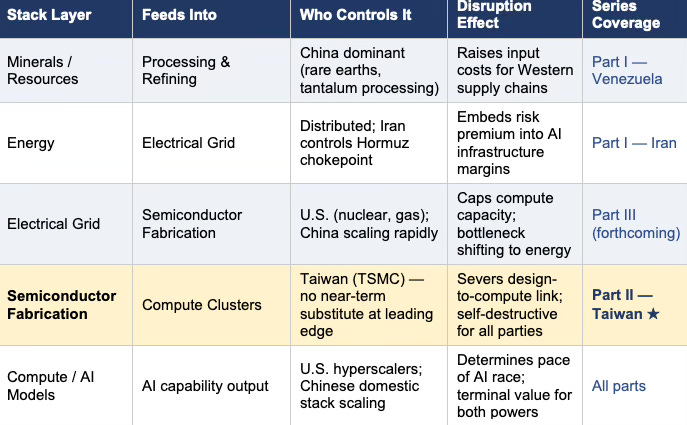
★ Taiwan is the current paper’s subject — the fabrication layer where the Silence Dividend logic inverts.
Taiwan sits at the fabrication layer of that same stack. Venezuela and Iran illustrated upstream shocks. Taiwan represents the most important downstream manufacturing bottleneck. China’s Silence Dividend logic applies when disruptions occur upstream of layers Beijing already buffers through processing, industrial coordination, or domestic scaling. Taiwan is different because it occupies a layer China does not yet securely control and cannot disrupt without risking damage to the entire compute chain.
The strategic question therefore changes. The issue is not whether Beijing dislikes Taiwan’s political status. The issue is whether Beijing judges the benefits of direct coercion to exceed the costs of damaging the most important semiconductor node in the world at precisely the moment when compute capacity defines industrial power.
VII. Economic Interdependence Still Matters
Decoupling rhetoric has outrun actual industrial separation. China still operates through export channels, dollar-linked trade systems, imported technology dependencies, and external demand conditions that would all come under severe pressure in a Taiwan war. The United States and its allies also remain exposed to Chinese processing and manufacturing capacity in multiple industrial domains.
Interdependence does not produce peace by itself. It raises the cost of maximal escalation, especially when the dispute centers on a node whose destruction would cascade across the global economy. War over Taiwan would not resemble a discrete regional clash. It would function as a synchronized shock to semiconductors, AI infrastructure, shipping, insurance, energy, and financial markets.
Industrial consequence disciplines intent. A state can desire strategic revision while still choosing lower-cost coercive tools over a self-damaging all-in move.
VIII. Xi’s Observable Priority Signals Point Inward
The strongest public argument against fixed-date invasion rhetoric is not ideological moderation. The strongest argument is state attention. China’s political system has spent enormous visible energy on domestic economic stabilization, property-sector repair, industrial policy, technological self-sufficiency, employment management, and regime resilience. The 2026 Government Work Report and related planning documents continue to stress those internal priorities. Those priorities do not prove Taiwan has disappeared from Beijing’s horizon. They show where observable governing effort has been concentrated.
That allocation of attention matters because major war is not a side project. A credible near-term decision to invade Taiwan would likely require a larger and more legible reorientation of political capital, economic preparation, and risk acceptance than public evidence currently shows. China is building options, but option-building is not the same as choosing the most catastrophic one on a clock.
IX. The Real Near-Term Risk Is Coercion Below Invasion
The invasion-window narrative overweights one scenario because it is dramatic and easy to communicate. The more likely near-term danger sits elsewhere: quarantine, blockade, maritime pressure, cyber disruption, gray-zone attrition, air and naval encirclement, or episodic coercive demonstrations designed to test political response without incurring the cost of full-scale amphibious war.
Those options fit the industrial logic better than a clean invasion countdown. They raise pressure on Taiwan. They test U.S. alliance credibility. They preserve strategic ambiguity. They can impose costs without immediately detonating the full semiconductor self-destruction problem that a direct invasion would create.
A blockade or quarantine could still produce massive economic harm and strategic crisis. The forecast problem is broader and more structural: which coercive form best aligns with Beijing’s objective function under the constraints imposed by war costs, semiconductor exposure, and domestic political economy?
X. Vision Function Runtime: Five-Framework Foresight Simulation
MindCast AI evaluates the Taiwan question by routing the identified parties through five Vision Function CDT flows, drawing on the full MindCast Predictive Cybernetics Suite. The relevant parties are: PRC leadership and PLA as the primary decision system, Taiwan’s semiconductor ecosystem as the industrial chokepoint, the U.S. national security system as the opposing actor, and the broader AI industrial stack as the structural context. Each framework fires independently against the same input set; convergence across frameworks constitutes the evidentiary basis for the foresight output.
1. Causation Vision
PRIMARY CAUSAL FINDING
The Runtime Causation Arbitration Directive routes the Taiwan question through a five-layer causation stack — Event, Incentive, Feedback Loop, Structural Geometry, Identity Grammar. The public invasion-window narrative is being driven by a real military-capability buildup, but the most important explanatory variables now sit outside pure force accumulation. The stronger causal structure combines four elements: capability buildup, the demonstrated cost lesson from Ukraine, Taiwan’s fabrication-layer centrality, and China’s domestic economic stabilization burden. Public U.S. statements have repeatedly described 2027 as a readiness benchmark, not proof of a final decision to invade on that date.
INTERPRETATION
Causation Vision rejects the simpler story that “2027” is itself the forecast. The better causal explanation is that Washington converted a readiness horizon into a public countdown because countdowns are institutionally useful. The military buildup is real. The inference that buildup equals fixed-date invasion is weaker.
PREDICTION — 12 TO 24 MONTHS
The public narrative will continue to recycle named danger windows, but actual Chinese behavior will more likely manifest as pressure short of full amphibious invasion unless a separate trigger changes the payoff structure.
FALSIFICATION CONDITION
The model weakens if Beijing begins making large, observable preparations difficult to reconcile with coercion short of invasion: nationwide mobilization measures, unmistakable wartime logistics staging, or a political-economic posture that accepts semiconductor self-destruction as tolerable.
2. Field-Geometry Reasoning
DOMINANT STRUCTURE
Field-Geometry Reasoning — developed further in Runtime Geometry — asks whether constraint topology explains behavior better than incentive narratives. On Taiwan, geometry dominates. Taiwan is not just a territorial dispute. Taiwan is the leading fabrication chokepoint in the global semiconductor stack. Taiwan occupies a node whose disruption would damage every actor that depends on leading-edge chip fabrication, including China. Where Venezuela and Iran sit upstream of China’s controlled layers — as analyzed in Part I— Taiwan sits at the fabrication layer, a node China seeks to control but does not yet securely hold.
INTERPRETATION
Geometry makes exercising the invasion option far more destructive than public rhetoric suggests. The Part I Silence Dividend logic applied to upstream disruptions. Taiwan is different — Taiwan sits much closer to the compute bottleneck itself, which means direct war is a far more self-damaging move than upstream coercion.
PREDICTION — 24 TO 36 MONTHS
The highest-probability Chinese actions will remain those that raise pressure without detonating the fabrication node: quarantine signaling, maritime encirclement practice, legal and coast-guard pressure, cyber pressure, and gray-zone escalation.
FALSIFICATION CONDITION
Field geometry loses dominance if fabrication concentration falls materially because alternative advanced manufacturing capacity becomes sufficiently substitutable outside Taiwan.
3. National Innovation Behavioral Economics Vision
INSTITUTIONAL-THROUGHPUT FINDING
The National Innovation Behavioral Economics (NIBE) framework measures institutional throughput — the speed and coherence with which an actor converts stated goals into synchronized action. The competition is not just military. It is an infrastructure-throughput race. China’s current governing priorities continue to place heavy emphasis on growth stabilization, employment, industrial upgrading, domestic demand, advanced manufacturing, and technological self-reliance. The 2026 Government Work Report confirms that weighting. A state can prepare for external contingencies while still spending most visible political capital on domestic stabilization and industrial resilience.
INTERPRETATION
NIBE reads China’s priority signals as inward-facing state capacity work rather than unmistakable near-term wartime conversion. AI competition increasingly turns on who can convert energy, grids, fabs, and industrial coordination into sustained compute — a race China is fighting domestically, not by gambling its fabrication access.
PREDICTION — 1 TO 3 YEARS
China will keep trying to improve its relative position through industrial self-reliance, domestic chip substitution, and coordinated infrastructure scaling more than through a maximal military gamble over Taiwan.
FALSIFICATION CONDITION
The model weakens if China sharply deprioritizes domestic economic stabilization in favor of a visibly war-preparatory national posture.
4. Chicago Law & Behavioral Economics Vision
Applied across the Chicago School Accelerated framework — including the Posner efficient liability extension— all three Chicago School lenses independently confirm that full invasion remains the highest-cost option:
• Coase layer: the transaction costs of war are immense — sanctions risk, trade shock, shipping disruption, financial instability, and alliance hardening.
• Becker layer: expected penalties remain extremely high relative to more incremental coercive options. Ukraine reinforced the observed cost of attacking a defended target.
• Posner layer: lower-cost coercion may dominate full war because Beijing can improve its position through capability accumulation, industrial substitution, and pressure short of self-destructive rupture.
INTERPRETATION
Chicago Law and Behavioral Economics does not say China is harmless. It says the highest-cost option is not automatically the rational one, even for a powerful state with revisionist aims. That is the missing move in most public countdown narratives.
PREDICTION — 12 TO 36 MONTHS
Beijing will likely prefer a portfolio of industrial buildup plus calibrated coercion over a direct invasion timetable.
FALSIFICATION CONDITION
The model fails if Chinese leadership begins acting as though political or legitimacy gains from war clearly exceed catastrophic industrial and financial penalties.
5. Chicago Strategic Game Theory Vision
EQUILIBRIUM FINDING
The Live-Fire Game Theory Simulator routes the U.S.-China-Taiwan interaction through the Adversarial Equilibrium Detection Model. The current system looks more like a delay-dominant strategic equilibrium than a countdown to imminent resolution. Washington gains from public urgency because urgency supports budgetary, alliance, and deterrence mobilization. Beijing gains from preserving ambiguity while accumulating options and improving its industrial position.
INTERPRETATION
Chicago Strategic Game Theory explains why the invasion-window story persists even when the deadline keeps failing. The rhetoric is not random error. The rhetoric is part of the game. One side benefits from urgency. The other benefits from optionality.
EQUILIBRIUM BREAKERS
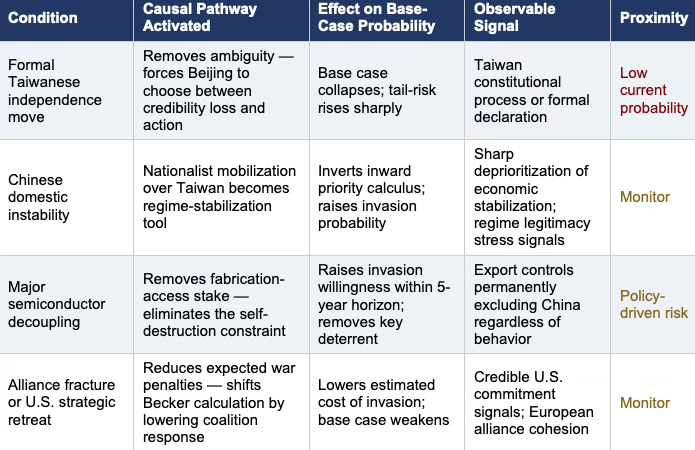
The delay-dominant equilibrium is durable but not permanent. Four conditions could break it, each activating a different causal pathway:
• A rapid or formal Taiwanese independence move that forces Beijing to choose between credibility loss and military action — removing the ambiguity that makes delay rational.
• Chinese domestic instability severe enough that nationalist mobilization over Taiwan becomes a regime-stabilization tool — inverting the current calculus where internal priorities favor restraint.
• Major semiconductor decoupling that credibly removes China’s fabrication-access stake — eliminating the self-destruction constraint and freeing Beijing from the industrial cost of invasion.
• Alliance fracture or U.S. strategic retreat that materially reduces expected war penalties — shifting the Becker expected-penalty calculation by lowering the coalition response China would face.
Equilibrium Breakers — Decision Matrix
PREDICTION — 2 TO 5 YEARS
The most likely equilibrium is not clean resolution. The most likely equilibrium is persistent crisis signaling, deeper dual-use industrial competition, and recurring public invasion dates that outrun actual decision evidence.
FALSIFICATION CONDITION
The equilibrium changes if one side concludes delay is no longer beneficial — if Beijing believes the window is closing fast, or if Washington and allies materially reduce Taiwan-related semiconductor leverage and alter the geometry.
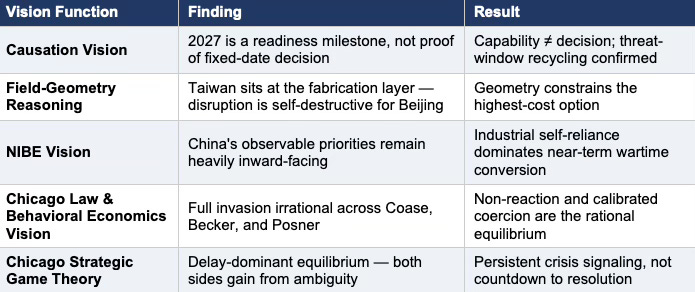
Vision Function Runtime Summary
XI. Integrated MindCast Interpretation
The five frameworks converge on one output. The invasion-window narrative is directionally serious but structurally overstated. China is building the option. Public evidence does not yet prove a fixed-date decision to use the most destructive option on the public timetable Washington keeps repeating. Predictive Institutional Cybernetics — drawing on the intellectual lineage documented in Cybernetic Foundations and From Cybernetic Proof to Simulation Infrastructure — strengthens that interpretation as an overlay. The system behaves like a feedback loop: U.S. officials issue warning windows, institutions amplify urgency, China preserves ambiguity, industrial systems adapt, and the loop repeats. The loop is real. The standard public interpretation of the loop is too shallow.
Output Classes
Base Case — 60–70% probability through 2028. China continues military preparation, industrial self-strengthening, gray-zone pressure, and coercive optionality. The United States continues public warning cycles and alliance signaling. No full invasion. Fabrication constraint holds. Coercion remains calibrated below the self-destruction threshold.
Higher-Risk Case — 20–25% probability through 2028. Blockade, quarantine, or sharp coercive escalation below invasion. This becomes more likely than a clean amphibious assault because it pressures Taiwan without immediately accepting the full cost structure of fabrication-layer destruction. Markets misprice this scenario as lower risk than the invasion countdown they are tracking.
Tail-Risk Case — 5–10% probability through 2028. Direct invasion or war-triggering crisis. Still possible, but not the lead forecast on present structure. The probability rises materially if any of the equilibrium breakers identified above activate within the same window.
XII. Forward Predictions — Falsifiable Ledger
Consistent with MindCast’s falsifiable prediction discipline, these predictions are logged against the public record and tested as evidence accumulates.
1. “Ready by 2027” will continue to be cited as though it were a decision deadline, even though official public statements themselves distinguish readiness from decision. Prediction: the recycling continues; the invasion does not.
2. Chinese strategy will continue emphasizing industrial resilience and technological self-reliance while preserving military pressure. Observable signals: processing investments, state-backed manufacturing moves, and domestic compute-cluster coordination rather than public confrontation.
3. The most probable near-term military danger is coercion short of full invasion — blockade, quarantine, and gray-zone operations rather than amphibious assault.
4. Taiwan’s semiconductor centrality will keep acting as a restraint on maximal escalation until substitution capacity materially changes. Falsification: a Chinese strike directly targeting TSMC fabrication infrastructure.
5. The most destabilizing near-term U.S. policy would be export controls calibrated to permanently exclude China from leading-edge access regardless of behavior. That policy eliminates the deterrence incentive by removing the asset being protected. By removing any residual industrial benefit from restraint, permanent exclusion can reduce the deterrent value of preserving the fabrication node intact. Prediction: aggressive export control escalation increases rather than decreases Chinese willingness to act militarily on Taiwan within a 5-year horizon.
XIII. Capital Market Implications
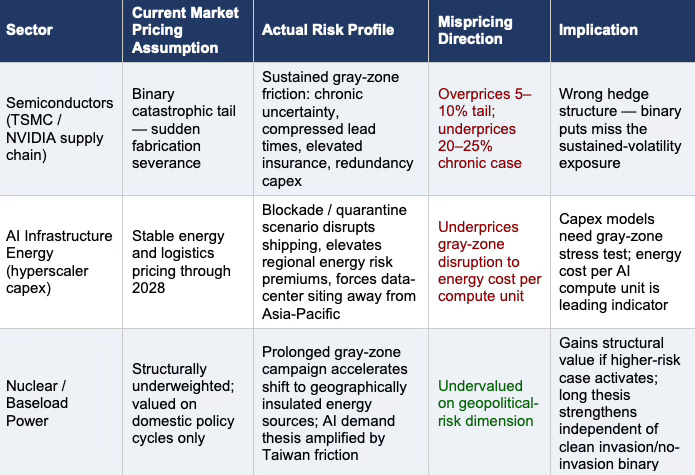
Markets currently price Taiwan risk as a binary invasion countdown. That framing produces systematic mispricing across at least three sectors. The AI industrial stack framework from Part I clarifies where the real exposure sits — and it is not where the headline risk premium is concentrated.
Semiconductors — mispriced invasion binary: TSMC and the broader Hsinchu ecosystem carry a risk premium sized to the probability of a sudden catastrophic disruption. The more accurate risk profile is sustained gray-zone pressure — quarantine signaling, maritime encirclement, cyber operations — that introduces chronic uncertainty without a single detonation event. That profile implies lower catastrophic-tail risk and higher sustained-volatility risk than binary invasion pricing suggests. NVIDIA’s supply-chain concentration maps directly onto this: the relevant scenario is not TSMC fabs destroyed overnight but TSMC fabs operating under persistent geopolitical friction that compresses lead times, elevates insurance costs, and forces supply-chain redundancy capex.
AI infrastructure energy — underpriced chronic risk: The blockade and quarantine scenario — the 20–25% probability higher-risk case — is the scenario that most directly pressures AI infrastructure economics without triggering the full fabrication severance. A Taiwan Strait quarantine disrupts shipping, elevates energy risk premiums in the region, and forces data-center siting decisions away from Asian proximity. Hyperscaler capex models that assume stable energy and logistics pricing through 2028 have not stress-tested against the higher-risk case. Energy cost per AI compute unit is the metric that would move first in a sustained gray-zone escalation.
Nuclear and baseload power — structurally underweighted: If the higher-risk case materializes as a prolonged gray-zone campaign rather than a clean military resolution, the AI infrastructure buildout accelerates its shift toward energy sources that are geographically and politically insulated from Asia-Pacific disruption. Nuclear baseload and long-term natural gas agreements in North America and Europe gain structural value under that scenario. Both governments are already accelerating nuclear buildout in ways that would have been politically difficult a decade ago — the AI energy demand thesis is driving that regardless of Taiwan, but Taiwan gray-zone escalation would sharpen the urgency.
Capital Market Mispricing — Sector Summary
XIV. Foresight Implications
For investors and capital allocators: The Taiwan risk premium embedded in semiconductor supply chains and data center capex is real but partially misdirected. The invasion-probability risk is lower than the invasion-window narrative implies precisely because the AI race has raised the self-destruction cost. The more important risk is sustained gray-zone pressure that disrupts production without triggering full military response — more sustained uncertainty, less binary catastrophe.
For AI policy architects: Export control design should account for the deterrence externality. Controls calibrated to slow Chinese AI development without foreclosing all paths may preserve the fabrication-access incentive that constrains Chinese military action. Controls calibrated to permanently exclude China may eliminate that incentive. This is an argument for calibrating them with the deterrence effect in the objective function.
For institutional foresight practitioners: The AI race has created a novel class of structural constraint that operates below the level of treaty, alliance, or explicit deterrence doctrine. Ignoring it produces systematically overestimated invasion probabilities and systematically misallocated risk hedging. Incorporating it respecifies the form and probability distribution of that risk toward coercion below invasion threshold.
Conclusion
The standard Taiwan narrative mistakes a useful bureaucratic frame for a predictive one. China remains a serious threat. Taiwan remains the central semiconductor chokepoint in the global AI economy. Neither point supports the claim that invasion by a publicly repeated year is the most likely near-term outcome.
Ukraine raised the demonstrated cost of major war. Taiwan’s semiconductor centrality made invasion more self-damaging than headline rhetoric admits. Economic interdependence still imposes severe penalties on maximal escalation. Xi’s observable priorities remain heavily internal. Those conditions do not eliminate conflict risk. They widen the gap between countdown narratives and decision logic.
The deeper mistake is analytical. Washington keeps discussing Taiwan as though the problem were mainly military timing. The real problem is industrial geometry. Taiwan is the fabrication-layer chokepoint inside the AI stack. Any forecast that ignores that fact will keep confusing capability with intent, planning horizons with decisions, and bureaucratic urgency with foresight.
The sharpest formulation is also the simplest: 2027 is best understood as a planning milestone, not an invasion prophecy. China is building the option. The evidence does not support the conclusion that Beijing is most likely to exercise it on the public timetable Washington keeps recycling.
MindCast AI Framework References
All frameworks cited in this publication are open-access at mindcast-ai.com.
The Silence Dividend, Part I — Why U.S. Actions in Venezuela and Iran Reveal the Structure of the AI Supply Chain — https://www.mindcast-ai.com/p/ai-us-venezuela-iran-china
Runtime Causation Arbitration Directive — Operationalizing Structural Foresight Across Domains — https://www.mindcast-ai.com/p/run-time-causation
Field-Geometry Reasoning — A Unifying Framework for Structural Explanation in Law, Economics, and AI — https://www.mindcast-ai.com/p/field-geometry-reasoning
MindCast AI Constraint Geometry and Institutional Field Dynamics — https://www.mindcast-ai.com/p/constraint-geometry
Runtime Geometry — A Framework for Predictive Institutional Economics — https://www.mindcast-ai.com/p/runtime-geometry-economics
Chicago School Accelerated — The Integrated, Modernized Framework of Chicago Law and Behavioral Economics — https://www.mindcast-ai.com/p/chicago-school-accelerated
Chicago School Accelerated, Part III — Posner and the Economics of Efficient Liability Allocation — https://www.mindcast-ai.com/p/chicagoseriesposner
MindCast AI Emergent Game Theory Frameworks — Defining NIBE and Strategic Behavioral Coordination — https://www.mindcast-ai.com/p/mindcast-game-theory
Predictive Institutional Cybernetics — How MindCast AI Uses Constraint Geometry and Causal Signal Integrity to Forecast Institutional Behavior — https://www.mindcast-ai.com/p/predictive-institutional-cybernetics
The Cybernetic Foundations of Predictive Institutional Intelligence — https://www.mindcast-ai.com/p/cybernetics-foundations
From Cybernetic Proof to Simulation Infrastructure — https://www.mindcast-ai.com/p/cybernetics-simulations
MindCast Predictive Cybernetics Suite — Umbrella — https://www.mindcast-ai.com/p/cybernetics-umbrella
Live-Fire Game Theory Simulators — Runtime Predicti