

Companion to How Export Control, Investment Screening, and Cable Geopolitics Reprice Data Center Capital
Related works: AI Data Center Developers Going Public in America Must Disclose Foreign Ownership and Control | AI Data Center Credit Risk — Permitting, Curtailment, and the Cost of Capital · The MindCast AI Data Center Record (August 2026) · The Authorization Market: Standardized Bargaining, Rationed Power, and the Competition to Build America’s AI Infrastructure (2026) · The Data Center Authorization Price: A 50-State Baseline (2026) · Capital Is the New Computing: Financing the Next Era of AI Infrastructure, 2025–2045 (November 2025) · Power Brokers & Digital Real Estate: How CRE Firms Are Building the AI Infrastructure Backbone (November 2025)
Critical references: The Model AI Infrastructure Authorization Code · The Data Center Authorization Market: A 50-State Regulatory Atlas
See MindCast AI Data Center Live-Fire Mission
Executive Summary
American states now quote a price into a global auction, and most of the officials setting that price do not know they are bidding.
County councils, utility commissions, and legislatures fix the terms on which a data center may be built, powered, and operated. Sovereign wealth funds in Abu Dhabi, Riyadh, Singapore, Tokyo, and Toronto read those terms into underwriting models before committing capital to American ground. Hyperscalers read the same terms when choosing whether marginal capacity lands in Ohio or in Johor. Authorization law has become a traded instrument.
Two markets move at once, and American authorization policy prices both. Foreign investors buy ownership positions in American infrastructure. Foreign governments compete to attract the American compute capability those same investors help finance. Money travels toward the United States while compute capacity travels away from it, and the two flows can move in opposite directions at the same moment. Recognizing the divergence is the central contribution of this publication.
Both markets price one variable. Foreign capital enters the United States when the American authorization burden sits below the domestic alternative, adjusted for power delivery, technology access, and tenant credit. Foreign governments courting developers work to push their own burden beneath that difference. The difference — the authorization spread — is the instrument defined and measured here.
American authorization authority fragments in a way no competitor’s does. Fifty legislatures, roughly three thousand counties, fifty utility commissions, and a federal export-control apparatus each hold a piece, and no single layer controls the full stack. Every foreign jurisdiction examined here controls its own authorization price more centrally than any American jurisdiction controls its own. The United States competes globally through a mechanism with no global-facing operator.
Authorization is the only competitive factor a legislature governs. Land, water, and generation potential arrive from nature. Capital, firm power, and queue position accumulate across years. Advanced chips are allocated by another sovereign through export licensing. Authorization alone is manufactured by law inside a single session, which concentrates the entire competitive margin onto one row of the ledger.
Five foreign jurisdictions have already completed a price correction, and each settles against public record rather than forecast. Singapore paused, repriced, and reopened under published criteria. Ireland reached effective refusal in Dublin through grid-operator and regulator action, then reopened in December 2025 on published terms. Chile lost a granted permit in court over groundwater. Alberta rationed an oversubscribed queue. Quebec restricted utility allocation. Completed corrections carry evidentiary weight that American forecasting cannot match.
Ireland answers the officials who believe inaction preserves optionality. Grid operator and regulator action closed the Dublin region to new large energy users from 2021, with no statute and no vote, while elected officials still marketed Ireland as open for business. The market reopened in December 2025 when authorization moved from implicit refusal to explicit, published terms — four years later, with the physical constraint unchanged.
Displaced capacity relocates rather than disappearing. Capacity priced out of one jurisdiction moves to whichever neighbor shares the customers, the cables, and the latency envelope but not the regulator. Singapore and Johor demonstrate the mechanism across sixty kilometers and an international border. Washington and Idaho present the same geometry, and so do Virginia and West Virginia.
Not all capacity can move, and the distinction sets policy. No foreign jurisdiction in the study captures latency-sensitive American-serving capacity at material scale. Training and batch workloads are mobile. American jurisdictions hold real bargaining power over the captive share, and treating all capacity as mobile concedes leverage that does not need conceding.
Most jurisdictions spend on the factor they already hold. Capital-rich and power-poor jurisdictions cannot buy firm power with policy. Power-rich and capital-poor jurisdictions cannot conjure capital and should be reforming interconnection queues instead of writing tax holidays. Jurisdictions holding both endowments — the United States, Canada, and Saudi Arabia — face authorization as the principal marginal factor, which bounds the threat to American states more tightly than either side of the debate assumes.
Four distinct failure modes show why cheap or unstable authorization does not convert into durable capacity.Ireland priced low and ended in refusal. Vietnam offers generous terms on a factor the buyer weights lightly. Chile granted a permit its courts withdrew. Johor is absorbing displaced demand without pricing the constraint it is approaching. Singapore did the opposite — raised its price openly, published criteria, and kept the high-value work.
Capacity leaves a state without leaving the country. Fragmented American authority is a liability and a moat at once. Fragmentation permits invisible repricing and raises transaction costs, and the same fiber density and market depth that produce the fragmentation also produce numerous domestic substitution corridors. State-level capital flight can therefore be real while national-level foreign substitution stays small — which reconciles the two claims that otherwise appear to contradict each other.
Repricing propagates as a cycle rather than a one-way transfer. A state reprices, marginal capacity moves to a neighbor, the neighbor’s queue and ratepayer burden rises, and the neighbor reprices in turn. Equilibrium arrives not when a cheap state wins but when successive corridor repricing drives the marginal authorization spread down to the value of relocating.
Announced capacity and energized capacity measure different things. Cheap jurisdictions win announcements, because commitment language carries option value at no cost. Physical and legal constraints decide whether announced megawatts ever energize. Competitive share should therefore be read from energized capacity, and authorization certainty should show up there first.
Where to start, by role.
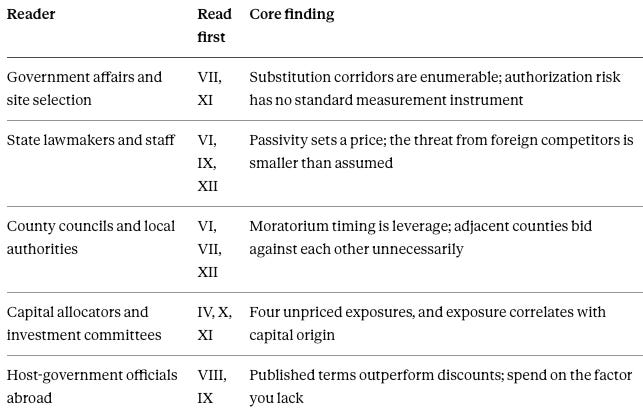
Parts I through VII build the instrument and the evidence. Part VIII tests what host governments conclude from watching American states reprice, and Part IX sets out what policy can actually buy in each factor position. Part X converts the analysis into twenty-five predictions, each with a deadline, a falsifier, and a named settlement source. Parts XI and XII state what follows for investors and for lawmakers.
I. The Authorization Price as an Exchange Rate
Authorization price behaves like an exchange rate and requires a more precise instrument to function as one. Currency rates map one denominated value into another continuously. The 50-State Authorization Price Atlas grades jurisdictions rather than denominating them, so cross-border comparison needs a spread rather than a rate.
Authorization Spread (A→B) = expected all-in authorization burden in jurisdiction A minus expected all-in authorization burden in jurisdiction B, conditional on power delivery timing, technology access, and tenant credit quality.
All-in authorization burden comprises the four components the Atlas already grades: statutory conditions, tariff and cost-allocation exposure, commission-order risk, and local ordinance and veto risk. Adding the three conditioning variables converts a domestic grade into a cross-border comparison. A jurisdiction with a light authorization burden and a five-year energization queue does not offer a favorable spread, whatever its grade suggests.
Capital allocators compute the spread whether or not they name it. An underwriting committee weighing a Texas site against a Johor site calculates exactly that quantity, and every term inside it is set by a government somewhere.
Spread language also carries a warning that rate language hides. Rates imply symmetry and continuous convertibility, and authorization markets offer neither. Latency, cable landing, tenant contracts, and export licensing all constrain substitution, so a favorable spread converts into relocated capacity only where substitution remains physically and legally available.
Every spread computed in this publication draws one side from the Atlas and the other from published foreign instruments. Parts VI and VII identify where substitution is open, and Parts II through V identify who is trading on each side.
II. The Two-Way Market: Capital In, Compute Out
American authorization policy prices two markets simultaneously, and conflating them has produced most of the confusion in public debate. Market one sells foreign investors ownership positions in American infrastructure. Market two sells hyperscalers and developers the right to build on American ground rather than elsewhere. A single policy change moves both, and not always in the same direction.
Sorting jurisdictions by direction of flow separates those facing a genuine two-sided decision from those that only receive.
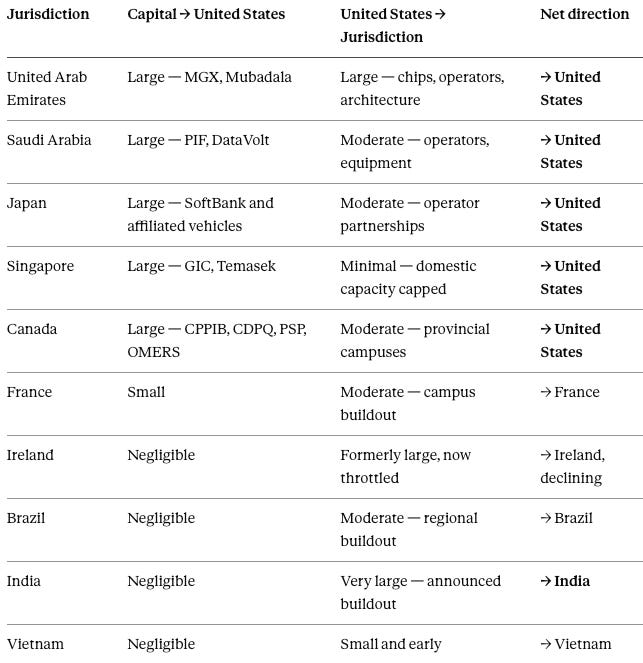
Five of ten jurisdictions send capital toward the United States, and all five hold surplus investable capital. The remaining five receive American buildout without returning capital. The familiar framing — foreign actors either invest here or compete with us — therefore describes one population running both legs and a second population running one.
American capital runs a third leg the table above omits. United States infrastructure funds, private-equity platforms, and pension allocators deploy into foreign data center assets, and the Blackstone acquisition of AirTrunk moved American capital into Australian capacity at scale. Australia illustrates the outbound leg without entering the ten-jurisdiction comparative set. Host governments therefore compete for American money as well as for American compute, which means an American state raising its authorization price can push both capacity and domestic capital toward the same foreign jurisdiction.
The Gulf pattern makes the divergence concrete. Emirati and Saudi capital moves west into American projects while American chips, operators, and reference architectures move east into Gulf campuses. Capital and capability trade in opposite directions between the same two parties, which is the signature of a market where one side holds surplus capital and the other holds scarce technology. Interpretive confidence: 70–80%.
France exposes a competitive triangle that bilateral framing conceals. MGX partners with Bpifrance and Mistral on Campus AI, targeting up to 3 GW of French capacity, so France and the United States compete for the same sovereign pool rather than trading with each other. Authorization price operates as a bid into a shared auction rather than as a term between two counterparties. Interpretive confidence: 60–70%.
Two markets, one price, and opposite directions of travel. Part III explains why authorization law rather than any other input carries the competitive weight.
III. Authorization Spread and the Four-Factor Model
Sorting inputs by who controls them explains why authorization law absorbs the competitive margin. Three factor classes sit beyond a legislature’s reach entirely. The fourth is created by statute, tariff, commission order, and ordinance.
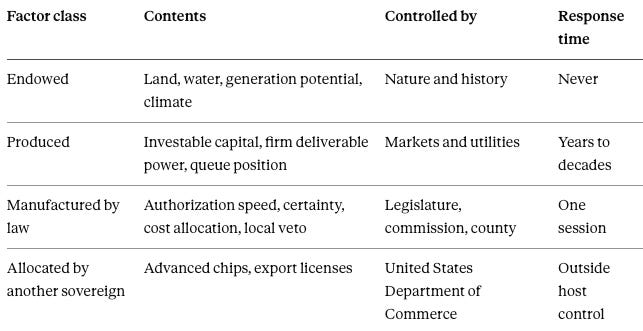
Legislators control one row. Competing on the other three means competing on inputs a finance ministry cannot manufacture, which is the error Part V documents in Vietnam and the reason authorization policy determines outcomes that appear to turn on geography.
Two amendments to classical factor analysis are required before the model fits this industry.
Energy is not a primitive factor. Electricity is produced from land, capital, and fuel, and what data centers actually bid for is firm power deliverable on a date certain. An interconnection queue position, not generation capacity, is the traded good. Brazil holds enormous surplus generation alongside multi-year energization delay, and abundance without deliverability loses to less abundance with a queue slot.
Labor has inverted. Hyperscale campus employment runs in the low hundreds at most and often below one hundred. Finance ministries competing on workforce cost and training subsidies bid a factor the buyer weights lightly. Locally, no labor constituency forms to defend a project when opposition organizes — the political dynamic behind several American county moratoria.
Classical trade theory supplies the ancestry of the taxonomy without supplying its mechanics. Factor-endowment reasoning correctly predicts that capital-surplus and power-scarce jurisdictions export capital while power-surplus and capital-scarce jurisdictions host, and the prediction holds across every jurisdiction examined. Factor price equalization does not follow. Capital moves under CFIUS review, the decisive technology moves under export license, electricity is not tradable across the relevant distances, latency imposes hard geographic limits, and agglomeration produces increasing rather than diminishing returns.
The operative theory is narrower and more testable: jurisdictional arbitrage under heterogeneous regulatory prices and constrained substitution. Differing authorization prices create arbitrage opportunities. Physical and legal limits constrain substitution. Capacity relocates only along the paths that remain open.
Two variables define the cells, and the second requires care. Endowment measures power resource — generation potential, fuel, hydrology, climate — not delivered power. Deliverability is a separate and later condition, which is why cell III jurisdictions hold abundant endowment and still lose to jurisdictions holding less of it.
The full hierarchy runs: resource endowment → deliverability → authorization → realized capacity. Endowment sets who can compete. Deliverability sets whether the endowment reaches a tenant. Authorization sets the terms. Realized capacity is what survives all three.
Factor cells identify who can participate in each market.
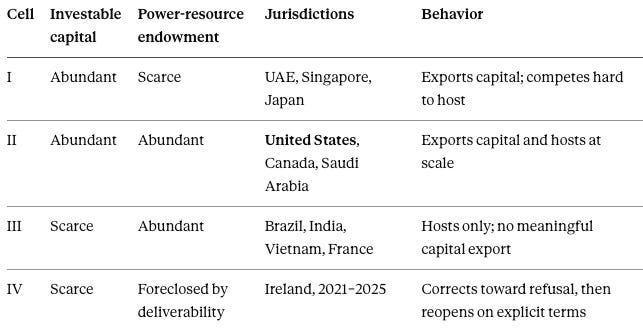
Cell II is the position the United States occupies and can lose. Canada and Saudi Arabia are the only other occupants, reaching the cell through different endowments — Quebec hydro and Alberta gas in one case, gas-fired generation cost in the other. Cell IV sits outside the endowment frame: Ireland holds adequate national resource and lost the Dublin region to deliverability foreclosure, which is how a jurisdiction exits the competition without any endowment changing.
Contact mcai@mindcast-ai.com to partner with us on Predictive Game Theory AI in Law and Behavioral Economics. We specialize in predictive simulations for Complex Litigation, Innovation Economics, Geopolitical Risk Intelligence and Legacy Innovation. See more about MindCast series at our new website MindCast Corporate.
To test our predictive simulation AI system, in 2026 we simulated the Super Bowl and the World Cup. See 🏈 Super Bowl LX — AI Simulation vs. Reality | ⚽ The 2026 World Cup Final Simulation Validation
To deep dive on MindCast works upload the URL of this publication into any LLM (preferably Google AI mode) and prompt ‘reconstruct MindCast framework with three degrees of cited sub links.’ See Live-Fire Game Theory Simulators, Runtime Predictive Infrastructure.
IV. Who Funds America
Five jurisdictions supply nearly all foreign capital entering American data center assets, and the institutional concentration inside those five runs tighter still. Roughly twelve to fifteen institutions carry the inbound leg: MGX and Mubadala from Abu Dhabi, the Kuwait Investment Authority, the Public Investment Fund and DataVolt from Riyadh, GIC and Temasek from Singapore, SoftBank and affiliated vehicles from Tokyo, and CPPIB, CDPQ, PSP, and OMERS from Canada. Every name appears in public disclosure, so the count is verifiable rather than estimated.
Scale is no longer theoretical. A consortium of MGX, BlackRock’s Global Infrastructure Partners, and the AI Infrastructure Partnership closed the acquisition of Aligned Data Centers at a $40 billion valuation covering 51 campuses and roughly 6.4 GW of operational and planned capacity across the Americas, then committed a further $5 billion to expansion in July 2026. MGX closed its first fund at $49 billion. One transaction placed Gulf sovereign capital behind more American data center capacity than most states host in total.
Concentration produces a consequence American legislators rarely price. A dozen underwriting committees, each reading state commission orders and county ordinances as inputs to a discount rate, collectively govern more capital deployment than any single legislative session directs. Underwriting decisions of that kind stay largely invisible to the state authorization process, which sees intervenor filings and hearing testimony rather than discount-rate assumptions.
Exposure differs materially by source, and the difference is the diligence finding this publication contributes. Gulf capital carries correlated exposure, because one American regulatory apparatus governs both its inbound chip access and its outbound investment treatment. A tightening in export licensing and a tightening in CFIUS review are not independent events for an Emirati or Saudi allocator. Canadian and Japanese capital faces the same two channels without the correlation. Pricing the correlation is straightforward once identified and absent from public analysis. Interpretive confidence: 70–80%.
Structure determines exposure as much as origin. Passive limited-partner positions, direct joint ventures, and debt each draw different CFIUS treatment, and sovereign vehicles draw the most scrutiny in every structure.
Authorization risk compounds the question at the asset level. A moratorium at a named site, a commission order reallocating transmission cost, or an interconnection queue outliving the fund horizon each converts an infrastructure asset into a warehouse.
Twelve institutions, four exposures, and one variable none of them can hedge. Part V turns to the jurisdictions competing for the capacity those institutions finance.
V. Who Competes With America
Five jurisdictions compete for capacity without supplying capital, and each competes on a different factor. Testing their instruments against the four-factor model separates the strategies that can work from the strategies that cannot.
India competes on market access enforced through data localization, converting a regulatory mandate into permanent domestic demand. Indian states then compete against one another with incentive packages, reproducing American interstate competition inside a single country and eroding the aggregate national price without improving grid delivery. India remains capital-light, with no material outbound position in American data center assets. Naming the asymmetry matters, because the selection test in Part XIII asks whether a jurisdiction sends capital, receives buildout, or does both — and India does one thing only.
France competes on dispatchable nuclear generation, the one endowment a finance ministry cannot manufacture and the strongest competitive position in Europe. Sovereignty framing wrapped around Gulf-funded, American-equipped campuses creates terms investors discount, and EU regulatory overlay adds friction the French state does not control.
Brazil competes on renewable surplus and fails on deliverability. Curtailed generation in the Northeast is real. Multi-year energization timelines convert the surplus into an unusable endowment for any tenant requiring firm power on a committed date.
Vietnam competes on labor cost, training subsidies, and tax holidays — the playbook that built its electronics manufacturing sector — against an industry whose campuses employ in the low hundreds. Grid reliability, data-transfer rules, and approval opacity are the binding constraints, and none appears in the offered package. Vietnam can win every negotiation it runs and still lose. Interpretive confidence: 70–80%.
Ireland competes again, on terms requiring applicants to bring their own generation. Part VI examines the arc.
Vietnam’s failure mode transfers most directly to American state legislatures. Offering the wrong factor generously looks identical to competing hard in a press release, and only the buyer can tell the difference.
VI. Completed Foreign Price Corrections
Five jurisdictions have run an authorization-price correction to completion, and each outcome settles against a named public source. Weighting completed corrections above forward projections applies the same evidentiary standard the Authorization Series applies to its own claims.
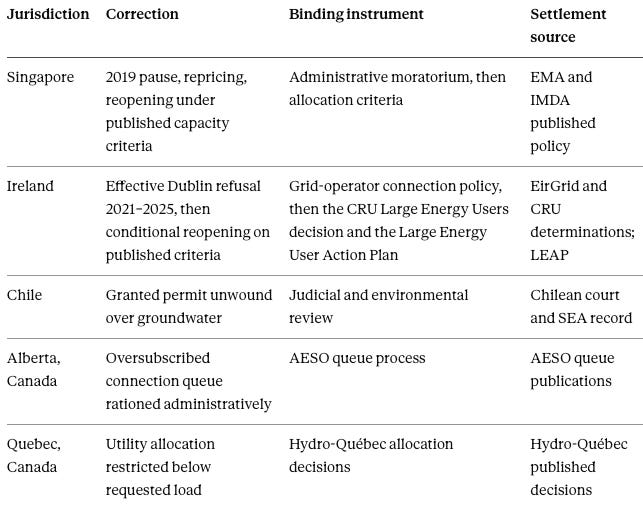
Ireland is the most instructive case in the study, because the correction arrived through instruments no elected official controlled. Grid adequacy margins eroded. The operator restricted connections. The regulator formalized assessment criteria. No statute changed, no vote occurred, and the government presiding over the closure was still marketing openness while applications were being refused.
The reopening completes the arc and carries the sharper lesson. Ireland regained access to its own market only after the regulator published a connection decision in December 2025 and the government adopted the Large Energy User Action Plan in January 2026 — four years after the invisible refusal began. Applicants must now supply generation or storage covering full demand and source at least 80% of annual demand from new Irish renewables. The physical condition never changed; only the terms did.
Chile settles abroad the water objection that Washington counties are raising domestically, and settles it against a developer. Where independent review retains reversal power, a granted permit is not a permit held.
Johor appears in Part VII rather than here. Johor absorbed demand Singapore shed and has not yet corrected, which makes Johor substitution evidence rather than a completed correction.
Ireland and Alberta converged on the same instrument without coordinating. Ireland requires applicants to supply generation covering full demand. Alberta’s Data Centre Regulation, in force June 2026, prioritizes projects tethered to dedicated new generation. Two jurisdictions on different continents, facing the same adequacy problem, independently adopted bring-your-own-generation — authorization architecture converging internationally rather than only across American states.
Three lessons follow for American jurisdictions. Passivity preserves nothing, because Ireland’s closure was a product of inaction rather than of policy. The binding instrument frequently sits beneath the visible one, which is why the Atlas grades tariff and commission order alongside statute and ordinance rather than treating them as technical plumbing. And a market closed by implicit refusal reopens only on explicit terms.
VII. Jurisdictional Arbitrage and Substitution Pairs
Capacity priced out of one jurisdiction relocates rather than disappearing, and relocation requires an available path. Identifying open paths is the operational core of the analysis, because a jurisdiction with no substitute can raise its price further than one sitting sixty kilometers from a permissive neighbor.
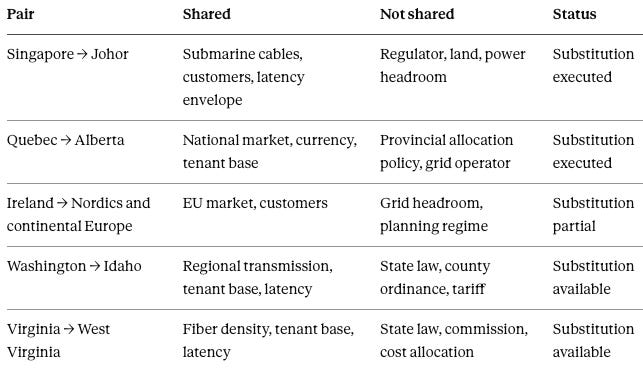
Substitution requires four conditions to hold at once: latency parity for the workload class, physical connectivity through existing fiber or cable, an available power path within the tenant’s timeline, and legal permission including any applicable export controls. Failure of any single condition closes the path, which explains why a favorable spread does not always produce relocation.
Constrained substitution also bounds the competitive threat foreign jurisdictions pose. Latency-sensitive workloads serving American users do not migrate to Johor or Riyadh at material scale, so foreign competition applies to training capacity, batch workloads, and regional serving rather than to the whole market.
Distinguishing the substitutable share from the captive share is the single most useful thing an American legislator can know before setting a price. Treating all capacity as equally mobile overstates the constraint on domestic policy and concedes bargaining position that does not need conceding. Interpretive confidence: 70–80%.
VIII. What Host Governments Conclude, and What the Evidence Shows
Foreign ministries are watching American states reprice, and most will draw the same conclusion: an opening has appeared, and the way to capture it is to price beneath the American burden. Four observed cases give reason to doubt the conclusion. The four are not four attempts at one strategy — each jurisdiction failed differently — and read together they describe four distinct ways a low or unstable authorization price fails to convert into durable capacity.
Host governments compete for capital from every origin, not only their own. American infrastructure funds, Gulf sovereigns, Canadian pensions, and Japanese vehicles all allocate across borders, so a jurisdiction courting data center development is bidding for money and for capacity in the same auction. Undercutting appears to serve both objectives, but the observed cases show that cheapness alone does not reliably convert into durable capacity.
Authorization cost and authorization certainty are separable, and the market pays far more for the second. A high but fixed, published, non-reversible price beats a low price subject to reversal.
A queue position that clears on schedule is worth more to an underwriting committee than a discount a commission order or a court can claw back after capital commitment. Call the difference the certainty premium.
No jurisdiction has run a controlled comparison between the two variables. The four cases below supply comparative observational evidence consistent with the proposition rather than proof of it. Interpretive confidence: 70–80%.
Four distinct failure modes appear across the study, each with a jurisdiction that demonstrates it.
Failure mode one — pricing low and absorbing everything. Ireland set the lightest authorization burden in Western Europe, absorbed demand past grid adequacy, and terminated in effective refusal through grid-operator and regulator action. A low price without a delivery constraint is not a competitive position; it is deferred refusal, and the deferral cost Ireland four closed years.
Failure mode two — offering the wrong factor generously. Vietnam competes with workforce cost, training subsidies, and tax holidays against an industry employing in the low hundreds per campus, while grid reliability and data-transfer rules remain unaddressed. Generosity on an input the buyer weights lightly reads as effort domestically and as noise to an allocator.
Failure mode three — granting what independent review can withdraw. Chile issued a permit and lost it in court over groundwater. Any jurisdiction whose environmental or judicial review retains reversal power quotes an inflated certainty it cannot honor, and sophisticated capital discounts the quote accordingly.
Failure mode four — absorbing a neighbor’s displaced demand without pricing it. Johor captured capacity Singapore shed, on permissive terms, and now approaches the grid and water constraints that triggered Singapore’s pause. Absorbing displaced demand is a windfall only where the absorbing jurisdiction prices the constraint before reaching it.
Singapore ran the opposite play and kept the outcome worth keeping. Singapore paused, published allocation criteria, raised its price openly, and reopened selectively — shedding commodity capacity to Johor while retaining the high-value workloads, the customers, and the cables. Raising a price transparently and defending it proved compatible with remaining a regional hub.
Two conclusions follow, and each serves a different reader.
For a host government, the competitive instrument is a published, stable, deliverable authorization process rather than a discount. The Model Data Center Authorization Code is jurisdiction-neutral drafting, and its certainty mechanisms — fixed timelines, defined cost allocation, and bounded reversal authority — transfer across legal systems without importing American law.
For an American legislator, the same evidence bears directly on the capital-flight objection. Four foreign jurisdictions offered a low or unstable authorization price, four failed to convert it into durable capacity, the capacity able to relocate is a minority share, and the one jurisdiction that raised its price openly kept the business worth keeping.
IX. What Policy Can Buy, by Factor Cell
Factor position determines which policy instruments work and which waste money. Sorting the study jurisdictions by cell produces a diagnostic rather than a menu: each cell faces a different binding constraint, and only one cell can improve its position through legislation alone.
One rule runs across all four cells. A jurisdiction should spend on the factor it lacks, and nearly every jurisdiction in the study currently spends on the factor it already holds. Interpretive confidence: 70–80%.
Cell I — capital abundant, firm power scarce. United Arab Emirates, Singapore, Japan.
Policy cannot manufacture power resource inside a physical limit. Capital buys equity positions in jurisdictions that hold the power, and domestic policy buys a niche in high-value, low-megawatt workloads — inference serving, financial and regulated data, sovereign-controlled functions. Additional hosting incentives purchase nothing, because the binding constraint is physical rather than fiscal. Singapore has already accepted the logic and allocates by value per megawatt. Gulf jurisdictions are still testing whether capital scale can substitute for the constraint.
Cell II — capital abundant, firm power abundant. United States, Canada, Saudi Arabia.
In cell II authorization becomes the principal marginal factor, because neither capital nor firm-power endowment binds first and authorization is left to decide the margin. Authorization matters in every cell — Chile lost a project to permit reversal from cell III — and only in cell II does authorization operate as the deciding variable rather than as one constraint among several that bind earlier.
Cell II is also the only cell that can lose its position through inaction. A jurisdiction holding both endowments and pricing them badly forfeits an advantage it cannot rebuild quickly. Canada demonstrates the internal version of the problem, with national clean-power marketing running against provincial allocation restriction.
Cell III — firm power abundant, capital scarce. Brazil, India, Vietnam, France.
Policy cannot conjure investable capital, so the operative lever is deliverability: interconnection queue reform, energization timelines a tenant can underwrite, and permitting insulated from post-grant reversal. Every cell III jurisdiction in the study currently spends on tax holidays, incentive zones, and workforce programs instead, which is spending on generation abundance it already possesses. Brazil holds curtailed surplus alongside multi-year energization delay, and no incentive package closes that gap.
Cell IV — corrected to constraint. Ireland.
Policy cannot manufacture capacity, and Ireland’s reopening shifted the generation obligation onto applicants rather than relieving the system constraint. What policy can buy in cell IV is an explicit allocation instrument, which is what restored access.
Two conclusions follow, and each serves a different reader.
For a host government, cell position sets the realistic ambition before any instrument is chosen. Cell I buys a niche, cell III buys deliverability, cell IV buys orderliness, and cell II buys competitive outcome through authorization design because authorization is what remains at the margin.
For an American legislator, the same diagnostic bounds the competitive threat. Cell I competitors cannot absorb American capacity at scale without first relieving a physical power constraint, and relieving it takes years rather than sessions. Cell III competitors can absorb it, but only after multi-year deliverability reform none has completed.
The genuine competitive threat sits in cell II — Canada and Saudi Arabia — and remains small relative to the capacity that cannot leave at all. Capital flight is a weaker argument against American repricing than either side of the debate currently assumes.
X. The Foresight Register
Twenty-five predictions follow from two independent executions of the same Cognitive Digital Twin register, run against the same observation record. Where both runs produced a band, the entries below carry the reconciled range and note the agreement.
Every entry is fixed as of August 12, 2026 and carries a deadline, a falsifier, a named settlement source, and a confidence band with a class label. Event-class entries resolve against an observable occurrence and are eligible for scoring. Interpretive-class entries express confidence in a structural read and never enter a probabilistic aggregate.
X.1 Five marquee predictions
Five entries carry the theory. A reader with time for nothing else should read these, and each appears again in the full register below with its falsifier and settlement source.
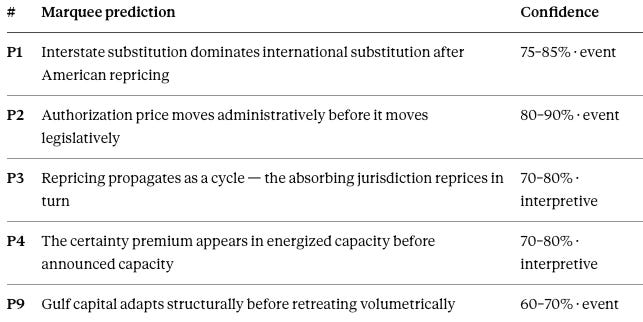
Taken together the five describe one dynamic: authorization price moves through the channels least visible to legislators, capacity relocates domestically rather than abroad, the receiving jurisdiction inherits the burden and reprices, and capital adapts its structure rather than its volume.
X.2 Primary register — predictions that test the theory
Eleven primary predictions test the mechanisms this publication introduces rather than the behavior of any single jurisdiction. Each one would fail if the underlying theory were wrong, which is what separates a prediction from a description.
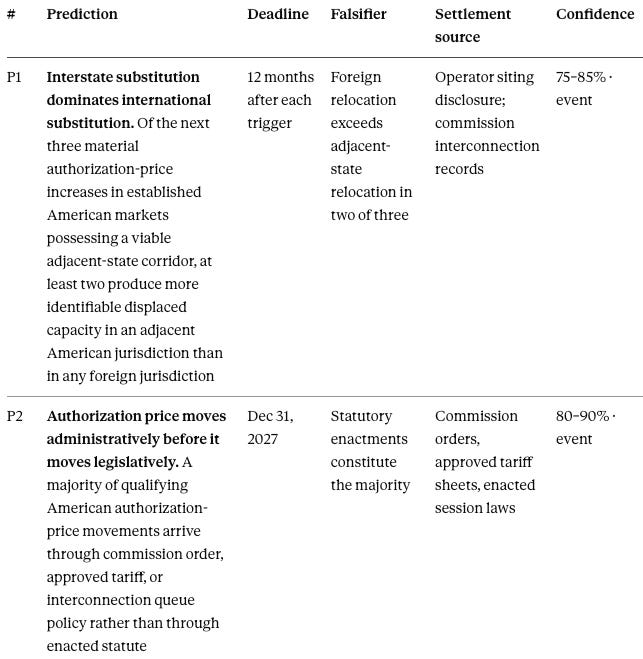
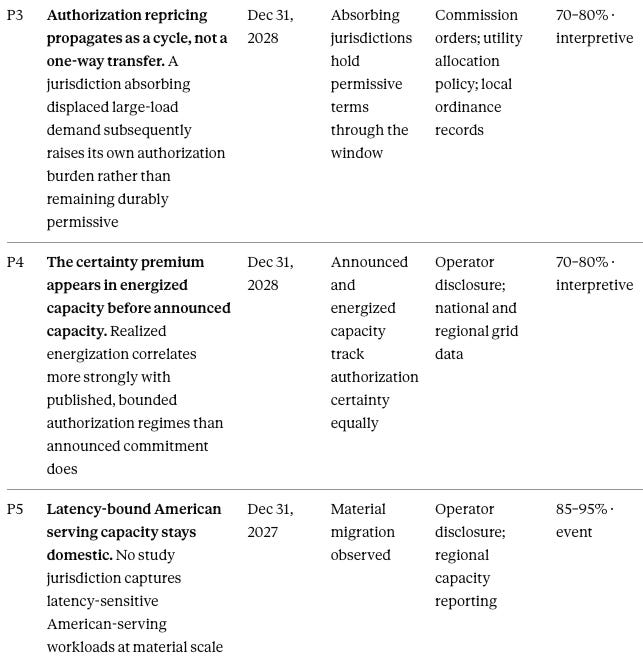
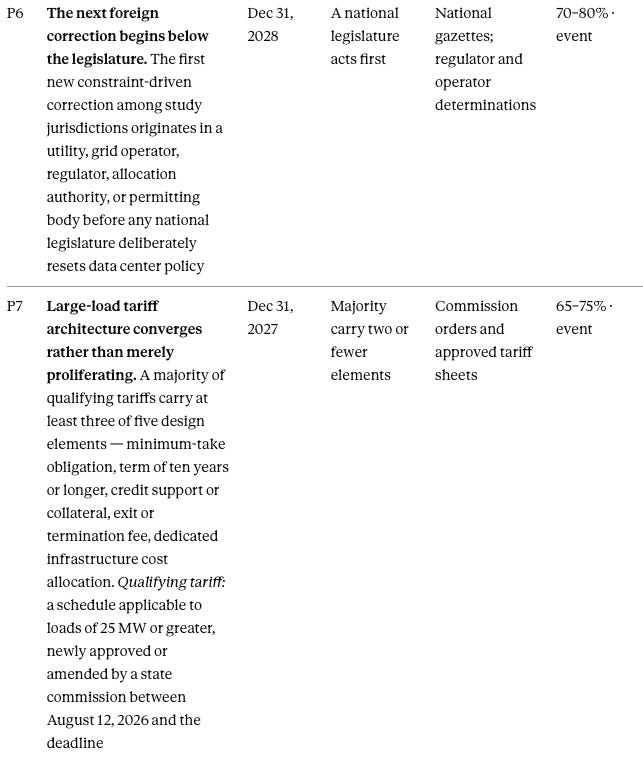
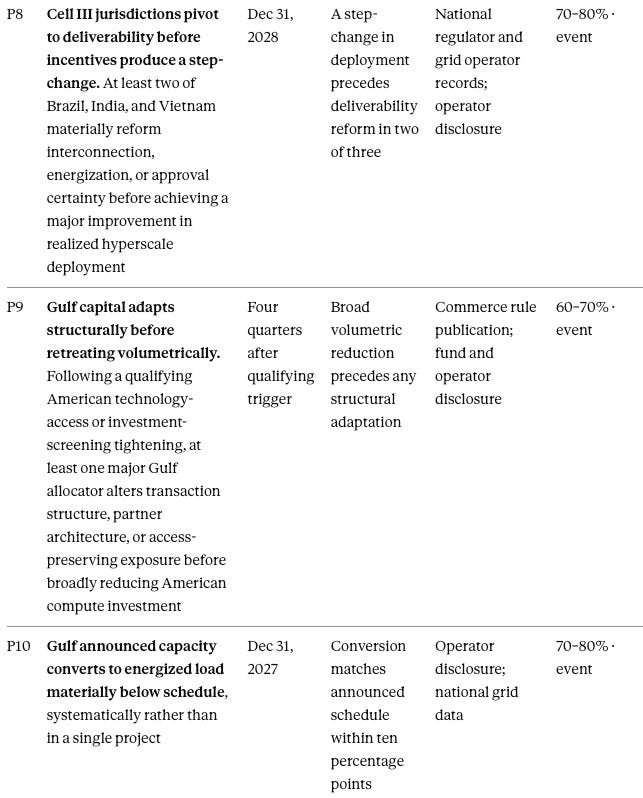
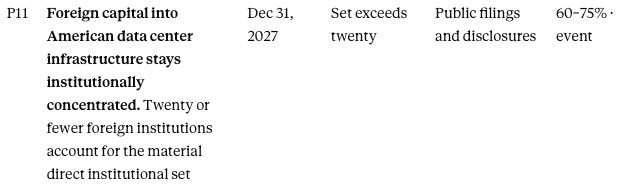
P11 carries a wider band because the two executions diverged. Support is stronger for the institutional count, which is verifiable from public filings, than for the behavioral inference drawn from it.
X.3 Secondary register — jurisdiction-level calls
Fourteen secondary predictions test individual jurisdictions against the mechanisms above. Each resolves faster than a primary entry and grades against a single named source, which makes the secondary register the early-warning layer for the primary one.
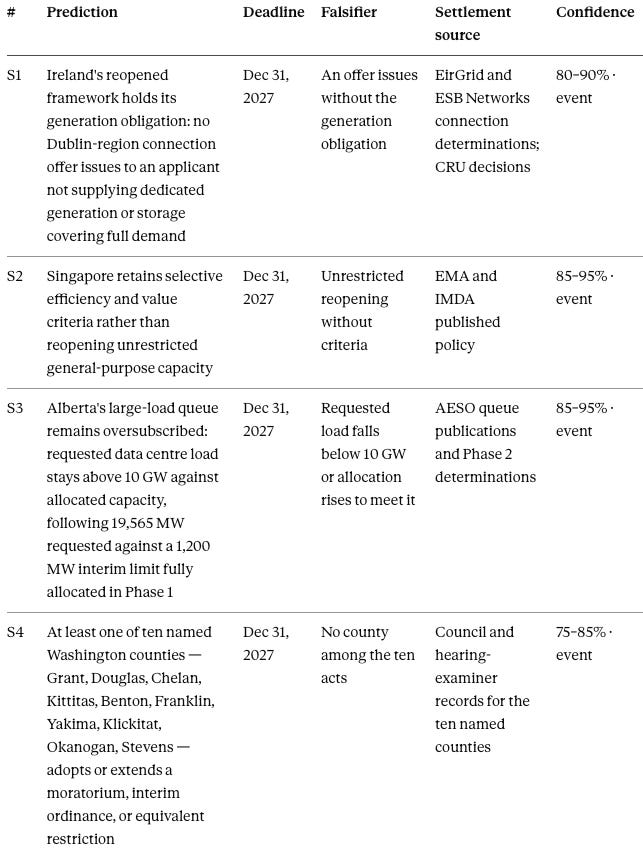
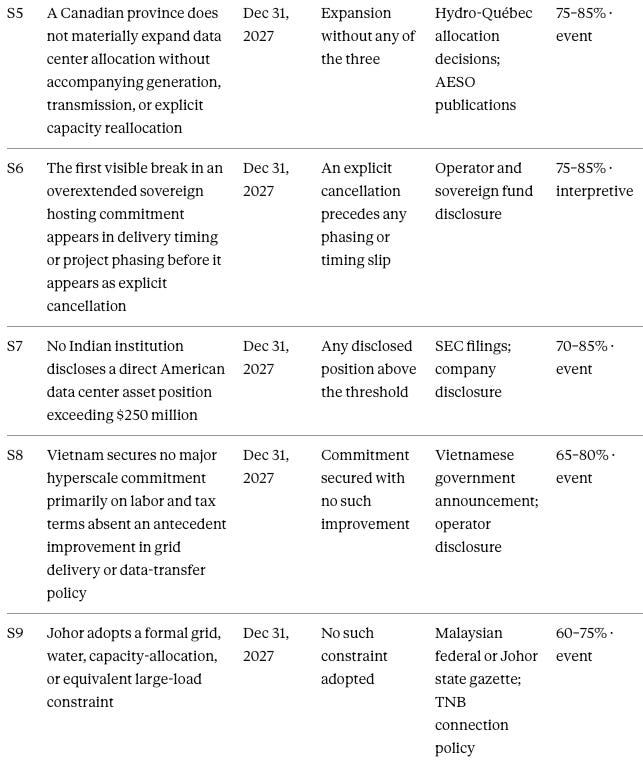
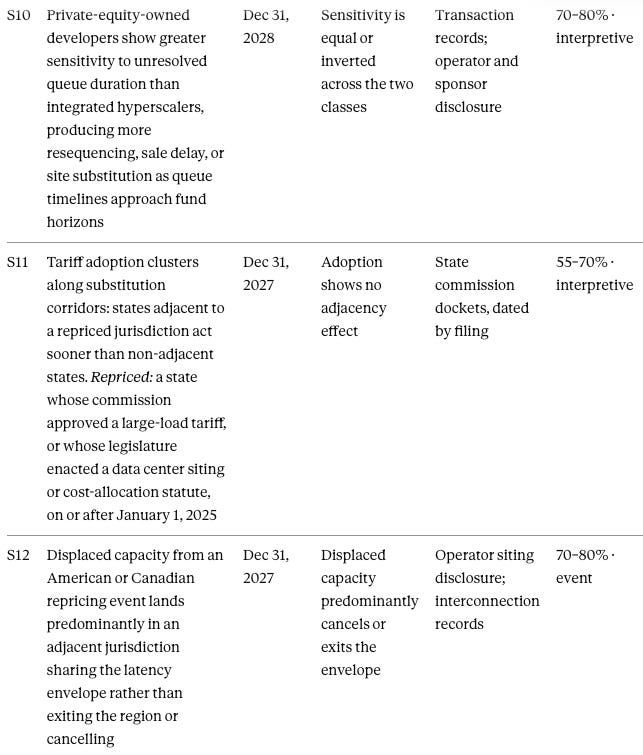
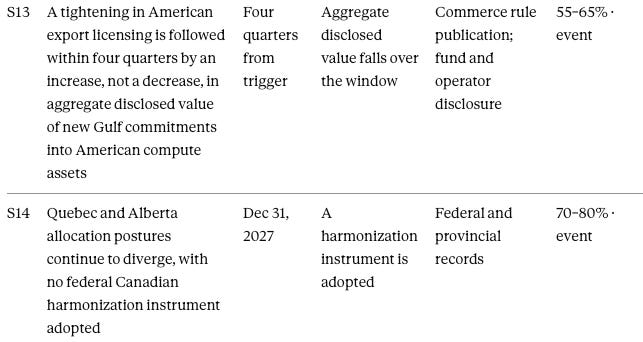
Four secondary entries — S1, S3, S4, and S9 — could produce observable signals well before the primary register matures, and each tests a different mechanism. Early signals across all four would corroborate the primary register ahead of its own deadlines.
X.4 Model-implied scenario quantiles
Four predictions resolve to a measurable share rather than to a binary occurrence. Quantiles below are model-implied scenario values, not empirically calibrated statistical estimates: each range comes from the scenario branches the analysis produced, with P50 taken from the most likely path and P10 and P90 from the bounding branches. No underlying historical series supports them, and the generation rule is stated here so a reader can weigh them accordingly.
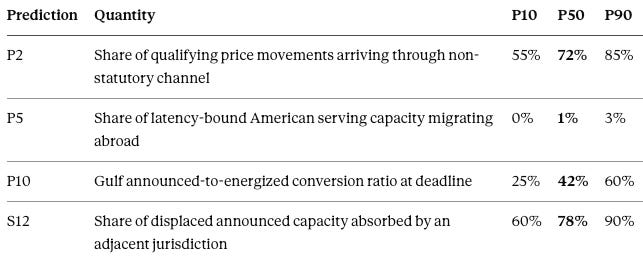
Quantiles above express branch spread, not sampling error. Every other entry in the register resolves as a binary against its named source.
X.5 Cross-run corroboration and divergence
Reconciliation between the two executions follows one rule, set before outcomes and applied uniformly: converged bands within five points carry the reconciled range; divergent bands carry the union envelope. Agreement on a causal mechanism does not justify adopting the more confident band, so no divergence is resolved by preference.
Eleven predictions converged within five points. Convergence is treated as corroboration rather than independent validation.
Three divergences carry envelopes. Institutional concentration produced P11 at 60–75%. Ireland’s connection prediction diverged by five points, and the December 2025 reopening required restating the entry, so S1 now tests whether the generation obligation holds. The regime-transition sequence behind P3 and P6 remained qualitative because the executions did not yield comparable numeric outputs.
X.6 Tail risk and decisive uncertainty
A coordinated multi-state cost-allocation standard emerging through commission convergence rather than legislation would compress the substitution corridors P1, P3, and S12 depend on, and would reduce adjacent absorption sharply. No coordinating forum currently exists across state commissions for that purpose, which places the outcome in the tail. Interpretive confidence: 10–20%.
Export-control timing governs the Gulf branch entirely. P9, P10, and S13 all condition on it, and neither timing nor magnitude is forecastable from the routed function set.
A prediction requires reissue if a substitution corridor named above closes through physical or legal change not present when the register was set.
XI. Investor Implications
Authorization risk lacks a standard measurement instrument, and the gap is structural rather than accidental. Construction risk, power cost, and tenant credit each carry established diligence practices with quantified inputs and recognized benchmarks. Authorization risk carries no standard instrument, no rating, and no widely used metric, so it enters underwriting as a qualitative comment rather than as a priced variable.
Four exposures deserve explicit pricing at commitment.
Cost-allocation reversal. A commission order reallocating transmission or capacity cost after capital commitment changes operating economics without changing any contract term. Virginia and Ohio proceedings demonstrate the channel.
Local veto latency. County moratoria arrive after site selection and after land control in most observed cases, concentrating the risk precisely where capital is least reversible.
Queue-position value decay. An interconnection position is an asset with a term, and a position outliving the fund horizon converts a data center into a warehouse regardless of building quality.
Correlated regulatory exposure by capital origin. Gulf allocators face one apparatus governing both chip access and investment treatment. Canadian and Japanese allocators do not. Pricing the correlation changes required return by source.
Structure remains the primary mitigant. Passive limited-partner positions, joint ventures, and debt draw different CFIUS treatment, and sovereign vehicles draw the most scrutiny across all three.
Sequencing offers the second mitigant. Authorization diligence conducted before land control, rather than after, addresses the timing problem that produces most observed losses.
XII. Policy Implications
State and county authorization terms sit inside the underwriting model of a sovereign wealth fund in Abu Dhabi. Washington is not choosing whether to regulate. Washington is quoting a price into a market where five foreign jurisdictions supply capital and five compete for capacity.
A price set too high inflicts damage twice, repelling inbound equity and relocating marginal capacity along whatever substitution paths remain open. A price set too low inflicts a different injury, absorbing externality-bearing buildout the host cannot fund and producing the disorderly correction Ireland experienced. Neither error announces itself.
Four propositions follow for state and county decision-makers.
Passivity is a price, not the absence of one. Ireland demonstrates that passivity can produce closure. Washington’s tariff dockets and interconnection queues are setting a price today, whether or not the legislature addresses them.
The binding instrument is often not the visible one. Grading tariff and commission order alongside statute and ordinance is not methodological fussiness. Grading them is the difference between reading the price capital sees and reading the price the press release states.
Substitution bounds the threat. No foreign jurisdiction in the study captures latency-sensitive American-serving capacity at material scale. Treating all capacity as mobile overstates the constraint on domestic policy and concedes bargaining position unnecessarily.
Coordination is the unexploited asset. Fragmented authority means adjacent jurisdictions bid against each other on terms neither would choose alone — the Washington-Idaho and Virginia-West Virginia dynamic in operation. Canadian provinces and Indian states run their own versions, and no comparator in the study reproduces the American combination of federal technology control, state legislation, commission ratemaking, utility interconnection, and local land-use veto across so many independent decision centers.
Equilibrium rather than stringency or permissiveness is the objective, and locating it jurisdiction by jurisdiction remains the work of the AI Infrastructure Authorization Series.
The competitive question is therefore not whether America should charge an authorization price. Every jurisdiction already charges one, including the jurisdictions that believe they have not set it. The question is whether America knows the spread it is quoting before capital and compute trade against it.
XIII. Methodology
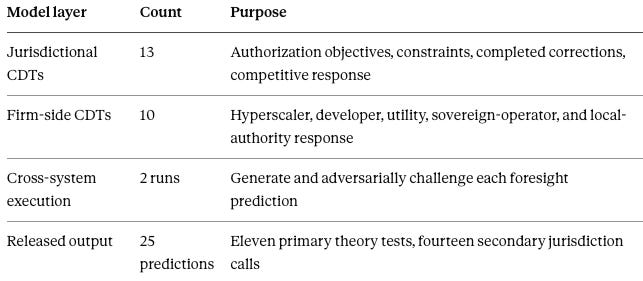
Findings in this publication derive from a register of Cognitive Digital Twins (CDTs) modeling each jurisdiction and each principal firm class as a decision system rather than as a profile. A profile describes what an actor is. A Cognitive Digital Twin generates behavior under changed conditions, which is the property required when the question is how a jurisdiction or a firm responds to a price move by a competitor.
Twenty-three Cognitive Digital Twins support the analysis: thirteen jurisdictional CDTs — eleven primary, covering the ten study jurisdictions plus a United States reference case, and two embedded, for Johor and Chile — together with ten firm-side CDTs covering hyperscalers, independent developers, sovereign-backed operators, utilities, and county authorities. Sovereign and firm CDTs run opposite each other, because a bargaining outcome requires both sides of the table modeled.
Three fields per Cognitive Digital Twin carry the analytical weight: objective function, constraint stack, and failure modes. Each of the three generates behavior when a counterparty moves. Every CDT closes with a falsifier, because a decision model without a disconfirmation condition is a description, and descriptions cannot be graded.
XIII.1 How the ten jurisdictions were selected
Ten jurisdictions entered the study through two distinct gates rather than one. Capital-flow jurisdictions — the United Arab Emirates, Saudi Arabia, Singapore, Canada, and Japan — send material capital into American data center assets. Mechanism and correction jurisdictions — Ireland, France, India, Vietnam, and Brazil, with Johor and Chile embedded — demonstrate how an authorization price moves and what follows when it moves badly. Naming two gates is more accurate than forcing every jurisdiction through one.
Selection ran a single test before either gate applied: does the jurisdiction send capital into American assets, receive American buildout, or do both? Sorting by answer produced the factor cells in Part III, and each jurisdiction below earned inclusion by testing something no other jurisdiction in the set tests.
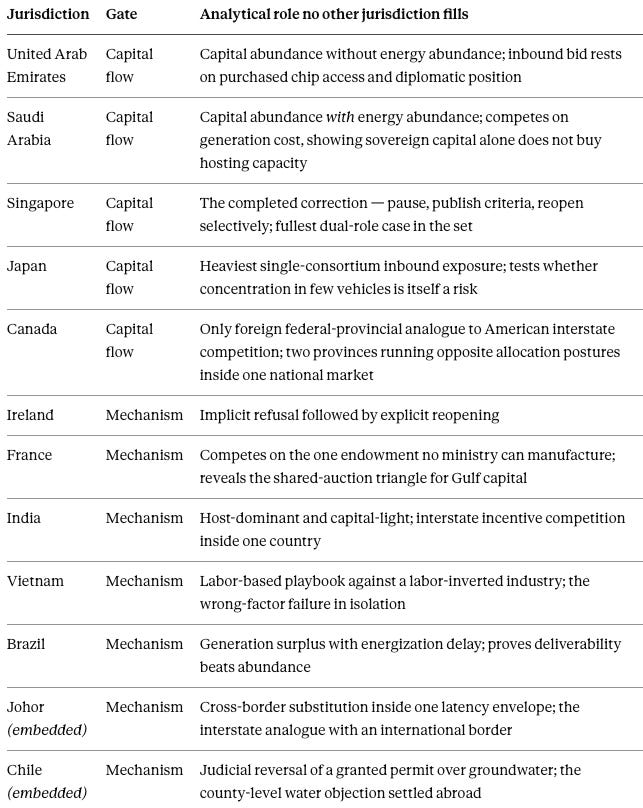
Regional pairing followed a rule: two jurisdictions from one region enter only where they split on a factor rather than on geography. The Gulf pair splits on energy endowment. The Asian pair splits on correction history against playbook error. The European pair splits on a price set too high against a price set too low. Canada enters alone because no other foreign jurisdiction reproduces American interstate competition inside its own borders.
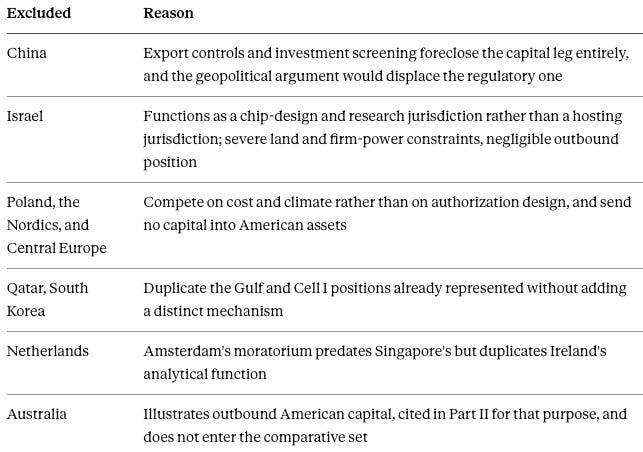
XIII.2 Exclusions
Stating why a jurisdiction stayed out demonstrates the selection test performing work rather than decorating a list.
Model provenance in summary:
The complete CDT register is maintained as a separate MindCast technical artifact and is available on request. Appendix A names the prior MindCast work each instrument came from, and Appendix B states the limits of the comparison.
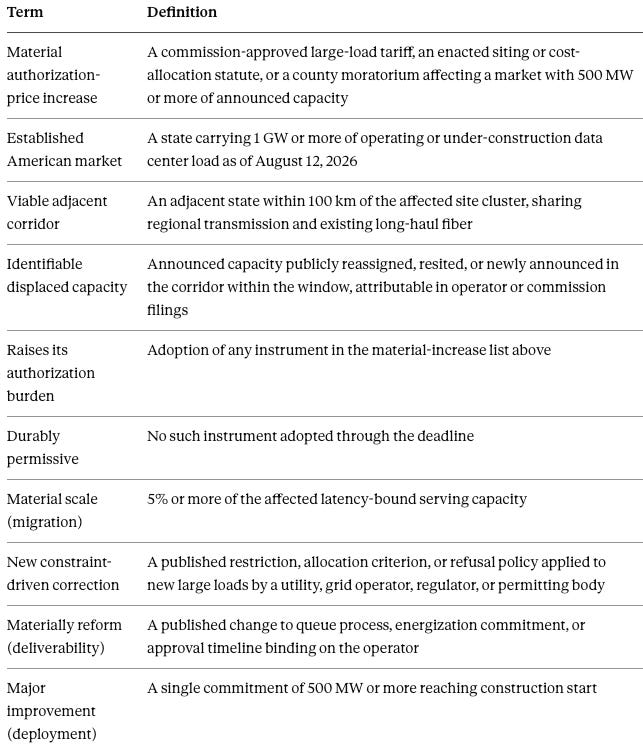
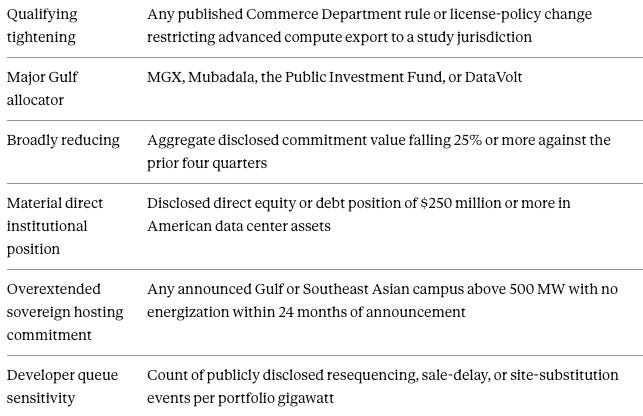
XIII.3 Settlement definitions
Elastic terms in the register carry fixed definitions, set with the register so that boundaries cannot move after events occur.
Appendix A — Scope and Limitations
Two limitations bound the claims above.
Comparative resolution is asymmetric by design. The American side rests on fifty-state grading at Atlas depth across statute, tariff, commission order, and ordinance. Foreign jurisdictions rest on a coarser comparison built only from published, citable instruments. Applying fifty-state resolution to ten countries would constitute a multi-year research program rather than a publication.
Commitment magnitudes carry mixed verification status. Closed transactions cited here — the Aligned acquisition, MGX Fund I, the Alberta allocation, and the Irish connection decision — are confirmed against public disclosure and regulator records as of August 12, 2026. Forward commitment announcements remain directional.Sovereign and corporate data center commitments announced across 2025 and 2026 have been revised, restructured, and in several cases reduced without formal withdrawal. Every figure implied here requires confirmation against filings and disclosures before carrying weight in an underwriting or legislative setting.
Neither limitation affects the mechanism findings, which rest on completed corrections settled against public record.