
Companion publication to Senator Warren Just Asked Compass the Questions Its “Seller Choice” Answer Can’t Survive | The Third Congressional Front — House Antitrust Oversight Reaches Compass and MRED Through Two Doors | The House Committee Citations — How the House Antitrust Letter Built Its Opening Theory From the Record Against Compass
See the MindCast Compass Live-Fire Mission at our corporate site.
I. Executive Summary
Compass, the country’s largest residential real estate brokerage, faces simultaneous pressure from Congress, two federal courts, a state statute, and its own investors over one architecture: a private-listing system that holds inventory inside the company before, or instead of, exposing it to the open market. Across eighteen months and five distinct institutional settings, the company’s responses form a single repeating sequence. Where another institution controls the questions — a legislature, a court, a congressional committee — Compass narrows its answers, delegates them downward, or goes silent. Where Compass controls the microphone — earnings calls, social media, corporate communications — senior leadership escalates: seller choice, no downside, monopoly, illegal. The escalation then generates the most portable evidence available to the next adversarial forum, because Compass authenticated it. MindCast names the sequence the Compass Recoil Loop.
The loop rests on a deeper finding: Compass shows high tactical elasticity and low narrative elasticity. Under pressure, the company changes the forum, then the representative, then the metric, then the definition, then the adversary — everything before the core seller-choice proposition itself. An institution built that way is not unpredictable; it is unusually predictable at the level that matters — not what it will say, which has not changed in eighteen months, but how it will move when the next constraint lands.
Validated in advance. MindCast published the loop’s components before the events that confirmed them: the delegation pattern in February, the identity-grammar analysis in March, the self-generated-evidence rule in April, and a May commitment that the next earnings calls would produce new executive-tier specimens. Before the August 4 call, MindCast forecast that Compass would keep the congressional inquiry away from investors (72–84% confidence) and defend with seller-choice grammar while avoiding the economics (82–90%). The inquiry appeared zero times across the release, remarks, and analyst questions; the grammar ran verbatim. In July, the loop ran in open court: a courtroom adversary in a Chicago federal hearing used emails from Compass’s chief executive attacking another MLS — a controlled-forum statement completing its migration into an adversarial record in real time.
The Skillman Moment, armed. MindCast’s Skillman Moment names the failure that occurs when the company’s narrative meets a forum whose governing question it cannot answer — first completed when a compelled witness could not speak to the business model. August produced the construct’s strongest controlled-forum precursor from the opposite pole: the chief financial officer voluntarily revived the “no downside” proposition and tied it to “no days on market, no price drop history” — vocabulary already placed in tension with Compass’s own seller disclosures, left unengaged in the company’s April motion, and reintroduced seventeen hours before a congressional deadline the call never mentioned. The statement becomes a completed Skillman Moment if an adversarial forum imports it and exposes the mismatch.
What the model predicts next. A model that describes behavior this stable should predict it, and MindCast structures the register by contingency rather than by calendar — what Compass does when each branch fires. Six entries preview the register; every entry carries a window, a public falsifier, and named settlement sources.
Prediction snapshot:
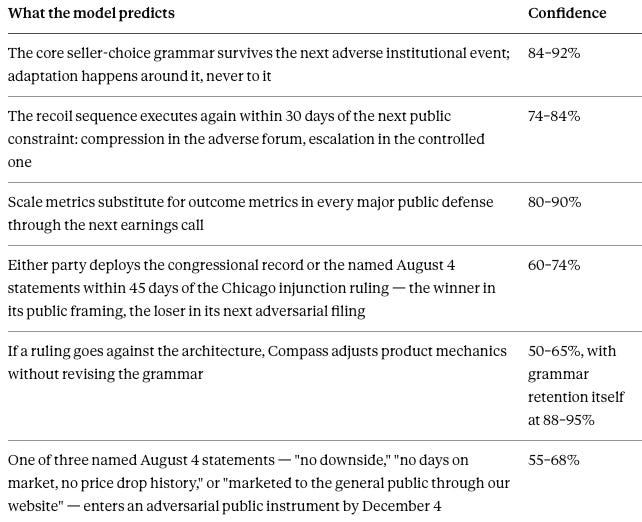
The full register, with windows, falsifiers, and settlement sources, appears in the predictions section below and on the MindCast Live-Fire Mission.
Who should read this. The register settles against public sources, so different readers can test different parts of it against records they already follow.
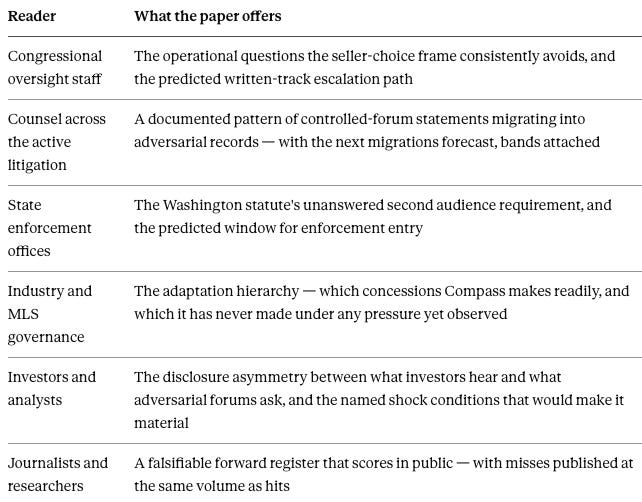
The sections below reconstruct the pattern episode by episode, extract the behavioral model behind it, and stake the full prediction set in public.
II. The Week That Completed the Pattern
The most recent episode supplies the paper’s occasion, so it comes first. One August week contained every element of the pattern the rest of the paper documents.
On July 22, 2026, the House Judiciary Committee’s antitrust subcommittee sent letters to Compass and to Midwest Real Estate Data, the Chicago-area listing service known as MRED, questioning whether their partnership and Compass’s private-listing architecture harm competition — closed information, fragmented inventory, increased double-ended transactions in which one brokerage represents both sides, and captive buyers. The letters asked both companies to arrange staff briefings by 10 a.m. on Wednesday, August 5.
Seventeen hours before the August 5 deadline, Compass held its second-quarter earnings call. Revenue reached $4.31 billion; adjusted EBITDA set a record; shares rose eleven percent after hours. Across the release, the prepared remarks, and the analyst question-and-answer session, the congressional inquiry appeared zero times.
Compass’s chief executive instead escalated against the MLS system itself — private monopolies “controlled by a collection of our competitors,” conduct “anti-competitive,” “anti-consumer,” and “illegal” — and the chief financial officer, as transcribed, told investors “there’s no downside” to the private-listing product, naming the benefits as “no days on market, no price drop history.” A third statement from the same call completes the set the register tracks: private-exclusive listings, investors were told, are “marketed to the general public through our website.”
The deadline passed without public confirmation that Compass had arranged the briefing; on August 6, Realtor.com reported that Compass declined to comment on the inquiry. MRED’s July pledge of cooperation remains the only affirmative public response from either recipient.
Compression toward Congress, escalation toward investors, and a fresh stock of attributable statements: one seventy-two-hour window supplied all three movements of the loop.
III. The Loop, Episode by Episode
One window matters more if it repeats something, and the record shows the August window was the fifth of its kind. Each row below pairs the high-accountability forum with the controlled-forum response and the evidence the pairing generated.
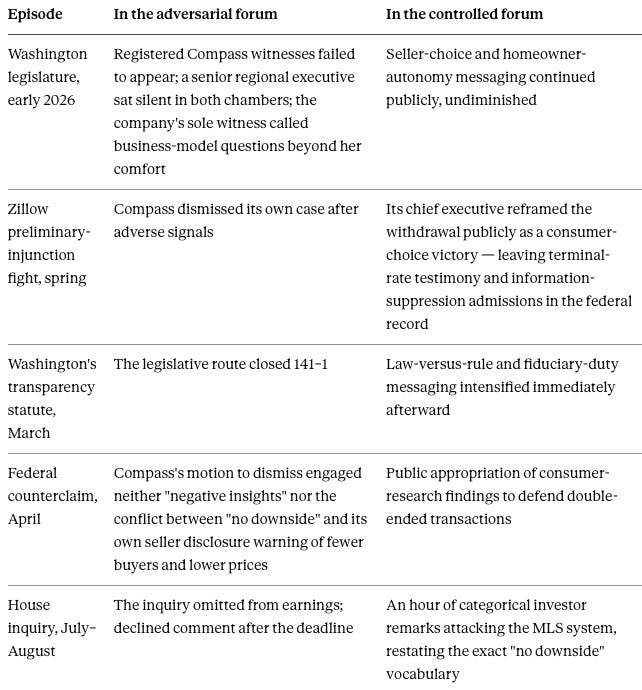
The July Chicago hearing then demonstrated the loop’s third movement live. During two days of testimony on Zillow’s injunction motion, the adversary used the Compass chief executive’s own emails attacking Bright MLS — “sold us out” — in the hearing, and confronted MRED’s chief executive with deposition testimony that cut against her direct-examination account. Statements produced where Compass and its partner controlled the framing became adversarial material where someone else controlled the questions. MindCast’s April analysis, The Counterclaim That Closed Compass’s Antitrust Thesis, identified compilation — not investigation — as the company’s defining exposure; the courtroom confirmed it.
The April-to-August pair remains the cleanest specimen. A proposition Compass left unanswered when an adversary placed it in a federal pleading reappeared four months later as an affirmative selling point when Compass controlled the forum — spoken by a second senior executive. Repetition by another senior officer is what moves “no downside” from individual rhetoric toward institutional grammar.
Five episodes, one sequence, and a live courtroom demonstration: the record above is the paper’s evidence base, and everything that follows builds on it.
Contact mcai@mindcast-ai.com to partner with us on Predictive Game Theory in AI era Law and Behavioral Economics. We specialize in predictive simulations for Complex Litigation, Innovation Economics, Geopolitical Risk Intelligence and Legacy Innovation. See our new website at MindCast Corporate.
To test our predictive simulation AI system, in 2026 we simulated the Super Bowl and the World Cup. See 🏈 Super Bowl LX — AI Simulation vs. Reality | ⚽ The 2026 World Cup Final Simulation Validation
To deep dive on MindCast works upload the URL of this publication into any LLM (preferably Google AI mode) and prompt ‘reconstruct MindCast framework with three degrees of cited sub links.’ See Live-Fire Game Theory Simulators, Runtime Predictive Infrastructure.
IV. What the Pattern Reveals
A single omission can be tactical; five behaviors re-executed under different institutional pressures reveal a stable response architecture, and the architecture has a visible hierarchy. Under pressure, Compass changes the forum, then the representative, then the metric, then the definition, then the adversary — everything before the core seller-choice proposition itself. When outside institutions reject the argument, Compass changes the environment around the argument before changing the argument.
Five regularities run through the record. The accountability gradient: message authority rises as accountability falls — categorical where Compass controls the microphone, narrow or silent where another institution controls the questions. Identity-grammar persistence: the seller-choice vocabulary has absorbed a legislative defeat, litigation exposure, a federal counterclaim, consumer research, and congressional scrutiny without revision — and MindCast’s May analysis, Compass’s Skillman Moment Reaches the C-Suite, forecast its reproduction on this quarter’s call.
Metric substitution: when an outcome denominator becomes adversarial, Compass substitutes a scale denominator it controls — ninety percent of MLSs, fifty-seven percent adoption, one-hundred-eleven percent traffic growth, in place of the exclusion, duration, and double-ending measures Congress asked about. Semantic compliance: when a rule threatens the architecture, Compass moves the boundary of the rule’s key term — “public marketing” becoming visibility on compass.com is the statutory edition of a move already run on “open access” and “consumer choice.”
Executive propagation: the “no downside” recurrence shows the vocabulary reproducing across executive roles, which makes the grammar organizational rather than personal.
The accountability gradient has a lineage worth naming. MindCast’s earlier work defined the Skillman Moment as the failure that occurs when the company’s narrative meets a forum whose governing question it cannot answer — first completed when a compelled witness could not speak to the business model. The May analysis moved the construct to the executive suite and committed to a specific forecast — the next earnings calls would produce new executive-tier specimens. August delivered the mirror image: the same gap surfaced not through what an executive could not say under questioning, but through what an executive would not stop saying when no one compelled the questions. The chief financial officer’s “no downside” statement is the construct’s strongest controlled-forum precursor to date — vocabulary already placed in tension with the company’s own seller disclosure form, left unengaged in the company’s April motion, then voluntarily reintroduced by a second senior executive seventeen hours before a congressional deadline the call never mentioned. A precursor completes into a Skillman Moment when an adversarial forum imports the statement and exposes the mismatch — against the seller disclosures, consumer-outcome evidence, congressional incidence questions, or litigation evidence. The August call armed the next Skillman Moment. Silence where questions are externally controlled and categorical overclaim where Compass controls the forum are the two poles from which the Recoil Loop generates boundary failures.
The broadest regularity is the ratchet: institutional constraint is repeatedly followed by migration and escalation rather than retreat — legislative restriction by the law-versus-rule doctrine, litigation constraint by public escalation, the portal conflict by a multi-forum filing campaign, and congressional scrutiny by an earnings-call attack on the MLS system itself. MindCast’s March analysis, Cybernetics of Compass’s Narrative Control Architecture, described the dynamic in advance: forum exhaustion produces escalation, not revision.
Taken together, Compass is predictable at two levels. Content persistence predicts what it will say: seller choice, legality, access, scale. Response persistence predicts how it will react when a forum turns adverse: compress, substitute, migrate, then escalate elsewhere. The second is the more consequential, because it predicts behavior even when the substantive issue changes — and it is what makes the register below possible.
V. The MindCast Predictions
A behavioral model earns its keep by saying what happens next, and a model of responses should predict responses. Calendars in this contest keep moving — the Seattle trial has now been continued twice, most recently to June 2027, and the pending Chicago injunction ruling could land any week — so MindCast structures the register by contingency rather than by date: standing behaviors that require no trigger, and branch predictions that activate when a specific event fires.
Each entry carries a confidence band, a window, and a public falsifier, and each settles against named public sources — court dockets, committee releases, company filings and transcripts, and the major trade record. The full register lives on the forward book; the entries below are its core.
Standing — no trigger required. The core grammar persists through the next adverse institutional event, with adaptation around it rather than to it (84–92% through year-end), and no core revision occurs absent one of seven pre-specified shocks — an adverse merits ruling, compulsory congressional process, a state enforcement action, a settlement, a credit event, public divergence by MRED, or material consumer-outcome evidence against the no-downside claim (78–88%).
Scale metrics lead every major public defense before any outcome metric appears (80–90% through the next earnings call). Compliance and openness get defined through a Compass-controlled or agent-mediated channel again (72–84%). Another senior executive repeats the grammar in a public forum (70–82% by the next call). The Seattle case stays on its litigation track — no settlement, discovery grinding toward the June 2027 trial (80–90% through year-end). Congressional escalation, if it comes, arrives on paper: no public hearing with company witnesses through late October (76–85%).
On the next public constraint — whatever form it takes. Within thirty days, the recoil sequence executes again: a narrow, delegated, or qualified response where the adversary controls the questions, followed by a more categorical statement where Compass controls the microphone (74–84%). The falsifier is concrete: Compass answers the adverse forum with controlled-forum-level detail and does not escalate elsewhere within the month.
On the Chicago ruling — either direction. Within forty-five days of the ruling, either party deploys the congressional record or the named August 4 statements — the prevailing side in its public framing, the losing side in its next adversarial filing or public response (60–74%, conditional on a ruling arriving in the window).
On an adverse ruling against the architecture. Compass adjusts operational mechanics — broker-side concurrent visibility, statutory-state marketing flows — while the public grammar retains its seller-choice framing without engaging the incidence economics (50–65%, with the grammar-retention component itself at 88–95%).
The migration watch. One of the three named August 4 statements enters an adversarial public instrument by December 4 (55–68%); any post-August executive statement does the same (60–74%) — the loop staying live on fresh material. The Washington statute’s second, unexplained audience requirement — concurrent marketing to all other brokers, which website visibility alone does not address — appears by name in a public instrument by late November (52–68%). A state enforcement office issues a qualifying instrument by December 4 (45–60%). And public tension between Compass’s and MRED’s accounts of rule initiation and coordination — the fracture the July hearing record began to expose — surfaces by year-end (42–56%, the register’s most tentative entry, released with that qualification stated).
The section closes where honest forecasting has to: with the conditions that would break the model. Criticism alone demonstrably does not move the core grammar — the record already proves that. The loop breaks only if a shock removes the tactical escape routes or makes the grammar itself materially costly: compulsory operational evidence, a merits ruling constraining the architecture, partner divergence, state enforcement, or investor materiality. If Compass voluntarily engages buyer-incidence economics without any of those shocks, the model is wrong, and the register will say so at the same volume it would claim a hit.
VI. Conclusion
The August window did not change the Compass playbook; it made the playbook easier to see — a fifth distinct confirmation of the pattern’s existence, plus a courtroom demonstration of the loop’s evidentiary mechanics running in real time. An institution that changes forum, speaker, metric, definition, and adversary before changing its core proposition is not unpredictable — it is unusually predictable, at the level that matters: not what it will say, which has not changed in eighteen months, but how it will move when the next constraint lands. The register above stakes that claim in public, against named sources, with the falsifiers attached. The next constraint is already in motion; the pending Chicago ruling will supply the first test.
Appendix: Sources
Primary record. Compass Q2 2026 earnings call transcript (Investing.com, Aug. 4, 2026); Compass Q2 2026 earnings release; Realtor.com, Compass declines comment on congressional probe (Aug. 6, 2026); Washington SSB 6091, enacted text; House Judiciary subcommittee letters of July 22, 2026, reproduced in full at Housing Notes; RISMedia, The Real Deal, Real Estate News, and HousingWire coverage of the July 1–2 Chicago preliminary-injunction hearing and the Seattle scheduling record.
Prior MindCast analyses and their relevance to this paper.
The Third Congressional Front — establishes the July 22 subcommittee letters as the third congressional front in seven months and supplies the inquiry architecture the August window compressed against.
The Committee’s Citations — maps the committee’s evidentiary sourcing and the written-track escalation path the register’s congressional-process entries extend.
Cross-Forum Contradictions — documents the audience-separation contradictions that make controlled-forum statements portable into adversarial records, the loop’s third movement.
The Self-Disclosure Trap — applies the self-generated-evidence rule to a public quote-card specimen, extending the pattern beyond litigation filings.
The Counterclaim That Closed Compass’s Antitrust Thesis — operationalized compilation-not-investigation as Compass’s defining exposure inside active federal litigation; the July Chicago hearing confirmed the mechanism in open court.
The Motion Compass Filed and the Architecture It Could Not Address — documents the April motion’s non-engagement with the “no downside” versus seller-disclosure conflict, the gap the chief financial officer’s August statement reopened.
Cybernetics of Compass’s Narrative Control Architecture — formalized the narrative-control architecture, named the Self-Disclosure Trap pattern, and stated in advance the ratchet dynamic this paper tests: forum exhaustion produces escalation, not revision.
Compass’s Skillman Moment Reaches the C-Suite — moved the Skillman construct from the compelled-witness tier to the executive tier and committed the earnings-call forecast the August 4 call settled.