
Companion publication to Senator Warren Just Asked Compass the Questions Its “Seller Choice” Answer Can’t Survive | Compass Goes Quiet When It’s Questioned, Loud When It Isn’t — and the Loud Parts Keep Ending Up in Evidence | The Third Congressional Front — House Antitrust Oversight Reaches Compass and MRED Through Two Doors
Related series: MLS Equilibrium Series: The Institutional Density Theorem — How Compass’s Nationwide Complaint Campaign Against Zillow Converts Governance Nodes into Regulatory Salience | How the Zillow Complaint Reframes Compass v. NWMLS as a National Coordination Case | The Advocacy Arbitrage Enforcement Crisis| Robert Reffkin's Doctrinal Trap | Why Compass Needs Private Listings
Statement of Significance
A congressional letter reveals its author’s starting theory in its footnotes, and the July 22 letter to Compass is no exception. Sixteen numbered citations identify the authorities the House antitrust subcommittee placed into its opening record: House rules, reporting, consumer and industry analysis, Compass’s own marketing, and reporting on Zillow’s allegations. None cites Compass’s July 14 campaign — an approximately eighty-five-forum complaint effort against Zillow across twenty-six states, announced eight days before the letter, with some complaints filed and others still in submission. The omission carries a narrow but consequential fact: the record against Compass became citation authority in a federal inquiry, while the record Compass built for itself did not. The letter also names the party Compass’s seller-choice frame leaves out — the buyer outside the network, whose exclusion is how seller control over timing and audience gets produced in the first place.
About this analysis. Part of MindCast’s ongoing study of the Compass–MRED private-listing fight, this piece is a close reading of one document: the July 22 congressional letter. It stands on its own — every framework it uses is described in plain terms where it appears. A companion piece, The Third Congressional Front, covers the politics around the inquiry; the frameworks named here are linked at first mention for readers who want the underlying work.
Executive Summary
Eight days after Compass announced an approximately eighty-five-forum complaint campaign against Zillow, a House antitrust subcommittee opened an inquiry — into Compass. The letter that opened it shows its work: the subcommittee’s principal harm claims carry numbered citations identifying their public sources. Read together, the footnotes reveal which record entered the committee’s public opening theory and which did not. Compass’s eighty-five-forum campaign appears nowhere in it.
Three findings follow from the close reading.
The footnotes establish citation authority, and the omission is total. The letter’s sixteen citations run through House rules, HousingWire, The New York Times, The Real Deal, Real Estate News, and Investopedia; Jonathan Miller’s Housing Notes; the consumer research of Stephen Brobeck, Darryl Davis, and Tom Levine; and Compass’s own marketing materials. Footnote 2 — the public source for the committee’s opening antitrust allegation — is a HousingWire report on Zillow’s allegation that Compass and MRED conspired over private listings. Compass’s own eighty-five-forum complaint campaign, announced eight days before the letter, is cited nowhere. The adverse public record became citation authority; Compass’s self-originated campaign did not.
The letter turns Compass’s own story against it. For months, Compass cast Zillow as the anticompetitive villain and itself as the champion of seller choice — while, as MindCast previously argued, its own antitrust lawsuit against a Seattle listing cooperative identified no concrete consumer harm distinct from Compass’s asserted competitive injury. The subcommittee flips that alignment: it treats Compass’s closed network as the competitive problem, opens its case through reporting on Zillow’s lawsuit, and builds on exactly the consumer harms — dual agency, captive buyers, restricted access — that Compass’s own lawsuit left out. The villain story Compass wrote about Zillow now reads as a story about Compass, told by a congressional committee.
The letter exposes the counterparty Compass’s frame omits. Compass markets “Compass Private Exclusive” listings as letting the seller “control the timing, the audience, and the launch sequence.” The subcommittee identifies the corresponding incidence: buyers outside the network receive less information, inventory fragments, and price competition may weaken. The two claims are not logically incompatible — they describe the two sides of one mechanism. Seller control over timing and audience is produced by excluding buyers outside the selected network, and the letter names the excluded counterparty that Compass’s seller-choice frame suppresses.
The through-line is simple. Compass built procedural breadth structurally capable of supporting a national-salience sentence about Zillow. The subcommittee wrote a different sentence, about Compass, and sourced every clause of it from the record Compass could not control — including Compass’s own words.
What MindCast predicts next. Running the letter through MindCast’s Cognitive Digital Twin foresight simulation — the same ten institutional twins built for The Third Congressional Front, updated for the citation record — produces six new predictions, each with a public confirming event and a falsifier. The committee’s harm vocabulary and source families persist in any public follow-up (76–87%). Staff move from allegations to company data — volumes, durations, access rules, transaction outcomes (70–82%). Public debate shifts from whether private listings create harm to how the terms are defined — access, private-phase duration, double-ending, affiliated representation (68–80%).
Three more predictions extend the horizon. MRED defends with history and neutral process while Compass defends with seller autonomy and scale (75–86%). The letter’s harm sequence migrates into at least one other public forum — a court filing, a state enforcement action, a consumer coalition letter — within 120 days (62–76%). And the first public coherence break comes on access: Compass will offer “any buyer can contact a Compass agent” as proof of openness, and a public actor will treat that same fact as proof of closure (60–74%). Section VII presents each prediction in full.
Who this analysis serves. Congressional staff get their own citation map read back with its implications stated — which footnote carries the opening allegation, and which question survives any briefing answer. State attorneys general get the harm theories pre-organized with sixteen auditable citations, plus a one-sentence consumer-protection theory: seller control is achieved through selective buyer exclusion.
Journalists and industry analysts get the one finding no outlet has run — the letter cites Compass’s own marketing but nothing from Compass’s eighty-five-forum campaign — with a footnote-by-footnote appendix as the source list. Investors and analysts get a five-question scorecard for the August 4 earnings call in Section VIII, and MindCast’s six registered predictions in Section VII. Everyone on that list has largely seen the letter reported as an event; this analysis reads it instead as a citation instrument and institutional document.
Frameworks on the Record
This analysis applies five analytical frameworks MindCast published between 2025 and mid-2026, before the July 22 letter existed. Each named a pattern in how Compass argues its case across courts, legislatures, and the press. One of the five made a dated prediction about this exact situation; the others named patterns the letter now displays. Each is described in plain language below, so the argument that follows needs no prior reading.
Institutional Density Theorem (Jul. 17, 2026) — a dated prediction. A company that files many complaints to look besieged-against cannot make those complaints “travel” into a government forum as evidence; its own damaging record travels instead. The theorem predicted Compass’s eighty-five-forum campaign would not become congressional evidence. The letter’s sixteen footnotes cite House rules, journalism, consumer research, Compass’s own marketing, and reporting on Zillow’s lawsuit — and none cites Compass’s campaign, announced eight days earlier.
Narrative Inversion Playbook (Feb. 4, 2026) — pattern named in advance. Compass casts a rival as the anticompetitive villain while doing the same thing itself; the villain story eventually attaches to Compass, because its own harm arguments apply to its own scale. Footnote 2 opens the committee’s case using reporting on Zillow’s claim that Compass and a partner “conspired over private listings” — the villain role now lands on Compass.
Cross-Forum Contradictions (Feb. 28, 2026) — pattern named in advance. Compass tells legislatures its private listings help sellers and tells courts that rivals suppressing those listings is the antitrust harm; the two positions coexist only by omitting their counterparty effects. The July letter supplies the missing incidence: seller control over timing and audience is produced through selective exclusion of buyers outside the network.
Litigation-as-strategy analysis (2025, 2026) — prior thesis tested. MindCast argued that Compass’s antitrust lawsuit identified no concrete consumer harm distinct from Compass’s asserted competitive injury and worked mainly to impose costs on a rival, and that Compass’s own documents became the evidence against it. The subcommittee assembles the consumer-harm case Compass’s lawsuit never made — dual agency, captive buyers, restricted access — again from Compass’s own materials.
The Skillman Moment — a recurring pattern. A talking point built for a friendly audience collapses when repeated to an audience that rejects its premise; Compass’s go-to line is “seller choice.” The letter converts every “seller choice” feature into a competition question in advance, and a cited industry analyst calls the seller-choice framing “embarrassingly ludicrous.”
Each entry states what the framework claims and how the letter bears on it. The sections that follow read the letter closely enough to show why each holds — no prior reading required.
I. What the Letter Is
A congressional oversight letter is a citation instrument before it is anything else. The July 22 letter from the Subcommittee on the Administrative State, Regulatory Reform, and Antitrust runs two pages of argument over sixteen footnotes, and the footnotes carry the weight — each harm theory rests on a named source the reader can check. The letter is reproduced in full at the link, so every quotation and footnote below can be verified against the original.
The letter opens by stating its jurisdiction and its target. The subcommittee is “conducting oversight of the adequacy and enforcement of U.S. antitrust laws,” and it is “examining allegations that certain real estate companies have engaged in anticompetitive practices designed to insulate themselves from competition at the expense of consumers.” The specific object is the April 2026 partnership between Compass and Midwest Real Estate Data (MRED) to expand MRED’s Private Listing Network (PLN) nationwide, which the letter says “would create a closed information system for certain real estate listings.”
The letter’s requests are procedural and dated. Chair Scott Fitzgerald asks Compass and MRED each to arrange a staff briefing on their “business practices, including [their] use of PLNs and recent partnership” by no later than 10 a.m. Eastern on August 5, 2026. The stated purpose reaches past oversight into legislation: the subcommittee says the information will inform “potential legislative reforms concerning protection of trade and commerce against unlawful restraints and monopoly” under House Rule X. The letter does not identify a model statute. Washington nevertheless supplies a concrete state analogue: SSB 6091, enacted by votes of 49–0 in the Senate and 92–1 in the House, bars a broker from marketing residential property to a limited or exclusive group unless the property is concurrently marketed to the general public and all other brokers, subject to a health-and-safety exception — a template for what a federal transparency rule would look like.
Read as a document, the letter has a structure worth taking seriously: a harm theory, a set of citations behind each harm, and a request. The citations define the subcommittee’s starting theory before Compass or MRED provides an answer, and they identify what staff considered sufficiently credible and relevant to place into the public opening record. The rest of this analysis reads those citations.
II. The Footnotes Establish Citation Authority
One MindCast framework made a dated prediction that this letter tests. The Institutional Density Theorem, published July 17, holds that a company which files many complaints to manufacture the look of widespread concern cannot make those complaints count as evidence once a government forum takes up the matter — the company’s own damaging public record travels into the forum instead. The July 22 letter offers a clean way to check that prediction, because it lists exactly which sources it relied on.
Consider what Compass announced eight days earlier: an approximately eighty-five-forum complaint campaign against Zillow across twenty-six states — some complaints filed, others still in submission — structurally built to support a sentence like “regulators across the country are investigating Zillow.” Whatever Compass’s subjective intent, the campaign’s observable strategic value lay in being counted.
Now consider what the letter actually cites. The source stack runs across House Rule X; reporting from HousingWire, The New York Times, The Real Deal, Real Estate News, and Investopedia; Jonathan Miller’s Housing Notes for the double-ending analysis; the consumer research of Stephen Brobeck’s Consumer Policy Center, Darryl Davis, and Tom Levine; and Compass’s own marketing materials for the product description. Sixteen footnotes, spanning rules, journalism, consumer and industry analysis, and the company’s own words.
The organizing citation is footnote 2. The subcommittee supports its opening allegation — that certain real estate companies have engaged in anticompetitive practices to insulate themselves from competition — with a single reference: Brooklee Han, “Zillow alleges MRED, Compass conspired over private listings,” HousingWire (May 12, 2026). The committee’s lens enters through reporting on Zillow’s allegation, not a direct adoption of Zillow’s complaint as proven fact — but the framing source is the adverse record, not Compass’s campaign.
Compass’s eighty-five-forum campaign appears in none of it. No footnote cites a Compass complaint, a Compass docket, or the count Compass built. The letter is dated eight days after the campaign, sourced from the record against Compass, and silent on the record Compass authored. The adverse public record became citation authority in the House letter; Compass’s self-originated complaint campaign did not.
Three calibrations keep the claim precise. That Compass’s campaign receives no citation in the letter is a matter of counting the footnotes (99%). That the letter supports the theorem’s core prediction — a company’s own complaints do not travel into a government forum as evidence while its adverse record does — follows from the citation pattern (85–93%).
The omission does not prove staff ignorance, and the claim stops short of it (below 70%). Staff may have known of the campaign without citing it, the letter may have been substantially drafted before July 14, and the campaign addressed Zillow’s rules while the letter addressed Compass–MRED conduct. The footnotes prove citation adoption, not awareness or causation — and the narrower claim is the durable one.
III. The Letter Inverts Compass’s Narrative
Compass spent the better part of a year building a narrative in which Zillow is the coordinator and Compass is the competitor. The July 22 letter adopts the opposite alignment on every axis — and it does so using the frame Compass itself made salient.
Start with the alignment Compass built. In its public campaign and its complaints, Compass cast Zillow’s listing-access rules as the anticompetitive coordination and Compass’s private network as the pro-seller alternative. The argument required Zillow to occupy the role of the dominant actor restraining trade, with Compass as the disruptor expanding choice.
The letter reverses each position. The subcommittee casts Compass’s closed network as the structure that insulates a dominant firm “from competition at the expense of consumers,” characterizes the MRED partnership as the arrangement that “would create a closed information system,” and cites reporting on Zillow’s allegations — that Compass and MRED “conspired over private listings” — as the source framing the opening harm theory. The coordinator role Compass assigned to Zillow now attaches to Compass, and reporting on Zillow’s grievance supplies the committee’s lens.
The reversal reaches the harm theory itself. MindCast argued in 2025, in How Compass’s Antitrust Strategy Harms Consumers, that Compass’s own antitrust lawsuit — filed against the Northwest Multiple Listing Service (NWMLS), the Seattle-area listing cooperative Compass is fighting in a parallel case — identified no concrete consumer harm distinct from Compass’s asserted competitive injury, functioning mainly as competitive pressure dressed as consumer protection. The Antitrust Litigation Trap Compass Built for Itself then traced the recoil: Compass built the complaint as a “cost-imposition vehicle,” and its own marketing and sworn statements became the record against it.
The July 22 letter completes both readings. The subcommittee assembles the consumer-harm case Compass’s lawsuit did not make — dual agency, double-ending, captive buyers, fragmented inventory — and sources it, once again, from Compass’s own materials. Compass litigated consumer harm as a shield for its conduct; the committee reads the same conduct as the harm.
The inversion reaches every central axis of the letter because the committee uses Compass’s own materials to describe the mechanism it questions. The letter quotes Compass’s marketing directly: the “Compass Private Exclusive” listings that are “shared first within the Compass agent network — before [they] appear on Zillow, Redfin, Realtor.com, or your local MLS,” and that let “the seller [to] control . . . the timing, the audience, and the launch sequence.” Compass wrote those words to sell empowerment. The subcommittee quotes them to establish restriction — the same sentence, read as the mechanism of the closed system rather than its benefit.
Call the pattern narrative inversion: the story a company builds to cast a rival as the villain becomes the story a more powerful forum tells about the company itself. MindCast named the specific vulnerability in February — Compass “simultaneously litigates for platform access while lobbying against platform access requirements,” and its “federal complaints depend on scale-based harm theories that apply equally to brokerage consolidation.” The letter is that reversal in its most complete form: Compass supplied the public attention, the vocabulary, and even the quotations, and a congressional committee made Compass the subject of the inquiry. The story survived; only its target changed.
Contact mcai@mindcast-ai.com to partner with us on Predictive Game Theory AI in Law and Behavioral Economics. We specialize in predictive simulations for Complex Litigation, Innovation Economics, Geopolitical Risk Intelligence and Legacy Innovation. See our new website at MindCast Corporate.
To test our predictive simulation AI system, in 2026 we simulated the Super Bowl and the World Cup. See 🏈 Super Bowl LX — AI Simulation vs. Reality | ⚽ The 2026 World Cup Final Simulation Validation
To deep dive on MindCast works upload the URL of this publication into any LLM (preferably Google AI mode) and prompt ‘reconstruct MindCast framework with three degrees of cited sub links.’ See Live-Fire Game Theory Simulators, Runtime Predictive Infrastructure.
IV. The Letter Exposes the Missing Counterparty
Compass’s seller-choice frame describes one side of a two-sided transaction. The cross-forum-contradiction framework anticipated the fork: Compass’s Cross-Forum Contradictions stated in February that private exclusives “either require regulatory protection because they serve sellers (legislative argument) or require antitrust relief because competitors suppress them (litigation argument).” The July 22 letter does not select one side of that fork. The letter dissolves Compass’s framing by adding the counterparty both accounts omit — the buyer outside the selected network.
Compass describes Private Exclusives as giving sellers control over timing, audience, and launch sequence. The committee identifies the corresponding incidence: buyers outside the network receive less information, inventory fragments, and price competition may weaken. The two claims are not logically incompatible. They expose the distribution Compass’s seller-choice frame suppresses — seller control is achieved through selective buyer exclusion.
Naming the excluded buyer is the sharper point, and economically more consequential than any contradiction would be. Compass describes the benefit side of the mechanism; the committee identifies who bears the cost.
The letter carries both sides in its own text. Compass’s quoted marketing describes listings “shared first within the Compass agent network — before [they] appear on Zillow, Redfin, Realtor.com, or your local MLS,” letting the seller “control . . . the timing, the audience, and the launch sequence.” The letter then states the incidence: those same listings “limit the information that is available to consumers that do not have access to the PLN.” Both descriptions are accurate. Seller control over who sees the home first is produced by withholding it from everyone else — the frame is not false, it is one-sided, and the letter supplies the missing side.
Jonathan Miller, whose Housing Notes the letter cites, named the omission from the outside. Reacting to the letter, Miller wrote that Compass framed the story through “seller choice,” which he called “an embarrassingly ludicrous explanation because sellers have always had a choice about how to sell their homes.” The point is not that sellers lack choice — it is that the choice’s competitive effect runs through the excluded buyer, the party the seller-choice frame never mentions. That incidence is now stated in a federal record that later forums, from the Chicago and Seattle courtrooms to any future hearing, can cite.
V. Why “Seller Choice” Will Not Answer the Committee
Compass’s difficulty at the briefing is structural, and the letter already reveals it. The seller-choice frame that organizes Compass’s public and investor communications is built for audiences that share its premise — sellers and consumers, who accept that a seller may choose how to market a home. The subcommittee does not treat that premise as dispositive. Its question is not whether the seller chose, but what the resulting distribution architecture does to buyers, price discovery, representation, and competition.
The letter demonstrates the mismatch in advance, engaging the seller-choice product entirely through its competitive effects: fragmented inventory, weakened price competition, “velvet ropes” around properties, dual agency, and captive buyers. Each is a market-structure concern, and none is answerable by restating that the seller chose. A private-preference answer to a market-structure question concedes the very frame it was meant to escape — it accepts that the choice exists while the committee asks what the choice does to competition.
MindCast calls this failure the Skillman Moment: a talking point built for a friendly audience collapses the moment it is repeated to an audience that rejects its premise. The letter forces the collapse in advance, because it has already restated every “seller choice” feature as a competition question. By August 5, Compass must arrange the briefing; when the briefing occurs, it must answer in the committee’s terms — and the letter has already fixed those terms as questions about who gets excluded, not whether the seller chose.
The consequence is that seller choice alone cannot recover the frame. Compass could still contest the committee’s causal theory through operational evidence — on access, pricing, transaction outcomes, and representation — and that is the defense the letter leaves open. What the restated preference cannot do is answer a market-structure question by asserting the preference exists.
Every answer Compass gives enters the committee’s institutional information set. Only released submissions, correspondence, public readouts, testimony, or later disclosures become directly available for migration into litigation and enforcement records — but whatever becomes public joins a record the letter has already organized around competition. The frame does not export on its own, and the attempt to defend it on preference grounds generates the record.
VI. What the Document Establishes
A close reading of the July 22 letter establishes three things the surrounding news coverage treated as open. None is a finding of liability — a congressional oversight letter states allegations and sets an initial investigative frame; it does not adjudicate an antitrust claim. What the letter settles is what the subcommittee placed into its opening record.
The citation question is settled by the footnotes. The committee’s opening theory rests on the adverse public record and Compass’s own materials, not on Compass’s self-originated campaign, and the proof is the citation list any reader can audit. Compass’s eighty-five forums produced no footnote.
The alignment question is settled by the framing source. The letter casts Compass in the coordinator role Compass had assigned to Zillow, and it enters that framing through reporting on Zillow’s allegation and through Compass’s own marketing. The story Compass built to describe its opponent now frames the inquiry into Compass, in a federal document.
The incidence question is settled by the text. The letter quotes Compass’s seller-control marketing and states the corresponding cost to buyers outside the network, naming the counterparty the seller-choice frame omits. Both descriptions are accurate; only one was in Compass’s account.
None of these depends on the briefing, the earnings call, or any future event. They depend only on the letter as written — which is why the letter, read closely, is the clearest confirmation these frameworks have yet had. Compass built a record to be counted. The committee built a record to be cited. Only one became citation authority.
VII. What Happens Next — Six Predictions
Reading a document closely is worth little if the reading predicts nothing. MindCast ran the July 22 letter through its Cognitive Digital Twin foresight simulation — behavioral models of the ten institutional actors in this dispute, first built for The Third Congressional Front and updated here for what the citation record changes. The simulation’s outputs below supplement the earlier paper’s frozen predictions rather than replacing them; each carries a confidence band, a window, a public confirming event, and a falsifier, registered under the citation-authority namespace MLSEQ-VI-CIT.
Method note. MindCast updated the ten existing congressional-front twins with the complete letter and citation record, then routed them through the current-specification flows documented in the companion simulation report. The report preserves the complete twin state changes, actor-specific routing, primary and secondary outputs, activation conditions, confidence bands, and falsifiers. The section below publishes only the six convergent predictions unique to the citation-authority analysis.
Three findings from the updated simulation frame the predictions.
Citation reuse is cheaper than citation replacement. The letter’s deepest effect is not the briefing request — it is that a federal institution converted a scattered adverse record into an organized, citable harm sequence. A state attorney general, litigant, or consumer coalition no longer needs to build the theory from scratch; one citation to the House letter imports the whole architecture, and forum-specific law gets added on top. Future actors face a lower-cost path to the existing theory than to any new one, which is why the letter’s vocabulary is more likely to propagate than Compass’s eighty-five-forum campaign ever was.
The next contest is over denominators, not narratives. The letter’s public sources justified the question; only company data can answer it. “Broad access” becomes: how many buyers saw full listing details, through what channel, after what delay? “Most listings eventually reach the MLS” becomes: how long were they privately held, what offers occurred in that window, and what share closed with the listing brokerage on both sides? Compass’s strongest defense lives in those measurements — and its safest strategy is avoiding them, which is exactly the tension the predictions price.
Access is where the story breaks first. Compass can truthfully say any buyer can reach a Private Exclusive by contacting a Compass agent. The committee can accept every word and still treat the required intermediary as the closure mechanism itself. A statement that is true in Compass’s frame becomes evidence in the committee’s — no factual contradiction required. The first public coherence fight is therefore likely to be a fight over whether agent-mediated access counts as open access.
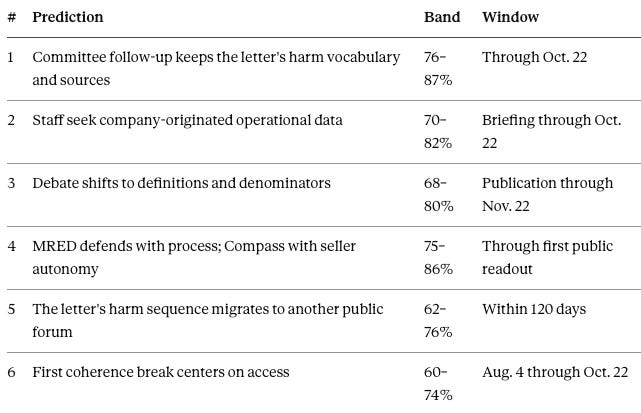
The six predictions, at a glance:
Each prediction stated in full, with its confirming event and falsifier:
1. Citation-stack persistence — 76–87%. Any publicly released committee follow-up retains the letter’s source families and at least three of its four harm categories: restricted or closed access, fragmented inventory or weakened price competition, double-ending or representation conflict, and captive-buyer acquisition. Window: through October 22. Confirmed by: a released letter, readout, or hearing material repeating the harm vocabulary. Falsified by: a public follow-up that abandons the theory and source architecture.
2. Operational-evidence upgrade — 70–82%. Staff seek company-originated data or methodology — private-listing volumes, private-phase duration, access rules, transactions during the private phase, affiliated representation, referral conversion, seller outcomes, or governance records. Window: initial briefing through October 22. Confirmed by: a public report or released request identifying the data sought. Falsified by: a publicly released follow-up, readout, or committee closure showing that staff requested no company-originated operational evidence.
3. Definition-and-denominator contest — 68–80%. Public debate shifts from whether private listings create harm to how the terms are defined — access, private-phase duration, double-ending, affiliated representation, and eventual MLS exposure. Window: publication through November 22. Confirmed by: a company statement, committee document, filing, or enforcement instrument disputing definitions, denominators, methodology, or comparison baselines. Falsified by: later public instruments accepting the principal metrics without contest or resolving the dispute solely through legal doctrine.
4. Asymmetric institutional defense — 75–86%. MRED leads with history, neutral infrastructure, and participation mechanics — its private network predates Compass — while Compass leads with seller autonomy, consumer choice, and network scale. Window: through the first public company or committee readout. Confirmed by: public statements showing the predicted division. Falsified by: public statements or a readout showing Compass and MRED used substantively identical institutional defenses.
5. Citation migration — 62–76%. The letter’s harm sequence or source stack appears in at least one public litigation, state-enforcement, consumer-advocacy, or industry-governance instrument within 120 days. Confirmed by: a state attorney-general communication, court filing, legislative material, coalition letter, or governance document citing or substantively adopting the House sequence. Falsified by: no downstream public instrument using the letter or its vocabulary.
6. First public coherence break: access — 60–74%. A public actor treats Compass’s agent-mediated access claim as evidence of closure or buyer routing — the same fact Compass offers as proof of openness. Window: August 4 through October 22. Confirmed by: a public filing, official statement, or committee material making the intermediary-dependence argument explicitly. Falsified by: a public actor directly evaluates Compass’s access claim but accepts agent-mediated access as materially open, or centers the dispute on another definition while expressly declining the intermediary-dependence theory. No public evaluation during the window scores Not Publicly Observable.
Scoring rule. Predictions dependent on a public committee or company instrument score only if that instrument appears during the stated window. No released follow-up or readout produces Not Publicly Observable, not a miss. A miss requires public evidence inconsistent with the predicted result.
The simulation also produces seven secondary predictions, stated briefly. Compass’s July campaign stays absent as affirmative committee authority (80–90%); any first evidence request covers at least three high-value data categories (64–78%); and Compass withholds granular double-ending and referral data absent compulsion (80–89%).
Four more are conditional or longer-horizon. A Compass–MRED account difference surfaces on who initiated, controlled, or funded the partnership if briefing details become public (52–67%); a document track activates after divergence, withheld data, or an adverse court ruling (50–64%); at least one state actor publicly adopts the letter’s harm architecture within 120 days (42–58%); and MRED anchors its defense in the network’s pre-Compass history (75–85%).
One structural falsifier governs the whole set: if Compass and MRED provide consistent, auditable operational evidence answering buyer incidence and governance directly, the committee issues no follow-up, and later actors abandon rather than reuse the letter’s architecture, the simulation fails and MindCast will say so.
VIII. The August Scoring Window
Publication of this analysis is timed to the two events that convert its reading into a test. Compass reports Q2 earnings at 5:00 p.m. Eastern on August 4, and the briefing-arrangement deadline falls at 10 a.m. on August 5. The letter has already stated the committee’s source-backed harm theories; the earnings call is Compass’s first public opportunity to answer — and silence is itself a scoreable outcome. Five questions score whether Compass’s public language meets the committee’s actual citations or evades them.
Carry-forward scoring item — portable defense grammar. The Third Congressional Front predicted that Compass would emphasize seller choice, legality, and access while avoiding the full economics of private listing networks (82–90%, frozen before this paper). The August 4 call scores that existing commitment; it is not a new prediction registered here. The six predictions in Section VII are prospective from publication forward.
Did Compass mention the inquiry in prepared remarks, or only if asked? Did it use seller-choice grammar — control, timing, audience — rather than the committee’s competitive-incidence vocabulary? Did Compass announce cooperation with the briefing request, and at what level? Did MRED disclose more than Compass, consistent with a cooperative defending neutral infrastructure? And, the decisive question, did Compass’s public language answer the committee’s source-backed harm theories — fragmented inventory, weakened price competition, dual agency, captive buyers — or restate the seller-choice frame the letter has already set aside?
The letter fixed the terms; the call shows whether Compass argues on them. A seller-choice answer to a competitive-incidence question is the Skillman Moment resolving in public, and this window is where it either occurs or does not. After the call and the August 5 deadline, each question scores as one of four outcomes: hit, miss, pending, or not publicly observable — and the scored results publish alongside this analysis.
Appendix A: The Letter’s Citations
The subcommittee’s July 22 letter to Compass CEO Robert Reffkin carries sixteen numbered footnotes. Listed by number below, they establish the sourcing pattern this analysis reads: House rules, journalism, consumer and industry analysis, and Compass’s own marketing materials — and no citation to Compass’s July 14 campaign.
Rules of the House of Representatives R. X (2026).
Brooklee Han, Zillow alleges MRED, Compass conspired over private listings, HousingWire (May 12, 2026) — the sole citation supporting the letter’s opening antitrust allegation.
Ann Urbance, Answering the Top Question Buyers & Sellers Ask: Private Listings v. Going to Market, Greenridge Realty; James Chen, MLS Guide: Benefits, Fees & How It Works in Real Estate, Investopedia (May 9, 2026).
Lillian Dickerson, MRED opens access to all agents – with Compass the first to join, Real Estate News (Apr. 24, 2026).
Elizabeth A. Harris, Real Estate Giants Compass and Zillow Fight Over the Future of the Market, N.Y. Times (June 6, 2026).
Tracy Velt, MRED opens private listing network to agents nationwide with Compass data deal, HousingWire (Apr. 24, 2026).
Id.
Compass Private Exclusives Explained | Off-Market Homes Network, PNW Residences; Private Exclusives, Compass (Compass’s own materials).
Private Exclusives, Compass (Compass’s own materials).
Jake Indursky, How Compass’ market share exploded post-merger, The Real Deal (Apr. 15, 2026); AJ LaTrace, Could a Compass–Anywhere merger violate federal guidelines?, Real Estate News (Dec. 26, 2025); Bess Freedman, It’s time to call out the facts around private listing networks, HousingWire (Apr. 24, 2026); Cornering The Real Estate Market: How A Quiet Merger May Have Big Antitrust Consequences, Hoffman Forde (Feb. 10, 2026); Stephen Brobeck, Private listings negatively impact both buyers and sellers: Watchdog, Consumer Policy Center (Apr. 29, 2026); Jonathan Miller, Private Listings = Double Ending More Deals, HousingNotes (Apr. 28, 2026).
John Cronin, The Case for Transparency in Real Estate: Why the Industry Must Evolve, Proven ROI (June 18, 2025); Bess Freedman, It’s time to call out the facts around private listing networks, HousingWire (Apr. 24, 2026).
Darryl Davis, Private listings: The full truth both sides are avoiding, HousingWire (Mar. 12, 2026); Private Listing Networks are Damaging the Housing Market, Harming Buyers, Sellers and Agents, ShowingTime (Feb. 18, 2025).
Stephen Brobeck, Private listings negatively impact both buyers and sellers: Watchdog, Consumer Policy Center (Apr. 29, 2026); Tom Levine, Private Listing Networks Reduce Transparency and Hurt Consumers, Native Angelino with Tom Levine (May 1, 2026).
Stephen Brobeck, Compass Expansion: New Data on Market Share and Double Ending 8 (2026); Jake Indursky, How Compass’ market share exploded post-merger, The Real Deal (Apr. 15, 2026); Amie Fisher, Across the US, the ‘New Compass’ is running away with the lead, Real Estate News (Apr. 14, 2026); Jeremy Steckler, Dual agency pros, cons, and considerations, Rocket Mortgage (June 4, 2026).
Adrian Bell, 5 Problems with Agent “Double-Ending”, Century 21 Prospect Realty (June 18, 2020).
Stephen Brobeck, Compass Expansion: New Data on Market Share and Double Ending 2 (2026).
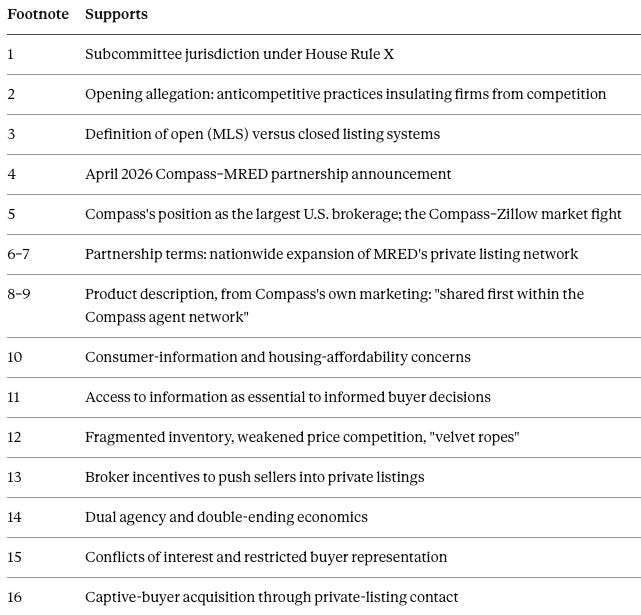
The pattern. Across sixteen numbered footnotes, the letter cites House rules, Compass and third-party marketing materials, journalism, consumer research, and industry commentary. Several footnotes contain multiple authorities, and several sources recur. No footnote cites Compass’s July 14 complaint campaign. Footnote 2 supplies the only numbered authority attached to the opening antitrust allegation, and it enters through reporting on Zillow’s allegations.
The citation map below pairs each footnote with the claim it supports in the letter’s text.
Primary sources.
The July 22 letter to Robert Reffkin, reproduced in full — Jonathan Miller, Housing Notes, “Even the House Judiciary Committee Has Concerns About Private Listings” (July 24, 2026). House Judiciary Subcommittee on the Administrative State, Regulatory Reform, and Antitrust, letters to Robert Reffkin (Compass) and Rebecca Jensen (MRED), July 22, 2026, signed by Chair Scott Fitzgerald (WI-05).
Letters obtained and verified by HousingWire, RISMedia, and Real Estate News.
Consumer coalition letter to the DOJ and FTC (July 1, 2026), PDF — the Consumer Federation of America–led request that federal enforcers investigate Compass’s MLS agreements, filed three weeks before the House letters; announcement and signatories. Part of the adverse public record preceding the inquiry; the House letter cites Brobeck’s consumer research directly rather than this coalition letter.
Appendix B: MindCast Analytical Foundations
The Third Congressional Front — House Antitrust Oversight Reaches Compass and MRED Through Two Doors — The companion analysis. Covers the institutional convergence around the inquiry — three congressional engagements in seven months, the bipartisan record meeting inside one subcommittee, the timing lattice — and carries the frozen prediction register the August 4–5 events score. The present paper reads the letter itself; that paper reads the politics around it.
The Institutional Density Theorem — How Compass’s Nationwide Complaint Campaign Against Zillow Converts Governance Nodes into Regulatory Salience — The dated prediction this paper tests. Published July 17, five days before the letter, it holds that self-filed complaints do not travel into government forums as evidence while a company’s adverse public record does. Section II counts the footnotes against that claim.
The Compass Narrative Inversion Playbook — Named the reversal in February: Compass litigates for platform access while lobbying against access requirements, and its scale-based harm theories apply equally to its own consolidation. Section III shows the letter completing the inversion — Compass supplied the vocabulary and the quotations; the committee supplied the new subject.
Compass’s Cross-Forum Contradictions — Stated the fork the letter dissolves: private exclusives either serve sellers (the legislative argument) or are suppressed by rivals as the antitrust harm (the litigation argument), positions that coexist only by omitting counterparty effects. Section IV supplies the missing incidence the framework anticipated.
How Compass’s Antitrust Strategy Harms Consumers — Argued in 2025 that Compass’s lawsuit against NWMLS identified no concrete consumer harm distinct from Compass’s own competitive injury. Section III shows the subcommittee assembling exactly the consumer-harm case that lawsuit did not make, from Compass’s own materials.
The Antitrust Litigation Trap Compass Built for Itself — Traced the recoil mechanics: the complaint as a cost-imposition vehicle whose own marketing and sworn statements became the record against it. The letter extends the pattern to a congressional forum.
The Skillman Moment as Analytical Rosetta Stone of the MindCast MLS Equilibrium Series — Formalizes the export-failure pattern Section V applies: a talking point built for a friendly audience collapses when repeated to a forum that rejects its premise. The letter pre-translates every seller-choice feature into a competition question, forcing the collapse in advance.