
Companion to Senator Warren Just Asked Compass the Questions Its “Seller Choice” Answer Can’t Survive | Compass Goes Quiet When It’s Questioned, Loud When It Isn’t — and the Loud Parts Keep Ending Up in Evidence | The House Committee Citations — How the House Antitrust Letter Built Its Opening Theory From the Record Against Compass |
Related: MLS Equilibrium Series, fifth entry set. Companion works The Institutional Density Theorem — How Compass’s Nationwide Complaint Campaign Against Zillow Converts Governance Nodes into Regulatory Salience | How the Zillow Complaint Reframes Compass v. NWMLS as a National Coordination Case | The Advocacy Arbitrage Enforcement Crisis| Robert Reffkin's Doctrinal Trap | Why Compass Needs Private Listings
Executive Summary
Compass spent mid-July activating roughly eighty-five industry forums against Zillow. Eight days later, the first visible federal move ran in the opposite direction: the US House opened an inquiry into Compass and MRED, drawing on an adverse public record rather than on Compass’s campaign. That asymmetry is the story. Trade coverage reported the real-estate dispute and largely missed the institutional stakes around it — an antitrust-enforcement event that changes the information environment around Compass well beyond the subcommittee.
Here is why it matters, and to whom. A congressional antitrust inquiry is not an enforcement finding, but it creates a federal oversight channel and publicly organizes the principal harm theories — and released correspondence, written submissions, committee readouts, follow-up demands, or later testimony can then expand the record available to enforcers, litigants, and investors. For a state attorney general weighing a review, a sitting member of the state’s own delegation has now lowered the political cost of acting. For any adversary preparing to test Compass’s claims elsewhere, the company is about to make fresh statements — to investors on one day, to congressional staff the next — that can be set against its filings and testimony. And for anyone tracking whether coordinated complaint volume actually buys institutional influence, the answer just arrived: the volume produced no visible federal adoption, while the adverse record did the work.
Four findings organize the analysis.
The third engagement. The July 22 letters mark the third congressional engagement with Compass in seven months. Warren and Wyden pressed the Justice Department and the FTC in December 2025 over the transaction’s competitive and consumer effects. Balint and Warren followed in February 2026 with an eighteen-member letter challenging how the Department cleared the deal. Chair Fitzgerald’s July letters shift the target to post-merger conduct.
Bipartisan convergence inside one subcommittee. Republican Chair Fitzgerald opened a conduct review before a panel whose Democratic side already holds a clearance-process record: four of its six Democratic members — Ranking Member Nadler, Balint, García, and Johnson — signed the February letter. Two-thirds of the minority engaged Compass before the majority did. Two independently built records, one from each party, now converge in one room — a configuration no “this is politics” defense can dissolve, even though the July inquiry carries only the chair’s signature.
The density campaign failed where it counts. Compass’s roughly eighty-five-forum campaign was structurally capable of generating the appearance of distributed concern from a single originating actor. It produced no visible congressional adoption. The House inquiry drew instead on journalism, consumer research, and the Zillow litigation record — none of the reporting reviewed for this analysis identifies Compass’s complaint campaign as an input. The Institutional Density Theorem predicted exactly this on July 17: self-filed complaints travel poorly into public forums while a company’s adverse public record travels freely. The event confirms the mechanism (85–92%), though it does not by itself establish what caused staff to act — a distinction Section III keeps precise.
A doctrine meets its terminal forum. Robert Reffkin’s “law versus rule” argument depends on state-by-state variation — it works where legislatures have not acted. A federal transparency floor could reduce that variation substantially. By August 5, Compass must decide how to defend a doctrine built on the absence of legislation before staff of the body that legislates. And the calendar puts its weakest seam on display: Compass reports Q2 earnings at 5:00 p.m. Eastern on August 4, and seventeen hours later the deadline expires for Compass and MRED to arrange — not necessarily conduct — the requested briefings. The seller-choice frame that reassures investors is a private-preference answer to what Congress will treat as a market-structure question — a category error the MindCast corpus tracks as the Skillman Moment, now scheduled at the C-suite with a one-day fuse.
The foresight simulation converges on controlled cooperation, not confrontation. Both companies arrange the briefings, with Compass routing its response through counsel and keeping Reffkin from serving as principal briefer (78–88%) and installing a compressed seller-choice defense (82–90%). Compass minimizes the inquiry in prepared Q2 remarks (72–84%), while MRED cooperates earlier and more visibly (70–82%). The medium-term prediction is reuse: an earnings, congressional-response, or briefing statement surfaces in the public litigation record before the October 7 trial (55–70%). Additional committee action appears within 90 days (55–68%), though visible bipartisan participation in it is a lower bet (38–52%). Section VII translates these findings into what each actor can do with them; Section VIII commits the full register with public falsifiers and confirming events; Section IX presents the simulation.
The near-term outcome is therefore quiet, but the strategic position is not. A congressional inquiry rarely ends in enforcement, and this one most likely resolves in voluntary briefings and controlled disclosure. What changes is the information environment: Compass must now hold one account across an earnings call, a congressional briefing, and two active courtrooms running on compressed and overlapping schedules, and every actor whose interests run against it can read those accounts side by side. The company built breadth against Zillow; the breadth did not travel, and the adverse record did. That reversal — not the briefing request itself — is why the July engagement matters, and why the actors named in Section VII should treat the next six weeks as a window rather than a formality.
I. Three Congressional Engagements in Seven Months
Congressional interest in Compass did not start on July 22, 2026. Scrutiny began in December 2025 and has escalated through three engagements, each aimed at a different target.
Warren and Wyden opened the sequence in December, urging the Justice Department and the FTC to scrutinize the proposed merger’s competitive, consumer, and fair-housing effects. Balint and Warren sharpened it in February, leading an eighteen-member letter that posed seventeen questions about how the Department had cleared the transaction. The December engagement challenged the transaction’s competitive and consumer consequences; the February engagement challenged the integrity and adequacy of the clearance process. Four of the current subcommittee’s six Democratic members signed the February letter.
The July engagement shifts the target. Chair Fitzgerald sent separate, reportedly identical letters on July 22 to Compass CEO Robert Reffkin and to Rebecca Jensen, CEO of Midwest Real Estate Data (MRED), the Chicago-area multiple listing service (MLS), requiring each company to arrange a staff briefing by 10 a.m. Eastern on August 5. The letters ask about conduct: business practices, private-listing-network use, and the April Compass–MRED data partnership. The July inquiry is the first Republican-authored instrument and the first to examine what Compass does now rather than how its merger was approved.
The July letters name four harms: competitive insulation, a closed information system, dual agency and double-ended deals, and captive buyer pipelines that route unrepresented buyers back to the listing brokerage. Two features stand out. The letters cite journalism — HousingWire, The New York Times, The Real Deal, and Jonathan Miller’s Housing Notes — rather than Compass’s own filings or the Chicago court record. And the two recipients answered differently: MRED confirmed receipt and pledged cooperation, while Compass said nothing.
The three engagements escalate along every axis that matters — who is asking, what they are asking about, and what power sits behind the question.
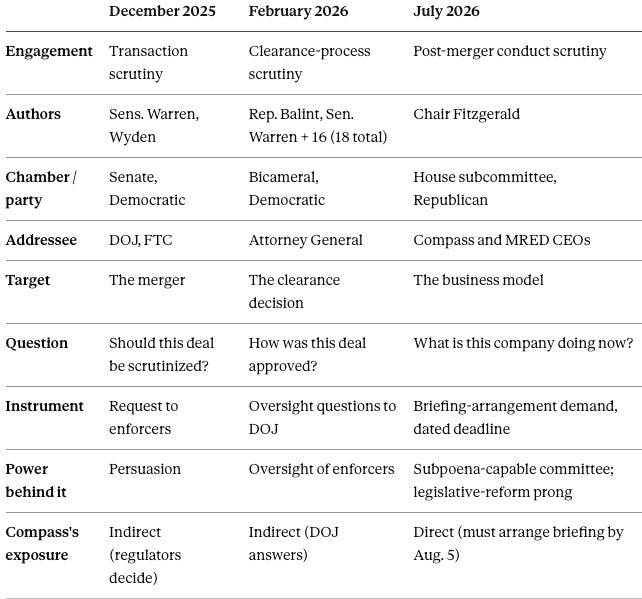
Each step moves the pressure closer to Compass. The first two engagements aimed at the government — asking enforcers to act, then asking how they had acted. The third aims at the company itself and sets a clock. Three engagements, two parties, one company — and a subcommittee that has moved from questioning a merger to questioning the business model it produced. Additional committee action within ninety days runs 55–68%; visible bipartisan participation in it is a lower bet at 38–52%.
II. Two Doors, One Room
A single company now faces two congressional records built independently by opposing parties, and both converge inside the same antitrust subcommittee. Bipartisan record convergence is worse for Compass than a partisan attack from either side, because neither record can be dismissed as the other party’s politics.
Democrats built the first record, and it concerns process: whether the merger clearance was improperly routed, the divergence between career-staff recommendations and final enforcement posture, and the access-channel engagement documented in the Advocacy Arbitrage brief. Four of the subcommittee’s six Democratic members — Nadler, Balint, García, and Johnson — signed the February letter carrying it.
Republicans are building the second record now, and it concerns conduct: whether private-listing networks let a dominant brokerage insulate itself from competition at consumers’ expense. Chair Fitzgerald authored it alone — the July inquiry is Republican in authorship even as the surrounding record is bipartisan in composition.
Geography deepens the convergence on both sides of the aisle. García represents part of MRED’s core Chicagoland market on the Democratic side. Baumgartner supplies a Washington-state statutory nexus through SSB 6091, the concurrent-marketing law anchoring the Seattle litigation. And Fitzgerald’s own Wisconsin district sits within MRED’s regional footprint, giving the chair a home-market connection to the MLS his letters address.
The subcommittee’s stated purpose ties the two records together. The panel describes its work as a review of antitrust enforcement, and that framing lets the Republican majority reach the same clearance controversy the Democrats raised — through the safer door of company conduct rather than the pointed door of enforcement capture (65–75% confidence). Both doors open into one room: whether the government got this merger right, and what the merged company is doing with the approval.
Compass cannot answer this configuration with its usual defense. When scrutiny comes from one party, “this is politics” works. When two parties build separate records that converge without coordination, the defense collapses — and on the current roster, the convergence is already in place.
III. The Adverse Node
Compass spent mid-July building the appearance of regulatory pressure on Zillow. Eight days later, real congressional pressure landed on Compass — through a channel Compass could not control. The gap between those two outcomes is the finding.
On July 14, Compass announced a complaint campaign targeting approximately eighty-five industry bodies across twenty-six states, with some complaints filed and others still in submission. Whatever Compass’s subjective intent, the campaign’s observable strategic value came from volume: enough parallel proceedings to support a sentence like “regulators across the country are investigating Zillow.” That sentence is worth more than any single complaint, because observers count institutions rather than outcomes. In formal terms, the campaign builds a pseudo-equilibrium — apparent convergence produced by one actor’s structural arrangement rather than by independent judgments — the false-stability pattern the Dual Nash-Stigler Equilibrium Architecture is built to detect.
The campaign produced no visible congressional adoption. When the subcommittee opened its inquiry on July 22, published reporting identified journalism, consumer research, and the Zillow litigation record as prominent inputs. None of the reporting reviewed for this analysis identifies Compass’s complaint campaign as an input to the letters.
The Institutional Density Theorem predicted this asymmetry on July 17, five days before the letters. The theorem’s core claim is that a company’s self-filed complaints lose force when they cross from private trade forums into public enforcement, while the company’s adverse public record crosses that boundary intact. The letters confirm the mechanism: the constructed density stayed home, and the adverse record reached Congress.
The bands sit at three levels. The House event is consistent with the export-asymmetry mechanism at 85–92%. The visible sourcing favors the adverse public-record channel over the constructed-density channel at 70–82%. What specifically caused congressional staff to act cannot be established from public evidence, and this analysis does not claim to know — the mechanism is confirmed, the causation is not.
The event also exposes a variable that simple density arithmetic misses: authority-weighted independence. Density counts how many institutions are activated, not how many independent sources reached the same conclusion — and one federal node with legislative jurisdiction outweighs dozens of common-source private nodes, because a legislative body can connect evidence, demand information, and produce a law. Compass’s complaint volume still creates procedural breadth. Control of the federal narrative now sits elsewhere.
One consequence is immediate. The salience sentence inverted at the federal level: Compass now faces a congressional antitrust inquiry it neither initiated nor controls, while its own campaign to author that sentence about Zillow found no federal audience. Watch the August 4 earnings call for the tell — Compass counting its own eighty-five-forum campaign as regulatory momentum while omitting the one federal inquiry it did not file (72–84%).
IV. The Doctrine Meets the Lawmakers
Reffkin’s central legal argument works wherever legislatures have not acted. The August 5 deadline forces Compass to decide how that argument performs before the institution that acts by writing law.
The doctrine is simple: MLS rules are private contracts, not law, so a broker’s duty to the client overrides them. In the March op-ed that formalized it, Compass added a coercion claim and a disclosure trigger, then built a broker culture treating MLS fines as an acceptable operating cost. The doctrine’s power comes from geography: it holds in every state that has not converted listing-transparency obligations into statute, and Compass’s lobbying works to keep that map from shrinking.
A federal statute changes the terrain. State-by-state legislation closes one gap at a time; a national transparency floor would substantially reduce the state-by-state variation the doctrine depends on — one forum instead of dozens of statehouses. The inquiry opens that legislative-reform pathway, though no public record yet establishes that the subcommittee is drafting such a measure. A statute of that kind would also do something antitrust litigation struggles to do on its own — define the harm object in law. Listing infrastructure is coordination infrastructure, the shared architecture through which buyers, sellers, and brokers discover and price homes, and a transparency floor would codify its protection directly rather than leaving “competition” undefined for courts to fill in. By August 5, Compass must decide how it will defend a doctrine built on the absence of legislation before staff of the body that legislates.
Expect a defensive, narrow briefing. Compass will likely soften the coercion claim and lead with its strongest fact — that 94% of its listings still sell through the MLS — as reassurance that the private-network share is marginal (70–80%). Reffkin himself probably will not appear; the three-tier communications pattern points to counsel and government-affairs staff carrying the room, keeping the CEO’s framework vocabulary off the congressional record (75–85%).
Narrative compression is where the doctrine meets its weakest boundary — the Skillman Moment, scheduled. Across the MindCast corpus, a Skillman Moment names a category error: an actor reframes a public market-design question as a matter of private choice, and the frame collapses the instant it crosses into a forum that does not share its assumptions. Compass’s seller-choice grammar coheres before investors and consumers, the audiences it was built for. On August 4 the company faces investors; seventeen hours later it faces congressional antitrust staff, whose jurisdiction is competition. “Sellers should choose how to market their homes” is a private-preference answer to a market-structure question — and a subcommittee examining whether private-listing networks insulate a dominant firm from competition is precisely the forum where that answer does not translate. The simulation’s own prediction, that Compass compresses to seller-choice, legality, and access (82–90%), is a prediction that Compass walks into the export boundary rather than around it. The tell for every downstream forum is a single phrase: the moment “seller choice” is offered to answer an antitrust question, the frame is being tested where it is weakest, and any statement that survives the briefing carries that vulnerability into every record that later cites it.
Every statement made in the briefing enters the committee’s institutional information set. Written submissions, public readouts, follow-up correspondence, or later testimony may then become part of the public congressional record and supply material for comparison against Compass’s court filings, investor statements, and Washington positions. Washington and Wisconsin already supply model text a federal bill could draw from (55–65% that a federal product references them). And any Compass claim about why private networks serve consumers enters that information set roughly nine weeks before the same claims may be compared against testimony, filings, and evidentiary positions in the Seattle litigation.
Contact mcai@mindcast-ai.com to partner with us on Predictive Game Theory AI in Law and Behavioral Economics. We specialize in predictive simulations for Complex Litigation, Innovation Economics, Geopolitical Risk Intelligence and Legacy Innovation. See our new website at MindCast Corporate.
To test our predictive simulation AI system, in 2026 we simulated the Super Bowl and the World Cup. See 🏈 Super Bowl LX — AI Simulation vs. Reality | ⚽ The 2026 World Cup Final Simulation Validation
To deep dive on MindCast works upload the URL of this publication into any LLM (preferably Google AI mode) and prompt ‘reconstruct MindCast framework with three degrees of cited sub links.’ See Live-Fire Game Theory Simulators, Runtime Predictive Infrastructure.
V. The Governance Question
The subcommittee says it wants to understand the relationship between the MLS and the brokerage. The structural answer is straightforward, and it explains why MRED accommodated Compass while a comparable Seattle service resisted: governance geometry, not regional culture, determined each response.
Three seats on MRED’s board are held by individuals affiliated with Compass-owned brands. Compass holds Preferred Unit Owner status, a position the Anywhere acquisition deepened as acquired brands joined the ownership structure. MRED’s CEO, Rebecca Jensen, concurrently chairs the board of MLS Grid, the technology provider tied to the feed dispute. The Seattle service carries none of that concentration, and it fought.
Antitrust law gives that structure legal significance without making it dispositive. American Needle rejects automatic single-entity treatment when independent competitors cooperate through a common venture: the question is whether challenged decisions represent concerted action among independent economic actors, analyzed under the rule of reason. MRED’s governance concentration matters to that question — board alignment strengthens an influence theory and shapes how the venture’s restraints are evaluated. Concentration alone does not establish capture or illegality; it establishes the terrain on which the subcommittee’s “closed information system” concern will be tested.
MRED’s cooperative posture toward the subcommittee fits a legitimacy-preserving strategy. A venture defending its neutrality performs openness, and MRED’s pledge to “help the committee understand our business practices” is consistent with its litigation stance that its rules are neutral and generally applicable.
The two recipients face different institutional incentives, and the difference is where staff leverage lives. MRED must defend its legitimacy as cooperative infrastructure, so it benefits from visible openness. Compass must defend a national brokerage strategy, so it benefits from controlled disclosure. Their defenses overlap without fully aligning — and staff questions about who initiated specific rules, who subsidized participation, who influenced feed decisions, and who measured consumer outcomes are precisely the questions that can separate the two accounts. A divergence between them converts a routine briefing into a document track.
The briefing will test the structure directly. If MRED’s account documents the board alignment and the depth of the Compass relationship, it corroborates the governance indicators already on the public record; if it establishes genuine arm’s-length governance, it rebuts them. Either way, the relationship the subcommittee is asking about is one the governance record already describes — the briefing determines only how far MRED’s own account corroborates or rebuts it.
VI. The Timing Lattice
August 5 is not a standalone deadline. It sits inside a dated sequence that no single forum controls, and the tightest link in that sequence is a single overnight.
Compass reports Q2 earnings and holds its investor call at 5:00 p.m. Eastern on Tuesday, August 4. Seventeen hours later, the 10 a.m. Wednesday deadline expires for arranging the congressional briefings. Compass must characterize its regulatory environment to investors immediately before responding procedurally to Congress — a high-information disclosure test compressed into one overnight.
The full sequence runs five steps: the August 4 earnings call; the August 5 briefing-arrangement deadline; Judge Tharp’s pending injunction and arbitration rulings in Chicago; pretrial filings on September 18–28 in the Seattle case, where the Northwest Multiple Listing Service (NWMLS) is defending against Compass; and the Seattle trial opening October 7, nine weeks after the briefing deadline.
The steps interact. The two-week arrangement window looks calibrated to the August recess and the litigation calendar (70–80%). An adverse Chicago ruling could shape settlement leverage, pretrial narrative, admissibility disputes, and the parties’ public positioning before the Seattle trial. And any public Compass statement from the August window — the earnings call, a briefing readout — enters a record available to both sides of the pending cases.
Leverage runs underneath the calendar. Compass carried approximately $3.14 billion in long-term debt as of March 31, including a $500 million tranche at a 9.75% coupon, at below-investment-grade ratings. Public filings do not isolate a private-listing profit stream as the source of debt service, but leverage at that scale makes sustained regulatory friction potentially material to the capital markets.
The calendar is the point. Four forums — an earnings call, a congressional deadline, a pending Chicago ruling, and an approaching Seattle trial — now run on overlapping clocks, and a statement made to satisfy one can be read against the others. Compression is what converts a routine briefing request into a strategic event.
VII. What Each Actor Can Do With This
The July engagement is not neutral information; it is usable by every actor whose interests run against Compass’s, and the uses differ sharply by seat. The organizing principle is coherence: the August 4–5 sequence forces Compass to speak to two audiences in two days, and the value to everyone else lies in whether those statements hold together across forums. Each actor below can act on that seam within days.
Parties to the pending litigation. The compressed calendar generates a public statement record. Whatever Compass says to investors on August 4, and whatever becomes public from the congressional briefings, enters a body of statements that any party to the Chicago or Seattle proceedings can compare against court filings, testimony, and operational evidence. The statements most exposed to that comparison are the ones the antitrust frame stresses hardest: that MLS rules are private and non-binding, that private networks broaden rather than restrict access, and that seller choice — not brokerage economics — drives the model. Each is a private-ordering claim entering a record where a competition question is live, which is exactly where the Skillman category error becomes legible. The timing sharpens the point: statements made in the August window precede the Seattle trial by roughly nine weeks, and inconsistency across forums is available to whichever party a given inconsistency helps.
State enforcers. A congressional antitrust inquiry lowers the political cost of a parallel state review and supplies a partial evidentiary map at no cost. An attorney general in any of the twelve delegation states can point to a sitting member of the state’s own congressional delegation who has already engaged Compass — converting a federal signal into local cover. The inquiry itself develops no compulsory record, but it publicly organizes the harm theories — closed information systems, dual agency, captive buyer pipelines — that a state consumer-protection or antitrust action would build on. The actionable move is not to wait for the subcommittee to conclude; it is to open or expand a state review while the federal record accumulates, using the delegation member’s engagement as the domestic anchor.
Listing services and governance bodies. Any board holding one of the July 14 complaints should characterize its own process before a national tally characterizes it. An intake review is not “an investigation,” and a one-sentence public correction from a board carries disproportionate weight against a nationwide count — it breaks the density arithmetic at the single point where the counted institution controls the description. Boards weighing rule changes that arrive through shared technology vendors should treat them as governance decisions of the board, not technical updates, since a rule altered to favor one dominant participant is what converts neutral cooperative infrastructure into a concerted-action problem.
Investors and analysts. The August 4 call is the quarter’s highest-information event, and the tell to watch is asymmetric counting: Compass citing its own eighty-five-forum campaign as regulatory momentum while minimizing the one federal inquiry it did not file. Symmetric disclosure would falsify the prediction; asymmetric disclosure confirms that the company is managing the congressional exposure as a narrative rather than a material risk — a judgment that itself becomes comparable against the company’s later filings.
The common thread is coherence under pressure. Compass’s exposure is not any single statement; it is the requirement to keep investor, congressional, and litigation accounts aligned across a compressed calendar. Every actor above benefits from the same fact: the more forums Compass must speak to at once, the harder its story is to hold together — and the four playbooks above are four ways to apply that pressure at once.
VIII. Prediction Register
Analysis without accountability is commentary. The register below converts this paper’s claims into public tests, each with a window, a confidence band, a confirming event observable in the public record, and a falsifier. The bands reconcile the structural analysis with the foresight simulation in Section IX.
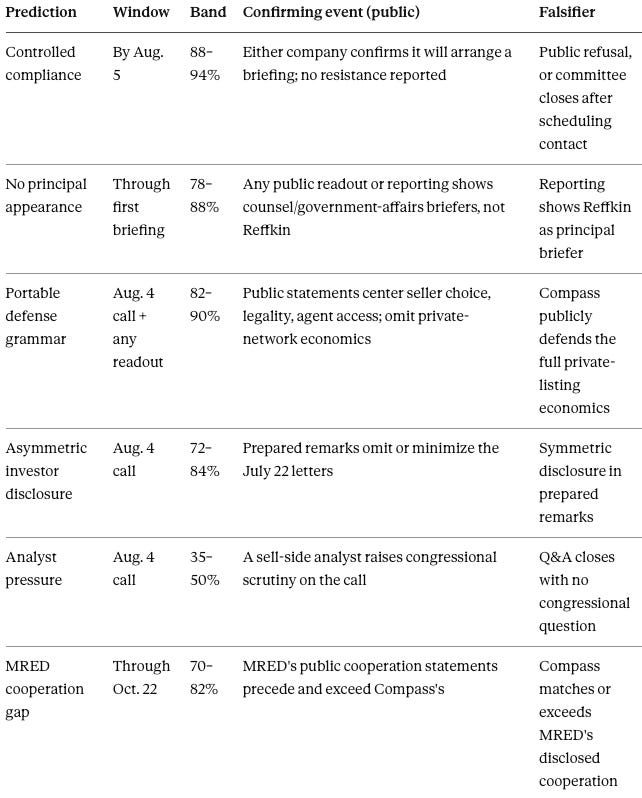
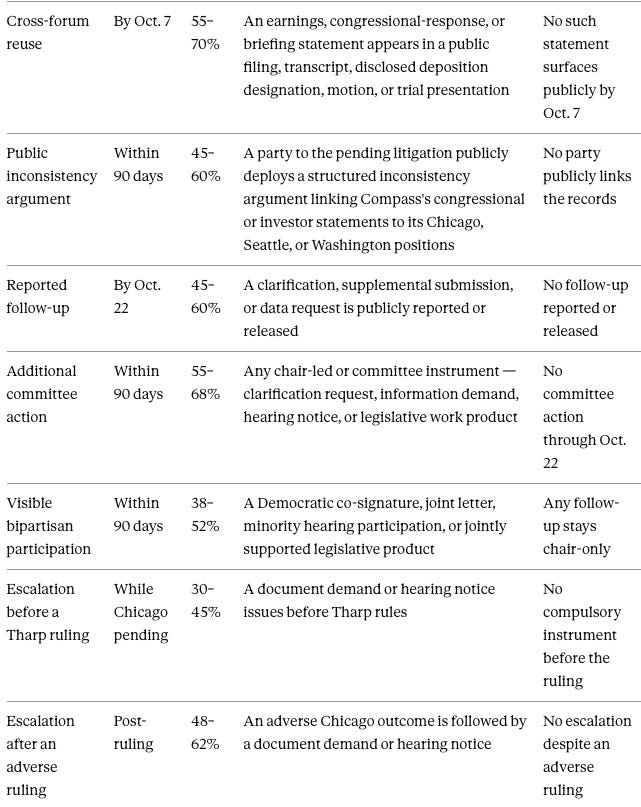
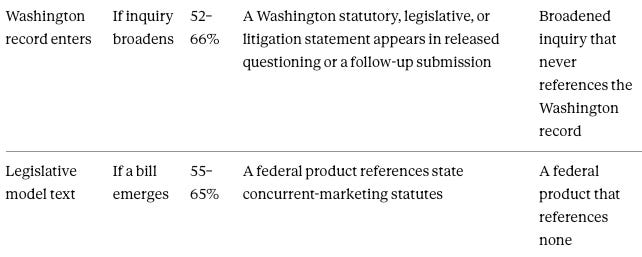
Structural falsifier: if the subcommittee’s eventual public record cites Compass’s July 14 campaign as evidence of Zillow misconduct, the adverse-node reading fails and the theorem’s export coefficient requires upward revision.
IX. Cognitive Digital Twin Foresight Simulation
The predictions in this paper come from the MindCast AI Proprietary Cognitive Digital Twin Foresight Simulation (MP CDT FS) — the firm’s method for forecasting institutional behavior. A Cognitive Digital Twin is a structured behavioral model of a real decision-maker, built from that actor’s documented incentives, constraints, prior conduct, and institutional position. The simulation instantiates a twin for each party to a situation, then runs their interaction forward under the actual facts and calendar, surfacing the moves each actor is most likely to make and the confidence attached to each. The bands express calibrated model judgment, not statistical frequencies, and each resolves in public as a hit or a miss — which is what makes the register in Section VIII scoreable rather than rhetorical.
For this analysis, the simulation instantiates ten actor twins against the July 22 letters, the August 4 earnings call, the August 5 deadline, the pending Chicago rulings, and the October 7 trial date. Each twin is constructed and routed according to the methodology established in the Institutional Density Theorem, and a companion simulation report preserves the full twin constructions, activation conditions, primary and secondary outputs, confidence bands, and falsifiers. The section below reports only the convergent findings material to the article, organized by party. Outputs are scenario-based projections, not factual findings or legal conclusions.
Congressional staff hold the questions now, and that is the change. The inquiry does not establish liability; it changes who controls the frame. Compass can no longer define the dispute as a seller-choice conflict with Zillow or an MLS-rule quarrel, because staff can compare business-model claims, merger representations, private-listing economics, and consumer-access effects inside one review. The most likely staff sequence is corroboration before conclusion: probing for company-originated quantitative data — listing volumes, time in private phases, transaction-side concentration, subsidy mechanics, governance decision rights — rather than resting on published allegations (72–84%). A cross-record follow-up drawing on the February clearance inquiry or public litigation materials arrives within 90 days even if no hearing does (60–72%).
Compass’s optimal play is narrative compression, and the simulation expects it. A detailed defense of private-listing economics creates comparison points across forums; a compressed grammar — seller choice, lawfulness, broad agent access, claimed consumer benefit — travels across earnings, Congress, and litigation with less new divergence. Compass therefore complies cooperatively but narrowly: counsel and government affairs carry the briefing, message authority centralizes, and granular claims about dual-ending rates, seller-price effects, or MRED influence stay off the table unless anchored to auditable data (78–88%). Compression buys consistency at a price — the minimum-sufficient-answer strategy raises the probability of a supplemental request when staff detects omitted operational detail (62–74%).
MRED cooperates faster because its institution requires it. A cooperative must preserve trust among many participants, so visible openness is MRED’s rational posture; a national brokerage must protect a business model, so controlled disclosure is Compass’s. The gap between those postures is the inquiry’s leverage point: if the two accounts diverge on who initiated rules, subsidized participation, or influenced feed decisions, a routine briefing converts into a document track. MRED discloses earlier and in greater detail while anchoring its account in the network’s pre-Compass history — its private listing network dates to 2016 — and its neutral-governance position (70–82%).
The exposure compounds over time. Compass's largest risk is not a congressional accusation; it is later reuse of whatever Compass says. Every public statement from the August window can be compared against court filings, testimony, and operational evidence in the pending cases, and the approaching Seattle trial makes that statement record durable rather than fleeting. Delay increases rather than eliminates evidentiary risk: press attention decays if the committee issues no second instrument, but litigation relevance persists after coverage fades. At least one earnings, congressional-response, or briefing statement surfaces in a public filing, transcript, or trial presentation by October 7 (55–70%), and a party to the litigation publicly deploys a structured inconsistency argument linking those statements to the Washington, Chicago, or Seattle record within 90 days (45–60%).
Escalation stays conditional, and the branch points are identifiable. A briefing request is an early oversight instrument, not compulsory process. The modal path runs voluntary engagement, then written clarification. Compulsory process becomes materially likely only on three triggers: the company accounts conflict, quantitative evidence is withheld, or Judge Tharp rules adversely — the last of which moves the escalation band from 30–45% to 48–62%. If the inquiry broadens at all, the Washington record — a statute, a 141–1 legislative outcome, and Compass’s own litigation statements, all public and export-ready — offers staff the lowest-friction template for how a legislature resolved the same market-design conflict (52–66%).
Integrated judgment. The ten flows converge on one result: the inquiry does not yet create a high-probability enforcement or legislative outcome, but it materially changes the information architecture. Near term, expect disciplined voluntary engagement paired with narrative compression. Medium term, expect cross-forum reuse of whatever the companies say. The consequential conditional branch is a mismatch between the two accounts or an adverse Chicago ruling — either converts a staff briefing into a document and hearing track. Structural falsifier for the simulation as a whole: the committee closes the matter after a routine briefing, no follow-up occurs by October 22, the company accounts stay fully consistent, and no congressional-response statement migrates into the Chicago or Seattle litigation.
Conclusion
The Institutional Density Theorem rests on one distinction: a single complainant can create many dockets, but many dockets cannot create many independent complainants. The July engagement adds a congressional corollary. An adverse public record, carried by journalism and independent research, reached the one forum Compass could not file into, count, or control. A campaign spanning roughly eighty-five forums produced no visible federal adoption.
The convergence is the danger, and coherence is the cost. Two parties built two records without coordinating, and both now sit in one subcommittee. A federal transparency floor threatens the state-by-state variation Compass’s legal doctrine depends on. And the calendar compresses the next moves into a sequence — a courtroom, a hearing room, and an earnings call — that forces Compass to hold one story across forums that do not share assumptions. The seam opens first at the seller-choice boundary, where a private-preference frame meets an antitrust question, and every actor with an interest against Compass now knows where to watch for it.
None of this presumes bad faith. Parallel complaints can carry merit, petitioning many forums is lawful, and institutional engagement is not evidence of wrongdoing. The claim is narrower and harder to escape: the adverse record reached Congress before the counting sentence did. The register above states exactly what would prove this reading wrong, and MindCast will score every entry in public.
Appendix: Analytical Foundations
Load-bearing foundations
The Institutional Density Theorem — How Compass’s Nationwide Complaint Campaign Against Zillow Converts Governance Nodes into Regulatory Salience — The paper’s analytical engine. The July 22 letters are an adverse node in the theorem’s salience formula, opened against Compass through the adverse-record channel rather than the density channel. Section III is the theorem’s first congressional test.
Why Compass Needs Private Listings, The Inventory-Routing Premium — Compass, the Anywhere Merger, and the Multi-State Enforcement Window — Documents the first two congressional engagements and establishes July 22 as the third. Supplies the delegation map and the financial spine — $3.14 billion in debt, a 9.75% tranche, below-investment-grade ratings — that makes regulatory drag potentially capital-markets material.
Jurisdictional Analysis and Independent Enforcement Warrant Across Concurrent Antitrust Matters of Compass, HPE, Live Nation, Netflix — The Advocacy Arbitrage Enforcement Crisis — Maps the enforcement-adequacy controversy the subcommittee’s own framing engages, and grounds Section II’s two-door convergence.
Compass Holdings, Robert Reffkin’s Doctrinal Trap — Why Reffkin’s “Law vs. Rule” Distinction Is Structurally Self-Defeating — Establishes that the doctrine survives on state-by-state variation, the terrain a federal transparency floor would substantially reduce. Supplies Section IV’s briefing forecast.
How the Zillow Complaint Reframes Compass v. NWMLS as a National Coordination Case — The structural answer to the subcommittee’s question about the MLS–brokerage relationship. Supplies the board-alignment and Preferred Unit Owner analysis behind Section V.
The Compass Antitrust Self-Destruction Sequence — Documents Compass’s own filings inverting into SSB 6091’s statutory definitions, the model for how a record built from admissions converts into legislative text.
Mechanism support
The Dual Nash-Stigler Equilibrium Architecture — Behavioral Settlement and Inquiry Sufficiency as Runtime Constraints — Supplies the pseudo-equilibrium classification Section III applies to the eighty-five-forum campaign: constructed density presenting as convergent concern is false stability, detectable through the Stigler source-diversity requirement. Also supplies the persistence logic beneath Section II — capture equilibria survive personnel changes because the incentive structure, not the actors, sustains them — which is why the subcommittee’s structural review matters more than any single enforcement-official outcome.
Chicago School Accelerated — The Integrated, Modernized Framework of Chicago Law and Behavioral Economics — Supplies the coordination-infrastructure-capture harm object beneath Section IV: listing systems are the shared architecture through which markets discover and price homes, and harm to that architecture is pleadable before price effects appear. The subcommittee’s “closed information system” phrase is the lay statement of the theory, and a federal transparency floor would codify the harm object legislation-side rather than leaving “competition” undefined for courts.
Zillow v. MRED and Compass — Residential Real Estate Enters Infrastructure Sovereignty Conflict — Casts legislatures as a fourth infrastructure actor, a role Congress now federalizes. Supplies the American Needleconcerted-action analysis behind the “closed information system” phrase.
Compass Transaction Fees Convert a Private-Listing Dispute Into a State AG Platform-Control Case — Operationalizes the letters’ dual-agency and captive-buyer theories through the Florida complaint, the SEC fee disclosure, and the Batton standing analysis.
Compass’s Skillman Moment Reaches the C-Suite, Cris Nelson Moment Holds at the Regional Tier — The three-tier communications pattern behind Section IV’s prediction of staff-level briefing attendance.
The Skillman Moment as Analytical Rosetta Stone of the MindCast MLS Equilibrium Series — Formalizes the export-failure pattern the congressional sourcing is consistent with.
How Compass, Zillow, and MLS Governance Broke the Cooperative Transparency Equilibrium — The three candidate equilibria framing what Congress chooses among when it legislates on listing transparency.
Compass’s Interpretation of “Public Marketing” May Draw Antitrust Scrutiny from State Attorneys General — Frames the definitional fight over “public marketing” any federal bill must resolve.
Compass Rhetorically Reframing MLS Transparency — Documents the move from public market question to private contract question that a briefing will test.
Context and distribution
The Reciprocal Injunction — What Tharp’s TRO Reveals About Zillow v. MRED & Compass — Background for the timing lattice: the May 22 order and its injunction-geography consequence.
The Antitrust Litigation Trap Compass Built for Itself (Visual Synthesis) — Low novelty, high staff utility: the visual format matches how congressional staff consume litigation records.
Platform-Mediated Price Discovery, A Runtime Measurement Framework for the Compass–Redfin–Rocket Architecture — Documents the February 26 Compass–Redfin–Rocket alignment that removed the market self-correction defense.
Primary sources
Inman, House antitrust panel seeks answers from Compass, MRED (July 22, 2026)
Real Estate News, Judiciary subcommittee summons Compass, MRED CEOs (July 22, 2026)
Wyden–Warren press release on the Compass–Anywhere merger (December 2025)
Balint–Warren letter to the Attorney General (February 19, 2026; 18 signatories, 17 questions)
Compass Q2 2026 earnings announcement (call August 4, 5:00 p.m. ET)
HousingWire, Compass ethics complaints against Zillow (July 14, 2026)
Consumer Federation of America coalition letter to DOJ/FTC (July 1, 2026)
Compass Form 10-Q (Q1 2026)