

Companion work in the MindCast MLS Equilibrium series: The Equilibrium Selection Problem in Residential Real Estate | The Collapse of Compass’s Local Narrative | The Skillman Moment as Analytical Rosetta Stone of the MindCast MLS Equilibrium Series | Zillow v. MRED and Compass — Residential Real Estate Enters Infrastructure Sovereignty Conflict
Other frameworks: The Compass Skillman Moment as Analytical Rosetta Stone | The Dual Nash-Stigler Equilibrium Architecture | Compass’s Coasean Coordination Problem
Executive Summary
One company filed complaints against its chief rival across 26 states, roughly 55 multiple listing services (MLSs), and 30 Realtor associations — in a single week. Compass International Holdings launched the campaign against Zillow on July 14, 2026, alleging false advertising in how Zillow displays, and declines to display, publicly marketed listings (HousingWire: https://www.housingwire.com/articles/compass-ethics-complaints-zillow/; Inman: https://www.inman.com/2026/07/14/compass-zillow-mls-realtor-associations-ethics-complaints/; RISMedia: https://www.rismedia.com/2026/07/14/compass-targets-zillow-barrage-consumer-ethics-complaints-dozens-states/). The filings landed days after the National Association of Realtors (NAR) published guidance requiring all active MLS listings to flow through virtual office website (VOW) data feeds, and while a federal judge in Chicago weighs Zillow’s antitrust case against Compass and Midwest Real Estate Data (MRED).
The campaign matters far beyond real estate, because it tests a question every regulator, legislator, and journalist now faces: can institutions tell the difference between many independent parties raising the same concern and one party raising the same concern in many places? Within weeks, expect a sentence shaped like “regulators and Realtor associations across the country are investigating Zillow.” Every proceeding behind that sentence will trace to a single filer. Whether decision-makers catch the distinction — or count the dockets and move on — determines who wins this contest and how the next hundred campaigns like it, in any industry, get evaluated.
The Institutional Density Theorem names the mechanism: influence increases with the density of institutional engagement even when no institution has reached a substantive conclusion, because observers count participating institutions rather than completed findings. Beneath the theorem sits its deepest claim: institutional density and evidentiary independence are orthogonal variables. Dozens of proceedings can trace to one originating source, and the entire strategic value of a density campaign depends on observers confusing the two quantities. The operational model separates four measurable layers:
Raw Salience = Open Institutional Nodes × Narrative Repetition
Net Salience = Raw Salience + Favorable-Disposition Weight − Adverse-Disposition Weight
Public Regulatory Salience = Net Salience × Export Coefficient
Enforcement Exposure = Filing Density × Cross-Forum Relevance × Amplification
The strategy also carries a structural flaw its author cannot remove. The Skillman Moment — MindCast’s documented pattern in which narratives that cohere inside a sympathetic ecosystem fail when exported to outside institutions — predicts that Compass’s self-initiated private proceedings transfer into public enforcement at a severe discount. Compass’s own signed filings face no such discount: they travel as primary-source party statements, usable against the firm whose Private Exclusive network withholds the very listings its complaints champion. The claimed asset must cross a forum boundary; the filings created while building that asset do not.
What each stakeholder should take from this analysis. State attorneys general and legislators: one distinction neutralizes the arithmetic — many dockets may reflect one campaign, not many independent judgments — and Section V maps where the campaign expands Compass’s own enforcement exposure. MLS boards and association panels: Section VI provides same-day operational guidance — adjudicate the complaint on its merits while preventing routine intake from being recast as “nationwide investigation.” Zillow and defense counsel: Section V.A documents an admission corpus of at least 85 Compass-authored filings asserting that withholding publicly marketed listings harms consumers. Investors and trade media: Sections VII–VIII predict how the campaign’s narrative value peaks, decays, and can invert — on a measurable schedule.
Major predictions, committed with confidence bands and public falsifiers (full register in Section VII):
Counting behavior (80%): within 30–60 days, Compass communications frame the campaign by institutions engaged rather than outcomes obtained.
Earnings-call migration (75%): the campaign appears as regulatory-momentum framing in Compass’s Q2 2026 earnings communications — checkpoint early August.
Governance topology (75–85%): adjudication outcomes track governance architecture, not geography — pre-registered classification criteria committed at publication.
The Washington absence (65–75%): Washington sits outside the 26 target states, because the campaign’s instruments cannot reach a non-Realtor-affiliated MLS operating under SSB 6091, Washington’s concurrent-marketing statute.
Strategic continuation (82–88%): Compass expands governance-based competition so long as institutional engagement outperforms litigation — and pivots toward evidence-building if institutions begin distinguishing density from corroboration (72–80%).
Media vocabulary shift (75–83%): industry reporting increasingly separates “complaints filed” from “investigations opened” from “findings reached,” draining the persuasive value of raw counts.
Every prediction resolves in public, and a filing followed by silence — no counting, no amplification, no cross-citation — falsifies the central thesis outright. Two questions, developed throughout and usable by any staffer today, close the analysis: Who filed the complaints being counted? And: Why should private proceedings supply public-policy validation when the complainant has repudiated materially related rules and questioned the legitimacy of the same governance machinery?
I. The Governance Transition
The Compass–Zillow contest has moved from competitive strategy to governance strategy, and the sequence of forum outcomes explains the move. Judge Vargas denied Compass’s preliminary injunction against Zillow in the Southern District of New York on February 6, 2026, finding Compass’s claimed injury substantially self-inflicted. Compass dismissed its own federal antitrust suit in March 2026. By July 2026, Compass sat as defendant in Chicago, where a two-day preliminary injunction hearing on July 1–2 tested Zillow’s allegation that Compass and MRED coordinated an unlawful group boycott, with reply briefs exchanged on July 13. The principal neutral forums that reached Compass’s requests for immediate relief rejected them, while Compass voluntarily dismissed its affirmative federal action before obtaining merits relief.
A party that has exhausted behavioral forums holds one class of moves remaining: relocate the contest into governance processes whose decisions shape market rules after individual cases conclude. The complaint campaign executes that relocation across at least eighty-five identified governance nodes simultaneously, with additional state-regulatory filings reported. Market competition now operates through ethics panels, MLS compliance systems, and state licensing agencies rather than through courtrooms Compass was losing.
The controlling reframe for everything that follows: the product this campaign seeks is not a ruling but a sentence — “regulators and Realtor associations across the country are investigating Zillow” — a reusable narrative artifact whose value realizes at filing, before any adjudicator acts, and which can be presented to legislators, regulators, courts, investors, and industry audiences as evidence of convergent institutional concern.
II. Governance Topology
The complaints follow governance architecture, not geography, and the topology exposes the campaign’s design logic. Compass built a jurisdiction-adaptive, three-layer battery: ethics complaints route to Realtor associations, listing-display and Internet Data Exchange (IDX) rule complaints route to MLSs, and false-advertising complaints route to state regulators — Departments of Real Estate and Departments of Commerce, varying by state (RISMedia sourcing, July 14, 2026). Each jurisdiction receives whichever enforcement surfaces its institutional structure offers.

Two constraints define the map. A jurisdiction-specific factual predicate becomes strongest where Compass can identify an actual listing affected by Zillow’s Listing Access Standards, concentrating the campaign in Compass’s high-share footprint where Zillow actively enforces. And Judge Tharp’s May 22, 2026 order bars Zillow from enforcing those standards in ZIP codes within MRED’s April 2025–April 2026 listing footprint — meaning fresh enforcement conduct, and therefore the strongest factual predicates, accrue outside that zone. The complaint geography operates as the approximate complement of the injunction geography: institutional pressure extends where federal relief left Zillow’s standards intact (confidence 75–85%). The inference deserves plain statement: a complaint map that tracks enforcement standing jurisdiction by jurisdiction and stops at the federal injunction line is a designed map, not an organic wave of local grievances.
Instrument choice sorts by observable governance classification, extending Part II’s structural-conditions framework directly. Where MLSs are accommodation-aligned — MRED, Realtracs, The MLS/CLAW, Bright, each operating under partnership terms or rule templates favorable to Compass — the MLS itself constrains Zillow and no complaint is needed. Where governance architecture is distributed and structurally resistant, the complaint arrives as the substitute instrument. Any stronger characterization of individual institutions is an inference that requires demonstration through decision rights, incentives, dependency, and conduct — the demonstration Part II performed for MRED — and this analysis classifies by observable structure rather than asserting it elsewhere. Washington confirms topology over geography by structural absence: the Northwest Multiple Listing Service (NWMLS) operates outside the Realtor-association apparatus, so the ethics instrument cannot reach it, and Washington’s SSB 6091 forecloses the underlying display dispute as a matter of state law (confidence 65–75% that Washington sits outside the 26 states).
Part II predicted that governance geometry, not regional culture, determines institutional response to Compass pressure. The complaint battery now runs that prediction as a statistical experiment across roughly ten times the original sample. Adjudication outcomes across 55 MLSs and 30 associations, scored against observable governance features, will either validate the structural-conditions framework at scale or force its refinement.
III. The Cost Asymmetry
Institutional density is strategically valuable because density is nearly free to build — and the cheapness is not a detail of this campaign but the condition that makes the theorem operate at all. Becker’s framework prices the decision: a rational actor files when expected narrative yield during pendency exceeds filing cost plus expected sanction discounted by detection probability. Administrative complaints drive every term of that equation toward the filer. Ethics and display-rule complaints carry no meaningful filing fee, no Rule 11 analogue, no fee-shifting for frivolous filing, and no reciprocal discovery — the four deterrents that price sincerity into federal litigation are simply absent from the forums Compass selected. Federal court taught Compass the priced version of the lesson directly: its own antitrust suit consumed months of counsel time, produced an adverse injunction ruling, and ended in voluntary dismissal. A templated complaint replicated across dozens of administrative forums costs staff hours, generates months of quotable pendency, and risks nothing comparable.
The asymmetry compounds because the costs the filer avoids do not disappear — they transfer. Each complaint costs its author minutes of template adaptation while costing the receiving institution board attention, counsel review, and enforcement bandwidth, and costing the target legal assessment multiplied across every forum. A conservative ratio runs well past one-to-fifty between filer cost and system cost (confidence 70–80%). Section IV develops the receiving institutions’ side of that transfer as the coordination-load tax; the point here is strategic: the campaign functions as asymmetric procedural warfare, cheap to send and expensive to process, and the expense lands entirely on institutions and rivals rather than the initiator.
Cost collapse also explains why density decouples from evidentiary independence — the theorem’s orthogonality principle has an economic cause, not merely a logical one. When filing was expensive, filing behavior carried information: a party that paid litigation prices signaled conviction, so counting filings was a rational heuristic for counting independent judgments. Administrative forums removed the price while observers kept the heuristic. Institutions still read complaint volume as a sincerity signal calibrated to a cost structure that no longer exists — and the gap between the dead assumption and the live heuristic is precisely the arbitrage the campaign harvests (confidence 80–85%). The theorem operates independently of any particular filer’s finances; cost asymmetry explains instrument selection, and the balance-sheet anatomy behind this filer’s selection receives full treatment in a forthcoming companion analysis. See MindCast: The Compass Commission Consolidation Strategy and Real Estate Marketing Transparency for the withheld-inventory premium the display contest ultimately protects.
IV. The Counting Machine and the Regulatory Salience Index
The campaign’s product is arithmetic, not adjudication. Institutional multiplication creates legitimacy independently of outcomes because observers — policymakers, journalists, investors, and other institutions — frequently count participating institutions rather than completed findings. A handful of associations opening routine inquiries, two or three MLSs issuing display-rule findings, and a single state regulator requesting information from Zillow together support the consensus sentence regardless of merit, and even dismissals remain quotable while pending — parallel proceedings can multiply from a single strategic action without multiplying the underlying factual disputes.
One institutional mechanism deserves a name, because the mechanism outlasts this campaign: Procedural Access Arbitrage. A pending docket converts contact that would otherwise read as improper influence into legitimate docket management. Status inquiries, supplemental submissions, responsive filings, and educational briefings all become routine once a complaint is pending — so a filing purchases, at administrative-fee prices, a recurring access channel to an institution that lobbying norms would otherwise restrict. The complaint is the permission structure; the proceeding is the relationship.
The counting machine has a formal name in the MindCast architecture: a pseudo-equilibrium. The Dual Nash-Stigler Equilibrium Architecture flags apparently stable outcomes driven by information asymmetry or structural arrangement rather than genuine convergence — false stability that observers mistake for settlement. Constructed institutional density fits the definition precisely. At filing, Compass has constructed engagement, not consensus; consensus would emerge only if multiple bodies independently adopted the theory. The appearance of convergent judgment survives anyway, because no single forum can observe the coordinated whole.
The orthogonality principle explains why the illusion works. Genuine evidence saturation certifies only when independent sources converge. A regulator observing that dozens of institutions are engaged perceives saturation — while the actual source count is one. Density inflates apparent source diversity while true diversity stays at unity, so the campaign invites observers to end their inquiry on correlated repetition dressed as independent convergence. Every question this analysis poses, including the two closing questions, works by forcing the source count back into view.
One further cost falls on the receiving institutions themselves, and coordination-cost economics names it. The Coasean Coordination framework establishes that MLSs and associations are coordination infrastructure with finite governance capacity — board attention, counsel hours, enforcement bandwidth. Dozens of templated complaints consume that capacity across the cooperative network simultaneously: a coordination-load tax levied on the infrastructure through its own discipline machinery, invisible to anyone pricing the campaign at filing fees (confidence 75–80%).
The theorem operationalizes into a publishable instrument. Density (institutions engaged), repetition (cross-references and public citations of the proceedings), completion (adjudications resolved), and disposition (how each resolved) are all countable. MindCast will publish a Regulatory Salience Index for this campaign at launch and update the index as outcomes land — runtime predictive infrastructure rather than static commentary, scoreable by any reader against public events. One corollary follows directly from the model and deserves its own name: raw salience peaks in the window between filing and first adjudications, then dispositions begin converting it — the campaign’s half-life. The half-life corollary generates the index’s first prediction: salience-exploiting behavior should front-load into the 60–90 days following filing and decay as MLS panels and association tribunals begin resolving complaints, because completion converts raw density into disposition-weighted density, and accumulating adverse dispositions push net salience toward inversion into impeachment salience.
Contact mcai@mindcast-ai.com to partner with us on Predictive Game Theory AI in Law and Behavioral Economics. We specialize in predictive simulations for Complex Litigation, Innovation Economics and Geopolitical Risk Intelligence.
To test our predictive simulation AI system, in 2026 we simulated the Super Bowl and the World Cup. See Super Bowl LX — AI Simulation vs. Reality | Predictive Game Theory + Behavioral Economics Cognitive Digital Twin Foresight Simulations in the World Cup
To deep dive on MindCast works upload the URL of this publication into any LLM (preferably Google AI mode) and prompt ‘reconstruct MindCast framework with three degrees of cited sub links.’ See Live-Fire Game Theory Simulators, Runtime Predictive Infrastructure.
V. The Second Edge and the Export Boundary
Sections I through IV established how the campaign creates value for its author; the present section establishes how the same campaign creates liability — and why the liability travels better than the value. Density multiplies whichever record gets assembled, and Compass’s filings assemble two records at once: the narrative Compass wants counted, and a corpus of Compass’s own signed assertions that opponents can deploy without asking anyone’s permission. Three subsections develop the second edge in sequence: the admission corpus the filings create (V.A), the export asymmetry that moves liabilities across the private-public boundary more efficiently than constructed validation (V.B), and the three perimeter layers where the campaign expands Compass’s own enforcement exposure (V.C).
V.A The Admission Corpus
Institutional density multiplies whichever record gets assembled — and Compass has run this experiment before, at a fraction of the current scale. Compass’s 2025 federal complaints against NWMLS and Zillow recursively legitimized the firm’s narrative inside its own communications environment until Washington’s legislature assembled the cross-forum record. At that point, the identical corpus inverted into the operative statutory definitions of SSB 6091 — Washington’s 2026 law requiring concurrent public marketing of listings, passed 141–1 — with the definitional language drawn from filings drafted by Compass’s own counsel. See MindCast: The Compass Antitrust Self-Destruction Sequence. The precedent establishes the mechanism; the present campaign reruns the structure across at least forty times as many filings.
Each filing in the battery is a Compass-authored institutional document asserting that withholding publicly marketed listings from buyers harms consumers, that mislabeling availability constitutes false advertising, and that buyers deserve accurate information about what is actually for sale. Every assertion is available as a primary-source party statement against the firm whose Private Exclusive network exists to withhold what is for sale, whose transaction record includes documented address suppression, and whose Redfin syndication strips days on market, price history, and valuation estimates from consumer view. The corpus is available to Zillow’s counsel before Judge Tharp, to NWMLS’s trial team in October 2026, to every state attorney general developing a consumer-protection theory, and to every legislative committee evaluating a concurrent-marketing bill. Compass has distributed its opponents’ brief to at least eighty-five institutions across 26 states, with jurisdictional coverage no coordinated enforcement effort could have assembled as quickly.
V.B The Skillman Asymmetry
The theorem’s export boundary carries the campaign’s sharpest structural flaw: the transfer across the private-public boundary is asymmetric, and the asymmetry runs against Compass. The theorem’s recursive-legitimacy dynamics — proceedings citing and reinforcing one another until repetition reads as validation — require salience to migrate from private trade-organization proceedings into public regulatory consideration — legislative hearings, attorney-general inquiries, administrative rulemaking. The Skillman Moment pattern, established across the MindCast Compass corpus and defined in the executive summary, predicts a severe discount at that crossing: what persuades inside the Realtor ecosystem arrives at a statehouse or an enforcement agency stripped of the shared assumptions that made it persuasive. A policymaker asking the natural question — why should conclusions, or even pending proceedings, from private trade organizations materially influence state enforcement or legislation? — applies the discount automatically. Formally: salience transfers across each boundary class at an export coefficient below one, and the Skillman record predicts the coefficient is small (confidence 80–85% on the asymmetry as an analytical claim).
Compass-authored filings cross the same boundary with substantially less institutional discount, and the asymmetry has a precise evidentiary basis. The filings operate as primary-source party statements — opposing-party statements usable against Compass directly, depending on no private tribunal’s endorsement, subject only to the ordinary questions of relevance, context, and admissibility any evidence faces — while self-initiated validations from private ethics processes are discounted precisely because they are self-serving and self-arranged. The signature formulation: Compass’s claimed asset must cross a forum boundary; the filings created while building that asset do not. The loop therefore exports Compass’s liabilities far more efficiently than its constructed assets, which travel at the Skillman discount. The campaign is structurally biased against its author at the exact crossing its strategy requires.
Compass’s own governance record compounds the discount toward zero. The firm is asking NAR-affiliated discipline machinery to validate its theory — machinery whose materially related national rules Compass formally repudiated. Robert Reffkin’s July 2025 written notice to NAR and every MLS in the country declared that Compass “has not and will not adhere to” the Clear Cooperation Policy or any national NAR MLS rule affecting clients, and his public statements at Inman Connect characterized MLS fines against agents as illegitimate. The repudiation may not extend to every association’s ethics authority or every MLS compliance function — but when Compass presents an ethics-panel outcome to a regulator, opposing counsel presents Compass’s declaration that materially related exercises of the same governance authority are illegitimate. The export fails twice — structurally at the forum boundary, and on credibility against Compass’s own record (confidence 85% that the repudiation record is deployable this way).
V.C The Expanded Enforcement Surface
The campaign expands Compass’s own enforcement exposure, and precision about where matters, because the filings themselves are the one layer that carries no concealment: Compass files in its corporate name, and a signed complaint is disclosed advocacy. Exposure concentrates in three perimeter layers, each independently testable.
The amplification layer. Washington’s legislative record documented a 17:1 ratio of undisclosed to disclosed Compass affiliation in coordinated opposition testimony — a documented precedent establishing that distributed representation has previously overstated independent support for Compass positions. The precedent raises the prior without asserting recurrence. If affiliated agents or coordinated infrastructure now echo the complaints to regulators or the public without disclosing coordination, the second occurrence converts an episode into a pattern — and pattern-and-practice evidence is what state unfair-and-deceptive-practices enforcement is built on. Every attorney general whose state hosts a complaint inherits Washington’s replicable methodology at zero cost. The half-life dynamic makes amplification nearly operationally required, because sustaining the counting sentence through the salience window demands repetition — and repetition is precisely where inference would convert to evidence (confidence 70–75% that affiliate amplification occurs; 85% that, if it occurs, at least one attorney general’s office maps it against the Washington template).
The characterization layer. Public communications that describe self-initiated complaints as independent regulatory scrutiny — “regulators and associations across the country are investigating Zillow,” when the speaker filed every complaint and no adjudicator has found anything — would create a characterization risk under consumer-protection and investor-disclosure regimes, depending on wording, audience, materiality, and the status of each proceeding. The exposure is a trigger, not an established violation: whether any statute’s elements are met turns on the exact language used and to whom. The structural anatomy, however, is familiar from the record MindCast documented in Compass’s Cross-Forum Contradictions — a public claim standing against the company’s own documents. “Regulators are investigating” against “we filed all of them, none resolved” carries the same shape as “there is no downside” against the company’s own Disclosure Form (confidence 75–80% that the characterization risk materializes if counting behavior occurs; liability assessment is fact-dependent).
The forum-migration layer. Legislative lobbying enjoys near-maximal Noerr-Pennington petitioning protection; misrepresentation to legislatures is largely the political process’s problem to police. By moving from legislative advocacy into adjudicative and quasi-adjudicative proceedings — ethics tribunals, MLS compliance systems, licensing agencies — Compass may enter settings where material misrepresentations receive less constitutional insulation and more procedural scrutiny than ordinary lobbying, consistent with the California Motor Transport line’s greater sensitivity to abuse of adjudicatory processes. Whether any exception applies would depend on the forum, the statements, and the governing law; the structural point is directional, not conclusory. Compass moved from the most-protected petitioning zone toward less-protected ones at the exact moment its public characterization of those proceedings becomes strategically load-bearing (confidence 70–80% on the directional exposure; application is forum-specific and fact-intensive).
One additional consequence closes the section, and the consequence is symmetric with the strategy. Each regulator complaint formally invites a state licensing agency to develop expertise in listing-display deception — to examine what consumers are shown and not shown about what is actually for sale. An agency that opens that inquiry examines the display ecosystem, and the display ecosystem includes the Private Exclusive architecture, documented address suppression, and stripped-data syndication. Compass has asked 26 states’ enforcement apparatus to build exactly the analytical capacity that its own model least wants examined, while New York’s attorney general holds an open review of Compass’s post-merger conduct. The sequencing raises an analytically important question — whether occupying the complainant’s chair first was designed to frame agency dockets ahead of maturing enforcement inquiries — and this analysis states the docket-occupation reading as a hypothesis rather than a conclusion, at 70–80% confidence, falsifiable if Compass’s regulator-layer filings show no follow-up engagement or public citation within the enforcement window.
VI. Operational Guidance for the Institutions Holding a Complaint
For the MLS boards, association panels, and agency reviewers now holding one node of this campaign, the theorem translates into same-day practice. Nothing here suggests how to rule — the complaint may raise legitimate display questions, and a display-rule violation is a display-rule violation regardless of who reports it. The guidance concerns what your participation will be counted as, and how to process the matter without routine procedure becoming someone else’s evidence of nationwide institutional concern.
Characterize your own process precisely and let no one else characterize it for you. Opening a file is an intake review, not “an investigation”; requesting a response is not “regulatory scrutiny”; a scheduled hearing is not “proceedings underway” in the sense the counting sentence needs. Expect your institution’s name to appear in third-party communications as part of a national tally, and know that a one-sentence correction from an MLS or agency carries disproportionate weight against that tally.
Expect the follow-up contact Procedural Access Arbitrage predicts — status inquiries, supplemental submissions, offered briefings — and answer it with procedural symmetry: log all party contact, route supplemental material through the same intake as the original complaint, offer the respondent equivalent access, and set your own calendar rather than accepting urgency framing, because the half-life dynamics reward speed for the complainant and nothing in your rules obligates you to supply it.
One diagnostic deserves a name, because you will recognize it in the cover letter: Selective Institutional Deference — performative reliance on governance authority by an actor that previously repudiated materially related exercises of that authority. The complainant invoking your Code of Ethics formally notified NAR and every MLS in July 2025 that it “has not and will not adhere to” the Clear Cooperation Policy or any national NAR MLS rule affecting clients; its chief executive publicly characterized MLS fines as illegitimate; its filings assert buyers deserve accurate information about what is for sale while its exclusive Redfin syndication strips days on market, price history, and valuation estimates from consumer view. Nothing in the record resolves the complaint’s merits. The record resolves how much weight to give the complainant’s framing — and what your institution’s name will be used for.
Preserve the filing itself. The document in your inbox is a Compass-authored assertion that withholding publicly marketed listings harms consumers — a primary-source party statement now lodged in materially identical form with dozens of institutions, and Section V.A establishes where such corpora travel. Retain it, date-stamp it, and process it knowing it points in both directions. Finally, the governance decision point: a listing service that lets a dominant participant’s dispute reshape its rules — particularly through changes arriving via shared technology vendors as technical updates — may expose the institution to allegations that it moved from neutral coordination infrastructure into participant-directed restraint, as the Illinois litigation illustrates; a service that adjudicates on existing rules and treats any proposed rule change as a board-level decision remains a firebreak. Fragmentation is the campaign’s operating condition, and coordination defeats the arithmetic — the Council of Multiple Listing Services, state association leadership, and regulator peer networks each hold the capacity to circulate this shared frame.
VII. Prediction Register — MLS Equilibrium Series, Fourth Entry Set
Analysis without accountability is commentary. The register below converts the paper’s claims into public tests: ten committed forecasts, each with a window, a confidence band, and a stated condition that would prove it wrong. Readers need not trust the framework — they can score it.
Each entry specifies the observable, the window, the confidence band, and the falsification condition; the MLSEQ namespace designates the MLS Equilibrium (MLSEQ) series register, fourth entry set. The register resolves in public.
Two methodological notes govern the prediction architecture. First, the register and the Section VIII engine outputs occupy distinct layers by design: the register commits dated, falsifiable forecasts about observable events, while Section VIII presents mechanism validation (whether the theorem’s internal dynamics hold) and actor dynamics (what each party is expected to do). Where a subject appears in both layers — complaint counting, institutional standardization, the shift toward governance competition — the register entry is the scoring instrument and the engine output is its analytical derivation; no forecast is counted twice. Second, all confidence bands in this paper express calibrated analytical judgment derived from Cognitive Digital Twin (CDT) routing and the documented base rates of the MindCast Compass corpus — not statistically estimated probabilities from an empirical sample. The bands function as forecast commitments: each resolves publicly as a hit or a miss, and MindCast’s cumulative resolution record, rather than the derivation method, gives readers the basis for weighting them.
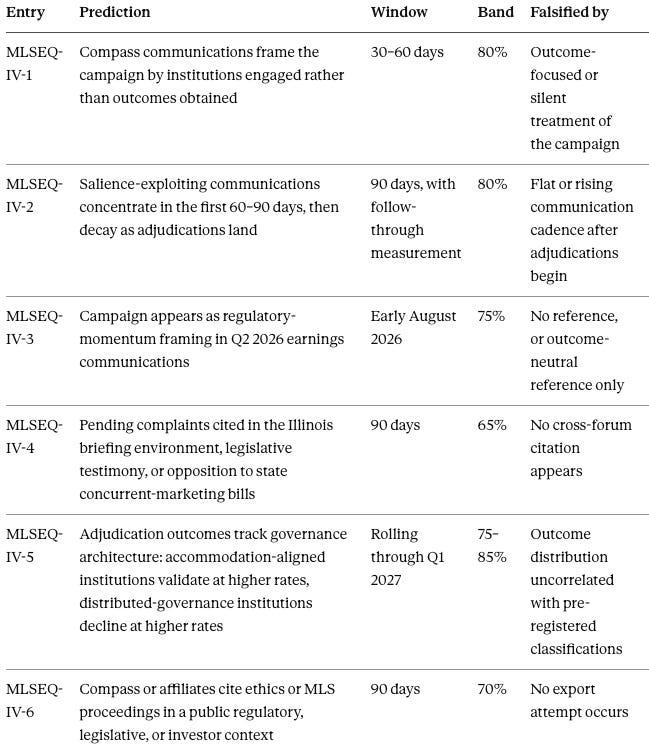
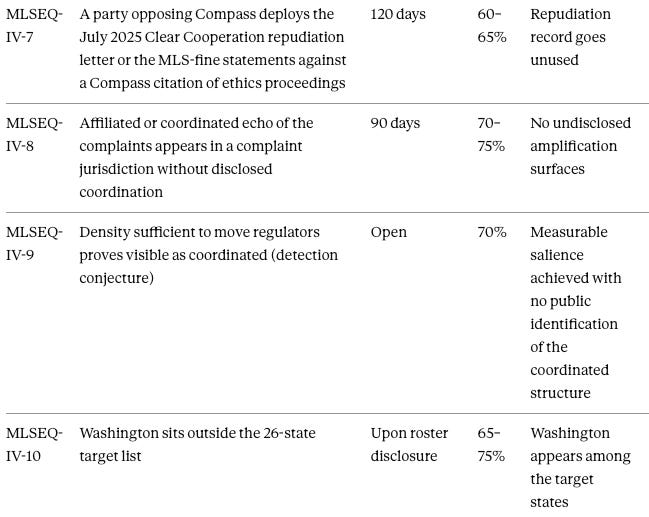
Three entries carry conditions the table compresses. MLSEQ-IV-5 pre-registration: classification criteria are committed at publication — accommodation-aligned (partnership terms, Compass-favorable rule templates, or concentrated brokerage influence in governance), distributed (broad-membership boards, brokerage-neutral rule processes), resistant (documented refusal of rule-change demands or independent governance structure). MRED, Realtracs, The MLS/CLAW, and Bright are classified accommodation-aligned as of this date on the Part II record. The full target roster is not yet public; MindCast commits to publishing the complete classification table within 14 days of roster disclosure and before scoring any outcome, and outcomes adjudicated before classification are excluded from scoring. MLSEQ-IV-9 migrates the Nash-Stigler no-viable-threshold constraint from the Address Suppression Calculus to the complaint layer and is stated as a conjecture. MLSEQ-IV-10, if falsified, also forces refinement of the topology framework, because the ethics instrument has no structural path to a multiple listing service outside the Realtor-association apparatus.
Structural falsifier. Filing followed by silence — no counting behavior, no amplification, no cross-citation — defeats the salience thesis entirely and reverts the campaign to pure adjudication-seeking, collapsing the Section V.C exposure analysis to the invitation layer alone.
VIII. MindCast Proprietary Cognitive Digital Twin Engine Foresight Predictions
The following predictions derive from routing actor-level CDTs through their assigned MindCast Vision Functions inside the MindCast Proprietary Cognitive Digital Twin (MP CDT) Engine. The outputs are scenario-based analytical predictions grounded in the theorem, not empirical forecasts or factual assertions about future conduct; each CDT’s Vision Function routing appears with its output. The format surfaces only the predictions that materially affect the paper’s conclusions rather than intermediate reasoning steps. Per the Section VII methodological note, the outputs below supply mechanism validation and actor dynamics; wherever they share a subject with a register entry, the register scores it.
Theorem validation outputs. Before the actor predictions, five mechanism-level simulation outputs from the engine’s first run test the theorem’s constructs directly, one output per claim. Density–independence divergence: institutional node count grows faster than independent evidentiary sources, confirming the orthogonality principle at the simulation layer. Half-life and disposition weighting: raw salience peaks early, then becomes disposition-weighted — early publicity exceeds later adjudicative significance. Export discount: private governance narratives lose persuasive force when exported to public enforcement, while party statements remain directly usable — the Skillman asymmetry reproduced independently of the analytical derivation. Sign resolution: two competing information architectures race toward regulators, with outcomes depending partly on whether density narratives or cross-forum admission records become dominant first. Topology over geography: governance structure influences complaint outcomes, with distributed governance responding differently than accommodation-aligned governance. Each mechanism output has a corresponding falsifier in the Section VII register, so validation is scoreable rather than asserted.
Compass Executive CDT (Chicago Strategic Game Theory (CSGT) → Field-Geometry Reasoning (FGR) → Becker → Posner). Primary: Compass continues expanding governance-based competition so long as the expected strategic return from institutional engagement exceeds the expected return from incremental litigation (82–88%). Secondary: if receiving institutions increasingly distinguish institutional density from independent corroboration, Compass shifts resources from complaint expansion toward strengthening the evidentiary record and public messaging (72–80%).
Zillow Executive CDT (CSGT → Nash–Stigler → Posner). Primary: Zillow increasingly reframes the dispute around common-source origin rather than addressing each complaint individually (80–85%). Secondary: selective product refinements occur where they reduce regulatory friction without altering Zillow’s broader competitive strategy (65–75%).
State Attorney General CDT (AGE → Posner → FGR → Causal Signal Integrity (CSI)). Primary: state enforcement decisions increasingly emphasize evidentiary independence over the absolute number of complaints (78–85%). Secondary: multi-state information sharing increases when complaints present common legal or factual issues, but independent corroboration remains the principal threshold for significant enforcement activity (68–76%).
State Legislature CDT (AGE → Becker → FGR). Primary: legislative discussions increasingly focus on structural transparency and market design rather than resolving individual company disputes (72–80%). Secondary: committee hearings place greater weight on measurable consumer outcomes than on the existence of parallel institutional proceedings (68–75%).
Institutional Investor CDT — Compass Equity (Becker → Posner → FGR → CSGT). Primary: institutional investors increasingly evaluate the complaint campaign through its effect on execution quality, governance risk, and long-term enterprise value rather than complaint volume itself (78–85%). Secondary: future earnings calls are more likely to include questions regarding regulatory strategy, litigation exposure, and expected return on governance initiatives (72–80%).
MLS Governance Network CDT (Coase → AGE → FGR). Primary: MLS organizations gradually standardize complaint intake and procedural handling as complaint density increases (75–85%). Secondary: coordination among MLS governance bodies increases to reduce duplicative administrative costs and improve consistency (68–78%).
Trade Media CDT (Installed Cognitive Grammar (ICG) → FGR). Primary: coverage initially emphasizes the geographic scale and number of institutional filings, then progressively shifts toward substantive outcomes as adjudications accumulate (82–88%). Secondary: industry reporting increasingly distinguishes between “complaints filed,” “investigations opened,” and “findings reached,” reducing the persuasive value of complaint counts alone (75–83%).
Cross-CDT emergent predictions. First: the strategic contest increasingly shifts from litigation to governance competition, with institutional architecture becoming the principal arena of competition (82–88%). Second: the long-term effectiveness of institutional density depends on whether key decision-makers continue to treat complaint volume as a proxy for independent evidentiary convergence (80–87%). Third: as the campaign matures, source diversity becomes a more influential decision variable than institutional density across regulators, legislators, and sophisticated market participants (78–85%). Emergent secondaries: repeated nationwide complaint campaigns encourage institutions to develop standardized procedures that reduce the signaling value of complaint volume over time (72–80%); the campaign’s short-term narrative influence exceeds its long-term influence unless favorable substantive outcomes accumulate alongside institutional engagement (75–82%); and capital markets increasingly separate governance activity from enterprise performance, placing greater emphasis on execution, earnings, and durable competitive advantage than on procedural momentum alone (70–78%).
IX. Conclusion: Two Questions
The Institutional Density Theorem predicts that the campaign’s influence will peak before any merits are resolved, that the influence depends on observers counting institutions rather than findings, and that the same density accumulating Compass’s narrative accumulates its admission corpus faster than the Skillman-discounted export path can convert proceedings into public legitimacy. The theorem’s sign — whether the loop resolves as installed narrative or assembled impeachment record — is decided by an assembly race, and the race is decided by whoever moves first: the counting sentence, or the cross-forum record. The Council of Multiple Listing Services, coordinated state attorneys general, and MLS governance leadership each hold the capacity to circulate the shared analytical frame that collapses the fragmentation the arithmetic requires. Washington demonstrated the mechanism at legislative scale; the present campaign invites its repetition at adjudicative scale.
State officials hold the countermeasure in two questions, both intent-neutral, both self-executing, and both memorizable by any legislative staffer:
Who filed the complaints being counted?
Why should private proceedings supply public-policy validation when the complainant has repudiated materially related rules and questioned the legitimacy of the same governance machinery?
The first question collapses raw salience by exposing the source count. The second closes the export path. Neither requires proving anything about intent, and both get stronger the more widely they are asked. The controlling distinction underneath both fits in one sentence: one complainant can create many dockets, but many dockets do not create many independent complainants.
Scope conditions. The theorem’s boundaries deserve explicit statement, because the framework is analytical rather than outcome-driven. The theorem does not imply that parallel complaints lack merit — any individual filing may raise a legitimate display question deserving rigorous adjudication. The theorem does not imply that coordinated filings are improper — parties petition multiple forums lawfully every day. And the theorem does not imply that institutional engagement is evidence of bad faith. The theorem predicts one thing: institutional density should not be treated as a proxy for independent evidentiary convergence without examining the origin of the proceedings. Where the proceedings trace to independent sources, density carries real informational weight; where they trace to one, density measures campaign scale, and nothing more.
One final claim extends beyond this dispute. The asymmetric assembly race — a single actor multiplying procedural nodes, converting procedural multiplication into perceived independent concern, while each node simultaneously stores the actor’s own substantive representations, with validation facing an export discount its admissions never encounter — is not a real estate mechanism. At bottom, the theorem is information theory operating inside fragmented governance: fragmentation destroys the origin information observers need, and whoever restores it controls what density means. The same structure operates wherever petitioning meets fragmented governance: corporate complaint campaigns before sector regulators, platform disputes routed through standards bodies, trade-association enforcement, environmental permitting contests, and the emerging institutional architecture of artificial intelligence governance. MindCast will apply the Institutional Density Theorem to those domains as the campaigns arrive; the present analysis timestamps the framework against the case now running.
Appendix: MindCast Analytical Foundations
The Dual Nash-Stigler Equilibrium Architecture — Supplies the capture framework and the detection-threshold constraint underlying the topology analysis (Section II) and the detection conjecture (MLSEQ-IV-9), and the Pseudo-Equilibrium Detector and Stigler source-diversity requirement that formally classify constructed density presenting as apparent convergence as false stability (Section IV).
Compass’s Coasean Coordination Problem, Part I — Establishes MLSs as coordination infrastructure with finite governance capacity, grounding the coordination-load tax (Section IV) and the framework distinguishing infrastructure from restraint.
Compass’s Coasean Coordination Problem, Part III — Supplies the core reframe available to receiving institutions — from adjudicating an isolated grievance to recognizing a unified pattern directed at coordination infrastructure — and the litigation-pattern analysis the companion briefing operationalizes.
MLS Equilibrium Series Part I — The Equilibrium Selection Problem in Residential Real Estate — Establishes the three candidate equilibria and the defection taxonomy within which the governance transition (Section I) operates.
MLS Equilibrium Series Part II — How the Zillow Complaint Reframes Compass v. NWMLS as a National Coordination Case — Establishes the structural-conditions framework the Governance Topology section extends to a 10x sample.
The Skillman Moment as Analytical Rosetta Stone — Establishes the export-failure pattern formalized in Section V.B as the export coefficient.
The Compass Antitrust Self-Destruction Sequence — Documents the 2025 precedent for the Second Edge: Compass litigation filings inverting into the SSB 6091 statutory definitions.
Compass’s Cross-Forum Contradictions — Supplies the cross-forum record methodology and the characterization-layer exposure anatomy (Section V.C).
The Compass Narrative Inversion Playbook — Documents the Washington precedent for distributed representation overstating independent support, cited in Section V.C as base-rate precedent.
The Compass Commission Consolidation Strategy and Real Estate Marketing Transparency — Develops the withheld-inventory premium referenced in Section III; full balance-sheet anatomy reserved for the forthcoming finance companion.
Primary trade-press sources: HousingWire (https://www.housingwire.com/articles/compass-ethics-complaints-zillow/), Inman (https://www.inman.com/2026/07/14/compass-zillow-mls-realtor-associations-ethics-complaints/), RISMedia (https://www.rismedia.com/2026/07/14/compass-targets-zillow-barrage-consumer-ethics-complaints-dozens-states/).