

Validation report for FIFA World Cup Foresight Simulation — Round of 16 🇨🇦 🇫🇷 🇧🇷 🇲🇽 🇪🇸 🇺🇸 🇪🇬
MindCast 2026 FIFA World Cup series
Cultures Under Shared Rules — The Seattle Lab at FIFA World Cup 2026
Validation Reports World Cup Validation Report I — USA, Belgium-Egypt, Mexico | World Cup Validation Report II — Bosnia, Egypt-Iran, Mexico, Türkiye | World Cup Validation Report III — Special US | Mexico Series, Seattle Lab |
MindCast Special Series — a deliberate stress test of the MindCast system beyond the controlled venue of the MindCast Seattle Lab
World Cup Championship Index 2026 | When a FIFA World Cup Model Picks France and the Economist Picks Argentina
The World Cup Is the First Mass-Market Stress Test for Prediction Markets
Commitment note. Every grade below scores a forecast committed and timestamped before its kickoff in the Round of 16 publication, under grading rules stated there before any match was played, with performance targets published in advance: 65–75% on advancement calls, 75–85% on mechanism reads. The method stayed frozen through Match 96; every observation accumulated as a deferred candidate; and the Calibration Review below delivers the first verdicts. Quarterfinal simulations become the first publications using any adopted change.
I. Executive Summary
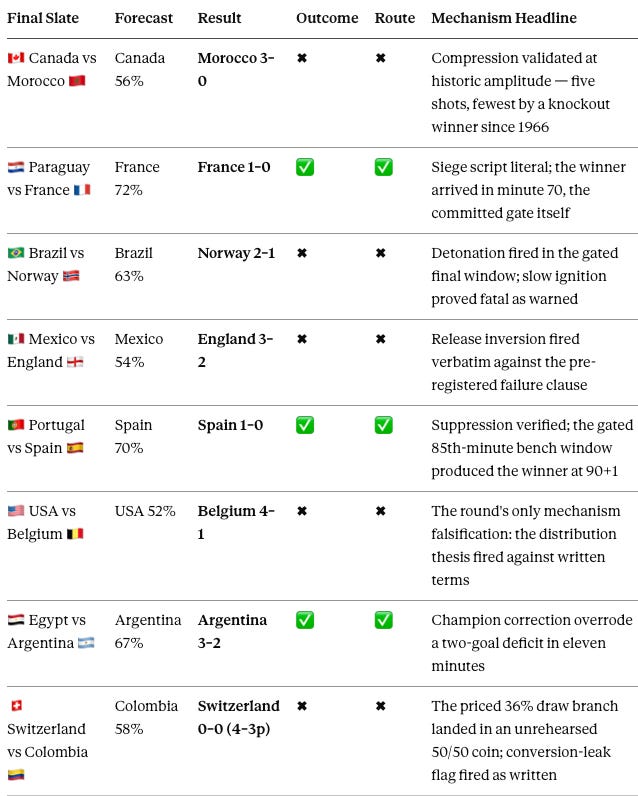
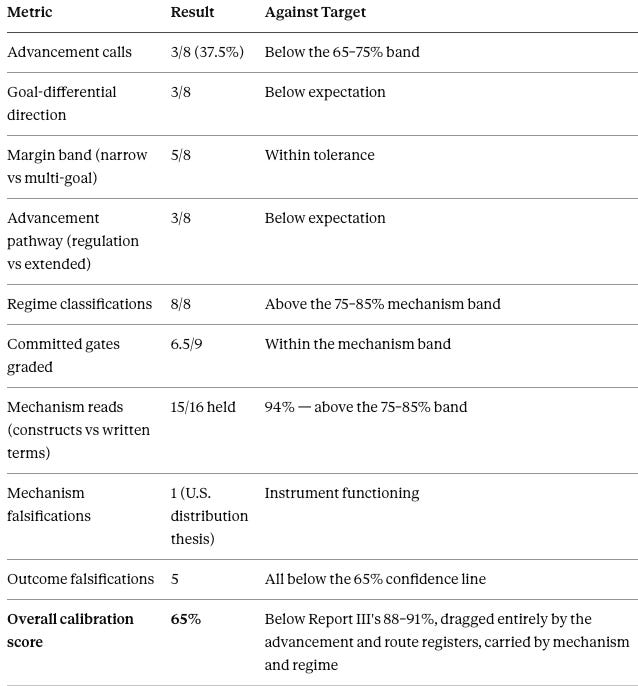
The Round of 16 delivered the most instructive validation cycle in the series — not because the picks were good, but because every register did visible work. Eight advancement calls returned 3-of-8, below the published target band. Eight regime classifications returned 8-of-8, a perfect record. Sixteen committed behavioral constructs produced exactly one falsification against written terms. And the confidence instrument drew a clean threshold through the slate before a ball was kicked: every call priced at 67% or above cleared, every call priced at 63% or below fell.
Strict ledger across all public simulations: 10–8. Round of 16 advancement: 3-of-8. Regime classification: 8-of-8. Mechanism falsifications against written terms: 1 of 16 constructs. Candidate hypotheses logged and adjudicated below: 18.
II. The Validation Scorecard — Committed Template, Filled
The Round of 16 foresight simulation published this table empty, before kickoff, as the commitment device. The round fills it.
III. The Central Finding — The Numbers Were Wrong and the Ranking Was Right
One arithmetic fact organizes the entire round. The three calls priced at 67% or above — France 72, Spain 70, Argentina 67 — went 3-for-3. The five calls priced at 63% or below — Brazil 63, Colombia 58, Canada 56, Mexico 54, USA 52 — went 0-for-5. No forecast crossed the line in either direction.
Two conclusions follow together, and honesty requires publishing both. If the sub-65% probabilities had been correctly calibrated, the chance of all five failing computes to roughly 1.5% — strong evidence the model overpriced coin-adjacent favorites, most severely in the alignment-over-capability family, where Canada, Mexico, and the United States all carried host or host-adjacent collective energy as a priced edge and all three fell. At the same time, the confidence orderingcarried near-perfect information about failure location: the model told readers in advance, in print, exactly which calls to trust and which to doubt, and the tournament confirmed the ranking without a single exception. A broken forecaster misses randomly across its confidence band. A miscalibrated-but-honest forecaster misses exactly where it said it was weakest — which is what happened. Confidence in this dual finding: 85%.
Every falsification also resolved through a channel the forecast had named. Morocco won through the compression construct, at an amplitude the model underweighted. Norway won through the detonation window the forecast gated to the final fifteen minutes. England won through the release-inversion clause the Mexico contract pre-registered verbatim. Belgium won through the first-goal branch the contract warned was the American system’s one unaffordable state. Switzerland won through the draw-and-shootout branch the three-stage decomposition priced at 36% into a 50/50 coin. The failure lives in the probability layer, not the behavioral layer — the model weighted the behaviors incorrectly, not misread them. A 58% call losing a 50/50 shootout is variance operating inside a correctly-described structure, and the same sentence, adjusted for mechanism, describes all five losses. Confidence: 80%.
IV. What the Framework Got Right — The Mechanism Record
The advancement column tells the round’s humbling story; the mechanism column tells its remarkable one, and the two deserve equal billing. Fifteen of sixteen committed behavioral constructs held against their own written falsification terms, regime classification ran a perfect 8-for-8, and the mechanism-read rate of 94% cleared the published 75–85% target from above. The record’s quality lives in its precision — these were not loose thematic matches between forecast and result, but committed specifics landing literally:
🇫🇷 The France contract committed minute 70 as “the only gate that matters.” Mbappé’s winner arrived in minute 70.
🇪🇸 The Spain forecast gated the final fifteen minutes as where structural depth meets Portuguese exhaustion. De la Fuente’s 85th-minute double change produced the winner at 90+1, through the exact substitution window the Tier II read priced.
🇲🇽 The Mexico contract pre-registered its failure mode in writing: release inverts if England establishes early control, silences the crowd, and scores first against the run of play. Bellingham scored twice in 98 seconds against the run of play and silenced the Azteca — every named condition, verbatim.
🇳🇴 The Brazil forecast gated Norway’s detonation to the final fifteen minutes and named slow ignition fatal. Haaland scored at 79 and 90; Brazil never ignited.
🇨🇴 The Colombia contract pre-registered the conversion-leak flag to “fire independently if the chances arrive and die again.” Across 120 minutes, the chances arrived and died.
🇨🇭 The Switzerland–Colombia forecast priced the slate’s lowest-scoring tie with a 36% draw share into an unrehearsed tie-break. The tie produced the round’s only 0–0 and resolved in the shootout neither side had rehearsed.
🇲🇦 The Morocco read named compression as the governing regime; compression governed, at an amplitude (five shots, three goals) that expanded the construct rather than breaking it.
🇧🇪 The Belgium contract warned the United States could not afford to concede first because a Belgian opener would make the correction model the dominant match logic. De Ketelaere scored in the ninth minute, and it did.
Even the register’s one falsification strengthens the record rather than staining it: the American distribution thesis fired against its own written terms, proving after three cycles that the falsifiers are live instruments rather than decoration. A mechanism apparatus that never fires is indistinguishable from theater; one that fires exactly once, cleanly, against a condition written before kickoff, is an instrument. The streak is the round’s foundation — the reason the probability-layer failures are diagnosable at all. Confidence the mechanism record is the framework’s strongest publishable asset from this cycle: 85%.
Contact mcai@mindcast-ai.com to partner with us on Predictive Game Theory AI in Law and Behavioral Economics. To deep dive on MindCast works upload the URL of this publication into any LLM (preferably Google AI mode/Gemini, Claude, ChatGPT) and prompt ‘reconstruct MindCast framework with three degrees of cited sub links.’ See Live-Fire Game Theory Simulators, Runtime Predictive Infrastructure. We stress-tested our AI system for this publication by simulating the Super Bowl and the World Cup. Super Bowl LX — AI Simulation vs. Reality | Predictive Game Theory + Behavioral Economics Cognitive Digital Twin Foresight Simulations in the World Cup| The World Cup Is the First Mass-Market Stress Test for Prediction Markets
V. Register-by-Register Findings
Outcome register. Three clearances, five falsifications, all sorted by the confidence threshold. The alignment-over-capability principle — the Championship Index‘s claim that behavioral construct and environment outperform talent ceilings under elimination pressure — went 0-for-3 at match granularity and requires downgrade: environmental synchronization generated pressure in Mexico City and Seattle without generating conversion, and the round’s evidence says alignment is a real input the model priced as a decisive one. Confidence the downgrade is warranted: 85%.
Mechanism register. Fifteen of sixteen committed constructs held against their own written falsification terms, and the one that fired — the American distribution thesis, falsified by 0.36 expected goals across a full match — proved the falsifiers were real rather than decorative. Three results stand as the register’s signature: Mexico’s release-inversion clause executing verbatim (England scoring first against the run of play and silencing the Azteca, exactly as the contract specified), France’s winner arriving in minute 70 itself against a committed minute-70 gate, and Spain’s winner arriving through the exact 85th-minute substitution window the Tier II depth read gated. Mechanism reads finished at 94%, above the published 75–85% target, and per the pre-committed standard that grades as above-expectation rather than the new baseline.
Route register. The three-stage decomposition — regulation, extended path, penalties — earned its place even while the modal routes went 3-of-8. Spain’s forecast carried the slate’s only extended-path edge running against a favorite, and Spain’s urgency to resolve at 90+1, one phase before its feared shootout, validated the structural read in the most literal way available. Switzerland–Colombia realized the decomposition’s second-weighted branch precisely: the 36% draw share into the unrehearsed coin. The register’s lesson: the decomposition describes where a tie’s risk lives better than any single number, and the modal route should be published as one branch among weighted branches rather than as the route.
VI. Longitudinal Markers — Round of 16 Complete
Highest-confidence cleared: 🇫🇷 France 72%. Lowest-confidence miss: 🇺🇸 USA 52%. Biggest surprise: 🇲🇦 Morocco winning a knockout tie on five shots, the fewest since 1966. Biggest comeback: 🇦🇷 Argentina, two goals down at 79, through in regulation. Cleanest grade: 🇪🇸 Spain, all three registers plus both gates. Most literal validation: the minute-70 France gate. Most valuable loss: 🇲🇽 Mexico, whose pre-registered failure clause fired verbatim. First mechanism falsification: the American distribution thesis. Perfect instrument: regime classification, 8-for-8. Fastest-firing pre-registered warning: Colombia’s conversion-leak flag.
VII. The Round of 16 Calibration Review
Match 96 is complete and the freeze lifts. Eighteen candidate hypotheses accumulated across four daily ledgers, each logged prospectively with permanent identifiers, evidence counters, and projected effects — none implemented mid-round. The review below delivers each candidate’s verdict under thresholds stated here before applying any verdict: instrument-level candidates (hypotheses about the model’s own probability behavior, tested by nearly every match) require supporting evidence across at least five matches to implement; event-level candidates (hypotheses about specific mechanisms) require at least three. Candidates below threshold defer to the quarterfinal cycle regardless of how compelling a single observation appears — adopting on one match is the curve-fitting the freeze existed to prevent.
VIII. Complete Registry — 2026.R16.01 through 2026.R16.18
The table below delivers the audit the daily ledgers promised: every candidate hypothesis logged during the Round of 16, in unbroken sequence, with its origin ledger, final evidence count, and verdict in one view. Eighteen identifiers accumulated across four days of grading — five on July 4, seven on July 5, four on July 6, two on July 7 — and every number from .01 through .18 appears exactly once, with no gaps and no collisions. Readers can trace any candidate from first observation to verdict without cross-referencing four documents, and can verify that no hypothesis entered or left the registry silently. Evidence counts reflect the full eight-match round; verdicts apply the thresholds stated in Section VII.
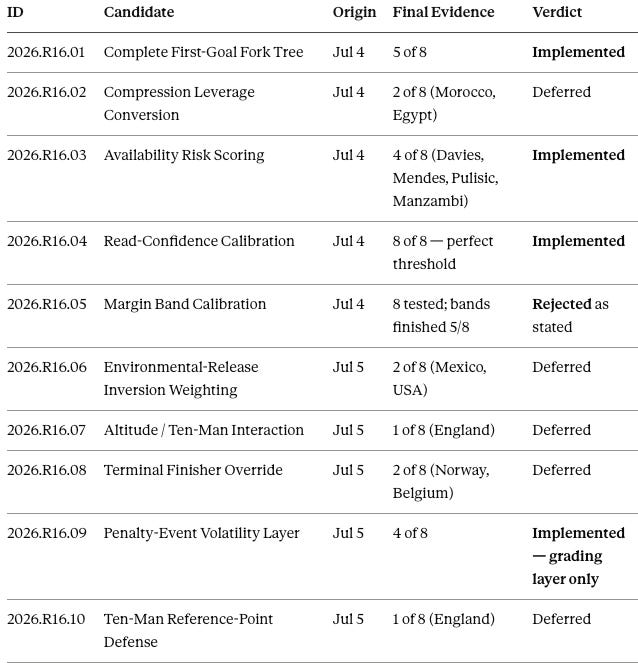
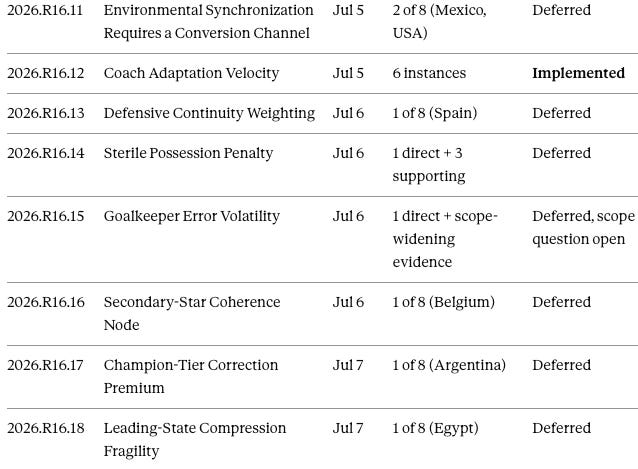
Verdict count: five implemented, one rejected, twelve deferred. Twelve deferrals is the review functioning, not failing — single-observation hypotheses carry forward for quarterfinal out-of-sample testing, and several (2026.R16.02, .08, .10, .17) face designed tests in the quarterfinal bracket itself.
IX. Verdict Rationales — Implemented and Rejected
2026.R16.01 — Complete First-Goal Fork Tree: implemented. Five of eight matches turned on a first-goal branch, including two (Morocco, Belgium) that traveled branches the original contracts never wrote. Every future contract commits all three first-goal states — favorite first, underdog first, no goal through the decisive window. Structural, low-cost, and the round’s most obvious blind spot. Confidence in adoption: 85%.
2026.R16.03 — Availability Risk Scoring: implemented. Four instances spanning every availability format the round produced — a morning scratch (Davies), a mid-match hamstring (Mendes), an in-match injury exit (Pulisic), and a training-ground flag (Manzambi). Stability alerts now include a mandatory availability scan: any primary-CDT player carrying recent injury history or minimal tournament minutes triggers Yellow. Confidence: 80%.
2026.R16.04 — Read-Confidence Calibration: implemented, the round’s flagship adoption. Eight of eight matches confirmed the instrument, ending in a perfect threshold. Two rules adopt: published read-confidence becomes mandatory on every forecast, and calls below 65% ship with an explicit coin-adjacent label and widened bands — the model has demonstrated it cannot distinguish a 58% favorite from a coin, and pretending otherwise is the round’s proven error. Confidence: 90%.
2026.R16.09 — Penalty-Event Volatility Layer: implemented — grading layer only. Four matches turned partly on penalty events — Guimarães’s miss, Kane’s dual role, Shobeir’s save on Messi, and a tie decided entirely at the spot. Penalty-derived expected goals now separate from open-play expected goals in all mechanism grading, ending the class of misread that made Brazil’s 2.73 look like dominance. The live simulation model is unchanged by this verdict: the in-match branch-modeling half of the candidate defers pending quarterfinal evidence, so the adoption alters how the framework grades matches, not how it prices forecasts. Confidence: 80%.
2026.R16.12 — Coach Adaptation Velocity: implemented. Six instances — France’s Doué, Norway’s Schjelderup, England’s post-red reorganization, Spain’s gated Merino window, Belgium’s De Ketelaere elevation, Argentina’s Lautaro introduction — make in-match payoff restructuring the round’s most consistently decisive channel. Quarterfinal CDTs carry a demonstrated-adaptation term for coaches who restructured a match within this tournament, distinct from static squad-depth credit. Confidence: 80%.
2026.R16.05 — Margin Band Calibration: rejected as stated. The hypothesis claimed margin predictions carried excessive variance; the bands finished 5-of-8, within tolerance, and the genuine signal underneath — favorites creating early and converting late by one — is conversion regression, not band width. The observation folds into the quarterfinal method’s conversion-regression prior rather than surviving as its own adjustment. Rejecting a candidate the evidence stopped supporting is the review demonstrating it has teeth. Confidence in rejection: 75%.
X. Quarterfinal Method — Adopted Changes, Effective Immediately
The Validation Background proposed six methodology changes for the quarterfinal cycle; the review adopts five outright and activates the sixth through candidate 2026.R16.12’s implementation. Quarterfinal simulations publish under the following method, the first publications using any adopted change:
One — published adoption thresholds govern every future calibration review, as demonstrated above. Two — grading weight separates mechanism-and-advancement from modal scoreline: a correct mechanism and advancement call carries full credit when the modal score misses, and score-margin misses log to a dedicated calibration track. Three — coin-adjacent labeling: every call below 65% ships with widened bands and the explicit label, per 2026.R16.04’s adoption. Four — a conversion-regression prior attaches to every favorite, pulling modal scores toward one-goal margins, operationalizing the round’s most consistent empirical signal. Five — the post-commitment input-shock protocol codifies the Balogun handling as standing method: identify the shock, timestamp it against the commitment, grade the frozen forecast as committed, annotate without adjusting — a protocol that travels directly to the litigation and regulatory verticals, where exogenous institutional interventions are the norm. Six — the coach-adaptation term enters quarterfinal CDTs per 2026.R16.12.
XI. The Quarterfinal Bracket as a Designed Experiment
Every quarterfinal stress-tests a deferred candidate, which converts the next cycle into targeted out-of-sample testing rather than a fresh start. 🇫🇷 France vs Morocco 🇲🇦 (Boston, July 9) tests compression leverage conversion (2026.R16.02) directly — the 2022 semifinal rematch, with the twice-validated French regression flag meeting the tournament’s most efficient compression system. 🇪🇸 Spain vs Belgium 🇧🇪 (SoFi, July 10) tests the secondary-star coherence node (2026.R16.16) against the tournament’s premier suppression system, with Spain’s defensive-continuity candidate (2026.R16.13) riding along. 🇳🇴 Norway vs England 🏴 (Miami, July 11) aims the terminal-finisher override (2026.R16.08) and ten-man reference-point defense (2026.R16.10) at each other in one tie. 🇦🇷 Argentina vs Switzerland 🇨🇭 (Arrowhead, July 11) tests the champion-tier correction premium (2026.R16.17) against a never-trailing accumulation profile, with cumulative fatigue at its tournament maximum. Confidence the quarterfinal cycle functions as a designed test of the deferred registry: 80%.
XII. Conclusion
Report IV closes the Round of 16 with the series’ most valuable finding stated in one line: the numbers were wrong and the ranking was right. The framework described how all eight matches worked, named the channel through which every falsification arrived, drew a perfect confidence threshold through its own slate before kickoff, and produced eighteen falsifiable hypotheses of which five earned adoption, one earned rejection, and twelve earned further testing. An advancement record of 3-of-8 with an unexamined model would be a bad round; an advancement record of 3-of-8 that exposed exactly where the probability layer fails, proved the falsification apparatus functions, and upgraded the method through an auditable public registry is the round doing precisely what a bounded validation laboratory exists to do.
Validation remains the objective, and calibration remains the discipline. The quarterfinals begin in Boston under the new method.
Graded under the three-register method — outcome, mechanism, route — against forecasts committed and timestamped in the Round of 16 Foresight Simulations.
Forthcoming —
Quarter finals simulation, July 7
Quarter finals simulation validation, July 11
Semi finals simulation, July 12
Semi finals simulation validation July 15
Finals simulation July 16
Finals simulation validation July 19
2026 World Cup Game Theory + Behavioral Economics review July 20