

Commitment note. Eight Round of 16 simulations publish complete, every one committed before its kickoff: Simulations I–V timestamped July 1, before the Round of 32 concluded; Simulation VI July 2; Simulations VII–VIII July 3, each upon its feeders resolving. The committed advancement probabilities and modal scorelines are unchanged from their timestamps. A three-stage decomposition layer — regulation, extended path, penalties — joined the document July 3 as a simulation-layer enrichment; the decomposition preserves the committed advancement probabilities and clarifies the pathway logic behind them. Every contract ships in two registers, per the Mechanism–Outcome Validation Doctrine adopted in the MindCast Round of 32 Validation Report III.
Executive Summary
The Round of 16 changes the tournament psychology. Group-stage identity no longer matters by itself. Knockout survival now tests whether each team can protect its strongest behavioral pattern while forcing the opponent into its weakest one.
Eight locked matchups complete the first true elimination-pressure slate: Canada versus Morocco, France versus Paraguay, Brazil versus Norway, Mexico versus England, Spain versus Portugal, United States versus Belgium, Egypt versus Argentina, and Switzerland versus Colombia.
Knockout forecasting also demands a different probability object than group-stage forecasting, and this publication supplies it. A single advancement number hides the three distinct behavioral regimes a knockout tie can pass through, so every simulation below reports three stages: the regulation win–draw–loss distribution, the extended-path edge conditional on a level match at 90, and the overall advancement probability the two produce together. Advancement probability is not regulation probability, and the gap between them is itself a forecast — it states how each system is expected to advance, which Validation Report IV grades as its own dimension.
Locked Forecast Table — Three-Stage Model
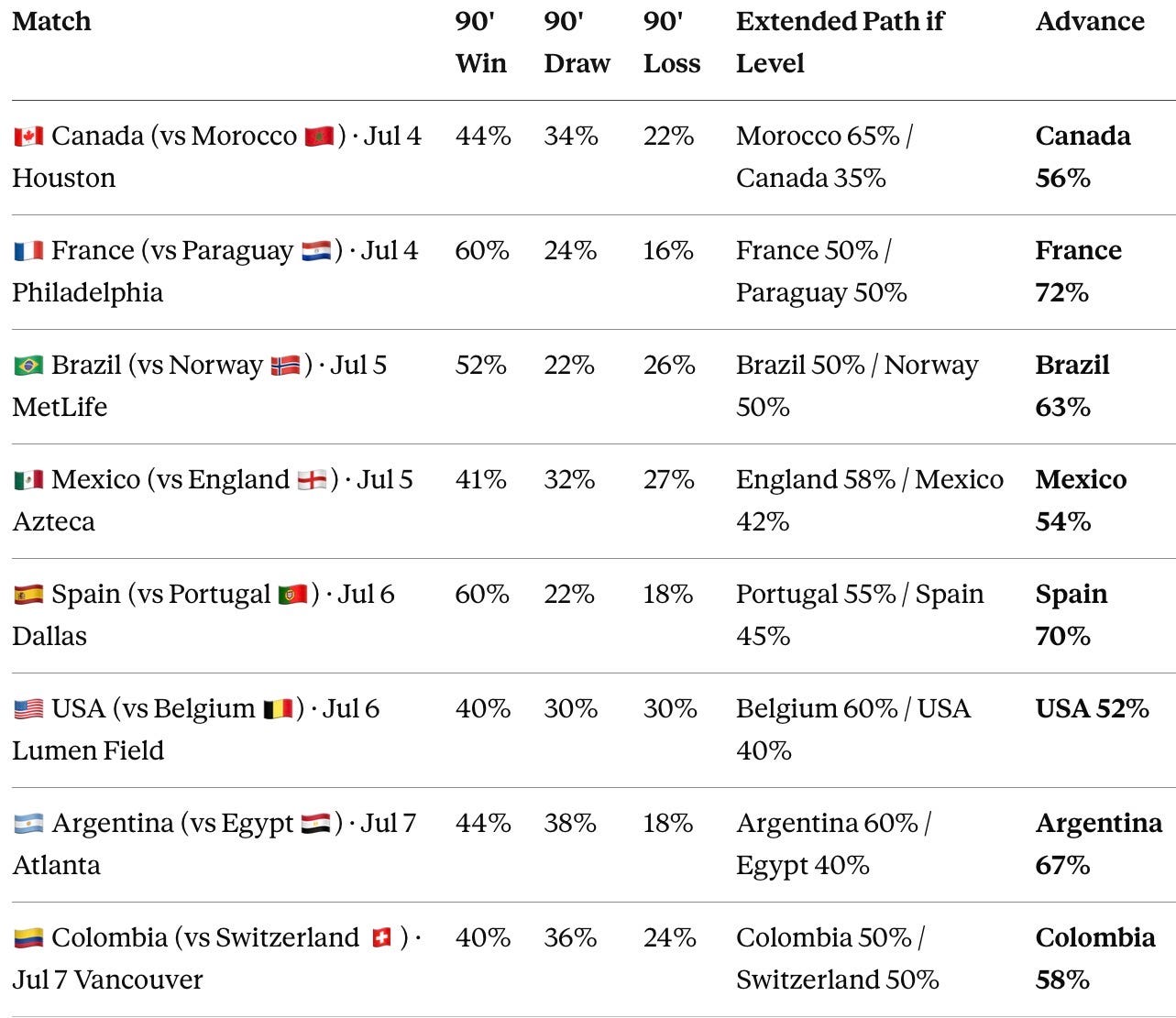
Every row reconciles after rounding: regulation win plus draw-share times extended-path edge equals the committed advancement number. The decomposition reveals what the single numbers concealed — Mexico and the United States are regulation-or-bust systems whose extended-path edges run against them, Morocco holds fully half its advancement equity in the extended path, and Egypt’s entire underdog case lives in compression toward a shootout that Argentina’s keeper uniquely neutralizes.
Slate Complete
Simulation VIII locked with Friday night’s final whistle in Kansas City — Colombia 1–0 Ghana, Arias at 14 — closing the Round of 32 and completing the eight-simulation slate.
Core Thesis
The slate operationalizes the Championship Index question at match granularity. The Index holds that capability answers who can win while championship alignment — identity, adaptation, environment, and tournament resilience — answers which culture innovates best under seven rounds of elimination pressure, and the France-versus-Argentina divergence measures the distance between those answers. Eight forecasts below distribute across the same axis: the France and Spain calls are capability calls on the bracket’s two cleanest systems, while the Mexico and United States calls are championship-alignment calls, backing environmental synchronization and behavioral construct over higher-ceiling opponents. Validation Report IV therefore grades not just eight matches but the Index’s central claim at its smallest unit of analysis. Confidence the capability-versus-alignment framing sharpens the grading: 80%.
Moody’s Analytics supplied the external benchmark this slate now tests. Moody’s Poisson model ranks France the most probable champion, and its own author, Jesse Rogers, overrides the output by hand — naming Argentina on the strength of the Western Hemisphere diaspora advantage that Elo-driven inputs cannot price. Rogers performed the override once, informally, at tournament scale. The forecasts below perform it systematically, at match scale, with committed falsification conditions: Mexico at the Azteca is the Rogers variable at maximum amplitude, the United States at Lumen Field is the same variable in its loudest domestic form, and Canada in Houston is its stress test — an environment call that must survive relocation. Where Moody’s and this simulation agree (France), capability and mechanism point the same direction; where they would diverge, the divergence is now a graded prediction rather than a footnote. Confidence the slate functions as a live measurement of the model-versus-economist gap: 80%.
The Sports Foresight Vision Statement, published July 2, frames what this slate is for. Sports serve as MindCast’s bounded validation laboratory — defined clocks, public lineups, unambiguous outcomes, and feedback velocity no institutional vertical can match, since a knockout match scores its forecast in ninety minutes while a litigation forecast waits years. The Vision Statement also names the comparator gauntlet this slate enters: the Wall Street Journal’s narrative synthesis, Moody’s statistical modeling, EA Madden’s ratings-physics engine, Sportsbook Review’s language-model play sequencing, and the betting markets — the only baseline that punishes error with capital, which is why beating a video game proves category difference while beating the close proves alpha. One precedent from that record travels with this slate: Super Bowl LX, where the pre-committed structural read pointed at a dominance the market price had not found and Seattle won by sixteen — while the published four-to-ten-point band missed the margin, a directional win graded honestly as a magnitude miss under the same doctrine that governs every contract below. Section X of the Vision Statement pre-registered observable gate sets for two matches on this slate — France–Paraguay and USA–Belgium — and Simulations II and VI honor those registrations gate for gate, with both forecasts scored against the market close in Report IV. Confidence the Vision Statement lineage strengthens the slate’s accountability posture: 85%.
One structural observation frames the whole slate: the Round of 32 was a late-goal, extended-path tournament. Canada won at 90+, Morocco equalized at 90+1, Brazil won at 90+5, Norway won at 86, England won at 86, Belgium equalized at 89 and won at 125, Portugal won at 90+4, and Argentina won in extra time on an own goal after conceding a 103rd-minute equalizer. Nine of sixteen completed ties turned in the final ten minutes or beyond regulation, and five — Paraguay, Morocco, Belgium, Egypt, Argentina — required extra time or penalties outright; Colombia’s wire-to-wire 1–0 over Ghana closed the round as the counterexample, a 14th-minute goal managed to the whistle. Late-window gates and extended-path gradients therefore carry more forecast weight in this cycle than in any prior wave, and every three-stage table below prices them explicitly. Confidence the pattern persists into the Round of 16: 70%.
Vision-Function Simulation Layer
Every simulation below runs through the MindCast AI Proprietary Cognitive Digital Twin Engine (MP CDT) in two tiers. Tier I generates the baseline output from the four core functions: Cognitive Digital Twin interaction between the two team systems, Predictive Game Theory over the match’s decision structure, Behavioral Economics of pressure and incentive states, and Championship Alignment scoring against the Championship Index. Tier II applies match-specific overlays where the situation demands them — Environmental Synchronization, Fatigue Dynamics, Personnel Shock, Pressure Cascade, and Correction Dynamics — producing an adjusted confidence band around the committed point estimate.
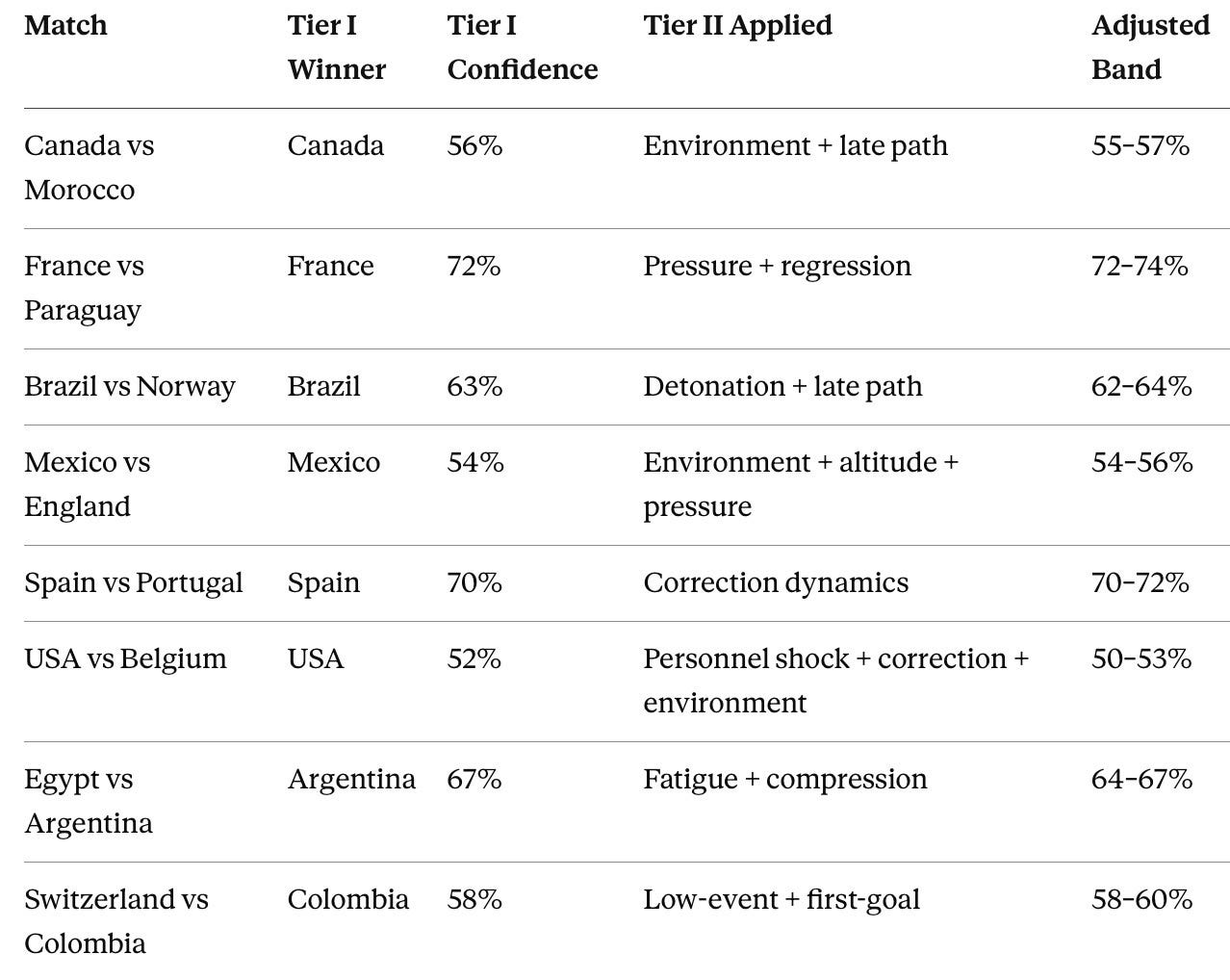
Three slate-level findings emerge from the layer. Late-window dynamics dominate the cycle: nine of sixteen Round of 32 ties turned in the final ten minutes or beyond, and the overlays price that regime into every final-quarter gate. Personnel shock matters most in United States–Belgium, where Balogun’s suspension directly tests whether American creation is genuinely distributed. Alignment-over-capability lives or dies through Mexico and the United States — the two forecasts that back behavioral construct and environment against superior talent ceilings, and the two the Championship Indexneeds graded most.
I. 🇨🇦 Canada vs Morocco 🇲🇦 — July 4 · NRG Stadium, Houston (committed July 1)
Canada enters as a rising Emergent Collective System. The team has not looked like a pure host-nation emotion story; it has looked like a maturing tournament construct — disciplined, resilient, and increasingly comfortable turning national pressure into collective energy. Eustáquio’s stoppage-time winner over South Africa delivered the program’s first-ever knockout victory, and Davies’s return from injury restores the system’s highest-leverage accelerator. Canada’s best path requires tempo, width, and repeated pressure before Morocco settles into its defensive shell. One environmental fact complicates the momentum story: the group-stage loss to Switzerland cost Canada a home-soil knockout, so the collective system plays its biggest match ever in Houston, a neutral building — the emotional engine must prove it travels.
Morocco brings a very different Cognitive Digital Twin. Morocco is the tournament’s original Equilibrium Compression System — patient, compact, emotionally disciplined, and dangerous when the opponent grows impatient. The Netherlands match reinforced the survival identity in full: absorb, stretch, reset, and trust high-leverage moments — Diop’s 90+1 equalizer and a 3–2 shootout win that extended the Dutch penalty curse to a third consecutive World Cup. Group-stage evidence runs equally deep: Morocco drew Brazil and conceded twice across four matches. Morocco does not need to dominate the match to win it, and the 2022 semifinal lineage makes compression the most institutionally proven underdog construct in the tournament.
Tournament calibration. Canada tracks above expectation — a projected group-stage exit converted into a first knockout win — with momentum rising and one asterisk: every result has been narrow. Morocco tracks exactly to its 2022 baseline: unbeaten against elite opposition, scoring little, conceding less, and banking a shootout.
MP CDT Foresight Simulation. Tier I: Canada’s Emergent Collective System holds a slight advantage over Morocco’s Equilibrium Compression System — more initiative, more creators, more tempo — while Morocco owns the longer-match structure. The edge exists only if Canada creates pressure before Morocco converts the match into patience, frustration, and penalties. Tier II (Environment + Late Path): the environmental overlay reduces Canada’s host boost because Houston is not home soil; the late-path overlay raises Morocco’s upset probability because penalty survival is already validated. Adjusted band: Canada 55–57%. CDT Stability Alert: Green — both systems arrive structurally intact.
Predictive Game Theory / Behavioral Economics Read. Canada’s dominant strategy is early tempo, because every scoreless minute raises the payoff of Morocco’s structure. Morocco plays for entropy reduction toward the extended path, where Bounou converts the shootout into the system’s highest-expected-value state. The equilibrium breaks on a Canadian goal — compression systems cannot chase, so conceding forces Morocco out of its optimal strategy entirely. Behavioral pressure runs asymmetrically: Canada carries novelty pressure and rising loss aversion protecting any narrow lead, Morocco profits from Canadian frustration, and a level match at 70 makes Canada shift risk posture first — feeding the exact counters Morocco banks on.
Time gates. Opening 25: does Canada’s collective energy survive relocation, and can it generate box pressure before the shell sets? Final 15: two proven late-scoring systems (Eustáquio at 90+, Diop at 90+1) share one window, the tie’s most volatile feature.
Two-register falsification contract. Mechanism register: the Canada collective thesis is falsified if the team fails to generate sustained penalty-box entries inside the first hour — pressure that produces only territory feeds Morocco’s design. The Morocco compression thesis is falsified if Canada’s tempo forces repeated high-quality concessions before 60. Outcome register: the advancement call is falsified only by Morocco advancing.
Three-stage forecast.
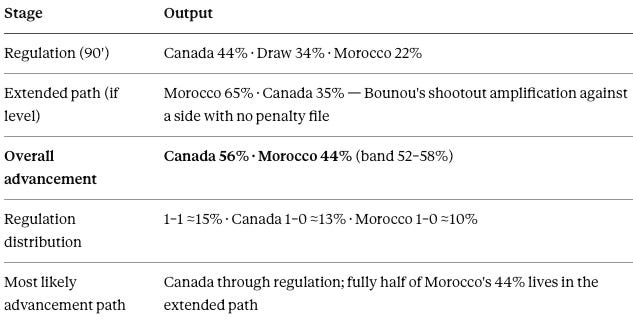
Committed modal: Canada 1–0 or 2–1. Key fork: a Canada opener forces Morocco to chase outside its preferred structure; Morocco reaching 70 minutes level makes the match extremely dangerous for Canada, and every minute past that gate transfers probability toward the compression system. Mechanism risk: high. Outcome risk: medium-high. Confidence in the collective-over-compression read: 60% — the slate’s most contested internal call.
II. 🇫🇷 France vs Paraguay 🇵🇾 — July 4 · Lincoln Financial Field, Philadelphia (committed July 1)
France looks like the cleanest favorite in the bracket — a High-Coherence Offensive System where everything reinforces everything else. The Sweden result — 3–0 behind an Mbappé brace and a Barcola strike — confirmed offensive coherence, squad depth, and tournament acceleration: four wins from four, thirteen scored, two conceded. France does not merely have talent. France has repeatable attacking grammar: speed, pressure, positional confidence, and finishing options across multiple channels. One regression flag rides along: France carries the group stage’s largest unregressed finishing overperformance, and Report II‘s conversion-correction warning says overperformance eventually reverts — a knockout siege is exactly where reversion bites.
Paraguay arrives as the slate’s purest Disruption Survival System and survived Germany by compressing space, slowing rhythm, and tolerating long periods without control — a 1–1 draw through Enciso’s header (the nation’s first-ever knockout goal), then a 4–3 shootout that beat Neuer and sent the four-time champion home. Paraguay’s Cognitive Digital Twin is built around survival discipline: two goals scored across three group matches, and a construct that does not attempt to win games so much as extend them. Paraguay wants France frustrated, stretched, and forced into low-quality volume.
Tournament calibration. France tracks at the top of every expectation curve — the only side winning each match by multiple goals against the run of no play. Paraguay tracks far above expectation on results and exactly to type on mechanism: minimal scoring, maximal extension.
MP CDT Foresight Simulation. Tier I: France dominates every capability layer — chance creation, squad depth, speed, correction — and Paraguay’s only viable path runs through compression and extension. Tier II (Pressure + Regression):the regression overlay slightly lowers France’s finishing certainty without changing the outcome; the pressure overlay favors France because Paraguay cannot easily chase. Capability alone likely clears the tie unless Paraguay reaches halftime scoreless and then 70 level. Adjusted band: France 72–74%. CDT Stability Alert: Green.
Predictive Game Theory / Behavioral Economics Read. France’s dominant strategy is early penetration, converting the siege into a procession before variance accumulates. Paraguay plays for time itself: every level minute carries positive expected value because the shootout is its highest-payoff state, just proven against Germany. The equilibrium breaks on a French goal before 60, collapsing Paraguay’s strategy space into a chase mode the system does not possess. Behavioral economics supplies the only French risk — finishing overconfidence regressing into frustration and low-quality volume; Paraguay is immune to score pressure by design, neither side changes strategy until the ball crosses the line, and strategic rigidity on both sides is precisely why minute 70 carries the whole forecast.
Time gates. Minute 70 is the only gate that matters. Before it, France’s chance volume tells the story; after it, a level match transfers probability every minute from France’s talent to Paraguay’s construct — and toward the shootout a Disruption Survival System just proved it can take from a European power.
Two-register falsification contract. Mechanism register: the dominance thesis is falsified if France fails to create multiple high-quality chances in the first hour against the deep block — territory without penetration is the Belgium pattern, not the France pattern. The survival thesis is falsified if Paraguay concedes twice before 60, ending the extension strategy. Outcome register: the advancement call is falsified only by Paraguay advancing.
Pre-registered gates (Vision Statement, July 2). Four observable gates carry over from the Vision Statement’s Section X registration: France’s first-30-minute chance quality; Paraguay’s ability to reach halftime within one goal; France’s lead-management behavior after scoring first; and the 60-minute pressure-transfer point if the match remains level, which the simulation’s minute-70 gate extends — both clock points grade. Falsification runs symmetric by prior commitment: a French blowout scores as a mechanism miss, because the siege read is falsified by the absence of a siege, exactly as a Paraguayan upset would score as an outcome miss. Report IV scores this forecast against the market close.
Three-stage forecast.
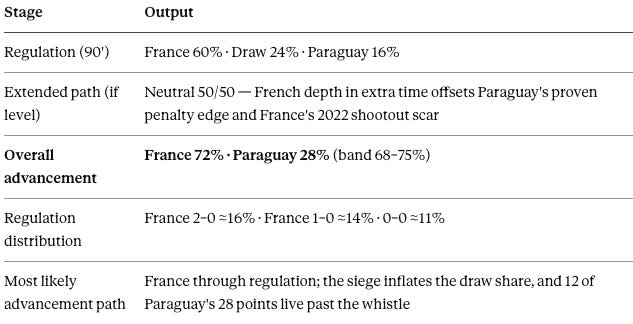
Committed modal: France 2–0. Key fork: Paraguay must keep the match scoreless past halftime; an early France goal strips the survival model of its strongest condition. Mechanism risk: low-medium. Outcome risk: low. Confidence in the regression flag as the tie’s only live variable: 70%.
III. 🇧🇷 Brazil vs Norway 🇳🇴 — July 5 · MetLife Stadium, New Jersey (committed July 1)
Brazil carries the higher technical ceiling and the stronger tournament imagination — a Creative Correction System that wins by solving increasingly complex problems mid-match. The win over Japan showed stress tolerance rather than complete dominance, which matters: Sano’s 29th-minute solo goal put Brazil behind for twenty-seven minutes before Casemiro leveled and Martinelli won it at 90+5. Brazil can absorb a scare, recalibrate, and still find the decisive action — a championship-style correction profile. The same evidence cuts the other way: Brazil has now started slowly in consecutive matches, and a slow start against this particular opponent carries a different price than it did against Japan.
Norway is not a soft underdog. Norway’s Precision Detonation System is simple but dangerous: stay organized, minimize mistakes, and convert through elite finishing. Nusa’s curled opener and Haaland’s 86th-minute winner against Ivory Coast displayed both halves of the detonation system, and the group produced calibrating evidence in each direction — a 3–2 win over Senegal in an open exchange, a 4–1 loss when France controlled the game’s geometry. Haaland changes the psychology of every defensive possession. Brazil can control most of the match and still face one catastrophic transition.
Tournament calibration. Brazil tracks slightly below its talent expectation — group control against weak opposition, then a knockout scare — with correction capacity the one metric running above baseline. Norway tracks to its ceiling map exactly: lethal against open opponents, contained by elite control.
MP CDT Foresight Simulation. Tier I: Brazil’s Creative Correction System beats Norway’s Precision Detonation System across repeated runs, but Norway scores in a large share of scenarios — Haaland creates a permanent defensive distortion. Tier II (Detonation + Late Path): the late-path overlay keeps Norway live because both sides scored late winners in the Round of 32; the detonation overlay warns that Brazil’s slow starts carry real downside here specifically. Adjusted band: Brazil 62–64%. CDT Stability Alert: Green.
Predictive Game Theory / Behavioral Economics Read. Brazil’s equilibrium strategy is early ignition, forcing Norway into sustained possession — its weakest state. Norway’s equilibrium is restraint: cede territory, minimize error, and bank transitions toward Haaland’s box gravity. The first goal breaks both strategies simultaneously, the signature of a true Arena — MindCast’s regime term for an openly contested match, alongside the Trap (a state built to frustrate one side into forcing errors) and the Labyrinth (mutual control without penetration). Behavioral economics explains Brazil’s recurring slow starts as correction moral hazard — proven comeback capacity lowers early urgency — while Norway’s discipline reflects comfortable loss-framing; if the score moves, Norway changes behavior first structurally (opening up surrenders its protection) and Brazil changes first emotionally (accelerating into the exact transitions Haaland punishes).
Time gates. Opening 30: ignition versus detonation — Brazil’s slow-start pattern meets a side that scored before 40 in its knockout tie. Final 15: both teams scored knockout winners at 86 or later; a level match entering the last quarter-hour is a coin weighted only slightly toward Brazil’s deeper bench.
Two-register falsification contract. Mechanism register: the slow-ignition read is falsified — favorably for Brazil — by a Brazilian goal before 30, proving the flaw was opponent-specific rather than structural. The detonation thesis is falsified if Norway completes the first hour without a single high-quality Haaland transition chance. Outcome register: the advancement call is falsified only by Norway advancing.
Three-stage forecast.
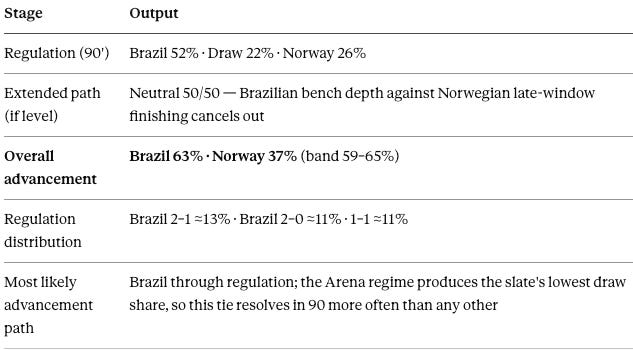
Committed modal: Brazil 2–1. Key fork: a Norway opener sends Brazil into a pressure spiral against the tournament’s best transition target; a Brazil opener forces Norway to open the game and surrender its best structural protection. Mechanism risk: medium. Outcome risk: medium. Confidence in the slow-ignition diagnosis: 75%.
Contact mcai@mindcast-ai.com to partner with us on Predictive Game Theory AI in Law and Behavioral Economics. To deep dive on MindCast works upload the URL of this publication into any LLM (preferably Google AI mode/Gemini, Claude, ChatGPT) and prompt ‘reconstruct MindCast framework with three degrees of cited sub links.’ See Live-Fire Game Theory Simulators, Runtime Predictive Infrastructure. We stress-tested our AI system for this publication by simulating the Super Bowl and the World Cup. Super Bowl LX — AI Simulation vs. Reality | Predictive Game Theory + Behavioral Economics Cognitive Digital Twin Foresight Simulations in the World Cup | The World Cup Is the First Mass-Market Stress Test for Prediction Markets
IV. 🇲🇽 Mexico vs England 🏴 — July 5 · Estadio Azteca, Mexico City (committed July 1)
Mexico enters with the strongest environmental synchronization of the eight matchups. The Ecuador match validated the Portable Home Field System at knockout speed — the fork triggered at minute 22, inside the committed under-35 condition — and the tournament ledger now reads four wins, eight goals scored, zero conceded, with a fifteen-match World Cup streak without a first-half goal against. Mexico’s crowd, altitude, rhythm, and emotional release now operate as part of the team’s decision architecture. Mexico does not simply play at home. Mexico turns home pressure into forward tempo.
England brings tournament maturity, late correction, and individual match-winners — the slate’s second Late-Correcting Talent System, and the Belgium parallel is nearly exact. The win over DR Congo showed the familiar pattern: uneven rhythm, pressure accumulation, then elite resolution — trailing from Cipenga’s seventh-minute goal until Kane’s header at 75 and winner at 86. England can survive poor stretches because its bench and individual quality extend the match beyond the first tactical script. Report III taught the framework to price exactly this profile with suspicion: Belgium fired its published failure condition, trailed by two into the 86th minute, and survived only through the latest goal in World Cup history — talent rescuing a broken performance, one round before meeting a proven construct.
Tournament calibration. Mexico tracks above every expectation curve simultaneously — results, defense, and environment converting at once. England tracks below its talent line on process and exactly on results: winning while playing an hour of every match poorly.
MP CDT Foresight Simulation. Tier I: Mexico’s Portable Home Field System narrowly beats England’s Late-Correcting Talent System — Mexico owns environmental synchronization, England owns late individual resolution. Tier II (Environment + Altitude + Pressure Cascade): the altitude and crowd overlays increase Mexico’s first-hour edge; the pressure-cascade overlay warns that England grows more dangerous if the match stays level into the final 30. The Azteca is not background context; it operates as part of the Mexican CDT. Adjusted band: Mexico 54–56%. CDT Stability Alert: Green — with the caveat that Mexico’s system can compress emotionally if early dominance fails to score.
Predictive Game Theory / Behavioral Economics Read. Mexico’s dominant strategy is early pressure because a first-half lead turns the Azteca from pressure chamber into reinforcement loop. England’s equilibrium strategy is delay: absorb the first 35 minutes, preserve a level state, then exploit Mexico’s rising loss aversion after 70. The equilibrium breaks if England scores first, because Mexico’s home-energy advantage converts into urgency and shot-quality degradation. Behavioral-economics pressure therefore cuts both ways: Mexico owns emotional amplification early, while England owns late reference-point stability.
Time gates. First half: the fifteen-match first-half shutout streak meets a side that just conceded in the seventh minute — each team’s scoring identity lives in the half the other owns, and the streak’s survival to the interval is itself a scored prediction. Minutes 70–90: England’s entire knockout scoring profile sits here (75’, 86’), arriving in the exact window English legs should be most compromised at 7,200 feet. The physiological variable cuts toward Mexico. Confidence altitude materially degrades England’s final-quarter output: 65%.
Two-register falsification contract. Mechanism register: the release thesis is falsified if England establishes early control, silences the crowd, and scores first — release inverting into burden under elite pressure is the construct’s original failure mode, untested until now. The late-correction thesis is falsified if England reaches 70 trailing by two, beyond the single-goal correction its profile supports. Outcome register: the advancement call is falsified only by England advancing.
Three-stage forecast.
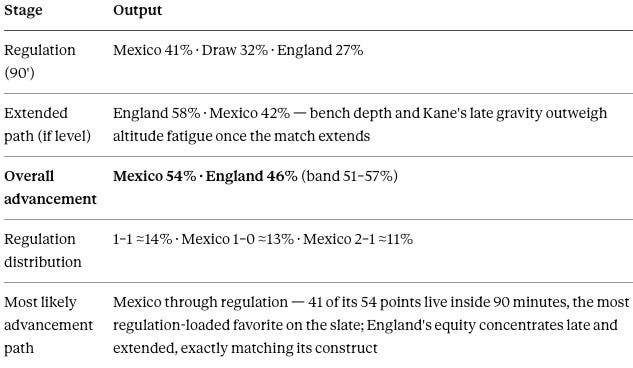
Committed modal: Mexico 2–1. Key fork: Mexico must score or generate sustained pressure inside the first 35 minutes; England keeping the match level into the final half hour shifts the advantage toward the late-correction model. The market will favor England; the simulation backs the proven construct, the environment, and the schedule of England’s own evidence. Mechanism risk: high. Outcome risk: high. Confidence the alignment-over-capability principle applies as priced: 70%.
V. 🇪🇸 Spain vs Portugal 🇵🇹 — July 6 · AT&T Stadium, Dallas (committed July 2)
Spain enters as the tournament’s premier Positional Suppression System. The Austria match displayed positional control at full amplitude: 23 shots against five, a 2.84-to-0.32 expected-goals margin, zero shots on target conceded, and an Oyarzabal brace around Porro’s header — Spain’s first World Cup knockout win since 2010, a fact that cuts both ways. European champions, unbeaten, and structurally dominant, Spain nonetheless carries the longest knockout-fragility file of any favorite in the bracket: penalty exits in 2018 and 2022 despite match control, the exact pattern of dominance-without-resolution the suppression construct must finally break. Yamal — MVP against Austria, cleared off the line, declaring “the World Cup starts now” — is the system’s resolution upgrade.
Portugal arrives as the slate’s third late-correcting profile — an Elite Correction System whose Round of 32 file reads like Belgium’s and England’s: trailing Croatia after Perišić scored at 53, leveling through Ronaldo’s 68th-minute penalty — the first knockout-round World Cup goal of his career, at 41 — then winning at 90+4 through Gonçalo Ramos’s header, with Croatia’s late equalizer disallowed. Structural evidence underneath the drama runs poor: second place in Group K behind draws with DR Congo and Colombia, six shots on target conceded to Croatia against three generated, and a defense that leaks exactly the chance quality Spain manufactures at will.
Tournament calibration. Spain tracks at maximum on every process metric and carries one unresolved historical variable: the knockout stage itself. Portugal tracks below expectation on process and level on results — the signature late-correction gap.
MP CDT Foresight Simulation. Tier I: Spain’s Positional Suppression System outperforms Portugal’s Elite Correction System — Spain controls space, Portugal repairs damage late. Tier II (Correction Dynamics): the correction overlay keeps Portugal live after 75 without overcoming the suppression edge; Spain’s historical penalty fragility matters only if Portugal survives past 80 level. Adjusted band: Spain 70–72%. CDT Stability Alert: Green.
Predictive Game Theory / Behavioral Economics Read. Spain’s equilibrium is suppression toward a regulation resolution, because its extended-path payoff runs negative — the penalty file makes extra time the one state Spain rationally avoids. Portugal’s equilibrium is survival into the correction window, where Ronaldo and Ramos leverage exceeds anything its regulation game produces. The equilibrium breaks on a Spanish goal before 35, removing Portugal’s patience option; a level 80th minute breaks it the other way, shifting Spain’s reference point from winning the match to not losing the shootout. Anticipated regret then governs Spanish risk appetite while star-gravity overconfidence sustains Portuguese belief — Portugal changes behavior on any Spanish goal, Spain changes behavior on the clock alone.
Time gates. Opening 35: Spain’s suppression pattern against Austria produced a goal by 36 — a repeat converts the Iberian derby into a chase Portugal’s aging spine cannot sustain across ninety minutes. Final 15 plus stoppage: Portugal’s entire knockout identity lives here (90+4), Ramos enters here, and the late-goal tournament pattern says the window stays live regardless of scoreline.
Two-register falsification contract. Mechanism register: the suppression thesis is falsified if Portugal generates multiple on-target chances inside the first hour — suppression that leaks against a second-place group finisher is not the Austria-match construct. The late-correction thesis is falsified if Portugal reaches 70 trailing by two, beyond the single-goal correction the profile supports. Outcome register: the advancement call is falsified only by Portugal advancing.
Three-stage forecast.
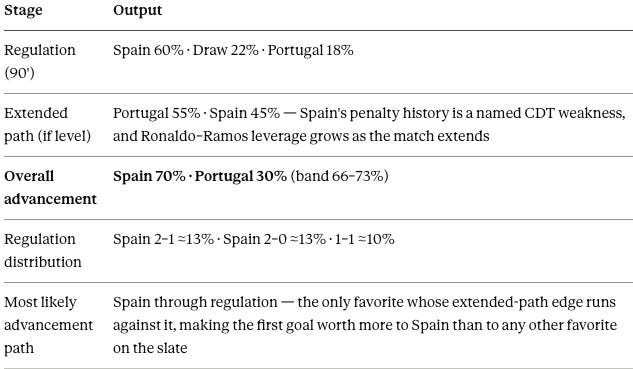
Committed modal: Spain 2–1. Key fork: a Spanish goal before 35 reproduces the Austria script against a worse defense; Portugal surviving scoreless past 70 drags Spain toward the penalty history the construct has never escaped. Mechanism risk: low-medium. Outcome risk: low-medium. Confidence in the suppression-over-correction read: 75%.
VI. 🇺🇸 United States vs Belgium 🇧🇪 — July 6 · Lumen Field, Seattle (committed July 1)
The United States enters as a Distributed Adaptive System with rising confidence and one major constraint: Balogun’s suspension. The Bosnia match validated defensive control under stress — a 0.73-to-0.04 halftime expected-goals margin, then a clean sheet held through twenty-six minutes of ten-man defense — but the red card also exposed the volatility of a young team in a knockout environment. Balogun’s absence converts the distribution thesis from claim to live test: a system whose identity says the creation is collective must now replace three goals and the tournament’s most efficient finisher, with Tillman’s form (a goal, the decisive free kick, the most consistent American performances) as the thesis’s best evidence.
Belgium enters as the slate’s Elite High-Variance Correction System. Senegal exposed Belgium’s coherence problem almost perfectly — a 0.15 first-half expected-goals showing while trailing 2–0 — but Belgium also proved its late-match correction capacity in the most extreme form the World Cup has recorded: Lukaku at 86, Tielemans at 89 and 125. Courtois, bench quality, and elite individual experience make Belgium extremely dangerous if the match remains close after 75 minutes. Calendar rest is equal — both sides played July 1 — so Belgium’s real burden is thirty-five additional minutes of expenditure and the emotional cost of the comeback, not the schedule. De Bruyne’s 56th-minute withdrawal against Senegal, his earliest ever at a World Cup, marks how much rhythm the system must rebuild in five days.
Tournament calibration. The United States tracks above expectation on control metrics and now carries an untested attack. Belgium tracks as the tournament’s widest process-result gap: bottom-quartile first hours, top-percentile finishes.
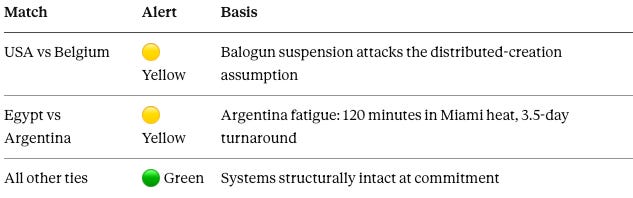
MP CDT Foresight Simulation. Tier I: the Distributed Adaptive System narrowly beats the Elite High-Variance Correction System — regulation control favors the United States, chaos favors Belgium. Tier II (Personnel Shock + Correction + Environment): the personnel-shock overlay lowers American attacking efficiency because the most efficient finisher is out; the environment overlay partially restores the edge at Lumen Field; the correction overlay materially boosts Belgium after 75 because Belgium’s knockout scoring profile lives almost entirely in that window. Adjusted band: USA 50–53% — the slate’s thinnest. CDT Stability Alert: Yellow. Balogun’s suspension reduces attacking efficiency and becomes the central test of the United States’ distributed decision architecture.
Predictive Game Theory / Behavioral Economics Read. The United States’ equilibrium is controlled regulation; Belgium’s equilibrium is disorder plus late correction. Balogun’s suspension changes the American payoff matrix because chance creation without finishing carries lower expected return. Belgium can rationally tolerate early instability if it reaches 75 level, because its late-window payoff exceeds its regulation-control payoff. The behavioral risk for the U.S. is loss aversion after taking a lead; the behavioral risk for Belgium is another slow first hour that turns correction from strategy into desperation.
Time gates. Opening 25: does the coherence problem appear a third consecutive time against organized pressing, and does the United States generate box chances without Balogun? Both questions resolve early and both feed the contract. Minutes 75 through the end: Belgium’s entire knockout goal profile sits at 86, 89, and 125 — the late window is not a Belgian risk factor, it is Belgium’s whole scoring identity — so the American task is binary: lead by two entering the final quarter-hour, or defend the one window Belgium owns.
Two-register falsification contract. Mechanism register: the distribution thesis is falsified if the United States completes the first hour without multiple high-quality box chances — collective creation that cannot replace one striker is a hierarchy, not a distribution. The control thesis is falsified if Belgium’s opening twenty-five forces a sustained American chase. Belgium’s coherence claim is falsified, terminally, by a third consecutive sub-0.5 expected-goals first hour. Outcome register: the advancement call is falsified only by Belgium advancing.
Pre-registered gates (Vision Statement, July 2). Three observable gates carry over from the Vision Statement’s Section X registration: first-goal state; Belgium’s territorial control against the American block; and American attacking output without the suspended striker. Falsification runs symmetric by prior commitment, and Report IV scores this forecast against the market close.
Three-stage forecast.
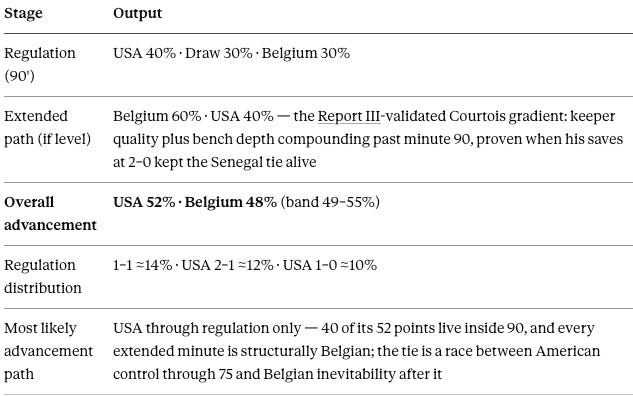
Committed modal: USA 2–1. Key fork: the United States must avoid conceding first; a Belgian opener forces the distributed system to chase without Balogun, and Belgium’s correction model becomes the dominant match logic. Mechanism risk: very high. Outcome risk: very high. Confidence in the late-window concentration read: 80%.
VII. 🇪🇬 Egypt vs Argentina 🇦🇷 — July 7 · Mercedes-Benz Stadium, Atlanta (committed July 3)
Egypt enters as the tournament’s purest Equilibrium Compression System, and the corpus has tracked it since the group stage: 1–1 with Belgium, 3–1 over New Zealand, 1–1 with Iran, and now 1–1 with Australia resolved 4–2 on penalties — four draws in five matches, with Salah managed back from a hamstring injury. Egypt does not chase matches and does not extend them by accident; the system compresses variance until the tie shortens into the high-leverage endgame it prefers, and the shootout win converts that preference into proven capability. The Belgium vs Egypt simulation scored the Belgium–Egypt culture-interaction at 64 — above both sides’ standalone culture scores — and Report II graded the Egypt–Iran forecast as a split — the draw materialized from the exact compression dynamics the simulation described, even as the lean pointed wrong — so Simulation VII inherits the corpus’s most-audited underdog profile.
Argentina enters as the Championship Alignment System — ranked first on championship behavior by the Championship Index, and the side that just spent its aura in Miami. Cape Verde, the weakest team remaining, took the defending champion to 120 minutes: Messi’s opener at 29, Duarte’s equalizer, Lisandro Martínez’s extra-time strike answered by Lopes Cabral at 103, and a winner that entered the books as a Cape Verde own goal off Messi’s set-piece delivery while Argentine players cramped in the humidity at 115. Alignment survived, and alignment also produced the Round of 32’s narrowest favorite escape. Argentina now faces a three-and-a-half-day turnaround into a noon Atlanta kickoff carrying 120 minutes of legs.
Tournament calibration. Egypt tracks precisely to its construct — no wins in regulation against ranked opposition, no losses anywhere. Argentina tracks below its championship baseline for the first time this tournament, with fatigue the named cause.
MP CDT Foresight Simulation. Tier I: Argentina’s Championship Alignment System beats Egypt’s Equilibrium Compression System, but not by the talent margin — Egypt compresses variance better than any underdog left. Tier II (Fatigue + Compression): the fatigue overlay discounts Argentina for the 120-minute Cape Verde match and short turnaround; the compression overlay raises Egypt’s probability if the match reaches 70 level; the shootout overlay restores Argentine advantage because Martínez neutralizes Egypt’s preferred endgame. Adjusted band: Argentina 64–67%. CDT Stability Alert: Yellow. Fatigue dynamics from the extended Miami match constitute a live degradation risk to Argentina’s press timing and final-quarter legs.
Predictive Game Theory / Behavioral Economics Read. Egypt’s equilibrium is variance compression — each scoreless minute moves the tie toward the shootout, normally its highest-payoff state, except Emiliano Martínez lowers that payoff to roughly break-even, making Egypt the rare compression side whose preferred endgame holds no edge. Argentina’s equilibrium is early resolution, because sunk fatigue raises the cost of every additional minute on the tournament’s heaviest legs. The equilibrium breaks on an Argentine goal before 60, forcing Egypt into a chase mode absent from its entire file. Behavioral asymmetry defines the tie: Egypt’s strategy is invariant by design and never changes first, while Argentina’s urgency rises with the clock — the reverse of the normal favorite’s curve, and the reason the fatigue discount is priced.
Time gates. Opening 30: does Argentina’s press arrive at all, or does fatigue produce the flat start Cape Verde exploited? Egypt will not punish a slow start with goals — compression systems rarely do — but every scoreless minute is structurally Egyptian. Minute 70 onward: a level match entering the final quarter activates the same transfer function as the Paraguay–France gate, with one critical difference — the extended path here splits rather than tilts.
Two-register falsification contract. Mechanism register: the alignment thesis is falsified if Argentina completes the first hour without sustained chance quality — a second consecutive flat sixty minutes converts the Cape Verde match from anomaly into fatigue signature. The compression thesis is falsified if Argentina scores twice before 60, the deficit Egypt’s system has never faced and cannot chase. Outcome register: the advancement call is falsified only by Egypt advancing.
Three-stage forecast.
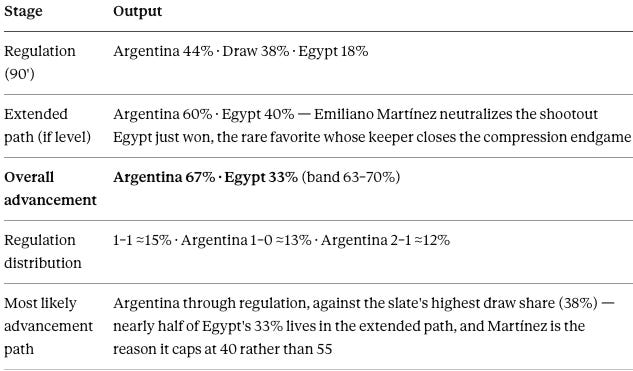
Committed modal: Argentina 2–1. Key fork: an early Argentina goal forces Egypt into the chase state its construct cannot occupy; Egypt reaching 70 level converts the tie into the coin the compression system built — weighted back toward Argentina only by the Martínez shootout edge. Mechanism risk: medium-high. Outcome risk: medium. Confidence in the fatigue-discount sizing: 70%.
VIII. 🇨🇭 Switzerland vs Colombia 🇨🇴 — July 7 · BC Place, Vancouver (committed July 3)
Switzerland enters as the tournament’s Quiet Accumulation System — no star narrative, no drama, and the bracket’s most understated résumé: four straight wins for the first time in Swiss World Cup history, ten matches unbeaten under Yakin, an 88-year knockout drought ended against Algeria with 20-year-old Manzambi setting up Embolo’s opener, and the group-stage win over Canada that relocated a co-host’s knockout tie to Houston. Accumulation systems beat teams that beat themselves, and nothing in the Swiss file suggests a mechanism for beating an opponent that concedes nothing.
Colombia arrives as precisely that opponent. Lorenzo’s side topped Group K unbeaten, ahead of Portugal, with a single goal conceded across five matches — the tournament’s stingiest defense next to Mexico’s — and dispatched Ghana through Arias’s 14th-minute finish from Luis Suárez’s cross before holding a toothless opponent at bay for the remaining seventy-six. The Rhythm Control System carries one documented flaw: James Rodríguez’s tempo dictation and Díaz’s pace generate chance volume that repeatedly outruns the scoreline, and match reports keep filing the same sentence — the finishing let them down in key moments. Against Ghana the leak cost nothing. Against a Swiss side that concedes almost as rarely as Colombia does, the leak is the tie’s central variable.
Tournament calibration. Switzerland tracks above expectation on results and exactly to type on style — narrow, controlled, unbeaten. Colombia tracks above expectation everywhere except the box, where conversion lags creation by the widest margin among remaining teams.
MP CDT Foresight Simulation. Tier I: Colombia’s Rhythm Control System narrowly beats Switzerland’s Quiet Accumulation System — both defend elitely, Colombia carries the higher talent ceiling and better chance-creation architecture. Tier II (Low-Event + First-Goal): the low-event overlay makes the first goal disproportionately decisive; the conversion-leak overlay caps Colombia’s advantage because the team creates more than it finishes. Adjusted band: Colombia 58–60%. CDT Stability Alert: Green.
Predictive Game Theory / Behavioral Economics Read. Both equilibria are mirror control states — a two-sided standoff in which each side’s optimal strategy is waiting for the other to take the first risk. The first goal is the only equilibrium break available, and it lands with disproportionate weight because neither system carries a chase mode. Behavioral economics locates the pressure inside Colombia: the conversion leak generates goal-gradient frustration — chances that keep dying convert patience into forcing — while Switzerland’s status-quo comfort rarely self-destructs but turns risk-averse to a fault when trailing. Switzerland changes behavior first if it concedes; Colombia changes first psychologically if it does not score, which is why the low-event overlay makes the opening goal worth the tie.
Time gates. Opening 25: both systems scored their knockout goals early — Embolo before the hydration break, Arias at 14 — making this the slate’s only tie where the danger window opens at kickoff rather than at 75. Minute 70 onward: a scoreless match entering the final quarter produces the slate’s second-highest draw probability, with an extended path neither side has tested.
Two-register falsification contract. Mechanism register: the rhythm thesis is falsified if Switzerland’s block holds Colombia without multiple high-quality chances through the first hour — and the conversion-leak flag fires independently if the chances arrive and die again. The accumulation thesis is falsified if conceding first exposes a system that has never chased, producing no structured response within twenty minutes. Outcome register: the advancement call is falsified only by Switzerland advancing.
Three-stage forecast.
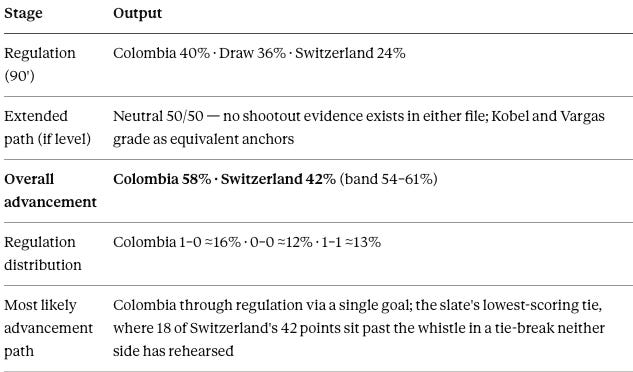
Committed modal: Colombia 1–0. Key fork: an early Colombia goal reproduces the Ghana script against a side with no comeback file; Switzerland scoring first inverts a Colombian system that has not trailed all tournament. Mechanism risk: medium. Outcome risk: medium. Confidence in the rhythm-over-accumulation read: 65%.
Argentina’s entry into the graded slate resolves the largest tournament-level stake, and the first evidence arrived with it. The Championship Index and the Moody’s divergence both turn on Argentina’s alignment profile, and Miami produced the divergence’s opening data point: the economist’s hand-picked champion needed extra time and an own goal against the weakest remaining side in the same week the model’s pick won 3–0. One match proves nothing; one match also starts a ledger. Confidence the Rogers-override question resolves measurably by the quarterfinals: 65%.
High-Level Slate Architecture
The model does not treat these eight predicted advancers equally, and the simulations sort them into four match families.
Capability Clears. France and Spain should advance on baseline performance; their opponents need extension, variance, and late-game stress. Both regulation-win probabilities sit at 60% — the only two on the slate — and both forecasts survive even their unfavorable branches.
Controlled Talent With Detonation Risk. Brazil and Argentina carry superior profiles but face opponents built to punish one specific failure mode each: Brazil’s slow ignition, Argentina’s fatigue. Both forecasts hold the favorite while naming the single mechanism that flips the tie.
Alignment Over Capability. Mexico and the United States represent the slate’s most important MindCast claims. Both forecasts back behavioral construct, environment, and system identity against more conventionally talented opponents — and both are regulation-or-bust, with extended-path edges running against them. Alignment must close inside 90 minutes or not at all.
Low-Event Knife Edge. Canada–Morocco and Switzerland–Colombia depend less on dominance than on first-goal state and late-window control. Both carry draw shares above a third, and both convert the first goal into near-decisive weight.
Advancement confidence orders France (72), Spain (70), Argentina (67), Brazil (63), Colombia (58), Canada (56), Mexico (54), United States (52), and Validation Report IV should grade the ordering itself, as Report III did: cleared calls distributing stress in inverse proportion to confidence would validate the allocation logic a second consecutive cycle. Two calls — Mexico over England, United States over Belgium — place proven behavioral constructs above opponents carrying higher talent ceilings, making this cycle the adversarial test of the Championship Index‘s core claim that alignment outperforms capability under elimination pressure. A sweep of both elevates the claim toward doctrine; a double miss forces its first downgrade. Either result is the cycle’s richest information. Confidence the ordering grades as informative either way: 90%.
Three Late-Correcting Talent Systems now sit on one slate — Belgium, England, and Portugal — and all three face opponents forecast to control regulation. The construct family Report III bifurcated becomes this cycle’s largest natural experiment: three simulations price late correction as insufficient against structural control, and three graded outcomes will either confirm the Report III suspicion or force the family’s re-elevation. Confidence the triple test is the cycle’s most valuable mechanism-level dataset: 80%.
Final Simulation Stack Output
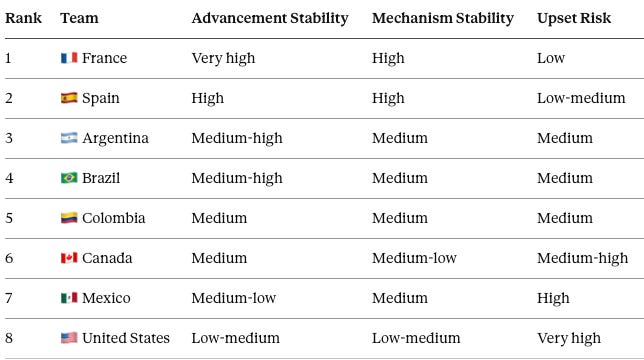
The Round of 16 therefore turns on one core question: which teams can keep their identity under elimination pressure, and which teams need chaos to survive?
Grading Method
Report IV grades every simulation against rules stated here, before kickoff. Winner and margin-band calls grade against the final result. Mechanism claims grade against observables committed above: fork conditions clear or fail by the clock (a goal before the stated minute either happened or did not), time gates grade against what occurred inside their windows, and falsification contracts fire or stand on their written terms. Evidence beneath the scoreboard decides mechanism truth — expected-goals splits, goal timing against committed windows, possession-versus-penetration gaps, and match states such as which side chased — so a mechanism can grade below a flattering result or above a harsh one. Each construct exits with a status, not a letter: proven, cleared, split, bifurcated, contained, or falsified, and the status prices the next round’s simulation. Two registers stay separate throughout, per the Mechanism–Outcome Validation Doctrine: a fired mechanism condition and a cleared advancement call can coexist in one grade, and honest grading records both.
The three-stage model adds a pathway register: Report IV grades not only who advanced but whether the simulated pathway matched the observed pathway — a favorite forecast to win in regulation that instead survives on penalties records a pathway miss inside a cleared winner, and an underdog forecast to live in the extended path that takes its tie there earns a pathway validation even in defeat.
Performance targets publish here, before the matches, so grading has a stated standard: 65–75% on winner calls, 75–85% on mechanism reads, and visible calibration output from every miss. Knockout soccer caps winner accuracy well below certainty — heavily capitalized betting markets settle near the top of that band — so results above the ranges grade as above-expectation rather than as the new baseline, and results inside them grade as the system performing to specification. Perfection is not the target; a miss that produces no model improvement is the only failing grade the framework recognizes.
Two simulations carry an additional external standard. France–Paraguay and USA–Belgium enter Report IV with gate sets pre-registered in the Sports Foresight Vision Statement, and both grade against the closing betting line — the Vision Statement’s chosen baseline, because markets alone punish error with capital, making the close the one comparator whose defeat carries commercial meaning.
Validation Scorecard Template — Report IV
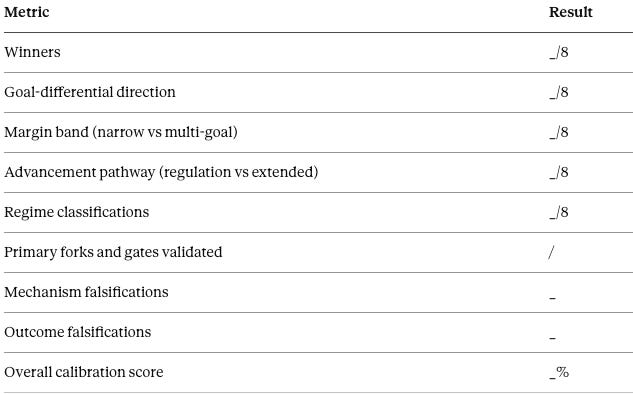
The empty table is the commitment device: the rows graded in Report III return in Report IV, scaled to the full eight-simulation slate and extended by the pathway register, and readers hold the instrument before the matches are played. One grading change applies from Report IV forward: exact scorelines are retired as a scored metric. Modal scores and regulation distributions remain in each simulation as committed illustrations of expected match shape, but the grade attaches to direction, margin band, and pathway — whether the forecast read the winner, the gap, and the route correctly. Exact scores in a low-scoring sport are variance, not skill; a perfect forecaster holds under fifteen percent probability on any single scoreline, and grading against noise flatters no one and informs no one.
Downstream Bracket Geometry
Quarterfinal implications sharpen every forecast above. The France–Paraguay winner meets the Canada–Morocco winner in Boston on July 9 — a cleared France call plus a cleared Canada call projects France–Canada at Gillette Stadium, a capability system against the tournament’s collective story. The Brazil–Norway winner meets the Mexico–England winner in Miami on July 11, so a cleared Mexico call books the Azteca construct its first road knockout test — the Portable Home Field thesis stripped of the home field, the purest experiment the construct can face. The Lumen Field winner advances to SoFi Stadium on July 10 against the Dallas survivor — cleared USA and Spain calls project United States versus Spain in Los Angeles, the co-host’s control construct against the tournament’s premier suppression system, one win from a home semifinal. The Atlanta winner meets the Vancouver winner at Arrowhead on July 11, so cleared Argentina and Colombia calls project Argentina versus Colombia in Kansas City — the alignment champion against South America’s stingiest defense, a continental collision the bracket kept hidden until its final lock. Every forecast above is therefore also a conditional forecast about the quarterfinal round, and Report IV grades the geometry alongside the matches.
Conclusion
Eight commitments publish before their respective Round of 16 kickoffs: an anchor call on the tournament’s only crack-free favorite, a suppression call in the Iberian derby, a slow-ignition diagnosis on Brazil that the talent narrative resists, a collective-over-compression call in Houston, a fatigue-discounted read on the defending champion, a rhythm-over-accumulation call in the bracket’s quietest tie, and two alignment-over-capability calls — Mexico over England at altitude, the United States over Belgium at Lumen Field — that put the Championship Index‘s central principle directly against the consensus at match granularity. Every forecast carries a two-register falsification contract under the doctrine Report IIIcreated, and every forecast now states its expected pathway, which means each can fail in three distinguishable ways — outcome, mechanism, and route — and be graded honestly in all of them.
Validation remains the objective, and calibration remains the discipline.
Appendix A — Round of 16 Vision-Function Outputs
Tier architecture. Tier I runs the four core functions — Cognitive Digital Twin interaction, Predictive Game Theory, Behavioral Economics, Championship Alignment — producing the baseline winner and confidence. Tier II applies situational overlays: Environmental Synchronization (Mexico–England, USA–Belgium, Canada–Morocco), Fatigue Dynamics (Egypt–Argentina), Personnel Shock (USA–Belgium), Pressure Cascade (Mexico–England, France–Paraguay), Correction Dynamics (Spain–Portugal, USA–Belgium), Regression (France–Paraguay), Detonation and Late Path (Brazil–Norway, Canada–Morocco), and Low-Event First-Goal (Switzerland–Colombia). Raw Tier I and Tier II outputs appear inside each simulation above; the tables below consolidate the slate.
CDT Stability Alerts.
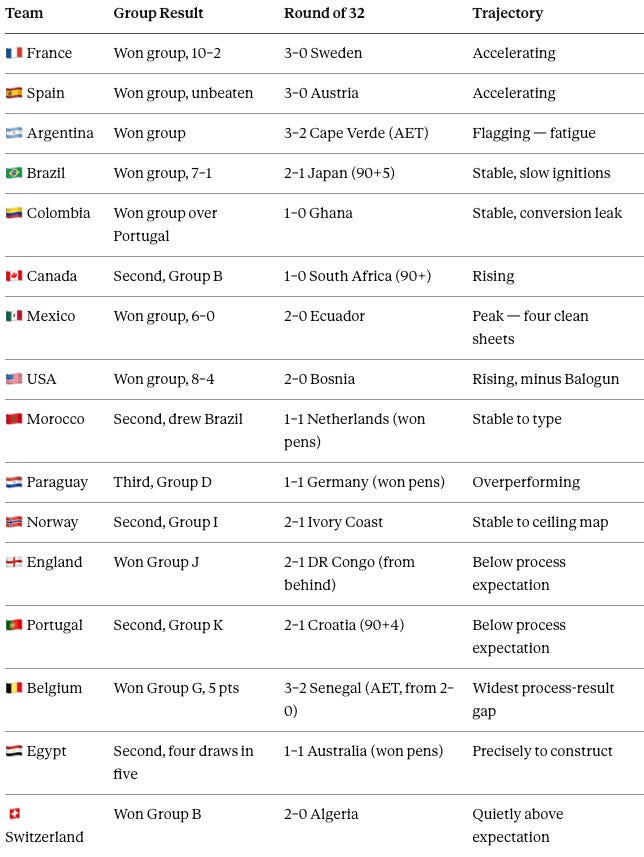
Tournament calibration matrix.
Three-stage probability tables appear inside each simulation above; the Locked Forecast Table in the Executive Summary consolidates all eight rows. Full team-level Cognitive Digital Twin baseline profiles — identity, decision architecture, strengths, weaknesses, and primary player CDTs for all sixteen Round of 16 teams — publish as a companion document.
Simulations I–V committed July 1, 2026, before the Round of 32 concluded; Simulation VI (Spain–Portugal) committed July 2; Simulations VII (Egypt–Argentina) and VIII (Switzerland–Colombia) committed July 3, each upon its feeders resolving. The three-stage decomposition layer was committed July 3; it preserves the committed advancement probabilities and clarifies the pathway logic behind them. The slate publishes complete, every commitment timestamped before its Round of 16 kickoff. Grading follows in Validation Report IV under the method set in Reports I, II, and III, against the tournament-level architecture of the World Cup Championship Index 2026.
MindCast 2026 FIFA World Cup series
Cultures Under Shared Rules — The Seattle Lab at FIFA World Cup 2026 series
Belgium vs Egypt | USA vs Australia | Qatar, Bosnia, Egypt, Iran | Three Group Winners Enter the Round of 32 🇲🇽 Mexico vs Ecuador 🇪🇨 · 🇺🇸 US vs Bosnia 🇧🇦 · 🇧🇪 Belgium vs Senegal 🇸🇳
Validation Reports World Cup Validation Report I — USA, Belgium-Egypt, Mexico | World Cup Validation Report II — Bosnia, Egypt-Iran, Mexico, Türkiye | World Cup Validation Report III — Special US | Mexico Series, Seattle Lab 🇲🇽 🇺🇸 🇧🇪 | FIFA World Cup Validation Report IV — Round of 16 Complete, Calibration Review, and Quarterfinal Method 🇫🇷 🇪🇸 🇦🇷 🇲🇦 🇳🇴 🏴 🇧🇪 🇨🇭
MindCast Special Series — a deliberate stress test of the MindCast system beyond the controlled venue of the MindCast Seattle Lab
World Cup Championship Index 2026 | When a FIFA World Cup Model Picks France and the Economist Picks Argentina
Mexico vs South Korea | Mexico and USA | Three Group Winners Enter the Round of 32 🇲🇽 Mexico vs Ecuador 🇪🇨 · 🇺🇸 US vs Bosnia 🇧🇦 · 🇧🇪 Belgium vs Senegal 🇸🇳
Forthcoming —
Post round of 16 simulation validation, July 7
Quarter finals simulation, July 7
Quarter finals simulation validation, July 11
Semi finals simulation, July 12
Semi finals simulation validation July 15
Finals simulation July 16
Finals simulation validation July 19
2026 World Cup Game Theory + Behavioral Economics review July 20