


Graded against the published forecast in Three Group Winners Enter the Round of 32 🇲🇽 Mexico vs Ecuador 🇪🇨 · 🇺🇸 US vs Bosnia 🇧🇦 · 🇧🇪 Belgium vs Senegal 🇸🇳 , following the method set in Validation Report I and Validation Report II.
I. Executive Summary
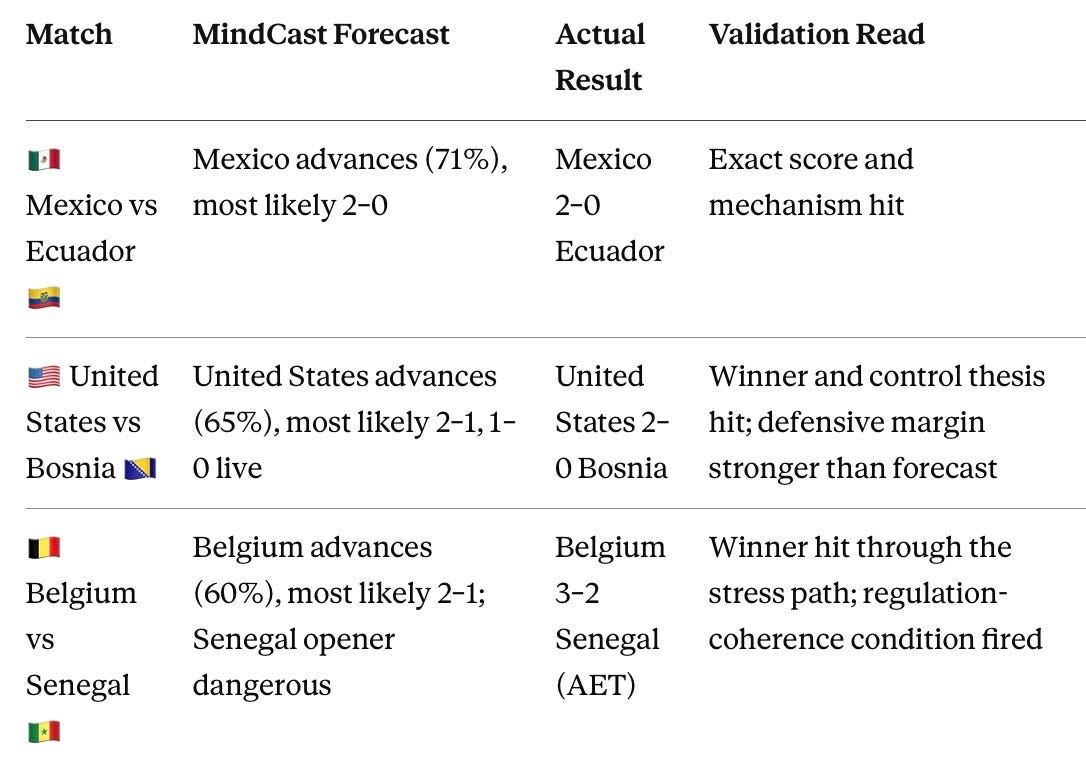
Special US | Mexico series and Seattle Lab III validated strongly on winners, score direction, and regime mechanics. The simulation called all three favorites to advance: Mexico, United States, and Belgium. All three advanced — the first knockout cycle on the ledger, and the cleanest.
Mexico produced the sharpest validation. MindCast projected Mexico 2–0 as the most likely result, and Mexico beat Ecuador 2–0 with first-half goals from Julián Quiñones and Raúl Jiménez. The Portable Home Field release thesis held almost exactly: the Azteca crowd lifted Mexico early rather than becoming burden pressure, and the committed Trap-to-Arena fork triggered at minute 22, inside the forecast’s under-35 condition.
The United States validation hit the core forecast next. MindCast projected a United States win, most likely 2–1 with 1–0 live, and the United States beat Bosnia 2–0. The model correctly anticipated that a restored first-choice structure could convert distributed expansion into knockout control — a 0.73-to-0.04 halftime expected-goals margin quantified the conversion — although Balogun’s 64th-minute red card exposed a variance channel the model never priced.
Belgium produced the most analytically valuable validation. MindCast called Belgium to advance but assigned the slate’s lowest probability because Senegal could score first and force Belgium’s coherence problem. Senegal did exactly that, led 2–0 into the 86th minute, and pushed Belgium into extra time before Belgium survived 3–2 through late correction, substitutes, Courtois, and Tielemans’ penalty at 124 minutes and 44 seconds — the latest goal in men’s World Cup history.
Overall validation grade: A-minus. Winner forecast: 3-for-3. Exact score: 1-for-3. Regime mechanics: highly validated. Falsification discipline: one condition fired in full at the mechanism level while the advancement call cleared — a split Report III formalizes as a new grading distinction (Section VI).
Quantitative Validation Scorecard
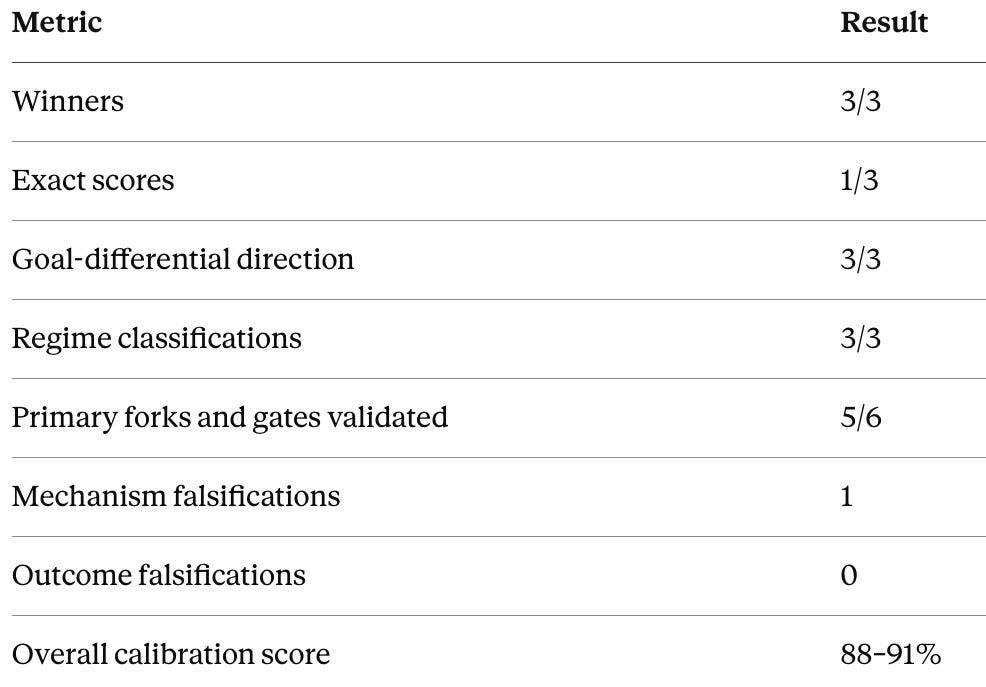
The scorecard becomes the running instrument of the series: Reports IV and onward carry the same eight rows, letting readers compare calibration across cycles at a glance. The 5/6 fork count reflects one honest miss — the United States under-30 goal condition never cleared — and the calibration score composites winners, direction, regime reads, fork resolution, and score precision.
II. Pre-Committed Forecasts Versus Results
III. Mexico–Ecuador: Full Validation
MindCast’s strongest forecast became the cleanest validation. The pre-match simulation projected Mexico as the slate’s most stable construct, gave Mexico a 71 percent advancement probability, and identified 2–0 as the most likely regulation result. Mexico won 2–0.
The game validated the regime fork on the clock. MindCast wrote that a Mexican goal before the 35th minute would turn the Trap into an Arena, allowing crowd energy to become release rather than burden. Quiñones drove home Roberto Alvarado’s through ball at 22, Jiménez curled in the second at 31 off a give-and-go with Quiñones, and the fork resolved before halftime — effectively ending Ecuador’s preferred disruption-recovery script. A one-hour thunderstorm delay changed nothing: Mexico generated six shots inside the opening fifteen minutes, the fast home tempo the opening-25 gate defined as the release signal.
The falsification condition did not trigger. Ecuador did not keep the match scoreless past 60 minutes. Ecuador did not create superior central-zone chance quality. Mexico did not show visible shot-quality decline under pressure. Instead, Mexico extended its tournament profile to four wins and four clean sheets — joining Switzerland 2006 as the only teams since 1994 to open a World Cup with four shutouts — became the first Concacaf side to eliminate a CONMEBOL team from the tournament, and recorded its first knockout win in forty years. Ecuador’s night ended in the frustration signature of a contained system: Piero Hincapié sent off in stoppage time, Moisés Caicedo booked at 90+9.
One caution travels with the grade. Expected goals ran 1.02 to 0.73, far closer than the scoreline, and John Yeboah struck the woodwork at 0–0. Release therefore validated as a control-and-conversion truth rather than a chance-dominance truth — the Trap held a live branch until the fork closed it. Confidence the distinction improves future environment scoring: 70%.
Validation grade: A-plus.
IV. United States–Bosnia: Winner Hit, Control Thesis Mostly Hit
MindCast projected the United States to advance at 65 percent, with a low confidence band because the model needed proof that distributed expansion could become defensive control. The United States beat Bosnia 2–0, so the advancement forecast hit — the program’s first knockout win since 2002, and its first World Cup win over a UEFA opponent since Portugal in that same tournament.
The mechanism mostly held, and the numbers held it up. The restored first-choice XI produced 62 percent possession, 89 percent pass accuracy, and a 0.73-to-0.04 expected-goals lead at the interval — Bosnia’s attacking output through 45 minutes rounded to nothing. Balogun scored at 45, after an offside disallowance at 31 and a strike off the crossbar, which aligned with the forecast that a United States lead would move the match toward Arena-and-control. Malik Tillman’s 82nd-minute free kick sealed the match and pushed the result beyond the forecast’s most likely 2–1 scoreline — and landed inside the forecast’s own 65–85 danger window, pointing the opposite direction from the one the window feared. Bosnia’s set-piece-and-Džeko path never materialized; Džeko came off at 51 with his side trailing.
The match still preserved the warning embedded in the model. The fork’s under-30 goal condition never cleared, the United States looked disjointed in stretches, and Balogun’s red card at 64 — a VAR-converted straight red for stepping on Tarik Muharemović’s ankle — introduced exactly the late-window instability the simulation flagged, in a form it never priced. Ten men defended a knockout lead for twenty-six minutes and conceded nothing, which upgrades the control thesis while exposing a discipline-variance gap in the model. Balogun’s suspension for the Round of 16 carries the cost forward. The result validated the United States lean but did not eliminate the control-risk finding before the Belgium match. Confidence a discipline term belongs in knockout simulations: 75%.
Validation grade: A-minus.
Contact mcai@mindcast-ai.com to partner with us on Predictive Game Theory AI in Law and Behavioral Economics. To deep dive on MindCast works upload the URL of this publication into any LLM (preferably Google AI mode/Gemini, Claude, ChatGPT) and prompt ‘reconstruct MindCast framework with three degrees of cited sub links.’ See Live-Fire Game Theory Simulators, Runtime Predictive Infrastructure.
MindCast AI is a cybernetic, predictive game-theory AI firm specializing in law and behavioral economics, applied to complex litigation, innovation systems, and geopolitical risk intelligence. Rather than extrapolating historical patterns, the firm models the mechanisms that generate institutional behavior, running Cognitive Digital Twin simulations grounded in Nash equilibrium, Stigler information economics, and the Chicago School of law and behavioral economics.
We simulate NFL and World Cup games to stress test our predictive AI system. See Super Bowl LX — AI Simulation vs. Reality | MindCast Predictive Game Theory + Behavioral Economics Cognitive Digital Twin Foresight Simulations in the World Cup and Super Bowl | The World Cup Is the First Mass-Market Stress Test for Prediction Markets
V. Belgium–Senegal: The Stress-Test Validation
Belgium–Senegal delivered the best test of the model because the forecast was not merely “Belgium wins.” MindCast projected Belgium to advance at only 60 percent, the slate’s lowest favorite probability, and warned that a Senegal opener would immediately revive Belgium’s coherence problem. Senegal scored first through Habib Diarra at 25, then led 2–0 after Ismaïla Sarr’s chest-and-volley finish at 51 — one of the goals of the tournament.
Senegal validated the opponent-danger modifier completely. Sarr missed a sitter and struck the woodwork twice, and first-half expected goals ran 1.90 to 0.15 in Senegal’s favor while Belgium held 51 percent possession and more penalty-box touches — sterile circulation, measured. Both clauses of the published falsification contract fired verbatim: Senegal scored first, and Belgium reverted to the Egypt-and-Iran pattern. Honest grading marks the regulation-coherence condition as fully fired, not partially triggered. The firing confirms the model’s decision to cap Belgium’s confidence despite Belgium’s superior talent ceiling. Confidence the condition fired as written: 90%.
Belgium’s late-correction thesis then survived under maximum stress — and one gate earlier than priced. Courtois made three key saves at 2–0 to keep the extended path alive, Rudi Garcia’s bench delivered (Lukaku finished Meunier’s cross at 86, the latest a team has trailed by two in normal time and avoided defeat), Tielemans headed Trossard’s delivery level at 89, and Tielemans converted the VAR-awarded penalty at 125. Belgium became the first side since itself, against Japan in 2018, to win a knockout tie from two goals down. The forecast’s exact 2–1 regulation score missed — De Bruyne’s 56th-minute withdrawal, his earliest ever at a World Cup, marks how far regulation drifted from the modal path — but the deeper behavioral call hit: the forecast located Belgium’s advantage in the tie-break path rather than regulation, and the tie-break path is where Belgium won.
Validation grade: B-plus, upgraded for mechanism quality despite the score miss.
VI. Calibration Findings
The validation confirms three model improvements from the prior cycle and commits three new ones.
Confirmed one: construct robustness outperformed talent ranking. Mexico carried the strongest construct and produced the cleanest match. Belgium carried the highest talent ceiling but required the most chaotic path. Match stress ordered itself in inverse relation to advancement confidence — Mexico cruised, the United States won with a complication, Belgium survived by sixteen seconds of history. The ordering aligned closely with the published confidence hierarchy, committed pre-match at 75 percent, and Report III elevates the principle to standing knockout status. Confidence: 85%.
Confirmed two: branch-not-label discipline worked. Each match started with a regime label, but the forecast turned on live forks: Mexico’s early goal, the United States halftime lead, and Senegal’s opener against Belgium. Each match resolved through one of the committed branches, even when unexpected events — the Balogun red card foremost among them — altered the path.
Confirmed three: opponent-danger modifiers mattered. Ecuador capped Mexico’s confidence but could not overturn the construct. Bosnia forced caution but lacked attacking ceiling — 0.04 first-half expected goals proved it. Senegal nearly flipped the result because its athletic transition and emotional elasticity were real, and the model’s paired risk read landed on both edges: the waves produced 1.90 first-half expected goals, and the looseness that conceded three to France and three to Norway conceded three again.
New one: separate mechanism falsification from outcome falsification — adopted as the Mechanism–Outcome Validation Doctrine. Belgium fired a structural-failure condition and still advanced, which means the two events are different and the framework must score them separately. Every future contract carries two registers — conditions that falsify the mechanism, and conditions that falsify the advancement call. Confidence the split is the cycle’s most important structural fix: 85%.
The doctrine extends well beyond sport, and MindCast adopts it across all Cognitive Digital Twin publications from Report III forward. A plaintiff can win on a legal theory the simulation never modeled; a bill can pass through a coalition the forecast did not price; a merger can clear on a remedy structure the twin never generated. Traditional forecasting scores each case as a success. The doctrine scores them as Outcome Correct, Mechanism Incorrect — right answer through a different pathway — and reserves full validation for right answers reached for the right reasons. Readers gain a principled instrument for auditing the difference, which strengthens the credibility of every forecast the framework publishes. Confidence the doctrine improves cross-domain validation quality: 80%.
New two: add a discipline-variance term to knockout simulations. Card risk scores on referee profile, VAR regime, and player aggression under fatigue, feeding both the late-window gate and squad carryover into the next round. Balogun and Hincapié anchor the case. Confidence: 75%.
New three: generalize the shootout edge to an extended-path gradient. Keeper quality plus bench depth now prices as a continuous 90-to-120-plus advantage rather than a shootout-only term. Courtois’s saves at 2–0 and the Lukaku–Meunier bench combination anchor it. Confidence: 75%.
VII. Updated Forward Read
Mexico exits this validation as the most stable host system in the tournament. The model upgrades the Portable Home Field release thesis from “validated” to “knockout validated,” with the Round of 16 supplying its graduation exam: England — survivors of a late Harry Kane double against DR Congo — arrive at the Azteca on July 5, the last knockout match Mexican soil hosts this tournament, at 7,200 feet, against a crowd now proven as a release mechanism.
The United States advances with a live but incomplete control thesis — and without Balogun. The win matters, but Belgium will punish the same transition gaps and red-card volatility more severely than Bosnia did, and the suspension converts the distribution thesis from claim to live test: a side built on distributed creation must now prove it can absorb the loss of the tournament’s most efficient finisher. Confidence the Balogun absence is the capstone tie’s central variable: 80%.
Belgium advances with the highest ceiling and the largest instability signature. The comeback strengthens Belgium’s resilience score, but Senegal exposed the original coherence problem almost perfectly, and Belgium arrives in Seattle on July 6 carrying thirty extra minutes of legs on a three-day turnaround. Match 94 at Lumen Field completes the Section X scenario the forecast named as the natural capstone: a United States side that controls regulation forces Belgium to correct late again; a Belgium side that ignites early forces the American control construct to chase for the first time since Türkiye.
VIII. Conclusion
Seattle Lab III validated the MindCast framework where it mattered most: advancement, regime mechanics, and falsification discipline. The model went 3-for-3 on winners, hit Mexico’s exact score, and raised the strict ledger to 7–3 across ten public simulations.
Belgium prevents overclaiming. The favorite advanced, but only through the danger path the model warned about — and through a fired falsification condition the framework now scores honestly by splitting mechanism from outcome. Capturing both the lean and the stress condition makes the validation stronger, not weaker.
The next calibration should not treat all three winners equally. Mexico strengthened its construct. The United States partially stabilized its construct. Belgium survived its construct. Three different wins deserve three different prices, and the Round of 16 wave — with the Seattle capstone at its center — will apply them.
Validation remains the objective, and calibration remains the discipline.
Cultures Under Shared Rules — The Seattle Lab at FIFA World Cup 2026 series
Belgium vs Egypt | USA vs Australia | Qatar, Bosnia, Egypt, Iran | Three Group Winners Enter the Round of 32 🇲🇽 Mexico vs Ecuador 🇪🇨 · 🇺🇸 US vs Bosnia 🇧🇦 · 🇧🇪 Belgium vs Senegal 🇸🇳
Validation Reports World Cup Validation Report I — USA, Belgium-Egypt, Mexico | World Cup Validation Report II — Bosnia, Egypt-Iran, Mexico, Türkiye | World Cup Validation Report III — Special US | Mexico Series, Seattle Lab 🇲🇽 🇺🇸 🇧🇪
MindCast Special Series — a deliberate stress test of the MindCast system beyond the controlled venue of the MindCast Seattle Lab
World Cup Championship Index 2026 | When a FIFA World Cup Model Picks France and the Economist Picks Argentina
Mexico vs South Korea | Mexico and USA | Three Group Winners Enter the Round of 32 🇲🇽 Mexico vs Ecuador 🇪🇨 · 🇺🇸 US vs Bosnia 🇧🇦 · 🇧🇪 Belgium vs Senegal 🇸🇳
Forthcoming
Round of 16 — the eight-match slate — July 4–7 (Matches 89–96). Full coverage begins here. Each commits only after its two Round of 32 feeders resolve, so they publish in a rolling wave July 2–4 rather than in one drop.