

MindCast 2026 FIFA World Cup series
Cultures Under Shared Rules — The Seattle Lab at FIFA World Cup 2026
FIFA World Cup Foresight Simulation — Round of 16 🇨🇦 🇫🇷 🇧🇷 🇲🇽 🇪🇸 🇺🇸 🇪🇬 | FIFA World Cup Quarterfinal Foresight Simulation — Every Favorite Is Coin-Adjacent 🇫🇷 🇲🇦 🇪🇸 🇧🇪 🇳🇴 🏴 🇦🇷 🇨🇭
Validation Reports World Cup Validation Report I — USA, Belgium-Egypt, Mexico | World Cup Validation Report II — Bosnia, Egypt-Iran, Mexico, Türkiye | World Cup Validation Report III — Special US | Mexico Series, Seattle Lab | FIFA World Cup Validation Report IV — Round of 16 Complete, Calibration Review, and Quarterfinal Method 🇫🇷 🇪🇸 🇦🇷 🇲🇦 🇳🇴 🏴 🇧🇪 🇨🇭 | FIFA World Cup Validation Report V — Quarterfinals Complete: Four Coin-Adjacent Calls, Four Clearances, and What the Sweep Does Not Prove 🇫🇷 🇪🇸 🏴 🇦🇷
MindCast Special Series — a deliberate stress test of the MindCast system beyond the controlled venue of the MindCast Seattle Lab
World Cup Championship Index 2026 | When a FIFA World Cup Model Picks France and the Economist Picks Argentina
The World Cup Is the First Mass-Market Stress Test for Prediction Markets
Susquehanna Is Building the Institutional Market the CFTC Does Not Require — but Still Needs
Commitment note. MindCast commits four quarterfinal forecasts on July 7, 2026, before the first quarterfinal kicks off in Boston on July 9. Only a final availability scan at each match’s team-news window can annotate them, and no result can revise them. Every forecast publishes under the method adopted in the Round of 16 Calibration Review — that cycle’s adjustments operate live for the first time here — and every number issues from a six-run MP CDT simulation sequence covering availability, coaching adaptation, scoreline regression, match-state fragility, extended-path pressure, and calibration discipline. Twelve deferred hypotheses stay frozen out of every price: prose may discuss them, numbers may not move on them. The 2026.QF.NN observation registry opens with this publication.
Mechanisms as the Primary Ledger
Readers must decouple this simulation from conventional outcome wagering. The true predictive claim of the slate lies not in the coin-adjacent advancement percentages, but in the explicit behavioral contracts, clock-bound time gates, and first-goal fork trees mapped within each match module. Under the grading rules adopted after the Round of 16, MindCast explicitly splits final outcomes from match-state dynamics. If a match resolves on a stray deflection but follows the exact situational script — Spain dominating via a late-unlock suppression loop, or England’s cautioned spine fracturing under a late transition — the mechanism register grades as a success. The publication audits football’s structural physics, scored on how the game breaks, not just who survives the breakage.
I. Executive Summary
The quarterfinal bracket compresses the board. France, Spain, England, and Argentina remain the advancement calls, but none clears 65% — the confidence line the Round of 16 exposed as the boundary between calls the model can trust and calls it cannot. Every forecast below therefore publishes as coin-adjacent, MindCast’s adopted label for any advancement call under 65%, shipped with widened bands and explicit route uncertainty.
The label exists because of an uncomfortable arithmetic fact. In the Round of 16, every advancement call priced at 67% or higher cleared, and every call priced at 63% or lower fell — zero for five below the line, an outcome with roughly a 1.5% probability if those numbers had been honest. The same round graded the model’s regime classifications at eight for eight and its mechanism reads at 94%. The model sees how matches break far more clearly than who survives them. Quarterfinal readers should therefore treat the four advancement numbers as ranked leans with proven ordering value, and treat the fork trees, time gates, and falsification contracts as the real forecast.
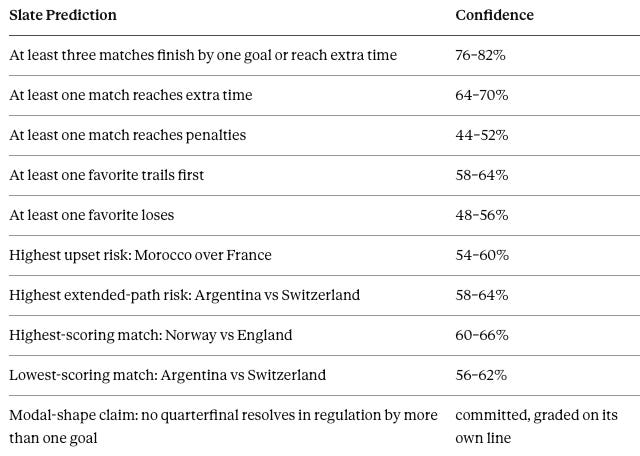
The strongest call on the slate is not a winner. The strongest call is structural: expect narrow margins, elevated draw share, and at least one match reaching extra time or penalties. Confidence: 76–82% — higher than confidence in any single advancement call, and the gap is deliberate.
Final Simulation Board — Locked July 7
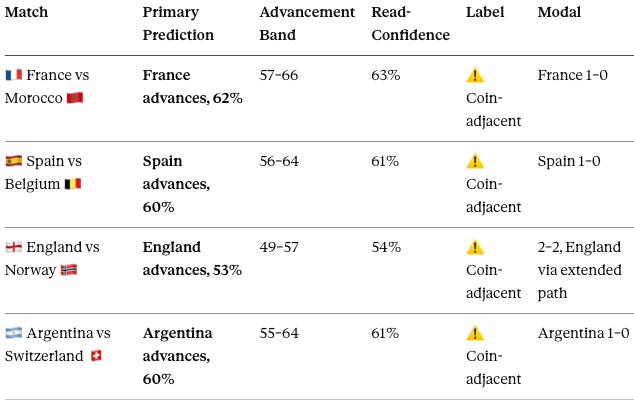
Read-confidence measures how clearly the model believes it sees a tie’s structure, published beside each advancement number rather than folded into it. Every modal scoreline ships at a one-goal margin or level under the newly adopted conversion-regression prior, which pulls every favorite’s projected scoreline toward one goal unless specific evidence justifies more. No tie supplied that evidence. Four narrow modals therefore constitute a committed claim about the shape of the entire round, graded on its own line.
Why Publish This Way
Forecasters usually respond to a bad round by quietly adjusting and moving on. MindCast runs a standing cycle instead: every forecast slate gets graded against public record, every grading feeds a calibration review, and every review's adopted changes govern the next slate. The Round of 16 review simply produced the cycle's most consequential adjustments yet, because the round exposed exactly where the confidence instrument works and where the probability layer overreaches. The quarterfinal simulation applies those adjustments in public. Confidence the fully labeled posture improves calibration credibility over a conventionally confident slate: 85%.
Core Thesis
The quarterfinals double as a designed experiment. During the Round of 16, the model logged a registry of observed patterns — hypotheses with names like compression-leverage conversion and champion-tier correction premium — that looked powerful but lacked enough evidence to enter the pricing. The Calibration Review deferred them, and the bracket then delivered a remarkable coincidence: each deferred hypothesis now faces its cleanest possible test in a specific quarterfinal. Boston tests Morocco’s conversion efficiency. Miami aims Norway’s terminal finisher and England’s ten-man defense directly at each other. Arrowhead tests Argentina’s comeback premium against the tournament’s stingiest defense. Each match supplies a data point; none of the hypotheses moves a price until the evidence clears the published adoption thresholds. Confidence the slate functions as targeted out-of-sample testing rather than a fresh start: 80%.
Coaching adaptation supplies the slate’s cleanest structural asymmetry. The adopted method credits only demonstrated in-tournament adaptation — a bench move, within a match at this World Cup, that changed the match. France and Argentina both hold qualifying instances against opponents holding none. Spain–Belgium and England–Norway pair qualified benches on both sides, cancelling the term. The asymmetric ties are exactly the two where the favorite’s number exceeds what raw structure supplies, which makes the term auditable this cycle: if both asymmetric favorites clear while the symmetric ties resolve as coins, the adaptation instrument moves toward adoption in a single round. Confidence the asymmetry framing is the round’s most testable overlay: 75%.
II. Common-Opponent Audit
Fans and pundits reason transitively: Team A beat Team C, Team C beat Team B, therefore Team A beats Team B. Transitive score logic creates false confidence, and the audit below exists to neutralize it before readers supply it themselves. Common opponents carry value only where they compare behavioral systems under similar stress.
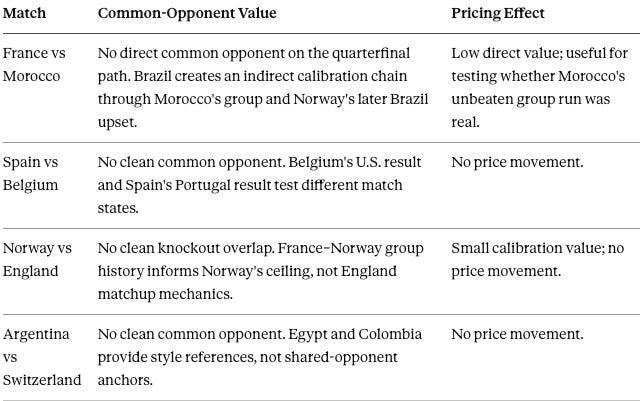
Brazil supplies the slate’s one useful indirect reference. Morocco advanced unbeaten from a group containing Brazil; Norway then eliminated Brazil 2–1 on two late Haaland goals. The chain does not rate Morocco and Norway equally. The chain establishes something narrower and more useful: both sides have already survived or beaten elite technical opposition without abandoning their identities. Construct integrity is calibration information, not a price input.
III. The Six-Run Simulation Architecture
Each MP CDT forecast issues from six sequential simulation layers. Run One prices availability. Run Two prices coaching adaptation. Run Three disciplines scorelines. Run Four maps match-state fragility. Run Five prices everything after minute 90. Run Six audits the whole stack against the deferral firewall. The outputs follow in order.
Run One — Availability and recovery load. The scan flags any key player with injury history, minimal minutes, a training-ground concern, or an in-tournament knock, and widens forecast bands accordingly:
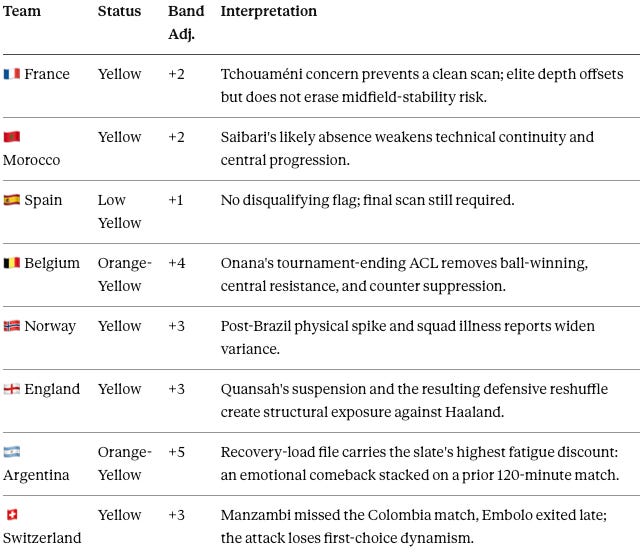
No squad scans clean — a first in the series, and a finding that reorganizes the slate’s risk architecture. Availability operates this round as a slate-level regime rather than a per-tie differentiator, and the uniformly wide bands in the simulation board trace directly to it. Availability flips no pick; it lowers confidence everywhere and keeps every forecast below 65. England’s file adds one more constraint the behavioral reads price later: Bellingham, Rice, Guehi, and O’Reilly each sit one booking from a semifinal suspension.
Run Two — Coaching adaptation. Six squads hold qualifying in-tournament instances: France (the Doué introduction that broke Paraguay), Spain (the gated 85th-minute double change that beat Portugal), Belgium (the De Ketelaere elevation), Norway (the halftime restructure that fed both Haaland goals against Brazil), England (the ten-man reorganization at the Azteca), and Argentina (the Lautaro introduction that assisted the Egypt winner). Morocco and Switzerland hold none — Regragui’s 2022 reputation and Yakin’s between-match restructure both fail the in-tournament demonstration standard, and the standard draws that line deliberately. Net effect: France +2, Argentina +2, both other ties neutralized, with Belgium’s credit discounted by the Onana loss. Adaptation clarifies late-match behavior; it does not justify confident favorite pricing.
Run Three — Conversion regression. Knockout forecasts habitually inflate favorite scorelines, and the regression layer exists to reject the inflation. France, Spain, and Argentina all regress to one-goal modals: France because Morocco punishes sterile dominance, Spain because its own 91st-minute resolution against Portugal proves suppression creates control faster than goals, Argentina because Switzerland has conceded twice in six matches. Norway–England behaves differently. No clean favorite regression applies there, the high-event draw branch stays live, and a 2–2 profile carries stronger behavioral coherence than any 1–0 profile — producing the series’ first committed level-scoreline modal.
Run Four — Match-state fragility. Every contract writes all three first-goal states — favorite scores first, underdog scores first, no goal through the decisive window — with a behavioral read, a numeric probability shift, and a falsification gate for each. The full trees appear in the match modules below.
Run Five — Extended path and penalty pressure. Everything after minute 90 changes the board more than regulation play does, and for the first time the model splits the extended path into separate extra-time and penalty edges:
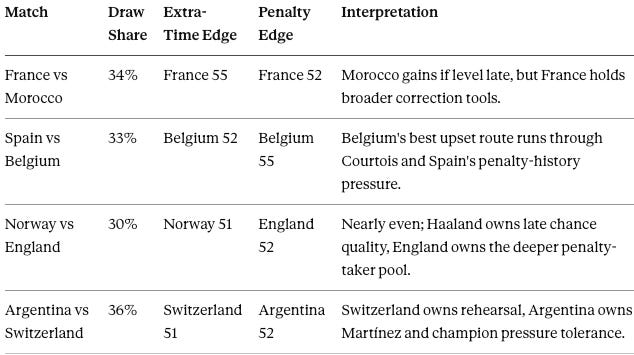
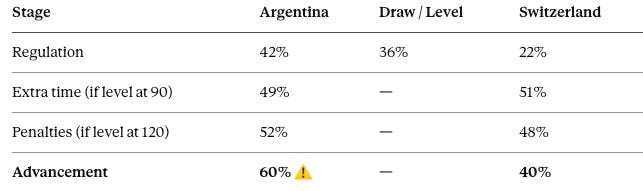
Two structural findings publish from the table. Spain can dominate the regulation map and still face Belgium’s strongest branch after 90 — the favorite is unfavored at both post-regulation stages, and most of Spain’s label lives in that fact. Argentina–Switzerland produces the slate’s only stage-split inversion: Switzerland edges extra time on fatigue, Argentina edges penalties on Martínez. The edge changes hands twice after minute 90 — no other tie inverts between stages. Penalty-event volatility remains a grading layer under the adopted method; no penalty term moves any live price.
Run Six — Calibration discipline. The deferral firewall, audited in full:
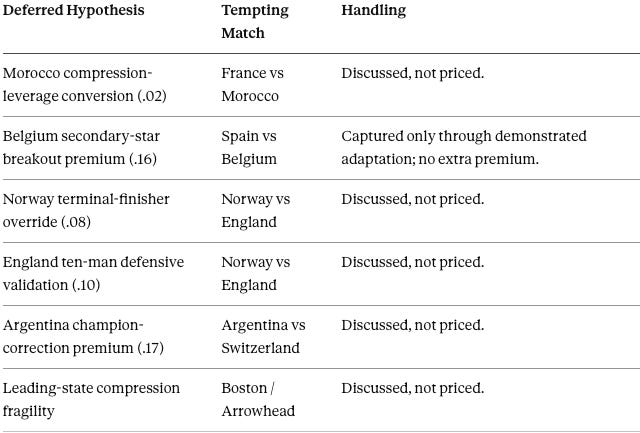
Calibration discipline prevents the publication from overstating its strongest stories. Morocco's Canada performance, Norway's Haaland eruption, England's ten-man survival, and Argentina's comeback all tempt narrative upgrades. The method refuses every upgrade until evidence reaches the published thresholds, and the Round of 16 record supports the refusal: the ledger closed with poor advancement accuracy but perfect regime classification, and the confidence line separated every clearance from every miss. Confidence holding the firewall matters more than any single point of probability on the slate: 85%.
IV. 🇫🇷 France vs Morocco 🇲🇦 — July 9 · Gillette Stadium, Boston
Boston opens the quarterfinal round with the tournament's richest rematch. France and Morocco last met in the 2022 World Cup semifinal, when France advanced 2–0 and Morocco's historic run ended one match short of a final. Four years later the pairing returns with both identities sharpened rather than reversed: France arrives as the bracket's most talented side carrying a twice-validated scoring-regression flag, and Morocco arrives as the tournament's proven compression system fresh off the most shot-efficient knockout win in sixty years. Timing adds a methodological layer on top of the sporting one — as the round's first kickoff, the match becomes the first forecast graded under the Round of 16 calibration adjustments, and the tie inherits more live calibration questions than any forecast in the series.
Primary prediction
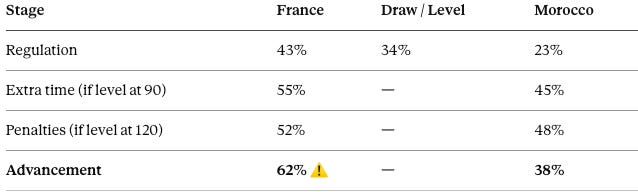
France advances, 62%. Band: 57–66. Read-confidence: 63%. ⚠️ Coin-adjacent. Modal: France 1–0.
France holds the edge through elite correction capacity, broader attacking options, and a coaching-adaptation credit earned when the Doué introduction broke Paraguay. Morocco suppresses the number through compactness, transition speed, and demonstrated composure against high-level opposition — neutral observers entering the match frame Morocco as France’s first true test. France’s own knockout file keeps the number honest: the Paraguay win was narrow, late, and penalty-mediated, resolved by Mbappé from the spot at the exact minute-70 gate the prior forecast committed. A 62 marks a ten-point drop from France’s Round of 16 baseline, and the drop is earned.
Morocco deserves better than sentimental-underdog pricing. Three goals from five shots beat Canada — the fewest shots to win a World Cup knockout tie since 1966 — in a match Canada controlled for long early stretches before Morocco punished the post-halftime transition window. The scoreboard overstated Morocco’s control and understated its efficiency, and the efficiency raises the tie’s live calibration question: is hyper-efficient conversion a repeatable Moroccan weapon or a two-match anomaly? The deferred hypothesis holds two instances against a three-instance threshold, and one of the two lost its match. The simulation prices Morocco’s compression through the standing model, debates the conversion question openly here, and lets Boston supply the third data point. Confidence holding the deferral line matters more than any single point of Morocco probability: 85%.
Availability scan (logged July 7). France: Yellow (+2) — the Tchouaméni concern prevents a clean scan; elite depth offsets but does not erase midfield-stability risk. Morocco: Yellow (+2) — Saibari’s likely absence weakens central progression, and compression-load tracking runs on the defensive core. Both squads re-scan at the team-news window; any post-commitment scratch routes through the input-shock protocol, which grades frozen forecasts as committed and logs the shock as a scored event rather than re-forecasting.
Adaptation asymmetry. France qualifies; Morocco does not. The term contributes +2 to France’s edge, stated here for post-round audit.
Mechanism read
France operates as a Late-Correcting Elite Talent System. Morocco operates as an Equilibrium Compression and Transition-Punishment System. France wins if pressure becomes cumulative. Morocco wins if pressure becomes impatient. The match turns on whether France converts control before Morocco makes the game feel like a referendum on patience — and every level minute past 60 transfers probability toward the side that wants the match longest. Behavioral pressure runs against the favorite late: French loss-framing sharpens after minute 70 in a level match, and the 2022 semifinal memory operates as a live reference point inside the French behavioral model, not as narrative color.
Time gates. Opening 30: penetration versus territory against the shell — the Paraguay siege pattern, retested against a better shell. Minute 70: the transfer gate, validated twice already this tournament; a level match at 70 moves probability toward Morocco every subsequent minute.
First-goal fork tree
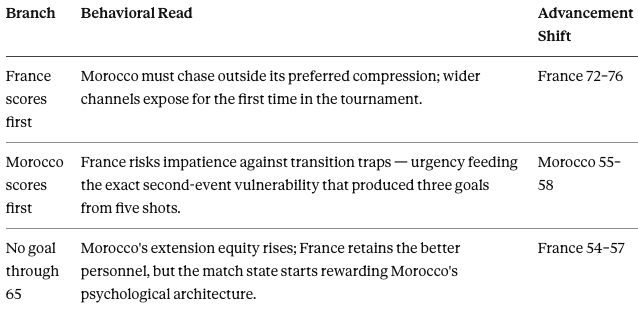
France’s fragile state begins when sterile control turns into urgency. Morocco’s fragile state begins when an early French goal forces higher possession and exposes central spacing. Falsification gates: the France model weakens if Morocco creates two transition shots before halftime; the Morocco model weakens if France scores first and Morocco fails to generate a counterthreat within twenty minutes. On the outcome register, only Morocco advancing falsifies the call.
Three-stage forecast
Secondary predictions
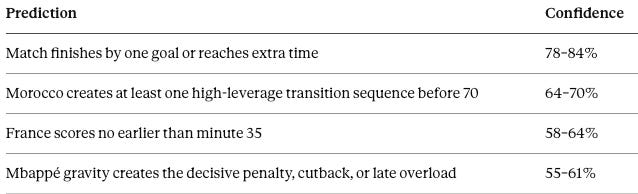
Committed modal: France 1–0, under a regression flag now validated twice. Modal route: regulation resolution inside the 60–80 window. Second-weighted route: extension, where France's edge persists but narrows stage by stage. Mechanism risk: medium. Outcome risk: high. Confidence the regression-meets-compression frame remains the tie's governing structure: 80%.
Contact mcai@mindcast-ai.com to partner with us on Predictive Game Theory AI in Law and Behavioral Economics. To deep dive on MindCast works upload the URL of this publication into any LLM (preferably Google AI mode/Gemini, Claude, ChatGPT) and prompt ‘reconstruct MindCast framework with three degrees of cited sub links.’ See Live-Fire Game Theory Simulators, Runtime Predictive Infrastructure. We stress-tested our AI system for this publication by simulating the Super Bowl and the World Cup. Super Bowl LX — AI Simulation vs. Reality | Predictive Game Theory + Behavioral Economics Cognitive Digital Twin Foresight Simulations in the World Cup| The World Cup Is the First Mass-Market Stress Test for Prediction Markets | Dynamic Predictive Game Theory From the 2026 🏈Super Bowl and ⚽World Cup
V. 🇪🇸 Spain vs Belgium 🇧🇪 — July 10 · SoFi Stadium, Los Angeles
SoFi pairs the tournament's most complete control system against its most dangerous repair system. Spain has spent five matches proving that suppressing an opponent works better than outscoring one; Belgium has spent five matches proving that a broken first hour means nothing if the last fifteen minutes belong to you. Structurally the tie stands alone on the slate: both benches carry demonstrated in-tournament adaptation credit — the only quarterfinal where the new coaching term fully cancels — which forces the forecast to price the match on system against system rather than manager against manager. One injury then tilts the scales before kickoff: Belgium lost its midfield anchor for the tournament, in the exact zone where Spain's suppression applies its pressure.
Primary prediction
Spain advances, 60%. Band: 56–64. Read-confidence: 61%. ⚠️ Coin-adjacent. Modal: Spain 1–0.
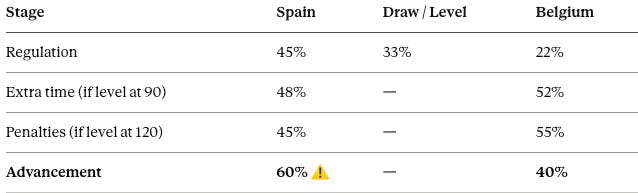
Spain controls the regulation map. Belgium owns the more dangerous path after minute 90. The split defines the tie, and the split explains a label that a casual reader might find strange under a 45–22 regulation gap.
Spain arrives with the Round of 16’s cleanest validated performance: a 91st-minute Merino winner against Portugal after a second half of domination against a stubborn shell, delivered through the exact substitution window the prior forecast priced. The win proves the suppression-and-late-unlock model works — and simultaneously reinforces the scoreline-regression prior, because suppression creates control faster than goals. Belgium arrives with the inverse profile: a 4–1 dismantling of the United States built on De Ketelaere’s double and a genuinely aggressive tactical reshuffle, stacked on a tournament file whose knockout goals cluster at minutes 9, 86, 89, and 125 — the bookends of a match and nothing between.
Onana’s tournament-ending ACL then reshapes the Belgian side of the ledger. Losing a midfield anchor hurts against anyone; losing one against Spain hurts most, because suppression works by strangling exactly the central duels Onana anchored. The availability layer assigns Belgium the slate’s second-heaviest penalty, and Belgium’s adaptation credit operates under the same discount.
Availability scan (logged July 7). Spain: Low Yellow (+1) — Yamal returned to the starting lineup off a hamstring-managed start; no disqualifying flag, final scan required. Belgium: Orange-Yellow (+4) — Onana out for the tournament; De Bruyne load management remains a watch item.
Adaptation asymmetry. Both benches qualify — the round’s only both-qualified pairing — so the term cancels, with Belgium’s credit discounted. Residual edge: Spain, whose qualifying instance was gated and executed to the minute.
Mechanism read
Spain operates as a Suppression-Control and Late-Unlock System. Belgium operates as an Adaptive Secondary-Star Activation System. The central question: does Belgium’s De Ketelaere-centered coherence survive against a side that suffocates the ball before the Belgian transition layer forms — now without the anchor those duels ran through? Spain’s best outcome arrives through patient suppression. Belgium’s best outcome arrives through early disruption or a 0–0/1–1 path into extension. Spain’s fragile state begins when possession lacks vertical access. Belgium’s fragile state begins when De Ketelaere becomes isolated and De Bruyne receives under pressure facing his own goal. Spain’s rational strategy is regulation resolution, because extension is the one state the construct has never survived — and the clock alone changes Spanish behavior.
Time gates. Opening 25–30: the counterpress test — Belgium repeatedly bypassing the counterpress early is the suppression thesis’s weakening signal. Minutes 75 through the end: Belgium’s entire scoring identity meets Spain’s lead-protection behavior, which grades as its own mechanism claim.
First-goal fork tree
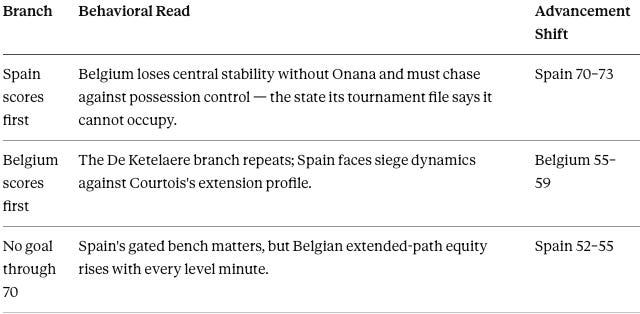
Falsification gates: the Spain model weakens if Belgium bypasses the counterpress repeatedly in the first 25 minutes; the Belgium model weakens if Spain controls second balls and pins Belgium deep without transitional release. On the outcome register, only Belgium advancing falsifies the call.
Three-stage forecast
Secondary predictions
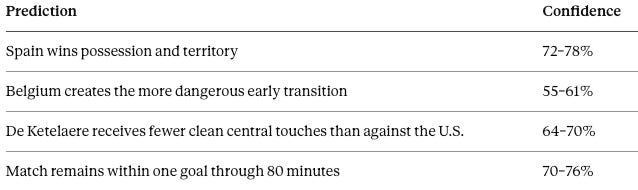
Committed modal: Spain 1–0 — suppression systems win by the unlock, not the procession, and Merino’s winner is the template. Modal route: regulation resolution before 85. Second-weighted route: the extended path, where the favorite is unfavored at both stages and where most of the label lives. The label communicates where the risk concentrates, not that the teams are even. Mechanism risk: medium. Outcome risk: medium-high. Confidence in the suppression-over-activation regulation read, separated from the advancement number: 75%.
VI. 🏴 England vs Norway 🇳🇴 — July 11 · Hard Rock Stadium, Miami
Miami stages the slate’s designed experiment. Two hypotheses the calibration review deferred — Norway’s terminal finisher as a construct-overriding force, England’s ten-man defense as proof of a reorganization floor — face each other directly, in the one pairing built to adjudicate both at once. The tie also compresses to the slate’s flattest number, because the two systems own opposite ends of the same match: England’s scoring evidence bursts inside the first half-hour, Norway’s detonates inside the last, and ninety minutes only has room for one of those identities to hold. Whichever side wins, Miami produces the round’s most valuable data.
Primary prediction
England advances, 53%. Band: 49–57. Read-confidence: 54%. ⚠️ Coin-adjacent. Modal: 2–2, England advances via the extended path.
England gets the narrow call because Bellingham and Kane provide more varied correction routes than Norway's Haaland-centered system. Norway nearly flips the number because Haaland's late-event profile attacks England's most exposed surface: a reshuffled back line, a suspended center-back, and four defenders one booking from a semifinal ban. Neither of the tie's two frozen hypotheses moves the price. A Norway win would validate the terminal-finisher hypothesis; a Norway win would not retroactively justify pricing the hypothesis before adoption. The method writes that sentence before the match, not after.
England’s Round of 16 file rewrites its construct in both directions. A 3–2 win at the Azteca — Bellingham twice in 98 seconds against the run of play, Kane from the spot — proves the system can score early against a proven opponent. Thirty-six ten-man minutes survived after Quansah’s red card prove a defensive floor. The same match shows volatility under stress and exacts the disciplinary and availability cost that now defines the quarterfinal. Norway’s file carries its own post-Brazil shadow: the halftime restructure fed both Haaland goals at 79 and 90, the round’s most literal underdog validation, and squad illness reports following the celebration place Norway on a formal health watch.
Availability scan (logged July 7). England: Yellow (+3) — Quansah suspended (appeal pre-registered below), Henderson out of the tournament with a fractured radius from a freak celebration accident, Livramento out, Reece James racing fitness after three matches missed. The caution cluster — Bellingham, Rice, Guehi, O’Reilly at one booking each — enters the behavioral read directly. Norway: Yellow (+3) — post-Brazil physical spike plus the illness watch; no individual starter ruled out at writing; re-scan at the team-news window.
Input-shock pre-registration. The Quansah appeal is a known pending ruling, so its handling pre-registers now: the forecast commits with Quansah out; any reversal before kickoff grades as a scored input event in the daily ledger; the frozen forecast grades as committed; no re-forecast occurs. Earlier this tournament, a U.S. suspension reversed after commitment established the protocol — the handling repeats without modification. Any Norway illness ruling naming a starter pre-registers identically.
Adaptation asymmetry. Both benches qualify, so the term cancels. The tie prices on structure, availability, and timing.
Mechanism read
England operates as an Early-Burst Talent and Emergency-Reorganization System. Norway operates as a Late-Detonation Finisher System built around Haaland’s conversion of small windows into decisive events. A timing asymmetry forms the contract’s spine: England owns the game’s first half-hour, Norway owns the final half-hour if the match remains level, and each system’s optimal strategy occupies the window the other owns least.
The caution constraint adds a behavioral term with no series precedent. Four English players defending the detonation window under a one-booking semifinal threshold face a live trade-off between tactical fouling — the standard tool for killing transitions — and personal availability. The constraint binds hardest in exactly the minutes Norway is most dangerous. Confidence the constraint materially degrades England’s late-window defensive toolkit: 65%.
Time gates. Opening 35: England’s burst window — an early goal forces Norway to create volume an hour before its preferred surge. Final 15 plus stoppage: Norway’s entire knockout identity meets a reorganized back line defending under the caution constraint. A level match entering that window is the slate’s most volatile committed state, and the committed modal runs directly through it.
First-goal fork tree
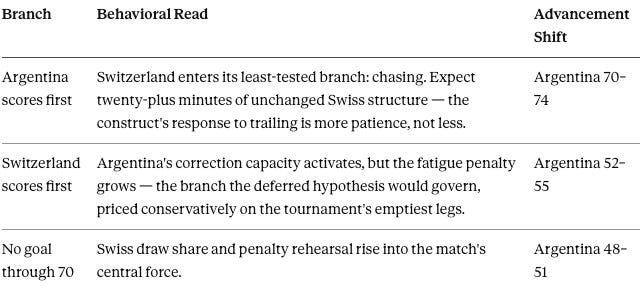
Falsification gates: the England model weakens if Haaland gets two central-box touches before halftime — early box access means the timing read failed in the worst direction. The Norway model weakens if England forces Haaland wide or back-to-goal while Bellingham receives freely between the lines. On the outcome register, only Norway advancing falsifies the call.
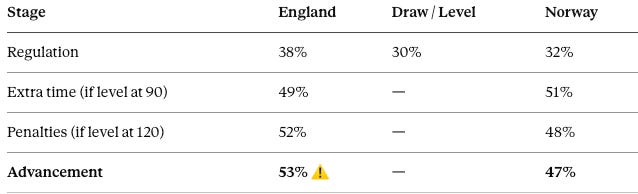
Three-stage forecast
Secondary predictions
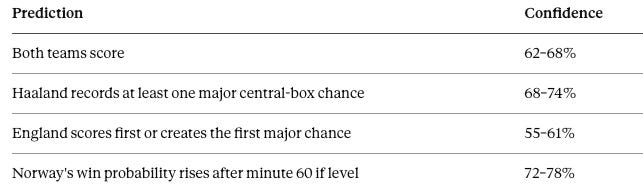
Committed modal: 2–2, England advances via the extended path — the series’ first committed level-scoreline modal, and a modeling result rather than a hedge. No clean favorite regression applies to this tie, the high-event draw branch stays live, and a 2–2 profile carries stronger behavioral coherence than any 1–0 profile in the round’s only two-window pairing. Modal route: an early English goal, a late Norwegian reply, then extension — where the edge itself changes hands, Norway 51 in extra time, England 52 at penalties on the deeper taker pool. The new grading separation logs the score-margin call on its own track, making the draw-modal the separation instrument’s first live test case. Mechanism risk: high. Outcome risk: very high. The simulation makes England the slight advancement call and names Norway the cleaner mechanism threat — both statements grade. Confidence in the timing-asymmetry spine as the tie’s governing structure: 80%.
VII. 🇦🇷 Argentina vs Switzerland 🇨🇭 — July 11 · Arrowhead Stadium, Kansas City
Arrowhead closes the round with the slate’s purest stress test — of the champion and of the model. Argentina brings the tournament’s strongest alignment and its emptiest legs, having played 120 minutes in Miami and then rescued a two-goal deficit in Atlanta on consecutive short turnarounds. Switzerland brings the inverse profile: never behind at this World Cup, two goals conceded in six matches, a shootout already banked, and a game model built to make tired opponents pay for every wasted minute. The forecast below lands in the exact probability band where the model went zero for five in the Round of 16 — the pre-committed watchlist predicted it would — which makes Arrowhead the sternest test of whether the new labeling discipline holds under temptation.
Primary prediction
Argentina advances, 60%. Band: 55–64. Read-confidence: 61%. ⚠️ Coin-adjacent. Modal: Argentina 1–0.
Argentina remains the call because championship alignment, Messi gravity, Scaloni’s demonstrated correction capacity, and Emiliano Martínez’s extended-path profile still matter. Switzerland suppresses the number by manufacturing the exact conditions that broke the model in the Round of 16: low event volume, elevated draw share, goalkeeper leverage on both sides, and an underdog arriving with a rehearsed, banked shootout. The pre-committed watchlist warned this number would land in the exposed zone. The number lands there, the label attaches, and the finding cites in full — the model went zero for five in this band, and the sixth attempt claims no exemption.
The key tension is not talent. The key tension is whether Argentina’s correction memory outruns its fatigue file before Switzerland drags the match into its preferred low-event corridor. Argentina trailed Egypt 2–0 with eleven minutes left before Romero, Messi, and Enzo Fernández completed the comeback, with Lautaro assisting the winner minutes after entering — the tournament’s loudest correction signal, and the price’s most disciplined exclusion. The champion-correction hypothesis holds one instance against a three-instance threshold, so the comeback enters the prose and the qualitative read while the number builds from alignment, fatigue, and the standing correction model. Confidence holding the deferral against the round’s most tempting observation: 85%.
Switzerland’s route to Arrowhead strengthens the structural read rather than weakening it. A 0–0 win over Colombia on penalties — 4–3, Kobel’s decisive save, Vargas converting the clinching kick, a first Swiss quarterfinal since 1954 — matters as a route signal, not a pricing premium. One tactical fact from that match enters the pricing directly: after Manzambi’s training-ground knee injury, Yakin reshaped the side into a more cautious, controlled game model, and the reshaped version banked the shootout. The accumulation construct did not survive Manzambi’s loss; the construct deepened.
Availability scan (logged July 7). Argentina: Orange-Yellow (+5), the slate’s heaviest file — 120 minutes in Miami plus a maximum-emotional-cost comeback in Atlanta, on consecutive short turnarounds. Press timing and final-quarter legs are the flagged channels, and the fatigue alert from the Egypt forecast grows rather than shrinks. Switzerland: Yellow (+3) — Manzambi (knee, MRI-confirmed, missed Colombia; possible return, minutes-limited at best), Embolo (late exit, monitoring), Vargas and Sow (discomfort, played through — Vargas converted the decisive penalty anyway), Jaquez (out), Aebischer (limited).
Input-shock pre-registration. A Manzambi fitness ruling is a known pending decision: the forecast commits with Manzambi projected absent or minutes-limited inside Yakin’s reshaped model; any reversal grades as a scored input event without re-forecast.
Adaptation asymmetry. Argentina qualifies through the Lautaro channel. Switzerland does not — Yakin’s restructure occurred between matches, not within one, and enters the qualitative read instead. The term contributes +2 to the Argentine edge, stated for audit.
Mechanism read
Argentina operates as a Championship Alignment and Late-Correction System under the slate’s heaviest fatigue alert. Switzerland operates as a Quiet Accumulation and Defensive-Stinginess System: never trailing at this World Cup, two conceded in six matches, now with banked rehearsal. Argentina wins if it scores first. Switzerland becomes dangerous if the game stays scoreless deep into regulation. Argentina’s rational strategy is early resolution at maximum urgency, because accumulated fatigue raises the cost of every additional minute more steeply than in any prior match. Switzerland’s rational strategy is the tournament’s purest waiting game, invariant by design. The first goal is worth more here than in any quarterfinal, because neither construct survives its own trailing state intact: Switzerland has never chased, and Argentine correction on empty legs is exactly the question the deferred hypothesis would answer and the price refuses to.
Time gates. Opening 30: does the Argentine press arrive on a third consecutive short turnaround, or does the flat start that opened the last two matches appear again — this time against an opponent that converts territorial patience into zero concessions rather than level scorelines. Minute 70 onward: the transfer gate at its steepest. A level match on maximum fatigue transfers probability toward Switzerland faster than the standard gradient, and the slate’s highest draw share makes the gate more likely to arrive here than anywhere.
First-goal fork tree
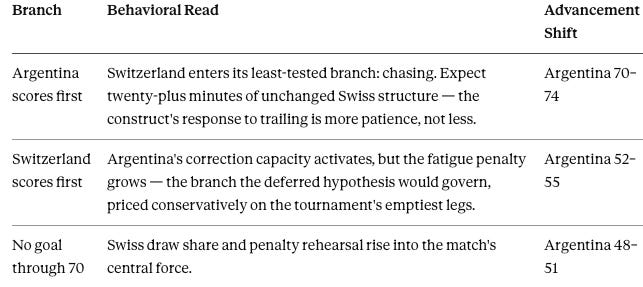
Falsification gates: the Argentina model weakens if fatigue suppresses first-hour chance quality — a third consecutive flat opening hour converts the fatigue flag from discount to signature. The Switzerland model weakens if Argentina scores first and Switzerland cannot progress possession within fifteen minutes. On the outcome register, only Switzerland advancing falsifies the call.
Three-stage forecast
Secondary predictions
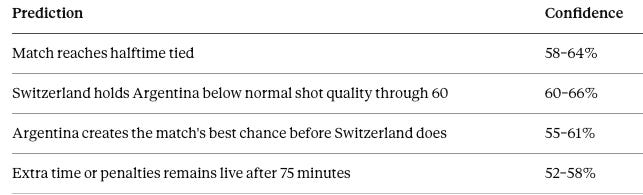
Committed modal: Argentina 1–0 — the regression prior and the Swiss concession rate jointly forbid anything wider. Modal route: a single Argentine goal inside minutes 35–70, protected. Second-weighted route: the slate’s most probable draw into the round’s only stage-split inversion, where Switzerland edges extra time on fatigue and Argentina edges penalties on Martínez against the banked Kobel rehearsal. The edge changes hands twice after minute 90, and the route register carries that volatility as the tie’s defining feature. Mechanism risk: medium-high. Outcome risk: very high. Confidence in the fatigue-discount sizing, the tie’s governing judgment: 70%.
VIII. Final Prediction Set
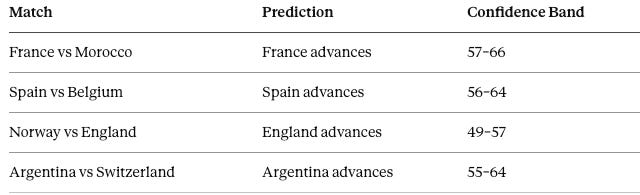
Every claim below carries a grade. The primary table restates the four advancement calls with their committed bands; the secondary table commits the slate-level structure — margins, extensions, upsets, scoring shape — as separately falsifiable predictions. Readers scoring MindCast after the round should score both tables, because the Round of 16 proved the two layers can diverge: the model can miss winners while calling the shape of the round correctly, and the grading method now separates those results by design.
Primary predictions
Secondary slate predictions
Ordering claim. Advancement confidence orders France (62), Spain (60), Argentina (60), England (53). The Round of 16 delivered one under-appreciated result: the confidence ranking carried near-perfect information about where failures would land even while the raw numbers ran hot. The quarterfinal ordering re-tests that instrument on a compressed band — including, for the first time, a genuine tie at 60, which the validation report will grade as an ordering-instrument edge case. Confidence the ordering grades as informative regardless of results: 85%.
IX. Downstream Bracket Geometry
The Boston winner meets the SoFi winner in Dallas; the Miami winner meets the Arrowhead winner in Atlanta. Composing the committed numbers, France–Spain arrives at roughly 37% — the single most likely semifinal, and still well short of even money, which is exactly what a fully labeled slate implies downstream. No Atlanta pairing exceeds one-third; the bracket’s bottom half is a genuine four-way cluster the labels already priced. Every forecast above therefore doubles as a conditional forecast about the semifinal round, and the validation report grades the geometry alongside the matches.
X. Grading Method — Continuity and the New Separations
Grading follows the standing three-register method — outcome, mechanism, route — with two adopted separations operating for the first time. Mechanism-and-advancement calls now grade at full credit independent of modal-score accuracy, while score-margin results log to their own calibration track; the Miami draw-modal becomes that separation’s first live test case. Penalty-derived expected goals separate from open-play expected goals in all grading, with no penalty-volatility term entering any price above — the extended-path table prices route structure, not penalty events. Performance targets restate: 65–75% on advancement calls, 75–85% on mechanism reads, with the caveat the labels make explicit — all four advancement calls sit in a zone where the model’s demonstrated skill is the ranking, not the number.
XI. Registry — 2026.QF.NN Opens
The quarterfinal observation registry opens live with this publication, numbering continuous from 2026.QF.01 in the standing Observation / Evidence / Projected-effect / Status format. Adoption thresholds restate in advance: instrument-level hypotheses require supporting evidence across five-plus matches; event-level hypotheses require three-plus; the quarterfinal Calibration Review applies both after Match 100. Deferred-hypothesis evidence counters initialize as carried: compression-leverage conversion at two instances (threshold three), terminal-finisher override at two, ten-man defense at one, secondary-star node at one, champion-correction premium at one. Boston, Miami, SoFi, and Arrowhead each supply a designed data point.
XII. Final Interpretive Conclusion
The quarterfinals will test MindCast’s calibration more than its courage. The model can still call favorites — France, Spain, England, and Argentina each hold enough mechanism advantage to justify the advancement side. None holds enough separation to justify high-confidence language, and the publication stops pretending sub-65 favorites are clean favorites.
The clean thesis: the Round of 16 did not break the model; it taught the model where its confidence instrument works and where its probability layer overreaches. The quarterfinal simulation applies that lesson in public — mechanisms and rankings carrying the weight, outcomes labeled at their proven reliability, bands widened where the widening is earned, every deferred temptation held out of every price, and every squad on the slate carrying a logged availability flag for the first time in the series. Narrow margins, widened bands, and coin-adjacent labels are not hedges. They are the forecast.
Validation remains the objective, and calibration remains the discipline.
Simulations committed July 7, 2026, before the first quarterfinal kickoff, subject only to final availability scans at each team-news window under the pre-registered input-shock protocol. Grading follows in the Quarterfinal Validation Report under the adopted method of the Round of 16 Calibration Review, against forecasts committed in this publication and the tournament-level architecture of the World Cup Championship Index 2026.
Appendix — Pre-Commitment Checklist Audit
All eleven items of the internal pre-commitment checklist cleared before lock. Availability scans logged for all eight squads — the first fully flagged slate in the series, France through Switzerland, with bands widened per adjustment. All three first-goal branches written with behavioral reads, probability shifts, and falsification gates in all four contracts. Conversion-regression prior applied to every modal, with no favorite multi-goal margin anywhere. Adaptation term restricted to demonstrated in-tournament adapters, both asymmetries stated for audit. Read-confidence displayed beside every advancement number, and coin-adjacent labels attached to all four calls. Deferral firewall audited in full: no hypothesis moved any price. Two-register falsification contracts and time gates committed for every tie. Four-stage decompositions published and arithmetically reconciled. Input-shock handling pre-registered for the Quansah appeal, any Norway illness ruling, and the Manzambi fitness decision. The 2026.QF.NN registry initialized live from .01, with deferred-hypothesis evidence counters carried forward.
Quarter finals simulation validation, July 11
Semi finals simulation, July 12
Semi finals simulation validation July 15
Finals simulation July 16
Finals simulation validation July 19
2026 World Cup Game Theory + Behavioral Economics review July 20