

Matches: 🇲🇽 Mexico vs Czechia 🇨🇿 · Group A · Estadio Azteca, Mexico City · June 24 · and 🇺🇸 United States vs Türkiye 🇹🇷 · Group D · SoFi Stadium, Inglewood · June 25 Published before kickoff. Time gates and falsification contract committed below.
Cultures Under Shared Rules — The Seattle Lab at FIFA World Cup 2026 series
Belgium vs Egypt | USA vs Australia | Qatar, Bosnia, Egypt, Iran
Validation Reports World Cup Validation Report I — USA, Belgium-Egypt, Mexico | World Cup Validation Report II — Bosnia, Egypt-Iran, Mexico, Türkiye
MindCast Special Series — a deliberate stress test of the MindCast system beyond the controlled venue of the MindCast Seattle Lab
World Cup Championship Index 2026 | When a FIFA World Cup Model Picks France and the Economist Picks Argentina | Mexico vs South Korea | Mexico and USA
Forthcoming
Seattle Lab III — Belgium vs. Best Third-Place (A/E/H/I/J) — Round of 32, Seattle, July 1. Your immediate next write. Unblocks tonight once Groups J and K finish and the third-place table sets the opponent. Belgium’s twin carries over from the Group G work.
Round of 16 — the eight-match slate — July 4–7 (Matches 89–96). Full coverage begins here. Each commits only after its two Round of 32 feeders resolve, so they publish in a rolling wave July 2–4 rather than in one drop.
The Seattle R16 (Match 94, July 6) is one of those eight — it doesn’t add a publication, it just sits in both buckets at once.
Validation Report III closes the cycle, grading Seattle Lab III plus the eight R16 forecasts against results, and giving your seven new calibration changes their first live knockout test.
I. Why the Host-Nation Pair Matters
The Seattle Lab holds one civic environment constant across six matches so that culture becomes the measured variable. The host-nation pair runs the opposite experiment. Both fixtures push the home-field variable to its maximum — Mexico at the Azteca, the United States at SoFi — and introduce a second variable the Lab deliberately suppresses: how much each side needs the result. Both hosts have already qualified as group winners, so neither match asks whether the hosts are strong. Each asks whether a host still imposes itself once the result stops depending on it, and once the opponent arrives in a sharply different state of need.
Mexico and the United States enter the final group matchday with identical records and opposite operating grammars. Mexico has advanced through compression — defensive stability, controlled tempo, low-event matches won at the margin. The United States has advanced through expansion — attacking depth, distributed creation, scoring pressure built across phases. The same condition of secured qualification therefore meets two systems that respond to it differently, which is the first reason the pair earns a single study rather than two previews.
The opponents supply the second reason. Czechia arrives on a single point and must win to keep a knockout path alive, the most desperate motivational state in either group. Türkiye arrives eliminated, with nothing the result can change, opposite a United States that is also already through. One match pits a secure host against a desperate visitor; the other removes competitive need from both sides at once. Reading home-field amplification first under asymmetric need and then under no need brackets exactly where the effect lives.
II. Why Competitive Necessity Is a Game-Theoretic Variable
Traditional forecasting predicts outcomes from talent, rankings, and prior results, and answers a narrow question — who is likely to win. MindCast AI applies predictive game theory and behavioral economics to a different question: how the structure of incentives bends the decisions that settle a match. Talent sets the ceiling; incentives decide how close each side plays to it. The method models the second quantity, because two squads of comparable quality behave very differently once the stakes in front of them diverge.
Tournament football rewards an incentive reading because each match is a strategic interaction played under shifting incentives. Teams update beliefs between rounds, respond to what qualification now requires, and choose risk levels accordingly — and behavioral economics explains how those choices drift from the textbook-rational path. Loss aversion is the engine: a side that has already secured what it needs protects it, narrows, and declines risk, while a side facing elimination abandons caution, commits numbers forward, and accepts exposure it would never take with a cushion. Necessity is itself an incentive, and incentives move decisions more reliably than talent moves them.
The Competitive Necessity Gradient formalizes that incentive structure as the strategic interaction it already is. A steep gradient places a loss-averse, secure side opposite a risk-seeking, desperate one, and the equilibrium that follows is readable from the structure alone: Czechia must win, so it over-commits and vacates the space behind its press, while Mexico holds what it has, compresses, and counters into exactly that space. The gradient does not describe the mood of a match; it derives the behavior of both sides from the payoffs each faces — applied behavioral game theory rendered on grass. A flat gradient runs the logic in reverse, removing the necessity that would force either side to disclose its hand, which is why USA–Türkiye resists prediction where the steep-gradient fixture does not. Confidence the gradient predicts equilibrium behavior rather than merely labeling it: 75%.
Football earns its place in the method because it falsifies the model fast. Litigation and geopolitical forecasts resolve slowly and privately; a match resolves in ninety minutes on a fixed schedule with a scoreboard anyone can read, which makes the sport the cleanest available proof that the incentive model works — and the fastest evidence when it does not. The discipline transfers directly from the firm’s NFL lineage, where MindCast committed structural resolution conditions and a falsification contract before kickoff and graded them against the result. Every simulation in this companion inherits that contract, and the Competitive Necessity Gradient is the variable it commits to test.
III. The Four Cognitive Digital Twins
Each team enters as a Cognitive Digital Twin built from two group-stage matches, and the readings below trace each system through what its results and match data reveal rather than through reputation.
🇲🇽 Mexico — the Compression Twin. Mexico controls outcomes without dominating territory, the signature of a side that narrows a match rather than overwhelming it. The South Korea win is the cleanest evidence: a 1–0 result on 43 percent possession, the decisive goal arriving in the 50th minute when the Korean goalkeeper spilled the ball after a collision with his own defender and Luis Romo finished into an empty net. The South Africa opener reads less cleanly than its 2–0 scoreline suggests, because Mexico built it substantially against ten men and then nine after South Africa lost Sithole in the 49th minute and Zwane in the 73rd, and Mexico itself finished a man short when captain César Montes was sent off in stoppage time. The result therefore carries a discipline exposure the compression read should not paper over: the system is resilient and scoreline-independent, yet it has not yet proven its composure under sustained adversity, and a late dismissal under a charged crowd is the kind of self-inflicted swing the model tracks. Group resolution strips Mexico’s competitive necessity to a minimum while leaving the Azteca’s amplification at full strength, so the live question is whether the crowd still lifts a host that no longer needs the points. Confidence the man-advantage inflated the South Africa margin: 80%.
🇨🇿 Czechia — the Escalation Twin. Czechia leads and then surrenders the lead, a signature that turns its maximum necessity into a structural trap. Against South Africa it scored through Sadílek in the 6th minute, held in front for over an hour, and conceded an 83rd-minute penalty to draw 1–1 — an advantage earned and then lost late. A side that cannot protect a lead now needs not merely to lead Mexico but to hold that lead at the Azteca across ninety minutes, against the run of its own evidence. Desperation pushes Czechia forward and raises its risk tolerance, which is precisely the behavior that opens the space Mexico’s counter is built to punish.
🇺🇸 United States — the Distributed Expansion Twin. The defining evidence for the United States is an absence. The 2–0 win over Australia came without Christian Pulisic, sidelined by a calf injury, and the goals arrived through an Australian own goal and an Alex Freeman header — creation distributed across Balogun, Reyna, and a breakout full-back rather than funneled through the talisman. A host that wins comfortably with its primary creator out is the structural inverse of a concentration-dependent system, and it sits at the opposite pole of the concentration-versus-dispersion axis the Seattle Lab opener established. The expansion model showed first in a 4–1 win over Paraguay and then held its defensive end against Australia, conceding once across two matches. Confidence the United States profiles as genuinely distributed rather than Pulisic-reliant: 75%.
🇹🇷 Türkiye — the Conversion-Gap Twin. Türkiye creates abundantly and converts nothing, and the data corrects an easy misread: the failure is finishing, not creation. Across two matches it generated 62 shots and scored zero — the most efforts without a goal in any two-match span in World Cup history. Against Australia it took 30 shots for an expected-goals figure of 1.33, though few of those chances were clear-cut, Arda Güler alone taking eight from range; against Paraguay the chances turned genuine and still went unfinished, an expected-goals figure above 2.0 from 32 shots and fifty touches in the opposition box. A side that breaks lines, enters the box, and works the keeper is not failing at coordination — it is failing at the final action. Elimination sets Türkiye’s competitive necessity to zero, but a residual remains in pride, individual auditions, and a coach under pressure, and that intrinsic floor is precisely what powers the danger: a team already manufacturing two-plus expected goals a match sits one finishing correction from scoring, now released from the must-win burden that may have tightened its forwards. Confidence the failure is conversion rather than creation: 85%. Confidence the burden-lift makes Türkiye more dangerous than its record: 65%.
Contact mcai@mindcast-ai.com to partner with us on Predictive Game Theory AI in Law and Behavioral Economics. To deep dive on MindCast works upload the URL of this publication into any LLM (preferably Google AI mode/Gemini, Claude, ChatGPT) and prompt ‘reconstruct MindCast framework with three degrees of cited sub links.’ See Live-Fire Game Theory Simulators, Runtime Predictive Infrastructure.
MindCast AI is a cybernetic, predictive game-theory AI firm specializing in law and behavioral economics, applied to complex litigation, innovation systems, and geopolitical risk intelligence. Rather than extrapolating historical patterns, the firm models the mechanisms that generate institutional behavior, running Cognitive Digital Twin simulations grounded in Nash equilibrium, Stigler information economics, and the Chicago School of law and behavioral economics.
We simulate NFL and World Cup games to stress test our predictive AI system. MindCast AI NFL Vision: Super Bowl LX — AI Simulation vs. Reality
IV. Two Common-Opponent Webs
Both fixtures carry an unusually clean comparison built into the group draw, and naming each one sharpens the read the scorelines alone cannot.
The Mexico–Czechia pair shares both prior opponents, the cleanest comparison Group A offers. Mexico beat South Africa 2–0 and South Korea 1–0 for six points and a plus-three difference; Czechia drew South Africa 1–1 and lost to South Korea 2–1 for one point and a minus-one difference. The chain runs one direction throughout: South Korea beat Czechia and then lost to Mexico, while South Africa drew with Czechia after losing to Mexico, so on identical opposition Mexico stands materially above its June 24 visitor. Confidence Mexico is the stronger side on shared form: 90%.
The USA–Türkiye pair shares both prior opponents as cleanly. The United States beat Paraguay 4–1 and Australia 2–0; Türkiye lost to Australia 2–0 and to Paraguay 1–0. Paraguay’s later win over Türkiye upgrades the American opening result from a rout of a weak side into a win over a team that stayed competitive in the group, and Australia’s defeat of Türkiye followed by its loss to the United States runs the same way. Shared form favors the United States decisively. Confidence: 88%.
Both webs convert a vague matchup into a measured one, and both push toward the host — which makes the opponent’s necessity, not the opponent’s quality, the variable that decides how close each match stays.
V. The Competitive Necessity Index
The companion’s single scorecard measures one quantity: how badly each side needs the result. Necessity runs 0 to 100 against a fixed band ladder — 0 to 20 reads minimal, a side eliminated or carrying nothing beyond intrinsic motivation; 21 to 40 low, qualification secured with only seeding or rhythm at stake; 41 to 70 moderate, position affected but survival not; 71 to 100 maximum, a side that must win to survive or advance.
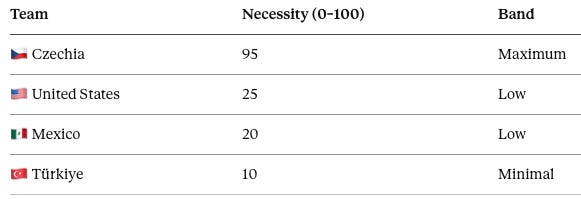
The Competitive Necessity Gradient is the differential between the two sides in a fixture, and the differential, not either side’s level alone, predicts the texture of the match. Mexico–Czechia runs a gradient of 75, the steepest in the group stage; USA–Türkiye runs a gradient of 15, among the flattest. The resolution that carries weight is the band and the gap rather than the single unit — Mexico at 20 and the United States at 25 sit in the same band, and the five points between them encode only a minor seeding residual, not a strong claim.
The size of the necessity gap is the structural reason the two simulations earn different confidence. A steep gradient sharpens a match by forcing the desperate side to over-commit, which generates early pressure, elevated tactical risk, and the open space a compression-and-counter side converts best — so Czechia must attack, Mexico does not, and the incentive structure favors Mexico’s model before any talent is weighed. A flat gradient slackens a match, leaving its texture to lineups and intrinsic motivation rather than to need. The 75-to-15 difference is therefore the same difference as the 64–69 percent confidence band on Mexico–Czechia against the 58–64 percent on USA–Türkiye: a wide gradient is forecastable, a narrow one is not.
Two readings travel with the scorecard. The construct carries one honest boundary worth committing now: both hosts sit in the Low band, so the pair varies the opponent’s necessity rather than the host’s, and the design cannot yet separate a true gradient effect from a plain opponent-necessity effect — a later fixture pairing a high-necessity host against a secure opponent would isolate the variable, and until then the gradient is supported, not proven. Türkiye’s 10 does quiet work that the floor above zero makes explicit: competitive necessity for an eliminated side is nil, so the residual is intrinsic motivation rather than competitive need, and that residual is exactly what powers the release scenario in which Türkiye’s real chance creation finally converts. Confidence the host-necessity confound is real: 70%. Confidence the intrinsic floor powers the upset path: 70%.
The scores are provisional scaffold, set from qualification state at kickoff and due for finalization once the matchday-three lineups confirm whether either host rotates. Read them as an ordinal index that ranks need, not a measurement to the single unit.
VI. Game Regimes
Both fixtures open as forks keyed to the first goal and to the host’s team sheet, the branch-not-label discipline the cohort validated.
Mexico–Czechia opens as a Trap — a low-necessity favorite controlling tempo, a maximum-necessity visitor pressing — and forks on the opening half hour. An early Mexican goal collapses Czechia’s must-win arithmetic and tips the match toward an Arena, where Czechia’s forced aggression hands Mexico the counter-attacking space its compression model converts best. No early goal holds the Trap, a low-event grind that Czechia’s closing problem makes hard to survive even when it leads. Rotation in the Mexican lineup is the variable that could flatten the fork into a sterile draw.
USA–Türkiye opens as an Arena with a flat-Labyrinth tail. The flat gradient lets two unburdened sides play openly, or lets both drift into a hollow exhibition, and the first goal and the lineup sheets decide which. A near-full United States against a released Türkiye produces an open, high-event match; two heavily rotated sides produce the empty fixture the gradient implies.
VII. Forecast
Each forecast leads with the mechanism and reports probabilities as bands, with a confidence band that reflects how much the framework actually knows. Both confidence bands sit below the Seattle Lab fixtures by design, because low-necessity hosts and rotation make group-resolution matches the hardest class to forecast.
Mexico versus Czechia turns on whether Mexico’s edge in quality outweighs its missing necessity. Mexico holds the stronger common-opponent record, the home roof, and a model built to punish an opponent forced to over-commit; Czechia holds genuine urgency and a single path that requires the one thing it has failed to do, hold a lead late. The steep gradient favors the secure side beyond what the raw quality gap suggests, because a must-attack posture is structurally unfavorable against a counter-built host.
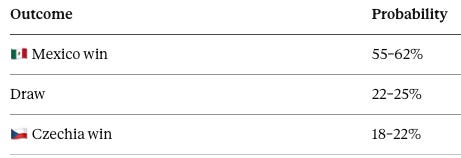
The most likely scoreline is a Mexico 2–1 or 1–0, with a 1–1 draw live, in an expected two-to-three-goal match. Confidence settles at 64–69%, held down by Mexico’s low necessity and its rotation risk.
United States versus Türkiye turns on team sheets as much as on quality. A near-full United States should win comfortably on home advantage and distributed creation; a rotated United States against a Türkiye side already generating two-plus expected goals a match widens the variance sharply, because Türkiye’s zero is partly a finishing trough that can correct.
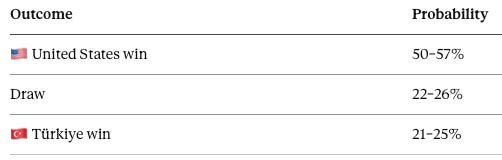
The most likely scoreline is a United States 2–1 or 2–0, with the open draw live, in an expected two-to-three-goal match. Confidence settles at 58–64%, the lowest of the slate, because flat-gradient matches are lineup-dependent and resist mechanism-first forecasting.
Reduced to one sentence: Mexico should compress past a desperate Czechia and the United States should out-expand a released Türkiye, but both hosts’ secured qualification makes each match looser than the quality gap alone implies.
VIII. Time Gates
Each match carries four observation windows — the opening 25 minutes, the halftime state, the first 15 minutes after the restart, and the final 20 — measured through shots on target and big chances created rather than possession share, the observable the cohort proved out when Mexico won on 43 percent of the ball.
For Mexico–Czechia, the opening 25 test whether the Azteca lifts a low-necessity host or whether rotation flattens the amplification, read through Mexican shots on target rather than territory. The halftime state tests whether Czechia’s must-win pressing has manufactured real chances or only the appearance of pressure. The third-quarter window tests whether Mexico is converting Czechia’s forced commitment into clear counters, the mechanism its compression model depends on. The final 20 test Czechia’s closing problem under the heaviest pressure of its tournament — a lead held there would break the late-degradation signature, a lead surrendered would confirm it.
For USA–Türkiye, the opening 25 test whether either rotated, low-necessity side plays with intensity or drifts from the first whistle. The halftime state tests the Türkiye conversion question directly, grading expected goals against goals scored rather than effort against effort. The third-quarter window tests whether the United States imposes its distributed expansion model or leans on a single channel. The final 20 test whether a flat-gradient match decays into exhibition, or whether Türkiye’s intrinsic motivation keeps it live after necessity has left it.
Both gate sets share one purpose: to catch the decisive moment whenever it arrives, and to read each construct through the chance it produces rather than the ball it holds.
IX. Falsification Contract
The simulations weaken, and the framework learns, if any of the following hold. Each condition is observable from the gates above, and pre-commitment is the discipline.
The Competitive Necessity Gradient fails as a variable if the steep-gradient match and the flat-gradient match produce comparable early event rates and comparable opponent risk-taking — should Czechia decline to over-commit and Türkiye decline to drift, necessity is not driving behavior and the construct collapses to a label. Home-field amplification returns to theory if neither low-necessity host registers an environmental lift, flat shots on target and no territorial reinforcement at the Azteca or SoFi severing the construct from this evidence rather than advancing it. The United States distributed-system claim weakens if the host visibly depends on Pulisic to break Türkiye down, or stalls in his absence, reversing the reading the Australia result established. The Türkiye diagnosis reverses if closer chance-quality data shows a creation failure rather than a conversion failure, low expected goals and few box entries relocating the problem to the buildup. The intrinsic-motivation floor carries its own falsification: an eliminated Türkiye that plays flat, with no release once the result no longer matters, would prove the residual mis-set and close the upset path the release scenario depends on. Czechia’s late-degradation signature weakens if it holds a lead through the final 20 minutes, the one outcome its two group matches have not produced.
Validation remains the objective, and calibration remains the discipline.
X. Comparative Reading
The two simulations converge on one finding: competitive necessity shapes these matches more than home-field amplification alone. Mexico benefits because Czechia’s desperation creates the tactical conditions its compression model exploits, an edge it draws from the opponent’s urgency. The United States benefits less from Türkiye’s elimination, because low necessity on both sides raises behavioral variance and lowers forecast confidence, so it draws its advantage instead from structural depth. The host edge is present in both, but its source differs — opponent urgency in one, distributed quality in the other — and naming that difference is the comparative payload the pair was built to produce.
The host-identity finding reaches past the group stage. Both hosts appear to hold an identity that persists once the result stops depending on it, Mexico through disciplined compression and the United States through multi-channel creation, and durable tournament runs tend to belong to systems whose identity survives a change in incentives rather than to systems that need the stakes to stay sharp.
XI. Why the Host-Nation Pair Matters
The first two rounds asked whether the hosts could leverage their environment. Group resolution asks the harder question: whether a host holds its identity once qualification removes the necessity that drove it, and once the gradient between its own need and its opponent’s runs steep or flat. Mexico answers across a steep gradient, against desperation; the United States answers across a flat one, against indifference. The home-field effect both hosts rode through two matches now meets the single condition that can expose it — a match the host does not need to win — and the Competitive Necessity Gradient gives Validation Report II a concrete variable to convert once the results land.