
Related works: The Law and Behavioral Economics of Compass v. NWMLS | Why Compass Needs Private Listings, The Inventory-Routing Premium — Compass, the Anywhere Merger, and the Multi-State Enforcement Window | Compass’s Skillman Moment Reaches the C-Suite, Cris Nelson Moment Holds at the Regional Tier
Executive Summary
Six state legislatures have now made deliberately different choices about private residential listings — Washington prohibits marketing to an exclusive group unless the property is concurrently marketed to the general public, New York and Connecticut permit the practice behind a mandatory, retained disclosure, others have declined to act — and Compass has answered all of them with one operational model and the interpretation required to fit it into each regime. Two consequences follow, and both are larger than the compliance dispute now playing out in Washington.
First, the staggered statutes are generating comparative outcome data in real time. Enforcers can measure what the private phase does to consumers by comparing the concurrent-marketing-mandate regime, the disclosure regimes, and the unlegislated baseline — an empirical design no single state could have constructed deliberately. Compass’s decision to keep operating Private Exclusives in the strictest statutory environment in the country does not merely create local licensing exposure; it preserves the treatment group. Second, the interpretive posture raises a sovereignty question: whether a national brokerage’s reading of “public marketing” can flatten legislative variation that the federal structure exists to permit — the question most likely to move attorneys general with no prior interest in real estate.
A single theme runs beneath both consequences, and it has governed the Compass record since April 2025: the exposure is self-inflicted. Compass filed the lawsuit that produced the statute, drafted the marketing materials that supplied the “negative insights” evidence, mounted the opposition campaign whose disclosure failures became their own specimen, and has now issued the compliance claim that undermines its own antitrust injury. At every decision point where silence, compliance, or withdrawal was available, Compass chose the move that generated new evidence against itself. An enforcer building this file does not investigate so much as compile.
The Washington trigger is concrete. SSB 6091 took effect June 11, 2026, prohibiting marketing residential property to an exclusive group unless concurrently marketed to the general public. The same day, Compass announced its Private Exclusives and Coming Soons are “fully compliant,” on the theory that listings count as publicly marketed if buyers can discover them by contacting Compass or visiting affiliated sites. Availability upon inquiry is not concurrent public marketing, and a sponsor’s office said so within twenty-four hours. How Compass conducts itself under each state’s public-marketing requirement — fighting the mandate state, routing around the disclosure states, accelerating in the unlegislated states — supplies the purpose evidence, course-of-conduct evidence, and harm quantification a state enforcement file is built from. One conclusion follows from the evidence architecture itself: no single state holds the complete record, and the proof assembles only through coordination. The pages below set out the division of labor.
I. What Compass Said on Effectiveness Day — and Why It Marks an Escalation
Every enforcement question in this paper begins with a single statement Compass made on June 11, 2026, so the analysis begins there too. The section establishes three facts a reviewer needs before evaluating any legal theory: what the Washington statute requires, what Compass claimed about its compliance, and how that claim departs from every prior Compass posture on the same question.
SSB 6091 prohibits marketing residential property “to an exclusive group of prospective buyers or real estate brokers” unless the property is “also concurrently marketed to the general public and other real estate brokers,” with exceptions limited to owner or occupant health and safety. The statute passed 141–1 across both chambers. The litigation record already frames the compliance question: Paragraph 43 of NWMLS’s April 2 counterclaim (Document 88, Case No. 2:25-cv-00766-JNW) alleges, under Rule 11 certification, that Compass knows “the Private Phases and related practices will violate state law” when the statute takes effect. An opposing party’s allegation is not an admission — but for ten weeks Compass left it unanswered in any forum.
On June 11, a Compass spokesperson told Real Estate News that “Compass Private Exclusives and Compass Coming Soons are fully compliant with the new law.” The supporting theory holds that because the statute requires no specific portal or MLS, listings remain available to the general public whenever buyers reach out to Compass directly or visit affiliated sites. The statement is, in substance, Compass’s first public answer to Paragraph 43 — delivered through trade press rather than a pleading, ten weeks after the allegation was filed and on the day the statute it disputes took effect. The forum choice is itself informative: a compliance theory a firm believes will survive judicial scrutiny ordinarily appears first in its briefs.
The statement escalates a pattern the MindCast corpus has tracked since January. At the January 23 Senate Housing Committee hearing, Compass Managing Director Brandi Huff reached the limit of what she would say about how the exclusive-network model functions without protective amendments — “that is probably above what I feel comfortable speaking to.” Regional Vice President Cris Nelson attended both hearings and declined to testify at all. Strategic silence was the posture under legislative examination, and silence persisted through ten weeks of an unrebutted Paragraph 43. The effectiveness-day statement abandons that posture: Compass now holds an affirmative, falsifiable public position on exactly the question its representatives previously declined to address. The firm converted a defensible silence into a testable claim on the record.
Who delivered the statement matters as much as what it said. The compliance claim carries no name — an anonymous corporate spokesperson, not an executive. Cris Nelson, the Pacific Northwest Regional Vice President who spoke extensively and publicly about private listings before the legislative session, then attended both hearings without testifying and signed in opposed without disclosing her Compass affiliation, appears nowhere in the effectiveness-day coverage of her own region’s statute. The Cris Nelson Moment — accountability breaking down at the regional-executive tier through structural silence — has now extended through three phases: vocal advocacy before the session, silence during it, and absence on the day the law took force. The progression is informative in itself: the executive tier that once promoted the model publicly will no longer attach a name to the theory defending it, and the gap between an attributed advocate and an unattributed spokesperson measures how much confidence the firm’s own leadership places in the position.
The interpretive structure is a fresh instance of the Skillman Moment — a Compass commercial framing applied to a statutory regime it does not match. “Available if you ask us” inverts the statute’s architecture. The law imposes an affirmative duty to market to the general public concurrently; Compass substitutes passive discoverability conditioned on the buyer already knowing to ask. Senator Jessica Bateman’s office, responding the same day, foreclosed the reading directly: properties marketed through word-of-mouth, brokerage networks, or other limited channels “must also be marketed to the general public at the same time.” The Bateman thread now runs unbroken from the January hearing — where she pressed the question Huff declined — to the effectiveness-day rebuttal of the theory Compass deployed in Huff’s place.
The section’s takeaway for an enforcement reader is narrow and sufficient: on the day the statute took force, Compass replaced months of strategic silence with an anonymous, uncertified, affirmative compliance claim that a bill sponsor’s office contradicted within twenty-four hours. Everything that follows — the litigation consequences, the antitrust theory, the multistate evidence design — flows from that single documented exchange.
II. Impact on the NWMLS Litigation — The Dilemma Compass Built for Itself
The effectiveness-day statement does its sharpest work inside Compass’s own lawsuit. The structural vulnerabilities The Law and Behavioral Economics of Compass v. NWMLS series identified converging at summary judgment — the cross-forum market-definition lock, the free-rider kill condition, the three-attack convergence — now acquire a fourth member, and Compass supplied it voluntarily. The sequence bears stating plainly: Compass sued NWMLS in April 2025 because Rule 2’s mandatory concurrent-marketing requirement allegedly blocked its private phases — the injury underlying every Sherman Act count. SSB 6091 now imposes substantially the same concurrent-marketing duty by statute, with a 141–1 legislative record. Compass’s June 11 position, that its Private Exclusives fully comply with the statute, therefore creates a dilemma with no safe horn.
If the compliance claim is true — if Private Exclusives genuinely constitute concurrent public marketing — then Rule 2’s parallel requirement never injured Compass, because the model satisfies what the rule demands. The antitrust injury evaporates, and with it standing for damages: a plaintiff cannot recover for being forced into conduct it now claims it performs voluntarily and lawfully. If the compliance claim is false — if Private Exclusives involve genuine withholding, as Compass’s own marketing materials and the “negative insights” record describe — then the model violates the statute, NWMLS’s Rule 2 enforcement becomes anticipatory statutory compliance shielded by Parker v. Brown state-action immunity, and Compass’s effectiveness-day statement becomes a public misrepresentation feeding the CPA counterclaim. Each horn destroys a different pillar of the case; neither leaves the complaint intact. NWMLS trial counsel can put the question in a single interrogatory: identify every respect in which Rule 2 requires anything SSB 6091 does not.
The statement also extends the cross-forum contradiction catalog by one forum. The documented record already holds mutually exclusive Compass positions across federal court, the legislature, investor communications, and consumer marketing — formalized in Compass’s Cross-Forum Contradictions. The new entry is the starkest pairing yet: in federal court, the private phases are conduct Rule 2 unlawfully prevents; in trade press, the same private phases comply with a statute that requires what Rule 2 requires. Both statements describe the same product in the same state in the same litigation window, and a spokesperson statement to a reporter is discoverable, attributable, and available as a party admission. The Compass Narrative Inversion Playbook predicted the mechanism — seller-choice vocabulary redeployed wherever the legal posture demands, without reconciliation across forums — and the effectiveness-day statement is the playbook executing under the least forgiving conditions it has yet faced: a pleaded knowledge allegation, a live trial calendar, and a statute already in force.
The timing compounds the exposure. Paragraph 43 sat unanswered for ten weeks while answering it in a pleading carried Rule 11 consequences; the answer finally arrived through a spokesperson, in a forum with no certification requirement, on the day enforcement became possible. The accountability architecture of the statement completes the picture: no certification, no named executive, no attributable speaker — the most consequential legal position Compass has taken since filing its complaint, routed through the lowest-accountability channel available to a public company. A court will eventually ask why the compliance theory appeared in trade press before it appeared in a brief — and the available answer, that counsel would not certify it and no executive would sign it, is itself the admission.
The statement also registers as a scored event in a running forecast. The CDT Foresight Simulation underlying the series assigned P50–P70 probability to NWMLS prevailing or settling on terms preserving mandatory-sharing architecture, and Compass v. NWMLS — The Counterclaim That Closed Compass’s Antitrust Thesis documented the April 2 filing moving that distribution toward the high end. The June 11 compliance claim moves it again, in the same direction: a plaintiff who publicly asserts compliance with the statute whose restriction grounds its injury has weakened its own standing position at summary judgment, before discovery closes and by its own hand.
The litigation posture matters to a state enforcer for a practical reason: the federal case is generating, at no cost to any state, the discovery record, the party admissions, and the summary-judgment findings a state investigation would otherwise have to build itself. Each Compass escalation since April 2025 has resolved as a simulation-confirming event, the effectiveness-day statement extends the pattern, and the October 2026 trial calendar means the record will deepen on a schedule a coalition can plan around.
III. Why Statutory Interpretation Becomes Antitrust Evidence
Antitrust scrutiny does not arise merely because a company disagrees with a regulator’s interpretation of a statute. Differential compliance across fifty states is ordinary federalism, and a firm adapting unilateral conduct to varied state law commits no violation by that fact alone. Liability under Section 1 requires agreement; under Section 2, market power plus exclusionary conduct. Public-marketing disputes become competition questions when inventory routing, listing visibility, market access, and transaction flow converge within a single business model — and Compass’s interpretation matters because it feeds every element enforcers are already assembling.
Purpose. The defense in the Northern District of Illinois coordination case will characterize the four-MLS partnership campaign as ordinary competition. The state-by-state conduct record undercuts the characterization. Compass deployed a substantially undisclosed opposition apparatus against the Washington bill — 162 affiliated sign-ins, nine disclosed — left NWMLS’s Paragraph 43 knowledge allegation unanswered for ten weeks, then claimed compliance through trade press on the day the statute took effect, while building identity-protective listing infrastructure precisely in the jurisdictions that have not legislated. Conduct that intensifies where law has not foreclosed it and contorts where law has reads as a firm protecting a specific economic asset — the withheld-inventory layer the MindCast three-layer model values at $400 to $800 million — rather than competing on product. Purpose evidence does not establish liability alone; it colors every ambiguous act in the record.
Course of conduct. Post-Anywhere, Compass plausibly holds market power in multiple metropolitan markets through the Corcoran, Sotheby’s, Coldwell Banker, and Century 21 brand stack. Monopolization doctrine permits aggregating individually lawful acts into an exclusionary scheme. Reinterpreting a flat statutory ban to preserve the buyer-funneling window, routing sellers to opt-out forms as the default pathway in disclosure-model states, and softening mandatory disclosure language would each constitute a scheme element. The disclosure states manufacture the proof: every New York and Connecticut opt-out form is a retained, subpoenable record of the routing element. Washington supplies its own hook — the Consumer Protection Act houses both the deceptive-practices provision and the state antitrust provisions, RCW 19.86.020 through .040, letting a Washington enforcer run the compliance-evasion theory and the restraint theory through a single statute.
Coordination watch. The unilateral/coordinated line is where enforcement attention should concentrate next, and the line deserves precise statement: identical legal interpretations, standing alone, establish nothing. Firms facing the same statute routinely reach the same self-serving reading independently, and parallel interpretation is no more an agreement than parallel pricing. Significance arises only if the common interpretation travels through the same vendor, governance, or implementation channels already identified in the record. Compass’s interpretation is unilateral today. If the four partnered listing services — Midwest Real Estate Data, Realtracs, The MLS/CLAW, Bright MLS — begin advancing the same “availability equals public marketing” compliance theory through the shared technology vendors that propagated the original identity-protective rule template, the channel itself becomes the evidence: a shared legal theory traveling the same infrastructure as a shared rule template is a concrete, watchable coordination tell. The Dual Nash-Stigler framework supplies the test — capture-enabled defection propagating through shared infrastructure is distinguishable from parallel independent judgment — and the vendor channel is where the distinction will surface first.
A practical question follows for any office weighing these theories: which statute carries them? Three vehicles are available, and every state holds at least two. The first is the Sherman Act itself — Clayton Act § 4C grants attorneys general parens patriae standing to bring federal antitrust claims on behalf of their residents, the route the multistate Google and Meta coalitions used. The second is the state antitrust act, and here the federal modeling works in the coalition’s favor: most state acts harmonize with Sherman Act doctrine, several by express statutory direction — Washington’s RCW 19.86.920 instructs courts to be guided by federal interpretation — so the Section 1 coordination analysis above transfers across jurisdictions without translation. The harmonization is asymmetric, though, and the asymmetry matters: the Section 1 analogs are near-universal, but several major states lack a Section 2 monopolization analog — New York’s Donnelly Act and California’s Cartwright Act reach agreements, not unilateral conduct — which means the course-of-conduct theory travels in those states only through federal parens patriae or through the consumer-protection statute. The third vehicle is that consumer-protection act, available everywhere and carrying the lowest evidentiary threshold. The asymmetry supplies one more coordination argument: a state whose antitrust act cannot reach unilateral routing conduct alone completes its toolkit only through the federal vehicle or the coalition’s shared record, so the states least equipped to act individually gain the most from acting together.
Three questions distill the theory into the form an investigator actually works with.
Why would a brokerage maintain substantially similar inventory-routing strategies across states that adopted materially different transparency frameworks?
Why would public-marketing requirements generate significant operational consequences if competitive advantage primarily derives from technology, service quality, or agent productivity?
Why do states keep moving toward statutory transparency mandates if seller-choice frameworks already provide adequate consumer protection?
Each question falls squarely within the traditional investigative responsibilities of a state attorney general, and the second is the structural tell: a genuine technology advantage does not evaporate when a state mandates concurrent marketing. A business model that requires the withholding window is not a technology business — it is an inventory-control business, and inventory control is what competition law examines.
Contact mcai@mindcast-ai.com to partner on Predictive Game Theory in Law and Behavioral Economics.
IV. The Natural Experiment — How Compass’s Defiance Solves the Harm Problem
Quantifying consumer harm against a but-for baseline is the hardest task in any enforcement action. The staggered six-state statutory map manufactures the baseline, and Compass’s Washington posture completes the experimental design.
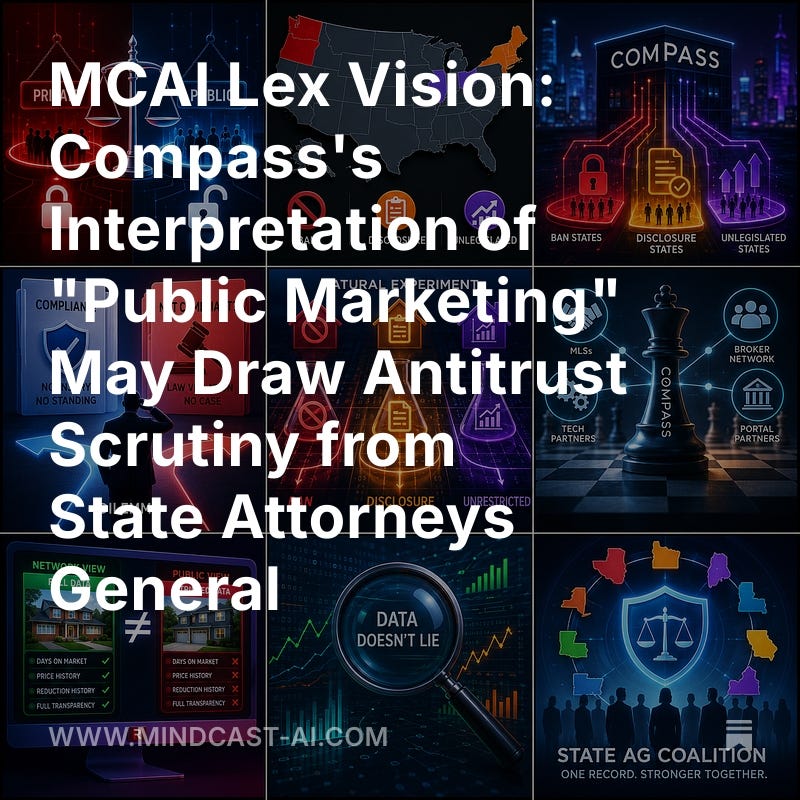
Three regimes now operate simultaneously. Washington bans the private phase outright. New York and Connecticut permit it behind a signed, retained disclosure form. The remaining Compass markets operate without statutory constraint. Enforcers can compare days-on-market, sale price against open-market comparables, listing visibility, and Compass’s double-sided commission capture rate across the three regimes, before and after each effective date. If consumer outcomes improve where the withholding window closes — or if the double-sided capture rate collapses — the comparison empirically isolates the harm the private phase causes in every unlegislated market. Compass’s own marketing data, cited in the Washington litigation, already gestures at the result: listings fail to sell during the private phases roughly 95 percent of the time before reaching the open market.
Compass’s claimed-compliance theory adds the final cell to the design. By continuing to operate Private Exclusives in Washington under an interpretive defense, the firm preserves observable private-phase conduct inside the strictest regime — a treatment group that would not exist had Compass simply complied. The evidentiary value works like a controlled trial: had Compass stopped, investigators could only infer what private-phase conduct does to consumers from historical data and competing expert models; because Compass continues, the same conduct now runs side by side against the open-market alternative under the closest scrutiny in the country, letting enforcers observe the difference directly rather than reconstruct it. Every Private Exclusive marketed in Washington after June 11 is simultaneously a potential licensing violation, a data point in the cross-state comparison, and an exhibit in the purpose record.
A severance line sharpens the target, and Compass drew it. Industry analysis on effectiveness day distinguished Coming Soons — displayed on Redfin and Compass’s own site, plausibly compliant — from Private Exclusives, which face scrutiny. Compass’s spokesperson defended both products in a single breath, bundling the defensible with the indefensible. An enforcer need not attack the three-phase strategy whole; the firm’s bifurcated defense identifies which phase carries the routing value, and it is the same phase the three-layer model prices.
The natural experiment resolves the problem that stalls most competition investigations before they start: proving harm. Lawmakers in the six statute states built the comparison without intending to, Compass’s continued Washington operation completed it, and the data accrues daily whether or not any office acts. The practical implication for both audiences is the same — the cost of measuring consumer harm has never been lower, and the window in which the cleanest pre/post comparison exists is open now.
V. The Sovereignty Question — One National Model Against Deliberately Different State Regimes
The Washington compliance dispute, examined alone, understates what is actually being tested. Six legislatures studied the same conduct and made deliberately different policy choices: Washington banned the private phase outright by a 141–1 margin; New York and Connecticut permitted it behind a mandatory, retained disclosure; other states have, so far, declined to act. Compass’s response to that deliberate variation has been to maintain substantially one operational model everywhere and to supply the interpretation that makes the model fit each regime — reading the ban state’s undefined terms permissively, treating the disclosure states’ opt-out as a routable default, and accelerating infrastructure in the unlegislated states.
The emerging question is therefore larger than whether Compass complied with SSB 6091. The question is what happens when a national brokerage applies one inventory model across states that deliberately adopted different transparency regimes — whether a firm’s interpretive resources can flatten legislative variation that the federal structure exists to permit. Compass’s reading does not merely contest a definition; it tests whether a state legislature’s near-unanimous policy choice binds a national brokerage at all. Framed that way, the dispute stops being a Washington licensing matter and becomes a question of state enforcement authority itself — and defending legislative prerogative against private reinterpretation is the institutional reflex of every attorney general’s office, including offices with no prior interest in real estate markets. The sovereignty frame is also what connects the state record to the federal one: nineteen members of Congress from twelve states have already questioned the merger, and an AG who acts defends both a local statute and the principle that statutes, not business models, set the terms of local markets.
VI. The Coalition Logic — Why No Single State Holds the Complete Record
The natural experiment carries a structural implication that converts the analysis into a coordination argument: each regime type holds one cell of the comparison, and no state holds the whole. Washington holds the conduct record — continued private-phase operation under the strictest statute, an unanswered Paragraph 43, and the legislative testimony file — but the ban model generates no per-listing paper trail. New York and Connecticut hold the subpoenable opt-out forms that document routing, but no defiance record, because their statutes permit the conduct the forms memorialize. The unlegislated states hold the open-market baseline against which harm is measured, but no statute to enforce. A single state investigating alone answers one of the three investigative questions; three regime types investigating together answer all of them. The evidence architecture is inherently multistate, and the case for coordination is not solidarity — it is that the proof does not assemble any other way.
Precedent supplies the vehicle. Multistate attorney general investigations — the model used in the tobacco litigation, the opioid settlements, and the Google and Meta antitrust coalitions — operate through common interest agreements, shared civil investigative demands, and an executive committee of lead states. The division of labor here writes itself from the statutory map. Washington leads on conduct, because the Department of Licensing referral pathway and the RCW 19.86 dual hook are already live. New York leads on records, because § 443-b generates the routing dataset and the AG’s review is already open. A volunteer from the unlegislated column — Illinois is the natural candidate, holding both a pending bill and the federal coordination case in its own district — leads on baseline measurement. Connecticut and Wisconsin replicate the records and conduct tracks respectively at low marginal cost.
The political precondition is already met, which is rarely true at coalition formation. Nineteen members of Congress across twelve states have questioned the merger on the record, meaning an AG in any of those states joins a coalition with a sitting member of their own delegation having flagged the conduct first — cover that ordinarily takes months of staff work to construct. The asymmetry runs in only one direction: a state that joins contributes one evidence cell and inherits eleven others; a state that abstains watches the comparison get built from its residents’ transaction data anyway, without a seat in the room where the remedy is shaped.
One design choice matters at formation. The coalition’s first instrument should be a coordinated data preservation demand, not a complaint — directed at the disclosure forms, the listing-feed records, and the CDOM/DOM data across all three regime types, before ordinary retention cycles thin the record. Preservation is cheap, requires no liability theory, commits no state to a filing, and converts the natural experiment from an analytical frame into an evidentiary fact. A coalition that preserves the dataset first decides later, from strength, whether the vehicle is antitrust, consumer protection, licensing referral, or settlement.
VII. The Redfin Question — Display Is Not Marketing
Compass’s compliance theory rests on one factual pillar: its listings reach the public through “affiliated sites,” chiefly the Redfin partnership. Reconciling that claim with the transparency regime requires three distinctions, and each one narrows the theory until the pillar carries nothing.
The first distinction is which phase actually reaches Redfin. Coming Soons — Phase 2 — display on Redfin and Compass’s own site. Private Exclusives — Phase 1, the layer the three-layer model prices — circulate inside the Compass network only and appear on no portal at all. Redfin never carries the withheld layer; the partnership supplies a public-distribution veneer for Phase 2 while Phase 1 remains invisible. For the product Compass most needs to defend, the affiliated-sites argument is empty on arrival.
The second distinction is whose duty the statute imposes. SSB 6091’s concurrent-marketing obligation falls on the listing broker, not the displaying platform. Redfin showing a Compass Coming Soon violates nothing; the display is an input to whether Compass satisfied its own duty. The same structure governs the NWMLS rules: the obligation runs to the listing member, and downstream display cannot cure an upstream withholding.
The third distinction is the decisive one: display is not marketing to the general public on equal terms. Compass listings appearing on Redfin carry stripped fields — days-on-market suppressed, price-drop history absent, the counter reset to the public-marketing date rather than the date marketing actually began — while every adjacent listing carries the full record. The exclusive network sees the complete picture; the public sees a redacted one. Concurrency of degraded information is not concurrency of marketing, and whether “marketed to the general public” means visible or visible on equal informational terms is the exact definitional gap Compass’s interpretation arbitrages. The gap is also measurable from Compass’s own platform: the delta between cumulative days on market and displayed days on market is the firm’s standing admission of pre-public marketing duration, listing by listing, timestamped.
The MindCast corpus traced this architecture from the ground up, and the lineage is itself evidence. The Compass–Anywhere Address Suppression Calculus — Team Foster Scenario documented suppression at the team level through the Foster-Skillman record, identifying the Nash-Stigler constraint that the strategy generating the revenue also generates the evidence. Platform-Mediated Price Discovery — A Runtime Measurement Framework for the Compass–Redfin–Rocket Architecture then identified the Redfin partnership’s structural function: migrating suppression upward from the team level — where individual conduct is detectable — to the platform level, where the same withholding presents as distribution architecture. The migration explains why Redfin display and the transparency statutes coexist without contradiction: the partnership was built to relocate the conduct, not to end it. The prediction record runs earlier still. Compass’s Coasean Coordination Problem Part II — Litigation-Acquisition Monopolization Strategy forecast in December 2025 that Compass would pursue “alternative opacity strategies through portal partnerships,” published before the February 26 deal existed, and Compass Rhetorically Reframing Seller Choice to Launch Jurisdictional Attack on MLSs named the Redfin partnership as confirmed portal-distribution infrastructure executing the Plan B circumvention logic.
Two consequences follow. The compliance theory now rises or falls on a checkable proposition — that a partial, data-stripped portal display constitutes public marketing — and the test runs from public data: first-appearance-on-Redfin dates against first-network-marketing dates, and stripped-field comparisons against adjacent listings. Redfin becomes a coalition monitoring target as a result — not because display itself violates the statute, but because the platform may supply the factual veneer for a compliance theory built on incomplete public information, under a three-year contract signed weeks before the governor’s signature. The monitoring case is evidentiary, not accusatory, and the conduct record is already accumulating. Rocket-Redfin Asks NWMLS to Rewrite Rules documents the partnership petitioning NWMLS directly to alter the rules constraining its profitability — through a corporate news platform rather than an amicus brief — converting the displaying platform into an advocate for the listing-side architecture it hosts. The Compass-Redfin Alliance — Market Self-Correction Is Dead, published one day after the deal, made the argument this paper extends: the partnership is a consumer-protection matter for state AG engagement independent of any federal proceeding. And the self-incrimination point completes the circle — The Cybernetics of Compass Holdings’ Narrative Control Architecture established that the arguments Compass filed against Zillow’s listing standards are directly portable against Compass’s own exclusive routing deal, meaning the firm drafted the antitrust theory against its own partnership before signing it. A firm that outsources its public-marketing function to a third-party platform has documented that it cannot — or will not — operate transparency internally.
VIII. Four Questions a State Review Can Answer Now
The interpretation dispute converts to enforcement through four narrow, checkable questions, each answerable from records that already exist.
First, does Compass apply the same compliance theory across states, and who else adopts it? Monitoring the four partnered listing services and their shared vendors for the “availability equals public marketing” framing tests the coordination boundary in real time.
Second, does the Washington conduct continue? Department of Licensing complaint records, Compass-affiliated site listings, and NWMLS feed data will show whether Private Exclusives persist after June 11 — and at what volume. Persistence is the licensing case; volume is the antitrust exhibit.
Third, does the public see what the network sees? The CDOM/DOM delta and the stripped-field comparison on Redfin displays of Compass listings measure, listing by listing, whether “concurrent marketing” delivered equal information or a redacted copy. The data sits on public-facing platforms today and requires no subpoena to begin collecting.
Fourth, what do the cross-regime outcomes show? The disclosure-state forms, the Washington post-effectiveness data, and the unlegislated-market baseline are all being generated now. The harm quantification that usually waits for expert discovery can begin from public and compelled records today.
State lawmakers hold a parallel assignment, and the Washington record defines it. Legislatures with bills pending — Illinois and Hawaii today, others to follow — can pair Washington’s concurrent-marketing mandate with New York’s machinery: define “concurrent public marketing” affirmatively or delegate the definition to the licensing agency by rule, require a retained record for any claimed exception, and bar reframing the statutory language. Compass’s effectiveness-day interpretation demonstrated exactly which gap a national brokerage will exploit; closing it costs a drafting session. A statute can stay durable against market evolution and still deny the interpretive room Compass found in Washington — the two goals were never in tension.
Drafter intent forecloses the interpretive escape. Washington Realtors, which conceived and drafted SSB 6091, stated on the record that the language was left open to remain durable as marketing channels evolve — not to tolerate private phases. Sponsor intent, drafter intent, NWMLS’s certified Paragraph 43 allegation, and Compass’s effectiveness-day compliance claim now sit in a single dated record, pointing in one direction. Future enforcement will determine whether Washington merely adjusted disclosure requirements or fundamentally rejected the private-listing model itself. The question is no longer what the statute means. The question is which enforcer tests the interpretation first — and state attorneys general watching the conduct repeat across multiple jurisdictions may find that question impossible to ignore. Whatever office moves first will inherit a file with an unusual property: nearly every document in it was authored, filed, published, or spoken by Compass. The firm built the record. The coalition only has to read it.