

Related works: The Protect College Sports Act of 2026 — Federal NIL Salary Cap, Antitrust Immunity, and the Private Equity Blind Spot | Cybernetic-Predictive Game Theory AI for Capital Allocators | Dynamic Predictive Game Theory From the 2026 🏈Super Bowl and ⚽World Cup | Reverse Engineering Sports Playbooks with Cognitive Digital Twins + Dynamic Predictive Game Theory | AI Governance Executive Presentation
See MindCast Live-Fire Mission on Sports Foresight Simulations
I. Executive Summary
Overwatch League buyers committed reported entry fees of $20 million and above for positions inside a competition one publisher controlled. When the publisher ended the league structure, the purchased seats disappeared, and participating team entities became eligible for $6 million termination payments. Investors had not bought weak franchises. They had bought positions inside an authorization capable of terminating the asset.
Every sports allocation carries the same dependency at a different intensity. Franchise stakes, tour positions, media rights, and commercial vehicles derive value from governing systems that determine participation, rules, economic rights, and distribution. Standard sports diligence examines the asset and its contracts; it rarely isolates the governing system above them. The Authorization Audit — the practice this paper introduces — grades whether that system can preserve the asset’s rights through the holding period.
For governing bodies, league executives, rights companies, and portfolio-company boards, the same framework converts authorization risk into proactive controls: coalition pre-clearance, capital continuity, contractual survival rights, escalation triggers, and adversarial simulation before public commitment.
The framework runs live on LIV Golf’s ownership transition, and four reads headline the register:
Capital Conversion. A named lead investor funds or irrevocably commits material capital by September 30 (66%, band 57–74%).
Operating Inventory. LIV publishes a 2027 schedule of at least eight events by year-end (72%, band 62–80%).
Player Control. Publicly operative documents grant players at least two material control rights by November 30 (29%, band 20–40%) — majority equity moves economics toward the players while covenants and board rights move effective control toward the investor.
Modal route — Contracted Continuity (52%). LIV most likely enters 2027 as a smaller standalone league whose survival is governed by investor covenants, not player governance.
No single read carries the forecast. The predictions combine into one non-obvious conclusion: capital probably preserves LIV, but the rescue probably transfers effective control toward the investor rather than the players.
2026 tested the dependency in public, four times. FIFA’s leadership proposed selling a minority stake in world football’s commercial operations at a $20 billion valuation and withdrew the proposal within 72 hours under coordinated confederation opposition. Saudi Arabia’s Public Investment Fund announced it will end funding of LIV Golf after the 2026 season, after committing more than $5 billion; the league has since announced a lead-investor agreement and entered an unresolved capital-and-governance transition. The ATP and WTA placed a near-complete commercial merger on indefinite hold, preserving tennis’s fragmented governance. And on August 4, a consortium led by Saudi Arabia’s Public Investment Fund closed the $55 billion take-private of Electronic Arts — the largest all-cash sponsor take-private in history, and sovereign capital’s largest outright purchase of a sports-adjacent authorizer rather than a position beneath one.
Sports-focused private equity, rights investors, family offices and ownership consortiums, sovereign capital, and private-credit providers all hold authorization exposure in different forms. One reader sits at the center: the investment partner preparing to defend a recommendation before committee — asking what the governing system can do to the asset during the holding period, who can force it to act, and how the risk becomes visible before valuation reflects it.
II. The Overwatch Exhibit
Every risk category needs a realized loss before allocators treat it as real. Sports authorization risk has one, and it settled in dollars.
Overwatch League buyers committed reported eight-figure fees for positions inside an authorization one publisher controlled. Franchises sold for more than $20 million in the league’s first season, with buy-in from owners including Robert Kraft, Stan Kroenke, and Jeff Wilpon. When the league structure ended, the seats ceased to exist. Activision Blizzard’s disclosure set a $6 million termination payment payable per participating team entity — roughly $114 million across nineteen teams — while realized losses varied according to fees previously paid and obligations later extinguished.
No rival league, fraud, or market crash was required. Publisher discretion — the governing event itself — ended the competitive structure, and every position beneath that decision ended with it. Owners with decades of professional sports experience held those seats. Conventional franchise analysis did not protect them against publisher-level termination power, because the risk sat above the franchise.
Overwatch is the limiting case, not an esports curiosity. Every sports allocation carries the same dependency at a different intensity: a franchise stake, tour position, or media-rights contract derives value from an authorizing system capable of preserving, changing, fragmenting, transferring, or terminating the rights beneath it. The rest of the paper grades that intensity.
III. The Thesis: Capital Buys a Position in Someone Else’s Authorization
Sports investing describes itself in asset language — teams, tours, rights packages, franchises. The language understates what the investor actually acquires.
A sport’s governing system determines who competes, under what rules, for what economic rights, and through which distribution channels. Capital therefore does not merely acquire a team, tour position, or media-rights interest — it acquires an asset whose value depends on the durability of the authorization above it. When new capital or an internal coalition contests that authorization, the incumbent may absorb the challenger, restructure the field, fragment control, transfer economic rights, or lose authority. Each resolution repositions every asset underneath it.
Institutional entry structures sharpen the dependency rather than softening it. Leagues admitting private equity do so within defined ownership limits, approved-fund lists, and multiyear minimum holds — minority positions, constrained exits, no governance rights. The investor retains economic exposure while holding limited power to alter league-level decisions. The modern sports allocation depends on a governing system the investor cannot meaningfully steer.
The thesis carries one immediate implication for diligence. Conventional legal review establishes who possesses authority — the documents, the bylaws, the approval rights. Authorization risk lives one level deeper: how those actors will use their authority under pressure, which coalitions hold, and which break. Documents answer the first question; answering the second requires modeling the actors themselves and simulating the contest.
IV. Three Contests and One Acquisition Moved in 2026
Overwatch established the terminal loss. Three additional governance contests moved between April and July 2026, each exposing a different authorization route in the public record.
FIFA: The Principals Vetoed the Agent
FIFA announced FIFA Forward Enterprise on July 28 — a commercial subsidiary consolidating broadcast, sponsorship, ticketing, and licensing for tournaments including the World Cup, valued near $20 billion, with external investors invited to purchase minority stakes raising up to $4.2 billion. Within 72 hours the proposal was withdrawn after opposition from UEFA, CONCACAF, and the AFC, including boycott threats.
The mechanism deserves precision. External capital never contested FIFA’s authorization. FIFA’s own executive attempted to sell what the member associations and confederations treat as collectively held — and the principals vetoed the agent. An executive-level commercial plan met a principal-level authorization boundary in three days.
For an allocator, the FIFA episode establishes the first structural lesson: the executive proposing to monetize an authorization may not control it. Any capital that had committed to the FFE structure would have underwritten a counterparty that could not deliver what it offered to sell.
LIV Golf: Capital Built Authorization Before It Proved Independence
LIV demonstrated that authorization can be manufactured — a rival tour, rival rules, rival payouts, built from zero with sufficient capital. The 2026 record demonstrates the harder half of the lesson. The Public Investment Fund announced in April it would end funding after the 2026 season, having committed more than $5 billion. The 2023 framework agreement with the PGA Tour produced no completed governance transaction; the PGA Tour instead took minority investment from a consortium of North American sports owners. LIV installed a new board and now operates as a capital-dependent authorization under forced transition, with a reported new lead investor and player-majority equity structure targeting a September close — a structure that would move majority economic ownership toward the players, while voting rights, board control, and responsibility for future operating deficits remain undisclosed.
The incumbent, meanwhile, remains intact — its authorization never sold, its returning-player terms set on its own schedule. LIV established a real competing authorization but remained dependent on its founding sponsor. PIF’s withdrawal now tests whether the league can transfer that dependence into a durable investor-and-player coalition.
The LIV case gives allocators the second lesson: capital volume alone does not convert into durable authorization. More than $5 billion financed the contest without establishing capital independence. Replacement capital may preserve the league while moving effective control from sovereign subsidy to investor covenants; survival and independence remain different settlement objects.
Tennis: Fragmented Principals Preserved the Standoff
Tennis holds no single seller. The ATP, WTA, ITF, and four Grand Slams each control fragments of ranking, calendar, eligibility, and prize structure. Consolidation approached anyway: the tours neared a commercial merger in 2025. Then the WTA’s new leadership rejected the revenue-share terms and the merger went on indefinite hold in July. Sovereign capital simultaneously retrenched — the WTA Finals will leave Riyadh after 2026 and the Next Gen ATP Finals ended its Jeddah run early, even as a PIF subsidiary maintains commitment to a future ATP Masters event.
Fragmentation cuts both ways for capital. Each fragment is individually cheaper to acquire, and no fragment delivers the whole. A single leadership change on one side stopped a consolidation years in the making.
Tennis supplies the third lesson: fragmented principals can preserve an inefficient equilibrium indefinitely by blocking one another — and a position acquired inside that equilibrium inherits its stalemate. The failed merger preserved the current structure without resolving the underlying contest over consolidation.
Electronic Arts: Capital Bought the Authorizer
On August 4, a consortium led by Saudi Arabia’s Public Investment Fund closed the $55 billion take-private of Electronic Arts, the largest all-cash sponsor take-private in history. Unlike capital acquiring positions beneath FIFA, golf, or tennis governance, the consortium acquired corporate control of a publisher that sets rules, operates competitive systems, and holds revocation power across its own platforms. Corporate ownership transferred the authorizer itself.
Electronic Arts sharpens the authorization thesis because the acquisition transferred one governing layer without transferring every upstream right. EA controls its publisher architecture but licenses essential inputs from leagues, clubs, player unions, and athletes. PIF therefore acquired an authorizer with rented inputs — and future license renewals remain points where capital origin, commercial leverage, and constituent resistance can reprice the acquisition.
PIF’s 2026 allocations form the framework’s natural experiment. More than $5 billion created LIV without making the league capital-independent; $55 billion acquired corporate control of EA. Capital scale did not determine the difference by itself. Ownership structure did: proprietary authorization transferred through corporate acquisition, while federated sports authorization remained subject to principal consent.
Together, the cases map the allocator’s outcome space: authorization can veto a transaction at FIFA, force a challenger into capital and control transition at LIV, preserve a fragmented standoff in tennis, revoke purchased positions in Overwatch, or transfer through corporate acquisition at Electronic Arts. EA produced a clean transfer at the publisher layer; none of the contested cases produced a clean transfer of federated authorization. No standardized instrument priced any of these transitions in advance.
Contact mcai@mindcast-ai.com to partner with us on Predictive Game Theory AI in Law and Behavioral Economics. We specialize in predictive simulations for Complex Litigation, Innovation Economics, Geopolitical Risk Intelligence and Legacy Innovation. See more about MindCast series at our new website MindCast Corporate.
To test our predictive simulation AI system, in 2026 we simulated the Super Bowl and the World Cup. See 🏈 Super Bowl LX — AI Simulation vs. Reality | ⚽ The 2026 World Cup Final Simulation Validation
To deep dive on MindCast works upload the URL of this publication into any LLM (preferably Google AI mode) and prompt ‘reconstruct MindCast framework with three degrees of cited sub links.’ See Live-Fire Game Theory Simulators, Runtime Predictive Infrastructure.
Working With MindCast
MindCast runs two service lines on one method. The Authorization Audit evaluates the governing system above a sports position — the five structural drivers, the exposure multipliers, and the coalition dynamics that decide whether an asset’s rights survive the holding period. The Authorization Resilience Plan gives authorizers the mirror image: the controls that keep a capital transaction from becoming the next 72-hour withdrawal.
Private equity deal teams and rights investors can commission a buy-side audit — the five-driver classification scored against a named position, with fork trees for the governance triggers most likely to arrive during the hold and early-warning indicators observable before valuation moves. Private-credit providers can commission a covenant review — governance triggers translated into covenant tests, monitoring cadences, and downside cases for the scenarios where contracted revenue impairs without a payment default.
Leagues, tours, federations, and publishers can commission an Authorization Resilience Plan — the minimum durable coalition, the formal and practical veto map, capital-continuity thresholds, announcement sequencing, and pretested constituent responses, run before the transaction goes public. Sovereign and strategic allocators can commission a portfolio authorization assessment inside MindCast’s Geopolitical Risk Intelligence vertical — posture-structure fit across building, renting, positioning beneath, and owning authorizations, with the second layer of screening regimes, ownership rules, and legitimacy dynamics priced alongside the sport’s own.
Engagements run as Cognitive Digital Twin simulations with dated, falsifiable outputs, and MindCast scores its record in public.
V. Classifying Exposure: Five Structural Drivers of Authorization Risk
Authorization dependency is universal across sports positions; authorization risk is not. Five structural drivers set the intensity, and each one appeared in a live case.
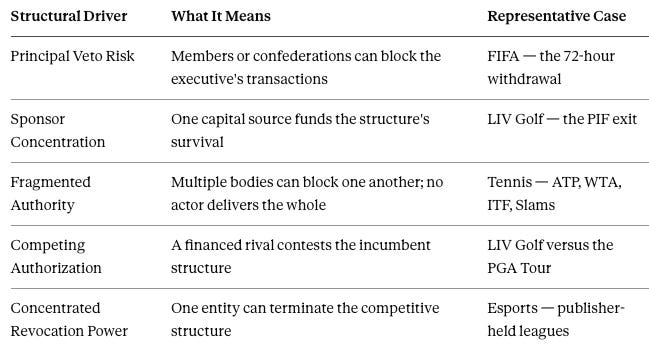
Structural drivers describe the governing system; a second set of factors describes the position itself. Minority ownership, limited voting rights, constrained exits, direct rights-company exposure, and long holding periods each multiply whatever structural risk the system carries. A minority stake with a ten-year hold inside a fragmented authorization is a different risk than the same stake under a stable single authorizer.
Capital origin functions as a multiplier of its own. Foreign and sovereign investors face the sport’s authorization plus a second layer — investment screening, league ownership rules, and legitimacy resistance from principals and fans — and the 2026 record shows that layer activating, from the investor-identity objections that helped sink FIFA Forward Enterprise to the political pricing LIV carried from launch. The same position draws different treatment from the authorization depending on who holds it, which makes origin an underwriting input rather than a footnote. Origin risk is also structure-dependent: the sovereign origin that drew veto pressure in federated football cleared every regulatory approval — including national-security review — to buy a publisher outright.
A passive minority interest in an established NFL franchise carries the dependency at low intensity: one stable authorizer, decades of institutional continuity, and no live challenger. A position in an emerging league, a commercial-rights vehicle, a breakaway tour, an esports competition, or a fragmented international sport concentrates several drivers at once — often with several multipliers attached.
The classification does immediate work for a portfolio. Each position receives a read across the five drivers and the multipliers; the read sets diligence depth at entry and monitoring cadence through the hold. An allocator finishing this section can map their own book against the drivers before any engagement begins.
VI. College Sports: The Highest-Complexity Live Market
One market concentrates more live authorization drivers than any other, and it is where sports capital is moving fastest. College athletics combines fragmented authority at its maximum — the NCAA, conferences, Congress, courts, state legislatures, and the new College Sports Commission — with principal veto power distributed across the most powerful conferences, active rule mutation, live congressional action on the Protect College Sports Act (S. 4668), and capital entering at the commercial-rights layer beneath all of it. The contest shifted this month. The White House endorsed S. 4668, the Senate revised the bill through direct negotiation with the conferences, and the SEC and Big Ten moved from opposition to support after extracting material concessions — pivotal authorization holders reshaping a governing proposal as the price of joining its coalition. The Senate then reached its August recess without a floor vote, leaving the coalition substantially assembled and the federal authorization unresolved.
The market also just produced a constructive counterexample to the failure cases above. In June, the University of Utah and its foundation closed the first private-equity-backed operating company built around a major public university’s athletics department. Crimson Brand Partners, with Otro Capital holding a minority stake, controls the commercial surface — sponsorships, licensing, ticketing, venue events, digital media — while coaching, recruiting, and student-athlete functions stay inside the university.
Utah names a fifth strategic posture the four contested cases lack: build beneath. Otro’s capital did not contest the authorization, buy into it, or wait for Congress to stabilize it. The structure partitions assets into a commercial layer the coordination rules reach less cleanly, enters as minority, time-bounded, and governance-constrained, and holds value across regulatory branches — if S. 4668 passes, the compliant operating company becomes the compliance-and-revenue machine; if the bill fails, the operating company retains a dedicated commercial platform under continued regulatory fragmentation. The structure seeks to preserve commercial value across both legislative branches, although each branch carries distinct execution and governance risks. When the authorization above an asset is mutating, the regime-resilient entry is one designed to hold value across the plausible regulatory outcomes.
One tension travels with the exhibit. Utah’s state auditor warns the foundation holding the transferred rights sits outside direct university control — the arm’s-length design that admits the capital is the same design a public audit flags as a governance gap. Building beneath an authorization creates a new authorization question one level down, and pricing that question belongs in the same diligence.
College sports closes the case set with the paper’s most useful message: authorization risk is not an argument against sports allocation. Priced correctly, it is an argument for structures designed to survive authorization change — and a closed transaction now demonstrates what those structures look like.
VII. From Governance Event to Valuation
A named risk category earns its place in underwriting only when it reaches the model. Authorization events transmit to valuation through defined channels, and each channel carries a standard underwriting response.
No standardized liquid instrument directly prices these governance events today. Bespoke insurance reaches the edges — Club Atlético Osasuna insured against relegation with a €1.2 million policy paying €6 million — and institutional capacity for exchange-traded sports risk is forming, with Susquehanna announcing up to $500 million in World Cup hedging capacity. MindCast AI participates in the CFTC rulemaking record that will shape where such instruments could eventually develop. Until that layer matures, simulation adds structured pricing where market instruments and historical comparables remain weak.
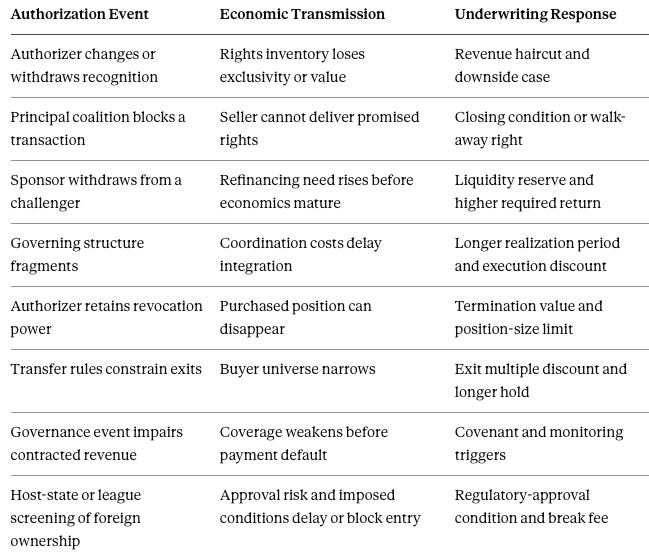
The table converts governance analysis into committee language. Each row pairs an observable event class with the valuation lever it moves and the underwriting response that prices it — haircuts, closing conditions, reserves, discounts, position limits, and covenants. Authorization risk stops being a narrative concern the moment it enters the model through these channels.
VIII. Executive Playbook: Reducing Authorization Risk Before the Contest
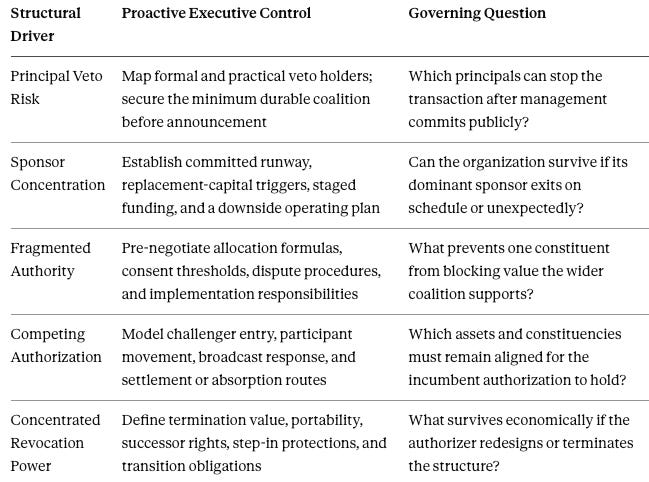
Authorization risk does not arise only from external shocks — the risk is partly endogenous, created or reduced by the leaders inside the governing system. Executives often increase exposure by announcing transactions before securing constituent support, concentrating survival funding in one sponsor, leaving control rights ambiguous, or selling economic rights without defining what happens when the governing structure changes. Each of the five structural drivers pairs with a proactive control, and each control answers a governing question a board can ask before capital, contracts, or institutional credibility become committed.
Secure the Coalition Before Selling the Rights
FIFA demonstrates the cost of reversing the proper sequence. Management designed the commercial transaction before securing the governing coalition capable of delivering it. Executive teams should identify whose continuing participation makes the rights valuable, test the transaction against each principal’s incentives, and resolve opposition before entering the market.
Coalition approval requires more than formal votes. Leaders should map practical veto power, reputational leverage, withdrawal threats, and the ability of dissatisfied members to coordinate. A transaction can satisfy the bylaws and still fail the authorization test.
Build Capital Continuity Before Sponsor Withdrawal
LIV demonstrates why launch capital and durable capital require different structures. Executives should establish replacement-capital triggers well before a dominant sponsor exits, separate committed funding from expressions of interest, and align ownership rights with responsibility for future deficits.
Player-majority equity, for example, does not establish player-majority governance or willingness to fund losses. Executives must specify voting authority, board representation, capital-call obligations, commercial-rights ownership, liquidity rights, and consequences when player and investor incentives diverge.
Design Contracts for Authorization Change
Transaction documents should state what survives when the governing layer changes. Relevant protections include closing conditions, break fees, termination payments, reversion rights, portability provisions, step-in rights, consent requirements, covenant triggers, and mandatory transition support.
Contractual protection cannot preserve an authorization by itself. It can preserve value, negotiating leverage, or an orderly exit when the authorization changes.
Partition Rights Without Creating a New Blind Spot
Utah’s build-beneath structure shows how executives can separate commercial operations from competitive and regulatory authority. The design can preserve commercial continuity across regulatory branches, but separation also creates a new governance perimeter among the university, foundation, operating company, and investor.
Executives should define reserved powers, information rights, conflict procedures, termination routes, and responsibility for compliance before transferring the commercial surface.
Monitor Authorization Before Valuation Moves
Boards should treat authorization indicators as operating metrics rather than episodic legal issues. Relevant signals include coalition defections, sponsor concentration, funding-runway compression, leadership changes, unrenewed participant contracts, broadcaster hesitation, litigation escalation, regulatory intervention, and unexplained changes to schedules or public commitments.
Predefined escalation rules convert those signals into decisions. A deteriorating authorization read may require additional liquidity, modified covenants, delayed transaction timing, renewed constituent engagement, or a different rights perimeter before the market reprices the asset.
Simulate Before Announcing
Executives can test the actor network before presenting a transaction publicly. Cognitive Digital Twins of management, governing principals, capital sponsors, challengers, participants, and rights holders expose which actors become pivotal, which concessions preserve the coalition, and which announcement sequence creates avoidable opposition.
Authorization resilience does not require static governance. Resilient executives preserve recognizable economic rights while capital, rules, coalitions, and competitive structures change. Proactive simulation turns authorization analysis from a post-failure diagnosis into a transaction-design and institutional-risk-control instrument.
IX. The Authorization Audit: What MindCast AI Evaluates
Proactive controls matter only if the actor network will honor them under pressure. The Authorization Audit stress-tests both sides of the decision: the authorization risk embedded in the position and the resilience of management’s proposed mitigation. The engagement evaluates the governing system before capital commits and monitors whether the controlling coalition remains durable through the hold.
Each audit models the full actor network as Cognitive Digital Twins — behavioral decision models of the authorizer, the challenger, the capital sponsor, the veto-holding principals, and the affected rights holders, each built from cited public-record behavior. The twins run against each other through Dynamic Predictive Game Theory: adversarial simulation of the contest under pressure, rule mutation, and coalition stress. Outputs arrive as an investment committee needs them — a regime classification for the position under the five structural drivers, scenario trees for the governance triggers most likely to arrive during the hold, coalition-stress reads identifying which actors become pivotal under pressure, and named early-warning indicators observable before valuation moves.
Four engagement shapes fit four buyer situations.
Buy-side, the audit runs during confirmatory diligence, before committee approval.
Lender-side, the same fork trees translate into covenant design and stressed-credit review. Governance triggers with defined windows and observable settlement conditions are structurally similar to covenant tests, and governance failure can impair contracted revenue without ever transferring control to the lender.
Authorizer-side, a governing body weighing a capital transaction can simulate its own principals’ response before announcing — the FIFA episode is the complete argument for running that simulation first. The deliverable is an Authorization Resilience Plan: the minimum durable coalition, a formal and practical veto map, capital-continuity thresholds, the rights that survive governance change, trigger-linked executive actions, a public-announcement sequence, and pretested challenger and constituent responses.
Sovereign-side, cross-border allocators run the same engagement inside MindCast AI’s Geopolitical Risk Intelligence vertical, where the second authorization layer — screening regimes, ownership rules, and legitimacy dynamics — is modeled alongside the sport’s own.
Every released read carries the same contract: a deadline, an explicit falsifier stating the public observation that would prove it wrong, and a named settlement source. A read that cannot be proven wrong by a specific public observation is opinion, and MindCast AI does not release opinion as foresight.
X. The Live Simulation: LIV Golf After PIF
The framework’s first full application runs on the sharpest authorization transition in sports. Governing question: can LIV convert a signed, board-approved lead-investor agreement and a player-majority ownership model into a durable operating authorization before PIF funding expires — or will player defection, disclosure incoherence, and incumbent pressure fragment the transition coalition first?
The evidence window compressed into ten days: a canceled $40 million team championship, a board-approved investor agreement targeting a September close, a clinched individual title, a reported star departure with reporting that the funding deal may depend on whether top players stay, and a Companies House debenture securing PIF as LIV’s lender under an undisclosed facility agreement. Player retention and capital closing are coupled: the investor is buying the coalition, the coalition is weighing the investor, and PIF’s repayment, security-release, and consent rights can condition the close.
The foresight simulation, observation record closed August 16 — instantiated eight actor categories as thirteen twins across twenty-one interaction edges: the LIV board, the unnamed lead investor, PIF as transition lender and residual principal, individually modeled captains with Rahm anchoring the exit-capable pole and DeChambeau the continuity pole, the contract-holder group, both incumbent tours, the broadcast partners, and prospective minority investors. Adversarial cross-simulation produced four mutually exclusive routes:
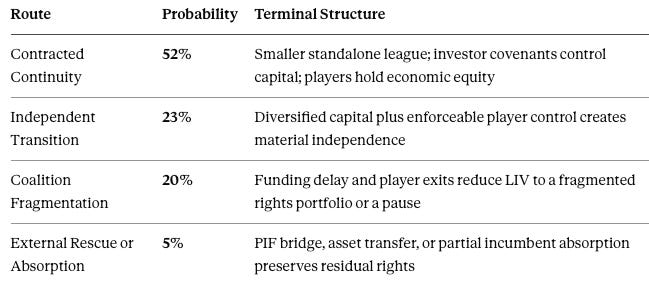
Contracted Continuity carries the highest probability because the announced structure solves immediate survival more directly than governance independence: the investor needs protection, the board needs capital, players need upside, and the broadcaster needs deliverable inventory — a smaller schedule can satisfy all four without transferring meaningful control to the player class. A Rahm exit can move the financing itself, cascading a player decision into a capital event.
The Register — Four Primary, Four Secondary
Primary — the four institutional facts an allocator prices:
Prediction 1 — Capital Conversion. A named lead investor funds or irrevocably commits material capital: 66%(band 57–74%), by September 30. Material capital means the named investor becomes unconditionally bound to fund LIV’s announced 2027 operating plan; irrevocable means the commitment no longer depends on financing or diligence conditions. PIF’s secured lender position is the decisive undisclosed variable. Settlement: a joint or corroborated announcement from LIV and the named investor, or an official filing; media reporting alone does not settle the entry. Falsifier: no named investor and no funded or irrevocable commitment by September 30, or an announced withdrawal or material deferral.
Prediction 2 — Operating Inventory. LIV publishes a 2027 schedule of at least eight events: 72% (band 62–80%), by December 31. Settlement: LIV’s dated schedule release. Falsifier: no official 2027 schedule, or fewer than eight events.
Prediction 3 — Player Control. Publicly operative documents grant the player class at least two material control rights from a defined four-right set — board appointment, binding budget approval, veto over material rule changes, or approval of a sale or merger: 29% (band 20–40%), by November 30. The prediction measures publicly provable control; marketing language about majority equity does not count. Falsifier: fewer than two enumerated rights become publicly operative.
Prediction 4 — Distribution Continuity. FOX or LIV confirms national U.S. distribution for 2027: 69% (band 58–78%), by December 31. Settlement: the distributor identified by FOX, a replacement, or LIV. Falsifier: no national distribution agreement, or FOX terminates without replacement.
Secondary — the coalition and market pathways that move the primary route:
Prediction 5 — Rahm Commitment. Rahm publicly confirms he will compete in LIV’s 2027 season: 43% (band 32–55%), by November 30. Silence does not settle loyalty; an affirmative commitment does. Falsifier: no affirmative 2027 commitment by November 30.
Prediction 6 — Minority Follow-On. At least one additional minority investor signs a definitive LIV agreement: 48% (band 36–60%), by December 31. A qualifying event requires a named investor and a publicly confirmed definitive agreement; expressions of interest do not count. Falsifier: none signed by December 31.
Prediction 7 — Michigan Correction. LIV removes, cancels, or materially corrects the Michigan sales page: 84%(band 75–90%), by August 24. A prompt correction demonstrates basic feedback closure; an unchanged page converts a temporary lag into evidence of weak transition control. Falsifier: the page remains unchanged after August 24.
Prediction 8 — Incumbent Access. The PGA Tour or DP World Tour formalizes a 2027 access path for at least one then-contracted LIV player: 61% (band 50–71%), by November 30. A qualifying action is a policy change or named-player agreement beyond the pathways existing at the evidence cutoff. Falsifier: no formal path created, reopened, or expanded.
The Combined Read
The entries interact as a causal bundle. Capital probably closes (66%), the schedule probably survives at viable scale (72%), and distribution probably holds (69%), yet meaningful player control probably does not emerge (29%). Read together under the 52% modal route, the register forecasts organizational survival while rejecting the public implication that player-majority ownership produces player governance.
Player Control at 29% is the read that separates the register from conventional coverage. Investors already understand refinancing risk; far fewer distinguish majority economics from effective control — deficit responsibility, veto power, board authority. The forecast identifies where headline ownership language may diverge from operative control — exactly the distinction a diligence process exists to catch.
The secondary entries sharpen the same picture. Incumbent access at 61% forecasts erosion through selective permeability rather than absorption — the tours weakening LIV player by player without buying anything. Minority follow-on at 48% tests whether the anchor investor catalyzes a genuine capital coalition or remains alone. And Rahm at 43% prices as a financing input, not roster news: his retention conditions the capital close itself.
The Indianapolis Window
Indianapolis, August 20–23, concentrates public attention four days before the Michigan deadline and five weeks before the capital deadline — a concentrated window for institutional evidence. Five signals matter, in order of weight: investor identity and closing language progressing from signed toward funded; player rights — board seats, vetoes, budget authority, sale approval — over percentage equity; pivotal-player posture, with Rahm and DeChambeau read separately; schedule and distribution reconciliation; and player exposure to future deficits, capital calls, and dilution. The week’s most valuable output is evidence: whether management controls the transition loop or merely controls the message.
The register is the paper’s thesis in falsifiable form — the layer above the asset, priced before the outcome arrives.
XI. Method and Record
Allocators evaluate managers on audited track records, and analytical firms should face the same standard. MindCast AI’s method is built around it.
Every forecast the firm releases is committed in public before the outcome resolves, published with confidence ranges, and scored openly afterward against the complete fixed record. The discipline exists because a public record only counts when it can be audited — and because this document’s audience is trained to discount retrospective narrative.
The public record now spans two domains this paper connects. Competitive-outcome validation includes a full NFL season culminating in Super Bowl LX and a 2026 World Cup cycle that scored 8/8 on Round of 16 regime classifications and 94% on mechanism reads. The combined scoring record and World Cup final validation are public. In capital formation under mutating authorization: a January 2026 analysis named college athletics’ firm-formation phase, forecast capital migration into specialized operating companies, and identified Utah as the prototype. Crimson Brand Partners closed five months later in the forecasted structural form — the record this paper’s claims stand on.
The validated public record covers competitive outcomes and capital formation. Authorization reads run on the same engine and earn their record the same way: the Section X register settles in public through December 31, with a validation report following the final deadline, scoring each prediction individually and evaluating performance across four causal clusters: the capital coalition (Predictions 1, 3, 5, and 6), operating continuity (2 and 4), disclosure control (7), and incumbent permeability (8).
XII. The Question for the Hold Period
Sports capital’s underwriting question has always been the asset’s: what will revenues do, what will scarcity protect, what will the exit look like. 2026 demonstrated that a prior question governs all three.
What can the governing system do to the asset during the holding period, who can force it to act, and how would the risk become visible before valuation reflects it? Overwatch answered for positions under concentrated revocation power. FIFA answered for capital courting an executive who did not control what he offered. LIV answered for capital that built a competing authorization before proving independence from its founding sponsor. Tennis answered for positions inside a fragmented standoff. Utah answered for capital that structured around the problem — and showed that investors can design for the risk instead of absorbing it.
Executives can reduce the exposure before it reaches valuation by securing the coalition before announcing, diversifying capital before withdrawal, defining what survives structural change, and simulating opposition before committing institutional credibility.
Diversification reduces case-specific exposure but cannot remove dependence on sports authorizers; no standardized instrument hedges the risk directly; and conventional diligence rarely isolates it as its own risk object. Authorization risk can, however, be measured, simulated, monitored, and structured for. MindCast AI evaluates the layer above the asset — before capital commits to what sits beneath it.
Appendix A: MindCast AI Works
Dynamic Predictive Game Theory From the 2026 Super Bowl and World Cup — Explains how the simulation engine behind this paper works: a shared behavioral foundation, a game model for each domain, a behavioral model for each actor, and a decision tree for each contest. The LIV register in Section X runs on this architecture.
Predictive Game Theory + Behavioral Economics Foresight Simulations in the World Cup — Announced, before the tournament began, that MindCast AI would use sports as its public testing ground and stated how the forecasts would be scored. The predictions in this paper follow the same rules that piece committed to.
Super Bowl and World Cup Simulation Validation and 2026 FIFA World Cup Final Simulation Validation — Show how the earlier forecasts actually performed, prediction by prediction, against the final results. Readers checking the track record cited in Section XI start here.
Next-Gen Cybernetics for Capital Allocators — Argues that investment models fail precisely when the rules governing a market change, and that those rule changes can be forecast. This paper applies that argument to one specific rule-setting layer: the governing bodies above sports assets.
Private Equity, NIL, Antitrust, and the Firm-Formation Phase of College Athletics — Forecast in January 2026 that private capital would enter college sports through specialized operating companies and named Utah as the likely first mover. The Crimson Brand Partners transaction closed five months later in that form — the forecasting record Section XI cites.
If the Protect College Sports Act Passes, Private Equity in College Sports Wins Differently — Analyzes the Utah transaction in detail: how the deal separates commercial assets from athletic governance, and why the structure holds value whether or not the federal bill passes. Section VI’s account of the deal draws on this analysis.
The Protect College Sports Act of 2026 (S. 4668) Becomes a Compliance-Infrastructure Bill — Tracks the federal bill that would reset college sports’ governing rules — the statute whose coalition fight Section VI describes, and the largest single source of authorization change hanging over the college-sports capital entry.
Susquehanna Is Building the Institutional Market the CFTC Does Not Require — but Still Needs — Examines the first institutional-scale facility for hedging sports outcomes and what it signals about where sports risk will eventually trade. Section VII’s point that no instrument yet prices governance events builds on this analysis.
Defining “Gaming” Under the Commodity Exchange Act, The Rule 40.11 Gap Driving the Nationwide Kalshi Litigation Web and MindCast Files Second Comment in the CFTC Prediction Markets Rulemaking — Document MindCast AI’s two filed comments in the federal rulemaking that will decide where event-based sports risk can legally trade — the regulatory participation Section VII references.