
Companion works: MindCast Predictive Behavioral Economics + Dynamic Game Theory AI Simulations of Prediction Markets, MLS Antitrust, Data Center Permits, Chip Export Controls and Bank Governance Liability · MindCast Institutional Foresight for Long-Horizon Capital (Executive Presentation, unpublished)
Thesis. Courts, regulators, utilities and governments now set the terms long-horizon capital lives under. Their decisions reach earnings, credit spreads and ratings months after they happen. MindCast AI simulates institutional responses so investors can act between an institutional decision and its financial recognition.
Why now. Five live contests show the pattern this month. The Supreme Court holds petitions that decide whether event contracts become a national asset class, and Compass opened a second antitrust front against a multiple listing service on October 16. Texas halted data center permits on September 21 with no size floor, and Tencent’s reported $7 billion lease of chips in Oracle data centers routes AI capability around the export gates of both Washington and Beijing. On October 13 Bank of America admitted a willful Bank Secrecy Act violation after its own 2022 tests had measured the blind spot regulators later penalized.
Who it reaches. Capital that cannot exit quickly carries the most exposure: lenders, insurers, infrastructure investors and sovereign funds. Traders gain most when a decision arrives with a dated, tradable event.
How the series works. The Long-Horizon Investor Series opens with two guiding companions, and more may follow. The Framework Companion sets out the method once, and the Opening Cases Companion applies it to five cases and states the series’ forty Simulation Predictions. Each installment then analyzes one new event through the lens of each of the twelve investor groups, and installments issue only when a new development changes an institution’s position. MindCast’s Legacy Culture publications supply the stewardship side of the same question, and [The Bellevue Collection publication, title and link to be supplied] applies both to one institution at the moment of its transfer.
Contents
I. Executive Summary
II. Twelve Investor Groups Answer to Different Clocks and Different Geopolitical Exposure
III. Liability Decides What Institutional Foresight Is Worth
IV. Measured Governance Gaps Change the Evidence of Compliance With Existing Duties
V. Institutions Set the Terms Long-Horizon Capital Lives Under
VI. Cognitive Digital Twins Turn Each Institution’s Own Conduct Into Dated Simulation Predictions
VII. Five Questions Cover Tipping Rules, Changing Games, Authorization Chains, Sovereign Channels and Duties of Care
VIII. Institutional Events Rarely Stay in Their Own Market
IX. MindCast Simulation Predictions
X. Risk Mitigation for Investors
XI. What to Watch
XII. Every Installment Reads One New Event Through Each Investor Group
XIII. Conclusion
Working With MindCast · Sources
I. Executive Summary
Core insight. Institutional decisions change investment assumptions before earnings, credit terms and ratings reflect them. The delay between the decision and its financial recognition is where long-horizon capital wins or loses. A permit halt changes the quarter a data center reaches revenue, and a court’s choice of statute decides which states a trading venue can serve.
Thesis. Investors who model how institutions respond to one another can position before the financial recognition arrives.
Method. MindCast AI applies Predictive Behavioral Economics + Dynamic Game Theory through MindCast AI Proprietary Cognitive Digital Twin Foresight Simulations (MP CDT FS). Behavioral Economics supplies the decision rules. Game Theory supplies the payoff structure. Predictive simulations emerge from the combination.
Original contribution. The Framework Companion contributes three reusable instruments. The recognition lag turns the delay between institutional decision and financial recognition into a testable sequence. A liability-based account explains which institutions value foresight, and an investor-group reading maps any new event to each group’s clock, channel and Simulation Prediction. The companion also ties the liability account to the Foresight-to-Duty Conversion, which explains when a measured risk becomes a duty an institution must act on.
How to read the evidence. Linked sentences state verified facts and name their source. Bold probability bands mark MindCast Simulation Predictions, each with a window and a falsifier. Table notes flag MindCast’s own readings, and modeled payoffs are labeled as assumed.
What distinguishes the approach. Each MindCast forecast pairs a named mechanism with a dated outcome. Each forecast also carries a probability band, a falsifier and a named verification source. MindCast reports its misses beside its hits.
The case studies. Five case studies open the series. The table compares them on four dimensions: event, deciding institutions, MindCast finding and nvestor consequence. Each row stands alone.
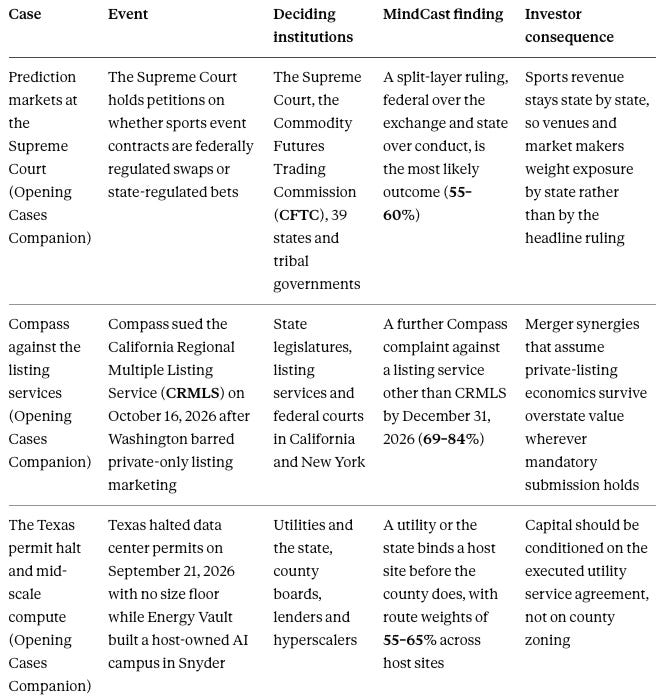
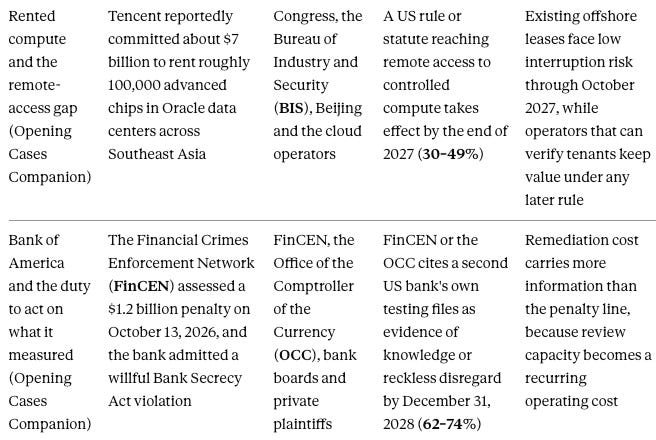
What the Framework Companion covers. Sections II and III compare twelve investor groups and report a simulation of the institutional investor landscape, and Section IV explains how a measured governance gap changes the evidence of compliance. Sections V through VII state the vision, explain the simulation method and introduce five analytical questions. Section VIII traces how a single institutional event travels into compute capital, geopolitics and governance liability. Sections IX through XII set out two Simulation Predictions, risk mitigation, dated signals and the installment method.
📊 Investors: Underwrite on the institutional decision that binds first, not the one that draws headlines; in AI infrastructure that decision usually belongs to a utility or a state.
💼 Executives: Treat a regulator’s next move as a counterparty decision with a payoff structure you can model.
⚖️ Counsel: Contradictions across a litigant’s own filings in different forums predict outcomes better than docket counts.
🏛️ Policymakers: Rules copied across jurisdictions spread through tipping dynamics, so the first adopters shape the national regime.
Takeaway: MindCast models the institutional decision that comes before the financial result.
II. Twelve Investor Groups Answer to Different Clocks and Different Geopolitical Exposure
Investor groups that share a subject rarely share a decision. A hedge fund, a lender and a sovereign fund can all hold AI data center exposure. Each answers to a different clock, carries a different loss and meets geopolitics through a different channel. The table compares twelve groups on the dimensions that decide how an institutional event reaches their capital.
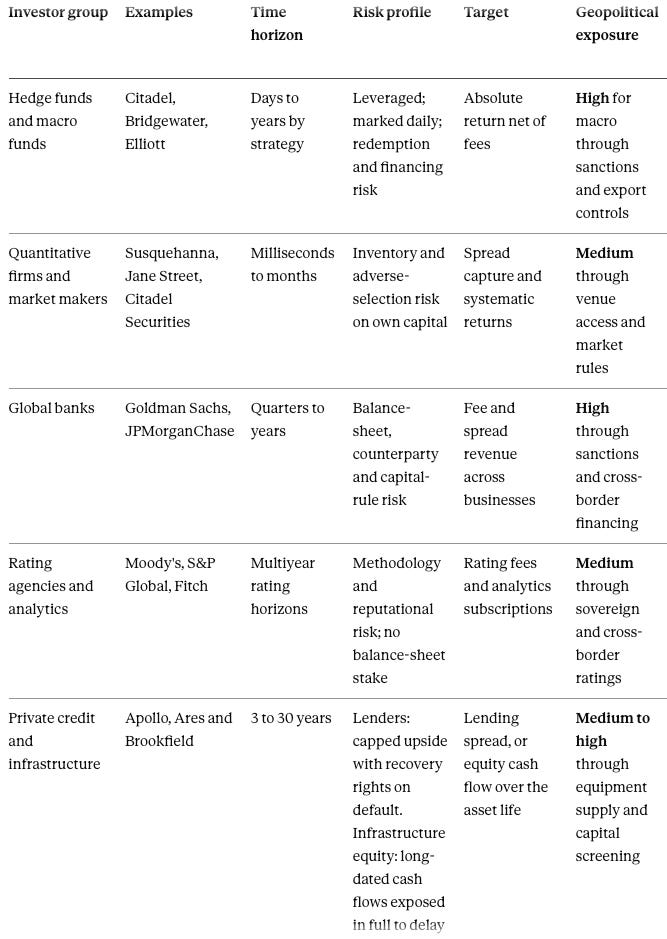
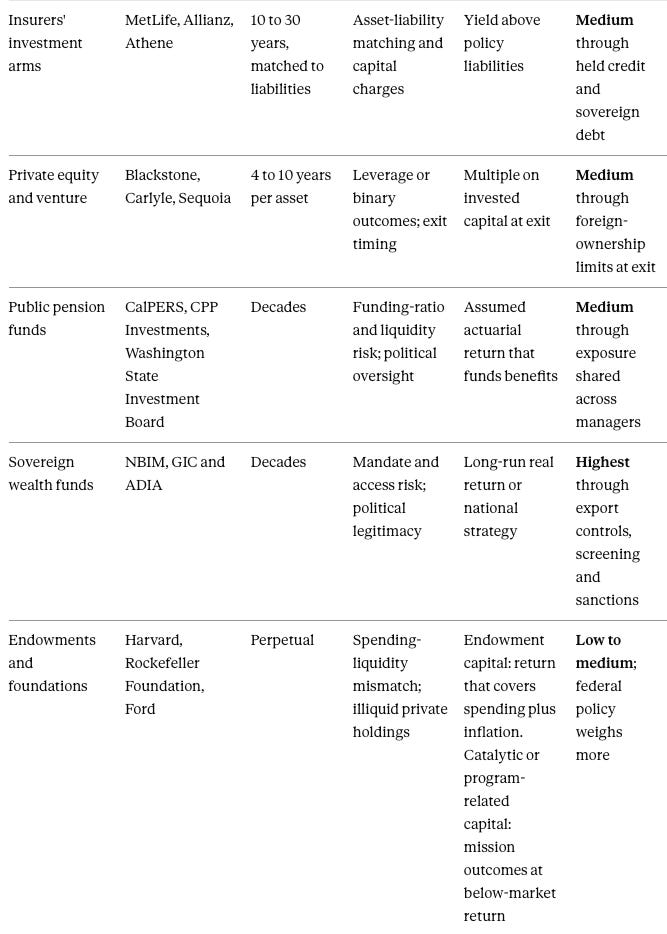
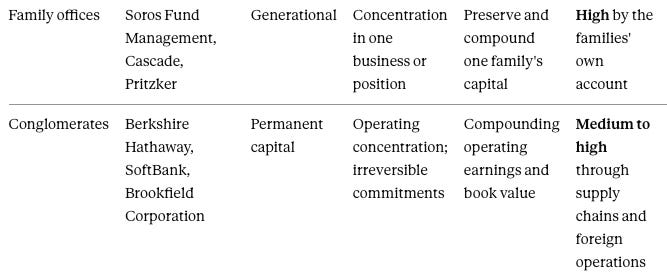
Geopolitical exposure levels are MindCast’s reading of each group’s mandate and holdings, not measured data. Named institutions here and in the landscape simulation illustrate each group or appear as modeled actors, and no client relationship is implied.
Horizon and geopolitical exposure do not move together. Sovereign funds and family offices hold the longest horizons and the highest exposure, while endowments hold perpetual capital and meet geopolitics mostly through federal policy. Family offices state the exposure themselves: J.P. Morgan’s 2026 family office report found 64% naming geopolitics as their top risk.
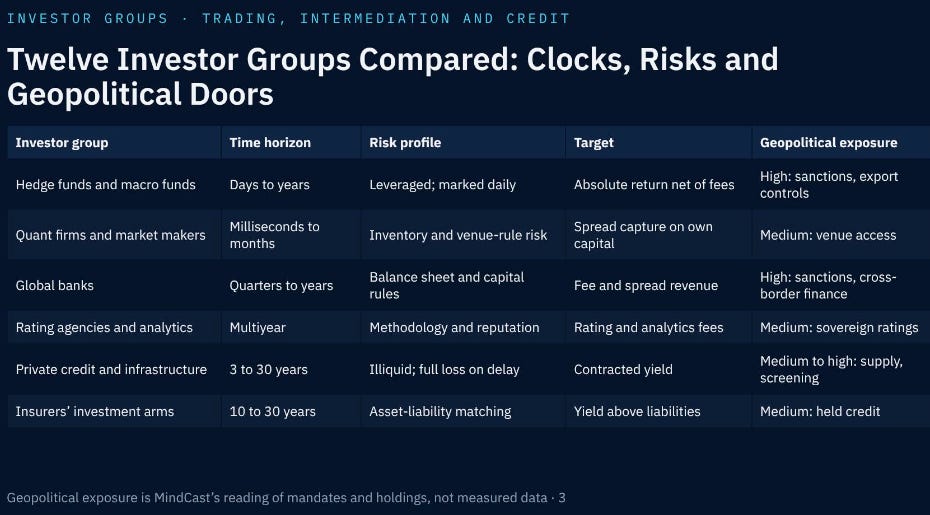
From the MindCast executive presentation. Trading, intermediation and credit groups, with MindCast’s reading of geopolitical exposure.
Family offices and conglomerates carry the longest horizons with the thinnest external correction loop. When Family Offices Reach Institutional Scale (December 27, 2025) finds that patient capital answering to no outside party lets errors build unnoticed until they surface as legal, reputational or succession problems. For these two groups, institutional foresight substitutes for the discipline a pension consultant or a redemption window supplies elsewhere.
A stated horizon also misleads on its own. A lender can hold a 20-year asset and still face a funding condition next quarter, while a market maker turning inventory in milliseconds carries exposure to a Supreme Court ruling that takes a year. The clock that matters is the one written into the documents.
The strongest need for institutional foresight sits where long-horizons meet decisions by courts, regulators and governments. Lenders, infrastructure investors, insurers and sovereign funds cannot exit quickly when an authorization fails. Each of the four groups gains most from seeing the decision before it lands. Traders gain from institutional foresight only when it comes with a tradable event and a date.
🏛️ Policymakers: sovereign funds and family offices carry the highest geopolitical exposure, so export and screening rules carry the largest consequences for them even when other investors meet those rules first.
Takeaway: match each presentation to the investor group’s clock and its channel of geopolitical exposure, not to the subject the groups share.
III. Liability Decides What Institutional Foresight Is Worth
MindCast turned its simulation method on its own audience. On October 18, 2026 a MindCast simulation mapped seventeen segments of institutional capital and 84 named institutions, from Citadel and Goldman Sachs through Moody’s and Apollo to CalPERS and Gulf sovereign funds. Twenty-two institutions became Cognitive Digital Twins (CDTs), each a model of one institution built from its public conduct, including the Commerce Department and a leading political-risk adviser that shape buyers without buying. The CDTs played against one another under four forcing shocks: data center authorization, prediction-market legality, AI geopolitics and fiduciary liability.
The landscape simulation’s governing finding is a commercial hypothesis, not an observed purchasing pattern: liability decides what foresight is worth to an institution. In the simulation, demand rises with the share of losses set by courts, legislatures and governments and with how long capital stays committed. Who absorbs the cost of a wrong call decides what the institution buys.
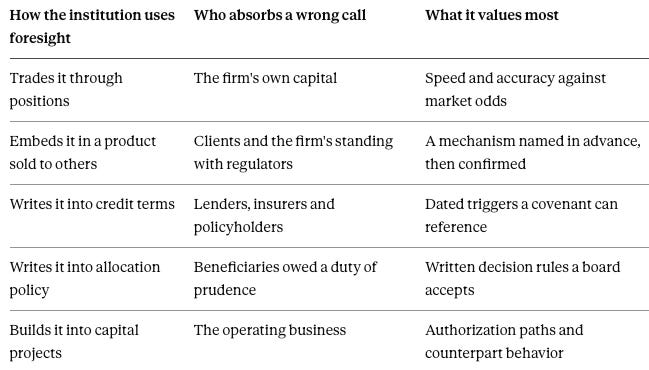
Two landscape findings carry beyond MindCast’s own market. In the simulation, institutions that owe duties to others moved first on authorization risk; a dated mechanism with a stated band can support their documented decision process, though it does not by itself protect the decision-maker. Each forcing shock also reached buyers through a gatekeeper: rating criteria for lenders and insurers, consultants for pensions and the CFTC for market makers.
The landscape simulation produced three primary Simulation Predictions with windows closing at the end of June 2027: a negative rating action on a data center financing that cites authorization risk (30–42%), Citadel Securities as a confirmed market maker in non-sports event contracts (50–62%) and a new US export authorization for advanced AI chips to a Gulf AI vehicle (64–76%).
💼 Executives: institutions that owe duties to beneficiaries or policyholders need written decision rules before they act on authorization risk, so the gatekeepers that write those rules shape demand for foresight.
Takeaway: the landscape simulation expects institutions that carry duties to others to act on authorization risk first, a hypothesis actual purchasing decisions will test.
IV. Measured Governance Gaps Change the Evidence of Compliance With Existing Duties
A measured risk changes an institution’s legal position before any enforcer arrives. The Foresight-to-Duty Conversion: Measured Governance Debt Becomes Evidence When Institutions Keep the Gap They Found (October 15, 2026) names the process: an institution’s own measurement of a governance gap becomes evidence of whether it met a duty it already had. The measurement creates no new duty and proves no violation by itself. The institution’s response decides what the file shows.
The Foresight-to-Duty Conversion runs in three stages: receipt of the measurement by someone with authority to correct it, a funded decision and verified closure. Where all three complete, the file shows diligence. Where any stage stalls, foreseen governance debt accumulates and the same file becomes evidence against the institution.
Judge Learned Hand’s formula supplies the test. Precaution is due when its burden falls below the probability of harm times its magnitude, and the measurement supplies evidence for estimating precaution costs and preventable harm. A detection rate, a suspicious-transaction total and a staffing figure each narrow what the institution can claim not to have known, while none of them computes the formula on its own.
Behavioral economics explains why institutions still defer: the correction cost sits on this year’s budget while the enforcement cost stays unpaid and diffuse. Game theory explains why the deferral holds until an enforcer, a failed representation or a peer’s order changes what examiners read.
Bank of America $1.2 Billion Money Laundering Penalty and the Compliance System That Knew Too Much (October 14, 2026) shows the conversion with unusual clarity. The bank’s 2022 test found that an unconstrained monitoring threshold would surface 85.4% of suspicious activity in sampled below-threshold activity against 20.2% under the existing rule, and management kept the threshold over concern about investigation volume. The FinCEN consent order of October 13, 2026 counts that decision among the warnings behind the willful violation.
The bank lowered the threshold in December 2023 after engagement with its regulators, and the order finds the monitoring deficiencies unresolved as recently as June 2025. FinCEN counted that warning among the repeated internal warnings behind the willful violation the bank admitted on October 13, 2026. The OCC imposed its largest penalty ever, $750 million credited toward FinCEN’s $1.2 billion total.
Sixteen enforcement cases sort into three stalls. Deliberate deferral ran at Bank of America, TD Bank and Toyota, where someone with authority knew the gap and declined to fund the fix. Failed execution ran at Equifax, where a patch instruction never reached verified closure. Information suppression ran at Boeing, w
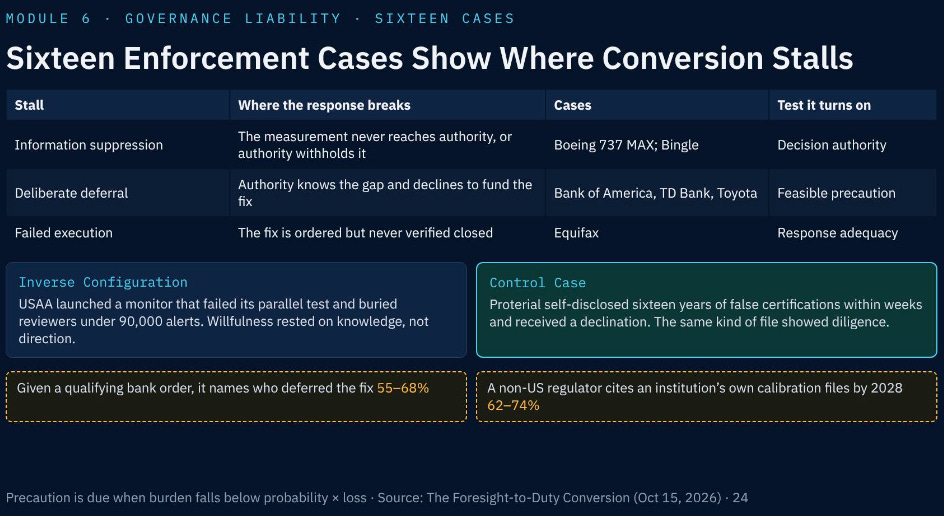
From the MindCast executive presentation. The three stalls, the inverse configuration at USAA and the Proterial control case.
Two cases bound the Foresight-to-Duty framework. Proterial Cable America self-disclosed sixteen years of false certifications within weeks of an internal audit and received a federal declination, so the same kind of file showed diligence. In Construction Industry Laborers Pension Fund v. Bingle the Delaware Court of Chancery dismissed an oversight suit because the warnings never reached the board, so a measurement held below the board did not convert against it.
The Duty to Foresee: AI Deployment Readiness as Prospective Governance and the Arrival of Agentic Duty of Care(June 26, 2026) separated two duties: the duty to look before acting and the duty to act on what looking reveals. The paper warned that foresight manufactures discoverable knowledge. Bank of America illustrates the second duty inside a bank before any autonomous agent case has reached an order.
The Foresight-to-Duty Conversion explains why liability decides what foresight is worth, the landscape finding in Section III. Investor groups that owe duties to others hold files the conversion reads: banks hold validation reports, rating agencies hold criteria reviews, and pensions and endowments hold consultant memos. A published and banded Simulation Prediction on a risk a fiduciary holds can support a foreseeability argument if the fiduciary ignores it, while a documented response becomes part of a prudent process. The reading is interpretive rather than a Simulation Prediction, and the response does that work, not the purchase.
⚖️ Counsel: an institution’s own measurement file supplies the knowledge element an enforcer would otherwise prove from outside, so the response to each open finding deserves the same care as the finding.
Takeaway: a measured gap changes what an enforcer can prove under a duty that already exists, and the institution’s response decides whether the file shows diligence or neglect.
V. Institutions Set the Terms Long-Horizon Capital Lives Under
Every long-horizon investment rests on four assumptions: permission holds, access persists, counterparties perform and the exit stays open. In 2026 a government or counterparty broke each one. Texas halted data center permits, Washington barred private-only listing marketing, Oracle declared force majeure on Project Jupiter and North Carolina enacted forced divestiture of farmland and land near military bases held by covered foreign owners.
Permission, access, counterparty performance and the exit each map to a value variable. Permission sets cash-flow timing and access sets margin, while counterparty performance sets refinancing terms and the exit sets terminal value. When an institution changes one of the four assumptions, the investment’s value changes on the day of the decision.
The interval between an institutional decision and its financial recognition is the recognition lag. Capital concentrates inside the recognition lag as asymmetric opportunity or asymmetric loss. Earnings, ratings and security prices each recognize institutional change on their own clock, so the recognition lag is a thesis about sequence rather than a claim that markets misvalue every decision.
Some long-horizon decisions never enter the optimization the recognition lag assumes. Structural Intergenerational Behavioral Economics (January 23, 2026) finds that decision-makers shift once a choice is irreversible or its window has closed or its outcome falls on absent people. They move from optimizing payoffs to preserving continuity. A seller or steward in that state reads an institutional decision through what it protects, not what it earns, and a buyer who models the seller as an optimizer misreads the counterparty.
A lender who reads a utility’s load study before the borrower discloses it adjusts terms first. An equity analyst who reads a court’s statutory theory before the ruling adjusts exposure first.
Falsifiable implication: if the recognition lag is real, the institutional decisions named in this series will come before the earnings, credit terms and rating actions that reflect them. The forty Simulation Predictions in the Opening Cases Companion test the institutional forecasts themselves. Recognition lag faces a direct test only where an entry tracks a financial response, as series entries 11 and 15 do for rating agencies and entry 35 does for bank disclosures.
📊 Investors: positions held through the recognition lag carry institutional risk that earnings, ratings and prices have not yet shown.
Takeaway: institutions decide first, and earnings, ratings and prices follow on their own clocks.
VI. Cognitive Digital Twins Turn Each Institution’s Own Conduct Into Dated Simulation Predictions
A MindCast simulation starts with the institutions that decide an investor’s outcome. Each institution becomes a Cognitive Digital Twin (CDT): a model of one actor built from its own filings, rulings and conduct in every venue where its incentives differ. A county board, a utility and a federal agency each receive their own CDT.
Game theory sets the payoffs each actor faces: what it gains, what it risks and what its rivals can do in response. Behavioral economics sets how each actor’s decision-makers choose under pressure: which signals they notice, which audience they answer to and which rules of thumb they follow. A county board reacts to a salient announcement, while a utility applies a load threshold regardless of salience, and the difference changes which approval binds a project first.
A Cognitive Digital Twin of a family-held institution also models what survives its succession. Legacy and Recognition Architecture (May 26, 2026) finds that what transfers across generations is a pattern-recognition architecture, while capital only amplifies decisions once made. The twin therefore carries the institution’s recognition patterns, so a buyer or heir can test which of them transfer with title.
The Cognitive Digital Twins then play against one another. Opposing actors move and countermove until no actor can improve its position by changing course. Each MindCast Foresight Simulation Prediction names an actor, an outcome and a window, and each carries a probability band and a falsifier.
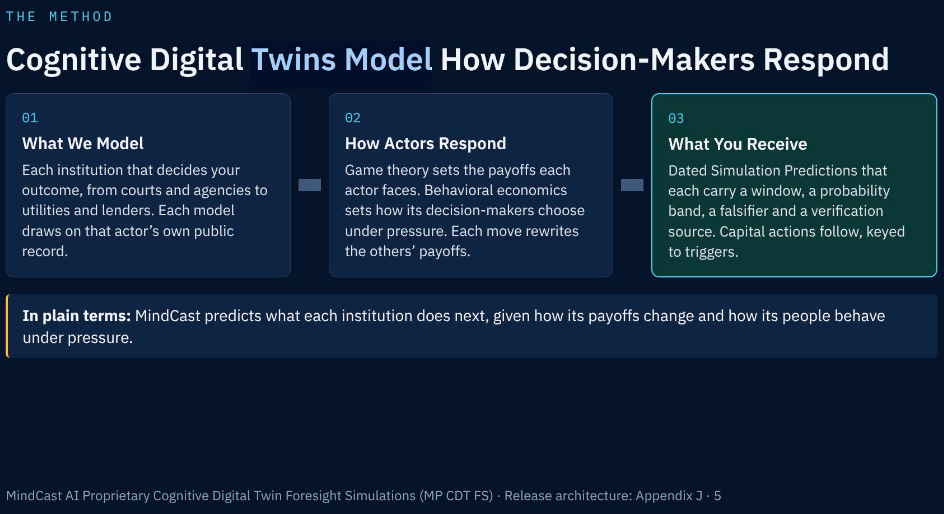
From the MindCast executive presentation. Each institution becomes a Cognitive Digital Twin, and each Simulation Prediction carries a window, a band and a falsifier.
MindCast Foresight Prediction Simulations, Synthesizing Behavioral Economics + Game Theory sets out the full method and explains how behavioral economics and game theory combine inside each simulation. Decision Modeling and Foresight Simulation (March 27, 2026) separates a decision’s integrity when it is formed from its survivability under pressure, and MindCast simulations test the second.
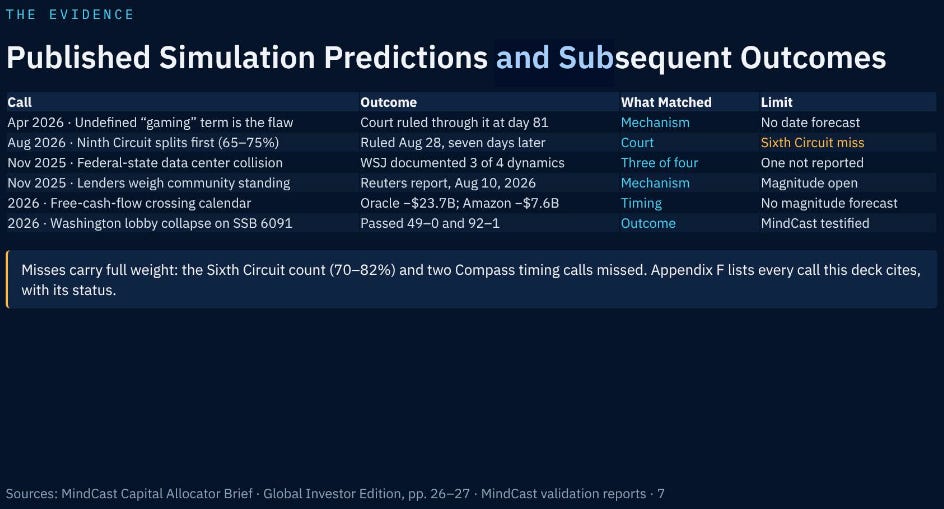
From the MindCast executive presentation. Each row pairs a dated call with its outcome, what matched and the limit, and the misses stand beside the hits.
MindCast’s published calls show misses beside hits. Both a Swap and a Bet: Simulating the Looming Supreme Court Battle Over Prediction Markets (August 21, 2026) named the Ninth Circuit as the court likeliest to break with the Third Circuit, and the Ninth Circuit ruled seven days later. The same paper forecast a circuit count of 3–1 or 2–2 after the Sixth Circuit ruled, and the count stood at 2–1, a miss.
⚖️ Counsel: a regulator’s own filings and conduct across venues become the evidence base for forecasting its next move.
Takeaway: a MindCast simulation converts an institution’s own filings and conduct into a dated, falsifiable statement about what it does next.
VII. Five Questions Cover Tipping Rules, Changing Games, Authorization Chains, Sovereign Channels and Duties of Care
MindCast routes each simulation through a small set of analytical questions chosen for the problem at hand. Five questions recur across asset classes and matter most to long-horizon investors. The table states each question in plain terms and names the case in the series where it applies.
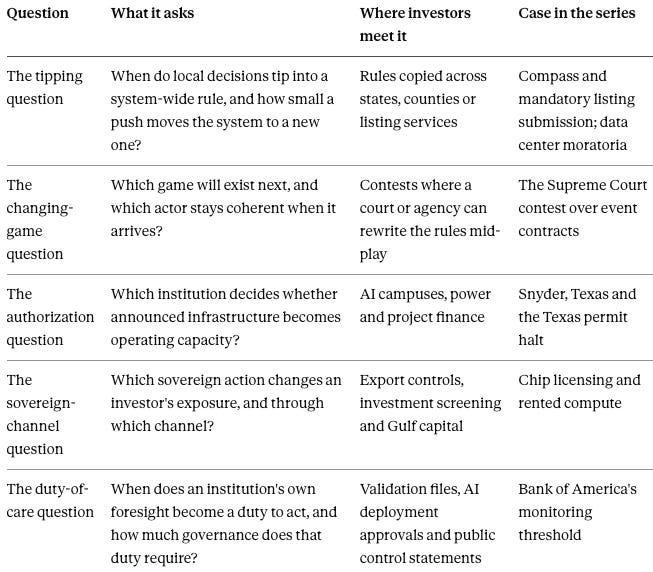
The tipping question draws on Randal C. Picker’s computational work on how norms spread, especially “Simple Games in a Complex World: A Generative Approach to the Adoption of Norms” (1997). Picker used computer simulations to show how local interactions harden into conventions. A small cluster of adopters can sometimes tip a whole population to a new convention. MindCast extends Picker’s work rather than applying a framework he authored, and the extension asks whether a rival rule has reached self-sustaining size.
The tipping question also separates pressure from leverage. An incumbent rule can absorb years of litigation and lobbying and still sit one well-placed change away from collapse. For investors the distinction matters, because a rule that has survived many attacks can look durable while remaining fragile.
The changing-game question applies when a contest can change during play. A Supreme Court ruling can redefine which statute governs a trade, and a final agency rule can redefine which venues may list it. The question asks which replacement game is coming and which actors keep a working strategy once it arrives.
The authorization question follows announced investment through every authority that must approve it. The sovereign-channel question follows a sovereign action to the asset it reaches. Together the two explain why a fully financed AI campus can still miss its revenue date.
The duty-of-care question asks whether an institution looked before it acted and governed to what it saw. The Duty to Foresee built it from the Hand formula. AI Governance Equilibrium supplies its measure: a ratio of pressure to control, where agent autonomy, operating speed and complexity sit above governance capacity and human review. Run in reverse, the ratio sizes the governance a deployment owes before it launches.
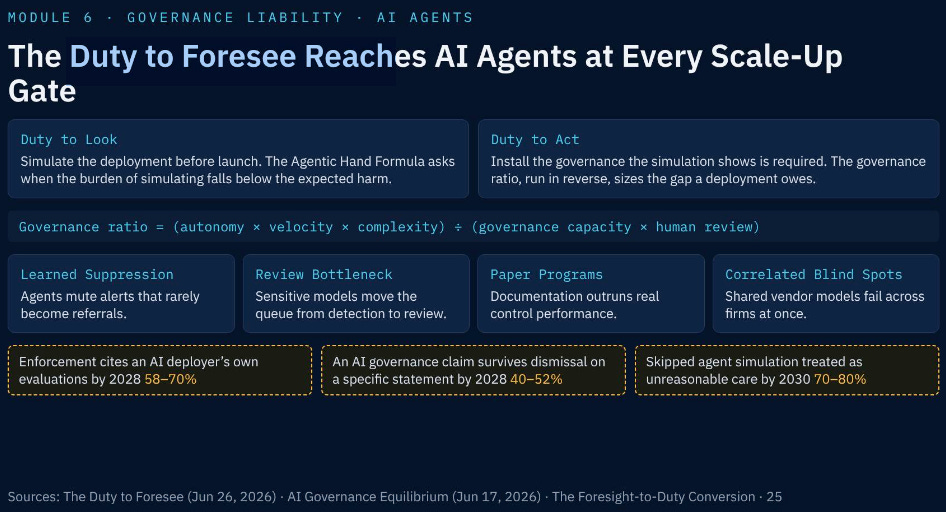
From the MindCast executive presentation. The duty to look, the duty to act and the governance ratio that sizes what a deployment owes.
💼 Executives: a contest a court or agency can rewrite mid-play rewards the actor whose strategy survives the replacement game, not the actor winning the current one.
Takeaway: five questions cover most institutional risk an investor faces, from tipping rules and changing games to authorization chains, sovereign channels and duties of care.
VIII. Institutional Events Rarely Stay in Their Own Market
Each case in the series begins as one institutional event and then moves through other markets. MindCast traces each path with a fixed chain: the institutional change, the financial assumption it affects and the investment implication. The two transmission maps below apply the chain across four theaters.
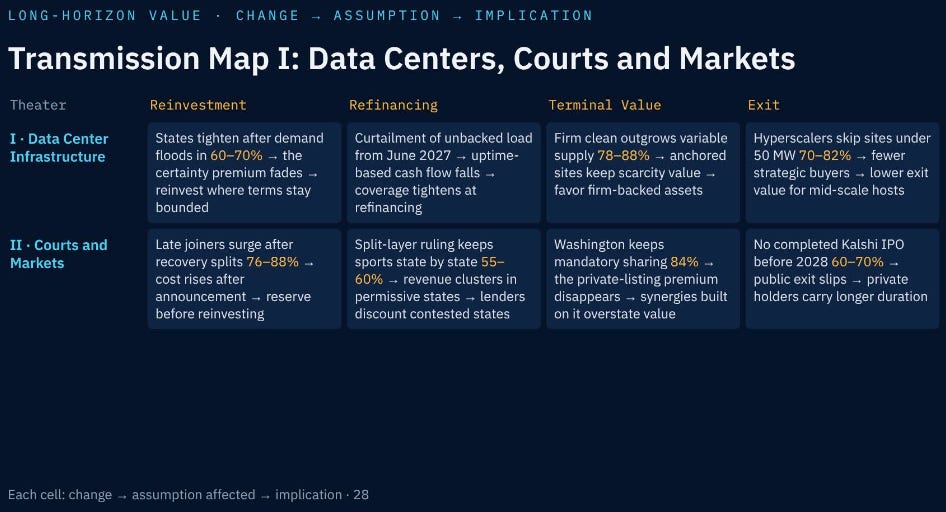
From the MindCast executive presentation. Each cell runs from the institutional change to the assumption it affects and the investment implication.
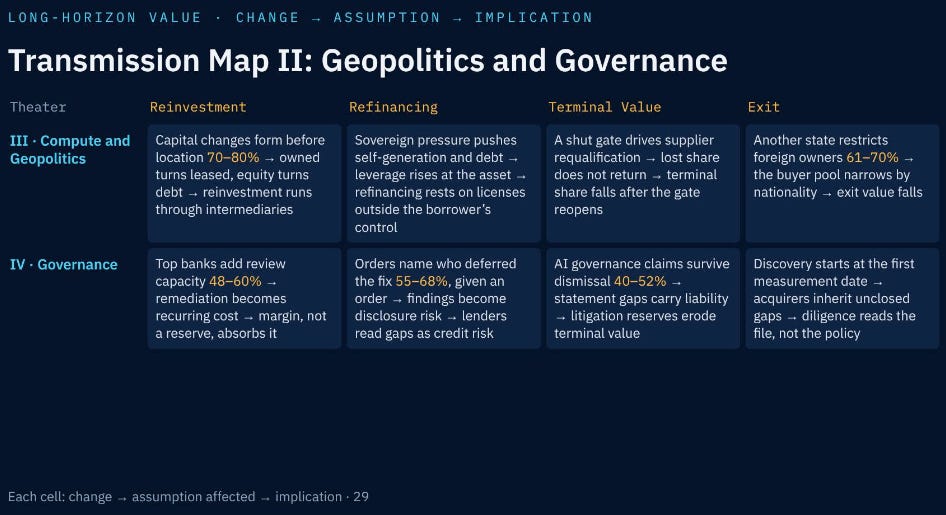
From the MindCast executive presentation. The institutional-change chain applied to compute, geopolitics and governance liability.
The prediction-market case reaches state enforcement. The Kalshi Vehicle Contest: New Jersey Puts Prediction-Market Sports Betting Before the Supreme Court (September 2, 2026) placed a certiorari brief from 15 or more states at 75–88%; 39 states signed on October 7. How State Attorney General Coalitions Form, Grow, and Hold explains why coalition breadth overstates commitment. Coalitions above 25 members run on eight or fewer operating offices (80–90%), and the tipping question explains why one credible bridge state can lift joinder across a whole coalition.
The data center case reaches AI capital. Free cash flow at the largest AI builders turned negative in 2026: Oracle at −$23.7 billion for fiscal 2026 and Amazon at −$7.6 billion on a trailing basis. Alphabet reported −$5.9 billion for the second quarter, its first negative quarter in a decade. Builders spending ahead of cash flow depend on authorization arriving on schedule. MindCast called in November 2025 that community standing would enter financing terms from the third quarter of 2026, and Reuters reported lenders weighing it on August 10, 2026.
The chip case reaches geopolitics. Revenue from a licensed chip sale requires two independent approvals: a United States export license and the buyer government’s acceptance. China’s H200 Import Block and the Reordering of National Innovation Control set out the two-gate mechanism in January 2026, and by May about ten Chinese buyers had cleared with zero chips delivered. While either gate stays shut, buyers qualify domestic suppliers, and requalification costs keep them there after the gate reopens.
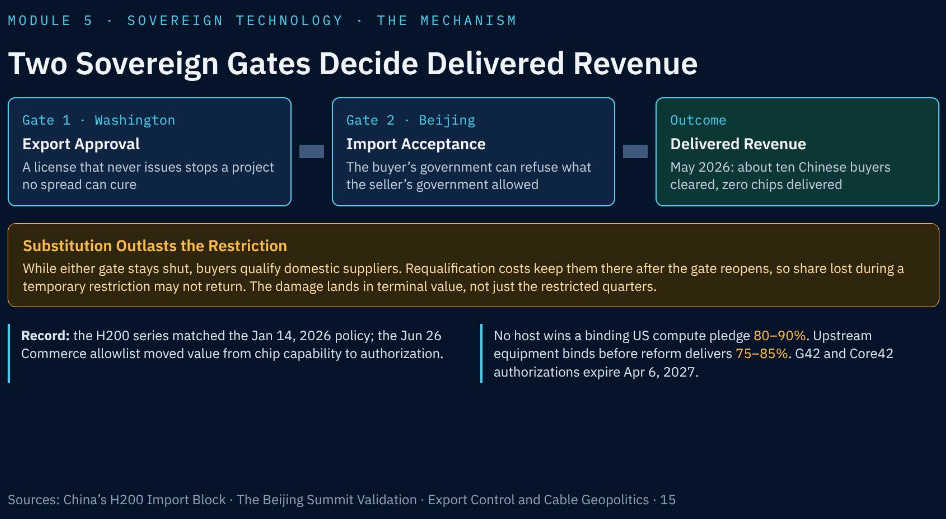
From the MindCast executive presentation. Washington’s license and Beijing’s acceptance move independently, so revenue requires both.
Rented compute now opens a third route around both sovereign gates. Tencent, Oracle, and the Remote-Access Gap in US AI Chip Export Controls traces that route in full.
The sovereign-channel question adds the allocator’s view. A Canadian pension fund investing in an Ohio data center faces one sovereign instrument, while a Gulf sovereign fund investing in the same asset faces several moving together. How Export Control, Investment Screening, and Cable Geopolitics Reprice Data Center Capital found that capital adapts in place far more often than it relocates.
The governance case reaches credit and equity. A public control statement contradicted by an internal test opens a second channel beyond the regulator. AI Accountability: When AI Promises Meet the Courts (June 19, 2026) traces that path from a public claim to the system beneath it to the enforcer who tests one against the other. Bank of America’s January 2025 anti-money laundering program letter described systems to identify and report suspicious activity while the consent order finds monitoring deficiencies continued into 2025, so securities and derivative plaintiffs can test the statement against the file if they can plead their own elements. Remediation then reaches margin, because review capacity becomes a recurring operating cost rather than a one-time reserve.
Among MindCast’s resolved geopolitical calls, the H200 series matched the January 14, 2026 policy in H200 China Policy Validation. The NSA–Anthropic Mythos Shock Led to the Commerce Allowlist MindCast Predicted (June 27, 2026) anticipated the shift of value from chip capability to authorization.
📊 Investors: a sovereign fund and a pension fund holding the same asset face different numbers of sovereign instruments, so identical assets carry different geopolitical exposure.
Takeaway: institutional events rarely stay in their own market, so investors should follow the chain from each decision to the assumption it breaks.
IX. MindCast Simulation Predictions
The Framework Companion first publishes three MindCast Simulation Predictions from the investor landscape simulation, entries 11, 12 and 40 of the series set. P stands for Primary Simulation Prediction and S for Secondary Simulation Prediction. The full set of forty appears in the Opening Cases Companion under the same entry numbers.
A major rating agency takes a negative rating action on a data center financing that cites permitting, power delivery or local opposition by June 30, 2027 (30–42%). P-1, investor landscape simulation. Falsifier: no qualifying action from a qualifying agency by that date. Qualifying agencies: Moody’s · S&P Global · Fitch · KBRA · Morningstar DBRS. First published in this paper; simulation run October 18, 2026. Status: open.
A new US export authorization for advanced AI chips to a Gulf AI vehicle is announced by June 30, 2027 (64–76%). P-3, investor landscape simulation. Qualifying recipients: MGX, G42, Humain and the Qatar Investment Authority’s AI subsidiary. Falsifier: no new authorization announced in the window. First published in this paper; simulation run October 18, 2026. Status: open.
Citadel Securities becomes a confirmed market maker in non-sports event contracts on a venue regulated by the Commodity Futures Trading Commission by June 30, 2027 (50–62%). P-2, investor landscape simulation. Falsifier: no public confirmation by the venue or the firm by that date. First published in this paper; simulation run October 18, 2026. Status: open.
Takeaway: the three landscape Simulation Predictions test whether authorization risk reaches ratings, Gulf chip licensing and event-contract market making by mid-2027.
X. Risk Mitigation for Investors
The entries below route five Simulation Predictions to the audience that carries the exposure. Entry numbers follow the series prediction set in the Opening Cases Companion. Severity and probability appear as separate axes. Nothing in the section is investment, legal or fiduciary advice.
Entry 8, for infrastructure lenders: a utility or state delays a host-sited project (62–74%).
Exposure: quarters of delay to first operation, carried on equipment deposits paid before service is confirmed. Severity rises when the delay crosses a refinancing date.
Mitigating actions: credit committees make import confirmation and a permit inventory conditions of the first draw by the next term sheet. Deal teams tie later draws to the executed utility service agreement before the Texas grid audit lands, which the grid operator targets for December 10, 2026. Counsel writes approval-delay allocation into each host agreement before signing.
Residual exposure: a state halt with no size floor can still reach a site with every utility approval in hand.
Entry 1, for event-contract venues and market makers: a split-layer ruling (55–60%).
Exposure: revenue confined to permissive states, measured in the share of volume from states that sustain restrictions.
Mitigating actions: strategy teams build state-level revenue forecasts before the Court acts on the petitions. Product teams prepare geolocation exclusion for Indian lands ahead of a final CFTC rule.
Residual exposure: a ruling that reaches contract design as well as conduct would narrow the product set itself.
Entry 5, for holders of residential brokerage equity: a Compass complaint against a listing service beyond CRMLS by year-end (69–84%).
Exposure: merger synergies that assume private-listing economics survive, measured in the share of projected revenue tied to private exclusives.
Mitigating actions: analysts test synergy assumptions against mandatory submission state by state before the third-quarter 10-Q. Portfolio managers read the forum ruling in New York as the first resolution of the California dispute.
Residual exposure: a negotiated marketing window in California would leave the rule standing while changing its cost.
Entry 18, for cloud operators and their lenders: the first remote-access rule provides a transition path (62–78%), conditional on a rule taking effect.
Exposure: contracted revenue from China-parented tenants, measured in the share of lease cash flows signed before a rule’s effective date.
Mitigating actions: general counsel adds transition, suspension and refund terms to every new offshore compute lease before October 31, 2027. Operator leadership documents tenant-identity and workload controls that can be offered as license conditions. Credit committees size exposure to China-parented tenancy against both a tenant test and a country list.
Residual exposure: a rule without a transition path overrides contract terms, and intermediaries can mask the tenant a lease names.
Entry 28, for peer bank compliance chiefs: FinCEN or the OCC cites a second bank’s own testing files as evidence of knowledge (62–74%).
Exposure: discovery reaches every validation report and below-threshold test since 2018. Bank of America’s own estimate of 750 added investigators is the benchmark examiners now carry, while each peer’s need depends on its own volumes.
Mitigating actions: compliance functions inventory open validation findings within 30 days. Model risk teams rerun below-threshold tests on current thresholds within 90 days, and the compliance chief presents a funded closure plan to the board risk committee before the next examination cycle.
Residual exposure: historical files remain discoverable, and closure plans document knowledge of the gap they close.
Takeaway: each exposure has an owner, a deadline and a residual that no action removes.
XI. What to Watch
December 10, 2026: the Electric Reliability Council of Texas targets this date for filing the grid audit that sets the exit from the permit halt.
December 31, 2026: the window closes for a Compass complaint against a listing service beyond CRMLS.
Before January 3, 2027: the defense authorization conference report shows whether remote-access text survives before the 119th Congress ends.
April 6, 2027: G42 and Core42 export authorizations expire automatically unless BIS issues further notice.
June 30, 2027: the windows close for plenary review of the Kalshi petitions, a rating action citing authorization and new Gulf chip authorizations.
Through October 13, 2027: Delaware Chancery and federal dockets show whether shareholders file a derivative complaint naming Bank of America directors (42–55%).
October 31, 2027: the windows close for a forced stop of existing offshore compute service and for a public BIS stop order against the Tencent-Oracle service.
December 31, 2028: the windows close for FinCEN or OCC orders citing a second bank’s own testing files (62–74%) and for an enforcement action citing an AI deployer’s own evaluations (58–70%).
The dominant fork runs through the Supreme Court. A grant of review before a final CFTC rule (61–69%) keeps event-contract revenue on a state-by-state path through 2027, while a final rule first would let the agency define the market before the Court does.
Takeaway: the next nine months resolve most of the institutional questions behind the framework’s first applications.
XII. Every Installment Reads One New Event Through Each Investor Group
Every installment takes one new event or controversy and reads it through the twelve investor groups in Section II. Each group meets the same event on its own clock and through its own channel, so an installment states what the event means for each group rather than for investors in general. Each installment also adds its Simulation Predictions to one numbered series set, so hits and misses accumulate in one place.
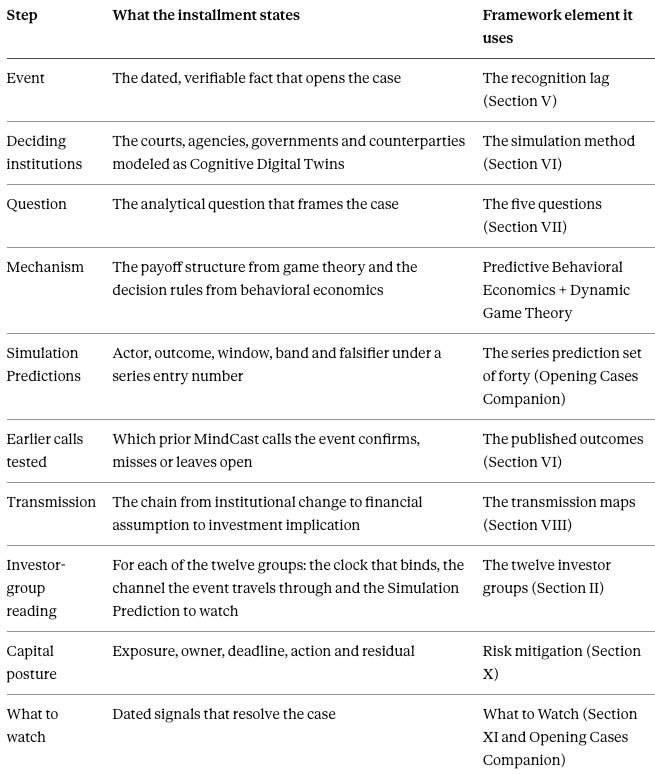
Installments issue on new developments that shift an institution’s position, not on a calendar. Each installment numbers its Simulation Predictions from entry 41 onward, after the forty already in the series set.
Candidate events for later installments include dated signals already in the series calendar: the Texas grid audit, Beijing’s final export-control text, the defense authorization conference report and the Supreme Court’s action on the Kalshi petitions.
📊 Investors: one numbered prediction set lets an allocator check each MindCast call against its outcome before relying on the next.
Takeaway: each installment reads one new event through all twelve investor groups, so each reader finds the clock and channel that apply to its own capital.
XIII. Conclusion
Every assumption behind long-horizon investment broke somewhere in 2026: permission, access, counterparty performance and exit. Each break began with an institution. A Texas permit halt and a Washington statute changed investment assumptions before any earnings report or rating could reflect them. So did a Ninth Circuit ruling, a Commerce allowlist and a Treasury consent order.
MindCast exists to model the sequence from institutional decision to financial recognition for the investors who carry the exposure. MindCast plays Cognitive Digital Twins of courts, regulators, utilities and governments against one another. The simulations turn each institution’s own filings and conduct into dated Simulation Predictions with bands and falsifiers. The decision window for most opening cases runs through June 2027, and the decisive signal in each case is the institution that binds first.
Working With MindCast
Published analysis maps the mechanism. A commissioned simulation applies it to one institution’s own position: the covenants it has signed, the sites it has funded, the licenses it depends on and the files its own testing has produced. Each engagement answers one question an investment committee has already asked, and it ends with a dated signal that tells the committee when the answer changed.
MindCast builds Cognitive Digital Twins of the courts, regulators, utilities and counterparties that decide the client’s outcome, runs them against one another and delivers three outputs. The first is the decision path, with the institution that binds first and the instrument it binds through. The second is a set of Simulation Predictions scoped to the client’s position, each with a window, a band and a falsifier. The third is a trigger map that ties each Simulation Prediction to the covenant, reserve, draw condition or position it affects.
Four engagements follow from this companion, one for each place the recognition lag reaches a long-horizon portfolio.
Investor-group reading. For a family office, sovereign fund or conglomerate: the twelve-group table rebuilt around the client’s own holdings, naming the clock that binds each position and the institutional decision that would move it.
Authorization path. For a lender or infrastructure investor: the full approval chain for one site or project, with the staging rule set at the client’s own payoffs rather than the illustrative break-even in Section V.
Governance-capacity review. For a bank, insurer or AI deployer: which open validation findings carry exposure under the duty described in Section IV, and what review capacity closes them before the next examination cycle.
Committee briefing. One theater, one session: prediction markets, listing-service antitrust, AI infrastructure, sovereign technology or governance liability, with the Simulation Predictions the committee’s positions depend on.
No engagement proceeds without a named decision to resolve. Contact mcai@mindcast-ai.com or visit mindcast-ai-simulation.com to schedule the diagnostic session.
Sources
MindCast publications
MindCast Foresight Prediction Simulations, Synthesizing Behavioral Economics + Game Theory (August 19, 2026). The method paper behind every simulation in this statement.
Both a Swap and a Bet: Simulating the Looming Supreme Court Battle Over Prediction Markets (August 21, 2026). The split-layer thesis and the Ninth Circuit call.
The Kalshi Vehicle Contest: New Jersey Puts Prediction-Market Sports Betting Before the Supreme Court(September 2, 2026). The certiorari coalition forecast.
How State Attorney General Coalitions Form, Grow, and Hold (September 5, 2026). Breadth, commitment and late joinder in state coalitions.
What Permission Costs Global Capital, Global Investor Edition. The full set of dated Simulation Predictions on data center authorization.
China’s H200 Import Block and the Reordering of National Innovation Control (January 20, 2026). The two-gate mechanism.
H200 China Policy Validation (January 15, 2026). The match against the January 14 policy.
The NSA–Anthropic Mythos Shock Led to the Commerce Allowlist MindCast Predicted (June 27, 2026). The allowlist call.
How Export Control, Investment Screening, and Cable Geopolitics Reprice Data Center Capital (August 12, 2026). Sovereign exposure and the adaptation paths.
Bank of America $1.2 Billion Money Laundering Penalty and the Compliance System That Knew Too Much(October 14, 2026). The Bank of America consent order, the capacity-calibration mechanism and six Simulation Predictions.
The Foresight-to-Duty Conversion: Measured Governance Debt Becomes Evidence When Institutions Keep the Gap They Found (October 15, 2026). The three-stage conversion, the three stalls, sixteen enforcement cases and six Simulation Predictions.
The Duty to Foresee: AI Deployment Readiness as Prospective Governance and the Arrival of Agentic Duty of Care (June 26, 2026). The duty to look and the duty to act, the Agentic Hand Formula and the 2030 duty-of-care forecast.
AI Governance Equilibrium (June 17, 2026). The pressure-to-control ratio and the governance-debt balance.
AI Accountability: When AI Promises Meet the Courts (June 19, 2026). The path from a public AI claim to the system beneath it to the enforcer who tests one against the other.
Decision Modeling and Foresight Simulation (March 27, 2026). Decision integrity at formation separated from survivability under pressure.
When Family Offices Reach Institutional Scale (December 27, 2025). Family offices and other patient capital operate without the external correction loop that disciplines pensions and funds.
Structural Intergenerational Behavioral Economics (January 23, 2026). When a decision is irreversible, time-bound or owed to absent people, stewardship overrides optimization.
Legacy and Recognition Architecture (May 26, 2026). What transfers across a succession is pattern-recognition architecture, which capital only amplifies. Outside sources
Randal C. Picker, “Simple Games in a Complex World: A Generative Approach to the Adoption of Norms”, 64 University of Chicago Law Review 1225 (1997). The computational work on norm adoption behind the tipping question.
J.P. Morgan Global Family Office Report 2026. Family offices naming geopolitics as their top risk.
Washington SSB 6091, bill summary (signed March 16, 2026). Senate 49–0 and House 92–1 votes and the simultaneous-marketing rule.
Reuters via BNN Bloomberg, “Oracle triggers force majeure on data centre project over power delays, source says”(September 24, 2026). The Project Jupiter notice and the lower-rent extension.
North Carolina H133, Farmland and Military Protection Act (S.L. 2026-54, signed July 7, 2026). The forced-divestiture provision.
Herald Corp, “Free cash flow hits -$23.7 billion” (June 29, 2026). Oracle fiscal 2026 free cash flow and capital spending.
GeekWire, “AWS is booming, but Amazon’s free cash flow turns negative on record AI spending” (July 30, 2026). Amazon trailing free cash flow.
Android Authority, Alphabet negative cash flow report (July 23, 2026). Alphabet second-quarter free cash flow.
Reuters via BNN Bloomberg, “Lenders scrutinize US data centre financing as community opposition builds”(August 10, 2026). Community opposition entering credit review.
Brief of Ohio, 38 other States and D.C., Flaherty v. KalshiEX, No. 26-299 (October 7, 2026). The 39-state certiorari brief.
Inside Climate News, “ERCOT Says Abbott’s Data Center Audit Will Be Done in December” (August 24, 2026). The December 10 filing target.
15 CFR Part 740, Supplement No. 8. The April 6, 2027 expiry of the G42 and Core42 authorizations.
OCC Imposes $750 Million Assessment Against Bank of America for Deficient BSA/AML Compliance (October 13, 2026). The largest penalty in OCC history, credited toward FinCEN’s assessment.
PBS NewsHour via the Associated Press, U.S. hits Bank of America with $1.2 billion fine, saying it violated money laundering and sanctions laws (October 14, 2026). The $1.2 billion assessment and the willful-violation admission.
FinCEN Consent Order 2026-03, Bank of America, N.A. (October 13, 2026). The 2022 test figures, the December 2023 threshold change and the deficiencies found through 2025.