
Companion works: Predictive Behavioral Economics + Dynamic Game Theory AI Simulations and Long-Horizon Investor Foresight on Courts, Regulators, Geopolitical Dynamics and Markets · MindCast Institutional Foresight for Long-Horizon Capital (Executive Presentation, unpublished)
Thesis. Courts, regulators, utilities and governments decide investment assumptions before earnings and ratings recognize them. MindCast AI simulates those institutions so investors can act inside the delay.
Why now. Five contests reach decision points between now and 2028. The Supreme Court holds petitions that decide whether event contracts become a national asset class, and Compass opened a second antitrust front against a multiple listing service (MLS) on October 16. Texas halted data center permits on September 21 with no size floor, and Tencent’s reported $7 billion lease of chips in Oracle data centers routes AI capability around the export gates of both Washington and Beijing. On October 13 Bank of America admitted a willful Bank Secrecy Act violation after its own 2022 tests had measured the blind spot regulators later penalized.
Who it reaches. Event-contract venues, brokerage shareholders and infrastructure lenders each meet one contest first. Cloud operators and bank boards meet the other two.
Contents
I. Executive Summary
II. The Supreme Court Decides Whether Event Contracts Become a National Asset Class
III. Compass Carries Its Listing-Access Fight from Washington to California
IV. One Texas Permit Halt Revalues Mid-Scale Compute
V. Washington and Beijing Compete Through Two Sovereign Gates While Rented Compute Routes Around Both
VI. Bank of America Measured Its Own Blind Spot, and the Measurement Became the Evidence
VII. The Operative Instrument Connects Institutional Decisions to Investment Exposure
VIII. MindCast Simulation Predictions
IX. Risk Mitigation for Investors
X. What to Watch
XI. Conclusion
Working With MindCast · Sources
I. Executive Summary
Core insight. Institutional decisions change investment assumptions before earnings, credit terms and ratings reflect them. The delay between the decision and its financial recognition is where long-horizon capital wins or loses. A permit halt changes the quarter a data center reaches revenue, and a court’s choice of statute decides which states a trading venue can serve.
Method. MindCast AI applies Predictive Behavioral Economics + Dynamic Game Theory through MindCast AI Proprietary Cognitive Digital Twin Foresight Simulations (MP CDT FS). Behavioral Economics supplies the decision rules. Game Theory supplies the payoff structure. Predictive simulations emerge from the combination.
Original contribution. One mechanism repeats across five contests, from a Supreme Court case to a bank’s monitoring threshold: the authority that draws attention rarely binds first.
How to read the evidence. Linked sentences state verified facts and name their source. Bold probability bands mark MindCast Simulation Predictions, each with a window and a falsifier. Table notes flag MindCast’s own readings, and modeled payoffs are labeled as assumed.
The framework in brief. Each deciding institution becomes a Cognitive Digital Twin (CDT) built from its own filings, rulings and conduct. The CDTs play against one another until no actor can improve its position. Each resulting Simulation Prediction names an actor and an outcome with a window, a probability band and a falsifier.
Five analytical questions frame the cases:
The changing-game question, applied to the Supreme Court contest, asks which game will exist next and which actor stays coherent when it arrives.
The tipping question, applied to listing-service rules, asks when local decisions tip into a system-wide rule.
The authorization question, applied to the Texas permit halt, asks which institution decides whether announced infrastructure becomes operating capacity.
The sovereign-channel question, applied to the contest between Washington and Beijing, asks which sovereign action changes an investor’s exposure and through which channel.
The duty-of-care question, applied to Bank of America’s monitoring threshold, asks whether an institution looked before it acted and governed to what it saw.
The Framework Companion sets out the method and the five questions in full.
The case studies. Five case studies carry the Opening Cases Companion. The table compares them on four dimensions: event, deciding institutions, MindCast finding and investor consequence. Each row stands alone.
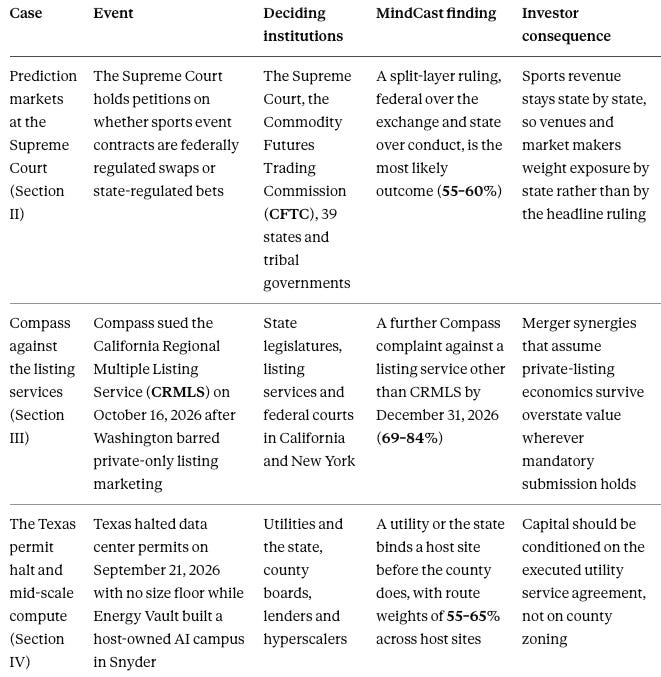
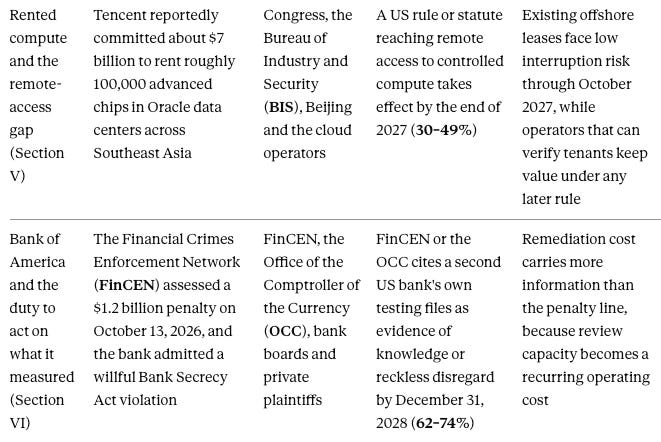
What the Opening Cases Companion covers. Sections II through VI work through the five opening cases, and Section VII states the instrument that connects each case to investment exposure and the lessons each adds to MindCast’s framework. Section VIII sets out the series’ forty Simulation Predictions, including fifteen from the October 19 rented-compute papers and twelve from MindCast’s governance papers. Sections IX and X route six of them to the investors who carry the exposure and list the dated signals that resolve them.
📊 Investors: Underwrite on the institutional decision that binds first, not the one that draws headlines; in AI infrastructure that decision usually belongs to a utility or a state.
💼 Executives: Treat a regulator’s next move as a counterparty decision with a payoff structure you can model.
⚖️ Counsel: Contradictions across a litigant’s own filings in different forums predict outcomes better than docket counts.
🏛️ Policymakers: Rules copied across jurisdictions spread through tipping dynamics, so the first adopters shape the national regime.
Takeaway: in each of the five contests an institution changes an investment assumption before the financial result arrives.
II. The Supreme Court Decides Whether Event Contracts Become a National Asset Class
Prediction markets proved the demand for event contracts and left the hardest legal question open. The Intercontinental Exchange (ICE) committed up to $2 billion to Polymarket in October 2025 (ICE announcement). Kalshi reached a $22 billion valuation in early 2026, and 89% of its 2025 fee revenue came from sports. Whether sports event contracts count as federally regulated swaps or state-regulated bets now sits before the Supreme Court.
Both a Swap and a Bet: Simulating the Looming Supreme Court Battle Over Prediction Markets (August 21, 2026) holds that a single trade is both a swap and a bet across three layers: the venue, the contract and the conduct. Federal control of one layer need not reach the other two. Three outcomes compete before the Supreme Court.
Full federal preemption. Federal commodities law governs the exchange, the contract terms and trading conduct, so states lose authority over sports contracts listed on a federally regulated exchange. Falsifier: the Court leaves any conduct regulation to the states.
Full state authority. State gaming law reaches the contracts themselves, so federal registration does not protect the venue in restrictive states. Falsifier: the Court holds that federal law governs the exchange.
Split layers. Federal authority governs the exchange while state authority governs conduct. Falsifier: the Court adopts either of the other two outcomes.
Both a Swap and a Bet names a split-layer ruling as the most likely outcome (55–60%). Under a split-layer ruling, sports revenue stays state by state rather than national.
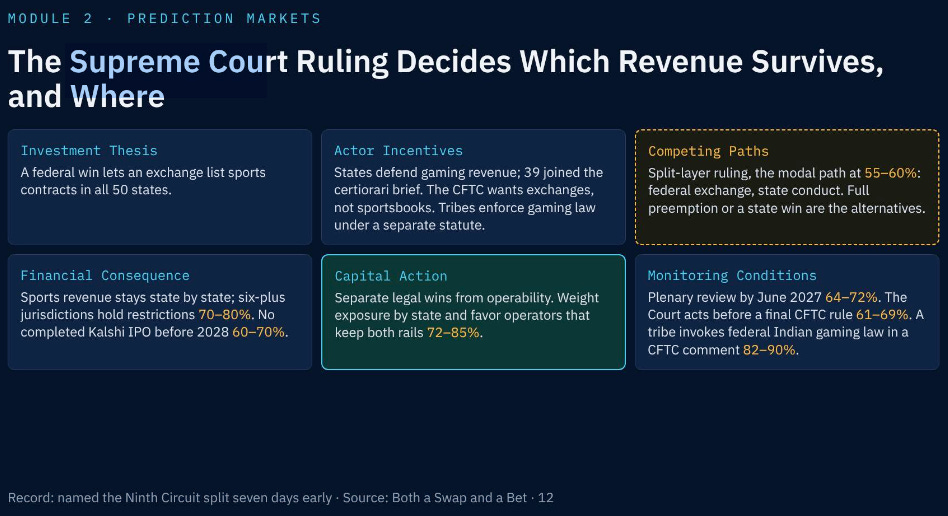
From the MindCast executive presentation. Dashed borders mark Simulation Predictions; solid borders mark documented facts.
The changing-game question explains why the event-contract contest resists a clean win. The CFTC wants exchanges rather than sportsbooks, and states defend gaming revenue; 39 states joined a certiorari brief in October. Tribes enforce gaming law under a separate federal statute. On September 16, 2026 the Ninth Circuit held in Blue Lake Rancheria v. Kalshi that two California tribes are likely to succeed on federal Indian gaming law claims, adding a third sovereign to a two-sided fight.
MindCast’s prediction-market calls include a hit and a miss. Both a Swap and a Bet named the Ninth Circuit as the court likeliest to break with the Third Circuit, and the Ninth Circuit ruled seven days later. Both a Swap and a Bet also forecast a circuit count of 3–1 or 2–2 after the Sixth Circuit ruled; the count stood at 2–1, a miss.
📊 Investors: separate legal wins from operability, and weight event-contract exposure by state. Operators that keep both a prediction-market venue and a licensed sportsbook hold the hedge a split-layer ruling rewards.
Takeaway: the Supreme Court decides which states an event-contract venue can serve, and that map sets what a national event-contract business is worth.
III. Compass Carries Its Listing-Access Fight from Washington to California
Compass built a distribution strategy on private exclusive listings: homes marketed inside Compass before they reach the cooperative database rival brokers share. The Anywhere Real Estate merger assumed the private-listing premium would hold. Listing services defend the opposite rule, mandatory submission, under which a listing marketed to the public must enter the shared database within a set window.
Washington answered the listing-access question for one state, where the Northwest Multiple Listing Service (NWMLS) runs the shared database. The legislature passed Substitute Senate Bill (SSB) 6091 by 49–0 in the Senate and 92–1 in the House, barring marketing to a select group unless the home reaches the public and all brokers at the same time; MindCast’s founder testified on the bill. The Compass–NWMLS Settlement Changed the Private Governor After Washington Changed the Governing Law (September 1, 2026) found that mandatory sharing survived the August 31 agreement. The September 1 paper places Washington holding as cooperative absorption at 84%, a point estimate published without a closing date.
Compass opened a second front on October 16, 2026. Compass sued CRMLS in the Central District of California with Sherman Act counts that attack mandatory submission itself. Compass v. CRMLS Is the Suit That Tests It (October 17, 2026) observes that Compass endorsed mandatory submission in 2024 and preserved it in its Washington agreement. CRMLS had filed first in the Southern District of New York on October 5.
Two rules compete for the national listing market. A discriminating observation favors one reading without disproving the other, while a falsifier rules a reading out.
Mandatory submission holds. Listing services keep requiring publicly marketed listings to enter the shared database, and peer services adopt the rule ahead of new statutes. Discriminating observation: CRMLS changes its rules to allow public marketing before submission.
Private exclusives spread. Courts or agreements open a lawful path to market listings privately before submission, and other listing services follow. Discriminating observation: two or more peer listing services adopt mandatory-sharing reforms by August 31, 2027. Peer services can adopt different rules at once, so adoption favors the first reading without disproving the second.
The tipping question frames the national listing-access contest: mandatory submission is the incumbent rule across most of the country, and private exclusive listings are the rival rule. Washington reinforced the incumbent rule in one state, and California tests whether the rival rule can take hold in a second. Compass v. CRMLS places a further Compass antitrust complaint against a listing service other than CRMLS by the end of 2026 at 69–84%. Compass v. CRMLS also places a quiet rule change by at least one listing service that copies the California outcome at 40–54%.
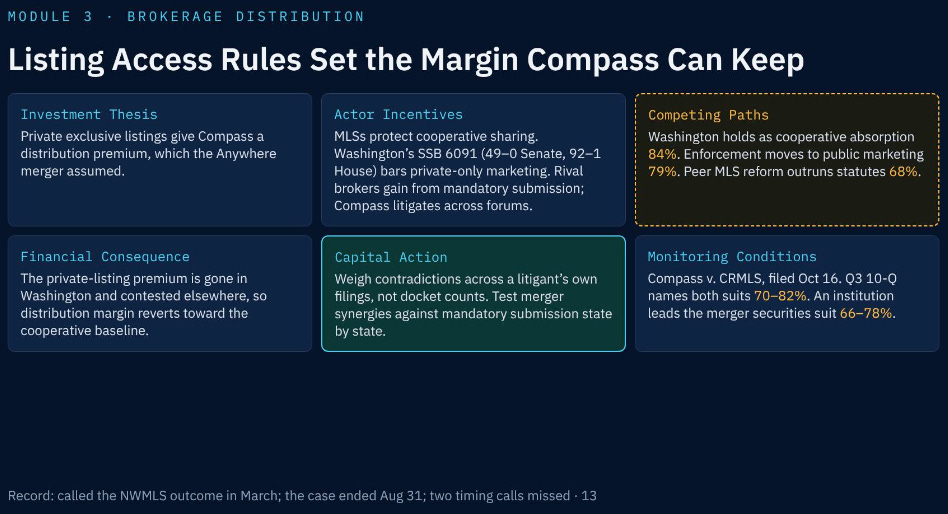
From the MindCast executive presentation. Washington’s 84% figure is a point estimate as published.
The California litigation also reaches Compass’s equity. What the Private-Listing Economics Add to Magloire v. Compass, the Securities Act Case Already Pending Over the Anywhere Merger (October 17, 2026) covers the Securities Act suit over the Anywhere merger and places Compass’s third-quarter 10-Q naming both suits at 70–82%. MindCast’s Compass calls are mixed: the March 23, 2026 call that NWMLS would prevail or the case would resolve by agreement closed with the August 31 agreement, while two Compass timing calls missed.
⚖️ Counsel: Compass’s own 2024 endorsement and its Washington agreement both cut against the Sherman Act theory it now presses in California.
Takeaway: a publicly traded firm’s multi-state campaign against one industry rule becomes an equity question once merger synergies depend on the rule falling.
IV. One Texas Permit Halt Revalues Mid-Scale Compute
Owning land, storage and generation should let a clean energy company host AI compute first. Energy Vault broke ground on a host-owned AI campus in Snyder, Texas on July 27, 2026. The first phase places 10 Crusoe Spark modular data centers at the site with 8 megawatts of capacity, and a second phase could reach 25 megawatts. On September 21 the Texas governor directed the state environmental agency to halt data center permits pending grid and water audits, with no size floor.
MindCast ran thirteen CDTs on the Snyder case on October 9, 2026. The roster set four hyperscalers and two power providers alongside hosts, operators and state and county approvers. Lenders, firm clean power developers and curtailment providers completed it.
Two readings compete for which authority binds a host site first:
The county binds first. Local boards react to the data center label and halt modules through zoning or moratoria. Discriminating observation: no county halts modules at an operating energy site before the end of 2027.
The utility or state binds first. Load thresholds and state permits stop or delay a host site before any county acts. Discriminating observation: no host-sited modular project reports a delay from a utility or the state before the end of 2027.
Where the Clean Energy Host Advantage Holds and Where It Breaks in AI Data Centers (October 9, 2026) reports the Snyder result. The county, the authority that draws public attention, is the least likely of five authorities to bind a host site. A utility or the state binds first.
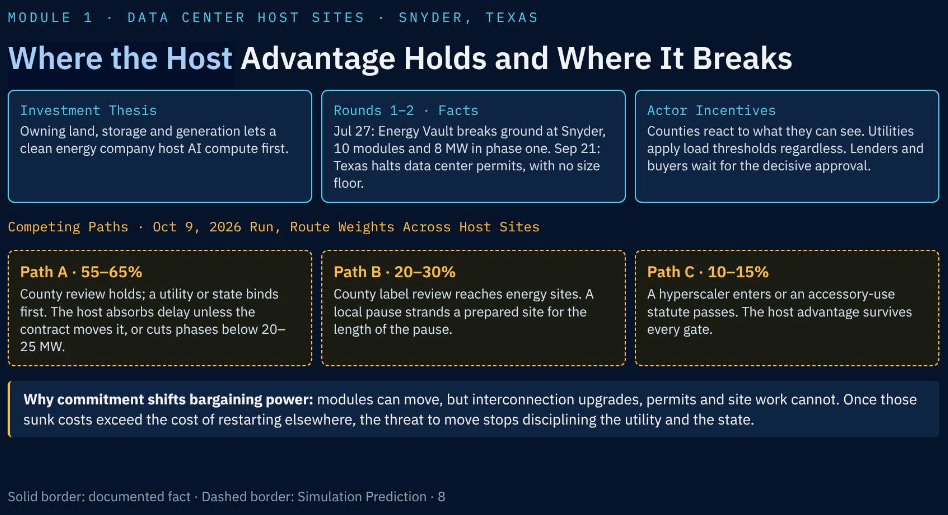
From the MindCast executive presentation. Route weights from the October 9, 2026 Snyder simulation describe host sites in general, not one project.
Behavioral economics explains why authorities split on host sites. County boards react to the salient “data center” label, while utilities apply load thresholds whatever the label says. Game theory explains the cost of the split: each authority writes terms inside its own instrument, and the host bears the cost of translating among them.
The Snyder simulation also found a squeeze on mid-scale AI load. Hyperscale campuses pass every gate by scale, and a single small module can sometimes connect below utility thresholds. Mid-scale load fails three gates at once: firm clean power suppliers set minimum contract sizes, federal reliability criteria reach only sites of 50 megawatts (MW) and above, and hearings judge the tier as a campus. MindCast places no hyperscaler hosting below 50 MW at a third-party energy site through 2027 at 70–82%, which shrinks the exit buyer pool for mid-scale capacity.
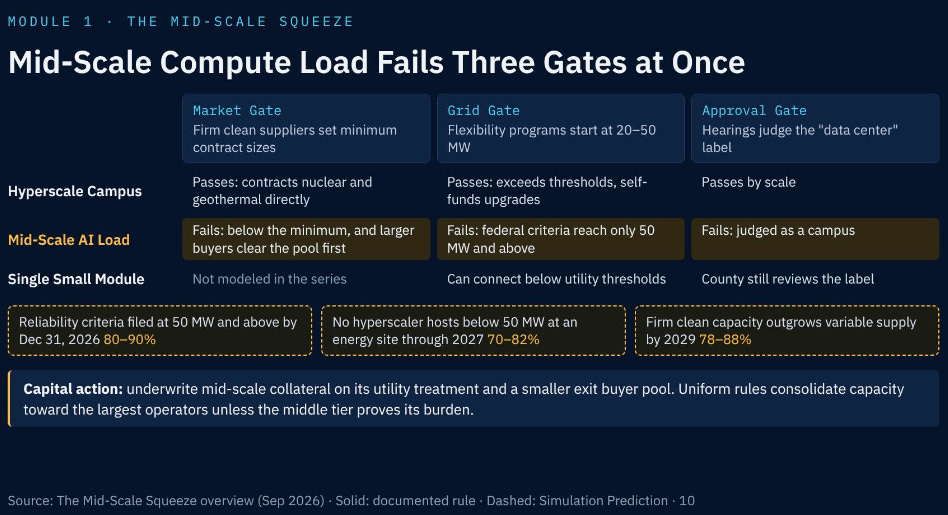
From the MindCast executive presentation. Solid cells mark documented rules; dashed chips mark Simulation Predictions.
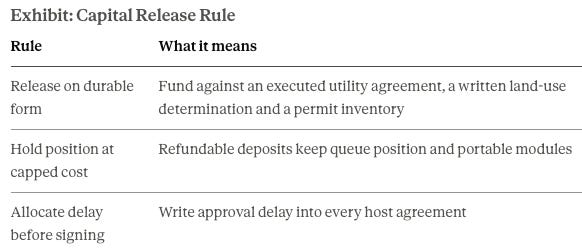
The Snyder simulation’s paths set the capital decision. With assumed payoffs, staging funding to the executed utility service agreement beats committing on zoning once the chance that a utility or state binds the site tops 29%. The 55–65% route weight describes host sites in general, so a commissioned simulation sets each site’s own figure. Staging also keeps the decision reversible, which matters because Structural Intergenerational Behavioral Economics (January 23, 2026) finds that decision-makers stop optimizing once a commitment becomes irreversible and start preserving what they already hold.
📊 Investors: condition capital on the utility, not the county.
Takeaway: in AI infrastructure the authority that binds first is rarely the one in the news, and capital that waits for the binding approval keeps its bargaining power.
V. Washington and Beijing Compete Through Two Sovereign Gates While Rented Compute Routes Around Both
AI competition between Washington and Beijing now runs through permissions rather than chip performance. Revenue from a licensed chip sale requires two independent approvals: a United States export license and the buyer government’s acceptance. China’s H200 Import Block and the Reordering of National Innovation Control set out the two-gate mechanism in January 2026, and by May about ten Chinese buyers had cleared with zero chips delivered. While either gate stays shut, buyers qualify domestic suppliers, and requalification costs keep them there after the gate reopens.
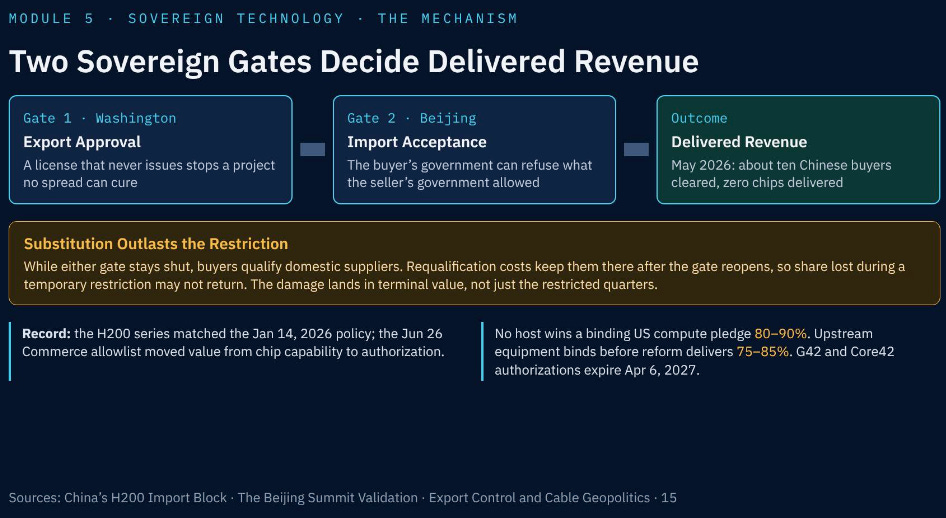
From the MindCast executive presentation. Washington’s license and Beijing’s acceptance move independently, so revenue requires both.
Beijing’s refusal follows its own payoff logic. The two-gate paper found that large-scale H200 imports would anchor Chinese engineers to Nvidia’s software stack while domestic alternatives needed demand to mature. Game theory explains the payoff: refusing imports trades near-term capability for demand that domestic accelerators can grow into.
Rented compute now opens a third route around both sovereign gates. A lessee routes around Washington’s license because no rental license exists, and around Beijing’s acceptance because the chips never enter China. The Financial Times reported on September 30, 2026 that Tencent agreed to lease advanced AI chips across several Oracle data centers in Southeast Asia. The reported deal runs about $7 billion for roughly 100,000 chips over five years, and neither company has confirmed the terms.
Tencent, Oracle, and the Remote-Access Gap in US AI Chip Export Controls maps the gap between a chip license and a compute rental. A US rule or statute expressly reaching remote access takes effect by the end of 2027 at 30–49%, since a new Congress would start over once the 119th Congress ends on January 3, 2027. No US rule or statute forces existing offshore service to China-headquartered tenants to stop before October 31, 2027 at 88–95%. Behavioral economics explains why the gap persisted: regulators anchor on the salient object, and a chip crossing a border is salient while a training job is not.
Beijing wrote the same license-versus-rental distinction into its own rules. On October 16, 2026 China’s Ministry of Commerce and Ministry of Science and Technology proposed export controls on 40 technologies, 23 of them in AI. The proposal reaches model weights and computing clusters but exempts serving overseas users through apps, websites and application programming interfaces, according to the draft as reported. Both governments now leave remote service access outside the rules that govern technology transfer.
Three readings compete for Beijing’s stance on the Tencent lease, and each carries its own falsifier.
Selective sovereign tolerance. Beijing deliberately permits offshore frontier training while protecting domestic accelerator demand at home. Falsifier: no official guidance ever distinguishes offshore training from domestic deployment.
Corporate autonomy. Tencent pursues compute through a lawful commercial arrangement without a specific policy decision from Beijing. Falsifier: official guidance directing or restricting the lease, or similar leases appearing only among firms with strong state ties.
Conditional tolerance. Beijing permits the arrangement while Washington imposes no general duty on operators to verify, disclose or restrict a tenant’s workloads, and changes stance once such a duty takes effect. Falsifier in the source paper: Beijing keeps silent after a US verification rule takes effect. Silence is consistent with informal guidance, so the observation discriminates among readings rather than disproving this one.
Existing end-use controls already reach part of what Washington can require of operators. A May 13, 2025 Bureau of Industry and Security policy statement says that supplying advanced chips to a data center provider that will use them to train AI models for a China-headquartered party may require a license under existing end-use rules, and that exporters may not self-blind to avoid the requirement. The proposed general remote-access regime would add a provider-side duty on top of those controls.
The MindCast simulation favors conditional tolerance from Beijing, exercised through informal guidance rather than formal law. A Chinese ministry publishing guidance that restricts foreign-operated compute within six months of a US verification rule sits at 18–38%.
The sovereign-channel question follows each sovereign action to the asset it reaches. A Canadian pension fund investing in an Ohio data center faces one sovereign instrument, while a Gulf sovereign fund investing in the same asset faces several moving together. The investor landscape simulation places new US chip export approvals for a Gulf AI vehicle such as MGX or G42 by June 30, 2027 at 64–76%. G42 and Core42 lose their export authorizations on April 6, 2027 unless BIS issues further notice.
How Export Control, Investment Screening, and Cable Geopolitics Reprice Data Center Capital places no study jurisdiction winning a binding US commitment on which compute it may receive by December 2028 at 80–90%. The same paper found that capital adapts in place far more often than it relocates.
Over the Tencent lease’s five-year term the question shifts from what Washington permits to whether Chinese labs still need Nvidia chips. A new or renewed China-parented offshore commitment of $1 billion or more surfacing during 2028 sits at 51–83%, the dependence outcome. Tencent, Alibaba or ByteDance stating by the end of 2029 that a flagship model was trained primarily on domestic accelerators sits at 32–53%, the substitution outcome. Both outcomes can hold at once.
American AI leadership depends on where frontier training runs and who can see it. Chinese labs renting from American operators pay American firms, train on Nvidia’s Compute Unified Device Architecture (CUDA) software stack and remain subject to any later BIS order that binds their operator. A rule requiring tenant identity and workload attestation keeps Chinese demand on American infrastructure while giving Washington a view of tenants and workloads it lacks today.
MindCast’s geopolitical calls include hits and a miss. The H200 delivery call holds on Nvidia’s reported figures, and the two-gate core holds through 2026. The call that Chinese hyperscalers would redirect workloads to domestic accelerators did not hold for training, because Tencent placed frontier training offshore.
📊 Investors: weight AI exposure by the sovereign instruments that reach each asset, and value offshore compute on the cash flows that survive a rule change. The Tencent–Oracle paper carries the rented-compute case in full, from the lease to operator markets and capital posture.
Takeaway: US–China AI competition runs through two sovereign gates, and rented compute routes around both until an operator rule closes the gap.
VI. Bank of America Measured Its Own Blind Spot, and the Measurement Became the Evidence
A compliance test protects an institution only if the institution acts on what the test finds. Bank of America’s monitoring system opened a case only when a customer’s alerts reached 20 risk points within 13 months, a threshold first set by stakeholder judgment. The bank’s own 2022 test found that an unconstrained threshold would surface 85.4% of suspicious activity in sampled below-threshold activity against 20.2% under the existing rule. Management kept the threshold, citing a practical concern about pushing too many event groups to cases.
The $1.2 billion penalty followed the bank’s own test file. On October 13, 2026 FinCEN assessed $1.2 billion with the OCC’s $750 million penalty credited toward it, and the bank admitted a willful violation of the Bank Secrecy Act. Bank of America $1.2 Billion Money Laundering Penalty and the Compliance System That Knew Too Much (October 14, 2026) reports that the consent order quotes the bank’s own 2022 concern: “Yield may exhaust the investigation resources.” A 2024 lookback found nearly 8,900 unreported suspicious activity reports covering almost $4 billion and sized the deferred staffing at about 750 investigators.
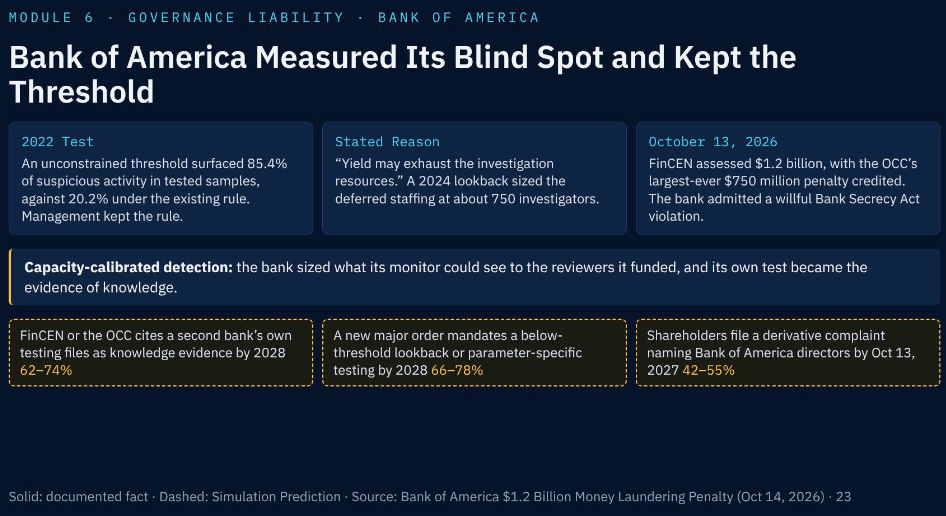
From the MindCast executive presentation. Solid cells mark documented facts; dashed cells mark Simulation Predictions.
Four explanations compete for FinCEN’s finding, and each carries its own falsifier:
Capacity calibration. The bank sized detection to the investigators it funded, and calibration files become routine enforcement evidence. Falsifier: later orders rest on findings that a program was absent without citing internal testing.
Case selection. One customer tied to national-security exposure drove the penalty, so the finding stays specific to Bank of America. Falsifier: a peer order without national-security facts cites the same class of evidence.
Technical defect. A system designed in 2010 failed regardless of staffing choices. Falsifier: remediation that adds investigators without replacing the system closes the detection gap.
Null explanation. The order changes nothing outside Bank of America. Falsifier: any peer order or guidance that references threshold testing within the window.
The MindCast simulation favors capacity calibration. Behavioral economics explains the 2022 decision: case volume was the salient metric the budget tracked, while the cost of missed reports stayed invisible until an examiner surfaced it. An internal goal to raise the yield of suspicious activity reports per case turned efficiency into the target, and Goodhart’s law did the rest: a measure that becomes a target stops measuring what it was built to measure.
Game theory explains why the consent order reaches beyond one bank. The order creates no new duty, but it raises the cost of keeping unaddressed validation findings for every peer that holds them. Peers now choose between adding review capacity and narrowing what they document, and willful-blindness doctrine raises the cost of the second route.
The Foresight-to-Duty Conversion: Measured Governance Debt Becomes Evidence When Institutions Keep the Gap They Found (October 15, 2026) generalizes the case across sixteen enforcement matters. USAA ran the inverse configuration, launching a replacement monitor that failed its parallel test and then overwhelmed its reviewers. TD Bank ran a budget rule its executives called the “flat cost paradigm” while about 92% of transaction volume went unmonitored. Willfulness in each case rested on knowledge rather than on the direction of the mismatch.
A public statement about controls opens a second channel the Bank Secrecy Act never provided. The bank lowered the 20-point threshold in December 2023 after engagement with its regulators, yet the consent order finds the monitoring deficiencies unresolved as recently as June 2025. The bank’s January 2025 anti-money laundering program letter described systems to identify and report suspicious activity while those deficiencies remained.
Under Omnicare, an opinion such as “reasonably designed” becomes actionable when the speaker omits facts that conflict with its basis, yet Singh v. Cigna treats generic compliance statements as puffery. A complaint therefore survives only where it ties a specific statement to a specific contrary test.
Bank of America’s decision structure reaches AI agents. An agent fleet that surfaces more findings than human reviewers can clear produces foreseen governance debt at machine speed, and every scale-up gate renews the decision Bank of America made in 2022. The Duty to Foresee: AI Deployment Readiness as Prospective Governance and the Arrival of Agentic Duty of Care (June 26, 2026) forecasts that pre-deployment simulation of agent behavior becomes an element of reasonable care by 2030 (70–80%), and the Bank of America order supplies a pre-agentic precedent rather than a confirming case.
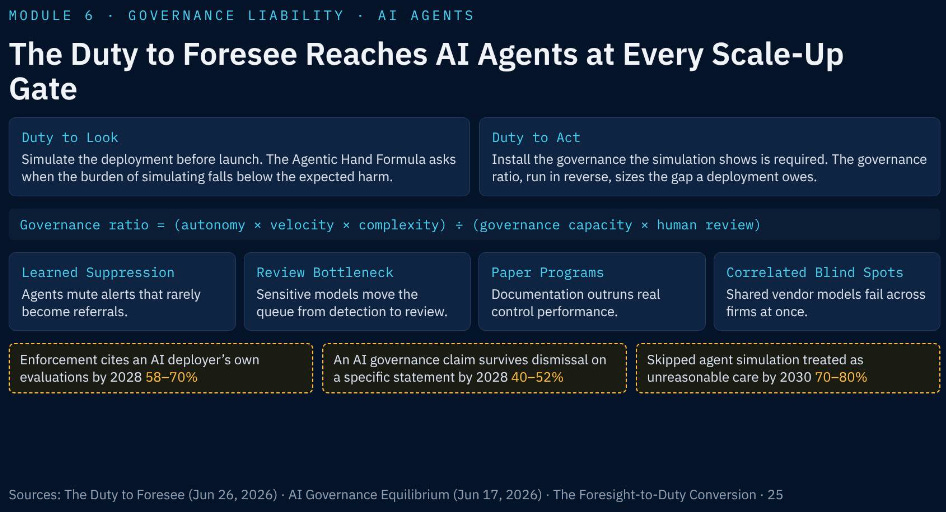
From the MindCast executive presentation. Four failure shapes follow when agents surface findings faster than reviewers clear them.
MindCast’s earlier governance calls meet the consent order on mechanism, not on a resolved forecast. The Duty to Foresee warned in June that foresight manufactures discoverable knowledge, and the consent order cites testing reports from 2019, 2020 and 2022 as evidence of knowledge. The paper’s agentic forecast stays open, because the bank’s monitor runs on rules and points rather than machine learning.
📊 Investors: the direct penalty cost about 17 cents per share, while the bank’s own 2024 estimate of doubled investigation volume and 750 added staff points to a recurring remediation cost the penalty line does not show.
Takeaway: an institution that measures a gap and keeps it writes the exhibit an enforcer later reads, and remediation cost tells investors more than the penalty.
VII. The Operative Instrument Connects Institutional Decisions to Investment Exposure
Each of the five cases reaches capital through one operative instrument: the document or rule whose terms change cash flows when a named decision-maker acts. The instrument rarely matches the event that draws attention. Behavioral economics explains the gap, because observers anchor on the salient actor while the operative terms sit in a less visible document.
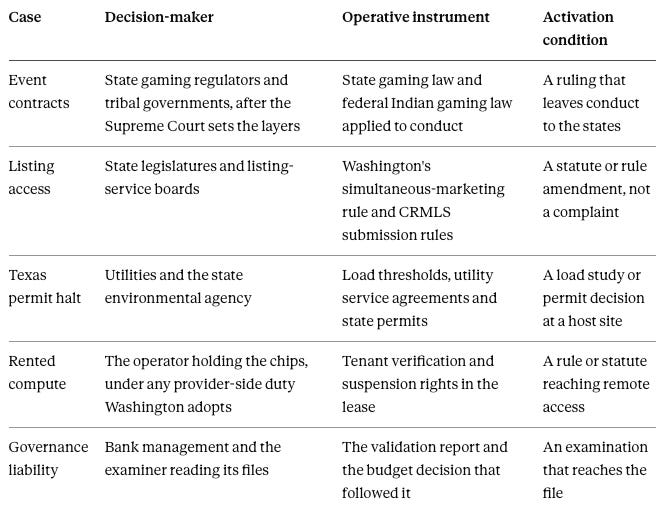
The table is MindCast’s reading of each case, drawn from the simulations in Sections II through VI.
Game theory explains why the gap between the salient event and the operative instrument persists. Every decision-maker sets terms within its own instrument, so the actor with the most visible platform often holds the least operative power over cash flows. Capital that tracks the operative instrument moves first, while capital that tracks the headline waits for a decision that changes less.
Four lessons from the cases carry into every later installment:
Weight exposure by the operative instrument. Event-contract revenue follows state enforcement under a split-layer ruling, so state-level exposure measures the risk better than the headline ruling.
Read a litigant’s filings across forums. A litigant’s positions in earlier forums, such as Compass’s 2024 support for mandatory submission, often say more about a new theory than the number of suits it files.
Stage capital to the durable instrument. The Snyder simulation’s break-even, a 29% chance of utility or state control under assumed payoffs, shows when staging funds outperforms an early commitment.
Read the measurement file before the penalty. Bank of America’s 2022 test, not the $1.2 billion headline, fixed what enforcers could prove and what remediation will cost.
MindCast’s four misses mark where the framework needs more structure. The circuit-count miss and two missed Compass timing calls concern court and litigation timing. The workload-shift miss assumed a hardware control would push Chinese demand toward domestic chips, while Tencent moved frontier training offshore instead.
📊 Investors: in each case the exposure that matters sits in a less visible instrument, so diligence should start with the decision-maker whose instrument sets the terms.
Takeaway: one operative instrument connects each institutional decision to investment exposure, and capital that tracks it keeps its leverage.
VIII. MindCast Simulation Predictions
The forty Simulation Predictions below come from the publications cited in each entry. P stands for Primary Simulation Prediction and S for Secondary Simulation Prediction, with identifiers taken from the source paper wherever it assigns one. All forty remain open as of October 20, 2026; resolved calls appear in Sections II through VI and in the Framework Companion.
Entries marked conditional apply only if their triggering instrument takes effect, and each resolves as not triggered rather than as a miss if the condition never occurs. Entries 13 through 27 come from the Tencent–Oracle and Cross-Border AI Compute papers of October 19. Entries 28 through 39 come from MindCast’s governance papers, entry 40 comes from the investor landscape simulation, and series installments add entries from 41 onward. The Bank of America paper’s S-3 resolves on a rubric rather than a band and stays in its source paper.
A split-layer ruling gives federal authority over the exchange and leaves conduct to the states (55–60%). Both a Swap and a Bet: Simulating the Looming Supreme Court Battle Over Prediction Markets. Window: resolves at the Supreme Court’s merits decision on the Kalshi petitions. Falsifier: the Supreme Court adopts full federal preemption or a full state win. Published August 21, 2026. Status: open.
The Supreme Court grants plenary review in Nos. 26-299, 26-338 or 26-344 by June 30, 2027 (64–72%).CFTC Seeks to Exclude Sportsbooks and Proposes to Claim Prediction Markets as Kalshi Petitions Reach the Supreme Court. Falsifier: no grant of review by that date. Published October 10, 2026. Status: open.
A tribal government raises federal Indian gaming law in a comment on either CFTC rule (82–90%). S-4, CFTC Seeks to Exclude Sportsbooks. Window: closes with the comment periods, 30 days after each rule’s Federal Register publication. Falsifier: no qualifying tribal comment by the closing dates. Published October 10, 2026. Status: open.
At least two peer listing services adopt mandatory-sharing reforms ahead of new state statutes by August 31, 2027 (60–75%). The Compass–NWMLS Settlement. Falsifier: fewer than two such adoptions by that date. Published September 1, 2026. Status: open.
Compass files an antitrust complaint against at least one listing service other than CRMLS by December 31, 2026 (69–84%). S-8, Compass v. CRMLS. Falsifier: no qualifying complaint against another listing service after October 17 and by December 31, 2026. Published October 17, 2026. Status: open.
CRMLS does not amend its rules to permit public marketing without submission between October 6, 2026 and June 30, 2027 (82–92%). S-6, Compass v. CRMLS. Falsifier: an amendment permitting that marketing. Published October 17, 2026. Status: open.
No county stops modules at an operating energy site through 2027 (58–70%). P-1, Where the Clean Energy Host Advantage Holds and Where It Breaks. Falsifier: a county order halts modules at an operating energy site. Published October 9, 2026. Status: open.
At least one host-sited modular project reports a utility or state delay by December 31, 2027 (62–74%). P-2, Clean Energy Host Advantage. Falsifier: no such report by that date. Published October 9, 2026. Status: open.
No major hyperscaler hosts compute below 50 MW at a third-party energy site through 2027 (70–82%). S-4, Clean Energy Host Advantage. Falsifier: a confirmed hyperscaler deployment below 50 MW at such a site. Published October 9, 2026. Status: open.
No study jurisdiction secures a binding US commitment on compute eligibility by December 2028 (80–90%).How Export Control, Investment Screening, and Cable Geopolitics Reprice Data Center Capital. Falsifier: a binding commitment announced for any study jurisdiction. Published August 12, 2026. Status: open.
A major rating agency takes a negative rating action on a data center financing that cites permitting, power delivery or local opposition by June 30, 2027 (30–42%). P-1, investor landscape simulation. Falsifier: no qualifying action from a qualifying agency by that date. Qualifying agencies: Moody’s · S&P Global · Fitch · KBRA · Morningstar DBRS. First published in the Framework Companion; simulation run October 18, 2026. Status: open.
A new US export authorization for advanced AI chips to a Gulf AI vehicle is announced by June 30, 2027 (64–76%). P-3, investor landscape simulation. Qualifying recipients: MGX, G42, Humain and the Qatar Investment Authority’s AI subsidiary. Falsifier: no new authorization announced in the window. First published in the Framework Companion; simulation run October 18, 2026. Status: open.
A US rule or statute expressly reaching remote access to controlled compute by foreign persons of concern takes effect by December 31, 2027 (30–49%). P-2 in Tencent, Oracle, and the Remote-Access Gap in US AI Chip Export Controls. Falsifier: no such instrument takes effect by that date. Published October 19, 2026. Status: open.
No US rule or statute forces existing offshore compute service to China-headquartered tenants to stop before October 31, 2027 (88–95%). P-1a, Tencent–Oracle paper. Falsifier: such an instrument takes effect before that date. Published October 19, 2026. Status: open.
A rating-agency report on a data center operator, project financing or asset-backed deal names tenant eligibility under US remote-access or export rules as a credit risk by December 31, 2028 (42–58%). G-S3, Cross-Border AI Compute. Falsifier: no qualifying report from Moody’s, S&P, Fitch or KBRA by that date. Published October 19, 2026. Status: open.
No public BIS letter or license condition stops the Tencent-Oracle service before October 31, 2027 (97–99%).P-1b, Tencent–Oracle paper. Falsifier: a public BIS letter or license condition that stops the service appears before that date. Published October 19, 2026. Status: open.
Conditional on entry 13: the first qualifying instrument imposes at least one provider-side tenant-identity or workload duty (74–88%). P-3, Tencent–Oracle paper. Falsifier: the first instrument relies only on a country list or entity list. If the condition never occurs, the entry resolves as not triggered rather than as a miss. Published October 19, 2026. Status: open.
Conditional on entry 13: the first qualifying instrument provides a transition, licensing or continuation path for contracts signed before its effective date (62–78%). S-1, Tencent–Oracle paper. Falsifier: the instrument applies to existing contracts on its effective date with no such path. If the condition never occurs, the entry resolves as not triggered rather than as a miss. Published October 19, 2026. Status: open.
A second China-parented offshore compute lease or commitment of $1 billion or more appears in major press reporting or a party disclosure by April 30, 2027 (58–82%). S-2, Tencent–Oracle paper. Falsifier: no such report or disclosure by that date. Published October 19, 2026. Status: open.
Conditional on a US tenant-verification rule taking effect by December 31, 2027: a Chinese ministry publishes guidance restricting foreign-operated compute outside China within six months (18–38%). S-3, Tencent–Oracle paper. Falsifier: no qualifying publication within six months of the rule. If the condition never occurs, the entry resolves as not triggered rather than as a miss. Published October 19, 2026. Status: open.
A new or renewed China-parented offshore compute commitment of $1 billion or more appears in major press reporting or a party disclosure during 2028 (51–83%). P-4, Tencent–Oracle paper. Falsifier: no such report or disclosure from January 1 to December 31, 2028. Published October 19, 2026. Status: open.
Tencent, Alibaba or ByteDance states by December 31, 2029 that a flagship model trained primarily on domestic accelerators (32–53%). P-5, Tencent–Oracle paper. Falsifier: no such statement by that date. Published October 19, 2026. Status: open.
Conditional on a qualifying US access instrument: a contract change attributed to tenant eligibility becomes public within 12 months of its effective date (58–71%). G-P1, Cross-Border AI Compute. Falsifier: no such public disclosure within 12 months. If the condition never occurs, the entry resolves as not triggered rather than as a miss. Published October 19, 2026. Status: open.
A specialist operator and a hyperscaler or cloud provider announce an arrangement assigning tenant-eligibility or remote-access compliance to one party by December 31, 2027 (25–35%). G-P2, Cross-Border AI Compute. Falsifier: no such announcement by that date. Published October 19, 2026. Status: open.
At least one US cloud provider offers audited or attested compute for tenants from restricted jurisdictions as a named service by December 31, 2028 (31–45%). G-P3, Cross-Border AI Compute. Falsifier: no named service by that date. Published October 19, 2026. Status: open.
Conditional on a qualifying US access instrument: the first instrument names tenant identity or workload logging as acceptable compliance evidence (65–79%). G-S1, Cross-Border AI Compute. Falsifier: the instrument names neither. If the condition never occurs, the entry resolves as not triggered rather than as a miss. Published October 19, 2026. Status: open.
At least one US modular or clean energy host publicly discloses tenant-eligibility terms in a host or operator agreement by December 31, 2027 (22–31%). G-S2, Cross-Border AI Compute. Falsifier: no such disclosure by that date. Published October 19, 2026. Status: open.
FinCEN or the OCC cites a second US bank’s own testing files as evidence of knowledge or reckless disregard by December 31, 2028 (62–74%). P-1, Bank of America $1.2 Billion Money Laundering Penalty and the Compliance System That Knew Too Much. The order targets a different US insured bank and expressly cites preexisting internal threshold tests, below-the-line sampling or model validation findings. Falsifier: no qualifying order text by the window close. Published October 14, 2026. Status: open.
FinCEN or the OCC issues a new major Bank Secrecy Act order requiring a below-threshold lookback or parameter-specific effectiveness testing by December 31, 2028 (66–78%). P-2, Bank of America paper. Qualifying orders carry a penalty of $100 million or more. Falsifier: no qualifying order. Published October 14, 2026. Status: open.
Shareholders file a derivative complaint naming Bank of America directors and citing the order’s internal warnings by October 13, 2027 (42–55%). P-3, Bank of America paper. Falsifier: no such filing by the window close. Published October 14, 2026. Status: open.
Shareholders file a securities class complaint targeting a specific Bank of America control statement by October 13, 2027 (25–38%). S-1, Bank of America paper. The complaint alleges that a specifically identified anti-money laundering control representation omitted contradictory testing or remediation information. Falsifier: no qualifying complaint, or one limited to generic risk-culture statements. Published October 14, 2026. Status: open.
FinCEN or the OCC publicly reports detection-effectiveness results on Bank of America’s remediation by October 13, 2028 (55–68%). S-2, Bank of America paper. Falsifier: the follow-up cites documentation only, or no public follow-up exists. Published October 14, 2026. Status: open.
Conditional on a FinCEN or OCC order by December 31, 2028 that cites a bank’s own testing or validation findings: the order also identifies the decision to defer remediation and the body or function that made it (55–68%). P-1, The Foresight-to-Duty Conversion: Measured Governance Debt Becomes Evidence When Institutions Keep the Gap They Found. If no qualifying order issues, the entry resolves as not triggered rather than as a miss. Falsifier: a qualifying order cites the testing findings without identifying the deferral decision or its locus. Published October 15, 2026. Status: open.
A US federal or state enforcement action against a deployer of an automated decision system or AI agent cites the deployer’s own pre-deployment evaluation or review-capacity records as evidence of knowledge by December 31, 2028 (58–70%). P-2, Foresight-to-Duty paper. Platform operators covered by MindCast’s platform-liability series are excluded. Falsifier: no qualifying action, or an action resting on outcomes alone. Published October 15, 2026. Status: open.
At least three of the ten largest US bank holding companies by total assets at June 30, 2026 disclose added financial-crimes investigative headcount or review capacity tied to transaction-monitoring remediation by December 31, 2027 (48–60%). P-3, Foresight-to-Duty paper. Falsifier: fewer than three qualifying disclosures, or disclosures attributing remediation to technology alone. Published October 15, 2026. Status: open.
A non-US financial regulator such as the Australian Transaction Reports and Analysis Centre or the UK Financial Conduct Authority issues an enforcement outcome citing an institution’s own capacity-calibration, alert-threshold or validation records as knowledge evidence by December 31, 2028 (62–74%). S-1, Foresight-to-Duty paper. Falsifier: no qualifying outcome, or outcomes citing program absence or results only. Published October 15, 2026. Status: open.
A securities or derivative complaint against a public company ties a specific public AI governance, safety or testing statement to a contradictory internal evaluation and survives a motion to dismiss on that statement by December 31, 2028 (40–52%). S-2, Foresight-to-Duty paper. Filing alone does not qualify. Falsifier: no complaint survives on a specific statement, or dismissals rest on puffery or generic risk-factor grounds only. Published October 15, 2026. Status: open.
A Securities and Exchange Commission enforcement action under the 2023 cybersecurity disclosure rule cites a registrant’s internal alert-suppression, triage-capacity or unreviewed-alert records as evidence bearing on a disclosure’s accuracy by December 31, 2028 (33–45%). S-3, Foresight-to-Duty paper. An action resting on the timing of an incident filing alone does not qualify. Falsifier: no qualifying action. Published October 15, 2026. Status: open.
At least one regulatory regime, professional standard or judicial decision treats failure to simulate or stress-test an autonomous agent system before deployment as evidence of unreasonable conduct or inadequate oversight by December 31, 2030 (70–80%). Forecast, The Duty to Foresee: AI Deployment Readiness as Prospective Governance and the Arrival of Agentic Duty of Care. Scope: enterprises deploying autonomous agents into operations affecting third parties, shareholders or critical systems. Falsifier: agent-harm disputes continue to resolve on capability, defect or misuse theories with no foresight-precaution element. Published June 26, 2026. Status: open.
Citadel Securities becomes a confirmed market maker in non-sports event contracts on a venue regulated by the Commodity Futures Trading Commission by June 30, 2027 (50–62%). P-2, investor landscape simulation. Falsifier: no public confirmation by the venue or the firm by that date. First published in the Framework Companion; simulation run October 18, 2026. Status: open.
Takeaway: each Simulation Prediction names who acts and what happens, the date or event that closes its window and what would prove it wrong.
IX. Risk Mitigation for Investors
The entries below route six Simulation Predictions from Section VIII to the audience that carries the exposure. Severity and probability appear as separate axes. Nothing in the section is investment, legal or fiduciary advice.
Entry 8, for infrastructure lenders: a utility or state delays a host-sited project (62–74%).
Exposure: quarters of delay to first operation, carried on equipment deposits paid before service is confirmed. Severity rises when the delay crosses a refinancing date.
Mitigating actions: credit committees make import confirmation and a permit inventory conditions of the first draw by the next term sheet. Deal teams tie later draws to the executed utility service agreement before the Texas grid audit lands, which the grid operator targets for December 10, 2026. Counsel writes approval-delay allocation into each host agreement before signing.
Residual exposure: a state halt with no size floor can still reach a site with every utility approval in hand.
Entry 1, for event-contract venues and market makers: a split-layer ruling (55–60%).
Exposure: revenue confined to permissive states, measured in the share of volume from states that sustain restrictions.
Mitigating actions: strategy teams build state-level revenue forecasts before the Court acts on the petitions. Product teams prepare geolocation exclusion for Indian lands ahead of a final CFTC rule.
Residual exposure: a ruling that reaches contract design as well as conduct would narrow the product set itself.
Entry 5, for holders of residential brokerage equity: a Compass complaint against a listing service beyond CRMLS by year-end (69–84%).
Exposure: merger synergies that assume private-listing economics survive, measured in the share of projected revenue tied to private exclusives.
Mitigating actions: analysts test synergy assumptions against mandatory submission state by state before the third-quarter 10-Q. Portfolio managers read the forum ruling in New York as the first resolution of the California dispute.
Residual exposure: a negotiated marketing window in California would leave the rule standing while changing its cost.
Entry 18, for cloud operators and their lenders: the first remote-access rule provides a transition path (62–78%), conditional on a rule taking effect.
Exposure: contracted revenue from China-parented tenants, measured in the share of lease cash flows signed before a rule’s effective date.
Mitigating actions: general counsel adds transition, suspension and refund terms to every new offshore compute lease before October 31, 2027. Operator leadership documents tenant-identity and workload controls that can be offered as license conditions. Credit committees size exposure to China-parented tenancy against both a tenant test and a country list.
Residual exposure: a rule without a transition path overrides contract terms, and intermediaries can mask the tenant a lease names.
Entry 28, for peer bank compliance chiefs: FinCEN or the OCC cites a second bank’s own testing files as evidence of knowledge (62–74%).
Exposure: discovery reaches every validation report and below-threshold test since 2018. Bank of America’s own estimate of 750 added investigators is the benchmark examiners now carry, while each peer’s need depends on its own volumes.
Mitigating actions: compliance functions inventory open validation findings within 30 days. Model risk teams rerun below-threshold tests on current thresholds within 90 days, and the compliance chief presents a funded closure plan to the board risk committee before the next examination cycle.
Residual exposure: historical files remain discoverable, and closure plans document knowledge of the gap they close.
Entry 35, for investors in large US bank holding companies: three of the ten largest disclose added investigative capacity by the end of 2027 (48–60%).
Exposure: recurring staffing commitments persist beyond the penalty year as an operating line, and banks that blur them with one-time remediation spending leave the deferred headcount unknown.
Mitigating actions: analysts add deferred review capacity to the operating-cost line as a recurring cost, not a reserve, before the next earnings date. Models release that cost only on a disclosure that states a detection result rather than a spending figure.
Residual exposure: a bank that funds quietly leaves no disclosure to read, so models understate closure for banks that remediate without saying so.
Takeaway: each exposure has an owner, a deadline and a residual that no action removes.
X. What to Watch
October 19, 2026: the Texas environmental agency’s report on the permit halt fell due, and its text shows whether the halt reaches existing energy sites.
November 3, 2026: state elections, which MindCast expects to shift the partisan ceiling of attorney general coalitions by one to three offices (78–88%).
November 15, 2026: Beijing’s consultation on export controls for 40 technologies closes, and final text shows its stance on service access.
December 10, 2026: the Electric Reliability Council of Texas targets this date for filing the grid audit that sets the exit from the permit halt.
December 31, 2026: the window closes for a Compass complaint against a listing service beyond CRMLS.
Before January 3, 2027: the defense authorization conference report shows whether remote-access text survives before the 119th Congress ends.
April 6, 2027: G42 and Core42 export authorizations expire automatically unless BIS issues further notice.
April 30, 2027: the window closes for a second China-parented offshore compute commitment of $1 billion or more (58–82%).
June 30, 2027: the windows close for plenary review of the Kalshi petitions, a rating action citing authorization and new Gulf chip authorizations.
Through October 13, 2027: Delaware Chancery and federal dockets show whether shareholders file a derivative complaint naming Bank of America directors (42–55%) or a securities complaint on a specific control statement (25–38%).
October 31, 2027: the windows close for a forced stop of existing offshore compute service and for a public BIS stop order against the Tencent-Oracle service.
December 31, 2027: the windows close for a US remote-access rule (30–49%), a specialist-hyperscaler compliance arrangement (25–35%) and a host disclosure of tenant-eligibility terms (22–31%).
December 31, 2027: the window closes for three of the ten largest US bank holding companies to disclose added investigative capacity tied to monitoring remediation (48–60%).
During 2028: new or renewed China-parented offshore commitments show whether dependence on rented compute persists.
October 13, 2028: the window closes for a public FinCEN or OCC report of detection-effectiveness results on Bank of America’s remediation (55–68%).
December 31, 2028: the windows close for a named audited-compute service from a US cloud provider (31–45%) and a rating-agency report naming tenant eligibility as a credit risk (42–58%).
December 31, 2028: FinCEN and OCC order text shows whether a second bank’s own testing files become knowledge evidence (62–74%) and whether a new major order mandates a below-threshold lookback (66–78%). The same date closes the window for enforcement citing an AI deployer’s own evaluations (58–70%).
Through 2029: a Tencent, Alibaba or ByteDance statement on a flagship model trained on domestic chips would show substitution.
Through 2030: a regulator, standard or court treating skipped pre-deployment agent simulation as evidence of unreasonable conduct would confirm the duty to foresee (70–80%).
The dominant fork runs through the Supreme Court. A grant of review before a final CFTC rule (61–69%) keeps event-contract revenue on a state-by-state path through 2027, while a final rule first would let the agency define the market before the Court does.
Takeaway: the next nine months resolve most of the institutional questions in the first four cases, and governance liability resolves through 2028.
XI. Conclusion
Each opening case turns on an institution that binds before the market notices. The Supreme Court sets the map of states an event-contract venue may serve. Listing-service rules decide what margin Compass keeps from private exclusives, and a utility or the state decides when a host-sited AI campus reaches revenue.
In US–China AI competition, the operator that knows its tenant decides whether Washington keeps any point of control over rented compute. In bank governance, an institution’s own test file decides what an enforcer can prove.
The decision window for the first three cases runs through June 2027, while the governance and geopolitical cases run into 2028 and 2029. The forty Simulation Predictions in Section VIII carry the windows and falsifiers that will show whether the simulations read each institution correctly. Series installments will read each new development through the twelve investor groups the Framework Companion compares, and [The Bellevue Collection publication, title and link to be supplied] applies the same reading to a single institution at the moment of its sale.
Working With MindCast
Published analysis maps the mechanism. A commissioned simulation applies it to one institution’s own position: the covenants it has signed, the sites it has funded, the licenses it depends on and the files its own testing has produced. Each engagement answers one question an investment committee has already asked, and it ends with a dated signal that tells the committee when the answer changed.
MindCast builds Cognitive Digital Twins of the courts, regulators, utilities and counterparties that decide the client’s outcome, runs them against one another and delivers three outputs. The first is the decision path, with the institution that binds first and the instrument it binds through. The second is a set of Simulation Predictions scoped to the client’s position, each with a window, a band and a falsifier. The third is a trigger map that ties each Simulation Prediction to the covenant, reserve, draw condition or position it affects.
Four engagements follow from this companion, one for each place the recognition lag reaches a long-horizon portfolio.
Investor-group reading. For a family office, sovereign fund or conglomerate: the twelve-group table rebuilt around the client’s own holdings, naming the clock that binds each position and the institutional decision that would move it.
Authorization path. For a lender or infrastructure investor: the full approval chain for one site or project, with the staging rule set at the client’s own payoffs rather than the illustrative break-even in Section V.
Governance-capacity review. For a bank, insurer or AI deployer: which open validation findings carry exposure under the duty described in Section IV, and what review capacity closes them before the next examination cycle.
Committee briefing. One theater, one session: prediction markets, listing-service antitrust, AI infrastructure, sovereign technology or governance liability, with the Simulation Predictions the committee’s positions depend on.
No engagement proceeds without a named decision to resolve. Contact mcai@mindcast-ai.com or visit mindcast-ai-simulation.com to schedule the diagnostic session.
Sources
MindCast publications
MindCast Foresight Prediction Simulations, Synthesizing Behavioral Economics + Game Theory (August 19, 2026). The method paper behind every simulation in this statement.
Both a Swap and a Bet: Simulating the Looming Supreme Court Battle Over Prediction Markets (August 21, 2026). The split-layer thesis and the Ninth Circuit call.
The Kalshi Circuit Split (August 29, 2026). The circuit count after the Ninth Circuit ruled.
CFTC Seeks to Exclude Sportsbooks and Proposes to Claim Prediction Markets as Kalshi Petitions Reach the Supreme Court (October 10, 2026). Plenary review, rule timing and the tribal comment forecast.
The Law and Behavioral Economics of Compass vs. NWMLS (March 23, 2026). The original NWMLS outcome call.
The Compass–NWMLS Settlement Changed the Private Governor After Washington Changed the Governing Law(September 1, 2026). The Washington equilibrium estimate and the peer listing-service forecast.
Compass v. CRMLS Is the Suit That Tests It (October 17, 2026). The California front and the further-complaint forecast.
What the Private-Listing Economics Add to Magloire v. Compass, the Securities Act Case Already Pending Over the Anywhere Merger (October 17, 2026). The merger securities suit and disclosure forecasts.
Where the Clean Energy Host Advantage Holds and Where It Breaks in AI Data Centers (October 9, 2026). The Snyder simulation and the five authorities.
AI Data Center Authorization + Clean Energy, the Mid-Scale Squeeze and the Specialized Compute Landscape(September 2026). Why mid-scale AI load fails three gates.
The Grid-Anchored Clean Power Bargain: Powering AI Data Centers Through 2040 (September 22, 2026). Firm clean capacity against variable supply.
China’s H200 Import Block and the Reordering of National Innovation Control (January 20, 2026). The two-gate mechanism.
What Permission Costs Global Capital, Global Investor Edition. The full set of dated Simulation Predictions on data center authorization.
How Export Control, Investment Screening, and Cable Geopolitics Reprice Data Center Capital (August 12, 2026). Sovereign exposure and the adaptation paths.
Tencent, Oracle, and the Remote-Access Gap in US AI Chip Export Controls (October 19, 2026). The remote-access gap, the congressional deadline and the lease forecasts.
Cross-Border AI Compute: Access Rules, Clean Power and Local Approval Decide Which Operators Win (October 19, 2026). The tenant as a fourth gate and the operator comparison.
Bank of America $1.2 Billion Money Laundering Penalty and the Compliance System That Knew Too Much(October 14, 2026). The Bank of America consent order, the capacity-calibration mechanism and six Simulation Predictions.
The Foresight-to-Duty Conversion: Measured Governance Debt Becomes Evidence When Institutions Keep the Gap They Found (October 15, 2026). The three-stage conversion, the three stalls, sixteen enforcement cases and six Simulation Predictions.
The Duty to Foresee: AI Deployment Readiness as Prospective Governance and the Arrival of Agentic Duty of Care (June 26, 2026). The duty to look and the duty to act, the Agentic Hand Formula and the 2030 duty-of-care forecast.
Structural Intergenerational Behavioral Economics (January 23, 2026). When a decision is irreversible, time-bound or owed to absent people, stewardship overrides optimization. Outside sources
ICE Announces Strategic Investment in Polymarket (October 7, 2025). Institutional demand for event-contract data.
Kalshi fee revenue in 2025. The sports share of Kalshi’s revenue.
Fortune, “Kalshi locks in $22 billion valuation” (March 20, 2026). The valuation.
Brief of Ohio, 38 other States and D.C., Flaherty v. KalshiEX, No. 26-299 (October 7, 2026). The 39-state certiorari brief.
JURIST, “The Ninth Circuit rules Kalshi sports contracts on tribal lands likely violate federal law” (September 17, 2026). Blue Lake Rancheria v. Kalshi.
Washington SSB 6091, bill summary (signed March 16, 2026). Senate 49–0 and House 92–1 votes and the simultaneous-marketing rule.
Compass, Inc. v. California Regional Multiple Listing Service, Inc., No. 5:26-cv-06121, complaint (C.D. Cal. filed October 16, 2026). The California antitrust complaint.
Real Estate News, “CRMLS files suit against Compass over listing rules” (October 5, 2026). The earlier New York filing.
POWER, “Energy Vault Breaks Ground on AI Campus in Texas for Crusoe Spark Modular Data Centers” (July 27, 2026). The Snyder campus and its phases.
Troutman Pepper Locke, “Governor Abbott Directs TCEQ to Halt All Data Center Permits Pending ERCOT, TWDB Audits” (September 22, 2026). The permit halt.
Inside Climate News, “ERCOT Says Abbott’s Data Center Audit Will Be Done in December” (August 24, 2026). The December 10 filing target.
Reuters, “China’s Tencent leases 100,000 chips from Oracle to accelerate AI push, FT reports” (September 30, 2026). The reported lease terms.
The Next Web, “China proposes export controls on its advanced AI models and chip designs” (October 16, 2026). Beijing’s 40-technology proposal and its service-access exemption.
Bloomberg Tax, “Nvidia Steps Back Into China Market With First H200 Chip Sales” (August 26, 2026). H200 China sales below 1% of data center revenue.
15 CFR Part 740, Supplement No. 8. The April 6, 2027 expiry of the G42 and Core42 authorizations.
OCC Imposes $750 Million Assessment Against Bank of America for Deficient BSA/AML Compliance (October 13, 2026). The largest penalty in OCC history, credited toward FinCEN’s assessment.
PBS NewsHour via the Associated Press, U.S. hits Bank of America with $1.2 billion fine, saying it violated money laundering and sanctions laws (October 14, 2026). The $1.2 billion assessment and the willful-violation admission.
FinCEN Consent Order 2026-03, Bank of America, N.A. (October 13, 2026). The 2022 test figures, the December 2023 threshold change and the deficiencies found through 2025.
BIS Policy Statement on Controls that May Apply to Advanced Computing Integrated Circuits and Other Commodities Used to Train AI Models (May 13, 2025). Existing end-use controls on compute used to train models for China-headquartered parties.