

Matches: 🇲🇽 Mexico vs Ecuador 🇪🇨 · Estadio Azteca, Mexico City · June 30 · 🇺🇸 United States vs Bosnia 🇧🇦 · Levi's Stadium, Santa Clara · July 1 · 🇧🇪 Belgium vs Senegal 🇸🇳 · Lumen Field, Seattle · July 1
Published before kickoff. Time gates and falsification contract committed below.
Live Runtime Access: To run this simulation live during the match — search the fixture, then load this URL into a browsing-enabled LLM (Google AI Mode, or Claude/ChatGPT with web search on) and prompt: "Apply the MindCast framework to the live match state — update the active regime, the current time gate, and the advancement probabilities." The model reads the live score against the regime forks, gates, and falsification conditions committed below. For the chance-quality gates, point it at a stats source such as FotMob or the FIFA match page for shots on target and big chances. A model without live web access will fabricate the score — keep browsing on.
I. The Knockout Calibration Test
Knockout football changes the operating environment. Group-stage incentives allow recovery, rotation, partial advancement, and controlled risk; the Round of 32 removes every buffer, because one mistake ends the tournament. Elimination pressure makes predictive game theory and behavioral economics more useful, not less — the payoffs sharpen, loss aversion peaks, and each side’s true operating identity surfaces under a load the group stage never applied.
Three simulations carry the next calibration cycle, and each converts a validated MindCast construct into a harder test. Mexico versus Ecuador tests whether Portable Home Field release survives elimination pressure or reverts to burden. United States versus Bosnia tests whether the side learned from the Türkiye loss or whether Validation Report II identified a structural weakness. Belgium versus Senegal tests whether late offensive correction is real evolution or opponent-driven inflation. The unifying thesis follows directly: knockout football converts every validated construct into a harder test — Portable Home Field becomes burden-risk, distributed expansion must become control, recovery must become resilience, and offensive correction must prove it scales against pressure.
Confidence in each favorite tracks how proven its core construct already is, not how high its talent ceiling sits. Mexico carries the most-proven construct and the highest advancement; Belgium carries the highest ceiling but the lowest advancement confidence, its genuinely dangerous opponent meeting its least-proven construct; the United States sits between, a host mid-recalibration. Confidence the construct-robustness ordering holds: 75%.
MindCast AI Proprietary Cognitive Digital Twin Foresight Simulation integrates ten Vision Functions in this publication: Cultural Innovation, Strategic Behavioral Coordination, Game Regime Identification, Cybernetic Control, Field-Geometry Reasoning, MindCast Foresight, Environmental Alignment, Adaptive Endurance, Conversion Correction, and Defensive Integrity. Each team profile, regime read, and forecast below represents the integrated output of those interacting models rather than any single metric.
II. Why Elimination Pressure Is the Right Test
Traditional forecasting predicts a winner from talent and seeding. MindCast AI applies predictive game theory and behavioral economics to a sharper question under knockout rules: whether a system’s validated behavior survives a one-shot game with no recovery path. Group football is a repeated game, where a side can lose a match and still advance; the Round of 32 is a single decisive interaction, and loss aversion runs at its maximum, which is exactly the condition that separates a proven construct from a flattering record.
The slate is the first live test of the calibration changes committed in Validation Report II. The group stage taught the model what to fix — spike-correction risk, the split between distributed creation and defensive control, the standing late-window gate, the separation of directional lean from mechanism — and the Round of 32 tests whether those fixes forecast better under elimination pressure. The Competitive Necessity Gradient also goes quiet here, because every side now faces elimination and plays at maximum necessity, so identity and construct robustness carry the forecast where a necessity differential cannot. Confidence the fixes transfer to the knockouts: 75%.
III. The Six Cognitive Digital Twins
Each team enters as a Cognitive Digital Twin built from three group-stage matches, read through what the results and match data reveal rather than through reputation. The grid below is the quick read; the profiles beneath it carry the detail.
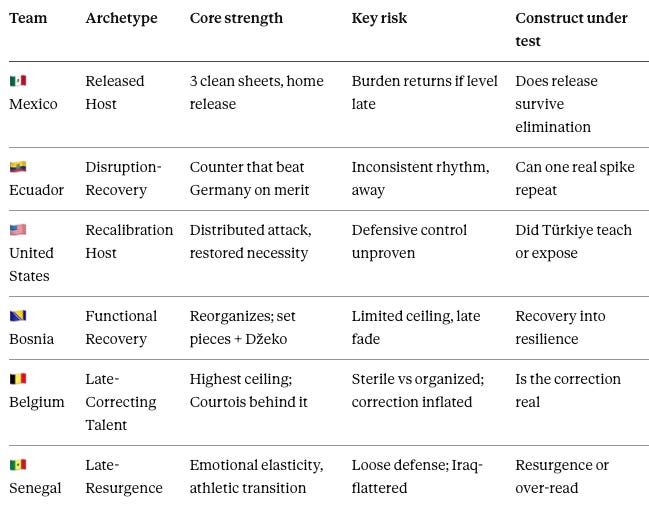
🇲🇽 Mexico — the Released Host. Mexico owns the cleanest profile in the tournament: three wins, six scored, none conceded, the strongest defensive integrity of any side on this slate. The South Korea win graded as a textbook Trap, 1–0 on 43 percent possession; the Czechia win showed the system freed, a 3–0 built on a 1.79-to-0.47 expected-goals edge without losing shape. Validation Report II upgraded Mexico from burdened host to released host at the Azteca, and the live question is whether release survives elimination — whether the crowd still lifts a side that now carries knockout pressure, or inverts into burden if the match stays level past the hour.
🇪🇨 Ecuador — the Disruption-Recovery System. Ecuador defends first and strikes once, and its qualifying result carries real credibility: a 2–1 win over group-winner Germany, from a goal down, out-creating the favorite 1.51 to 0.65 on seven shots. The profile does not need sustained dominance — it needs one destabilizing sequence, second-ball wins, and transition corridors. Moisés Caicedo anchors the midfield, Pedro Vite set a tournament tackle high against Germany, and Gonzalo Plata supplies the decisive moment. The limitation is rhythm: one high-value result, not a full tournament arc, and a low environmental reading away at the Azteca.
🇺🇸 United States — the Recalibration Host. The United States moved from high-upside host to recalibration host after Validation Report II. Distributed expansion is real, established when it beat Australia 2–0 without Pulisic, but the rotated 3–2 loss to Türkiye proved expansion does not equal control. Knockout football should restore role clarity, because the first-choice XI returns and necessity turns absolute, with Balogun, Reyna, and a returning Pulisic behind it. The dominant question is cybernetic: did the Türkiye loss cause learning, or did it expose structure. Confidence restored necessity re-strengthens the read: 70%.
🇧🇦 Bosnia — the Functional Recovery System. Bosnia reorganizes after damage and survives, the recovery frame validated by the 3–1 win over Qatar even as the micro-mechanisms missed. The system is pragmatic — it absorbs, reorganizes, and lives for direct play and set pieces — and Edin Džeko can settle a tight game on one chance. The ceiling is the limit: Bosnia has shown recovery, not the capacity to out-control a superior host, and its late-window risk remains live after conceding late against Canada and Switzerland.
🇧🇪 Belgium — the Late-Correcting Talent System. Belgium holds the highest talent ceiling on the slate and the least-resolved coherence. Two group matches weakened the distributed-creation thesis — sterile against an organized Egypt, scoreless against Iran — before a 5–1 demolition of New Zealand revived it. The correction is real but discounted, because New Zealand finished bottom and the quality of opposition may have inflated the signal. Belgium’s path runs through chance creation rather than defensive suffocation, since Egypt scored early, Iran held it out, and even New Zealand scored. De Bruyne, Lukaku, Doku, and Trossard set the ceiling; delayed in-match correction sets the risk. Confidence the New Zealand correction is partly opponent-inflated: 70%.
🇸🇳 Senegal — the Late-Resurgence System. Senegal carries high emotional elasticity and a genuine resurgence signal, which makes it more than an empty qualifier. Losses to France and Norway did not break its identity, and the 5–0 win over Iraq restored the attacking signal and the emotional coherence that powers it. The system turns matches into waves rather than patterns, dangerous through vertical pressure, athletic transition, and second-ball intensity, with Ismaïla Sarr, Iliman Ndiaye, and Nicolas Jackson supplying the speed. The risk is twofold: over-reading the Iraq result, and a defensive looseness that conceded three apiece to France and Norway.
Contact mcai@mindcast-ai.com to partner with us on Predictive Game Theory AI in Law and Behavioral Economics. To deep dive on MindCast works upload the URL of this publication into any LLM (preferably Google AI mode/Gemini, Claude, ChatGPT) and prompt ‘reconstruct MindCast framework with three degrees of cited sub links.’ See Live-Fire Game Theory Simulators, Runtime Predictive Infrastructure.
MindCast AI is a cybernetic, predictive game-theory AI firm specializing in law and behavioral economics, applied to complex litigation, innovation systems, and geopolitical risk intelligence. Rather than extrapolating historical patterns, the firm models the mechanisms that generate institutional behavior, running Cognitive Digital Twin simulations grounded in Nash equilibrium, Stigler information economics, and the Chicago School of law and behavioral economics.
We simulate NFL and World Cup games to stress test our predictive AI system. See Super Bowl LX — AI Simulation vs. Reality | MindCast Predictive Game Theory + Behavioral Economics Cognitive Digital Twin Foresight Simulations in the World Cup and Super Bowl
IV. Two Axes: Construct Robustness and Opponent Danger
The slate’s confidence ordering follows two axes, and separating them is the analytical center. The first axis measures how proven the favorite’s own construct is under pressure. The second measures how dangerous the opponent is. Confidence tracks the first axis primarily and the second as a modifier — which is why talent ceiling and forecast confidence diverge sharply here.
Mexico ranks highest because its construct is the most proven, and Ecuador’s real disruption credibility modifies that confidence without overturning it. A side with three clean sheets and the slate’s strongest defensive integrity carries its lean into a knockout even against an opponent that just beat Germany, so Mexico earns the widest band while Ecuador’s signal keeps the band from running higher.
Belgium carries the lowest advancement confidence despite the highest ceiling, because its construct is the least proven and its opponent is genuinely dangerous. A correction inflated by a bottom-place opponent, sitting on two sterile group matches against organized resistance, meets a Senegal side with real emotional elasticity and athletic transition — so the ceiling is high and the advancement is low, the one place on the slate where those two readings split most widely.
The United States sits between, a construct mid-recalibration against a functional-recovery opponent. Distributed expansion must convert to defensive control against a Bosnia side built to absorb and strike late, and the forecast cannot run confident until the control half of the construct proves out — which is why the United States carries the slate’s lowest confidence band even as its weaker opponent keeps its advancement above Belgium’s. Advancement therefore orders Mexico, then the United States, then Belgium — set by construct robustness against opponent danger, not by talent.
V. The Calibration Scorecard
The slate’s single scorecard ranks each favorite by the test its core construct must pass, with opponent danger as the modifier on confidence.
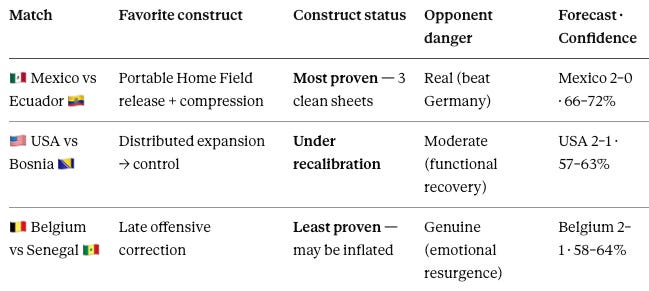
The column that orders the slate is construct status. Mexico’s proven construct earns the highest advancement despite a credible opponent; Belgium’s unproven correction carries the lowest advancement despite the highest ceiling; the United States sits mid-test, its confidence band the slate’s lowest even as a weaker opponent lifts its advancement above Belgium’s. Ceiling does not set confidence — proof does.
VI. Game Regimes
Each fixture opens as a fork keyed to the first goal, the branch-not-label discipline the cohort validated. The grid below is the quick read; the paragraphs beneath it carry the mechanism.
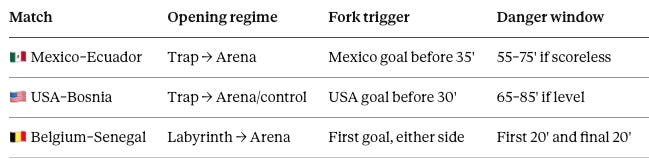
Mexico–Ecuador opens as a Trap, a favorite carrying elimination pressure at home against an opponent with upset validation. A Mexican goal before the 35th minute turns the Trap into an Arena, where crowd energy becomes release and Ecuador must leave the block it prefers; a scoreless match past 60 minutes deepens the Trap, the danger window where home pressure begins to invert. The fork condition is the first Mexican goal; the danger window is 55 to 75 minutes if scoreless.
USA–Bosnia opens as a Trap, a favored host recently exposed against an opponent built to stay level and force impatience. A United States goal before the 30th minute tips toward Arena-and-control; a tied game past the hour hands Bosnia the set-piece-and-transition path it wants. The danger window is 65 to 85 minutes if level.
Belgium–Senegal opens as a Labyrinth, both sides carrying rebound signals that require verification, and forks to an Arena the instant either team scores, because both carry enough attacking talent to create transition chains after the first rupture. The danger windows sit in the first 20 and the final 20 minutes, and a Senegal opener is the condition under which Belgium’s old coherence problem returns immediately.
VII. Forecast
Knockout rules change what a forecast must report. A match level after 90 minutes goes to 30 minutes of extra time, and a match still level after extra time goes to a penalty shootout — so no Round-of-32 result ends in a draw, and the number that matters is the probability each side advances, not the regulation split alone. The table reports three quantities per match: the regulation result after 90 minutes, the share of matches that finish level and carry into extra time and penalties, and the advancement probability that resolution produces.
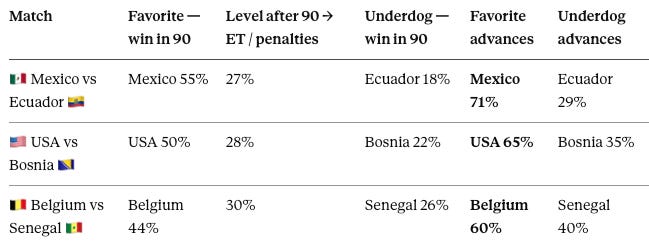
Mexico versus Ecuador turns on whether home release survives elimination and whether Mexico scores before the crowd shifts from release to pressure. The regulation result lands most likely at a Mexico 2–0, with 1–0 and 2–1 live; a scoreless or 1–1 deadlock carries the tie into extra time, where Mexico’s home control and composure hold the edge, and into a shootout it would enter the slight favorite. Across both paths, Mexico advances 71 percent, and confidence in the lean settles at 66–72%, the highest of the three, because the most-proven construct meets an opponent dangerous enough to cap the band but not to overturn it.
United States versus Bosnia turns on whether distributed expansion converts to defensive control. The regulation result lands most likely at a United States 2–1, with 1–0 live; a level game hands Bosnia the extra-time-and-shootout lottery its veteran composure and Džeko’s nerve relish, though US fitness and depth favor the host through 120 minutes. The United States advances 65 percent, and confidence settles at 57–63%, the lowest of the three, held down by the unproven control half of the construct and the late-window gate that a tie only widens.
Belgium versus Senegal turns on whether late correction scales against athletic pressure. The regulation result lands most likely at a Belgium 2–1, with a 1–0 and a level game live; a tie raises Senegal’s odds sharply over 90, but Courtois gives Belgium a genuine shootout edge, so Belgium’s advantage holds up better in the tie-break path than in regulation. Belgium advances 60 percent — the slate’s lowest — and confidence settles at 58–64%, because a Senegal opener would reinstate Belgium’s coherence problem at once.
Reduced to one sentence: Mexico should control and advance if it stays patient, the United States should progress if expansion becomes control, and Belgium should edge through — more comfortably in a shootout than in open play — if it ignites before Senegal does.
VIII. Time Gates
Each match carries four observation windows — the opening 25 minutes, the halftime state, the first 15 after the restart, and the final 20 — measured through shots on target and big chances rather than possession share. A paragraph per match maps each window to what it tests.
🇲🇽 Mexico–Ecuador 🇪🇨 runs its gates around the release-or-burden question. The opening 25 test whether the Azteca lifts a pressured host, read through Mexican shots on target rather than territory — a fast home tempo signals release, an early scoreless lull signals the inversion beginning. The halftime state tests whether Mexico has converted control into a lead or whether a level interval has started loading expectation onto the crowd. The first 15 after the restart test the Arena fork directly, since a Mexican goal there frees the match while a continued deadlock hands Ecuador the patience it prefers. The final 20, the 55-to-75 danger window carried to the whistle, test whether Ecuador has stayed level while creating central-zone chances above Mexico’s quality — the profile that carries an upset into extra time.
🇺🇸 USA–Bosnia 🇧🇦 runs its gates around the control question. The opening 25 test whether the restored first-choice United States imposes early tempo or whether Bosnia settles into its block and begins forcing impatience. The halftime state tests who owns the interval, a US lead pointing to control achieved and a level score pointing to the slow game Bosnia wants. The first 15 after the restart are the construct’s decisive window, testing whether the United States imposes distributed expansion without leaving the transition lanes the Türkiye loss exposed. The final 20, the 65-to-85 danger window, test Bosnia’s late strike and set-piece threat against a host that must hold a lead rather than chase one.
🇧🇪 Belgium–Senegal 🇸🇳 runs its gates around the ignition question. The opening 25 are the recursion tell, testing whether Belgium ignites early or stalls into the sterile possession that stranded it against Egypt and Iran. The halftime state tests whether Belgium leads or whether a level game has handed Senegal the belief its resurgence feeds on. The first 15 after the restart test whether Belgium’s late-correction pattern arrives on schedule or whether Senegal’s waves build first. The final 20 test whether Senegal’s athletic energy turns a verified Labyrinth into the Arena it wants — and whether a still-level match heads toward Courtois and the shootout edge that favors Belgium.
IX. Falsification Contract
The simulations weaken, and the framework learns, if any of the following hold. Each condition is observable from the gates above, and pre-commitment is the discipline.
Mexico’s forecast weakens if Ecuador keeps the match scoreless past 60 minutes while creating central-zone chances above Mexico’s quality, and the Portable Home Field release thesis fails outright if the Azteca turns visibly anxious and Mexico’s shot quality declines under pressure. The United States recalibration thesis weakens if the host creates chances but leaves repeated transition lanes, and the defensive-control correction fails if Bosnia generates high-quality chances from direct play or set pieces before halftime. Belgium’s correction thesis weakens if it dominates possession but fails to create high-quality chances in the first hour, and fails structurally if Senegal scores first and Belgium reverts to sterile circulation. Senegal’s resurgence thesis strengthens, against the lean, if it creates transition chances before Belgium establishes rhythm.
Validation remains the objective, and calibration remains the discipline.
X. What These Results Feed
The Seattle Round of 16 sits directly downstream. Match 94 on July 6 at Lumen Field pairs the winner of USA–Bosnia against the winner of Belgium–Senegal, so a United States win plus a Belgium win produces USA versus Belgium in Seattle — a marquee tie between two sides already deep in the MindCast corpus, and the natural capstone of the Seattle series. Mexico’s path, should it pass Ecuador, runs through its own Round of 16 at the Azteca. The three openers therefore do double duty: they grade the calibration thesis on resolution, and they set the board for the Seattle knockout that follows.
XI. Conclusion
The Round of 32 does not ask which favorite is strongest; it asks which favorite can carry its group-stage identity into a knockout game without letting elimination pressure rewrite the system. Mexico has the clearest path, because its construct is the most proven; Belgium has the highest ceiling, because its talent is the deepest; the United States has the most to prove, because its construct is still mid-correction. Ecuador can disrupt, Senegal can surge, and Bosnia can recover, and each opponent is dangerous enough to set the favorite’s confidence rather than merely fill the fixture.
Mexico is the most stable, Belgium the most talented, the United States the most uncertain. The group stage taught MindCast what to fix; the Round of 32 tests whether those fixes forecast better under elimination pressure. Graded the way the series grades itself, the slate asks the question the framework was built to answer — whether a validated construct holds when one mistake ends everything.
Cultures Under Shared Rules — The Seattle Lab at FIFA World Cup 2026 series
Belgium vs Egypt | USA vs Australia | Qatar, Bosnia, Egypt, Iran | Three Group Winners Enter the Round of 32 🇲🇽 Mexico vs Ecuador 🇪🇨 · 🇺🇸 US vs Bosnia 🇧🇦 · 🇧🇪 Belgium vs Senegal 🇸🇳
Validation Reports World Cup Validation Report I — USA, Belgium-Egypt, Mexico | World Cup Validation Report II — Bosnia, Egypt-Iran, Mexico, Türkiye | World Cup Validation Report III — Special US | Mexico Series, Seattle Lab 🇲🇽 🇺🇸 🇧🇪
MindCast Special Series — a deliberate stress test of the MindCast system beyond the controlled venue of the MindCast Seattle Lab
World Cup Championship Index 2026 | When a FIFA World Cup Model Picks France and the Economist Picks Argentina
Mexico vs South Korea | Mexico and USA | Three Group Winners Enter the Round of 32 🇲🇽 Mexico vs Ecuador 🇪🇨 · 🇺🇸 US vs Bosnia 🇧🇦 · 🇧🇪 Belgium vs Senegal 🇸🇳
Forthcoming
Round of 16 — the eight-match slate — July 4–7 (Matches 89–96). Full coverage begins here. Each commits only after its two Round of 32 feeders resolve, so they publish in a rolling wave July 2–4 rather than in one drop.