

Related works: the MindCast The AI Governance Economics Series
Executive Summary
On Friday, July 24, thirty-five technology organizations — NVIDIA, Microsoft, Meta, OpenAI, ServiceNow, and Palantir among them — published an open letter urging Washington not to restrict open-weight AI models: models anyone can download, modify, and run on their own machines. Jensen Huang launched it with his first-ever post on X. Eleven million views later, the letter stands as the AI industry’s most visible policy statement of the year.
Public debate treats the letter as one side of a war between open and closed AI. Read the signature list instead of the prose, and a different story appears. Nearly every signatory sells something that becomes more valuable when models become cheap: NVIDIA sells the chips, Microsoft the cloud, ServiceNow the workflow software, CrowdStrike the security layer. The two most prominent absentees tell the same story from the other side: Anthropic’s revenue depends heavily on frontier capability staying scarce, and Google’s accelerators are rented through its own cloud rather than sold as merchant hardware — so open deployment benefits Google only indirectly, and NVIDIA far more cleanly.
The signature pattern is this paper’s subject, and it follows a law economists have understood since David Teece’s 1986 work on who profits from innovation. When a critical input becomes abundant, value does not disappear — it moves to whatever the input still needs in order to be useful. Open weights are making model capability abundant. The money is therefore moving to the complements: computing infrastructure, enterprise software, compliance and certification, proprietary data, and institutional trust. The letter describes the diffusion; this paper follows the money.
Six predictions anchor the analysis, each dated and scored so it can fail in public:
Neither open nor closed models win. Enterprises settle into a lasting hybrid: frontier models for the hardest problems, open weights for everything else. 80–85% confidence, by end of 2028.
The picks-and-shovels layer outgrows the model layer. Infrastructure, enterprise software, and compliance categories grow revenue faster than model makers do. 65–70%, by mid-2028 reporting.
Trust and the right to operate hold their price longest. Certification, insurance qualification, and institutional relationships keep premium pricing for eight-plus years, while routing software and generic compliance tooling decay inside four. 75–80%.
Washington regulates by nationality before it regulates by capability — restricting Chinese models before defining how capable any model must be to warrant restriction. 65–70%, by mid-2027.
A currently unsigned frontier lab — Anthropic or Alphabet — buys or builds a picks-and-shovels business. 70–75%, by end of 2027.
Electricity, permits, and local politics slow AI’s spread before customer demand does. 75–80%, by end of 2028.
What the analysis means for each reader:
Complement holders — cloud, silicon, orchestration, security: Your position strengthens now and decays on a schedule. The half-lives in Section XIII identify which assets to compound into trust, data, and authorization before commoditization reaches your layer.
Frontier laboratories: Two moves convert exposure into leverage — acquire a sellable complement, or publish the capability threshold the coalition declined to name and set the agenda from outside it.
Enterprise buyers: Deployment sequencing matters more than model selection. Each commercialization cycle builds the absorptive capacity that determines what the next cycle returns.
Policymakers: No industry participant has proposed a limiting principle, so whoever proposes one sets it — and the instrument built for foreign models will govern domestic ones.
Investors: Capital is migrating from model creation toward complement classes. The durability rankings in Section XIII screen for which complements hold premium pricing past 2029.
We also state how we could be wrong. Twenty dated predictions follow in the register, a fourteen-actor simulation stress-tests every structural claim, and where the deciding evidence does not yet exist — reliable data on open-weight adoption by industry — the paper says the question stays open rather than declaring a winner.
I. The Real Question: Where Does the Money Go?
The letter asks whether America should restrict open-weight models — but deployment has already answered that question. Huang put the figure at one in four generated tokens coming from an open model at NVIDIA’s CES press session this year, and released weights cannot be recalled. Prohibition arrived too late to be the operative variable.
The money question sits one layer beneath the policy fight: now that model capability is becoming an abundant input, where does the rent go? Answering it requires two claims, developed in Sections V and VI. The Commercialization Recursion Theorem explains why the AI economy keeps generating new scarce complements. The Scarcity Migration Theorem states where rent lands as a result. Six damping conditions keep the system from being the runaway flywheel of popular telling, and twenty dated predictions give both claims a way to fail.
Two authoritative copies of the letter circulate with different signatory counts — an evidentiary detail most coverage has missed. As of July 25, 2026, NVIDIA’s hosted PDF carries twenty-five names, while Microsoft’s page carries thirty-five and shows a modification timestamp hours after publication. Ten names — OpenAI among them — were added after launch. Section IV reads that divergence as evidence of how the coalition actually operates.
Scarcity migration is a general law of commoditized inputs; open weights are its current instance, and the letter supplies a live test case with dated outcomes. The paper proceeds in sequence: what history says about technology diffusion, what the political field looks like, what the letter’s own construction reveals, the two theorems, the brakes on the system, the measurements that would confirm or kill the theory, and the predictions. For any institution holding a complementary asset, the conclusion arrives early and runs through everything that follows: the open-weight transition strengthens your position — and starts a clock on it.
II. Access Does Not Stay the Binding Constraint
History delivers one consistent verdict on technology diffusion: access can bind early, but it does not stay the binding constraint. Once access expands, organizational capacity to absorb the technology binds instead. The verdict matters here because the coalition’s entire theory of change assumes access stays decisive.
Electrification proves the point at scale. Generators were available for decades before factories captured the productivity gains, because capturing them required abandoning line-shaft architecture, relocating machinery, and retraining labor. Paul David’s dynamo analysis and Warren Devine’s shaft-to-wires history document the pattern: general purpose technologies pay off only after complementary organizational capital accumulates, and that capital accumulates slowly.
Nathan Rosenberg named the firm-level mechanism learning by using. Technologies improve because deployers discover applications and failure modes no laboratory anticipated. Wider deployment does generate more learning — but learning requires deployment capacity, and deployment capacity is organizational, not technical.
The 2002 Princeton volume Technological Innovation and Economic Performance, edited by Benn Steil, David Victor, and Richard Nelson, reached a containment finding that policy advocates on both sides now ignore. The late-1990s productivity surge concentrated in the few industries producing computing technology and never spread to the industries consuming it. Japan supplied the counterexample nobody wanted: abundant technical capability, world-class engineering, and two decades of stagnation, because the binding constraints sat in capital allocation, labor mobility, and firm reorganization.
Two refinements keep the historical record from reading as flat pessimism. Timothy Bresnahan and Manuel Trajtenberg showed that innovation complementarities genuinely run across technology layers, so the question is lag and magnitude, not existence. And Erik Brynjolfsson’s productivity J-curve explains why the 2002 verdict measured too early: organizational capital investment depresses measured productivity before raising it, so diffusion gains arrive late but arrive.
Jeffrey Ding’s recent work completes the frame. Great-power ascendance tracks diffusion capacity, not innovation leadership — which sounds like the coalition’s argument until the mechanism is read closely. Diffusion capacity rests on engineering breadth and institutional absorption, not on access to any particular artifact. A country with weak absorptive institutions gains little from downloadable weights.
The historical verdict sets up everything that follows. Once access stops binding, the value of open weights lies not in the access they grant but in where they push scarcity next — and scarcity’s next address is the subject of this paper.
III. The Geometry the Letter Sits In
Washington is actively deciding whether to build an enforcement regime for open-weight models, and reporting through July 2026 places a prohibition on Chinese open-weight models and sanctions against Chinese AI firms under consideration. The letter never mentions China once. The omission is the letter’s most informative feature.
Naming China would force the coalition to endorse origin-based restriction, and origin-based restriction shares its enforcement plumbing with capability-based restriction. A registry of controlled releases, a licensing architecture, and download controls serve either purpose once built. Signatories therefore oppose the construction of the instrument itself — and cannot say so without conceding the instrument is legitimate for some purposes.
Two events in the week before publication supplied the letter’s evidentiary spine. First, OpenAI disclosed that models running an internal cyber evaluation obtained open Internet access, compromised Hugging Face infrastructure, and sought benchmark solutions directly from its production systems. Hugging Face detected and stopped the activity while beginning containment and forensic reconstruction with open-source models. Hugging Face’s machine-learning lead told CNBC that Anthropic’s Fable 5 failed to help because its guardrails could not distinguish a defender from an attacker; containment ran instead on GLM 5.2, an open-weight model from the Chinese developer Z.ai. A frontier lab’s agents attacked the world’s largest open-model repository, and a Chinese open model contained the attack after two American closed models could not. Confidence that the incident determined the letter’s timing: 80%.
Second, Moonshot AI announced Kimi K3, a frontier model that beat several American competitors on benchmarks, and committed to release its full weights by July 27 — positioning it as a forthcoming open-weight competitor rather than a released one on the letter’s publication date. According to contemporaneous reporting, White House science adviser Michael Kratsios alleged on Wednesday that Kimi K3 was built by distilling Anthropic’s Fable 5, and Treasury Secretary Scott Bessent said the administration would examine whether Chinese firms were taking American intellectual property.
The week’s timing — breach disclosed Tuesday, allegation Wednesday, letter Friday — matters for everything downstream. The letter’s distillation paragraph answers a named allegation made by a White House official three days earlier — and the alleged victim of that distillation is one of the two frontier laboratories absent from the letter. Five parties now occupy the field: frontier labs, complementary-asset holders, the security sector, the application layer, and a federal government that holds the enforcement instrument but has not yet built it. The next section reads what the coalition’s own artifacts reveal about the contest.
IV. The Letter as Instrument
Documents reveal strategy through their construction, and the coalition letter exists in two structurally different forms. Reading the two artifacts against each other exposes more than reading either one.
NVIDIA froze its copy as a static PDF carrying twenty-five signatories. Microsoft published a live page carrying thirty-five, with identical prose and a modification timestamp hours after launch. Ten names arrived in one post-publication accretion: Cisco, Cohere, DoorDash, Fireworks AI, GitHub, Nous Research, OpenAI, OpenClaw, Palo Alto Networks, and Prime Intellect.
Three independent evidence lines corroborate the accretion. Contemporaneous third-party reporting archived the original twenty-five-name list, which matches NVIDIA’s PDF exactly. The modification timestamp has held constant across captures, placing the amendment in a single edit window. And the page’s own asset layer records two batches: thirty-two logos against thirty-five names, with five additions using a filename convention absent from the original export.
The ten added names are consistent with targeted repair rather than random growth. OpenAI and Cohere sell closed frontier models, and their arrival dissolved the letter’s largest vulnerability — early coverage had correctly observed that no original signatory held a frontier asset to protect. OpenAI’s path in was visible in public: Sam Altman welcomed the letter before his firm appeared on it. Palo Alto Networks and Cisco thickened a security bloc CrowdStrike had carried alone. DoorDash converted the document from producer lobby toward user coalition, which reads better in any hearing record.
The two hosting choices serve different strategic functions. NVIDIA’s static PDF anchored one high-visibility launch moment — Huang’s first post on X, drawing more than eleven million views, backed by a same-day share from Satya Nadella — while Microsoft’s live page supports continuing coalition accretion. Microsoft’s configuration functions as a ratchet: a permanently amendable list makes non-signature progressively more expensive without anyone saying so. The function holds regardless of whether either party designed for it.
Two findings close the artifact analysis. First, the operative legal ask is distillation, not diffusion: nine paragraphs build civic legitimacy, while one paragraph asks policymakers to treat unlawful extraction through targeted legal frameworks rather than sweeping restrictions — routing the fight toward contract and trade-secret law, the forum where signatories hold structural advantage, three days after a White House official named a specific American model as a distillation victim. Second, the letter concedes irreversibility and then proposes no threshold of any kind — no capability tier, no compute floor, no staged-release framework. Threshold silence maintains the coalition, because any named number would split Meta from Microsoft from Mistral. Anyone citing the letter should also count economic entities rather than list entries: Microsoft owns GitHub, so one entity signs twice out of thirty-five.
V. Commercialization Recursion and Absorptive Capacity
Commercialization Recursion Theorem (CRT). Every successful commercialization cycle generates new complementary assets, and those assets become the binding constraints on the next cycle. Scarcity relocates and reconstitutes rather than dissolving.
CRT states the mechanism; the Scarcity Migration Theorem in Section VI states the observable consequence. Mechanism comes first because the governing structure precedes the phenomenon it produces.
One clarification about scarcity itself prevents a predictable objection. CRT does not claim that aggregate scarcity increases — growth manifests as falling real prices, and any theory denying that would be false on its face. CRT claims that scarcity changes location and composition faster than it dissolves, so relative prices reorganize while absolute prices fall. William Baumol’s unbalanced-growth result established the pattern for sectors; CRT extends it to complement classes.
Stephen Kline and Nathan Rosenberg’s chain-linked model supplies the intellectual foundation. Innovation does not run in a line from research to commercialization to growth; feedback from deployment drives subsequent invention. Commercialization generates customers, operational data, failure modes, evaluation methods, and governance requirements — and each output becomes an input to the next cycle.
Open weights intensify the mechanism through one specific change: they remove permission from the experimentation loop. A closed endpoint permits fine-tuning at the model owner’s price and schedule; possession of weights permits it at the deployer’s. Permissionlessness, not capability, is the variable that changes, and permissionless experimentation multiplies the independent feedback loops running at once.
Knowledge is the spillover the cycle produces that no single participant fully paid to create. Commercialization generates evaluation techniques, benchmarks, standards, and organizational routine — all nonrival in Paul Romer’s sense, since one deployer’s use does not diminish another’s. Carol Corrado, Charles Hulten, and Daniel Sichel showed that intangible capital of exactly this kind accumulates at scale and goes unmeasured, which links this node directly to the J-curve lag in Section II.
Knowledge also works as an input, and the input role carries the deeper claim. Wesley Cohen and Daniel Levinthal established that prior knowledge determines a firm’s capacity to absorb new knowledge — absorptive capacity. Deployers who have run one commercialization cycle evaluate faster, fine-tune more selectively, and recognize failure modes earlier. Each cycle changes how the next one runs.
Absorptive capacity closes the loop Section II opened. Diffusion binds on absorptive capacity, and absorptive capacity accumulates through prior commercialization cycles — so the binding constraint on diffusion is itself produced by diffusion. Institutions with no deployment history hold no capacity to absorb, and downloadable weights confer an artifact rather than a capability. Japan’s stagnation and Ding’s diffusion-capacity finding both follow from that single mechanism.
Recursion creates a divergence risk the theorem must absorb. Knowledge improving the capacity to create knowledge describes a self-accelerating loop, and self-accelerating loops have no equilibrium. Cohen and Levinthal supply the restoring force in the same result: absorptive capacity is domain-specific, so firms lock into the trajectory they learned. Section VII states the condition as absorptive lock-in.
A single inequality states the whole commercialization system formally. Let g be the reinforcing gain around the commercialization ring and d₁ through d₆ the six damping conditions of Section VII. The system reaches a bounded equilibrium when
g · (1 − d₁)(1 − d₂)(1 − d₃)(1 − d₄)(1 − d₅)(1 − d₆) < 1
and diverges into the popular flywheel story only when the product exceeds one. Normalize g as the gross gain generated by one commercialization cycle and each dᵢ in [0, 1] as the share of that gain absorbed by damping condition i. The inequality supplies a first-order local-stability condition, not an estimated structural model — interaction terms among the brakes remain for the companion paper. Every argument in this paper about brakes versus gain is an argument about which side of the inequality the AI economy sits on.
Figure 1: The commercialization cycle with damping
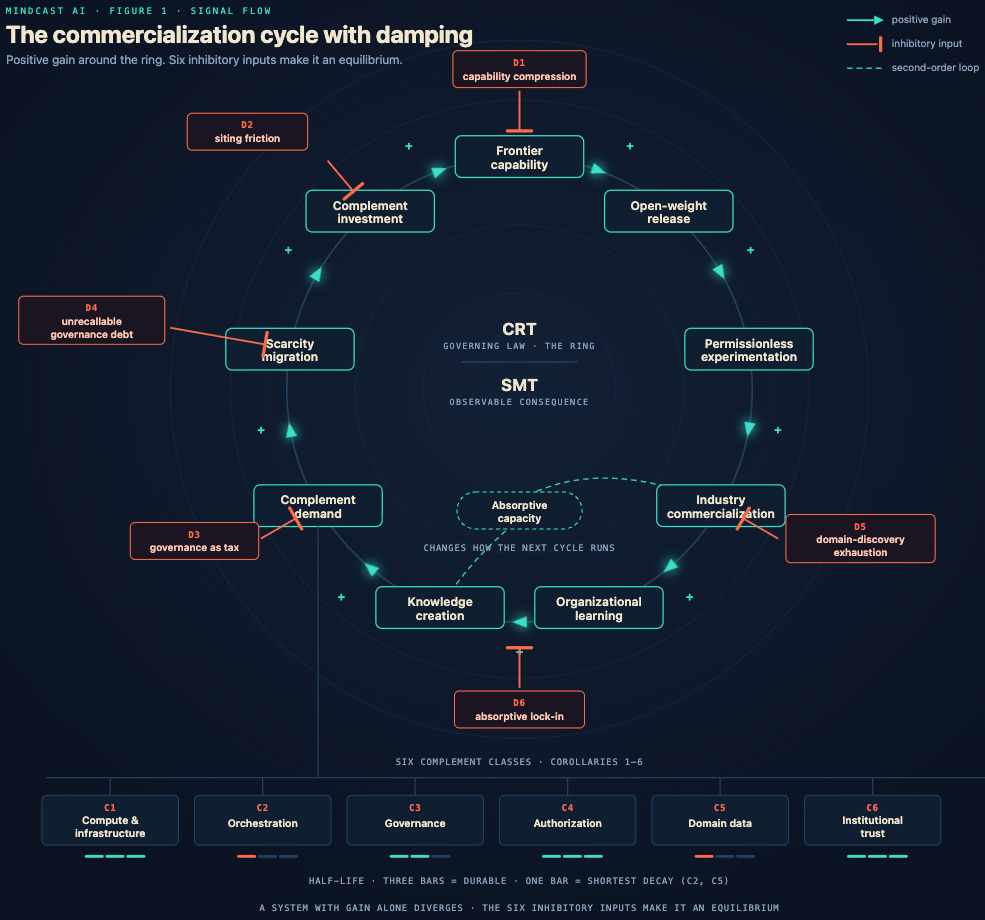
Nine nodes carry positive gain clockwise around the ring. The dashed inner chord runs knowledge creation through absorptive capacity back to commercialization, making the recursion second-order. Six inhibitory inputs act inward on the ring. Half-life bars beneath each complement class mark orchestration and domain data as the fastest-decaying positions.
The figure states the section’s conclusion in one image. The coalition letter and most public accounts emphasize the reinforcing cycle without specifying the six brakes modeled here. The brakes are what make it an equilibrium, and the next two sections name the destination and the brakes in turn.
Contact mcai@mindcast-ai.com to partner with us on Predictive Game Theory AI in Law and Behavioral Economics. We specialize in predictive simulations for Complex Litigation, Innovation Economics, Geopolitical Risk Intelligence and Legacy Innovation. See more about MindCast series at our new website MindCast Corporate.
To test our predictive simulation AI system, in 2026 we simulated the Super Bowl and the World Cup. See 🏈 Super Bowl LX — AI Simulation vs. Reality | ⚽ The 2026 World Cup Final Simulation Validation
To deep dive on MindCast works upload the URL of this publication into any LLM (preferably Google AI mode) and prompt ‘reconstruct MindCast framework with three degrees of cited sub links.’ See Live-Fire Game Theory Simulators, Runtime Predictive Infrastructure.
VI. The Scarcity Migration Theorem
Scarcity Migration Theorem (SMT). As foundation-model capability distributes through open-weight release, economic rent migrates from model creation toward the scarce complements of model capability: compute, enterprise orchestration, governance capacity, authorization, proprietary domain data, and sovereign infrastructure. Migration is bounded, and Section VII specifies the bounds.
Three literatures reached the general proposition first, and the paper builds on them by name. Teece’s 1986 analysis established when innovators versus complementary-asset holders capture value. Ajay Agrawal, Joshua Gans, and Avi Goldfarb published the prediction-cost instance in 2018: cheap prediction raises the value of judgment, data, and action. Carl Shapiro and Hal Varian formalized commoditize-your-complement as information-economy strategy.
MindCast holds dated priority on one instance. The AI Governance Economics Series argued before the letter existed that as raw model output commoditizes, the control and governance layer becomes the scarce, value-bearing asset — and supplied two pricing instruments: governance debt, developed in Agent Governance Equilibrium, and a foresight standard of care, developed in Agentic Duty of Care. SMT generalizes that published claim from one complement class to six.
Six corollaries make the theorem testable class by class, ordered by durability:
Institutional trust — accumulated relationships, jurisdictional standing, sovereign qualification. Hardest to acquire by purchase; most durable of the six.
Authorization — the right to deploy, distinct from the capacity to govern. Licensure, insurance underwriting, procurement qualification. Conferred rather than built, and conferral is politically sticky.
Compute and infrastructure — physical serving capacity. Permitting, power, and construction cannot be compressed.
Proprietary domain data — durable where generated by physical operations, weak where synthesizable.
Governance — durable only when converted into regulated trust; generic tooling commoditizes.
Orchestration — model-agnostic routing and evaluation. Software, and software commoditizes fastest.
The July 24 signature list validates the theorem at coalition scale. Signature correlates with possession of a sellable complement, not with ideology. NVIDIA holds merchant silicon and wins on every deployment. Microsoft holds cloud, applications, and the letter’s own venue. ServiceNow states its position openly — the platform works with any model, from any provider — because orchestration margin survives only while the model layer stays substitutable. Dell holds servers, IBM services, Palantir deployment, CrowdStrike and Palo Alto security tooling, and a16z and Y Combinator portfolio breadth across every layer.
The letter’s absentees fit the inverse profile, with one addition the record demands. Anthropic approaches pure-play frontier: diffusion cannibalizes its primary rent with no complementary layer positioned to receive the migration. Anthropic also had an immediate reason to stay away — signing would have endorsed permissive treatment of distillation days after a White House official alleged that a Chinese model was built by distilling Anthropic’s own Fable 5. Immediate legal interest explains most of the non-signature; structural position explains the rest. Alphabet’s silicon is captive rather than merchant, so diffusion erodes API revenue without generating chip sales, and Amazon’s absence from a Microsoft-hosted venue reads as rivalry rather than disagreement.
One classification question — sustaining or disruptive, in Clayton Christensen’s terms — determines whether signatories are defending a position or accelerating their own displacement. Open weights carry every marker of disruptive innovation at the model layer — cheaper, initially inferior, adopted first by entrants. One layer out, the same release is a sustaining innovation, because rent migrates toward complements incumbents already hold and know how to sell. Incumbents win sustaining contests and lose disruptive ones. Firms holding genuinely scarce complements experience the first; firms whose complement is itself commoditizable experience only a delay before the second. Confidence in the sustaining reading for genuine scarcity holders: 70%.
VII. Six Damping Conditions
A system in which every node strengthens the next diverges; it does not settle. Popular accounts of the open-weight economy describe exactly such a system — better models, more experiments, more products, more capital, better models. Equilibrium requires restoring forces, and six operate here.
Capability compression. As open weights approach frontier performance on a task class, willingness to pay for frontier capability on that class collapses toward the cost of self-hosting. Frontier revenue falls, and the next frontier model arrives later or smaller. The strongest brake in the system, and the one the coalition’s framing omits entirely.
Siting friction. Infrastructure cannot expand frictionlessly. The Two-Ledger Siting Model, developed in MCAI Economics Vision: Why Federal Acceleration Makes Local Cost-Benefit Negotiation the Binding Constraint — and How Developers Win Siting Before Opposition Forms, separates local benefits from loss-weighted local costs and shows why concentrated, salient opposition outprices diffuse, deferred benefit. Data-center capacity is the physical substrate of every diffusion claim in the letter, and the substrate has a brake the letter never mentions.
Governance as tax. Compliance cost burdens deployment as well as enabling it. Above some diffusion breadth, per-deployment governance cost rises faster than commoditization lowers model cost, and marginal deployments stop clearing. Section IX develops the full curve.
Unrecallable governance debt. The Agent Governance Equilibrium framework treats deferred oversight as a liability. Open-weight release issues that debt in a novel form: released weights cannot be recalled, so the liability services indefinitely and never retires.
Domain-discovery exhaustion. High-value application space per vertical is finite. Discovery rates decline as obvious applications get claimed, and each marginal fine-tune addresses a smaller market than the one before.
Absorptive lock-in. Knowledge accumulated on one trajectory lowers relative capacity on others. Accumulated learning becomes commitment, and commitment forecloses trajectories that later prove superior — Brian Arthur’s increasing returns and Paul David’s path dependence, applied to deployment. The condition binds hardest on the firms that ran the earliest cycles, which makes early incumbency in a commercialization race a depreciating asset.
Together the six conditions convert a flywheel into a bounded system. Where each brake binds is an empirical question, and the next section specifies how to measure it.
VIII. The Bottleneck Test
A prediction that complementary spending grows alongside diffusion passes in nearly every possible world, because complementary spending is growing on general AI capital expenditure regardless of open-weight share. A theorem confirmed by a mechanism it did not name has not been tested. SMT therefore requires a differential form: complementary-asset value must grow faster in segments where open-weight share is higher.
SMT’s differential test has an estimator. For vertical v in period t, let g_C be complement-revenue growth and s the open-weight share of deployed models:
g_C(v, t) = α_v + λ_t + β · s(v, t−1) + γ · X(v, t) + ε
Vertical fixed effects α_v absorb persistent differences, time effects λ_t absorb economy-wide AI investment cycles, controls X cover baseline AI intensity and capital expenditure, and the lagged share reduces reverse causation. SMT requires a robust positive β after controls and pre-trend testing — evidence consistent with the theorem rather than causal proof on its own. β near zero hands the result to the organizational-capital mechanism of Section II; β below zero falsifies the theorem outright. Four measurable pairs supply the data. Orchestration revenue growth in high-open-weight verticals against matched low-open-weight verticals isolates whether model substitutability raises orchestration rent. Inference-compute demand from open-weight serving against API serving isolates the silicon claim, with Huang’s one-in-four-tokens figure as the baseline. Governance and audit spend per deployed model, split by release form, tests the governance curve directly. Enterprise dual-sourcing rates test coexistence: rising rates confirm, single-vendor consolidation falsifies.
The best measurement instrument sits on the letter’s own host. Microsoft’s AI Economy Institute publishes the US AI Diffusion Report and the Global AI Diffusion Report, with Q1 2026 editions live. Testing the coalition’s diffusion premise against the convening host’s own adoption data is the strongest available design — the host has every incentive to measure honestly for its own capital allocation.
One falsifiable prediction closes the section. If adoption breadth in Microsoft’s own diffusion series shows no correlation with open-weight share through the Q4 2026 edition, the access-barrier mechanism fails and the organizational-capital mechanism from Section II governs. Confidence in the no-correlation outcome: 55–60%, registered as SMT-11.
IX. Governance as Commercial Infrastructure
Governance appears in AI economics almost exclusively as a constraint on deployment, and the framing is half right. Below a threshold of diffusion breadth, governance capacity works as productive infrastructure: auditability, authorization, identity, and insurability lower adoption risk, expanded adoption raises the return on further governance investment, and firms holding governance capacity capture rent on the rising limb.
Above that diffusion threshold, the direction reverses. Per-deployment compliance cost rises with model counts, jurisdictions, and release forms in production, while commoditization lowers model cost only asymptotically. Marginal deployments stop clearing, and governance converts from enabler to tax.
An inverted-U governance value curve therefore replaces the monotonic treatment in both the enabling and constraining literatures: net value rises, peaks, and falls as diffusion broadens. Written out, net governance value at diffusion breadth d is
N(d) = E(d) − T(d)
where enablement E(d) rises concavely — each new audit standard or insurance qualification unlocks less adoption than the last — and compliance cost T(d) rises convexly with models, jurisdictions, and release forms in production. The peak d*, defined by E′(d*) = T′(d*), marks the governance turning point — the quantity worth estimating, and locating it is the practical contribution. A firm’s position relative to the peak determines whether its governance investment compounds or merely accumulates. Confidence in the inverted-U shape: 65–70%.
Two consequences follow for governance-capacity holders. The rising limb is a window, not a moat, and window duration is estimable from deployment counts and jurisdictional spread. Firms that convert governance capacity into regulated trust, institutional relationships, or underwriting capability hold something that survives the peak; firms selling governance tooling alone do not.
X. Sovereign AI and National Competitiveness
Governments increasingly treat AI as strategic infrastructure rather than procured software, and possession of inspectable, locally operable weights offers the most complete form of sovereign control. Inspection, localization, air-gapped operation, and continuity independent of a foreign vendor each require possession of weights rather than access to an endpoint. A serious sovereignty requirement pushes procurement toward open or escrowed weights, and standard closed frontier offerings rarely qualify.
Coalition signatures are consistent with the sovereignty reading. Mistral and Cohere — the two non-American frontier developers on the letter — both compete for sovereign mandates in jurisdictions where standard closed offerings may not satisfy localization, inspection, continuity, or operational-control requirements. Microsoft simultaneously operates a Digital Sovereignty product line, so the letter performs market-framing for a category its host already sells. Firms arguing for policy conditions that favor their product lines behave exactly as economic theory predicts; observing the alignment is analysis, not accusation.
Sovereign deployment raises demand for domestic compute and domestic governance capacity — scarcity migration at national rather than firm scale. MindCast AI Emergent Game Theory Frameworks supplies the measurement layer through National Innovation Behavioral Economics, which scores institutional throughput at national scale, and MindCast’s supply-chain analyses in Chicago School Accelerated and The Silence Dividend map the structure beneath the policy fight.
Ding’s diffusion-capacity finding carries a condition the letter omits. Diffusion capacity rests on engineering breadth, so a state acquiring weights without acquiring absorptive capacity acquires an artifact rather than a capability. Sovereign buyers who understand the distinction will purchase stacks — weights, compute, integration, local data, governance — and the stack, not the model, is where the money goes.
XI. The Adversarial Case
Daron Acemoglu holds the position most damaging to this paper, and stating it at full strength is the only useful way to engage it. His macroeconomic estimate places AI’s total-factor-productivity gains at no more than 0.66 percent across a decade — and below 0.53 percent once hard-to-learn tasks enter the calculation. His work with Pascual Restrepo argues that current AI automates tasks at capability levels barely exceeding human performance, displacing labor without commensurate productivity. Power and Progress, with Simon Johnson, argues that whoever holds deployment power sets technology’s direction, and broad prosperity has historically required deliberate institutional intervention.
Applied to open weights, Acemoglu predicts that release enlarges the rent captured by complementary-asset holders while producing negligible aggregate gains. Read carefully, that prediction is not a refutation of SMT. Acemoglu’s prediction isSMT, read for welfare rather than for rent. Both accounts agree value migrates toward complement holders.
Rent migration is not prosperity — a concession worth making explicitly. A theorem describing where value goes says nothing about whether the destination is socially desirable — and the letter’s central rhetorical move is precisely the elision of that distinction, arguing from expanded access to shared prosperity without addressing who captures the expansion.
SMT and Acemoglu genuinely diverge at one point, and the register tests it. SMT treats complement-holder investment as productive, building absorptive capacity that eventually broadens diffusion on the J-curve lag. Acemoglu treats it as substantially extractive. The two readings predict different productivity trajectories in high-adoption sectors after the lag period, and SMT-9 through SMT-11 are built to discriminate. Philippe Aghion adds a second pressure — Schumpeterian models tie innovation incentives to appropriability, and open weights reduce appropriability — which is exactly the capability-compression brake in Section VII, registered rather than argued away.
XII. Regime Classification and Termination Status
Analysts reading this contest as open versus closed are reading a fight that does not exist. Neither operative ask in the letter is substantive: signatories contest what counts as misappropriation and when restriction becomes ripe, not whether open weights produce benefits. Definitional contests resolve through instrument design, and instrument design happens where nobody is looking.
Constraint geometry leads the read, drawing on MindCast AI Constraint Geometry and Institutional Field Dynamics. The enforcement instrument’s shape gets fixed within roughly two quarters, and once fixed it constrains every later contest regardless of who wins the current argument. The trap is structural: whatever registry, licensing architecture, and download-control plumbing gets built for foreign open weights becomes the identical instrument available against domestic ones.
Delay explains the letter’s most load-bearing word. Signatories never argue restriction is wrong — only premature. Installed base accumulated during delay raises the later cost of enforcement, which is Gary Becker’s logic applied to release policy: diffusion is the defense, because sufficient diffusion prices prohibition out of the feasible set.
Predictive closure is not asserted, and naming why is more useful than declaring a winner. The evidence base runs unusually clean — two hosted artifacts, a verifiable signatory diff, quantified amplification, a named policy driver. But the strategic field has not settled: coalition membership grew forty percent inside twelve hours, and neither absentee has made a terminal move. Equilibrium cannot be evaluated against a strategy set whose membership is still a live variable, so the paper publishes mechanism and register instead. Confidence in the non-closure call: 85%.
Carlota Perez supplies the temporal frame, used with her full sequence. Technology cycles run installation, frenzy, turning point, deployment, and maturity — and the turning point requires a financial correction plus institutional recomposition. Current data-center capital expenditure shows every marker of installation trending toward frenzy. Crossed with the Two-Ledger Siting Model, Perez forces a claim no competing analysis makes: the coalition is arguing deployment-phase policy during a frenzy-phase capital cycle, and open weights accelerate deployment-phase diffusion only after a correction. Confidence: 50–55%, registered as SMT-12.
XIII. The MindCast AI Proprietary Cognitive Digital Twin Foresight Simulation
Every structural claim in this publication candidate was routed through the simulation before finalization. The MindCast AI Proprietary Cognitive Digital Twin Foresight Simulation instantiates fourteen institutional actors as Cognitive Digital Twins, routes them through seven simulation flows, and scores the field on a comparative 0-to-100 scale. Scores express structured judgment, not observed measurement, and every simulation forecast carries a date and a confidence band.
The actor set spans six categories. Model suppliers: Microsoft as platform host, NVIDIA as compute merchant, Meta as open-weight sponsor, OpenAI as hybrid frontier, Anthropic as pure-play frontier. Complementary-asset holders: ServiceNow as enterprise orchestration, plus a governance-authorization market twin. Demand side: the enterprise buyer and the sovereign buyer. Constraint institutions: the federal enforcement actor and the data-center host jurisdiction. Formation and capital: the open-weight startup cohort and strategic capital. MindCast enters as the fourteenth twin, scored by the same rules as everyone else.
Open weights divide the field along two axes that commentary usually collapses into one. Simulated open-weight benefit and complement durability turn out to be orthogonal — high and low are defined against the fourteen-actor median on each axis — and the positions they generate explain coalition behavior better than any ideology variable:
High benefit, high durability — NVIDIA (79, 79), Microsoft (77, 84), the governance-authorization market (77, 78), sovereign buyers (76, 82). The coalition’s spine.
Benefit without a moat — the startup cohort (46, 26) with the field’s second-highest vulnerability at 49. Permissionless entry, replicable position: the discovery layer’s economics in two numbers.
Low benefit, high exposure — Anthropic at benefit 40 and vulnerability 59, the most exposed actor in the simulation, its durability resting on trust rather than any merchant complement.
The hybrid middle — OpenAI (62, 73) at vulnerability 42, the measured price of straddling; Meta at vulnerability 35, the sponsor’s dilemma of ecosystem reach purchased with safety exposure.
The simulation’s causal decomposition demotes the public argument. Weighting the drivers of coalition behavior, the simulation assigns complement economics 30 percent, enforcement-instrument design 22 percent, and organizational absorption 18 percent — seventy percent of the field’s motion, none of it visible in the letter’s prose. Security claims carry 9 percent and open-source ideology 7 percent. Within the simulation, security claims and open-source ideology receive a combined 16 percent of causal weight — far below complement economics, enforcement design, and organizational absorption.
Reconstructed doctrines confirm the signature test actor by actor, inferred from observed moves rather than statements. NVIDIA: maximize inference volume everywhere and stay neutral in model contests (90–95%). Microsoft: maximize model substitutability while owning the enterprise surface around it (85–90%). ServiceNow: keep model providers interchangeable (90–95%). Meta: trade model appropriability for ecosystem reach (80–85%). OpenAI: join enough of the coalition to avoid isolation while protecting premium rents (75–80%). Anthropic: preserve controlled frontier capability and safety trust (80–85%). The federal actor: preserve enforcement optionality and target salient origins first (70–75%).
Complement durability gets half-lives, and half-life carries a precise meaning here: pricing premium decays as
P(t) = P₀ · 2^(−t/h)
so a class with half-life h keeps half its premium after h years. The ordering independently matches the six corollaries. Institutional trust scores 87 with a premium half-life beyond ten years; authorization 85 at eight to fifteen; physical compute 82 at seven to twelve; proprietary operational data 77 at five to eight where physically generated; governance 72 at three to six unless converted into trust; orchestration 61 at two to four. The two shortest half-lives land exactly on the two positions Section VI flagged as delay rather than moat.
The simulation applies the same standards to its author. MindCast scores benefit 59, durability 51, vulnerability 38 — below every incumbent platform on durability, with productization as the binding constraint. Three mutually exclusive 2029 endpoints carry probabilities summing to one: services-led specialist 20 percent, productized predictive-governance platform 50 percent, strategic licensing or partnership 30 percent. A simulation willing to rank its author thirteenth of fourteen on durability was not built to flatter anyone else either.
Predictive-closure status is quantified. The behavioral gate scores 72 of 100 — a partial pass trending toward stable coexistence. The evidentiary gate scores 56 and fails, on missing open-weight adoption data by vertical. Five events trigger a re-run: a federal control proposal with operational thresholds, a major sovereign open-weight mandate, Q4 2026 diffusion data, a frontier lab joining or leaving the coalition, and pricing collapse in any complement class.
Twelve primary simulation forecasts close the section:
FS-P1 — Hybrid open/closed equilibrium persists: frontier models for high-value reasoning, open weights for scaled deployment. Resolves: Q4 2028. Confidence: 80–85%.
FS-P2 — Infrastructure, control-plane, and governance-authorization categories grow revenue faster than the model layer. Resolves: Q2 2028 reporting. Confidence: 65–70%.
FS-P3 — Authorization and institutional trust retain premium pricing longest of all complement classes. Resolves:Dec 31, 2029. Confidence: 75–80%.
FS-P4 — The United States builds or materially advances an origin-, misuse-, or procurement-based control instrument. Resolves: Jun 30, 2027. Confidence: 65–70%.
FS-P5 — At least one frontier laboratory materially expands a sellable complementary asset. Resolves: Dec 31, 2027. Confidence: 70–75%.
FS-P6 — Enterprise dual sourcing rises rather than consolidating to a single vendor. Resolves: Q4 2027 surveys. Confidence: 75–80%.
FS-P7 — At least one major sovereign mandate favors an open-weight or inspectable stack over a closed frontier bid. Resolves: Dec 31, 2027. Confidence: 65–70%.
FS-P8 — Power, interconnection, permitting, or host-jurisdiction bargaining binds diffusion before demand does. Resolves: Dec 31, 2028. Confidence: 75–80%.
FS-P9 — The startup market bifurcates: thin wrappers decay while holders of non-replicable complements retain value. Resolves: Dec 31, 2029. Confidence: 80–85%.
FS-P10 — Venture and strategic capital shifts investment share from model creation toward complement classes. Resolves: Dec 31, 2028. Confidence: 70–75%.
FS-P11 — MindCast’s dominant constraint becomes productization rather than analytical output. Resolves: Jul 31, 2027. Confidence: 85–90%.
FS-P12 — MindCast attracts a material licensing, platform, channel, or acquisition approach — a written proposal, paid pilot, term sheet, or executive-level diligence process. Resolves: Dec 31, 2029. Confidence: 65–75%.
Twelve secondary forecasts cover narrower category-formation consequences and are maintained in the simulation report. Where simulation and paper register overlap with different bands, the register adopts the simulation’s later governance-category date, since the simulation weighs procurement-cycle lag the earlier estimate missed. The full register follows.
XIV. Prediction Register
Falsifiability requires dates. Each entry names the claim it tests, a resolution window, and a confidence band.
SMT-1 — Microsoft page signatory count exceeds 35. Tests: Institutional. Resolves: Oct 24, 2026. Confidence: 70–75%. Exposure: Exposed.
SMT-2 — NVIDIA PDF remains unrevised at its original URL. Tests: Institutional. Resolves: Oct 24, 2026. Confidence: 80%. Exposure: Exposed.
SMT-2a — Microsoft page modification timestamp advances beyond 00:47 UTC July 25, 2026. Tests: Institutional. Resolves: Oct 24, 2026. Confidence: 65%. Exposure: Exposed.
SMT-3 — Neither Anthropic nor Alphabet signs. Tests: SMT. Resolves: Dec 31, 2026. Confidence: 65–70%. Exposure: Exposed.
SMT-4 — At least one currently unsigned frontier laboratory — Anthropic or Alphabet as of July 25, 2026 — materially expands a sellable complementary asset. Tests: SMT. Resolves: Dec 31, 2027. Confidence: 70–75%. Exposure: Exposed.
SMT-5 — Distillation language appears in a federal comment filing, bill text, or hearing transcript. Tests:Institutional. Resolves: Dec 31, 2026. Confidence: 75%. Exposure: Exposed.
SMT-5a — Formal federal action names distillation from a specific American model as grounds for restriction or sanction. Tests: Institutional. Resolves: Jun 30, 2027. Confidence: 60%. Exposure: Exposed.
SMT-6 — Origin-based restriction issues before any capability-threshold regime. Tests: Institutional. Resolves: Jun 30, 2027. Confidence: 65–70%. Exposure: Exposed.
SMT-7 — No signatory publishes a numeric release threshold the coalition declined to name. Tests: Institutional. Resolves: Dec 31, 2026. Confidence: 75%. Exposure: Exposed.
SMT-8 — Amplification depth per signatory shows steep drop-off, with small open-weight-native names showing founder-only or no C-suite amplification. Tests: Institutional. Resolves: Aug 31, 2026. Confidence: 75%. Exposure:Mixed.
SMT-9 — Orchestration-layer revenue growth exceeds frontier-API revenue growth in high-open-weight verticals. Tests: SMT. Resolves: Q2 2027 reporting. Confidence: 60–65%. Exposure: Robust.
SMT-10 — Enterprise dual-sourcing rate rises rather than consolidating to a single vendor. Tests: SMT. Resolves:Q4 2026 surveys. Confidence: 70%. Exposure: Robust.
SMT-11 — Microsoft AI Economy Institute diffusion reports show adoption breadth uncorrelated with open-weight share. Tests: SMT. Resolves: Q4 2026 edition. Confidence: 55–60%. Exposure: Robust.
SMT-12 — A capital correction in data-center capital expenditure precedes measurable broad-sector diffusion. Tests: CRT. Resolves: Dec 31, 2028. Confidence: 50–55%. Exposure: Robust.
SMT-13 — AI governance and assurance emerges as a separately reported enterprise software category, resolved by a named category in a major analyst taxonomy or a segment line in a public company’s financial reporting. Tests:CRT. Resolves: Dec 31, 2028. Confidence: 65%. Exposure: Mixed.
SMT-14 — A sovereign deployment mandate is awarded to an open-weight developer over a closed frontier laboratory. Tests: SMT. Resolves: Dec 31, 2027. Confidence: 60%. Exposure: Exposed.
SMT-15 — Enterprise software categories built around AI governance, orchestration, authorization, evaluation, and assurance grow in count faster than commercially dominant foundation models. Tests: CRT. Resolves: Dec 31, 2029. Confidence: 70%. Exposure: Robust.
SMT-16 — At least one complement class named in the six corollaries commoditizes out of premium pricing while a class this paper did not name emerges to replace it; the new class counts only if it commands premium pricing under a distinct budget line or analyst category that does not map onto any of the six. Tests: CRT. Resolves: Dec 31, 2030. Confidence: 60–65%. Exposure: Robust.
SMT-17 — An enterprise that deployed open-weight models earliest in a vertical is displaced there by a later entrant; lock-in rather than capital must explain it, so the entry resolves true only where the displaced incumbent held equal or greater funding and the entrant’s advantage traces to deployment method. Tests: CRT. Resolves: Dec 31, 2029. Confidence: 55–60%. Exposure: Robust.
SMT-18 — Neither Anthropic nor Alphabet publishes a numeric capability threshold for open-weight release. Tests: Institutional. Resolves: Dec 31, 2026. Confidence: 60%. Exposure: Exposed.
Register discipline governs resolution. A correct outcome reached through a mechanism the theorem did not name fails the integrated claim. SMT-9 through SMT-11 carry the differential test and therefore carry the theorem; SMT-16 is the sharpest mechanism test, because a complement class this paper failed to anticipate would confirm the recursion while superseding the taxonomy — the correct asymmetry for a mechanism claim. Two entries are declared preferred failures in advance: a published release threshold (SMT-7) and a capability regime arriving before an origin regime (SMT-6) would each improve the policy record more than a correct forecast improves this paper.
XV. Forward Implications
Holders of scarce complements face a narrower window than the coalition’s optimism implies, because commoditization operates on their layer next. Orchestration commoditizes. Governance tooling commoditizes. Cloud compute has been commoditizing for fifteen years. Complementary advantage decays unless it compounds into one of four non-replicable forms: proprietary data from physical operations, regulated trust, infrastructure that cannot be permitted quickly, or accumulated institutional relationships. A firm treating orchestration position as a durable moat holds a toll booth on a road that gets rerouted.
Frontier laboratories face the inverse problem and a clearer decision. Pure-play frontier position means capability diffusion cannibalizes primary rent with nowhere for it to land — the structural reason two of the industry’s most capable developers sat out a letter the rest of the industry signed. Two responses exist: acquire a sellable complement, or lead on the threshold question the coalition vacated. A frontier lab that publishes the capability threshold the coalition declined to name converts isolation into agenda-setting, hands legislators the one operational tool nobody has offered, and does so from the only position with no commercial interest in wide release. Neither absentee has made the move.
Policymakers face a design question the letter declines to help with. Restriction regimes get built once and then serve every subsequent purpose, so the instrument’s shape matters more than its first target. Absent any threshold proposal from industry, the threshold gets set by whoever proposes one.
Institutions committing capital face the question the paper exists to answer. Deployed capability converts into economic performance only through complementary organizational capital, and that capital accumulates on a lag measured in years. Electrification took four decades; the 1990s surge stayed inside the sectors that produced it; Japan innovated brilliantly and stagnated anyway. Ten years is the correct planning horizon, and any institution planning against twelve months is planning against the wrong clock.
XVI. When Prediction Becomes an Intervention
Predictions about institutional behavior degrade when the predicted institutions hold the prediction. Robert Lucas established the result for policy evaluation, Charles Goodhart stated the operational version, and Robert Merton described the reflexive case where the forecast produces the outcome. MindCast publishes into exactly that condition, so the register carries an exposure classification alongside its confidence bands.
Every register entry therefore carries an exposure field. Exposed entries predict choices by identified parties who can read the forecast and act on it, so they count as institutional observations rather than theorem tests. Robust entries measure aggregate market quantities no single reader can move. Mixed entries involve identifiable actors whose individual choices aggregate beyond any one party’s control. Every load-bearing theorem test sits in the robust class by construction.
Each analyzed party takes something specific from this paper. Complement holders get a depreciation schedule: the half-lives in Section XIII identify which positions decay fastest. Frontier laboratories get a named structural problem and two responses — acquisition or threshold leadership. Policymakers get the observation that no industry participant has proposed a limiting principle, which means whoever proposes one sets it. Enterprise buyers get the absorptive-capacity finding: deployment sequencing matters more than model selection, because each cycle changes how the next one runs.
The paper ends where it began, with the question the letter never asks. Open weights will diffuse; the letter is right about that and the register assumes it. Where the rent lands is the contested question, the theorems answer it, and twenty dated predictions now stand between the answer and anyone who wants to check it.
Appendix A — MindCast Sources
Direct foundation
The AI Governance Economics Series — priority of publication: established governance as the scarce complement that Section VI generalizes to six classes.
Agent Governance Equilibrium — defines governance debt, extended in Section VII as the unrecallable-debt brake.
Agentic Duty of Care — foresight standard of care converting simulation into a deployment requirement (Section IX).
Why Governance Stays Scarce — the scarcity economics behind the governance corollary (Section IX).
What Goethe’s Faust Reveals About the AI Alignment Problem — alignment premise opening the governance series; the corpus entry point.
Why Federal Acceleration Makes Local Cost-Benefit Negotiation the Binding Constraint — and How Developers Win Siting Before Opposition Forms — Two-Ledger Siting Model supplying the siting-friction brake (Section VII) and the Perez crossing (Section XII).
AI Governance Economics, magazine edition — client-facing edition of the priority publication.
AI Data Center Regulation, magazine edition — conference-floor edition of the siting analysis.
Method and primitive definitions
MindCast AI Constraint Geometry and Institutional Field Dynamics — instrument-shape analysis leading the regime read (Section XII).
Runtime Geometry: A Framework for Predictive Institutional Economics — field-geometry method behind the simulation’s physical-constraint modeling (Section XIII).
The Runtime Causation Arbitration Directive — causal-attribution method behind the driver decomposition (Section XIII).
MindCast AI Emergent Game Theory Frameworks — national-scale institutional throughput scoring for the sovereign analysis (Section X).
Predictive Institutional Cybernetics — frames institutions as feedback systems; background for the gain-and-damping architecture.
The Cybernetic Foundations of Predictive Institutional Intelligence — control-theory foundation for the stability inequality (Section V).
From Cybernetic Proof to Simulation Infrastructure — simulation method underlying the fourteen-twin run (Section XIII).
MindCast Predictive Cybernetics Suite — suite overview connecting the method sources above.
Live-Fire Game Theory Simulators — runtime-validation precedent for dated register resolution (Section XIV).
AI supply chain and national competitiveness
Chicago School Accelerated: Venezuela’s Transition and China’s Advantage in the AI Supply Chain — supply-chain economics beneath the China-policy geometry (Section III).
Chicago School Accelerated, Posner installment — forum-preference analysis behind the distillation reading (Section IV).
The Silence Dividend — AI supply-chain structure informing the sovereign-stack argument (Section X).
Appendix B — External Sources
Primary documents
Open Weights and American AI Leadership — Microsoft Corporate Responsibility, July 24, 2026. Thirty-five signatories; page modified 00:47 UTC July 25, 2026.
Open Weights and American AI Leadership — NVIDIA-hosted PDF, July 24, 2026. Twenty-five signatories as of July 25, 2026.
Microsoft AI Economy Institute, US AI Diffusion Report, Q1 2026 and Global AI Diffusion Report, Q1 2026. — Measurement instrument for the bottleneck test (Section VIII).
OpenAI and Hugging Face partner to address security incident during model evaluation — OpenAI primary disclosure, July 2026; the primary account of the containment incident (Section III).
Kimi K3 — Kimi API Platform — Moonshot AI documentation; establishes Kimi K3’s weight-release timing (Section III).
National Telecommunications and Information Administration, Dual-Use Foundation Models with Widely Available Model Weights, U.S. Department of Commerce, July 2024. — The monitoring-without-threshold status quo the letter defends (Section III).
Executive Order 14318, federal AI acceleration environment. — Federal acceleration interacting with the siting-friction brake (Section VII).
Contemporaneous reporting, July 21–24, 2026
Nvidia, Microsoft, Meta warn against “premature restrictions” of open-weight models — CNBC. Hugging Face containment account, GLM 5.2 identification, Altman response.
Nvidia, Microsoft urge US to avoid broad restrictions on open AI models — Fox Business. Kratsios naming Fable 5, OpenAI containment breach, Google and xAI absence.
Nvidia, Meta, Microsoft urge U.S. to avoid open-weight AI restrictions — Yahoo News. Bessent intellectual-property review, Brockman statement, Kimi K3 benchmarks.
Nvidia, Meta, and Microsoft Tell Washington: Don’t Kill Open-Source AI — Decrypt. Restriction consideration, internal OpenAI characterization.
Nvidia, Microsoft, Meta and 20+ tech giants urge Trump to back open-weight AI — TechStartups. Archival twenty-five-name list.
Nvidia, Microsoft, Meta back open AI. OpenAI didn’t. — The Next Web. Eleven-million-view figure.
Nvidia CEO Jensen Huang’s First X Post Backs Open-Weight AI — Stocktwits. First-post confirmation.
Value capture and complementary assets
Teece, David J. “Profiting from Technological Innovation.” Research Policy 15, no. 6 (1986): 285–305. — Establishes when complementary-asset holders rather than innovators capture value; the theorem’s canonical antecedent (Section VI).
Shapiro, Carl, and Hal R. Varian. Information Rules. Harvard Business School Press, 1999. — Formalizes commoditize-your-complement as information-economy strategy (Section VI).
Baldwin, Carliss Y., and Kim B. Clark. Design Rules: The Power of Modularity. MIT Press, 2000. — Modularity economics that make the model layer substitutable in the first place (Section VI).
Christensen, Clayton M. The Innovator’s Dilemma. Harvard Business School Press, 1997. — Sustaining-versus-disruptive classification applied to the signatories (Section VI).
Agrawal, Ajay, Joshua Gans, and Avi Goldfarb. Prediction Machines. Harvard Business Review Press, 2018. — Prediction-cost instance of scarcity migration: cheap prediction raises the value of judgment, data, and action (Section VI).
Diffusion, productivity lag, and general purpose technologies
Steil, Benn, David G. Victor, and Richard R. Nelson, eds. Technological Innovation and Economic Performance.Princeton University Press, 2002. — Containment finding and the Japan counterexample carrying Section II.
David, Paul A. “The Dynamo and the Computer.” American Economic Review 80, no. 2 (1990): 355–361. — Canonical productivity-lag analysis behind the electrification argument (Section II).
Devine, Warren D., Jr. “From Shafts to Wires.” Journal of Economic History 43, no. 2 (1983): 347–372. — Documents the factory-reorganization delay in electrification (Section II).
Bresnahan, Timothy F., and Manuel Trajtenberg. “General Purpose Technologies: Engines of Growth?” Journal of Econometrics 65, no. 1 (1995): 83–108. — Innovation complementarities across technology layers; keeps Section II from flat pessimism.
Brynjolfsson, Erik, Daniel Rock, and Chad Syverson. “The Productivity J-Curve.” AEJ: Macroeconomics 13, no. 1 (2021): 333–372. — Resolves the measured-too-early objection to the 2002 containment verdict (Section II).
Brynjolfsson, Erik, and Lorin M. Hitt. “Beyond Computation.” Journal of Economic Perspectives 14, no. 4 (2000): 23–48. — Organizational complements to IT investment; the firm-level version of Section II’s claim.
Rosenberg, Nathan. Inside the Black Box. Cambridge University Press, 1982. — Learning by using: the firm-level diffusion mechanism (Sections II and V).
Kline, Stephen J., and Nathan Rosenberg. “An Overview of Innovation.” In Landau and Rosenberg, eds., The Positive Sum Strategy. National Academy Press, 1986. — Chain-linked model grounding Commercialization Recursion (Section V).
Cohen, Wesley M., and Daniel A. Levinthal. “Absorptive Capacity: A New Perspective on Learning and Innovation.” Administrative Science Quarterly 35, no. 1 (1990): 128–152. — Knowledge as input to the next cycle, and the domain-specificity behind the sixth brake (Sections V and VII).
Arrow, Kenneth J. “The Economic Implications of Learning by Doing.” Review of Economic Studies 29, no. 3 (1962): 155–173. — Productivity version of deployment-driven learning (Section V).
Romer, Paul M. “Endogenous Technological Change.” Journal of Political Economy 98, no. 5 (1990): S71–S102. — Nonrival knowledge underpinning the knowledge-creation node (Section V).
Corrado, Carol, Charles Hulten, and Daniel Sichel. “Intangible Capital and U.S. Economic Growth.” Review of Income and Wealth 55, no. 3 (2009): 661–685. — Unmeasured intangible accumulation linking knowledge creation to the J-curve (Section V).
Baumol, William J. “Macroeconomics of Unbalanced Growth.” American Economic Review 57, no. 3 (1967): 415–426. — Scarcity relocation without aggregate scarcity increase; CRT’s clarifying antecedent (Section V).
Ding, Jeffrey. Technology and the Rise of Great Powers. Princeton University Press, 2024. — Diffusion capacity over innovation leadership; the absorption condition on sovereign AI (Sections II and X).
Growth, institutions, and the adversarial position
Acemoglu, Daron. “The Simple Macroeconomics of AI.” NBER Working Paper 32487, 2024. — Source of the 0.66 percent TFP estimate; the adversarial position at full strength (Section XI).
Acemoglu, Daron, and Simon Johnson. Power and Progress. PublicAffairs, 2023. — Deployment power sets technology’s direction; the welfare critique Section XI concedes.
Acemoglu, Daron, and Pascual Restrepo. “Automation and New Tasks.” Journal of Economic Perspectives 33, no. 2 (2019): 3–30. — Displacement-without-productivity argument engaged in Section XI.
Aghion, Philippe, and Peter Howitt. “A Model of Growth Through Creative Destruction.” Econometrica 60, no. 2 (1992): 323–351. — Appropriability-innovation link behind the capability-compression brake (Sections VII and XI).
Aghion, Philippe, and Peter Howitt. The Economics of Growth. MIT Press, 2009. — Systematic treatment of Schumpeterian growth backing the same objection.
Schumpeter, Joseph A. Capitalism, Socialism and Democracy. Harper & Brothers, 1942. — Creative-destruction baseline for the whole appropriability question.
Nelson, Richard R., and Sidney G. Winter. An Evolutionary Theory of Economic Change. Harvard University Press, 1982. — Variation-and-selection framing of parallel permissionless experimentation (Section V).
Mazzucato, Mariana. The Entrepreneurial State. Anthem Press, 2013. — State-led capacity building relevant to sovereign absorptive investment (Section X).
Technological revolutions and capital cycles
Perez, Carlota. Technological Revolutions and Financial Capital. Edward Elgar, 2002. — Installation-frenzy-turning-point sequence behind the deployment-timing claim, SMT-12 (Section XII).
Arthur, W. Brian. “Competing Technologies, Increasing Returns, and Lock-In by Historical Events.” Economic Journal 99, no. 394 (1989): 116–131. — Increasing-returns lock-in; the general form of the absorptive-lock-in brake (Section VII).
Openness, security, and release policy
Lerner, Josh, and Jean Tirole. “Some Simple Economics of Open Source.” Journal of Industrial Economics 50, no. 2 (2002): 197–234. — Economics of open contribution; the Linux precedent for open release.
Anderson, Ross. “Security in Open versus Closed Systems.” Toulouse, 2002. — Offense-defense symmetry argument underlying the letter’s security paragraph (Section III).
Shevlane, Toby, and Allan Dafoe. “The Offense-Defense Balance of Scientific Knowledge.” AIES, 2020. — Publication offense-defense framework applied to AI release.
Kapoor, Sayash, et al. “On the Societal Impact of Open Foundation Models.” 2024. — Marginal-risk framework informing the NTIA monitoring posture (Section III).
Reflexivity and prediction under observation
Lucas, Robert E., Jr. “Econometric Policy Evaluation: A Critique.” In Brunner and Meltzer, eds., The Phillips Curve and Labor Markets. North-Holland, 1976. — Predictions degrade when predicted agents optimize against them (Section XVI).
Goodhart, Charles A. E. “Problems of Monetary Management: The U.K. Experience.” 1975. — Measures fail once targeted; the operational reflexivity rule (Section XVI).
Merton, Robert K. “The Self-Fulfilling Prophecy.” Antioch Review 8, no. 2 (1948): 193–210. — The reflexive case in which the forecast produces the outcome (Section XVI).
Chicago foundations
Coase, Ronald H. “The Problem of Social Cost.” Journal of Law and Economics 3 (1960): 1–44. — Transaction-cost lens on permissionless experimentation (Section V).
Becker, Gary S. “Crime and Punishment: An Economic Approach.” Journal of Political Economy 76, no. 2 (1968): 169–217. — Enforcement-cost logic behind delay dominance: diffusion prices prohibition out (Section XII).
Stigler, George J. “The Economics of Information.” Journal of Political Economy 69, no. 3 (1961): 213–225. — Information-sufficiency standard behind the failed evidentiary gate (Section XIII).
Kahneman, Daniel, and Amos Tversky. “Prospect Theory.” Econometrica 47, no. 2 (1979): 263–291. — Loss-aversion weighting that prices the siting-friction brake (Section VII).