White House · Department of Commerce · Bureau of Industry and Security · State Council of China · Nvidia · Chinese hyperscalers and open-weight labs · Allied and Gulf hosts · Global South governments
Companion to China’s AI Chip Pathways Answer to Washington and Beijing.
Larger series: Commerce’s Rented GPU Ban Would Exempt Chips Already Delivered, and the Cutoff Date Decides Its Reach · Lutnick and the Commerce Department Likely Miss January 10 on the Rented GPU Rule, and His Tenure Shapes What It Exempts More Than When It Publishes · AI Chip Export Controls After the Remote-Access Rule: Treasury Wrote It, Commerce Signed It, and the Renter in China Stays Unreached
Interactive war gaming: US AI Exports (updated) | US AI Imports
I. Executive Summary
ByteDance is reportedly the largest customer at DayOne’s 390-megawatt data center campus in Johor, Malaysia. Since November 19, 2026, a US rule has given data centers already serving Chinese customers 90 days to obtain a license for advanced chips. Malaysia’s hosts can keep ByteDance under license, move its workloads onto Huawei chips or let it go, and the same choice now faces hosts in Singapore, Thailand, Indonesia and Brazil.
Washington and Beijing run two different AI races, and each can win its own while the other wins too. Washington keeps score on the frontier: the best models, the chips that train them and allied adoption of an American stack. Beijing keeps score on independence and adoption: an AI economy no foreign supplier can switch off, running through every sector at scale. The contest that decides the global standard runs beneath both races, in the swing states that host the compute and sign the agreements.
Thesis. Swing states hedge between US hardware and Chinese partners rather than choose a side, and three claims carry the hedge. First, Chinese firms keep their swing-state footprint under license or on Huawei hardware, and the remote-access rule pulls hosts toward US clouds only if BIS denies licenses to data centers already serving Chinese customers. Second, Chinese providers lead the race for swing-state AI agreements while the US export program has no designated packages. Third, Southeast Asia’s 2026 sovereign model releases lean toward Nvidia’s Nemotron, so the US gain at the model layer comes from Nvidia rather than from a US government AI program.
The rule shows how the two capitals’ strategies interact. The Bureau of Industry and Security (BIS) remote-access interim final rule of November 16, 2026 requires a license to ship advanced chips to a data center that gives Chinese-linked companies more than 12 million in aggregate total processing performance (TPP). TPP is the rule’s measure of computing power. The trigger covers companies headquartered in, or ultimately owned from, Macau or Country Group D:5, the BIS arms-embargo group that includes China.
The same rule requires licenses for advanced chip exports to Singapore, Malaysia, Thailand, Indonesia and Brazil, the swing states Washington most needs. Consignees headquartered in the United States are exempt, so US clouds keep easy access to those markets while local and Chinese hosts carry the compliance cost. The rule appeared in the Federal Register on November 19, 2026 at 91 FR 74970 and took effect that day, and data centers already serving covered customers must obtain a license within 90 days. Beijing still gains a fresh pitch to every country wary of US leverage.
MindCast AI applies Predictive Behavioral Economics + Dynamic Game Theory through MindCast AI Proprietary Cognitive Digital Twin Foresight Simulations (MP CDT FS). Behavioral Economics supplies the decision rules. Game Theory supplies the payoff structure. Predictive simulations emerge from the combination.
The paper treats the two national strategies as one coupled game with two arenas. The denial game covers Washington’s controls and China’s routes around them, and the adoption contest covers which providers governments and hosts sign with abroad. US denial raises China’s cost on each acquisition route, and Chinese substitution lowers the payoff of every later US control. The companion paper China’s AI Chip Pathways Answer to Washington and Beijing shows which routes enforcement closes, and Which Global AI Race asks how the closures shape the choices of governments and hosts caught between the two stacks.
MindCast Foresight Simulation Predictions. Four calls test the first two thesis claims: three Primary Simulation Predictions (P) and one Secondary Simulation Prediction (S). The third claim rests on the observed 2026 model releases rather than on a forecast.
P-1. ByteDance, Alibaba, Tencent and Huawei keep their combined swing-state AI data center capacity through 2027, 64% (48-77%).
P-2. If BIS denies licenses to swing-state data centers serving Chinese customers, a host cuts those customers by the end of 2027, 75% (57-88%). If BIS approves instead, with or without conditions, the same cut runs 32% (16-52%).
P-3. A government in Southeast Asia, India, the Gulf or Brazil signs an AI agreement with a Chinese provider by the end of 2027, 63% (53-70%).
S-1. The first swing-state national AI agreement goes to a Chinese provider rather than the US export program, 80% (73-86%).
Stakeholder readout.
🏛️ Policymakers. Denial alone feeds Beijing’s self-reliance case. Pair each new control with export financing, allied cloud deals or open-model programs that make the US stack the easier choice abroad.
💼 Executives. Plan for two stacks. Build product and supply chains that can serve markets standardizing on each, and track which stack the largest customers commit to.
⚖️ Counsel. Exposure now runs through tenants, lenders and model access, not only shipments. Review cloud contracts, financing terms and model access policies against the remote-access rule.
📊 Investors. Value AI infrastructure by the layer it sits on. MindCast’s open-weight economics work finds value moving from the model layer toward compute and cloud, so hardware and cloud exposure in the swing states deserves its own assessment.
Takeaway. Swing states run US hardware, keep Chinese tenants and sign with Chinese providers first, while their sovereign model releases lean toward Nvidia bases.
II. Two Capitals Define Winning in AI Differently
Washington and Beijing define AI leadership from different starting points, and the gap between the two definitions sets the game this paper models.
II.A Washington Defines Winning as the Frontier and the Chokepoints
Washington defines leadership as keeping the most capable models and the hardware that trains them in American hands. The White House titled its July 23, 2025 strategy Winning the AI Race: America’s AI Action Plan. The same day, Executive Order 14320 (Promoting the Export of the American AI Technology Stack) created an American AI Exports Program for full-stack packages that run from chips and servers to cloud services and models.
Washington works through five sets of tools:
Chip export controls, now reaching rented compute through the November 16, 2026 remote-access rule, which also rescinds the Biden-era AI Diffusion Rule.
Criminal enforcement against smuggling and diversion in cases against Hao Global, a Super Micro co-founder and Earthmade’s Greg Lui.
Entity List designations, with no new additions since October 9, 2025.
Entity List designations, with no new additions since October 9, 2025.
Private levers, including Nvidia’s reported requirement that cloud partners sell at least 51% of services on new contracts to non-Chinese customers.
Export promotion. The American AI Exports Program drew 78 applications in its first call and had announced no designated packages as of October 24, 2026.
The strategy carries one weak point. It assumes the frontier lead stays wide enough that the world wants the US stack despite its strings.
II.B Beijing Defines Winning as Independence and Adoption
Beijing defines leadership as never depending on a foreign supplier and as putting AI to work across its economy faster than anyone else. The State Council’s Opinions on the AI Plus Initiative of August 2025 target more than 70% adoption of intelligent terminals and AI agents across six key sectors by 2027 and more than 90% by 2030. China also launched a Global AI Governance Action Plan in July 2025, according to the United States Studies Centre.
Beijing works through four sets of tools:
Domestic-chip mandates. Beijing ordered new state-funded data centers to use only domestic AI chips in November 2025 and limited H200 purchases to special cases in January 2026.
Open-weight models that spread worldwide at low cost and sit outside any US license.
Energy and data center buildout at home, plus offshore leasing that SemiAnalysis projects will double from 2026 to 2029, toward about 4 gigawatts.
Seven acquisition pathways that carry foreign compute into Chinese hands while domestic chips mature.
A draft AI export list. Beijing’s commerce and science ministries proposed export controls on 23 AI technologies. The large-model triggers sit at 2 trillion parameters, 10^26 training operations or a global top-10 ranking, and open-source releases and app access stay outside them. Published Chinese open weights keep flowing, while future frontier releases depend on the final rule.
The weak point sits at the frontier. Domestic chips still trail, so Beijing keeps paying for foreign compute while it catches up.
II.C The Question Is Whether Denial Pushes the Middle Market to Hedge
Through 2030, the question is whether US denial pushes the world’s middle market to hedge between the two stacks rather than adopt one. Through 2027, the denial game adds a narrower test: whether denial wears down the US alliance advantage faster than it preserves the frontier lead.
The target system is the coupled contest between US denial and Chinese substitution, measured by stack commitments abroad. Outside scope: military AI, Taiwan contingencies and the merits of any pending prosecution.
Both capitals want their stack to become the global AI standard, and they start from unequal networks. Washington’s stack spreads through treaty allies, the EU, Japan, Korea and Taiwan, which already run on US chips, clouds and security ties. Beijing has to win adopters country by country on cost, openness and freedom from switch-offs.
The contest therefore sorts the world into three tiers. Allies lean toward the US stack. China’s own sphere runs on the Chinese stack. The non-aligned middle decides the outcome: the Gulf, India, Indonesia, Brazil, Vietnam and much of Africa choose on cost, financing and reliability of access.
Standard-setting adds a third arena beyond chips and models. Washington exports full-stack packages through the American AI Exports Program, and Beijing offers governance and open models through its Global AI Governance Action Plan. The stack that owns the default model formats, toolchains and safety norms keeps its adopters after the frontier gap closes.
Takeaway. The two capitals measure different outcomes, so the question that matters is which outcome the rest of the world commits to.
II.D Behavioral Economics Explains Why Each Capital Keeps Its Own Yardstick
Behavioral economics supplies the decision rules that narrative analysis underweights. Washington reacts to salience: a new smuggling indictment or a distillation report draws a new control, whatever its marginal effect on Chinese capability. Beijing reacts to loss aversion: the memory of a switched-off supplier weighs more than the performance gap of a domestic chip.
Reference points differ too. Washington anchors on the frontier benchmark, so any narrowing gap reads as a loss. Beijing anchors on dependence, so any foreign chip in a state data center reads as exposure. Buyers in the Global South anchor on reliability of access, and a supplier that has cut off one customer becomes salient as a supplier that could cut off the next.
II.E Dynamic Game Theory Explains Why the Two Strategies Feed Each Other
Game theory supplies the payoff structure, and the structure couples the two strategies into one feedback loop. A US control pays Washington only while Chinese demand still runs through the route it closes. Every Beijing mandate that moves demand onto domestic chips shrinks that payoff, and every US closure raises the return on Beijing’s substitution spending. Neither player gains by stepping off its path alone, so the loop holds as an equilibrium.
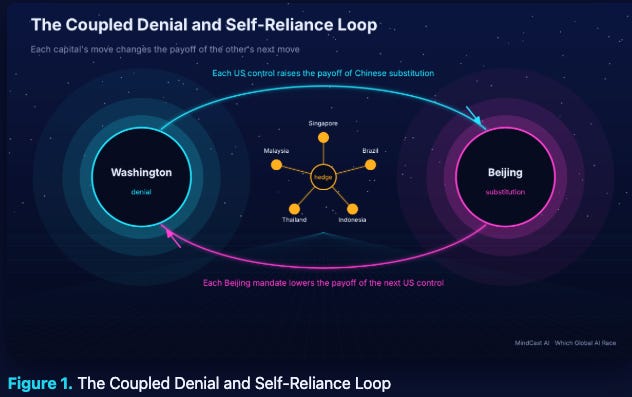
Read the loop clockwise from the top left. Washington closes a route, China’s cost on that route rises, Beijing substitutes, and the next US control buys less than the last one.
The alliance network adds a second channel to the loop. Washington’s network holds only while staying in it costs little. Each license requirement on a swing-state host raises that cost, and each Chinese open-weight release lowers the cost of leaving. Denial therefore raises the costs of the countries Washington is courting as well as China’s own.
The remote-access rule softens that cost for US firms. Its five-country license requirement exempts consignees headquartered in the United States, so US clouds can serve swing-state customers that local and Chinese hosts must license first. The exemption turns a denial rule into a partial adoption tool.
The two channels combine into a hedge. US chips and clouds hold the infrastructure layer in allied markets, and the exemption pulls swing-state hosting toward them only if BIS denies licenses to hosts serving Chinese customers. Chinese firms keep their swing-state tenancies, and Chinese providers keep signing with governments. Singapore’s national SEA-LION model shows the hedge inside one product: its base moved from Llama to Qwen in 2025 and onto Nvidia’s Nemotron in 2026.
The hedge also decides where the money goes. Open-Weight AI Economics — Where the Money Goes as the Model Layer Commoditizes shows that open weights commoditize the model layer and move value to its complements, led by compute and enterprise software. China can win usage on a layer whose margins are falling, while the US holds the hardware and cloud layer where that work finds value collecting.
A static model misses the loop because it measures each control against today’s demand. A dynamic model measures it against the demand that remains after Beijing responds.
Takeaway. Salience drives Washington’s next control, loss aversion drives Beijing’s next mandate, and the payoff structure makes each move raise the odds of the other.
II.F Eight Actors Move on Different Clocks While Three Hypotheses Compete to Explain Them
Eight actors become Cognitive Digital Twins (CDTs). Each carries an objective, the constraints and decision rights that bound it, and the trigger that makes it update.
White House and National Security Council. Objective: hold the frontier lead and export the US stack. Bounds: executive orders and interagency control. Update trigger: a Chinese model reaching frontier parity on a public benchmark.
Department of Commerce and BIS. Objective: close acquisition routes without disrupting allied sales. Bounds: export rules, licenses and the frozen Entity List. Update trigger: a named smuggling or rental case.
State Council and Chinese regulators. Objective: domestic self-sufficiency and AI Plus adoption targets. Bounds: procurement mandates and data center approvals. Update trigger: a new US control or a domestic chip milestone.
Chinese hyperscalers and open-weight labs. Objective: frontier capability at the lowest cost route. Bounds: domestic mandates at home and US rules abroad. Update trigger: a route closure or a domestic chip supply gain.
Nvidia and US cloud providers. Objective: keep Chinese revenue where lawful and protect allied deals. Bounds: export rules, board scrutiny after the November 12, 2026 leadership change, partner contracts. Update trigger: a Commerce listing or a compliance finding.
Allied and Gulf hosts. Objective: secure frontier compute and export eligibility. Bounds: US licenses and host-government policy. Update trigger: a license condition or a tenant rule.
Global South governments. Objective: reliable access to useful AI at low cost. Bounds: budgets, energy and political alignment. Update trigger: a supplier cutoff or a financing offer.
Congress. Objective: codify controls on chips and model access. Bounds: committee calendars and the distillation bills. Update trigger: a salient theft or smuggling case.
Three competing hypotheses and a null route frame the analysis. Each carries its own falsifier.
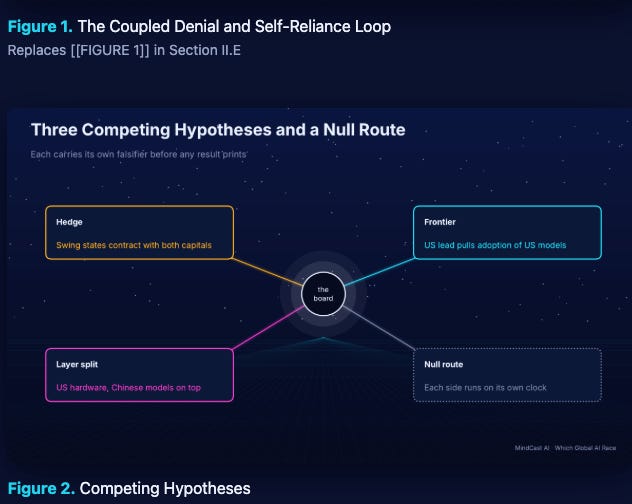
Hedge hypothesis. Swing states contract with both capitals’ providers at every layer and commit to neither. Falsifier: a swing-state government adopts an exclusive national AI arrangement with one capital’s providers, or bars the other’s by law, by the end of 2027.
Layer-split hypothesis. US denial accelerates Chinese self-reliance, and the middle market settles into US hardware with Chinese models on top. Falsifier: government AI programs in the nine named middle-market countries build on US base models at least as often as on Chinese ones while US controls tighten.
Frontier hypothesis. The US lead stays wide enough for allied and middle-market adoption of US models regardless of Chinese substitution. Falsifier: more government-backed programs in the nine middle-market countries build their latest release on a Chinese base than on a US base while a US model holds first place on the LMArena text leaderboard.
Null route. Each side’s strategy runs on its own clock, and neither changes the other’s trajectory. Falsifier: within six months of a named US control, Beijing issues a new measure that restricts foreign AI chips or extends domestic-chip requirements.
Takeaway. Eight named actors on mismatched clocks, three competing hypotheses and a null route define what the simulation tests.
II.G Five Facts Define the Swing-State Contest as of November 20, 2026
Five facts define the contest as of November 20, 2026, the paper’s data cutoff.
The remote-access rule. The rule appeared in the Federal Register on November 19, 2026 as document 2026-23529, and BIS confirms the November 19 publication. Comments are due January 19, 2027. Data centers already serving covered Chinese customers have 90 days to obtain a license, which puts the first licensing deadline on February 17, 2027.
US export packages. The American AI Exports Program shows 78 applications and no announced designations.
Hosts in the swing states. ByteDance is reportedly the largest customer at DayOne’s 390-megawatt Johor site and the anchor tenant at a 110-megawatt Bridge Data Centres site. DayOne has filed a registration statement with the US Securities and Exchange Commission that discloses its customer bookings. US hyperscalers hold large Malaysian commitments: Oracle more than $6.5 billion and AWS $6.2 billion, Microsoft $2.2 billion and Google $2 billion.
Sovereign model programs. Among 36 disclosed base-model instances in sovereign model projects worldwide, Llama accounts for about 40%, Gemma 17% and Qwen 14%. Southeast Asia’s 2026 releases lean toward Nvidia’s Nemotron. AI Singapore built SEA-LION v4.8 on Nemotron 3 after moving SEA-LION from Llama to Qwen in October 2025, and Vietnam’s Viettel AI built VT-Super-120B-A12B on Nemotron 3 Super. Malaysia’s YTL AI Labs added ILMU-Nemo-30B on Nemotron alongside its flagship ILMU model rather than replacing it.
China’s AI export list. Announcement No. 48 closed for comment on November 15, 2026. The final list is pending, and pre-export registration for covered technologies has applied since October 16.
Takeaway. Swing-state hosts serve both capitals’ firms, and the 2026 sovereign model releases in Southeast Asia lean toward a US base through Nvidia.
III. The Chip Pathways Companion Shows Which Routes Stay Open
The published companion supplies the current state of the denial game. China’s AI Chip Pathways Answer to Washington and Beijing maps seven routes for restricted AI compute and shows which ones US enforcement closes. The companion’s MindCast Foresight Simulation Predictions carry into this paper unchanged.
Enforcement keeps catching the visible routes:
Two or more new US chip smuggling cases unsealed by June 30, 2027: 72% (42-92%).
A new prosecution naming Blackwell-generation or newer hardware by December 31, 2027: 90% (66-99%).
Four quieter routes stay open through 2027:
Offshore affiliates. The Affiliates Rule suspension extends past January 10, 2027: 74% (62-84%).
Financiers. No US instrument names a financier solely for financing offshore compute: 92% (87-96%).
Rental inside China. BIS notifies no China-based provider of a license requirement by November 16, 2027: 82% (64-93%).
Distillation. No US rule treats model-output access as an export by December 31, 2027: 92% (84-98%).
Beijing issues no new measure restricting offshore AI compute rental through 2027: 78% (69-86%). The pattern fits a simple rule of domestic chips for domestic sites and foreign compute abroad.
The companion answers which routes stay open. It leaves open whether total Chinese acquisition rises or falls after a closure, and how the closures shape the swing states’ choices between the two stacks. Which Global AI Race takes up both questions.
Takeaway. Enforcement wins the visible cases while Beijing’s mandates and the quiet routes carry the strategic weight.
IV. Two Races Became One Coupled Game, and BIS Licensing Is the Dominant Fork
The US-China AI contest moved from one race to a coupled game in three steps, and each step changed the payoffs for both players. The rules now hold through 2027 because neither capital can drop its definition of winning without conceding the other’s.
IV.A Three Steps Turned One Race Into Two
2022 to 2024: one race. Both capitals chased frontier capability, and US chip controls aimed to slow China on the same track.
2025: the definitions split. Washington paired denial with the full-stack export program. Beijing answered with AI Plus adoption targets and the ban on foreign chips in state-funded data centers. Each side began measuring a different outcome.
2026: the routes moved offshore and into software. The remote-access rule reached operators outside China. Distillation and open-weight diffusion grew as channels no hardware control reaches.
The game’s rules hold through 2027 for a structural reason. Washington cannot stop denial without appearing to arm a rival. Beijing cannot drop its mandates without admitting dependence. The contest therefore sits in the short horizon on the denial game, where dated events still move routes, and in the emerging long horizon on adoption, where the 2027 and 2030 targets fix the yardstick.
IV.B A Named Offshore Closure Decides Which Chinese Firms Keep Renting Abroad
The companion paper’s dominant fork, a named offshore closure, decides which Chinese firms keep renting compute abroad. Under a closure by Commerce listing, Chinese hyperscalers move first because their leases run on short renewal clocks. The hyperscalers shift demand to rental inside China and to distillation, and Gulf and Southeast Asian hosts reassess Chinese tenants as compliance risk. A private closure through Nvidia and its hosts would close the same route with different enforcers: hosts would carry the enforcer role, and Commerce would keep its listing power in reserve.
The companion places a named offshore closure by June 30, 2027 at 76% (60-91%). Jensen Huang resigned as Nvidia’s chief executive on November 12, 2026 after revelations of an affair with a former Megaspeed executive suspected of being a Chinese government agent. The resignation puts vendor compliance under board scrutiny.
IV.C How the Game Branches
The baseline is a two-stack hedge. Washington keeps closing visible routes and Beijing keeps mandating domestic chips at home. Swing states run US hardware, keep Chinese tenants and sign AI agreements with both capitals’ providers. The simulation holds Chinese capacity in place at 64% (48-77%) and puts a Chinese provider first in the swing states at 80% (73-86%), while the companion paper has Beijing leaving offshore rental alone through 2027 at 78% (69-86%).
The dominant fork is how BIS licenses data centers already serving Chinese customers once the February 17, 2027 deadline passes. Commerce moves the fork, and hosts answer it. Under denial, a swing-state host cuts Chinese customers at 75% (57-88%); under approval, with or without conditions, the same cut runs 32% (16-52%). Huawei Ascend hosting needs no US license, so denial moves Chinese demand onto other chips inside the swing states more often than out of them.
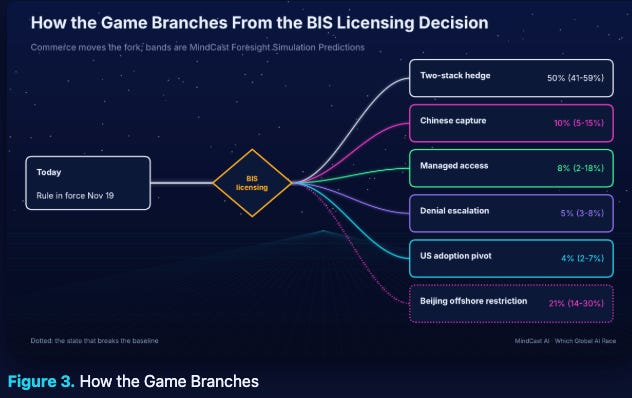
Five more states sit beside the one that breaks the baseline. The states exclude each other, and the Beijing restriction overrides the rest. A paired control is one Washington announces together with a financing, allied cloud or open-model program under the American AI Exports Program. Each entry gives the state’s weight, its class, the footprint or agreement call conditional on the state, and the seats that gain or lose.
Two-stack hedge, 50% (41-59%) (continuation). P(Chinese capacity holds | state) is 66% (52-79%), and P(signed Chinese agreement | state) is 57% (49-62%). Swing-state hosts keep Chinese tenants under license while US clouds take new capacity. US clouds and Chinese hyperscalers both hold, and governments keep both suppliers.
Chinese middle-market capture, 10% (5-15%) (game evolution). Two or more signed Chinese agreements reach the nine countries, Washington pairs no program with its controls and a Chinese provider signs first in the swing states. P(Chinese capacity holds | state) is 65% (48-80%). Chinese clouds and Huawei gain, and US controls stop reaching the decisions that matter.
Managed access, 8% (2-18%) (game evolution). The January 10, 2027 truce deadline yields licensed access for H200-class chips. P(Chinese capacity holds | state) rises to 75% (62-87%). Nvidia and Chinese hyperscalers gain, and Beijing’s mandates soften at the margin.
Denial escalation, 5% (3-8%) (equilibrium migration). Strict licensing meets an unpaired control and a named offshore closure. P(host cuts Chinese customers | state) is 75% (56-89%), and P(Chinese capacity holds | state) falls to 52% (33-72%). Swing-state hosts lose Chinese tenants, and Huawei gains the displaced demand.
US adoption pivot, 4% (2-7%) (game evolution). Washington pairs controls with financing and allied cloud programs, and a US package signs first. P(signed Chinese agreement | state) is 54% (41-64%). Allied and Gulf hosts gain, and the US export program takes the first move.
The state that breaks the baseline is a Beijing restriction on offshore rental (game evolution) at 21% (14-30%). The restriction is the same event as the companion paper’s Beijing call, and its band comes from that call. P(Chinese capacity holds | state) falls to 55% (38-70%).
Beijing would act only once domestic chips reach sufficiency for frontier training. US controls would then lose most of their remaining payoff, and Washington’s best response would shift from denial to competing on adoption, which feeds the next cycle of the loop.
Takeaway. BIS licensing is the dominant fork, the two-stack hedge carries half the weight, and the state that breaks the baseline begins when Beijing no longer needs foreign compute.
V. MindCast Foresight Simulation Predictions: Chinese Firms Stay, Chinese Providers Sign First and BIS Licensing Decides Host Moves
Four MindCast Foresight Simulation Predictions test the first two thesis claims: three Primary Simulation Predictions (P) and one Secondary Simulation Prediction (S). Each names its falsifier and verification source. The window opens on November 19, 2026, the day the remote-access rule took effect.
Two country sets apply. P-1, P-2 and S-1 cover the five swing states the rule names: Singapore, Malaysia, Thailand, Indonesia and Brazil. P-3 covers nine middle-market countries, the five swing states plus India, Vietnam, Saudi Arabia and the United Arab Emirates, because AI agreements reach beyond the rule’s license list. An S-1 hit also resolves P-3, because the five swing states sit inside P-3’s nine countries.
V.A Primary Simulation Predictions Test the Thesis
P-1. ByteDance, Alibaba, Tencent and Huawei keep their combined swing-state AI data center capacity through 2027, 64% (48-77%). No company statement or named-source report shows a net reduction in the combined AI data center capacity of ByteDance, Alibaba, Tencent and Huawei across the five swing states between November 19, 2026 and the end of 2027. A move from one swing state to another does not count. Falsifier: a company statement or named-source report of a net reduction in the window. Verification sources: company statements and Reuters, Bloomberg, Nikkei Asia or DigiTimes reporting.
P-2. If BIS denies licenses to swing-state data centers serving Chinese customers, a host cuts those customers by the end of 2027, 75% (57-88%). The condition is a BIS denial posture, observed as at least one reported denial of an installed-base license application from a swing-state data center serving China-headquartered customers by June 30, 2027. A reported denial opens the call even after earlier approvals. Given that denial, a data center operator in one of the five swing states discloses by the end of 2027 that it has dropped, reduced or converted China-headquartered customers. A US-listed operator reporting lower bookings or contracted capacity from those customers in absolute terms also counts. If BIS approves those applications instead, with or without conditions, the simulation puts the same disclosure at 32% (16-52%). The call is void if no denial is reported by June 30, 2027. Falsifier: a reported denial and no qualifying disclosure in the window. Verification sources: operator filings on US and Asian exchanges and named wire coverage, because BIS does not publish individual license decisions.
P-3. A government in Southeast Asia, India, the Gulf or Brazil signs an AI agreement with a Chinese provider by the end of 2027, 63% (53-70%). At least one head of government, national ministry or national agency in the nine middle-market countries signs a formal AI agreement or memorandum with a China-headquartered AI provider between November 19, 2026 and the end of 2027. A China-headquartered provider is a firm based in mainland China, Hong Kong or Macau that supplies AI models, cloud services or chips. A telecom carrier counts only when the agreement covers AI, and deals signed only by state-owned enterprises are excluded. Four agreements of this kind were signed from 2024 through November 2026. Huawei signed with Saudi Arabia’s data and AI authority (SDAIA) in September 2024, with Indonesia’s planning ministry (Bappenas) in November 2025 and with Malaysia’s cybersecurity agency (NACSA) in July 2026. Brazil’s science ministry and its federal data service Serpro signed with iFlytek in April 2026. Falsifier: no qualifying signed agreement in the window. Verification sources: government announcements and provider releases.
V.B Secondary Simulation Prediction Tests the Agreement Race
S-1. The first swing-state national AI agreement goes to a Chinese provider rather than the US export program, 80% (73-86%). The call counts national AI agreements signed by a swing-state government between November 19, 2026 and the end of 2027 with either a China-headquartered provider or a package under the American AI Exports Program. Given at least one such agreement, the first goes to a Chinese provider. The US program shows 78 applications and no designated packages. Falsifier: the first such agreement goes to a US export package. Verification sources: government announcements and American AI Exports Program releases.
Takeaway. Three primary calls and one secondary call test the footprint and agreement claims, and each names its falsifier and verification source.
VI. Stakeholder Strategy and Risk Mitigation: BIS Licensing and Swing-State Agreements Carry the Largest Exposure
Every stakeholder faces the same constraint: the swing states hedge rather than adopt one stack, and BIS licensing decides how far hosts move. The moves below stay useful in several states at once, and the triggers name the dated events that justify a committed move.
VI.A Moves by Stakeholder
🏛️ Policymakers. Low-regret move now: pair each new control with an adoption program abroad. Triggered move: shift weight from denial to adoption if Beijing extends its domestic-chip mandate beyond state-funded sites. Primary risk: controls that win cases and lose markets.
💼 Executives at cloud providers and chipmakers. Low-regret move now: segment customers by the stack they are building on. Triggered move: re-plan regional capacity after a named offshore closure. Primary risk: stranding capacity in a market that standardizes on the other stack.
💼 Allied and Gulf hosts. Low-regret move now: write tenant eligibility and transition terms into every lease. Triggered move: re-paper Chinese tenants after a Commerce listing. Primary risk: a host becoming the enforcer by default.
⚖️ Counsel. Low-regret move now: map client exposure across tenants, lenders and model access, not only shipments. Triggered move: update model access terms if a distillation bill passes either chamber. Primary risk: advice keyed to shipment rules after the routes have moved.
📊 Investors. Low-regret move now: rate AI infrastructure holdings by the stack their customers lock into. Triggered move: re-weight Global South exposure after the first national agreement on either stack. Primary risk: valuing enforcement headlines rather than adoption.
VI.B Risk Mitigation by Time Gate
Now to 30 days. Risk: leases and contracts silent on the remote-access rule. Mitigation: add tenant eligibility and transition terms. Escalation trigger: a BIS notice to a named host.
30 to 90 days. Risk: the January 10, 2027 truce deadline resets access. Mitigation: stage capacity commitments so each can change after the deadline. Escalation trigger: suspension extended or lapsed.
3 to 12 months. Risk: a named offshore closure moves demand. Mitigation: model both rental inside China and distillation as substitutes. Escalation trigger: a Commerce listing or a private host cutoff.
Beyond 12 months. Risk: the middle market standardizes on one stack. Mitigation: hold positions in both stacks until a national agreement shows the tip. Escalation trigger: a Global South government standardizes on either stack.
Takeaway. Each stakeholder’s best move today holds whichever way BIS licenses the swing-state hosts, and the triggers mark when to commit.
VII. Lock-In, Not Any Single Control, Decides the Outcome
Ecosystem lock-in and the coupled loop carry the implications for every stakeholder, and none of them adds a new forecast.
VII.A Ecosystem Lock-In Outlasts Any Single Control
Capability leaks across borders through distillation, published papers and people who change employers. Anthropic attributed millions of exchanges to distillation campaigns by China-based labs, and The Runtime Export Problem shows why model access still sits outside export law. Ecosystem lock-in lasts longer. Once a country standardizes on a chip family, a toolchain, a model format and a cloud, switching costs grow each year.
VII.B Each Closure Raises the Value of Independence
The denial game and the adoption contest run on one payoff structure. Each US closure raises China’s cost on one route and the value of independence across all of them. The two-stack state and the denial escalation state both strengthen Beijing’s pitch abroad, so pairing each control with an adoption program matters most for Washington.
VII.C Value Moves to Whoever Hosts the Middle Market
Allied and Gulf hosts, Chinese clouds abroad and the US export program compete for the same buyers. Hosts that write clear tenant terms capture demand from both sides while the stacks stay separate. Hosts that wait become enforcers by default once a private closure lands.
Open-Weight AI Economics — Where the Money Goes as the Model Layer Commoditizes adds the value question. As open weights commoditize the model layer, that work finds value moving to compute and enterprise software. Holders of hardware and cloud capacity in the swing states may keep value even where Chinese models win usage, a question this paper’s predictions leave open.
VII.D If the Falsifiers Fire
If P-1 fails, Chinese firms leave the swing states and the hedge gives way to a US infrastructure standard. If P-2 fails after a denial, licensing loses its grip on hosts and the remote-access rule stops steering swing-state infrastructure. If P-3 and S-1 both fail, governments avoid formal Chinese agreements and the US export program wins the first move.
Takeaway. Lock-in outlasts any single control, so every implication runs through which stack the middle market adopts.
VIII. What to Watch: February 17 Licensing, the First Swing-State Agreement and January 10
Eight dated signals decide which state the game enters, and each comes with its verification source.
February 17, 2027: the 90-day licensing deadline for data centers already serving covered Chinese customers. Links to P-1 and P-2. Source: Federal Register and operator disclosures.
Rolling: swing-state host deals and tenant changes. Links to P-2 and the dominant fork. Source: Bursa Malaysia, SGX and IDX filings and named press.
Rolling: national AI agreements and sovereign model releases. Links to P-3, S-1 and the model-layer shift toward Nemotron. Source: government announcements and model cards.
Pending: final text of China’s AI export list. Links to the Chinese model layer. Source: Ministry of Commerce announcements.
January 10, 2027: Affiliates Rule suspension extended or lapsed. Links to managed access. Source: Federal Register.
Through June 30, 2027: a named offshore closure. Links to the acquisition routes Chinese firms use and to the companion’s fork. Source: Entity List updates and host disclosures.
Rolling: Beijing notices on domestic-chip scope. Links to the Beijing offshore restriction state. Source: State Council and ministry notices.
Annual: China’s domestic chip share of new AI capacity. Links to the Beijing offshore restriction state, which waits on domestic chip sufficiency. Source: TrendForce and IDC.
Takeaway. BIS licensing decisions and swing-state agreements decide the adoption contest, while the January 10 deadline and a named offshore closure move the denial game.
IX. Conclusion: The Swing States Hedge, and BIS Licensing Decides How Far Hosts Move
Washington and Beijing each run the race they defined, and the swing states choose neither one whole. The November 16 rule shows the hedge at work. It exempts US-headquartered clouds, and whether swing-state hosting shifts toward them turns on how BIS licenses hosts serving Chinese customers. Chinese firms keep their tenancies, and Chinese providers keep signing with governments.
Stakeholders act now on moves that hold in every state and wait to learn how BIS licenses the swing-state hosts. The decisive signals are the first licensing decisions after February 17, 2027, the first swing-state national AI agreement and the next sovereign model release in Southeast Asia.
X. Working With MindCast
MindCast AI is a Predictive Game Theory Modeling-Simulation firm. MindCast builds Cognitive Digital Twins of the named actors in a client’s market and models how the game evolves through its next forks.
A commissioned engagement applies the coupled denial and adoption game to one organization’s own customers, contracts and markets. Clients receive complete scenario trees, P10/P50/P90 ranges and decision thresholds keyed to the dominant fork.
What MindCast can do
Cognitive Digital Twin builds of agencies, ministries, hosts, chipmakers and lenders, calibrated from public conduct and the client’s own decision history.
Strategy and Risk Simulation Snapshots for short horizon matters, with probabilities rounded to the nearest 10% at the next decision point.
Foresight Simulations with published bands, P10/P50/P90 ranges and complete scenario trees.
Interactive war gaming that lets a client’s team play its own moves against modeled opponents across dated forks.
When an engagement adds the most
A cloud provider or host faces a capacity or lease decision before January 10, 2027.
A fund holds AI infrastructure exposure in markets that could standardize on either stack.
A government weighs a national AI agreement with either the US export program or a Chinese provider.
How engagements begin. A complimentary Snapshot runs on publicly available information. Private engagements proceed after a nondisclosure agreement and retainer, starting with a diagnostic session on one live decision.
Contact: mcai@mindcast-ai.com · Corporate site: www.mindcast-ai-simulation.com · War gaming: www.mindcast-ai-simulation.com/live-fire-intelligence
Appendix A. Selected MindCast Works on AI Trade
Twenty MindCast works on AI trade supply the evidence, frameworks and prior forecasts behind this paper. The list runs from the November 2026 export-control series back to the 2025 work that first mapped the routes.
The Economics of Export-Control Effectiveness and AI Export Control Series, November 2026
China’s AI Chip Pathways Answer to Washington and Beijing — US Enforcement Moves the Route While Beijing Sets the Demand, November 20, 2026. The companion paper. Supplies the seven-route map and every carried band in Sections III and IV.
Trump-Xi Shenzhen Summit and the AI Chip Remote-Access Rule — The Trade Truce Meets a Chip Control It Never Covered, November 2026. Forecasts that Beijing answers the chip rule within bounds and renews the truce without chip terms, which anchors the managed access state.
AI Chip Export Controls After the Remote-Access Rule — Treasury Wrote It, Commerce Signed It, and the Renter in China Stays Unreached, November 2026. Shows the November 16 rule reaching the operator outside China while the renter inside China stays out of reach.
Lutnick and the Commerce Department Likely Miss January 10 on the Rented GPU Rule, and His Tenure Shapes What It Exempts More Than When It Publishes, November 16, 2026. Models the gatekeeper who decides how far each US control reaches.
Commerce’s Rented GPU Ban Would Exempt Chips Already Delivered, and the Cutoff Date Decides Its Reach, November 16, 2026. Shows how a cutoff date leaves installed offshore capacity outside the rule.
Enforcement Incidence and Capability Denial in Artificial Intelligence Export Controls, November 2026. Finds that domestic substitution reduces the marginal effectiveness of each successive control, the mechanism at the center of the feedback loop.
Import Controls, Export Controls and the US–China AI Infrastructure Contest, November 2026. Shows each capital running both an export gate and an import gate, the structure behind Beijing’s domestic-chip mandates.
AI Chip Export Enforcement Shifts Risk Onto US Firms as China Demand Moves to Domestic Chips, Rented Compute and State Financing, October 31, 2026. The Snapshot that first traced Chinese demand moving to domestic chips, rented compute and state financing.
Runtime Geopolitical Risk Series: Model Access, Data and Compute
Tencent, Oracle and the Remote-Access Gap in US AI Chip Export Controls, October 2026. States the two-horizon tradeoff this paper generalizes: tightening rental buys control now and speeds Chinese substitution later.
Cross-Border AI Compute — Access Rules, Clean Power and Local Approval Decide Which Operators Win, October 19, 2026. Identifies the hosts that capture middle-market demand under each access rule.
The Runtime Export Problem — Anthropic’s 151 Million-Exchange Distillation Record, Advisory AA26-251A and the Question Commerce Cannot Yet Answer. Explains why model access and distillation sit outside current export law.
The Runtime Global Data Market — When Stolen AI Interactions Become a Strategic Technology Supply Chain. Shows stolen AI interactions becoming a supply chain, the software route no chip control reaches.
Anthropic, Alibaba and the Runtime Theft Problem — How Attribution Cost Moves Frontier-AI Distillation Enforcement From the Courtroom to the Statute, June 25, 2026. Traces why distillation enforcement moves to statute, the path of the pending distillation bills.
Earlier Foundations
The Beijing Summit Validation — Geopolitical Ripples for the AI Industry Across the Three-Layer Equilibrium, 2026. Validated the two-gate model in which Beijing’s acceptance matters as much as Washington’s license.
The TSMC China License and the Limits of Hardware Export Controls, January 3, 2026. Found that hardware controls freeze fab capability while access governance stays unbuilt.
Foresight Analysis in Illegal GPU Export Pathways (2025–2030), November 21, 2025. Mapped the Southeast Asian corridors the physical routes still use.
Open-Weight AI Economics — Where the Money Goes as the Model Layer Commoditizes, July 25, 2026. Shows value migrating from the commoditizing model layer to compute and other complements, which sets the economic stakes of the swing-state hedge.
Method
The Calculus of Predictive Game Theory Evolution and Mutation, November 2, 2026. Supplies the short and long horizon classification and the branch tree discipline in Section IV.
Interactive War Gaming
US AI Exports Interactive War Gaming. Lets readers play Commerce, hosts and lenders through the export-control forks that drive the denial side of the loop.
US AI Imports Interactive War Gaming. Lets readers play the import gates each capital runs, the side of the contest behind Beijing’s domestic-chip mandates.
Appendix B. External Sources
Policy documents and reporting
Remote-Access Interim Final Rule, Bureau of Industry and Security, November 16, 2026.
Executive Order 14320, Promoting the Export of the American AI Technology Stack, White House, July 23, 2025.
Winning the AI Race: America’s AI Action Plan, Key Takeaways, Skadden, July 2025.
State Council Opinions on the AI Plus Initiative, CSET translation, August 2025.
Intelligent Everything: China’s Policy to Supercharge AI Adoption, United States Studies Centre.
China Bans Foreign AI Chips From State-Funded Data Centres, Reuters via Aaj News, November 5, 2025.
Nvidia H200 Exports to China Stalled, Techloy, February 2026.
Nvidia Tells Cloud Partners to Cap Chinese Business at 49%, The Next Web, November 3, 2026.
Jensen Huang Resigns as Nvidia CEO, BNN Bloomberg, November 12, 2026.
398 Days Without Entity List Additions, FourWeekMBA, November 2026.
Anthropic Details Distillation Campaigns From Alibaba, Moonshot AI and DeepSeek, TechCrunch, September 10, 2026.
ByteDance Data Centre Capacity, SemiAnalysis Data, The Next Web.
H.R. 8283, Deterring American AI Model Theft Act of 2026, GovInfo.
S. 5252, BLADE Act, GovInfo.