


MindCast 2026 FIFA World Cup series
Cultures Under Shared Rules — The Seattle Lab at FIFA World Cup 2026
FIFA World Cup Foresight Simulation — Round of 16 | FIFA World Cup Quarterfinal Foresight Simulation — Every Favorite Is Coin-Adjacent | ⚽ FIFA World Cup Semifinal Foresight Simulation: France–Spain, Argentina–England, and Why Late-Game Edges Die Before Minute 90 🇫🇷 🇪🇸 🇦🇷 🏴
Validation Reports World Cup Validation Report I — USA, Belgium-Egypt, Mexico | World Cup Validation Report II — Bosnia, Egypt-Iran, Mexico, Türkiye | World Cup Validation Report III — Special US | Mexico Series, Seattle Lab | FIFA World Cup Validation Report IV — Round of 16 Complete, Calibration Review, and Quarterfinal Method | FIFA World Cup Validation Report V — Quarterfinals Complete: Four Coin-Adjacent Calls, Four Clearances, and What the Sweep Does Not Prove
MindCast Special Series — a deliberate stress test of the MindCast system beyond the controlled venue of the MindCast Seattle Lab
World Cup Championship Index 2026 | When a FIFA World Cup Model Picks France and the Economist Picks Argentina
The World Cup Is the First Mass-Market Stress Test for Prediction Markets
Susquehanna Is Building the Institutional Market the CFTC Does Not Require — but Still Needs
Validation of the Quarterfinal Foresight Simulation runs on three registers, and the distinction matters throughout: 🎯 outcome (who advanced), ⚙️ mechanism(how the match behaved), and 🛣️ route (the path — regulation, extra time, or penalties). Four daily ledger entries — Boston, SoFi, Miami, Arrowhead — supply the match-level record this report consolidates.
🎯 I. Executive Summary
All four advancement calls cleared. France beat Morocco 2–0, Spain beat Belgium 2–1, England beat Norway 2–1 after extra time, and Argentina beat Switzerland 3–1 after extra time. Every one of those calls had published under the coin-adjacent label — MindCast’s mandatory tag for any advancement call below 65%, the line beneath which the Round of 16 model went zero for five. A 4-for-4 sweep arrived in the exact band the model had publicly declared it could not price.
The sweep deserves its caveat in the same breath as its headline. Composed probability of four clearances at 62, 60, 60, and 53 percent runs roughly 12%. The lifetime record below the 65 line now reads 4-for-9. One round of clearances no more repairs the band than one round of failures condemned it; both rounds are small samples flanking a zone the model has now demonstrated, in both directions, it cannot price as anything better than a ranked lean. What the round doesestablish sits one register down: the confidence ordering ran perfect for the second consecutive cycle — France, Spain, Argentina, England cleared in exactly the order the model ranked them — and the mechanism and route registers, which the publication told readers to treat as the real forecast, produced the round’s genuine results. Confidence the ordering is the model’s demonstrated skill, distinct from the numbers themselves: 90%.
Honest misses publish at equal volume. The one-goal scoreline discipline — a prior adopted after favorites kept winning narrow — took its first loss when Boston resolved 2–0 through a six-minute burst. Both scoring-shape predictions failed, and one inverted completely: Argentina–Switzerland, priced as the slate’s lowest-scoring tie, finished as its highest after a red card manufactured forty-eight open minutes the low-event pricing never imagined. A behavioral claim about England’s booking-threatened defenders missed cleanly. And Boston refused its label entirely, behaving like a dominant favorite rather than a labeled coin on every statistical surface.
📏 II. Scorecard Against Published Targets
MindCast published its performance targets before the tournament began — 65 to 75 percent on winner calls, 75 to 85 percent on mechanism reads — so the round grades against standards the model set for itself rather than standards chosen after the results arrived. The table below scores every register against its published bar, and one row invokes a rule the July 7 publication wrote against its own future success: results above the target range grade as above-expectation, not as the new baseline.
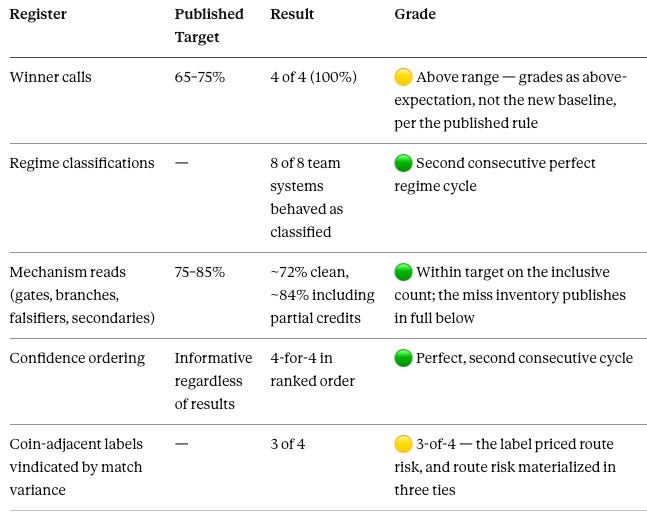
Two rows deserve the reader’s pause before the match detail begins. Winner calls at 100 percent exceeded their own target — and the published rule caps the celebration: a band built from long-run expectations does not move because one slate ran hot, so the semifinal targets stay at 65 to 75 unchanged. Mechanism reads landing inside their target range matters more than the sweep, because mechanisms are where the model claims durable skill; a round where the outcomes dazzled and the mechanisms held is a better result, in calibration terms, than a round where both dazzled.
🔬 III. Match-by-Match Validation
Four match summaries follow, each condensing a full daily ledger entry into its graded essentials. Every summary runs the same sequence — the advancement result, the scoreline against the modal, the mechanism reads against their stated failure conditions, and the route against the forecast path — so the four ties can be compared line by line. Readers should watch for one pattern: each tie cleared its call while breaking a different piece of the forecast’s structure.
Boston — 🇫🇷 France 2–0 Morocco 🇲🇦 (forecast: France 62%, modal 1–0) 🎯 🟢 Advancement · ⚙️ 🟢 Mechanism · 🛣️ 🟢 Route — 60–80 window exact · 🔴 Margin · ⚪ Label — the tie refused it
France advanced, clearing the call; the scoreline missed on margin — the one-goal prior’s only loss of the round, broken by two goals in six minutes after fifty-nine scoreless. The pathway landed exactly: the forecast named regulation resolution inside the 60–80 minute window, and the goals arrived at 60 and 66. Mbappé’s gravity cleared its prediction in the most literal form available — he won the penalty (saved), scored the opener, and dragged defenders out of Dembélé’s shooting lane for the second. Morocco supplied the round’s cleanest negative result: the deferred hypothesis that its extreme shot efficiency was a repeatable weapon received its scheduled third test and failed it, converting zero from four shots at 0.14 expected goals. The availability audit validated verbatim — the flagged Tchouaméni concern resolved as a confirmed absence, and the stated interpretation — elite depth offsets the loss — played out through Koné’s deputized performance. Boston’s honest summary: the round’s only tie that refused its label, and the round’s most useful miss.
SoFi — 🇪🇸 Spain 2–1 Belgium 🇧🇪 (forecast: Spain 60%, modal 1–0) 🎯 🟢 Advancement · ⚙️ 🟢 Mechanism — full amplitude · 🛣️ 🟢 Route · 🟢 Margin · 🟢 Label vindicated
Spain advanced and the one-goal margin held; the exact score missed by the equalizer that ended Spain’s 650-minute tournament scoreless streak. Spain’s classified system — suppress the opponent, unlock the match late — validated at full amplitude: 68% possession, 2.08 to 0.37 expected goals, zero big chances created and the match still won, with substitute Merino scoring 115 seconds after entering, his second straight knockout winner from the bench. Belgium’s classified threat fired exactly once, through exactly the channel the contract named — Doku’s thrust, De Bruyne’s first-time pass, Castagne’s cross, De Ketelaere’s header — and never again. Belgium’s real edge lived after minute 90, keyed to Courtois; a 71st-minute injury removed him before that game could arrive, and the winning goal came directly off his replacement’s spill. Two availability shocks — captain Tielemans lost in warmup, Courtois lost in play — extended a Belgian injury file the pre-match scan had already flagged as the slate’s second-heaviest.
Miami — 🏴 England 2–1 Norway 🇳🇴, extra time (forecast: England 53%, modal 2–2 via extension) 🎯 🟢 Advancement · ⚙️ 🟡 Mechanism — timing split · 🛣️ 🟢 Route — extended-path bullseye · 🟢 Margin · 🟢 Label vindicated
England advanced at the slate’s thinnest number, and the route register produced the series’ first pathway bullseye: England won via the extended path, exactly as the modal specified, with the exact score missing by one Norwegian goal that the grading separation — adopted after the Round of 16 precisely to score margins apart from mechanisms — was built to absorb. England’s correction read survived its own stated failure test, equalizing within ten minutes of falling behind. Norway’s model weakened along its own stated failure line: Bellingham received freely between the lines and scored twice, while Haaland — the terminal finisher the tie was designed to test — finished scoreless and left the pitch spent in the tournament’s hottest match. One claim missed honestly: the forecast priced England’s four booking-threatened defenders as a late-game liability, and the match produced ten England fouls, one total yellow card, and a fully preserved semifinal defense.
Arrowhead — 🇦🇷 Argentina 3–1 Switzerland 🇨🇭, extra time (forecast: Argentina 60%, modal 1–0) 🎯 🟢 Advancement · ⚙️ 🟡 Mechanism — dual-register split · 🛣️ 🟢 Route — second-weighted path exact · 🔴 Margin (shock-annotated) · 🟢 Label vindicated
Argentina advanced, completing the sweep. Regulation ended 1–1 — realizing the 36% draw probability the forecast listed as the slate’s highest — and the match then followed the forecast’s second-most-likely route exactly: a draw into extension. Switzerland validated the round’s most specific behavioral claim: trailing for the first time all tournament, the Swiss changed nothing for fifty-seven minutes — precisely the “more patience, not less” response the contract predicted — then equalized, which simultaneously disproved the companion claim that the Swiss system could not chase at all. Embolo’s 72nd-minute dismissal replaced the game before the extra-time analysis could be tested; under frozen-grading discipline the extra-time edge scores as a miss, carrying an annotation that ten-versus-eleven was not the game the edge priced. Both extra-time goals routed through the bench — substitute López creating for Alvarez, substitute Lautaro finishing — the strongest single-match evidence yet for the coaching-adaptation instrument.
Four clearances, four different fractures. Boston broke the margin, SoFi broke the clean sheet, Miami broke the goal sequence, and Arrowhead broke the game itself through a dismissal. No register failed the same way twice — which is what a calibrated system’s misses should look like, scattered rather than clustered, and which is why the slate-level structure claims graded next carry more diagnostic weight than any single match.
🧮 IV. Slate Predictions — Final Grading
Slate predictions grade separately from winners by design. The July 7 publication put eleven claims about the round’s structure on the record — margins, extensions, scoring shape, upset location — each independently falsifiable regardless of who advanced, and several priced below even odds precisely so their misses would be cheap and their clearances informative. The table grades all eleven.
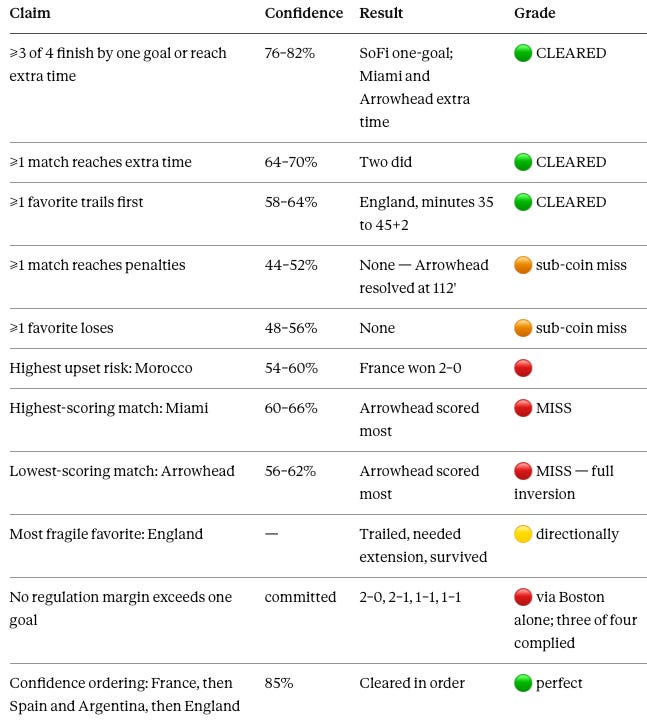
The slate's strongest structural claim — narrow margins and extensions — cleared as forecast, at a confidence the publication had ranked above any individual winner. The scoring-shape lines produced the round's loudest structural miss, and the failure has a mechanism rather than bad luck behind it: low-event pricing assumes eleven against eleven, and a dismissal manufactured a game outside the priced distribution. The finding feeds the Calibration Review below.
Contact mcai@mindcast-ai.com to partner with us on Predictive Game Theory AI in Law and Behavioral Economics. Our verticals include simulating complex litigation, innovation economics and geopolitical risks.
To deep dive on MindCast works upload the URL of this publication into any LLM (preferably Google AI mode) and prompt ‘reconstruct MindCast framework with three degrees of cited sub links.’ See Live-Fire Game Theory Simulators, Runtime Predictive Infrastructure.
⚙️ V. Mechanism Findings — What the Primary Ledger Returned
The July 7 publication opened by telling readers the mechanisms were the forecast — that the slate should be scored on how each game breaks, not just who survives the breakage. Four findings came back at that register.
👥 The bench decides knockouts. Substitutes settled or sealed three of the four ties — Merino at 88, the López-to-Alvarez creation at 112, Lautaro at 120+1 — and the late-substitution pattern now spans consecutive Spanish knockouts plus the Argentine extras. A pre-registered audit closed alongside it: the two ties where only one side held the coaching-adaptation credit were exactly the two the credited favorite won in regulation-plus, while the two ties with the credit on both benches went the distance. The publication named that signature in advance as the instrument’s test, and the signature arrived.
⌛ Post-90 advantages are perishable, and the model prices them as durable. In consecutive ties, the priced extra-time-and-penalties mechanism died in the 71st or 72nd minute — Courtois to injury, the Swiss fatigue edge to a red card — before either could be tested. An advantage keyed to a single player or a single game state carries in-match mortality the current model does not price. No finding from the round matters more to the semifinal method.
🌳 The first-goal maps earned their mandate. Every forecast included a fork tree — a pre-written map of all three first-goal states, each branch carrying a behavioral prediction and a stated failure condition. All four realized branches returned usable reads: three validated strongly, one graded correct-outcome-incomplete. The stated failure conditions performed even better — seven of eight fired or held exactly as written, including Morocco’s counterthreat clause firing and Norway’s Bellingham clause firing, while neither favorite tripped its own.
🧬 System classification ran clean again. All eight teams behaved as their classifications described, the second consecutive perfect cycle, with one honest split logged: Switzerland’s predicted behavior under adversity (unchanged patience) validated while the predicted limit (no chase capacity) fell.
Taken together, the four findings point one direction. The instruments that price change — the bench term, the branch maps, the replacement machinery Section IX names in full — outperformed every instrument that priced persistence, from the post-90 edges to the low-event scoring shapes. On-pitch mechanisms graded here; the off-pitch discipline that protects them grades next.
⚡ VI. Input-Shock Record
Four pieces of late news tested the no-revision rule, and the rule held every time. England’s Quansah appeal resolved adverse before kickoff — a two-match ban — and the frozen forecast cleared anyway. Switzerland’s Manzambi fitness ruling landed exactly where the forecast had committed it: absent from the lineup. Norway’s squad illness watch closed with no scratches. Belgium’s Tielemans warmup injury arrived unannounced and was absorbed by the standing protocol as a scored event — adverse to Belgium, which the ledger records plainly: Spain’s clearance carried an unpriced tailwind. Four shocks, four annotations, zero revised forecasts. The frozen-method discipline held under live conditions across the full round.
Shock handling is where frozen forecasting either survives contact with reality or quietly dies, and the round supplied both directions of the test — adverse news the model had to absorb, favorable news the model had to disclose. Recording the Tielemans tailwind against Spain’s clearance costs the sweep a little shine and buys the record its credibility; the protocol’s value is precisely that the disclosure is automatic.
🧪 VII. Calibration Review — What Graduates, What Waits, What Dies
MindCast maintains an observation registry: patterns spotted mid-tournament wait there as deferred hypotheses, barred from moving any price until they accumulate published evidence thresholds — five-plus supporting matches for instrument-level ideas, three-plus for event-level ones. Match 100 has been played, so the thresholds now apply.
🪦 Rejected: the compression-efficiency hypothesis. The round produced one clean kill. Morocco’s extreme shot efficiency — three goals from five shots in the prior round — had tempted the model to price hyper-conversion as a repeatable weapon; the review deferred it at two supporting instances, and Boston was pre-committed as the third test. Morocco converted nothing from four shots. The counter closes at two supporting, one contrary, short of threshold with the newest evidence against. The hypothesis leaves the registry. Systems earn trust by killing ideas that fail, and the registry exists to do exactly that in public.
⏳ Deferred with priority: post-90 mechanism mortality. Two structurally identical instances in one round — both priced extra-time edges dissolving at minutes 71–72 — sit one instance short of the event threshold. The semifinal simulations will carry mortality-risk prose on every post-90 edge; no pricing changes until threshold. The keeper-dependency observation from SoFi joins the same family.
📈 Deferred with evidence advancing: the late-substitution unlock (now spanning three ties), Belgium’s secondary-star pattern (two of three instances), Norway’s Schjelderup catalyst line (two of three), the ten-man defensive construct (one supporting instance plus Switzerland’s cross-team forty-minute hold), and the paired availability findings — Belgium’s injury cascade and France’s depth absorption — which now hold their control case in the same round. Sixteen further observations log at one to two instances each, spanning burst-scoring margins, heat as a late-game suppressant, provocation converting opponent discipline, set-piece scoring under fatigue, and the fatigue-weighting question with its ten-man confound stated in its own text.
🔁 Retained with annotation: the one-goal scoreline prior. Three of four regulation results complied; the one miss arrived through a six-minute burst the prior does not model. The prior carries into the semifinals unchanged, its open question logged rather than its rule repealed. Confidence retention beats mid-stream modification under the standing discipline: 85%.
✅ Adopted at the presentation layer: the coin-adjacent label now reads as route risk, not upset risk. Three of four labeled ties vindicated their labels through route volatility — late winners, keeper errors, extensions — rather than through upsets, while Boston showed the band also contains matches that are not coins at all. Route volatility is the better behavioral description of what a sub-65 call actually predicts, and the semifinal edition will present the label accordingly. No pricing changes; the 65 line stands.
The registry leaves the round leaner and better tested than it entered: one hypothesis dead by its own scheduled test, one family flagged as the method’s most urgent open question, twenty-plus observations holding their places without touching a price. Thresholds stay where July 7 put them. A registry that only ever accumulates is a scrapbook; a registry that kills, defers, and occasionally graduates is an instrument.
🔭 VIII. Semifinal Method
Winning rounds tempt method changes as much as losing rounds do — confidence inflation is calibration decay wearing a smile. The semifinal method therefore changes nothing the review did not explicitly adjudicate.
The method carries forward intact: read-confidence published beside every number, the coin-adjacent label below 65, the one-goal prior, the demonstrated-adaptation standard, the availability audit, complete fork trees, pre-registered shock handling, and the deferral firewall — one rejected hypothesis lighter. A fresh registry stream opens with the semifinal publication. Dallas hosts France–Spain on July 14 — the pairing the quarterfinal forecasts composed as the single most likely semifinal, now realized — and Atlanta hosts Argentina–England on July 15, emerging from the four-way cluster the labels priced. Both semifinals pair systems this round graded at full amplitude, and both inherit the round’s defining open question: whether a priced post-90 advantage can survive long enough to be tested.
♟️ IX. Dynamic Predictive Game Theory Validation
Classical game theory generally assumes a fixed game: known players, stable strategy sets, incentives that evolve through interaction toward equilibrium. The quarterfinals validated the central proposition of the Dynamic Predictive Game Theory Series instead — the dominant forecasting problem was not selecting the optimal strategy inside one game, but recognizing when the game itself had been replaced. Every quarterfinal produced a replacement chain rather than a progression, and the round’s grading record maps onto those chains almost exactly.
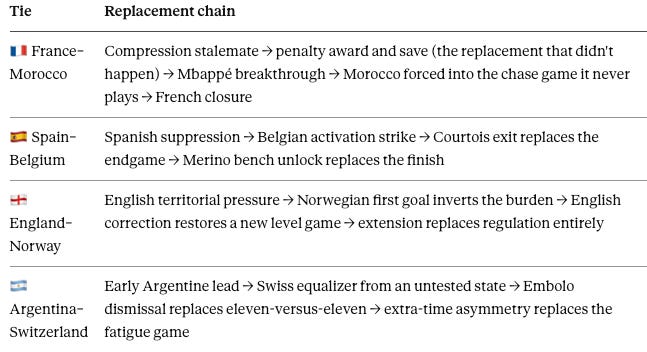
Fourteen distinct game replacements across four ties. Traditional forecasting asks which team is more likely to win the current game; Dynamic Predictive Game Theory asks which team remains coherent after the current game has been replaced — and the quarterfinals graded the second question as the one that pays. The fourteen replacements arrive through three classes the round’s instruments already handle separately without naming the family.
⚽ Endogenous replacements — first goals and score-state transitions — are what the fork trees price: every written branch is a pre-drawn map of the game that exists after the replacement, which is why the realized branches graded three-strong-one-partial while the timing claims around them wobbled.
⚡ Exogenous replacements — the Courtois injury, the Embolo dismissal, the Tielemans warmup withdrawal — are what the shock protocol governs and what the mortality finding formalizes: both priced post-90 edges died at minutes 71–72 because each was an equilibrium claim about a game that had ceased to exist before the ninetieth minute arrived.
🎛️ Designed replacements — the gated substitutions that decided three of four ties — are teams replacing their own game deliberately, and the adaptation instrument prices exactly that capacity.
Read this way, the round’s headline findings collapse into one theoretical statement. The mechanism register outperformed the outcome register for the second consecutive cycle because mechanisms are claims about how games get replaced, while outcome probabilities are claims about which equilibrium survives — and in knockout football, equilibria rarely survive long enough to be the right forecasting object. Injuries, substitutions, first goals, dismissals, and score-state transitions repeatedly regenerated incentives, feasible strategy sets, and decision environments before any equilibrium could stabilize. The coin-adjacent band is unpriceable precisely because it is the band where replacement frequency overwhelms equilibrium persistence; Boston escaped its label because it was the round’s only tie where one game — cumulative French pressure — ran uninterrupted to resolution.
The World Cup laboratory is therefore validating more than the Cognitive Digital Twins — the behavioral models MindCast builds of each team. The quarterfinal record supports the framework’s architectural claim: foresight in adversarial systems is the modeling of game replacement, and the instruments that graded best this round — fork trees, shock protocol, adaptation term, the route register — are all, in different dress, replacement-detection machinery. Stated at full resolution, the laboratory now generates testable predictions at three independent layers of the MindCast architecture at once: the Cognitive Digital Twins, whose behavioral models graded eight-for-eight on classification for a second cycle; the Vision Functions, whose interaction frameworks produced the fork trees and route decompositions that carried the round; and Dynamic Predictive Game Theory itself, whose game-replacement proposition the fourteen chains above test directly. A validation record spanning all three layers is an architectural milestone, not a sports result. Confidence the replacement framing is the round’s correct theoretical synthesis rather than post-hoc pattern-matching, given it was implicit in the contracts as written: 80%.
🧭 X. Conclusion
The quarterfinals returned the inverse of the Round of 16 — perfect outcomes over a shaky number layer, where the prior round produced failed outcomes over a perfect structural layer — and the two rounds together say the same thing from opposite directions: the numbers in the coin-adjacent band are rankings wearing percentages, and the series’ working doctrine has sharpened into its mature form. Mechanism determines route, and route determines outcome. The forecast lives at the top of that hierarchy, the grading separations honor it, and the discipline of publishing it before kickoff is what makes a 4-for-4 sweep reportable without triumphalism and a 3-of-8 round reportable without collapse.
Validation remains the objective, and calibration remains the discipline.
Forthcoming
Semi finals simulation, July 12
Semi finals simulation validation July 15
Finals simulation July 16
Finals simulation validation July 19
2026 World Cup Game Theory + Behavioral Economics review July 20