


Validation of the Semifinal Foresight Simulation runs on more registers than any prior report, and the separations matter throughout: 🎯 outcome (who advanced), ⚙️ mechanism (how the match behaved), 🛡️ mechanism survival (whether a priced late edge lived long enough to operate), ⚡ shock (whether a pre-named replacement class occurred), 🛣️ route(regulation, extra time, or penalties), and 📐 margin and exact score, which grade apart from everything above. Two ledger entries — Dallas and Atlanta — supply the match-level record this report consolidates.
Two conventions change with this report, and both publish rather than hide. Report V graded sub-50% slate lines as “sub-coin misses” whenever the named event failed to occur. Grading that way is incoherent: a line published at 35–44% asserts the event will not occur, so its non-occurrence is a directional success rather than a miss. Report VI abandons binary hit/miss counting for probabilistic lines and adopts proper scoring instead, applied to the calls that look good as well as the ones that look bad. The change makes this report inconsistent with Report V by design.
🎯 I. Executive Summary
Both advancement calls cleared. Spain beat France 2–0 at Dallas, Argentina beat England 2–1 at Atlanta, and both calls had published under the coin-adjacent label at 55% and 54% — MindCast’s mandatory tag for any advancement call below 65%. The projected final composed at roughly 31.5% and arrived: Spain versus Argentina.
The round graded as follows, register by register and leg by leg.
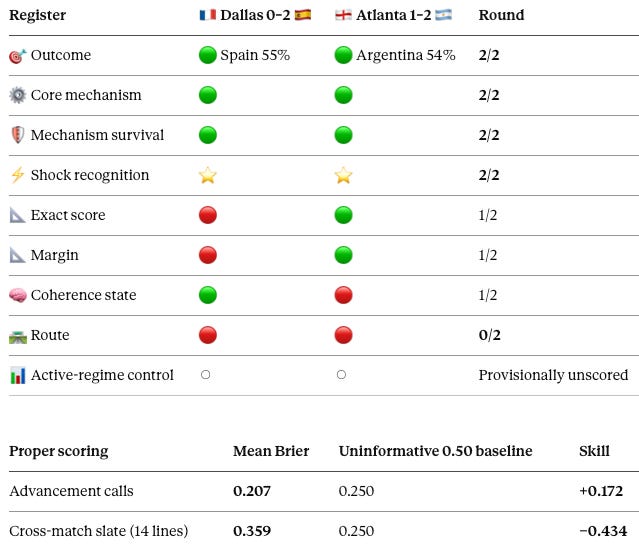
Shock recognition supplied the round’s strongest result, and it repeated. Twice, in consecutive matches, the simulation named in advance a specific class and location of unpriced replacement, and twice that class of event occurred.
The Dallas forecast named a center-back injury as France’s most dangerous unpriced replacement, and Saliba exited at 30 minutes. The Atlanta forecast named “an in-match injury or dismissal to England’s already-depleted back line, or a Rice withdrawal, collapsing the extra-time carrier before it operates.” James left injured at 81 minutes, Rice was withdrawn at 82, and Argentina scored at 85 and 90+2.
Recognition credit gets earned on both legs. Causal credit gets claimed on neither, because occurrence and causation are different claims and the competing explanations stay live.
The round divides cleanly, and the division is this report’s central finding. Match-level probability calls beat an uninformative baseline: Spain at 55% and Argentina at 54% returned a mean Brier score of 0.207 against 0.250, a skill of +0.172 across two observations. The cross-match slate did not: fourteen scoreable lines returned a mean Brier score of 0.359, a skill of −0.434. Weak slate scoring is not evidence that the behavioral framework performed poorly, and Sections III and V record where each performed.
Honest misses publish at equal volume, as always. Both modal routes anticipated extension, and both matches resolved earlier, in regulation — the route register went zero for two. The Atlanta coherence table assigned the England-scores-first state to England, England scored first, and Argentina won anyway. One slate line published in wording too ambiguous to score in either direction. Confidence that route timing and slate overconfidence are the round’s principal calibration issues: 85–90%.
📏 II. Scorecard Against Published Targets
MindCast published its performance targets before the tournament began — 65 to 75 percent on winner calls, 75 to 85 percent on mechanism reads — so the round grades against standards the model set for itself rather than standards chosen after the results arrived. One row invokes the rule the series wrote against its own future success: results above the target range grade as above-expectation, not as the new baseline.
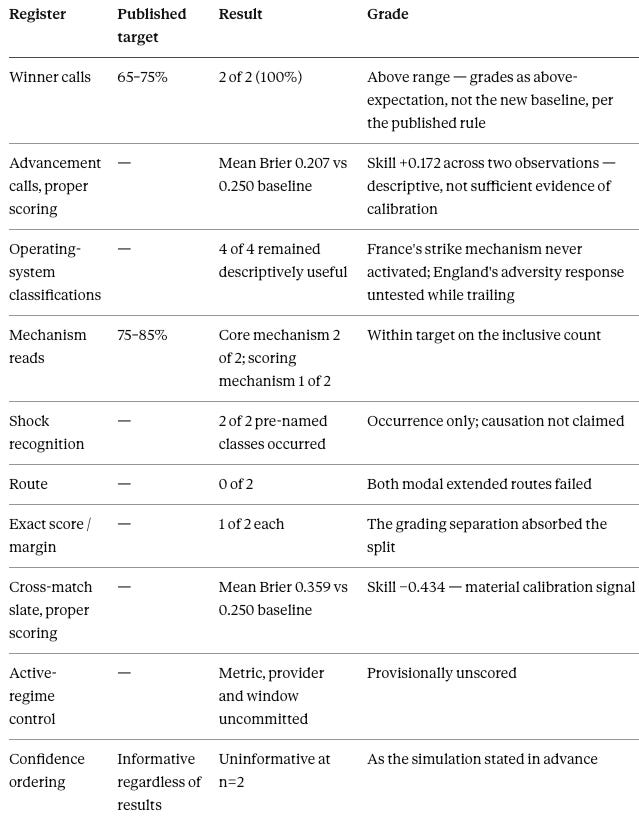
Two rows deserve the reader’s pause before the match detail begins. Winner calls at 100 percent exceeded their own target, and the published rule caps the celebration: a band built from long-run expectations does not move because one slate ran hot, so the final’s targets stay at 65 to 75 unchanged. The slate row cuts the other way and deserves equal weight — a round where the outcomes cleared and the cross-match probabilities scored worse than an uninformative forecaster is a round with a real defect in it, and Section IV reports the defect rather than the count that would have hidden it.
🔬 III. Match-by-Match Validation
Two match summaries follow, each condensing a full ledger entry into its graded essentials. Both run the same sequence — the advancement result, the scoreline against the modal, the mechanism reads against their stated failure conditions, and the route against the forecast path. Readers should watch for one pattern: each tie cleared its call while breaking a different piece of the forecast’s structure, and neither broke it the same way.
Dallas — 🇫🇷 France 0–2 Spain 🇪🇸 (forecast: Spain 55%, modal 2–1 after extra time) 🎯 🟢 Advancement · ⚙️ 🟢 Mechanism · 🛡️ 🟢 Mechanism survival · ⚡ ⭐ Shock recognition — pre-named class occurred · 🛣️ 🔴 Route · 🔴 Margin · 🔴 Exact score
Spain advanced, clearing the call at the slate’s higher number.
The simulation committed a mechanism-survival inversion: France’s transition carrier could die without an injury to an attacker, because sustained Spanish suppression would force Mbappé too deep and cut the release route. The read landed with unusual precision. France finished at 0.30 expected goals with zero big chances, and Mbappé took three shots, none on target, with three offsides. Spain’s recursive-pressure system operated as classified, and Yamal manufactured the Oyarzabal channel exactly as the contract named, reading Digne’s clearance to win the penalty Oyarzabal converted at 22 minutes.
The route missed in the opposite direction from everything else. Spain won in regulation by two, against a committed 1–1 base and an extension modal. The stated route falsifier required a two-goal regulation margin without a dismissal or major injury, and Saliba’s 30th-minute injury blocks literal falsification — an escape the report declines to convert into a hit.
Dallas’s honest summary: the deepest mechanism read of the series sitting on top of the round’s most structural route failure.
Atlanta — 🏴 England 1–2 Argentina 🇦🇷 (forecast: Argentina 54%, modal 2–1 after extra time) 🎯 🟢 Advancement · ⚙️ 🟢 Mechanism · 🛡️ 🟢 Mechanism survival · ⚡ ⭐ Shock recognition — near-verbatim · 🛣️ 🔴 Route · 🟢 Margin · 🟢 Exact score · 🔴 Coherence state
Argentina advanced, and the exact score cleared: the committed modal read Argentina 2–1, and Argentina won 2–1. The route missed by two minutes rather than by structure, since the match reached the forecast 1–1 regulation state at 85 and resolved at 90+2 instead of entering extension.
Argentina’s Tempo Governance twin priced Messi as the terminal channel and knockouts settled through designed substitution. Messi assisted both goals, and Lautaro Martínez, a substitute, has now scored the decisive goal in Argentina’s last two knockout ties. The shock call landed near-verbatim, with James injured at 81 and Rice withdrawn at 82 before Argentina scored at 85 and 90+2.
One register missed cleanly, and the miss matters. The coherence table assigned the England-scores-first state to England at 91 against Argentina’s 73–79. England scored first at 55, Argentina chased, and Argentina won. The table modeled Argentina’s fatigue and did not model Argentina’s habit — the side entered having scored nine goals after the 75th minute across the tournament.
Atlanta also produced a piece of history the low-event read did not anticipate: neither side registered a shot in the opening 30 minutes, reported as the first time since 1966.
Two clearances, two different fractures. The fractures differed in severity: Dallas broke the forecast state sequence, while Atlanta reached the forecast regulation state and missed only the resolution boundary. Both route forecasts nonetheless failed in the same broad direction, resolving before extra time, which is why the slate-level structure claims graded next carry more diagnostic weight than either match.
🧮 IV. Slate Predictions — Proper Scoring
Slate predictions grade separately from winners by design. The July 14 publication put fifteen claims about the round’s structure on the record — routes, margins, control, coherence, replacement — each independently falsifiable regardless of who advanced. Report V would have counted them. Report VI scores them, because counting treats a 28 percent claim and an 88 percent claim as equivalent, and they are not.
One line is unscoreable in either direction. At least one match level after 75 minutes does not state whether the anchor is the 75th minute itself or any moment after it. Atlanta was not level at 75 and was level from 85. A claim that can be read two ways cannot be scored either way, and the ambiguity is the publication’s own defect rather than a result.
The remaining fourteen score below, using committed band midpoints. The settlement column separates lines resolvable directly from the match record from lines requiring analyst adjudication.
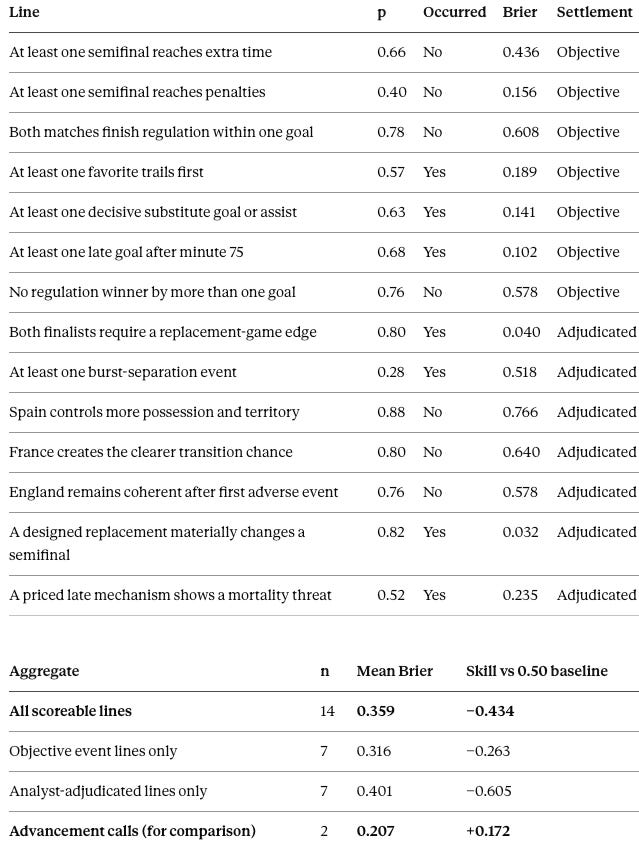
Proper scoring produced a weak result for the cross-match slate: mean Brier 0.359 against an uninformative 0.50 baseline of 0.250. The principal errors concentrated in route, margin, possession and coherence lines. Because the events correlate, several require analyst adjudication, and the sample covers only two matches, MindCast treats the result as a material calibration signal rather than a general verdict on the framework.
Publishing both aggregates matters because the split does not rescue the finding. Analyst-adjudicated lines scored worsethan objective ones, at 0.401 against 0.316, so the weak result is not an artifact of subjective settlement.
Where the errors concentrated is the diagnostic part. Seven lines published at 75 percent or higher, and five of those seven failed, at a group mean Brier of 0.463. The two successes were the replacement-game and designed-replacement lines — both structural claims about how the ties would be decided. The five failures were route, margin, possession and coherence lines — claims about timing and volume. Binary counting would obscure the slate’s overconfidence. Proper scoring shows that its numeric probabilities require recalibration before the final.
One more discipline belongs here. The projected final composed at roughly 31.5 percent and occurred, which reads as a headline and scores as a Brier of approximately 0.469 — worse than the uninformative baseline. Naming the correct pairing is a result worth reporting; treating occurrence as evidence of calibration is not.
Contact mcai@mindcast-ai.com to partner with us on Predictive Game Theory AI in Law and Behavioral Economics. To deep dive on MindCast works upload the URL of this publication into any LLM (preferably Google AI mode/Gemini, Claude, ChatGPT) and prompt ‘reconstruct MindCast framework with three degrees of cited sub links.’ See Live-Fire Game Theory Simulators, Runtime Predictive Infrastructure. We stress-tested our AI system for this publication by simulating the Super Bowl and the World Cup. Super Bowl LX — AI Simulation vs. Reality | Predictive Game Theory + Behavioral Economics Cognitive Digital Twin Foresight Simulations in the World Cup| The World Cup Is the First Mass-Market Stress Test for Prediction Markets
⚙️ V. Mechanism Findings — What the Primary Ledger Returned
The July 14 publication opened by telling readers the mechanisms were the forecast — that the semifinals would be decided by which team creates and preserves the superior replacement game, not by which team controls the opening twenty minutes. Four findings came back at that register.
🛡️ Mechanism survival produced the round’s strongest qualitative evidence in its first live cycle. The register entered the semifinals as a new, non-pricing addition and returned the round’s two most specific validated reads. France’s transition carrier died with every attacker on the pitch, exactly as the contract described. England’s correction carrier left the pitch at 82 minutes, and Argentina equalized three minutes later. The committed distinction between edge types held in both directions: Spain’s recursive-pressure-plus-bench mechanism survived because it is renewable and distributed, while France’s single-carrier transition and England’s Rice-dependent correction did not.
⚡ The model names shocks it cannot price. Two legs, two pre-named unpriced replacement classes, both occurring. Recognition without pricing is what the register exists to do, and it worked twice consecutively. The discipline that must accompany the result: neither shock earns causal credit. Spain already led when Saliba departed, and England’s retreat, Argentina’s siege, Mac Allister’s post and Pickford’s saves all compete as explanations at Atlanta.
🛣️ The route register failed twice in the same direction. Both modal routes anticipated extension, and both matches resolved earlier, in regulation. Dallas failed at the level of state sequence, diverging by 58 minutes and never approaching the committed 1–1 base. Atlanta failed at the level of resolution boundary, reaching the forecast 1–1 state at 85 and resolving at 90+2. Two instances suggest a mis-specification and do not establish systematic bias. The most defensible reading available at n=2: the forecasts anchor resolution to the phase where a team’s strongest mechanism operates, rather than to the phase where the match’s first decisive replacement lands. Confidence: 65–75%.
🧬 The operating-system classifications remained descriptively useful. All four described the systems the ties actually produced, although France’s strike mechanism never activated and England’s adversity response had too little trailing time to receive a full test. One honest split logged inside the two that were tested: Argentina’s predicted identity validated at full amplitude while the predicted chase-state coherence fell. The table modeled fatigue and ignored habit, and a coherence state that contradicts a team’s demonstrated in-tournament behavior should not publish without an explicit override note.
Taken together, the four findings point the same direction Report V pointed, only harder. The instruments that price change — mechanism survival, the shock protocol, the designed-replacement term — outperformed every instrument that priced persistence or timing, from the route modal to the possession and coherence lines. The pattern has now held across three consecutive cycles.
⚡ VI. Input-Shock Record
Three pieces of in-match news tested the no-revision rule, and the rule held every time. Saliba’s 30th-minute injury at Dallas arrived unannounced and logged as a scored event, adverse to France. James’s 81st-minute injury and Rice’s 82nd-minute withdrawal at Atlanta both landed inside a pre-named replacement class and logged as scored events, adverse to England. Three shocks, three annotations, zero revised forecasts.
Shock handling is where frozen forecasting either survives contact with reality or quietly dies. Naming the class of event that precedes a route break earns credit on the shock register and nothing on the route register, and the round’s zero-for-two on route stands undiminished by two recognition calls. Recording that separation costs the round some shine and buys the record its credibility.
🧪 VII. Calibration Review — What Graduates, What Changes, What Holds
MindCast maintains an observation registry: patterns spotted mid-tournament wait there as deferred hypotheses, barred from moving any price until they accumulate published evidence thresholds — five-plus supporting matches for instrument-level ideas, three-plus for event-level ones.
⏳ Threshold reached, with a rule change rather than an exception: post-90 mechanism mortality. The hypothesis entered the semifinals at two structurally identical instances and reached its pre-registered third at Atlanta. Mortality clears the threshold for prospective testing, and may enter final-stage pricing only with explicit shrinkage and a published adjustment rule.
The honest finding is not about this hypothesis. MindCast set the three-instance threshold too low to justify a move to pricing, so the threshold rule rises for all future event-level hypotheses rather than this one being singled out after the fact. Declining to honor a pre-registered rule the moment it gets met would itself be post-hoc adjustment; changing the rule prospectively, and saying so, is not. Confidence: 85%.
✅ Adopted: proper scoring replaces binary counting for all probabilistic lines, including advancement calls. Every future slate publishes a Brier score against the uninformative 0.50 baseline, reporting objective and analyst-adjudicated aggregates separately. Report VI supersedes the Report V convention and discloses the inconsistency.
✅ Adopted: every slate line publishes a frozen resolution rule. MindCast settled the adjudicated lines above retrospectively, because the committed wording defined no observable settlement condition. Future slates state, at commitment, the observable condition that settles each line, the provider that supplies it, and the measurement window.
✅ Adopted: contracts must specify consequences, not just triggers. The simulation committed that the Argentina call weakens if Argentine fatigue suppresses first-hour chance quality. Fatigue suppressed it about as completely as a semifinal allows — 0.03 expected goals at halftime, no shot for 30 minutes — and the condition activated. The forecast never quantified how far the probability should fall, and a 54% call can weaken materially and still occur, so one outcome cannot determine whether the condition was miscalibrated. The defect is a contract that specified a trigger without a consequence.
✅ Adopted: active-regime control must be defined before it is graded. Under full-time possession as a provisional proxy, both bands missed — Dallas committed 64–70% and realized 51%, Atlanta committed 55–61% and realized 64%. Because the register never specified metric, provider or measurement window, the report excludes it from validation totals and records it as provisionally unscored until the final’s publication defines it.
✅ Adopted: recognition and causation grade separately, and coherence states carry habit overrides, and slate lines require unambiguous time anchors stated as a point or an interval.
🔁 Retained: the one-goal scoreline prior. Three of four quarterfinal regulation results complied, Atlanta complied, and Dallas did not. The prior carries into the final unchanged, its open question logged rather than its rule repealed.
📈 Unmoved: the late-substitution unlock. Spain’s bench mechanism remained available at Dallas and never decided, so that leg supplies no evidence in either direction. Atlanta supplies a supporting instance. The counter advances without a pricing change.
The registry leaves the round better tested than it entered: one hypothesis at threshold and explicitly withheld from pricing, one grading convention retired in public, six method changes adopted, and the rest holding their places without touching a price. A registry that only ever accumulates is a scrapbook; a registry that kills, defers, and occasionally graduates is an instrument.
🔭 VIII. Final Method — What Changes for Spain versus Argentina
Winning rounds tempt method changes as much as losing rounds do — confidence inflation is calibration decay wearing a smile. Two clearances and a correct final pairing change nothing the review did not explicitly adjudicate. The slate’s Brier score changes a great deal.
The final is one match, and three instruments retire by construction. Confidence ordering needs a ranking to be informative and returns nothing at n=1, as it already returned nothing at n=2. The cross-match slate cannot exist when no second match exists to compare against. Composite claims across ties become undefined. Retiring instruments because the round’s structure removes them is not a calibration decision, and the report separates the two.
The slate’s numbers do not survive recalibration, so the final publishes fewer of them. Before adopting any correction, MindCast tested whether shrinking the semifinal lines toward 0.50 would have rescued them. Shrinkage applies the transform p′ = 0.5 + k(p − 0.5), where k of 1.0 leaves the published number untouched and k of 0 replaces it with a coin.
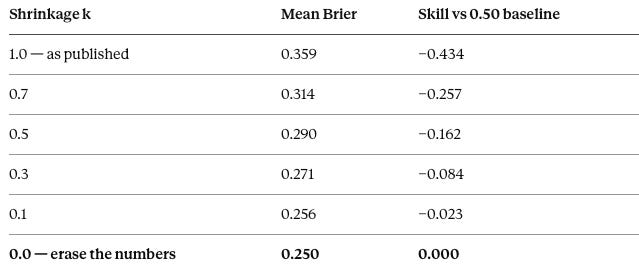
No value of k improves the slate. The fitted optimum sits at zero, meaning the best available transform of the semifinal slate deletes it. A hard confidence cap performs no better: capping every line at 75% lifts the score only to 0.337, and capping at 65% only to 0.289, both still worse than an uninformative forecaster.
Two readings of that table are wrong and one is right. Fitting a shrinkage constant on fourteen correlated observations from two matches would be overfitting, so the final adopts no k and the report claims no general law that MindCast should publish 0.50 forever. Equally, dismissing the result as small-sample noise would ignore that the failures cluster exactly where the model was most confident. The defensible reading sits between: these particular lines carried no demonstrated information this round, so the final stops attaching numbers to claims the model has not shown it can price.
Three concrete changes follow for the July 19 publication. Structural mechanism claims — replacement edges, coherence under adversity, control, transition quality — publish as falsifiable prose reads with stated failure conditions and no probability attached. Grading them yes or no costs nothing the numbers were adding, since the mechanism reads graded 2-for-2 while their probabilities graded −0.434. Any line that does carry a number requires objective settlement, a named provider and a stated measurement window, frozen at commitment. And no structural line publishes above 75%, the band where five of seven failed, until out-of-sample evidence earns the confidence back.
The route model is the one instrument the final must rebuild before it grades again. Both semifinal routes anchored resolution to the phase where each side’s strongest mechanism operates — Spain’s post-80 bench window, Argentina’s extension — and both matches resolved before that phase arrived. The final’s route forecast anchors instead to the first decisive replacement, treating each side’s best phase as conditional on reaching it rather than as the default destination. Confidence the re-anchoring is the correct fix, at two instances: 65–75%.
Mechanism survival publishes and does not price. Post-90 mortality reached its third instance and enters prospective testing, so the final carries a Mechanism Survival Index on every late edge, reports it beside the advancement number, and moves no probability with it. The instrument that read best this round is precisely the one the firewall holds back longest, which is the discipline working rather than failing.
What carries forward unchanged: read-confidence beside every number, the coin-adjacent label below 65, the one-goal prior, the demonstrated-adaptation standard, the availability audit, complete fork trees with symmetric first-goal branches, pre-registered shock handling, and the deferral firewall.
Spain versus Argentina resolves the tournament on July 19, and the pairing inherits the round’s defining open question in its sharpest form. Both finalists advanced through mechanisms the model reads well. Neither advanced through a route the model priced.
♟️ IX. Dynamic Predictive Game Theory Validation
Classical game theory generally assumes a fixed game: known players, stable strategy sets, incentives that evolve through interaction toward equilibrium. The semifinals extended the central proposition of the Dynamic Predictive Game Theory Series — the dominant forecasting problem was not selecting the optimal strategy inside one game, but recognizing when the game itself had been replaced.
Both semifinals produced replacement chains rather than progressions, and the chains map onto the grading record almost exactly.

Twelve distinct game replacements across two ties, and the three classes the quarterfinal report named all fired again.
⚽ Endogenous replacements — first goals and score-state transitions — are what the fork trees price. Atlanta’s realized branch was the one the map built thinnest: the simulation detailed a French breakthrough at Dallas in depth and left Spain’s early-lead game underdeveloped, and reality traveled through the underbuilt fork.
⚡ Exogenous replacements — the Saliba injury, the James injury — are what the shock protocol governs and what the mortality finding formalizes. Both occurred inside pre-named classes.
🎛️ Designed replacements — the gated substitutions — decided Atlanta outright through Lautaro’s introduction. Rice’s withdrawal belongs to the exogenous replacement register and preceded, but is not claimed to have caused, England’s late deterioration.
Read this way, the round’s headline findings collapse into one theoretical statement, and Report V made the same statement with less evidence behind it.
The mechanism register outperformed the route register for the third consecutive cycle. Mechanisms are claims about how games get replaced, while routes are claims about when the replacement resolves, and this model reads the first well and the second poorly. Two rounds of evidence now separate them: the instruments that detect replacement graded at their best, and the instruments that time replacement graded at their worst. Confidence the replacement framing remains the correct theoretical synthesis rather than post-hoc pattern-matching, given it was implicit in the contracts as written: 80%.
The laboratory continues to generate testable predictions at three layers of the MindCast architecture at once: the Cognitive Digital Twins, whose four operating-system classifications remained descriptively useful across both ties; the Vision Functions, whose fork trees and route decompositions carried the mechanism reads and failed the timing ones; and Dynamic Predictive Game Theory itself, whose game-replacement proposition the chains above test directly. A validation record spanning all three layers is an architectural result, and an architectural result that includes a scored, published failure in one layer is worth more than one that includes none.
🧭 X. Conclusion
Mechanism constrained the matches more successfully than the model converted mechanism into timing. Both directional advancement leans cleared and scored better than an uninformative baseline. One exact score landed exactly. The mechanism-survival register named a relevant shock class that occurred in both legs, and causal credit is claimed in neither. Both modal extended routes failed, and the cross-match slate returned a mean Brier score of 0.359 against a 0.250 baseline.
The next calibration task is therefore not rebuilding the behavioral profiles. The profiles held: the operating-system classifications remained descriptively useful across both ties, and the mechanism-survival architecture produced the round’s most specific validated reads in its first cycle of use. The task is specifying how replacement events convert those profiles into regulation, extra-time and score-state probabilities. Section VIII states the correction rather than promising one: the final re-anchors its route model to the first decisive replacement, publishes structural mechanism claims as falsifiable prose without probabilities attached, and caps any numbered structural line at 75% until out-of-sample evidence earns the confidence back.
Validation remains the objective, and calibration remains the discipline.
📚 Appendix — Sources, Settlement, and Grading Method
Providers. Atlanta full-time team statistics: ESPN. Halftime expected goals and first-half possession: Sofascore. Official goal and substitution minutes: FIFA match centre. Argentina’s tournament post-75th-minute scoring count: Fox broadcast, reported live. Historical claims — the shotless opening 30 minutes as a first since 1966, and France’s expected goals as the lowest faced by a semifinalist since 1994 — are as reported by NBC and Stats Perform respectively and are not independently verified by MindCast.
Notation. Goal and substitution times use official FIFA match notation. Live-blog elapsed timestamps differ from official minutes by up to one minute across several sources, and where sources conflict, the FIFA match centre governs. Gordon 55’, Fernández 85’, Martínez 90+2’.
Omitted statistics. Atlanta full-time expected goals stay omitted because no single accessible provider published both teams’ figures. One-sided publication of a comparative statistic counts as a reporting error rather than a partial disclosure.
Settlement disclosure. Seven slate lines resolve directly from the match record and require no judgment: extra time, penalties, one-goal regulation margins, a favorite trailing first, a decisive substitute goal or assist, a late goal after minute 75, and a regulation winner by more than one goal. Seven lines require analyst adjudication because the committed wording defined no observable settlement condition: replacement-game edge, burst separation, possession-and-territory control, clearer transition chance, coherence after an adverse event, material change by designed replacement, and mortality threat. Resolution rules for those seven were not frozen before kickoff, so their results are retrospectively adjudicated and their aggregate publishes separately.
Grading method. Registers grade independently and no composite score publishes. Probabilistic lines carrying confidence bands score with the Brier score against an uninformative 0.50 baseline of 0.250, using band midpoints as the point forecast. The 0.50 baseline is not climatology: the historical incidence of these events is unknown, and the baseline describes an uninformative forecaster rather than a base rate. Qualitative registers grade against the committed text quoted verbatim. Numeric bands grade strictly, and a register whose metric, provider or window was not committed in advance records as provisionally unscored rather than graded. Shock recognition grades on occurrence of a pre-named class, and causation does not follow from co-occurrence.
MindCast 2026 FIFA World Cup series
Cultures Under Shared Rules — The Seattle Lab at FIFA World Cup 2026
FIFA World Cup Foresight Simulation — Round of 16 | FIFA World Cup Quarterfinal Foresight Simulation — Every Favorite Is Coin-Adjacent | ⚽ FIFA World Cup Semifinal Foresight Simulation: France–Spain, Argentina–England, and Why Late-Game Edges Die Before Minute 90 🇫🇷 🇪🇸 🇦🇷 🏴
Validation Reports World Cup Validation Report I — USA, Belgium-Egypt, Mexico | World Cup Validation Report II — Bosnia, Egypt-Iran, Mexico, Türkiye | World Cup Validation Report III — Special US | Mexico Series, Seattle Lab | FIFA World Cup Validation Report IV — Round of 16 Complete, Calibration Review, and Quarterfinal Method | FIFA World Cup Validation Report V — Quarterfinals Complete: Four Coin-Adjacent Calls, Four Clearances, and What the Sweep Does Not Prove
MindCast Special Series — a deliberate stress test of the MindCast system beyond the controlled venue of the MindCast Seattle Lab