


Related publications: Kalshi Is Crypto’s Test Case | Kalshi’s Prediction Market Litigation Architecture, the CFTC Amicus, and the Strategic Framework for State Enforcement | The National Kalshi Prediction Market Litigation Map | The Full Arc of Prediction Markets | Prediction Markets and the Regulatory Split | Prediction Markets— Legislative Regime Conversion and the Collapse of Preemption | Kalshi Found the One Gap in American Gaming Law Nobody Closed | The Ninth Circuit on April 16 as System Convergence — The First Measurable Test of Prediction Market Structure | Kalshi, Prediction Markets and the Conflict Architecture of Regulation | Prediction Markets Litigation Stack — Federal, Private, and State Enforcement Converge
Executive Summary
Kalshi is not litigating for case-by-case survival. Kalshi is engineering an inter-circuit collision designed to force a Supreme Court ruling on federal preemption terms before states and Congress can stabilize the gambling classification.
Kalshi is not defending a product. Kalshi is executing a jurisdictional reclassification strategy designed to convert every state enforcement action into federal preemption ammunition and every favorable district ruling into circuit-level authority — until the inter-circuit conflict becomes irresolvable and the Supreme Court is forced to settle the question on federal derivatives terms rather than state gambling terms. The February 17, 2026 Commodity Futures Trading Commission (CFTC) amicus brief filed in the Ninth Circuit accelerates that strategy by transforming the dispute from one company’s aggressive statutory reading into a federal agency’s official assertion of exclusive domain. Any ruling against Kalshi now requires a court to rule against the agency Congress created to govern derivatives markets.
The controlling variable in this conflict is not only jurisdiction — it is timing. The party that controls the sequence of forum selection, injunction issuance, and appellate review controls the outcome before the law fully resolves. The decisive contest is not over whether the contracts qualify as swaps or wagers. The decisive contest is whether the case is adjudicated in a forum where that question is answered under federal preemption doctrine or state police power. Every procedural move the AG makes in the next thirty days determines which forum resolves that question.
State attorneys general face five interlocking pressures on a compressed timeline.
First, the Ninth Circuit oral arguments on April 16, 2026 will produce a ruling that functions as controlling authority across nine states simultaneously — Washington, Oregon, California, Arizona, Alaska, Hawaii, Idaho, and Montana.
Second, Kalshi will attempt to remove the Washington King County complaint to federal court, where that circuit authority becomes immediately operative.
Third, the inter-circuit split already active between Ohio and Tennessee within the Sixth Circuit, and forming between Maryland and Nevada across the Fourth and Ninth Circuits, creates the exact conditions for Supreme Court certiorari on preemption grounds.
Fourth, the legislative window to foreclose judicial resolution through a CEA amendment — the Prediction Markets Are Gambling Act — narrows with every day that passes before a Ninth Circuit ruling issues.
Fifth, the CFTC amicus brief is itself vulnerable to challenge on administrative law grounds: the brief represents a stark departure from decades of prior agency policy, issued by an administration whose family members hold documented financial stakes in the industry the brief defends — a record that implicates the Administrative Procedure Act’s requirement that agency action rest on reasoned basis rather than political patronage.
This publication advances six findings for state enforcement actors.
First, Kalshi’s litigation fragmentation is deliberate architecture, not emergent disorder — understanding the three-layer strategy (forum selection, precedent conversion, categorical reframing) is prerequisite to countering it.
Second, the CFTC amicus does four things simultaneously that states must address independently in their own briefs: it broadens the case beyond sports, converts novelty into statutory breadth, deploys national-market mechanics as a preemption weapon, and makes economic destabilization the appellate fear.
Third, the post-Loper Bright environment, Loper Bright Enterprises v. Raimondo, 603 U.S. 369 (2024), strengthens rather than weakens the CFTC’s brief, because the brief does not rely on deference — it provides independent statutory analysis the court must perform anyway, and states must engage it on its own terms rather than attacking deference credentials that no longer exist.
Fourth, Washington AG Nick Brown can preserve state-court forum through four specific procedural moves, all of which require immediate action before April 16.
Fifth, the existing amicus record contains a critical unoccupied gap — no brief challenges the premise that asserting exclusive jurisdiction and exercising effective oversight are equivalent conditions — and challengers who occupy that ground present the Ninth Circuit with a framework for ruling narrowly.
Sixth, removal petition wins and losses are not proportional — a Kalshi removal win compounds forward through cascade effects that a remand win does not reverse at the same velocity, and the optimal state counter-strategy is coordination across multiple AG offices rather than individual bilateral resistance.
The controlling asymmetry: Kalshi is winning arguments about jurisdiction. Congress is winning the argument about category. The CFTC amicus accelerates both dynamics simultaneously. Which track completes first determines the outcome for every state enforcement action currently active.
I. What the Litigation Map Identified — and What It Left Open
Kalshi is not merely reacting to the fragmentation that sixteen states and four circuits have produced. Its litigation sequencing consistently amplifies that fragmentation — converting each state enforcement action into preemption ammunition and each circuit disagreement into certiorari pressure. Understanding that architecture is the prerequisite to disrupting it.
The March 19 Prediction Markets and the Regulatory Split publication established the enforcement mechanism driving state action: existing gambling statutes create the shortest path to enforcement, and state regulators map novel instruments onto that path rather than constructing new regulatory categories. Arizona AG Kristin Mayes activated a preexisting wagering statute broad enough to cover any business accepting bets on the result of any unknown or contingent future event. The statute fit. The charges followed. Every state AG operating since then has followed the same logic — find the shortest path from existing statutory authority to the novel instrument and walk it.
By the time state AGs activated their shortest enforcement path, Kalshi had already designed its counter-strategy around that activation. Each state enforcement action that reaches a favorable federal court strengthens Kalshi’s preemption argument in the next jurisdiction. Nevada enforced. Kalshi obtained a federal injunction. Kalshi filed the injunction as supplemental authority in Tennessee. Tennessee ruled for Kalshi. Kalshi filed Tennessee as supplemental authority in every remaining active proceeding. The enforcement signal gets recycled as preemption ammunition at each step. State AGs are not just fighting Kalshi in their own jurisdictions — every enforcement action feeds the appellate record Kalshi needs to reach the Supreme Court on federal preemption terms.
Fragmentation is not a bug in Kalshi’s legal position. Fragmentation is the mechanism Kalshi deploys to generate the inter-circuit collision that produces Supreme Court jurisdiction — on federal preemption terms, not gambling-policy terms. Courts resolve jurisdiction questions faster than they resolve moral classification questions. Converting ‘is this gambling?’ into ‘who governs national derivatives markets?’ removes the case from terrain where states hold the strongest arguments and repositions it on terrain where the federal agency’s statutory mandate controls.
Understanding why state enforcement alone cannot resolve this dispute requires recognizing that Kalshi is not playing a single-play game against individual state AG offices.
Kalshi is playing a repeated game with a decade-long horizon — Supreme Court certiorari, congressional testimony, the next CFTC rulemaking cycle, and the valuation trajectory that depends on regulatory certainty. In repeated games, a player’s willingness to absorb significant current costs is rational when those costs build the precedent record, institutional relationships, and credibility that make future iterations cheaper to win. Every state enforcement action Kalshi defeats reduces the cost of the next defense. Every voluntary concession Kalshi makes — blocking politicians and athletes from trading — reduces the political cost of the next congressional hearing without conceding the legal argument.
Kalshi is not litigating against Washington AG Nick Brown. Kalshi is shaping the institutional landscape it will operate in for the next decade, and every current move is calibrated to that horizon. State enforcement, by contrast, is funded by annual appropriations, staffed by attorneys with competing dockets, and accountable to election cycles. The time horizon asymmetry alone — independent of legal merit — structurally favors Kalshi in any enforcement contest that does not reach a definitive legislative or judicial resolution quickly. (See MindCast: The Dual Nash-Stigler Equilibrium Architecture.)
Prior publications established that the fragmentation is real, the enforcement pressure is real, and the legislative override mechanism — a direct CEA amendment — is the most consequential single variable in the system. What this publication adds: the fragmentation is not accidental, the CFTC has now formally joined the strategy as an institutional participant, and states have specific procedural moves available that close the exposure window before the circuit conflict resolves against them. Understanding the strategy architecture is the prerequisite to deploying those moves effectively.
II. What State Enforcers Are Up Against: The Three-Layer Threat
Disrupting Kalshi’s litigation strategy requires understanding it as a system, not as a collection of individual lawsuits. Across sixteen active state proceedings and four appellate circuits, three interlocking layers operate in sequence — each one converting the output of state enforcement into raw material for federal preemption argument. Recognizing the architecture does not require defending against each filing in isolation. It requires denying Kalshi the inputs each layer needs to function.
Layer One: Preemptive Federal Filing to Freeze State Enforcement
Kalshi files preemptive federal lawsuits after state enforcement threats materialize, before state courts can establish controlling precedent with operational consequences. The Tennessee sequence is the clearest execution: Kalshi filed in federal court, obtained a preliminary injunction from Judge Trauger on February 19, 2026, and immediately transmitted that ruling as supplemental authority to every other active appellate proceeding. The Nevada sequence shows what happens when state enforcement moves first — the state court TRO issued March 20, 2026 before the federal track could overtake it, and Nevada temporarily preserved its enforcement position. Speed in the state forum is the primary countermeasure. Every state AG with an unfiled complaint faces the same race condition: file and move for a preliminary injunction before Kalshi can establish a federal forum.
Layer Two: Converting Every District Ruling into Multi-Jurisdiction Ammunition
District court wins are not Kalshi’s objective — they are raw material for circuit-level argument. No single district court ruling controls another, and Kalshi knows the preemption question cannot be resolved at the trial level. Every favorable district ruling gets filed as supplemental authority in every other proceeding. Every unfavorable ruling gets distinguished on procedural or factual grounds. States cannot treat any individual filing as an isolated contest. A state that wins at the district level in isolation provides Kalshi with factual distinctions it uses to neutralize the win in the next jurisdiction. The only effective counter is producing multiple simultaneous state court records that cannot all be distinguished or removed before the circuit authority question resolves.
Layer Three: Reframing the Legal Question Away from State Terrain
Kalshi’s most consequential strategic move is categorical, not procedural. Converting the dispute from ‘is this gambling?’ into ‘who governs national derivatives markets?’ renders state arguments about gambling harm secondary unless and until Congress directly amends the statute. Courts resolve infrastructure governance questions differently than moral classification questions. The Tennessee court acknowledged genuine state concerns about youth access and problem gambling — then framed the controlling question as what Congress did, not whether the product is wise. States counter this reframing by keeping the complaint on state-law terrain: pleading exclusively under state gambling and consumer protection statutes, avoiding any reference to the CEA or CFTC designation, and framing every motion as a Washington-resident protection action against unlicensed wagering conduct rather than a challenge to federal exchange regulation.
III. The CFTC Amicus: Four Things It Does Simultaneously
The February 17, 2026 CFTC brief filed in North American Derivatives Exchange v. State of Nevada, Case No. 25-7187, does not merely support Kalshi’s position — it converts the dispute from a private litigation matter into a federal-state jurisdictional conflict, materially increasing the probability of appellate and Supreme Court review. Without the CFTC, Kalshi is one company asserting an aggressive statutory reading against sovereign state police power. With the CFTC, Kalshi becomes a proxy for federal jurisdiction — and any ruling against Kalshi becomes a ruling against the agency Congress created to govern derivatives markets. The moment the CFTC filed, the case ceased to be Kalshi versus Nevada. It became the federal government versus state police power — a Supremacy Clause conflict certworthy by its own structure.
A. Broadening the Case Beyond Sports
The CFTC’s Section III economic stability argument carries the brief’s most consequential strategic payload. The Commission documents that at least eight Designated Contract Markets (DCMs) have collectively self-certified more than 3,000 event-based contracts. The brief states directly:
Nevada’s cease and desist letter to KalshiEX LLC at issue in a related case orders it to ‘immediately cease and desist from offering any event-based contracts in Nevada,’ without limitation to sports. If Nevada’s approach were permitted to stand, event contracts referencing agricultural, metal, energy, and financial outcomes could likewise all become subject to state-by-state bans across the country.
A judge ruling against Kalshi on sports contracts must now confront the institutional consequence that the same reasoning unravels agricultural, energy, financial, and weather derivatives simultaneously — a substantially higher cost than ruling against one company’s sports product.
B. Turning Statutory Novelty into Statutory Breadth
The CFTC’s textualist reading of CEA § 1a(47)(A)(ii) leans hard on the word ‘any.’ The brief establishes the statutory architecture:
CEA § 1a(47)(A)(ii) defines swap to include ‘any agreement, contract, or transaction . . . that provides for any purchase, sale, payment, or delivery . . . that is dependent on the occurrence, nonoccurrence, or the extent of the occurrence of an event or contingency associated with a potential financial, economic, or commercial consequence.’
The brief treats event contracts as precisely the kind of financial innovation the deliberately broad Dodd-Frank swap definition captured. By framing novelty as confirmation of breadth rather than evidence of exclusion, the CFTC converts Kalshi’s legal vulnerability — ‘this is unprecedented’ — into a statutory strength — ‘this is exactly what any was written to cover.’
C. Using National-Market Mechanics as a Preemption Weapon
The conflict preemption argument is structurally elegant. A DCM must provide impartial national access to all eligible participants nationwide under 17 C.F.R. § 38.151(b). State bans make compliance with that federal obligation physically impossible. The brief frames the obstacle preemption theory with precision:
Gambling laws often require local licensing, fees, and specific hardware (like localized servers). Applying state-by-state local requirements to national commodity exchanges would create the very ‘patchwork’ that Congress set out to prevent.
D. Making Economic Destabilization the Appellate Fear
The brief’s closing systemic risk warning is calibrated to how federal appellate courts think about market-structure rulings:
Because even modest ambiguity in the scope of the CEA can move rapidly through interconnected financial markets, the CFTC respectfully requests that the Court not adopt a construction that could generate systemic consequences for CEA preemption far removed from the case at hand.
The Ninth Circuit does not want to be the court that inadvertently unraveled the national derivatives framework. The CFTC brief hands the court a clean path to ruling for Kalshi that requires no endorsement of sports betting and no deviation from established preemption doctrine — only recognition that exchange-traded instruments on a federally registered DCM sit inside federal jurisdiction.
Courts are not deciding whether prediction markets should exist. Courts are deciding whether Congress has already decided who controls them.
E. Why the Economic Stability Argument Is Contestable
The CFTC’s systemic risk argument in Section III of its brief is the most strategically significant and the most empirically vulnerable claim in the document. State challengers who engage only the statutory text and preemption doctrine leave the brief’s most powerful appellate lever — economic fear — uncontested. Three analytical weaknesses in the economic stability argument are available to challengers and absent from the current record.
First, the systemic risk claims are speculative, not substantiated. The brief warns that ‘even modest ambiguity in the scope of the CEA can move rapidly through interconnected financial markets’ — but offers no empirical evidence that state-by-state regulation of sports event contracts has produced or would produce the derivatives market instability it describes. Appellate courts distinguish between plausible institutional concerns and demonstrated market effects. The CFTC’s argument rests entirely on the former. A challenger who places that gap before the court — noting that the brief identifies no market dislocation, no pricing distortion, and no settlement failure attributable to state enforcement actions — converts the CFTC’s strongest rhetorical move into an unsubstantiated prediction.
Second, binary sports event contracts do not perform the economic functions the Commodity Exchange Act was designed to protect. CEA § 3 identifies the statute’s purposes as protecting price discovery, enabling hedging against commodity price risk, and promoting market transparency for producers, processors, and merchants who use derivatives to manage legitimate commercial exposure. A binary contract paying a fixed amount if a sporting event outcome occurs serves none of those functions. No agricultural producer hedges crop price risk through a contract on the Super Bowl winner. No energy company manages fuel cost exposure through a contract on an NBA game margin. The Coasean transaction cost analysis developed in Chicago School Accelerated — The Integrated, Modernized Framework of Chicago Law and Behavioral Economics identifies the precise statutory gap: derivatives instruments reduce transaction costs in markets where commercial actors face genuine price exposure. Sports event contracts address no transaction cost the CEA was designed to reduce. The CFTC’s economic stability argument assumes functional equivalence between instruments the statute’s own purposes distinguish. That assumption is contestable on the face of the statute’s own statement of purpose.
Third, the fragmentation argument fails the sportsbook comparison. Licensed sportsbooks operate across more than thirty states under varying state licensing regimes, tax structures, geolocation requirements, and consumer protection frameworks — and national financial markets have not collapsed. The CFTC argues that state-by-state requirements for nationally traded event contracts would create the ‘patchwork’ Congress sought to prevent. But the existing sportsbook industry demonstrates empirically that a national wagering market can coexist with differentiated state regulatory requirements without impairing price formation, access, or settlement integrity. If the CFTC’s fragmentation argument were correct, DraftKings, FanDuel, and Fanatics — each operating under dozens of separate state licenses simultaneously — would have destroyed the national sports wagering market. Challengers should place that comparison before the Ninth Circuit as direct empirical evidence that the CFTC’s systemic risk premise does not survive contact with observable market reality.
Fourth, the CFTC’s statutory predicate for the economic argument contains a limitlessness problem that challengers should place before the court directly. The statute requires only that event contracts be ‘associated with potential financial, economic, or commercial consequence’ — and the brief argues sports events qualify because they generate billions in economic activity and affect regional markets. Under that logic, the statutory limitation becomes effectively meaningless. Elections affect the economy. Entertainment affects the economy. Weather affects the economy. Nearly every contingent event produces downstream economic effects on someone. A statutory standard that encompasses all economic consequences limits nothing — and a court applying independent judgment under Loper Bright should ask whether Congress intended the swap definition to extend to any event with indirect economic spillovers, or whether commercial consequence requires a more direct connection to the price-discovery and hedging functions the Act was enacted to protect.
Contact mcai@mindcast-ai.com to partner with us on Predictive Cognitive AI in Law and Behavioral Economics. To deep dive on MindCast Foresight Simulations upload the URL of this publication into any LLM and prompt ‘reconstruct MindCast framework with three degrees of cited sub links.’ See Live-Fire Game Theory Simulators, Runtime Predictive Infrastructure.
Recent projects: MindCast AI Emergent Game Theory Frameworks | Super Bowl LX — AI Simulation vs. Reality | Google’s Deep-Thinking Ratio Measures Effort, Not Structure | The Cognitive AI Response to Apple’s “The Illusion of Thinking | MindCast AI Constraint Geometry and Institutional Field Dynamics | The Runtime Causation Arbitration Directive | Runtime Geometry, A Framework for Predictive Institutional Economics | Foresight on Trial, The Diageo Litigation Validation | The Compass Antitrust Self-Destruction Sequence
IV. The Post-Loper Bright Question — and Why the Brief Is Stronger for It
State challengers who assume Loper Bright Enterprises v. Raimondo, 603 U.S. ___ (2024), weakens the CFTC brief are misreading the strategic landscape. Eliminating Chevron deference does not weaken the brief — it reorients the brief’s function in a way that materially strengthens Kalshi’s position. The CFTC never needed deference. It needed an audience performing independent statutory analysis, and Loper Bright requires exactly that. States must now engage the brief’s textual and historical argument on its own terms rather than attacking deference credentials that no longer exist.
Under Chevron, the CFTC’s statutory interpretation commanded deference only upon a court finding genuine statutory ambiguity — and only within the bounds of permissible construction. That two-step framework gave challengers a path: argue the statute is unambiguous in the state’s favor, and deference never triggers.
Under Loper Bright, courts exercise independent judgment on statutory meaning from the outset. Deference is eliminated. But the CFTC brief does not request deference — it never needed to. The brief provides comprehensive statutory text analysis, complete legislative history from 1921 through Dodd-Frank in 2010, regulatory practice documentation spanning nearly two decades, and economic consequence analysis calibrated to appellate risk aversion. Courts performing independent statutory interpretation under Loper Bright must conduct exactly that analysis. The CFTC has done it for them, in the most thorough form available in the record, with the imprimatur of the administering agency.
The post-Loper Bright brief functions as persuasive authority of the highest available quality — not because it commands deference, but because it performs the independent analysis the court must now conduct and does so with institutional knowledge no party can replicate. When the Ninth Circuit asks what ‘any agreement, contract, or transaction’ means in CEA § 1a(47)(A)(ii), and what Congress intended by ‘exclusive jurisdiction’ in 1974 and again in 2010, the CFTC’s answer is the most detailed and historically grounded answer in the record. Courts do not have to agree with it. But they have to engage with it — and engaging with a 41-page institutional analysis is a higher burden than rejecting a private party’s deference claim.
State challengers face a specific strategic problem created by Loper Bright that the existing state briefs do not address. Pre-Loper Bright, a state could argue: ‘the statute is ambiguous, deference does not apply here because the CFTC lacks the expertise to classify gambling instruments, and therefore the court should resolve the ambiguity in favor of the traditional state police power under the presumption against preemption.’ Post-Loper Bright, the deference step disappears but the statutory analysis obligation intensifies. States must now engage the CFTC’s textual and historical argument directly — not merely attack its deference credentials — or leave the field to the Commission’s analysis by default.
Three specific counter-arguments remain available to states under Loper Bright that no existing state brief has fully developed.
First, Loper Bright’s independent judgment requirement cuts both ways: courts must also independently assess whether the CEA’s savings clause in § 2(a)(1)(A) — which provides that the exclusive jurisdiction grant does not supersede state regulatory authority over matters outside the field — preserves state gambling enforcement as applied to conduct aimed at state residents, independent of exchange designation.
Second, independent judgment on the preemption question requires examining whether Congress, in establishing exclusive CFTC jurisdiction, contemplated the specific application of state gambling statutes to a category of instrument — sports event contracts — that did not exist when any relevant legislation was enacted.
Third, the economic consequence analysis the CFTC deploys in Section III of its brief — warning of systemic destabilization if states can regulate DCM-listed contracts — is an empirical claim, not a legal one. Courts performing independent judgment are not required to accept it without examining whether the CFTC’s claimed exclusive jurisdiction is accompanied by any operational supervisory capacity to deliver the stability it promises.
The bottom line for state enforcement strategy: do not argue Loper Bright as a weakening of the CFTC brief. Engage the brief’s textual and historical analysis directly, deploy the savings clause argument as an independent textual basis for state authority, and contest the empirical premise that federal exclusivity produces federal uniformity when the claiming agency faces the resource constraints documented in this publication. Attacking deference is the wrong move when deference is already gone. Contesting the analysis on its own terms is the right one.
V. The Circuit Split Manufacturing Process: Current State
Circuit non-uniformity governing a single national exchange creates a condition the Supreme Court historically resolves on preemption grounds — and that condition is actively forming across four circuits simultaneously. The CFTC amicus brief accelerates the timeline by converting the split from a private statutory interpretation dispute into a federal agency jurisdiction conflict, the most consistently certworthy category in the Supreme Court’s docket. Cert probability on a Q4 2026 petition updates from P50 at 73% to P50 at 79%. The reasoning is structural, not speculative.
The intra-Sixth Circuit split is already active. Judge Morrison in Ohio ruled for the state on March 9, 2026. Judge Trauger in Tennessee ruled for Kalshi on February 19, 2026. Two federal judges in the same circuit applied the same statute to the same contracts and reached opposite conclusions. Under Supreme Court Rule 10, that condition creates certiorari pressure within a single circuit independent of any inter-circuit conflict.
The inter-circuit split is in active formation. The Fourth Circuit’s Maryland oral arguments are calendared for May 7, 2026 with Neal Katyal representing Kalshi. The Ninth Circuit’s consolidated Nevada arguments occur April 16, 2026. The district court records in both proceedings point in opposite directions: Maryland denied Kalshi’s injunction in August 2025; Tennessee granted it in February 2026. If the circuit courts follow their district records, the Fourth rules for the states and the Ninth rules for Kalshi.
An irresolvable inter-circuit conflict on a question of federal statutory interpretation governing a $22.88 billion national market cannot persist. A national exchange cannot operate under non-uniform legality without impairing price formation, access, and settlement integrity — which converts the cert question from theoretical to structural. Circuit non-uniformity governing a single national exchange creates a condition the Supreme Court historically resolves on preemption grounds. The Supreme Court cannot allow four circuit courts to apply four different rules to the same national exchange listing the same contracts under the same federal statute. Certiorari becomes near-mandatory.
The CFTC amicus elevates the cert probability through one additional mechanism: a circuit split on preemption of federal agency jurisdiction, where the agency itself has formally intervened on one side, is categorically more certworthy than a circuit split on a private party’s aggressive statutory reading. Institutional presence converts the split from a statutory interpretation disagreement into a federal separation of powers question — the most consistently certworthy category in the Supreme Court’s docket.
State AGs hold one significant counter-signal within the administration’s own judicial record. On March 17, 2026, Trump-appointed federal Judge Liburdi in Arizona denied Kalshi’s attempt to block state criminal charges — ruling that Kalshi had not demonstrated the likelihood of success on the merits required for emergency preemptive relief. The Arizona ruling cannot be dismissed as partisan judicial resistance: it was issued by a judge appointed by the same president whose administration filed the February 17 CFTC amicus brief. Courts and congressional staff reading both documents confront an intra-administration disagreement about whether prediction market contracts are exempt from state gambling law — a contradiction that undermines the amicus brief’s claim to represent settled federal policy rather than politically driven advocacy.
VI. The Washington Nexus: Keeping the Case on State-Court Terrain
Removal determines whether the merits even matter. Washington’s complaint currently sits in King County Superior Court, where the CFTC amicus brief carries no binding weight and where RCW 9.46.240 holds favorable terrain — but only for as long as the case stays there. A single Ninth Circuit ruling, issuing April 16 from a proceeding that covers nine states simultaneously, could resolve the Washington AG’s enforcement action by operation of circuit precedent before King County ever reaches the merits. Preserving state-court forum is the AG’s highest-priority procedural objective. Four moves close the exposure window.
Move One: Audit and Amend the Complaint to Plead Exclusively Under State Law
The well-pleaded complaint rule limits federal question jurisdiction to claims that appear on the face of the plaintiff’s own complaint — not defenses the defendant raises. Under Gully v. First National Bank, 299 U.S. 109 (1936), a federal defense does not create removal jurisdiction. If the King County complaint as filed references the CEA, CFTC designation, or any federal regulatory standard in its own cause of action, Kalshi gains a removal foothold the AG does not need to provide. Amending now to plead exclusively under Washington gambling law and the Consumer Protection Act — framing the case as a Washington-resident protection action against unlicensed wagering conduct perpetrated by a platform operating without state authorization, not a challenge to federal exchange designation — forces Kalshi to manufacture the federal question as a defense rather than locate it in the complaint. Kalshi’s defense-based removal argument is substantially weaker and remandable.
Move Two: Move for Preliminary Injunction Immediately on State Law Grounds Only
Speed controls the forum outcome more than any doctrinal argument. Massachusetts obtained a state court preliminary injunction before its federal track overtook it. Nevada obtained a TRO. Both created state court records with independent legal weight. Under 28 U.S.C. § 1450, state court orders entered before removal survive into the federal proceeding and remain in effect until the federal court affirmatively dissolves them. A federal judge dissolving an existing state preliminary injunction on preemption grounds is a materially different procedural and political act than a federal court simply denying a motion never made. Filing for the preliminary injunction within days — grounded entirely in Washington’s gambling statute and consumer protection law, with no federal law invoked — maximizes the probability the order issues before any removal notice arrives.
Move Three: Oppose Removal Aggressively on Artful Pleading Grounds
If Kalshi removes the case, file the remand motion the same day. The artful pleading doctrine requires that the federal question appear necessarily in the plaintiff’s well-pleaded complaint — the AG is not required to anticipate and plead around a preemption defense. A state enforcement action under a state gambling statute, pleading only Washington-law claims based on Washington-resident conduct, does not require resolution of the CEA preemption question to adjudicate the plaintiff’s own theory. Kalshi’s preemption argument is a defense. Federal defenses do not confer removal jurisdiction. The remand motion should be fully briefed and ready to file the moment a removal notice appears.
Move Four: Coordinate Filing Timing with Other State AGs
Kalshi cannot remove all simultaneous state court actions before preliminary injunctions issue in at least some of them. Coordinating filing dates across additional state AG offices maximizes the probability that multiple state court records establish before federal preemption arguments reach the Ninth Circuit. Each state court preliminary injunction that survives into a federal removal proceeding is an independent constraint on a preemption ruling’s immediate operational effect. The April 16 oral argument calendar makes coordination timing urgent. States that file and obtain preliminary injunctions before the Ninth Circuit rules hold fundamentally stronger positions than states that file after.
VII. The Removal Domino: Game Theory of Wins, Losses, and Cascade Effects
Removal petition wins and losses are not proportional — and the asymmetry runs structurally in Kalshi’s favor. A removal win relocates the case to federal terrain, cascades as supplemental authority into every other pending removal motion nationally, and feeds the circuit authority track already moving toward a ruling. A remand win restores forum advantage without restoring substantive leverage. Understanding that asymmetry changes how state AGs should allocate litigation resources: fighting removal reactively in individual jurisdictions is the losing strategy. Coordinated preemptive action before removal is filed is the only counter that matches the cascade mechanics.
The Asymmetry Established
A Kalshi removal win does not immediately resolve the underlying case — it relocates it. Relocation produces four compounding downstream effects that a remand loss does not mirror in reverse. First, the case moves to a federal forum where the CFTC amicus brief is operative and the Ninth Circuit’s forthcoming ruling becomes controlling authority rather than persuasive influence. Second, if the Ninth Circuit rules for Kalshi before the removed Washington case reaches the merits, the district court faces controlling circuit authority directly on point — the AG’s preliminary injunction dissolves and the merits trajectory moves sharply against the state. Third, a successful removal in Washington signals to every other state AG that the federal court track cannot be avoided through state court filing alone. Kalshi files the removal win as supplemental authority in every pending removal motion nationally. The precedent cascades automatically. Fourth, capital markets read a removal win as a jurisdiction signal independent of the merits — each removal success tightens the circuit around state enforcement, compresses the PMAGA legislative window, and reinforces Kalshi’s $22 billion valuation bet on the preemption argument.
Certain procedural outcomes in this sequence are effectively irreversible on the operational timeline. A circuit ruling issues and binds nine states simultaneously. A removal win cascades nationally through supplemental authority filings. A legislative amendment extinguishes the preemption argument entirely. Early positioning decisions carry consequences that later substantive arguments cannot undo.
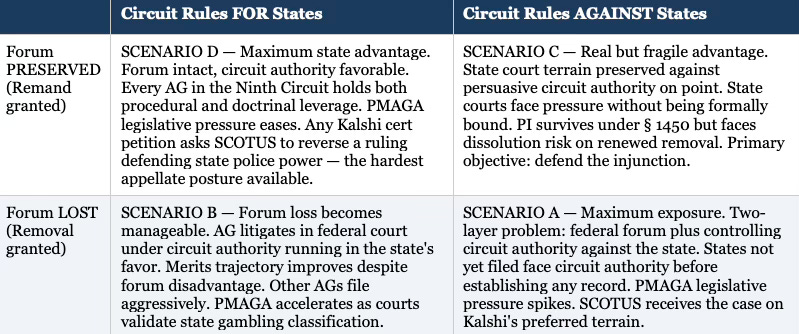
A Kalshi removal loss produces real but structurally different consequences. A remand order sends the case back to King County and restores the AG’s forum advantage. Critically, remand orders under 28 U.S.C. § 1447(d) are generally unreviewable on appeal — Kalshi cannot immediately escalate a remand loss to the Ninth Circuit. But the remand win is not a clean state victory. Kalshi retains the preemption defense on the merits in state court. Washington state courts are not bound by a Ninth Circuit ruling favorable to Kalshi but will face substantial pressure to reach the same conclusion. The AG wins forum without winning law. The domino effect from a remand win is time-limited and forum-dependent rather than self-reinforcing.
The Sequential Game Structure
Modeling removal as a sequential game with incomplete information and a fixed exogenous move — the Ninth Circuit oral arguments on April 16, 2026 — reveals why individual AG resistance is insufficient and why coordination is the only counter-strategy that matches Kalshi’s structural position.
Kalshi files removal attempts at low cost relative to expected value, accepting that some will fail. Each removal attempt is a forcing move: it compels the AG to litigate forum before litigating merits, consuming time and resources on procedural ground while the April 16 calendar runs. The critical vulnerability for states is time dependency. An AG who defeats removal in the week after April 16 oral arguments, after the Ninth Circuit has ruled for Kalshi on preemption, holds a state court forum advantage that sits directly beneath controlling circuit authority pointing against the state’s substantive position. Forum win, law loss — and the law loss compounds every subsequent proceeding in nine states simultaneously. Amending the complaint to plead exclusively under state law before removal is filed eliminates the federal question foothold Kalshi needs — it is the only move that closes the time dependency vulnerability before the clock runs.
The Four Outcome Scenarios and What Each Means for State Enforcement
Forum outcome and circuit ruling interact to determine the state’s strategic position. Each combination produces a distinct cascade effect.
The Coordination Imperative
The optimal counter-strategy for state AGs is not a bilateral contest against Kalshi in individual jurisdictions — it is a coordination game among state AG offices with a fixed deadline. Simultaneous state court filings across multiple jurisdictions, each supported by an immediate preliminary injunction motion pleaded exclusively under state law, saturates the removal and dissolution docket in a way that no single AG filing can accomplish alone. Kalshi’s litigation resources are finite. Coordination forces simultaneous litigation across multiple federal district courts while the Ninth Circuit argument proceeds on the same calendar. The AG offices with the most active litigation postures — Massachusetts, Maryland, Ohio, and Arizona — are the natural coordination anchors. Each state court preliminary injunction that survives into a federal proceeding under 28 U.S.C. § 1450 is an independent operational constraint that requires affirmative federal dissolution — a higher procedural threshold than simply opposing a motion never filed.
The payoff asymmetry documented above means states cannot afford to treat each removal attempt as an isolated bilateral contest. A forum loss in Washington that cascades forward through the April 16 circuit ruling is not recoverable through individual state-by-state resistance. Coordinated preliminary injunction records across multiple jurisdictions before April 16 is the only strategy that matches the structural compounding advantage Kalshi holds through the cascade mechanics of removal wins.
Understanding why that coordination has not yet materialized — despite being the obviously superior strategy — requires identifying the credible commitment problem embedded in the AG coalition structure. Simultaneous filing is optimal for the coalition as a whole but individually irrational for each member. Each AG benefits from other states filing first: the first filer absorbs Kalshi’s full removal and litigation bandwidth, creates the precedent record at its own expense, and takes the political risk of an early loss that subsequent filers avoid. Each AG individually benefits from waiting, observing, and filing after seeing how the first mover fares. The equilibrium of that incentive structure is sequential filing — exactly the pattern observable in the actual litigation record. Arizona filed. Nevada filed. Massachusetts filed. Washington filed. Each state waited, observed, and filed individually rather than coordinating a simultaneous action. Telling AG offices to coordinate is insufficient. Coordination requires a binding commitment mechanism — a designated lead-plaintiff AG office willing to absorb first-mover costs, or a NAAG coordinating function with operational authority to commit multiple offices simultaneously. Without that mechanism, the coordination imperative remains theoretically correct and practically unachievable.
VIII. The Strategic Amicus Gap: What the Existing Record Is Missing
The current amicus record assumes that exclusive federal jurisdiction corresponds to effective federal control. That assumption is not tested in the briefing — and it is the most consequential untested premise in the Ninth Circuit proceeding.
Any party seeking to challenge the CFTC’s preemption claim faces the same structural gap in the existing opposition briefs. Challengers dispute whether event contracts qualify as swaps, whether the savings clause preserves state authority, and whether Congress intended field preemption to extend this far. Those are the right legal arguments. All of them accept, without examination, the CFTC’s implicit premise that asserting exclusive jurisdiction and exercising effective regulatory oversight are equivalent conditions. Four arguments available to institutional challengers remain entirely unoccupied in the current record.
Ground One: Regulatory Capacity and the Enforcement Gap
The CFTC entered the Ninth Circuit proceeding as if its supervisory posture reflects active governance. The operational record tells a different story. A single-commissioner agency — all four remaining commissioner seats currently vacant — operating with approximately 540 staff oversees a market that processed $22.88 billion in annual volume at a 1,108% year-over-year growth rate, across fifty states simultaneously. KalshiEX self-certified its sports contracts in January 2025. The CFTC took no action. Federal courts have recycled that inaction as evidence of implicit federal approval. States should place that enforcement gap squarely before the court: agency inaction under resource constraint is not regulatory endorsement, and a preemption ruling that displaces state enforcement authority does not automatically activate substitute federal oversight.
Affirming exclusive federal jurisdiction without examining whether the claiming agency has the operational capacity to exercise it meaningfully produces a different institutional outcome than affirming jurisdiction backed by active supervision. No existing amicus has drawn that distinction for the Ninth Circuit. Critically, the brief does not establish any mechanism by which CFTC jurisdiction actually produces the stability it invokes — no enforcement examples, no rule application record, no supervision mechanism described. Federal exclusivity that rests on assertion rather than demonstrated governance capacity is a jurisdictional claim, not a market stability guarantee. The Dual Nash-Stigler Equilibrium Architecture identifies the structural mechanism producing this outcome: when a small agency with concentrated industry relationships faces high accommodation costs and low correction benefits, accommodation becomes the dominant institutional strategy. The CFTC’s enforcement inaction is not an anomaly — it is the predictable equilibrium output of an agency operating far below the capacity threshold required to govern a market of this scale.
Ground Two: The Strategically Sequenced Circuit Conflict
The inter-circuit conflict the court faces did not arise organically from independent legal development in different jurisdictions. A deliberate litigation sequencing strategy accelerated it: preemptive federal filings timed to precede state enforcement crystallization, supplemental authority transmissions converting each favorable district ruling into ammunition for the next proceeding, and a coordinated lobbying and litigation infrastructure — the Coalition for Prediction Markets, Miller Strategies LLC, Lincoln Policy Group — operating in parallel with the appellate proceedings. Courts carry institutional interests in understanding the litigation-driven character of a conflict before issuing broad structural rulings on preemption. No existing amicus has placed that sequencing record before the court.
Ground Three: Federal Vacancy vs. Federal Uniformity
The CFTC frames the preemption question as a binary: fifty-state fragmentation on one side, federal uniformity on the other. Challengers should contest that framing directly. Federal vacancy and federal uniformity are not the same condition, and a court accepting the binary without examination issues a ruling premised on an outcome the agency cannot deliver.
States enforcing gambling statutes against Kalshi provide active consumer protection, revenue oversight, and problem-gambling safeguards to their residents. A preemption ruling stripping state authority does not transfer those functions to the CFTC — it eliminates them. A preemption ruling that removes state enforcement without replacing it with active federal supervision does not produce uniformity — it produces unregulated national scale.
Challengers should ask the court to examine whether displacing operational state oversight in favor of an agency with a documented enforcement gap and severe resource constraints actually serves the congressional purposes the CFTC invokes. An administration that champions states’ rights in environmental regulation, immigration enforcement, and social policy cannot coherently deploy a federal agency to preempt state police power gambling laws — the traditional core of state sovereignty — without triggering the presumption against preemption that requires clear and manifest congressional intent before federal law displaces state authority. Rice v. Santa Fe Elevator Corp., 331 U.S. 218 (1947). Framing the argument that way presents the court with a framework for ruling narrowly — acknowledging the statutory case for preemption while conditioning any reversal on the recognition that exclusive jurisdiction carries the institutional obligation to govern, not merely to assert.
The economic non-equivalence argument reinforces Ground Three from a different angle. CEA § 3 identifies the statute’s core purposes as protecting price discovery, enabling hedging against commodity price risk, and promoting transparency for producers and merchants managing legitimate commercial exposure. Binary sports event contracts perform none of those functions. Preempting state gambling enforcement to protect instruments that serve no hedging or price-discovery purpose does not serve the congressional objectives the CFTC invokes as justification. Challengers should argue that the statutory purposes test — not just the textual swap definition — governs whether the preemption claim serves the Act’s congressional design.
Ground Four: The APA Arbitrary and Capricious Challenge — Policy Reversal Without Reasoned Basis
The CFTC amicus brief represents a stark and unexplained departure from decades of prior agency policy. Historically, the CFTC barred sports and political event contracts — the agency’s own proposed rule, withdrawn by Chair Michael Selig in January 2026, would have prohibited precisely the contracts the brief now defends as core swap instruments within exclusive federal jurisdiction. Under Motor Vehicle Manufacturers Association v. State Farm, 463 U.S. 29 (1983), an agency must provide a reasoned explanation when departing from prior policy. No such explanation accompanies the brief’s reversal. The capture pattern documented in The Dual Nash-Stigler Equilibrium Architecture explains the reversal without requiring individual bad faith: when regulatory posture shifts to align with the regulated industry’s interests, the observable signature is intent-outcome decoupling — stated institutional goals diverge from observable enforcement outputs in a pattern structural incentive geometry produces automatically. Challengers should argue that an amicus brief advocating for the industry whose prohibition the agency just withdrew — without accounting for the prior position or explaining why the statutory analysis has changed — fails the reasoned basis requirement independent of any deference doctrine.
The media campaign accompanying the brief provides independent evidence of institutional coalition-building rather than neutral statutory interpretation. On February 17, 2026 — the same day the amicus brief was filed — the CFTC issued CFTC Press Release No. 9183-26, titled ‘CFTC Reaffirms Exclusive Jurisdiction over Prediction Markets in U.S. Circuit Court Filing.’ The release quotes Chair Selig directly: ‘CFTC-registered exchanges have faced an onslaught of lawsuits seeking to limit Americans’ access to event contracts and undermine the CFTC’s sole regulatory jurisdiction.’ Characterizing state enforcement actions — the exercise of sovereign police power by sixteen state attorneys general — as an ‘onslaught’ is not statutory analysis. It is advocacy framing. An agency performing neutral statutory interpretation does not describe its counterparties in adversarial language in a simultaneous press release. The coordinated press-release-plus-brief publication strategy is itself evidence that the agency is conducting institutional coalition-building, not discharging the statutory interpretation obligation the APA requires. Challengers should cite Release No. 9183-26 alongside the brief to demonstrate that the two documents together reveal an agency posture indistinguishable from advocacy for the regulated industry.
The conflict of interest record compounds the arbitrary and capricious argument. Donald Trump Jr. serves as a paid strategic adviser to both Kalshi and Polymarket simultaneously, as confirmed by NPR, CNN, and the Washington Times. Truth Social — the president’s own media platform — launched Truth Predict, a cryptocurrency-based prediction market, as the CFTC’s enforcement posture shifted in the industry’s favor. CFTC Chair Selig, in a Wall Street Journal op-ed, described state enforcement actions as an ‘onslaught’ and committed the agency to active defense of Kalshi’s federal designation. Under the APA, agency action motivated by political relationships rather than statutory analysis is arbitrary and capricious regardless of whether the action otherwise falls within the agency’s jurisdiction. Challengers filing in the Ninth Circuit should present the reversal record, the conflict of interest record, the press release record, and the absence of reasoned explanation as a unified ground for discounting the brief’s institutional weight — not as a political argument, but as an administrative law argument about what the APA requires of agency action that claims to speak for the public interest.
IX. The AG-CFTC Conflict Map: Where to Focus Fire
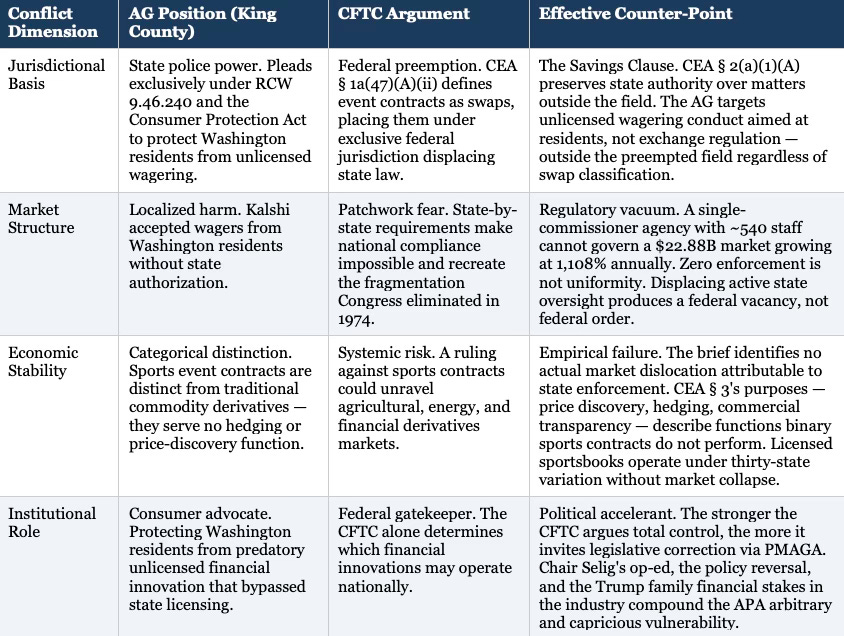
The CFTC brief is legally strong and empirically thin — and that gap is where state enforcement authority survives. Four dimensions of conflict run between the King County complaint and the February 17 brief. On each dimension, the CFTC’s argument is well-constructed on statutory text and preemption doctrine but underdeveloped on evidentiary support, operational capacity, and economic equivalence. The table below maps each dimension, the competing positions, and the effective counter-point for litigation counsel.
Tactical Priority Order for Litigation Counsel
Across all four dimensions, the correct appellate posture is concession-first, scope-limiting: the Commission’s economic concerns do not require the displacement of state authority in this context. The Court need not reject the CFTC’s jurisdictional claim to preserve state authority here; it need only recognize that the Act does not require displacement of state enforcement where the instruments at issue fall outside the statute’s core economic functions. The Posner efficient liability allocation framework in Chicago School Accelerated explains why this posture is structurally optimal: legal frameworks evolve toward efficient classification with a lag that is itself a strategic resource. A narrow ruling that preserves state authority over instruments outside the CEA’s core purposes is more durable than a broad ruling either way — it allocates regulatory liability to the institution with demonstrated capacity to exercise it, which in this context is the state, not the CFTC. Accepting that framing presents the court with a narrowing exit ramp that preserves state authority without requiring a frontal rejection of federal derivatives law. Three tactical moves carry the highest expected impact per unit of brief space within that posture. First, attack the ‘any’ breadth argument not by contesting the word itself but by deploying the CEA § 3 statutory purposes test — Congress wrote ‘any’ in the context of instruments designed for price discovery and commercial hedging, not binary wagers on sporting event outcomes. Second, place the enforcement gap before the court explicitly: argue that federal exclusivity in this context means zero active oversight, not uniform federal governance, and that the savings clause preserves state authority precisely because the CFTC’s claimed jurisdiction has produced no operational supervision. Third, invoke Loper Bright not as a deference argument but as an independent judgment requirement — force the court to examine whether the agency’s claimed capacity to deliver the stability it promises survives scrutiny of the enforcement record, the vacancy rate, and the policy reversal, and whether the statutory purposes the brief invokes are actually served by preempting the only active oversight that currently exists.
X. Where the Strategy Is Winning and Where It Is Losing
Kalshi is winning arguments about jurisdiction while losing control of category formation.
On jurisdictional arguments: Tennessee supports Kalshi’s preemption theory with a carefully reasoned February 2026 ruling. The CFTC has filed amicus briefs on Kalshi’s behalf and published op-eds warning state regulators the agency will no longer tolerate what it characterized as overreach into federal jurisdiction. New Jersey granted a preliminary injunction that has held through Third Circuit review. The Tennessee court specifically rejected the Maryland court’s conflict preemption analysis.
On category formation: Nevada obtained a state court TRO on March 20, 2026. Arizona moved to criminal charges with a Trump-appointed judge denying Kalshi’s preemptive block on March 17. Massachusetts obtained a state court preliminary injunction that the Appeals Court stayed but the SJC accepted for direct review. The bipartisan Prediction Markets Are Gambling Act — co-sponsored by Senators Schiff and Curtis — would amend the CEA to expressly bar the CFTC from permitting sports event contracts, eliminating the statutory ambiguity every preemption argument depends on.
The asymmetry is structural. Kalshi’s jurisdictional wins are reversible by congressional action — a CEA amendment expressing Congress’s intent forecloses the preemption argument regardless of any appellate ruling. Category formation through legislation is irreversible on the timeline that matters. Once the PMAGA enacts an express prohibition on sports event contracts, the CFTC’s amicus brief becomes legally inoperative — not because the brief was wrong, but because Congress has exercised the authority the brief claims belongs exclusively to the federal government.
The CFTC’s institutional intervention paradoxically accelerates both dynamics simultaneously. The stronger the Commission argues ‘we control sports prediction markets,’ the easier it becomes for states and Congress to argue the agency has overreached and requires direct legislative correction. The amicus is a legal win and a political accelerant simultaneously. The incumbent sportsbook coalition — DraftKings, FanDuel, Fanatics, and Robinhood simultaneously opposing Kalshi through the American Gaming Association while launching their own prediction market products — illustrates the Becker rational incentive analysis developed in Chicago School Accelerated: given the payoff structure incumbents face, opposition to Kalshi maximizes expected returns not because prediction markets are harmful but because Kalshi’s cost structure — bypassing state licensing, tax obligations, and compliance infrastructure the incumbents have already absorbed — converts those sunk costs into a competitive disadvantage unless the regulatory framework is harmonized. The opposition coalition is a barrier-to-entry strategy executing through the legislative process.
Kalshi’s own operational behavior provides the clearest signal of its true probability assessment. Signaling theory holds that voluntary costly constraints reveal private information: a player who imposes real costs on itself signals beliefs about its own position that public filings do not contain. Kalshi has voluntarily blocked politicians from trading on their own election outcomes and barred athletes from betting on their own sports — concessions it had no legal obligation to make and that reduce near-term trading volume. Standard interpretation reads these concessions as evidence of legal vulnerability. The signaling theory reading is the opposite: a platform that believes its preemption argument will fully prevail at the Supreme Court has no incentive to voluntarily constrain its product, because a complete preemption win eliminates the political pressure driving the concession demand. Kalshi’s concessions signal it privately expects a narrower outcome — one requiring a licensed compliance track rather than unlimited preemption. The Dual Nash-Stigler Equilibrium Architecture identifies voluntary behavioral concessions as Learning I outputs — surface behavioral adjustment — deployed against a Learning III structural problem. They signal Kalshi has correctly classified the depth of the political problem and is pre-positioning for statutory survival, not claiming the existing system works. AGs should read Kalshi’s behavioral concessions not as admissions of gambling classification risk but as operational pre-positioning for a regulatory settlement in which Kalshi survives as a licensed platform under a framework it helped negotiate. Legislative action — the PMAGA — is not just the most consequential outcome variable because it forecloses the preemption argument. It forecloses the licensed-platform settlement Kalshi’s signaling behavior suggests it is actively positioning toward.
XI. Forward Predictions and Probability Revisions
Four new falsifiable predictions follow from the analytical frameworks developed in this publication. Each carries an explicit measurement window, a stated probability, and a falsification condition. Updated probabilities for prior Litigation Map predictions follow the new predictions.
A. New Predictions
New Prediction 1 — Kalshi files preemptive federal action in Washington within 30 days of complaint service P50: 72% Kalshi’s established pattern — converting state enforcement actions into federal forum opportunities before state court records establish — predicts a federal filing in response to the Washington AG complaint consistent with the Tennessee and New Jersey sequences. The repeated game architecture makes this move low-cost and high-expected-value regardless of outcome: a successful removal relocates the case to federal terrain; a failed removal produces intelligence about the complaint’s federal law references. Measurement window: through April 27, 2026. Falsification condition: Kalshi takes no federal action in response to the Washington AG complaint within 30 days of service.
New Prediction 2 — No coordinated multi-state simultaneous filing materializes before April 16 oral arguments P50: 81% The credible commitment problem embedded in the AG coalition structure — each AG benefits from other states filing first, producing a sequential rather than simultaneous equilibrium — predicts that coordination will not materialize without a binding commitment mechanism. NAAG does not function as an operational coordination body. Absent a designated lead-AG office willing to absorb first-mover costs, the prisoner’s dilemma incentive structure produces the observable pattern: sequential individual filings. Measurement window: through April 16, 2026. Falsification condition: three or more state AG offices file coordinated simultaneous actions with preliminary injunction motions within the same 72-hour window before April 16.
New Prediction 3 — Kalshi expands voluntary behavioral concessions to additional contract categories before June 1 P50: 63% Signaling theory predicts that a platform privately expecting a narrower outcome than full preemption will expand voluntary constraints as pre-positioning for a licensed-platform regulatory settlement. Kalshi’s existing concessions — blocking politicians and athletes — are Learning I outputs. Expansion to additional categories (college sports, specific contract types) signals continued pre-positioning for a negotiated licensing framework rather than a full preemption win. Measurement window: through June 1, 2026. Falsification condition: Kalshi reverses existing concessions or publicly asserts it expects full preemption with no licensing framework required.
New Prediction 4 — At least one state AG brief deploys the combined APA reversal-plus-press-release argument before June 30 P50: 58% The Motor Vehicle Manufacturers v. State Farm arbitrary and capricious argument — policy reversal without reasoned basis, compounded by the coordinated press release characterizing state enforcement as an ‘onslaught’ — is the strongest unoccupied position in the existing state brief record. As the analytical framework for this argument circulates through AG networks, at least one office filing in an active federal proceeding will deploy the combined reversal-plus-press-release record as a unified APA ground. Measurement window: through June 30, 2026. Falsification condition: no filed brief deploys the combined policy reversal and CFTC Press Release No. 9183-26 record as a unified APA arbitrary and capricious argument.
B. Revised Prior Predictions
The following updates apply to predictions published in the March 27 Litigation Map, incorporating the CFTC amicus filing, the April 16 oral argument calendar, and legislative developments through publication date.
Prediction 4 — Circuit split produces cert petition by Q4 2026 Prior P50: 73% | Updated P50: 79% The CFTC amicus converts the split from a statutory interpretation disagreement into a federal separation of powers question — the most consistently certworthy category in the Supreme Court’s docket. The institutional character of the split, with a federal agency formally intervening on one side, elevates certiorari pressure above any prior prediction baseline. Measurement window: through Q4 2026. Falsification condition: both circuits rule in the same direction.
Prediction 1 — Federal agency posture holds through Fourth Circuit ruling Prior P50: 79% | Unchanged The CFTC amicus filing and coordinated press release campaign are confirmatory evidence. Agency resources flow toward institutional posture — amicus briefs, op-eds, press releases characterizing state enforcement as an ‘onslaught’ — rather than substantive rulemaking with enforceable restrictions. The Nash-Stigler equilibrium holds: accommodation generates positive signals; correction consumes resources and creates enemies. Falsification condition: CFTC issues proposed rule with enforceable sports contract restrictions before the Fourth Circuit rules.
Prediction — Washington maintains state-court forum through preliminary injunction P50: 54% (conditioned on complaint amendment and immediate PI motion) Forum preservation requires the AG to execute all four procedural moves in Section VI before Kalshi files a removal notice. Without complaint amendment and an immediate preliminary injunction motion, the probability of state-forum preservation falls below 35%. The credible commitment problem identified in Section VII means coordination support from other AG offices is unlikely to materialize without a binding mechanism. Measurement window: through June 1, 2026. Falsification condition: King County issues a preliminary injunction on state law grounds before any federal removal order is entered.
Prediction — PMAGA advances to Senate Agriculture Committee floor vote before Ninth Circuit ruling P50: 44% The legislative window narrows with each day that passes before April 16. A Ninth Circuit ruling favoring Kalshi before a floor vote materially reduces the political pressure driving Senate action — and New Prediction 1 suggests Kalshi will move quickly to establish federal forum in Washington, further compressing the legislative urgency signal. A Ninth Circuit ruling for states would materially elevate this probability. Measurement window: through June 30, 2026. Falsification condition: Senate Agriculture Committee schedules a markup before the Ninth Circuit issues its ruling.
XII. Conclusion: Jurisdiction Is Moving Faster Than the Legal Calendar
Exclusive jurisdiction and active governance are not the same condition — and the CFTC brief does not address that gap. An agency operating with a single commissioner, approximately 540 staff, against a $22 billion market growing at over 1,000% annually has formally intervened in a Ninth Circuit appellate proceeding to defend the jurisdiction that prevents anyone else from governing that market. The preemption argument is legally sound. The governance capacity is not.
April 16 oral arguments in the Ninth Circuit function as the inflection point for the inter-circuit conflict that routes to Supreme Court certiorari. Washington AG Nick Brown’s March 27 King County complaint is not a standalone enforcement action — it is the most recent data point in a convergence that will resolve, through appellate ruling, legislative amendment, or market restructuring, no later than Q3 2027.
Kalshi is winning arguments about jurisdiction. Congress is winning the argument about category. The CFTC amicus accelerates both simultaneously. The only question is which track completes first.
MindCast will publish formal probability revisions following the April 16 oral arguments and the Fourth Circuit Maryland ruling. All predictions carry explicit falsification conditions and measurement windows. The arc is documented. The convergence is active.