


Related publications: Kalshi Is Crypto’s Test Case | Kalshi’s Prediction Market Litigation Architecture, the CFTC Amicus, and the Strategic Framework for State Enforcement | The National Kalshi Prediction Market Litigation Map | The Full Arc of Prediction Markets | Prediction Markets and the Regulatory Split | Prediction Markets— Legislative Regime Conversion and the Collapse of Preemption | Kalshi Found the One Gap in American Gaming Law Nobody Closed | The Ninth Circuit on April 16 as System Convergence — The First Measurable Test of Prediction Market Structure | Kalshi, Prediction Markets and the Conflict Architecture of Regulation
Executive Summary
On March 17, 2026, Arizona became the first state in the country to file criminal charges against a prediction market platform. The state’s 20-count misdemeanor complaint against Kalshi, reported by CNBC, accused the company of running an unlicensed gambling operation and accepting illegal bets on Arizona elections. The same week, WIRED reported that prediction markets are finding institutional acceptance on Wall Street, with funds and research desks integrating event contract prices as alternative data signals. Those two developments are not in tension. They are the same conflict viewed from opposite ends of the capital stack: one side sees a new class of financial infrastructure; the other sees an unlicensed betting operation.
Category selection determines survival; product design is irrelevant under enforcement constraint. Arizona’s criminal charges against Kalshi — a platform registered with and regulated by the federal Commodity Futures Trading Commission (CFTC) — convert theoretical ambiguity into enforcement reality. State regulators have concluded that prediction market event contracts are wagers under existing gambling statutes, and they are acting on that conclusion without waiting for federal classification to settle. The CFTC disputes state authority but is operating with a single commissioner and no formal rulemaking proceeding. That vacancy is not a bureaucratic footnote. It is the primary structural condition sustaining the current enforcement conflict.
MindCast AI’s Field-Geometry Reasoning framework identifies the mechanism driving state enforcement as attractor dominance: when constraint density is high and a shorter legal path already exists in statutory form, enforcement agencies map novel instruments onto that path rather than constructing new regulatory categories. The gambling classification does not require a new theory. Arizona Attorney General Kristin Mayes did not invent one. She activated Arizona Revised Statutes section 13-3305, a preexisting wagering statute broad enough to cover any business accepting bets on the result of any unknown or contingent future event. The statute fit. The charges followed.
The resolution will not come through regulatory consensus. It will come through appellate courts, and possibly the Supreme Court, resolving whether federal commodities law preempts state gambling authority over registered prediction market exchanges. Until that resolution arrives, state-by-state enforcement will continue to narrow the contract universe, raise platform operating costs, and test the durability of the institutional capital interest that Wall Street reporting reflects. This publication maps the structural mechanisms driving that conflict and the observable conditions that will determine its outcome.
What Are Prediction Markets
A prediction market is a financial exchange where participants buy and sell contracts whose value is determined by the outcome of a real-world event. The contracts are binary: a position pays out a fixed amount if a specified outcome occurs and nothing if it does not. Platforms like Kalshi and Polymarket currently offer contracts on presidential elections, congressional races, Federal Reserve interest rate decisions, economic data releases, geopolitical events, sports outcomes, and even statements made by public officials. A participant who believes the Federal Reserve will cut rates at its next meeting buys a YES contract at the current market price — say, 60 cents — and collects $1 if the cut happens, losing the 60 cents if it does not. The price itself is the signal: a contract trading at 60 cents implies a market-implied probability of 60 percent that the event occurs.
Proponents argue that prediction markets aggregate dispersed information more accurately than polls, expert panels, or news coverage, because participants put money behind their beliefs rather than simply stating them. Academic research on earlier platforms like Intrade and Iowa Electronic Markets found that prediction market prices outperformed traditional forecasting methods on elections and economic outcomes. Institutional interest has grown on this premise: if a contract price reflects genuine probability, it becomes a real-time signal that trading desks, hedge funds, and research teams can incorporate into decision-making without waiting for official data releases or analyst consensus.
Controversy arrived with scale. When prediction markets were small, obscure, and limited in contract scope, regulators largely ignored them. Growth changed the calculus on three fronts. First, the contract categories expanded to include elections at every level — presidential, gubernatorial, congressional, and local — raising concerns that financial incentives could distort electoral participation or create manipulation vectors. Second, platforms moved beyond niche audiences and began attracting retail participants who behave, by every behavioral measure, like sports bettors: placing small, frequent, emotionally driven positions on high-salience public events. Third, the volume grew large enough to matter financially. Kalshi now processes billions of dollars in weekly contract volume, which is the threshold at which state gambling authorities treat an unregulated market as a revenue and enforcement problem, not an academic curiosity.
The legal dispute centers on a single unresolved question: are these instruments financial derivatives — contracts whose value derives from an underlying variable — or are they wagers — bets on the occurrence of an event? The answer determines which regulatory regime applies. Derivatives fall under federal jurisdiction through the Commodity Futures Trading Commission. Wagers fall under state jurisdiction through gambling statutes. Kalshi argues the former. Arizona argues the latter. Both arguments are legally coherent. The conflict is not about which side is wrong. It is about which classification locks in first.
For Investors
Prediction markets present a binary classification risk that precedes all questions of growth, adoption, or product quality. The same contract that functions as a high-signal forecasting tool under a derivatives framework becomes an illegal wager under state gambling law. That distinction is not semantic—it determines whether the market scales into institutional infrastructure or fragments under enforcement. Current signals indicate that enforcement velocity is outpacing federal rulemaking capacity, shifting the probability-weighted outcome toward constraint rather than expansion. Capital allocation in this sector therefore depends less on demand and more on tracking regulatory classification in real time, with appellate decisions and multi-state enforcement patterns serving as the primary forward indicators.
This publication addresses investors’ prediction market risks by mapping the classification process as it unfolds rather than treating it as a resolved legal question. It identifies the structural mechanism driving enforcement, models the behavior of each institutional actor, and converts those dynamics into observable indicators and probability-weighted outcomes. Investors do not need a static view of prediction markets; they need a framework that shows when regulatory risk is compounding, when it is stabilizing, and when it is reversing. By linking enforcement events, institutional capacity, and appellate pathways into a single causal system, this analysis provides a real-time decision framework for capital allocation under regulatory uncertainty.
I. The Collision Between Capital and Enforcement
Prediction markets now sit at the intersection of two incompatible regulatory systems. Wall Street treats these instruments as information aggregation tools that convert dispersed beliefs into tradable prices. State regulators treat the same instruments as wagers on real-world outcomes, subject to gambling prohibitions and licensing regimes. Arizona’s 20-count criminal complaint against Kalshi — the first criminal charges filed against any prediction market platform in any U.S. court — marks a transition from interpretive debate to active enforcement, demonstrating that states will not wait for federal clarification.
Capital has already moved. Institutional desks and funds explore prediction markets as alternative data sources capable of compressing uncertainty into actionable signals. Enforcement has also moved. States possess clear authority over gambling and can act without waiting for federal coordination. The collision arises because both interpretations remain internally coherent yet mutually exclusive. Financial classification enables scaling. Gambling classification constrains or eliminates the market.
The structural asymmetry favoring states runs deeper than enforcement speed. Arizona AG Mayes’s framing — that Kalshi is running an illegal gambling operation regardless of how it brands its products — is not rhetorical simplification. That framing is the legal mapping behavior that MindCast’s Field-Geometry Reasoning framework identifies as the default regulatory pathway when constraint density is high and shorter legal routes already exist: attractor dominance. The question is not whether the reframing is accurate. The question is whether a federal rulemaking can override it before the gambling classification locks in across enough jurisdictions to foreclose the alternatives.
II. Structural Mechanism: Category Selection Under Constraint
Prediction markets operate under structural conditions that bias classification toward gambling unless regulators intervene decisively. Payoffs depend on binary real-world outcomes, time horizons remain short, and participation incentives resemble wagering behavior.
Consider the contract architecture directly: a binary event contract paying $1 if Candidate X wins an election and $0 otherwise replicates sportsbook payoff structure with no hedging function. The participant does not hold an underlying exposure the contract offsets. The contract exists solely as a position on an outcome — which is the structural definition of a wager, not a hedge. That single contract design choice provides Arizona AG Mayes with all the statutory predicate she needs under A.R.S. § 13-3305, which governs any business accepting bets on the result of any race, sporting event, contest, or other unknown or contingent future event. No new legal theory required.
Field-Geometry Reasoning formalizes why this outcome was predictable. Constraint density is high: overlapping state gambling laws and federal derivatives oversight saturate the decision space. The shortest regulatory path classifies these instruments as wagering because existing statutes already govern that category — attractor dominance pulls classification toward gambling before any enforcement agency exercises discretion. MindCast’s Constraint Geometry and Institutional Field Dynamics framework operationalizes this through the Escape Velocity Threshold (EVT): the counter-mass required to flatten existing curvature. A federal derivatives rulemaking capable of overriding state gambling statutes across fifty jurisdictions would need to exceed EVT — a threshold the current single-commissioner CFTC, with no formal rulemaking proceeding active, does not approach. The same classification compression dynamic documented in MindCast’s analysis of Zillow vs. Redfin-Compass — where a dominant regulatory rule collapsed alternative market structures — is now operating against prediction market platforms.
Contact mcai@mindcast-ai.com to partner with us on Predictive AI in Law and Behavioral Economics. A full foresight simulation output report is available upon request.
To deep dive on MindCast work in Cybernetic Foresight Simulations upload the URL of this publication into any LLM and prompt ‘reconstruct MindCast framework with three degrees of cited sub links.’ See Live-Fire Game Theory Simulators, Runtime Predictive Infrastructure.
Recent projects: Chicago School Accelerated — AI Infrastructure Patent Coordination, MindCast Predictive Cybernetics Suite, The AI Infrastructure Energy Antitrust Landscape, Super Bowl LX — AI Simulation vs. Reality, Foresight on Trial, The Diageo Litigation Validation.
III. The Chicago Lens: Coase, Becker, and Posner on Why This Conflict Was Inevitable
The Chicago School Accelerated framework does not merely describe how prediction markets function. It explains why the regulatory conflict was structurally inevitable from the moment prediction market contracts crossed into public event domains. Three stages drive the loop, and each stage follows directly from the prior one.
Stage 1 — Coase: Prediction Markets Solve a Coordination Problem
Ronald Coase’s foundational insight in “The Problem of Social Cost” (1960) is that markets emerge to reduce transaction costs and aggregate dispersed information. Prediction markets extend that logic by converting privately held probability assessments into a real-time, incentive-compatible price — the market does aggregation work that no central planner or polling apparatus can replicate at low cost.
The Coase vulnerability is structural: the same contract domains that maximize information aggregation value — elections, sporting contests, macroeconomic outcomes — are precisely the categories that existing legal regimes most stringently govern against wagering. Platforms maximized their contract libraries in exactly the high-information-dispersion domains that also carry the highest regulatory exposure. Coasian logic drove them there. Enforcement logic followed.
▼ Coordination breaks when contracts cross into regulated public-event domains
Stage 2 — Becker: Participant Incentives Sort Toward Speculation
Gary Becker’s framework establishes that participants respond to the actual incentive structure they face, not to the label attached to the instrument. Platform framing does not determine participant behavior — the payoff architecture does. Three structural features of prediction market contracts produce behavior Becker’s framework classifies as speculative rather than information-revealing.
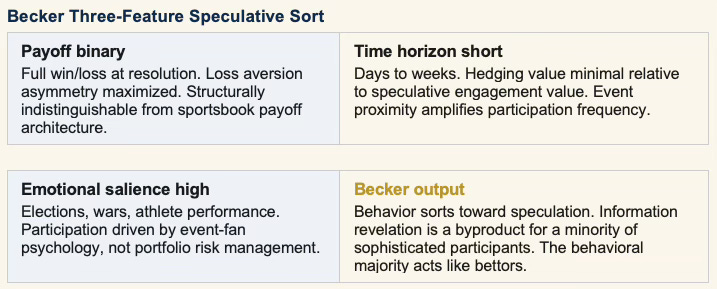
The implication for the regulatory dispute is direct: the behavioral profile of prediction market participants gives state regulators empirically defensible grounds for gambling classification, independent of platform framing. Arizona AG Mayes does not need to prove Kalshi intends to operate a gambling business. She needs only to demonstrate that participants behave like bettors — which the binary payoff architecture, short time horizons, and emotional salience of elections and sports contracts structurally guarantee.
▼ Legal systems must now determine whether this behavioral profile constitutes wagering — and they face the Posner correction problem
Stage 3 — Posner: Legal Correction Is Slow but Enforcement Is Fast
Richard Posner’s theory of law as an efficiency-seeking system establishes that legal rules behave like prices: they direct behavior by adjusting expected costs. Courts and regulators must determine whether prediction market instruments constitute hedging mechanisms or wagers — and that determination carries enormous economic consequences.
The Posner correction problem has a specific structure here. Legal systems correct slowly because classification disputes require litigation, administrative rulemaking, or legislative action — processes measured in years. Enforcement acts immediately because existing statutes already govern gambling behavior. States invoking gambling prohibitions do not need new authority. They activate existing authority against novel instruments.
Posner Asymmetry
Legal correction timeline: 2 to 7 years — rulemaking, litigation, appellate review, possible Supreme Court resolution.
Enforcement action timeline: Days to weeks — state AG invokes existing gambling statute, files complaint, generates immediate operational constraint.
Result: Enforcement moves faster than correction. States impose costs before federal classification resolves. The gap between enforcement speed and rulemaking speed currently favors state regulators decisively.
Posner’s efficiency framework also explains why the current CFTC posture is itself rational under constraint. A single-commissioner agency asserting exclusive jurisdiction without activating a formal rulemaking proceeding is maximizing institutional efficiency: the rulemaking process is costly, slow, and politically exposed, while a jurisdictional assertion costs nothing and postpones the classification work indefinitely. Rational under Posner’s framework — but it creates the regulatory vacuum that state enforcement fills.
The Loop Closes
Coase: Prediction markets emerged to solve a high-value information aggregation problem — and the highest-value contract domains are public events with the broadest information dispersion.
Becker: The same public events that maximize Coasian value produce participant behavior — binary payoffs, short time horizons, high emotional salience — that is structurally indistinguishable from wagering.
Posner:Legal systems move too slowly to resolve the classification dispute before enforcement catches up. States fill the gap using existing statutes. The market faces the Posner asymmetry at exactly the moment of its highest growth trajectory.
The loop does not imply that prediction markets cannot survive. It implies that survival requires disrupting the loop — either by narrowing the contract universe that activates Becker’s speculative sort, or by closing the Posner asymmetry through a federal rulemaking that moves faster than state enforcement accumulates. Neither disruption is currently underway. The contract universe has expanded. The CFTC rulemaking vacancy has grown. The loop is accelerating. The integrated analytical architecture underlying this section is developed in MindCast’s Chicago School Acceleratedframework.
IV. Strategic Game: Fragmentation, Delay, and the Chicago Strategic Game Theory Vision
The Chicago Law and Behavioral Economics Loop explains why the conflict was structurally inevitable. The Chicago Strategic Game Theory Vision (CSGT) explains why it has not yet resolved. The prediction markets enforcement landscape is a four-player strategic game with distinct incentive structures and a jurisdictional architecture that rewards delay for every actor simultaneously.
The Players
Platforms: Maximize contract volume before classification locks in. Strategy: preemptive federal court filings, CFTC jurisdiction assertion, expansion into new contract categories. Payoff under delay: positive. Payoff under gambling classification: severely negative.
State Regulators: Enforce existing gambling prohibitions and capture licensing revenue. Strategy: cease-and-desist letters, civil enforcement, now criminal prosecution. Payoff under delay: positive — each action narrows platform operating space and builds precedent.
CFTC: Assert exclusive jurisdiction without committing to formal rulemaking. Strategy: jurisdictional assertion, Nevada amicus brief, public statements. Payoff under delay: positive — avoids politically exposed rulemaking. Payoff under adverse appellate ruling: severely negative.
Institutional Capital:Access prediction market price signals without regulatory exposure. Strategy: exploratory engagement, cautious allocation, monitoring enforcement trajectory. Payoff under derivatives classification: strongly positive. Payoff under gambling classification: negative.
Three Structural Dynamics
Dynamic 1 — Rule Mutability
The prediction markets strategic game exhibits rule mutability: both platforms and state regulators actively contest the applicable legal framework rather than accepting it as fixed. Multi-Forum Stackelberg Sequencing (MFSS) maps the resulting architecture. Kalshi has simultaneously argued federal derivatives jurisdiction in CFTC proceedings, asserted preemption in federal court actions against multiple states, and framed its products as financial infrastructure in public communications — while Arizona applied a directly contradictory framing to the same contract categories using existing statutory language.
Institutional Signaling Corruption Theory (ISCT) identifies the specific vulnerability this creates. Form-content decoupling — the gap between how instruments are labeled and how they function — is sustainable until a forum with superior investigative authority forces reconciliation under oath. Arizona’s criminal prosecution is precisely that forum. It generates subpoena power, compels document production, and creates an evidentiary record available to parallel proceedings. The strategic value of form-content decoupling collapses under criminal discovery pressure.
Dynamic 2 — Delay Dominance
The equilibrium persists because delay produces positive payoffs for each actor independently. The Dual Nash-Stigler Architecture explains the stability. Nash settlement — no actor can improve by deviating unilaterally — combines with Stigler sufficiency — each actor has already found a workable strategy that satisfies its minimum threshold. The CFTC’s jurisdictional assertion is a Stigler satisficing move: it requires no rulemaking, costs little, and allows continued operation. Arizona’s criminal charges are a Stigler satisficing move: they activate existing authority, generate precedent, and impose costs without requiring new legal theory.
The structural condition that most directly determines whether this equilibrium breaks is the CFTC vacancy. Selig is currently the only commissioner on the five-seat CFTC, with other seats unfilled more than a year into the second Trump administration. A single-commissioner agency cannot issue binding rules, cannot file preemption lawsuits across multiple states simultaneously, and cannot credibly threaten adverse consequences for state enforcement. Equilibrium-breaking capacity has shifted to the appellate courts.
Dynamic 3 — Equilibrium Persistence Under Loss
Despite mounting legal costs — twenty-plus civil cases, cease-and-desist letters across more than a dozen states, criminal charges in Arizona, and a denied preliminary injunction in Ohio — platforms have maintained their expansion strategy. The Prospective Repeated Game Architecture (PRGA) explains why. Surrendering in any single state creates precedent that weakens the federal preemption argument and triggers parallel demands from every other state simultaneously. Maintaining the expansion strategy under loss preserves the preemption argument as a commitment device, forcing the classification dispute toward an appellate court that can resolve it with binding effect across all jurisdictions at once.
Criminal prosecution disrupts this calculus. Unlike civil enforcement, criminal prosecution generates discovery obligations, potential personal liability exposure for officers, and reputational damage that capital allocators cannot discount. Arizona’s criminal escalation is not a higher-magnitude version of prior civil enforcement. It is a structurally different enforcement tool that disrupts the commitment device logic the platform strategy depends on.
Equilibrium Stability Conditions
Equilibrium Type: Delay-Dominant, Jurisdictionally Fragmented
Condition 1 — Federal Vacancy Persists: Holds as long as the CFTC cannot issue binding rules. Single-commissioner constraint is the primary structural support for delay dominance.
Condition 2 — No Binding Appellate Precedent: Holds as long as no appellate court has ruled definitively on CFTC preemption of state gambling statutes. The Nevada case is the near-term observable most likely to disrupt this condition.
Condition 3 — Criminal Prosecution Remains Isolated: Holds as long as Arizona’s criminal charges are structurally novel. Additional states adopting the criminal model breaks the platform commitment device.
Disruption Threshold:The delay-dominant equilibrium breaks when two of the three conditions fail simultaneously. Single-condition failure produces adjustment. Dual-condition failure triggers a decisive move — most likely a Supreme Court certiorari grant, or a platform exit from the most contested contract categories to preserve the federal jurisdiction argument on the remaining product base.
The dual-termination architecture governing this equilibrium — Nash settlement determining where the system rests, Stigler sufficiency determining when search stops — is formalized in MindCast’s Dual Nash-Stigler Equilibrium Architecture. The MFSS, ISCT, and PRGA frameworks deployed in the dynamics analysis above are developed in MindCast’s Emergent Game Theory Frameworks. The structural parallel — local enforcement authority overriding platform-level strategy regardless of platform design — is documented in the Team Foster Luxury Double Commission Capture Scenario.
V. Competitive Federalism as the Active Mechanism
The prediction markets enforcement pattern does not reflect fragmented policy failure. It reflects competitive federalism operating as designed. When federal capacity collapses or is captured, state enforcement activates as a structural substitute — not a secondary corrective. Three modalities are now simultaneously active: executive enforcement action (Arizona’s criminal prosecution), legislative substitution (the bipartisan House bill targeting election and sports event contracts), and regulatory convergence (the Nevada case with CFTC amicus brief filed).
The Stigler Equilibrium framework’s core prescription governs this dynamic: when enforcement is concentrated through a single venue, capturing that venue no longer neutralizes the others. Fifty state AGs hold parallel authority. Arizona’s criminal escalation is a Topology Redistribution Delta event — the enforcement topology has shifted, state authority has expanded into criminal jurisdiction, and Kalshi’s available regulatory paths have narrowed nonlinearly. Each additional state that follows Arizona’s model compounds that narrowing.
The Live Nation validation provides the empirical parallel. Federal enforcement reached behavioral settlement under access-channel pressure; twenty-six state AGs immediately activated independent continuation — a distributed enforcement architecture documented in MindCast’s analysis of the DOJ-Live Nation settlement. The prediction markets enforcement cycle follows the same pattern: federal assertion generates a jurisdictional claim; state litigation generates structural costs; appellate courts define the preemption boundary. The federal settlement did not close the Live Nation enforcement cycle — it changed who holds enforcement authority. The same transfer is now underway in prediction markets. The Stigler Equilibrium prescription governing this dynamic — that capturing a single enforcement venue no longer neutralizes parallel state authority — is formalized in MindCast’s Stigler Equilibrium: Regulatory Capture and the Structure of Free Markets. The state-as-competitive-substitute principle underlying the Topology Redistribution Delta analysis is developed in MindCast’s Runtime Geometry framework.
VI. Cognitive Digital Twin Foresight Simulation: Category Outcomes and Capital Flow
Probability assignments reflect structural conditions active as of March 2026: first criminal charges filed against Kalshi in Arizona; bipartisan House legislation targeting election and sports event contracts; CFTC operating with a single commissioner; Ohio federal court denying Kalshi’s preliminary injunction; Nevada case pending.
Base Case (P45): State-level enforcement expands to several additional jurisdictions within twelve months. Platforms restrict high-risk contract categories under legal pressure. Institutional adoption slows but remains exploratory. The fragmentation equilibrium persists without a decisive resolution from courts or Congress.
Downside Case (P35): Coordinated enforcement across multiple states, amplified by criminal conviction risk in Arizona and the bipartisan House bill, classifies prediction markets broadly as illegal wagering. The CFTC’s exclusive jurisdiction assertion fails in appellate review. Institutional capital exits the sector pending Supreme Court resolution. The gambling classification locks in as the attractor-dominant outcome the Field-Geometry framework predicts under high constraint density with no countervailing federal rulemaking.
Upside Case (P20): Federal regulators establish a formal derivatives category through emergency rulemaking or a favorable Supreme Court ruling preempting state gambling statutes. Institutional capital accelerates. Probability reduced from P25 to reflect the bipartisan House bill, the Ohio injunction denial, and the CFTC vacancy constraint as of March 2026.
The downside case has strengthened materially over the past thirty days. The bipartisan House bill, the criminal charges, and the Ohio injunction denial each reduce the probability that the upside pathway opens without Supreme Court intervention.
VII. Forward Lock and Falsification
Prediction markets will either consolidate under a derivatives framework or fragment under gambling enforcement within the next twelve to twenty-four months. Observable enforcement patterns will resolve the category question. Capital will follow that resolution.
Derivatives pathway validation: Sustained decline in state criminal or civil enforcement actions; formal federal rulemaking establishing a prediction market derivatives category; appellate court rulings affirming CFTC preemption across at least three circuits.
Gambling classification confirmation: Rapid expansion of state criminal or civil actions to five or more additional jurisdictions following the Arizona model; passage of the bipartisan House bill; federal appellate court rulings affirming state authority over CFTC-registered platforms.
Near-term observable: The Nevada case is the single most important near-term data point for updating probability assignments. A ruling affirming state authority in Nevada shifts the downside case to P50 or higher. A ruling affirming CFTC preemption shifts the upside case to P35 or higher.
The Prospective Repeated Game Architecture predicts the platform behavioral trajectory under each scenario. The expansion strategy under loss is rational only as long as the commitment device holds — preserving the preemption argument by refusing state jurisdiction through compliance. Criminal prosecution erodes that device directly. Each additional criminal case weakens the repeated-game equilibrium the platforms are staking their survival on.
VIII. Vision Function Cognitive Digital Twin Simulations
Simulation Executive Summary
MindCast AI’s Cognitive Digital Twin (CDT) simulations identify a single governing result: prediction markets have entered a category-lock fight in which state gambling enforcement currently holds the structural advantage over federal derivatives classification. Field-Geometry Reasoning finds high constraint density, high attractor dominance, and low geodesic availability for a stable derivatives pathway under current institutional conditions. The Chicago Law and Behavioral Economics simulation confirms why the conflict was inevitable — Coasian information value pulled platforms into the very event domains that Becker sorting converts into bettor behavior and that Posner correction cannot regularize quickly enough. The Chicago Strategic Game Theory Vision simulation shows why the conflict persists despite mounting losses: every actor still benefits from delay, but Arizona’s criminal move raises the cost of that equilibrium materially.
The simulations also identify the primary break condition. A federal rulemaking or appellate preemption victory could still disrupt the gambling attractor, but current institutional capacity at the Commodity Futures Trading Commission remains below the estimated threshold required to flatten the state-enforcement curve. Unless that changes, state-by-state actions will continue to narrow the contract universe, reduce institutional comfort, and move the market toward a regulated-wagering equilibrium.
1. Field-Geometry Reasoning Simulation
Target: Prediction market event contracts under overlapping state gambling law and federal derivatives oversight.
Simulation Output
Constraint Density (CD): 0.86 / High — Overlapping state criminal statutes, gaming authority, election sensitivity, and federal uncertainty create a dense regulatory field.
Attractor Dominance Score (ADS): 0.81 / Gambling attractor dominant — States can classify contracts under existing wagering statutes without creating new legal categories.
Geodesic Availability Ratio (GAR): 0.29 / Low — The shortest legal route favors state gambling enforcement. The derivatives path requires more institutional energy, more coordination, and more time.
Structural Persistence Threshold (SPT): 0.78 / High — Once several states adopt the Arizona frame, reversal becomes materially harder because precedent, compliance costs, and discovery risk compound.
Escape Velocity Threshold (EVT):0.83 / Federal override threshold—A durable federal rulemaking or strong appellate preemption sequence would be required to overcome the current geometry. Present CFTC capacity does not meet that threshold.
Interpretation: Field geometry dominates intent. Prediction markets can describe themselves as forecasting tools, but the legal topology still routes them toward gambling classification because that path already exists in statutory form. Arizona did not invent a theory. Arizona activated a preexisting path of lower resistance.
2. Chicago Law and Behavioral Economics Simulation
Targets: Prediction market platforms, participants, state regulators, and the CFTC.
Simulation Output
Coase Coordination Capacity Index: 0.74 / Strong but conditional — Prediction markets do aggregate dispersed information efficiently, especially in election, macro, and policy domains.
Becker Behavioral Drift Factor: 0.79 / Speculative sorting dominant — Binary payoffs, short horizons, and high emotional salience push participation toward bettor behavior rather than true hedging.
Posner Correction Feasibility Score: 0.34 / Weak near term — Legal regularization through rulemaking or appellate doctrine is too slow relative to state enforcement speed.
System Coordination Integrity: 0.41 / Fragile — The informational value of the market exists, but its legal support structure is weak and fragmented.
Interpretation: The market’s strength creates its legal exposure. Coase pulls platforms toward high-information event categories. Becker converts those categories into bettor-like participation. Posner arrives too late to stabilize classification before states impose costs. The conflict was built into the market’s highest-value product set from the start.
3. Chicago Strategic Game Theory Vision Simulation
Players: Platforms, state regulators, the Commodity Futures Trading Commission, and institutional capital.
Simulation Output
Strategic Delay Preference Index (SDPI): 0.84 / Delay dominant — Every major actor still benefits from postponing definitive resolution.
Rule-Mutability Score (RMS): 0.88 / Very high — The core contest centers on who controls classification: derivative, wager, or hybrid.
Inquiry Suppression Ratio (ISR): 0.63 / Elevated — Ambiguity benefits multiple actors by preventing forced reconciliation between product form and functional use.
Equilibrium Persistence Under Loss (EPUL): 0.76 / High — Platforms continue expansion despite adverse rulings because retreat in one state weakens the federal position in all states.
Equilibrium Class: Delay-dominant, jurisdictionally fragmented, criminal-risk inflecting.
Interpretation: Arizona did not end the game. Arizona changed the game. Civil friction allowed platforms to preserve a repeated-game strategy. Criminal process introduces subpoena power, reputational spillover, and internal risk that civil actions did not create. The equilibrium still holds, but it now sits closer to break conditions.
4. Regulatory Vision Simulation
Targets: Arizona Attorney General, follow-on state regulators, the Commodity Futures Trading Commission, Congress.
Simulation Output
Enforcement Escalation Rate: 0.72 / High — Arizona increases the probability that additional states move from letters and civil threats toward formal proceedings.
Jurisdiction Expansion Probability: 0.68 / High — The enforcement model is portable because most states already possess broad wagering statutes.
Rulemaking Latency Index: 0.87 / Severe delay — Federal clarification remains institutionally slow and politically exposed.
Cross-State Convergence Index: 0.61 / Rising — States need not coordinate formally to converge on the same enforcement frame.
Interpretation: Competitive federalism is now active. One state can generate evidence, theory, and public legitimacy that other states reuse at lower cost. Federal silence no longer freezes the field. Federal silence redistributes initiative to states.
5. Trigger Train
The simulations identify the following trigger train as the most probable path under current conditions:
1. Arizona criminalizes the conflict. A criminal complaint converts abstract classification ambiguity into operational risk.
2. Additional states borrow the frame. State regulators do not need new theory. They reuse existing gambling statutes and Arizona’s public logic.
3. Platforms narrow the contract universe. Election, sports, and other emotionally salient event contracts become first-line retrenchment candidates.
4. Institutional capital pauses or segments. Funds and data buyers maintain interest in compliant macro or economic contracts while avoiding politically exposed categories.
5. Appellate courts inherit the conflict. State-federal tension moves upward because no administrative actor can impose stable closure fast enough.
6. Either preemption arrives or gambling lock-in compounds. A strong appellate or Supreme Court win could reopen the derivatives path. Absent that, state actions create a ratchet effect.
6. Simulation Output Interpretation
The simulations point to a simple structural reality. Prediction markets create informational value most strongly in the exact event categories that look most like gambling to state regulators. That overlap is not incidental. It is the engine of the conflict. Platforms pursued informationally rich contracts because those contracts maximize liquidity and attention. States moved against the same contracts because those features also maximize the salience of wagering statutes.
MindCast’s architecture does not treat Arizona as an isolated enforcement event. Arizona is a topology shift. Criminal prosecution changes the cost structure, changes the discovery environment, and changes what follow-on states can do with lower effort. The market can still escape the gambling attractor, but escape now requires federal institutional force that does not yet exist in sufficient quantity.
7. Foresight Predictions
Prediction 1 — Contract narrowing (T+6 to T+12 months): Platforms will narrow or geofence the most politically exposed event categories before broad federal clarification arrives.
Prediction 2 — Follow-on state action (T+3 to T+9 months): At least three additional states will escalate beyond informal objections into formal civil or criminal process using existing gambling-law theories.
Prediction 3 — Capital segmentation (T+6 to T+12 months): Institutional users will distinguish between macro-information contracts and high-salience public-event contracts, reducing exposure to the latter first.
Prediction 4 — Appellate centrality (T+9 to T+18 months): A small number of appellate cases will become the real classification battleground because administrative closure remains too slow.
Prediction 5 — Upside path requires a discrete institutional shock: Only two events materially reopen the derivatives pathway — a strong appellate preemption win or a formal federal rulemaking sequence with durable political backing.
8. Simulation Bottom Line
MindCast AI’s CDT simulations currently assign the market to a gambling-leaning, delay-dominant equilibrium rather than a stable derivatives equilibrium. The market remains alive, but its highest-value contracts face tightening legal curvature. Unless federal institutional capacity rises quickly, category lock will continue moving against the platforms.
Conclusion
Prediction markets face a structural test that determines whether they become core financial infrastructure or remain constrained as regulated wagering products. Capital has validated demand for price-based forecasting. Enforcement now determines whether that demand can scale within a legitimate regulatory framework.
The structural geometry favors the gambling classification under current conditions. Constraint density is high. The attractor dominant pathway is defined. The CFTC lacks the institutional capacity to impose a countervailing classification. State attorneys general have demonstrated willingness to use criminal prosecution tools. The bipartisan House bill, if enacted, forecloses the most commercially significant contract categories.
Reversing that geometry requires one of two interventions: a Supreme Court ruling affirming federal preemption, or a CFTC rulemaking that constructs a new derivatives category with sufficient durability to survive political transitions. Neither is imminent. Category selection governs survival. Enforcement momentum suggests the decision arrives through conflict, not consensus — and the conflict is already underway.