


Compass International Holdings · CRMLS · OneKey MLS · ARMLS · BridgeMLS · Canopy MLS · Doorify MLS · Hive MLS · REcolorado · MLSListings · Open Real Estate · Washington · New York · Connecticut · Wisconsin · California
See also
MindCast Compass MLS Value Proposition Q4 2026. The offering for MLS boards, associations, counsel and brokerages, sourced from this paper.
MindCast Compass MLS War Game Q4 2026. Short and long horizon branches, twelve successor states and their probabilities, playable from three seats.
MindCast Compass MLS Interactive War Game. Plays the turn sequence against an adapting Compass Cognitive Digital Twin, with inheritance applied at each successor state.
Companion to Compass's National MLS Campaign and the Economics of Local Resistance — Why Partnerships and Lawsuits Grow Together and The Calculus of Predictive Game Theory Evolution and Mutation
Thesis: Compass has won concessions, not cases. The MLSs it targets now sue it together in New York, and the brokerages it competes with are building their own listing-sharing agreement. Statehouses mostly choose opt-out laws over Washington’s stricter model, so Compass keeps the ability to extract concessions while losing control of where, when and on what evidence its disputes are decided.
Why now: A New York federal court will rule on the motion to dismiss, sever and transfer that Compass told the court on October 30 it plans to file. Open Real Estate launches in the first quarter of 2027, and most state legislatures convene in January. MLS boards and brokerage executives face decisions before those dates, as do state lawmakers, counsel and investors.
I. Executive Summary: Compass Has Won Concessions, Not Cases, and Is Losing Control of the Terms
Compass International Holdings has never won an antitrust case on the merits against a multiple listing service (MLS) or a listing portal. Compass’s litigation has produced procedural rounds, one lost injunction bid and one negotiated agreement that it calls a victory. Compass gains ground by keeping disputes open until a target concedes a status change.
Compass built its campaign against MLS cooperation rules for a game played against one target at a time. The game has changed around it: nine MLSs now sue Compass in its home federal district, and four national brokerage groups have launched a listing consortium whose founding seat Compass did not take.
Every front where Compass’s strategy is contested sits in the short horizon, and the pattern carries a game-theoretic meaning. The working hypothesis holds that Compass’s position rests on options rather than commitments, and options pay only while the governing game stays unresolved. Most resolutions in courts and coalitions would lower the value of that position, as would most in the new consortium and statehouses.
A short horizon game is one whose rules a court, legislature or new entrant can still change, so forecasts reach only to the next ruling. A long horizon game runs on settled rules, so forecasts reach several steps ahead.
State legislatures open their 2027 sessions with Washington’s hearing record in view. The simulation finds that Compass can still extract concessions and procedural rounds while losing control of the forum, the timing and the evidence base that decide its disputes. MLS boards, brokerages and lawmakers each hold a low-regret move now, before the first ruling fixes the next game.
On November 2, MLSListings joined six other MLSs in a federal declaratory action against Compass, as Real Estate News reported. The same report described Compass’s October 30 letter to Judge Mary Kay Vyskocil announcing a planned motion to dismiss the companion case brought by the California Regional Multiple Listing Service (CRMLS) and OneKey MLS, with severance and transfer to California as the fallback.
A week earlier Compass’s counsel had told the court that “Compass has not decided whether to file any other cases,” as RISMedia reported. Compass’s public statements still promise suits against any MLS that keeps fining agents. The two postures now sit in the same filings.
MindCast AI applies Predictive Behavioral Economics + Dynamic Game Theory through MindCast AI Proprietary Cognitive Digital Twin Foresight Simulations (MP CDT FS). Behavioral Economics supplies the decision rules. Game Theory supplies the payoff structure. Predictive simulations emerge from the combination.
Cognitive Digital Twins (CDTs) of the named institutions carry both layers.
MindCast testified at the 2026 Washington Senate and House hearings on Substitute Senate Bill (SSB) 6091. Compass vs. Competition, The Case for SB 6091 / HB 2512 Without an Opt-Out Exception made the case for the no-opt-out design Washington enacted, the design CE-S1 tests in other states. MindCast also filed the Brief of MindCast AI LLC as Amicus Curiae in Support of Defendant NWMLS in Compass’s federal suit against the Northwest Multiple Listing Service (NWMLS).
MindCast’s Predictive Game Theory series supplies the forecast architecture. Compass’s Washington sub-game sits in long horizon shape, with a statute in force and a negotiated agreement in operation. The national contest sits in short horizon shape, because courts, legislatures and the new consortium can still change the rules. Washington therefore serves as the reference equilibrium the national contest is tested against, not as its forecast.
The paper opens the Compass Equilibrium Series, which tracks Compass on a fixed schedule and reports on events as they arrive. Each checkpoint rates seven fronts on two dimensions: Compass’s posture and the state of the institutions around it. An event report follows any development that changes a rating, including a federal antitrust action. The series also runs a continuation scenario that asks what happens if Compass keeps its six documented operators, the recurring moves listed in Section III.G, while its opponents adapt.
The Checkpoint 0 simulation finds Compass’s posture unchanged on six fronts while the environment has moved against it on three. Fragmented accommodation is the most likely outcome at fifteen months, with an interpretive weight of 36%against 27% for Washington-like cooperation.
The opposition now works on two levels. MLSs defend cooperation rules in court, and their coalition grows when Compass threatens them. Brokerages, most of them independents, are writing cooperation into a voluntary agreement whose growth runs on their own economics rather than on Compass’s conduct. Compass can slow the first coalition by easing off in court, while the second keeps growing whatever Compass does there.
Six coming events can create twelve successor states. Each state lists the moves it opens for every institution and the conditional Simulation Predictions that apply once it arrives.
Listing economics matters most. Compass describes private listings as seller choice, while MindCast’s economic analysis infers that the private phases also raise the chance a Compass agent represents the buyer. Checkpoints follow in February, May, August and November 2027 and in February 2028.
MindCast’s earlier Compass Simulation Predictions stand at seven hits, one partial and one miss on the MindCast Prediction Scorecard dated November 1, 2026. The miss: Compass sued CRMLS in California rather than first counterclaiming in New York (Lex S-1, 66–76%). Mandatory submission surviving Compass v. NWMLS and the failure of Compass’s conspiracy theory against Zillow resolved as hits.
The paper issues sixteen MindCast Foresight Simulation Predictions: two primary (P), six secondary (S) and eight conditional on a named event (C). MindCast also carries open entries from earlier papers under their original identifiers, bands and windows. The table shows five headline entries and two carried entries, and Section III.H lists all sixteen.
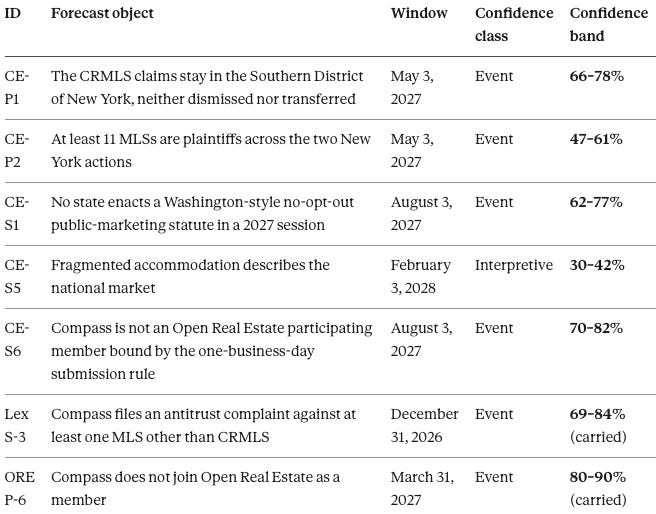
CE-S1 forecasts that Compass avoids Washington’s strictest rule in 2027 and inherits a public default instead. Opt-out laws make MLS or public posting the legal norm, attach a signed disclosure to every private listing and leave MLS cooperation rules in force.
🗂️ MLS Leaders. Exposure: Compass’s demand letters sit with every board that has not yet decided. Linked: CE-P2 and Lex S-3; H-C4 and H-C17. Window: before the first forum ruling. Move: preserve Compass’s statements and document any submission-preserving phased-marketing option.
💼 Brokerage Executives. Exposure: Open Real Estate entry costs nothing while Compass recruits against it. Linked: ORE P-6 and CE-S4; CE-S6 and H-C16. Window: Open Real Estate vendor selection, targeted for the first quarter of 2027. Move: keep reversible commitments such as support letters separate from listing-flow commitments.
🏛 Policymakers. Exposure: simultaneous 2027 hearings make coordinated sign-in campaigns visible across states. Linked: CE-S1; H-C9 as a watch condition. Window: January to June 2027. Move: compare sign-in lists and amendment language across states before weighing testimony volume.
⚖ Counsel. Exposure: Compass’s public threats and its court statements now diverge on the same question. Linked: CE-P1, H-C4. Window: briefing on dismissal, severance and transfer. Move: pair each Compass court position with its matching public statement.
📊 Investors. Exposure: the shareholder suit runs on its own clock and lengthens once lead counsel fixes the theory. Linked: Magloire P-2. Window: after December 8, 2026. Move: treat the MLS litigation and the securities case as separate clocks.
Compass’s opponents now choose the forum, the timing and the evidence, and the first forum ruling sets how far any forecast can reach.
Section II maps how the game moved around Compass. Section III presents the simulation and its Simulation Predictions, and Section IV maps six coming events and twelve successor states. Sections V through VII route consequences and mitigations to each audience.
II. Nine Listing Services, a Brokerage Bloc and Four Statehouses Moved the Game Around Compass
Nine MLSs, a brokerage consortium, three enacted statutes and a passed New York bill changed a game Compass designed for one target at a time. Compass’s strategy now pays most while the game stays unresolved, and two coalitions at two levels of the market work against it.
A. Compass Fought One Target at a Time Until October 2026
Compass sued NWMLS in April 2025 after launching its three-phase marketing program in Washington. The sequence ran in a fixed order.
A noncompliant program and a public monopoly framing came first. A demand and a federal suit followed, then legislative testimony and a negotiated rule change.
Washington enacted SSB 6091 on March 16, 2026. The statute requires concurrent public marketing with no seller opt-out and took effect June 11. Compass and NWMLS reached agreement on August 31, and NWMLS launched a 21-day “First Look” status on September 4 that still requires submission to the database. The Compass–NWMLS Settlement Changed the Private Governor After Washington Changed the Governing Law showed that the agreement left the statute’s floor in place and moved the next contest to the definition of public marketing.
The sequence paid against a lone target. Compass’s threats, reframings and contradictions cost little because no other party pooled them. MindCast documented the pattern in The Compass Narrative Inversion Playbook, which defined narrative inversion as describing a restraint Compass imposes as a freedom and the same restraint imposed by others as harm. Compass’s Cross-Forum Contradictions traced the positions that diverged between courtroom and statehouse.
Compass’s litigation results show how the playbook pays. Compass has won procedural rounds and one negotiated concession. No court has ruled for Compass on the merits of its antitrust claims.
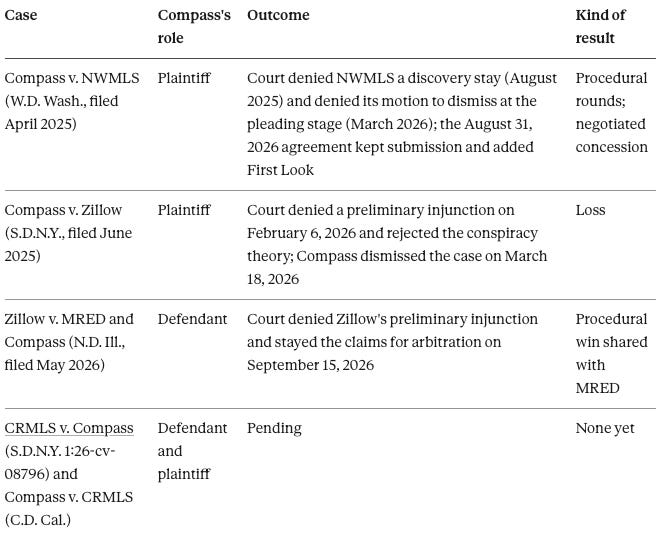
Washington shows where the concession came from. Sixteen months of litigation pressure and a new statute produced First Look, and Compass called its objective “fully realized,” as Real Estate News reported. Compass’s leverage has come from holding a dispute open long enough to extract a status change, never from a judgment.
Compass sent demand letters to MLSs on September 8, 2026 with an October 6 deadline. CRMLS sued first in the Southern District of New York (S.D.N.Y.) on October 5.
Compass sued CRMLS in the Central District of California on October 16 and began paying CRMLS fines for agents at its company-owned brokerages. Six MLSs filed a joint template complaint in S.D.N.Y. on October 21. OneKey MLS joined the CRMLS case by amended complaint on October 27, citing a March 21 email in which Robert Reffkin called OneKey’s rules “an illegal restraint of trade.” MLSListings joined the six-MLS case, reported November 2.
Four national brokerage groups launched Open Real Estate (ORE) on October 26. Real REMAX Group CEO Tamir Poleg said the founders invited Compass as a founding member, as BAM reported. Compass congratulated the founders, announced no plans to join and did not take the seat. By November 2 ORE reported 826 letters of support, 493 of them from independent brokerages.
Four MLS leaders issued statements ranging from a pledge to partner to an invitation for dialogue. Bright MLS, a Compass partner since May, pledged to partner with ORE. An ORE spokesperson said talks with brokerages about joining continue, Compass among them.
Compass also faces a Securities Act class action over the Anywhere merger, Magloire v. Compass, with lead plaintiff motions due December 8.
The legislative map moved in parallel. Wisconsin enacted a disclosure opt-out effective January 1, 2027, and Connecticut enacted one on May 27 that took force October 1.
New York’s legislature passed an opt-out bill in June that awaited the governor’s action as of early October. Illinois and Hawaii bills died in committee and can return in January.
The current state shows a target population that stopped bargaining alone, a consortium outside the MLS, and a statutory trend that mostly chose the opt-out model Compass sought in Washington.
B. The Governing Question Is Whether the National Contest Converges on Washington’s Arrangement
The series asks how Compass’s national position changes as it continues or modifies its conduct, as competing institutions respond, and as new constraints emerge.
The inaugural installment tests one form of that question over 15 months ending in February 2028. Does the national contest converge on Washington’s arrangement or a stronger-access national one? The alternatives are local fragmentation and a durable Compass advantage. The sharper form asks at which institutional transition the NWMLS playbook stops working as a short horizon strategy, and which actor holds the advantage once the long horizon game becomes dependable.
The target system covers the two S.D.N.Y. actions and the California action.
The system also covers MLS boards holding demand letters, the ORE consortium and the 2027 state sessions, with the securities case as a concurrent clock. Merits outcomes of the antitrust claims lie outside scope, because no merits ruling is likely inside the horizon. Valuation of Compass shares also lies outside scope.
The governing question converts a litigation update into a test of which institutional structure survives.
C. Behavioral Economics Explains Why Each Side Repeats Its Own Rule
Compass’s operators were rational habits in the game that produced them. Behavioral economics predicts that incumbents who lived through a short horizon game keep its decision rules after the game changes, holding options they no longer need. Compass’s reference point is the Washington outcome, which it describes as fulfilling its objective, so it reads each new MLS refusal as a negotiable delay rather than a structural shift.
MLS boards carry the opposite reference point. Rule integrity anchors their decisions, so each withheld listing counts as a loss rather than a foregone gain, and loss-framed actors litigate rather than concede. Legislators weigh hearing sign-ins as a salience cue for public demand. Once a coordination signature appears, the same cue flips from support to discount.
Behavioral economics supplies the decision rules the simulation runs: Compass repeats its operators, boards defend rule integrity, and legislators discount volume once they detect coordination.
D. Dynamic Game Theory Explains Why the Same Moves Now Pay Differently
The game itself changed during play. A demand letter worked as a credible threat against a lone MLS; against nine plaintiffs it supplies the evidence that a live controversy exists. Each new joiner by amended complaint reuses the template others paid for, while adding coordination burden and discovery exposure. Whether marginal benefit still exceeds marginal burden decides whether the coalition grows, plateaus or fragments.
Actors also compete over how predictable the game becomes, as Section II.G sets out. A coordinated legislative campaign forms a repeated game across states, and the first state to discount it lowers its value in every later state.
Dynamic game theory supplies the payoff structure: credible threats become evidence, forums become contested variables, and campaigns across states become one repeated game.
The core game seats four players. Each row names the strategies, the payoff that drives the choice and the move that now pays less than it did a year ago (interpretive reading, 65–75% confidence).
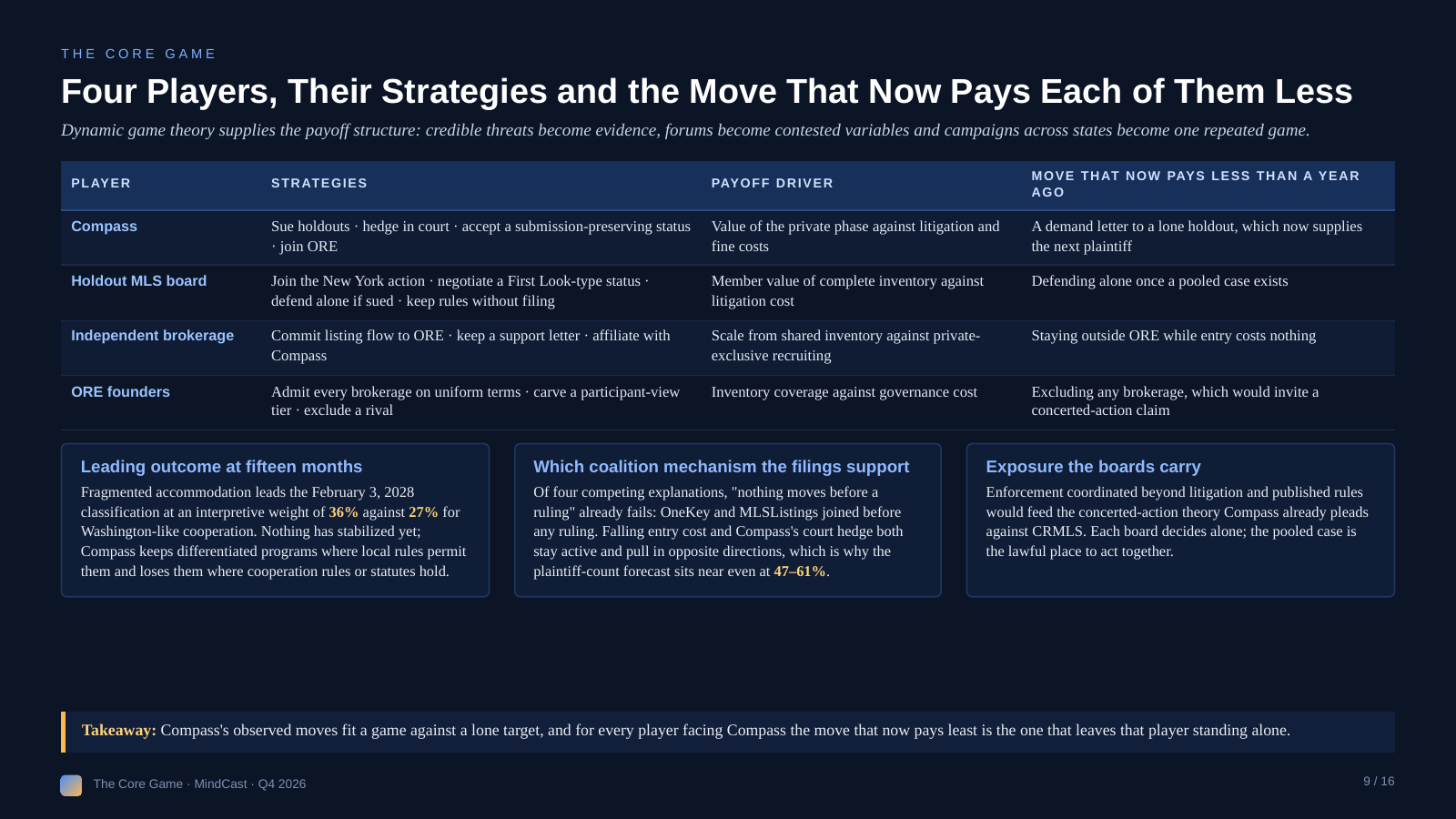
Figure 1. The core game: four players with their strategies and payoff drivers beside the move that now pays less than a year ago. Source: MindCast Compass MLS Value Proposition.
While the forum motion is pending, the run’s leading stable outcome is fragmented accommodation, the class Section III.D weights highest.
Coordination carries its own exposure for MLS boards. Enforcement coordinated beyond litigation and published rules would feed the concerted-action theory Compass already pleads against CRMLS.
E. Eleven Cognitive Digital Twins Carry the Simulation
The simulation models the institutions whose choices move the system. Each CDT carries an objective, its constraints and decision rights, and the trigger that makes it update.
Compass International Holdings. Objective: Preserve three-phase marketing; restore bilateral bargaining. Constraints and decision rights: Dismissal, severance and transfer motions; new suits; accommodations; fine payments. Update trigger: Forum ruling; new joiner; enacted statute.
CRMLS and OneKey. Objective: Declaration that cooperation rules are lawful. Constraints and decision rights: First-filed status; legal defense fund; rule amendments. Update trigger: Ruling on dismissal or transfer.
Six MLSs plus MLSListings. Objective: Same declaration through a shared template. Constraints and decision rights: Joinder; coordination; discovery posture. Update trigger: Compass motion in their case.
Holdout and aligned MLSs (Unlock, MRED, Bright). Objective: Member value at least litigation cost. Constraints and decision rights: Join, refuse without suing, partner or hold dual alignment. Update trigger: New Compass suit; coalition ruling.
Open Real Estate founders. Objective: A national listing input layer. Constraints and decision rights: One-business-day input; participant-only marketing ban; free entry. Update trigger: Vendor selection; Compass entry decision.
Independent brokerages. Objective: Access to all inventory; scale without merging. Constraints and decision rights: Own listings; ORE letters now, listing flow after launch. Update trigger: ORE vendor selection and launch.
Anywhere franchisees. Objective: Affiliation value and MLS access. Constraints and decision rights: Franchise terms; ORE support letters. Update trigger: Competitor entry into ORE.
Federal courts (S.D.N.Y., C.D. Cal.). Objective: Efficient, lawful forum allocation. Constraints and decision rights: First-filed doctrine; declaratory discretion; rule of reason. Update trigger: Motions on dismissal, severance and transfer.
State legislatures. Objective: Market transparency and seller choice. Constraints and decision rights: Washington model or disclosure opt-out; hearing scrutiny. Update trigger: Session calendars; bill texts.
Securities plaintiffs and Compass’s disclosure function. Objective: Pleading theory; disclosure accuracy. Constraints and decision rights: Lead plaintiff selection; 10-Q and 10-K language. Update trigger: December 8 deadline; quarterly filings.
Zillow and the National Association of Realtors. Objective: Listing access standards; cooperation policy. Constraints and decision rights: Portal rules; subpoenas in parallel litigation. Update trigger: Rulings in parallel cases.
Four competing hypotheses explain the coalition’s growth. Each carries its own falsifier, and the simulation tests all four before favoring any.
Hypothesis 1: Entry cost. Joinder by amended complaint lets each new MLS reuse a template others paid for, so the coalition grows as entry gets easier. Falsifier: joinders stop while the cost of joining keeps falling.
Hypothesis 2: Compass’s hedge. Compass’s October court statements lowered the risk that it sues a holdout first, so holdouts wait. Falsifier: joinders continue at the same pace after each Compass statement narrowing its litigation intent.
Hypothesis 3: Legislative exposure. Simultaneous 2027 sessions let lawmakers compare Compass-affiliated testimony across states, which raises the cost of coordinated advocacy. Falsifier: campaigns appear in two or more states and no hearing file notes the pattern.
Hypothesis 4: No change before a ruling. Nothing material moves until a court rules on the forum. Falsifier: a joinder, a statute or an agreement changes an institution’s position before any ruling.
The filings already separate the four. Hypothesis 4 fails its own test, because OneKey and MLSListings joined before any ruling. Hypotheses 1 and 2 both stay active and pull in opposite directions, which is why CE-P2 sits near even. Hypothesis 3 waits for the first 2027 hearings.
The simulation runs in five steps:
Name the decision and the actors. The institutions whose choices decide the outcome become the cast.
Build a Cognitive Digital Twin for each. Each CDT carries the institution’s objectives and constraints, its decision rights and the triggers that make it update, all drawn from its own filings and conduct.
Apply game theory and behavioral economics. Game theory sets the payoffs each institution faces, and behavioral economics sets the decision rules each one actually follows.
Run the game forward. Each ruling, rule decision or bill can change the game, and the simulation rebuilds the board from the new state.
Issue Simulation Predictions. Each carries a band, a window, a falsifier and a verification source.
The simulation tests whether joinders follow Compass’s threats or falling entry cost. The simulation also tests how fast Compass’s habits change, when commitment beats delay and when broker decisions tip the market from shared to private inventory.
Each branch of the tree also names the institutions that would populate it once it activates.
The architecture gives each institution a modeled decision rule and lets the board change as the institutions respond to one another.
F. The Compass Equilibrium Series Rates Compass’s Posture and Its Environment Separately
The series rates seven fronts on two dimensions at every checkpoint. The first rates Compass’s posture: what Compass does. The second rates the institutional environment: what the institutions around Compass have become. Separating the two avoids a modeling error, because Compass can hold its conduct while the environment turns against it.
MLS litigation. Compass posture options: Escalate · accommodate · withdraw. Environment states: Individual opposition · coordinated resistance · binding constraint. Checkpoint 0 preliminary assessment: Escalate in public, hedge in court; coordinated resistance.
MLS coalition. Compass posture options: Divide · negotiate · accept. Environment states: Expanding · stable · fragmenting. Checkpoint 0 preliminary assessment: Divide; expanding.
Commercial alliances. Compass posture options: Join · compete · adapt distribution. Environment states: Emerging · operating · entrenched. Checkpoint 0 preliminary assessment: Founding seat not taken; talks reported; emerging, with 493 independent letters.
State legislation. Compass posture options: Advocate · challenge · comply. Environment states: Proposed · enacted · implemented. Checkpoint 0 preliminary assessment: Advocate opt-out; enacted in three states, two on the opt-out model; New York’s opt-out bill awaits the governor.
Federal and state enforcement. Compass posture options: Cooperate · contest · change conduct. Environment states: None public · inquiry · action · remedy. Checkpoint 0 preliminary assessment: No public federal action; New York attorney general inquiry reported
Listing economics. Compass posture options: Maintain · revise the model. Environment states: Incremental advantage grows · holds · contracts. Checkpoint 0 preliminary assessment: Maintain; advantage unmeasured.
Financial and shareholder exposure. Compass posture options: Maintain · revise disclosures and strategy. Environment states: Claims · evidence · institutional response. Checkpoint 0 preliminary assessment: Maintain; claims filed, lead plaintiff pending, operations on plan.
Each checkpoint reports three readings: Compass’s posture, the environment’s state and the distance between them. A widening distance signals adaptation pressure. Persistence alone does not show equilibrium. Commitment and switching costs can sustain it, as can mistaken expectations or continuing benefit.
At Checkpoint 0 the distance widened on litigation, the coalition and legislative scrutiny. Operations remain on plan: second-quarter revenue reached $4.31 billion and first-year Anywhere synergies arrived five months early. No front meets the system-break condition defined at the end of this section.
Listing economics needs the most care. Compass’s seller-choice framing and MindCast’s in-house buyer-representation inference both apply to Coming Soon listings as well. The series separates ordinary in-house transactions from incremental buyer-side representation attributable to a private-marketing period, which public data does not yet measure.
Three cohort measures make the separation possible: private-marketing duration, the origin of the buyer’s representation, and incremental in-house capture against comparable fully cooperative listings.
The series defines a system break as a forced change in Compass’s posture on listing economics or financial exposure, with the environment at the binding stage on two other fronts within one checkpoint. A single adverse ruling does not meet the definition.
Each installment answers four questions in order. What did Compass or another institution do? How did the action change the strategies, payoffs and rules, or the participants and their information? Which hypotheses and Simulation Predictions can now be issued or validated, and did the usable horizon expand, contract or hold?
Event reports follow a fixed intake. Each new development gets classified as continuation or equilibrium migration, the two forms of game evolution, and routed to the fronts it touches. Mutation is reserved for an anomaly that the simulation classified as unavailable. A development that changes a posture or environment rating triggers a report before the next checkpoint; others enter a running chronology.
A Department of Justice (DOJ) complaint would add a federal litigant with new remedies, while a Federal Trade Commission (FTC) study would change information without changing rules. No federal action is public as of this checkpoint, and the series assumes none.
The series turns “will Compass implode” into two observable questions per front, and the preliminary answer is a widening distance on three fronts with no break.
G. Every Contested Front Sits in the Short Horizon, and Compass’s Strategy Pays Most While It Stays There
Every front where Compass’s strategy is contested sits in the short horizon. Courts have not chosen a forum or a doctrine, the 2027 sessions have not opened, and ORE has not written its governance. The one contested game that stabilized was Washington, where Compass accepted a submission-preserving status and called it its objective. Compass’s operations sit in a stable game; its strategy does not.
Game theory reads the pattern as a position built from options rather than commitments. A commitment pays in one candidate game, while an option pays across several as long as the governing game stays open. Three-phase marketing, the suits and the reframings each keep several outcomes alive. As rulings and statutes concentrate weight on one game, those options convert at a discount or expire.
Compass’s six operators work as horizon-control instruments. Litigation and severance requests multiply forums, and reframing keeps more than one meaning of “seller choice” in circulation. The Washington export opens new games before old ones close, and coordinated legislative opposition contests outcomes before they bind. The Calculus of Predictive Game Theory Evolution and Mutation gives 70% odds that actors whose payoff grows with ambiguity open new forums at higher rates, and Compass’s record fits that profile.
Most resolutions would lower the value of Compass’s position. A holding forum ruling, a durable coalition, ORE listing flow or a no-opt-out statute each concentrates weight on a game Compass did not choose. Only a Compass merits win (E3, the competitive private-listing outcome defined in Section III.D) stabilizes the game on Compass’s terms. The spread of opt-out statutes stabilizes it on a public default that Compass must opt out of one listing at a time.
The Calculus gives 60% odds that early committers capture more of the payoffs once a game stabilizes, and the early committers here are the MLS plaintiffs and the ORE founders.
The legislative front looks favorable to Compass and is not. Opt-out statutes are spreading faster than Washington’s no-opt-out rule (H-C10). Compass’s witness told Washington’s Senate housing committee that its model was unaffected “specifically with the amendments” adding an opt-out, as How Compass’s State Legislative Testimony Undermined its Federal Antitrust Claims documented. The enacted opt-out laws still make MLS or public posting the default, so private marketing becomes an exception Compass must justify listing by listing.
Each exception also leaves a document. A seller who keeps a listing private signs a disclosure that limited exposure could reduce buyer interest and offers. The disclosure becomes a dated exhibit for counsel, regulators and plaintiffs (interpretive reading, 65–75% confidence). Compass escapes the strictest rule and takes on a paper trail of its private-marketing volume.
The statutes also leave Compass’s real target standing. An opt-out law sets a floor for broker conduct and does not bar an MLS from requiring submission, so CRMLS Rule 7.9 and the other cooperation rules keep binding MLS members (interpretive reading, 75–85% confidence). The fight stays in MLS rulebooks and federal court, where Compass has won concessions but no case.
Washington’s statute remains in force and in every 2027 hearing file, and the next round of bills turns from visibility to showing and offer access (Cal P-3, CE-C6). Statehouses are also the forum where Compass’s coordinated-opposition history draws the closest scrutiny (H-C9). Compass’s legislative position therefore improves on the count of statutes and weakens on the default, the evidence trail and the next question.
Every Compass move therefore carries two returns. The first is its value inside the current game, such as leverage over one MLS. The second is its value in the successor game, such as whether the move makes joining a coalition more attractive to MLSs not yet involved. A move can succeed locally and weaken the position Compass carries into the next game (H-C13).
The fronts also couple. A reusable rationale from one federal ruling could change joinder decisions, which changes bargaining costs, which changes the value of private-listing differentiation. The same chain can run in Compass’s favor after a favorable ruling. Compass’s national exposure therefore cannot be read as a set of independent lawsuits (interpretive reading, 80–90% confidence).
Behavioral economics explains why the position persists. Loss aversion holds incumbents to options they no longer need. Washington also gave Compass a reference point in which instability ended in an accommodation it could call a win, so an actor that learned to win by keeping games open keeps opening them (H-C8).
The preference for ambiguity remains a hypothesis to test against behavior, not an assumed corporate objective: ambiguity also costs MLSs and brokerages, and a clear favorable judgment would benefit Compass. On the evidence to date Compass’s strategy earns most while the governing game stays unresolved. Every stabilizing event therefore tests the strategy itself (interpretive reading, 65–75% confidence).
H. Market-Tipping Analysis Reads Compass’s Strategy as a Seed for a Competing Equilibrium
Two equilibria compete beneath the litigation. In the incumbent equilibrium, brokers contribute listings to a shared pool and every buyer’s agent sees every listing. In the private-network equilibrium, large brokerages control early access to their own inventory, and the market fragments into networks. MindCast’s tipping analysis asks when decentralized broker decisions stop reproducing one equilibrium and start reproducing the other.
Compass’s conduct reads as a seed for the private-network equilibrium. Three-phase marketing and Coming Soon listings, at 57% of new Compass listings in July, recruit participants to it. So do the partnerships with MRED and Bright and the March 2026 joint letter with Redfin and Rocket.
ORE plants a counter-seed for the incumbent equilibrium with four founders and 826 letters of support, 59% of them from independents. The MLS coalition enforces the incumbent equilibrium, and nine plaintiffs show collective action without showing that the market has crossed a tipping point. Letters measure intent, so the tipping test waits for listing flow after ORE launches.
The tipping analysis measures how changes in information visibility tilt the basins between equilibria, and Compass’s demands sit in exactly that domain. Reffkin’s emails asked OneKey to remove days-on-market and price history, lift Coming Soon limits and decouple cooperation from feed distribution. First Look keeps days in status and pre-launch price changes visible to member brokers and hidden from the public. The Motion Compass Filed and the Architecture It Could Not Address documented Compass’s internal label for that data: “negative insights.”
Read together, the demands seek control over what buyers learn about a listing’s history and when they learn it. Buyer-side capture is one payoff of that control, not the whole of it (interpretive reading, 65–75% confidence). The reading extends From Inventory Control to Attention Control — The Compass Commission-Consolidation Model After First Look.
Signaling theory separates costless statements from costly actions. Compass’s statements about seller choice, open competition and ORE’s promise cost nothing to make.
Compass’s costly actions point elsewhere. Compass pays CRMLS fines of up to $2,500 per citation and spends on litigation. Compass also left a free founding seat in ORE untaken, though the seat would satisfy every stated goal except the private phase.
Leaving a free seat with governance rights untaken reveals that membership costs Compass more than a voice in ORE’s rules is worth. Compass’s entry as a participating member under the rule would falsify the reading, and ORE reports that talks with Compass continue (CE-S6). The one-business-day rule is the cost that conflicts directly with Compass’s model, while governance duties and commercial terms may add to it (interpretive reading, 65–75% confidence).
When statements and costly actions diverge, receivers weight the actions.
The fine payments set a lower bound. Compass reveals that keeping its private-marketing program running is worth at least the fines plus legal and reputational cost. The payments also acquire claims for Compass’s litigation, so part of their value is litigation value, and the bound remains a floor rather than an estimate.
Compass speaks to two audiences. Institutional receivers such as MLS counsel, ORE’s founders and legislative staff have begun to discount the statements and read the actions. Compass’s own agents and sellers form the population whose adoption decides whether the private-network equilibrium spreads, and messaging can still move them. Narrative spread therefore matters on the adoption side (H-C15).
The tipping analysis holds only while the game holds still. A holding forum ruling or an enacted statute starts a successor game, so the analysis reads markets where neither has arrived and leaves Washington to the long horizon tree.
Compass can keep its public narrative intact while its preferred equilibrium grows harder to sustain, because thousands of locally rational broker decisions decide which equilibrium spreads and no single actor controls them.
I. Two Coalitions Work at Two Levels, and Only One Responds to Compass
The opposition to Compass splits by actor type. MLSs own the cooperation rules and defend them in court. Brokerages own the listings and are building cooperation into a voluntary agreement. The two coalitions run on different engines, and the difference decides what Compass can still influence.
MLS coalition in New York. Members: Nine MLS plaintiffs. What it does: Defends cooperation rules in court. What drives growth: Compass’s threats and suits (CE-P2, Lex S-3) Can Compass slow it by easing off?: Yes.
Open Real Estate. Members: Four founders, five participating members, 826 letters. What it does: Writes a one-business-day submission rule into a brokerage agreement. What drives growth: Each brokerage’s own inventory payoff. Can Compass slow it by easing off?: Mostly no.
Independents sign because private listings reward firms with large in-house buyer pools, and independents run small ones. Shared inventory gives them scale without merging. Cooperation is therefore their best strategy whatever Compass does in court (interpretive reading, 70–80% confidence; H-C16).
The cooperation norm also moves out of reach of Compass’s litigation. Compass’s antitrust theory targets MLS rules as concerted action among competitors. A free, voluntary agreement that admits every brokerage offers a weaker target (interpretive reading, 65–75% confidence). Even a first Compass merits victory against an MLS rule would buy less than it would have a year ago, because the norm survives in a place the suit does not reach.
Dated filings show how MLSs respond to Compass threats. Each row pairs a Compass move with the next move of its target.
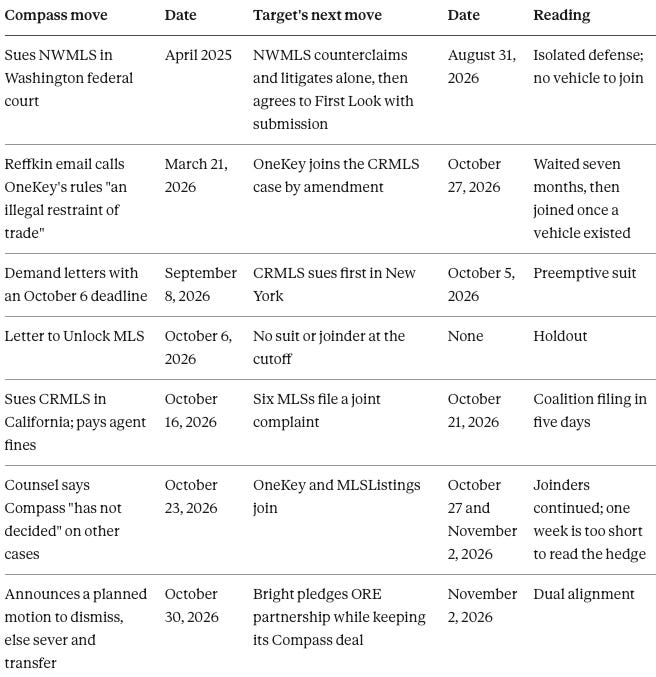
The filings suggest the direction of response changed once a pooled vehicle existed. Before October 2026 a threatened MLS defended alone, as NWMLS did for sixteen months. After CRMLS filed, threatened MLSs joined or filed within weeks (interpretive reading, 65–75% confidence; H-C17). Compass’s court hedge points the same way: the October 23 statement followed the CRMLS and six-MLS complaints rather than preceding them.
Compass now stands outside both coalitions, as a defendant at the MLS level and by choice at the brokerage level. Easing off in court can slow the first, while nothing Compass does in court reaches the growth of the second.
🗂️ MLS Leaders. A pooled New York action now exists, so a threatened board no longer defends alone.
💼 Executives. Open Real Estate grows on brokerage economics, not on Compass’s court posture.
🏛 Policymakers. Three of the four enacted or passed statutes chose the opt-out model.
⚖ Counsel. Compass’s court hedge and its public threats now sit side by side in the filings.
📊 Investors. Operations run on plan while litigation exposure widens.
III. The National Contest Branches Wide Until the Forum Ruling While Washington’s Rules Hold
Two trees separate the national contest from Washington. The national contest still branches wide, while Washington’s rules hold. Mechanisms come before outcomes, and identifiers stay stable from checkpoint to checkpoint.
Prediction date and data cutoff: November 3, 2026.
Verification sources: four federal dockets (1:26-cv-08796 and 1:26-cv-09253 in S.D.N.Y., 5:26-cv-06121 in C.D. Cal. and the securities action 1:26-cv-08885). Enacted session laws and the published MindCast papers in Appendix A support every carried band.
A. The Simulation Synthesis Separates a Short Horizon Contest From a Long Horizon Reference
The national contest and the Washington game read differently on every synthesis element. The paired readings explain why depth reaches further in Washington today.
Dominant mechanism. National contest: Game-identity uncertainty past the forum ruling. Washington: Weight concentrated on one candidate game.
Active regime. National contest: Court, coalition and consortium channels run alongside legislative and securities channels. Washington: Concurrent public marketing by statute; First Look by agreement.
Replacement conditions. National contest: Forum ruling; submission-preserving agreement outside Washington; 2027 enactment. Washington: Opt-out amendment; compliance dispute.
Behavioral equilibrium. National contest: Compass repeats operators; boards defend rule integrity. Washington: Compass operates within First Look and claims the outcome.
Institutional sufficiency. National contest: Existing doctrine supplies candidate rules; no forum has selected one. Washington: Licensing discipline and MLS rules carry the path without new law.
Both trees branch, but only Washington’s branches name the mechanism that would produce each next step.
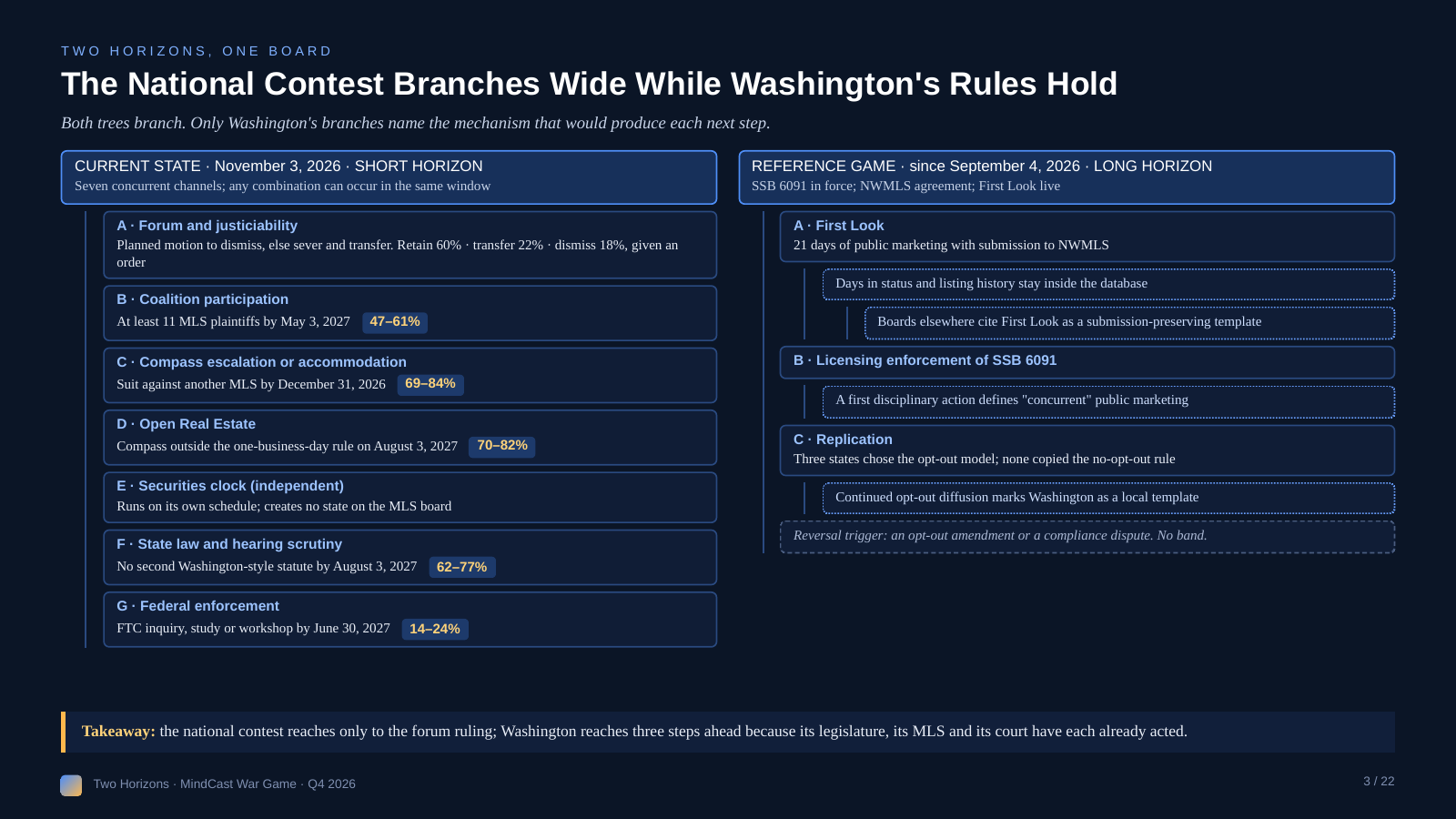
Figure 2. Two horizons on one board: the national contest’s seven channels beside Washington’s specified continuations. Source: MindCast Compass MLS War Game.
B. Seven Concurrent Channels Leave the National Current State
The national tree follows the series format. Channels run concurrently, bands appear as Simulation Predictions issued here or carried from published MindCast entries, and deeper nodes name the game they await without a band.
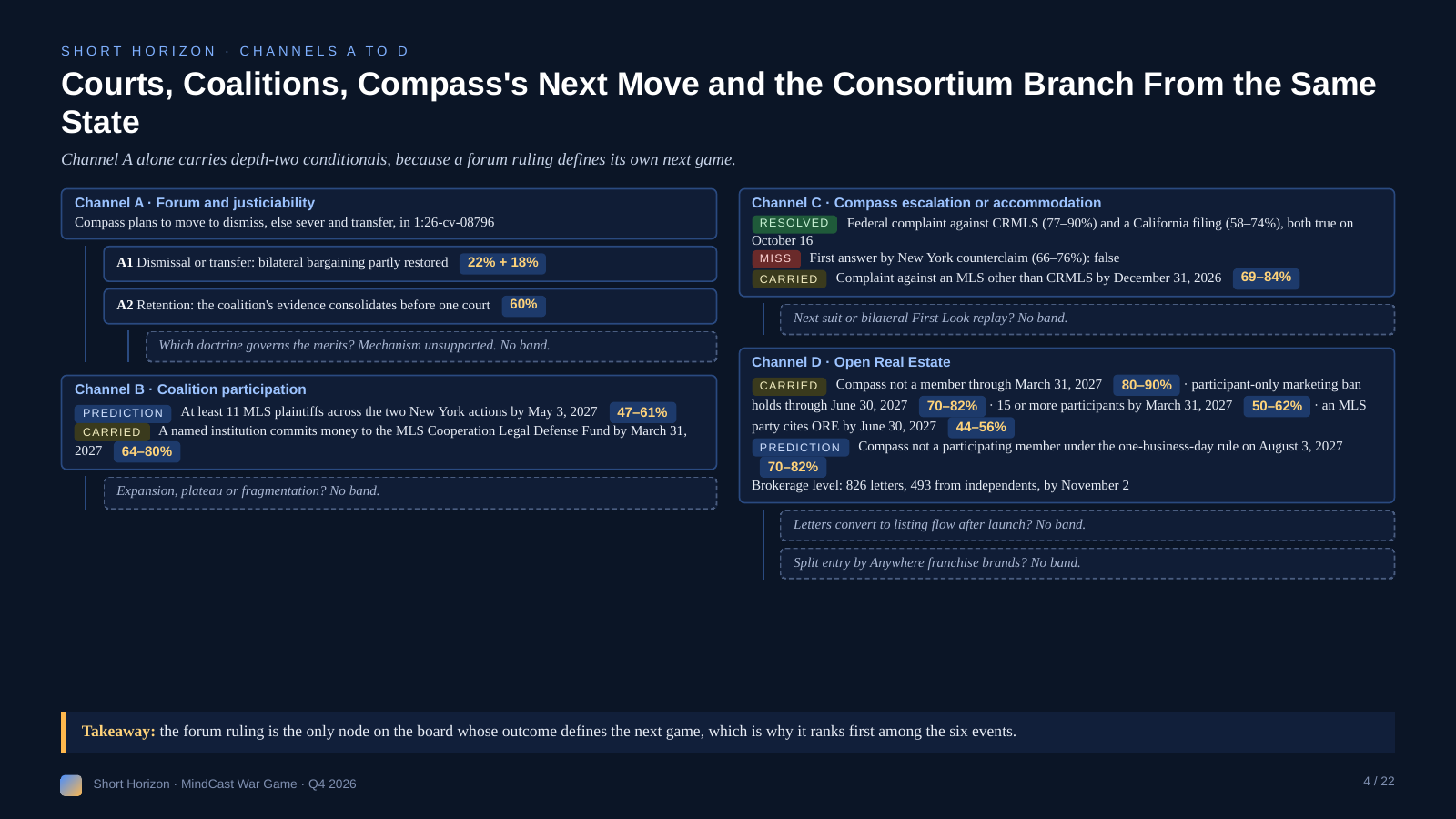
Figure 3. Short-horizon channels A to D: forum and coalition channels beside Compass escalation and Open Real Estate. Source: MindCast Compass MLS War Game.
Figure 4. Short-horizon channels E to G: the securities clock and statehouse channel beside federal enforcement and the persistence condition. Source: MindCast Compass MLS War Game.
Channel A alone carries depth-two conditionals, because a forum ruling defines its own next game. Channel E runs on its own clock and does not merge into the MLS branches.
The California entries come from California Private Listing Law After Washington SSB 6091 — Broker Conduct Rules for Listing Visibility Showing Access and Buyer Representation, which separates bill introduction, bill content and the market outcome. The paper’s forecasts point to a visibility law that leaves showing and offer access to brokerage networks. New York’s passed bill takes the same shape, since it does not regulate marketing once a listing reaches a public website.
California’s calendar also shapes CE-S1. California bills usually pass in late summer and reach the governor’s signature in September or October, after CE-S1’s August 3 window closes. CE-S1 therefore resolves mainly in states that adjourn by early summer, while California’s 2027 bills resolve at later checkpoints. Checkpoint 1 reads CE-S1 against the January bill texts.
C. Washington Carries Specified Continuations Beneath Fewer Channels
The Washington tree shows what a stabilized branch looks like. Dotted boxes mark continuations specified by mechanism that carry no band.
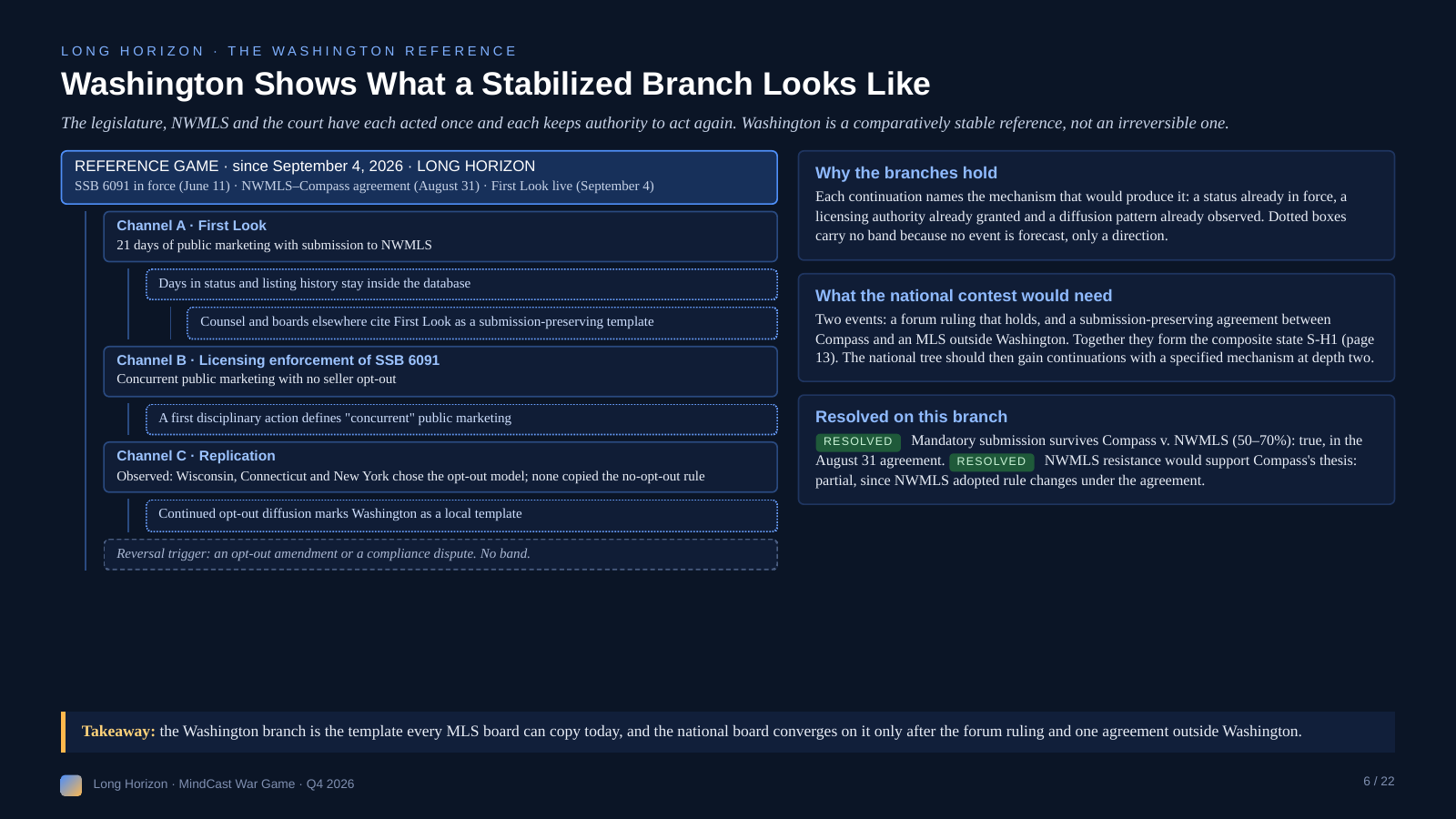
Figure 5. The long-horizon Washington reference: three channels with continuations specified by mechanism and one reversal trigger. Source: MindCast Compass MLS War Game.
SSB 6091 Has Passed. Here Is What It Now Reaches — and the Compass Enforcement Record It Inherits set out the statute’s reach over pre-MLS marketing networks and its use as a template for other states. Compass Plan B, Structural Circumvention After Washington SSB 6091 mapped the workarounds Compass could pursue under it, which Channel B’s licensing enforcement now tests.
The legislature, NWMLS and the court have each acted once and each keeps authority to act again. Washington is a comparatively stable reference, not an irreversible one.
D. Fragmented Accommodation Leads Five Possible Outcomes at Fifteen Months
Each class names a distinct institutional structure the national market could reach by February 2028.
E1a, Washington-like cooperation. Submission holds and a phased-marketing status is accommodated. Compass describes the outcome as its own.
E1b, stronger-access national cooperation. Cooperation rules gain access protections beyond Washington’s through MLS rules, ORE or statute.
E2, fragmented accommodation. Compass keeps differentiated programs where local legal and commercial incentives permit them.
E3, competitive private-listing equilibrium. Compass’s legal position, agent network or distribution model withstands collective resistance.
E4, statutory override. State law displaces MLS rules in enough states to reset the contest, with direction set by which model spreads.
The simulation assigns each class an interpretive probability. Fragmented accommodation leads at 36% and Washington-like cooperation follows at 27%.
Stronger-access cooperation carries 15%, opt-out statutory override 14% and a competitive private-listing equilibrium 8%. A brokerage-level coalition that grows without Compass lowers the chance that MLS fragmentation alone hands Compass the market. The probabilities describe where the board sits today, and each checkpoint revises them as rulings and statutes arrive.
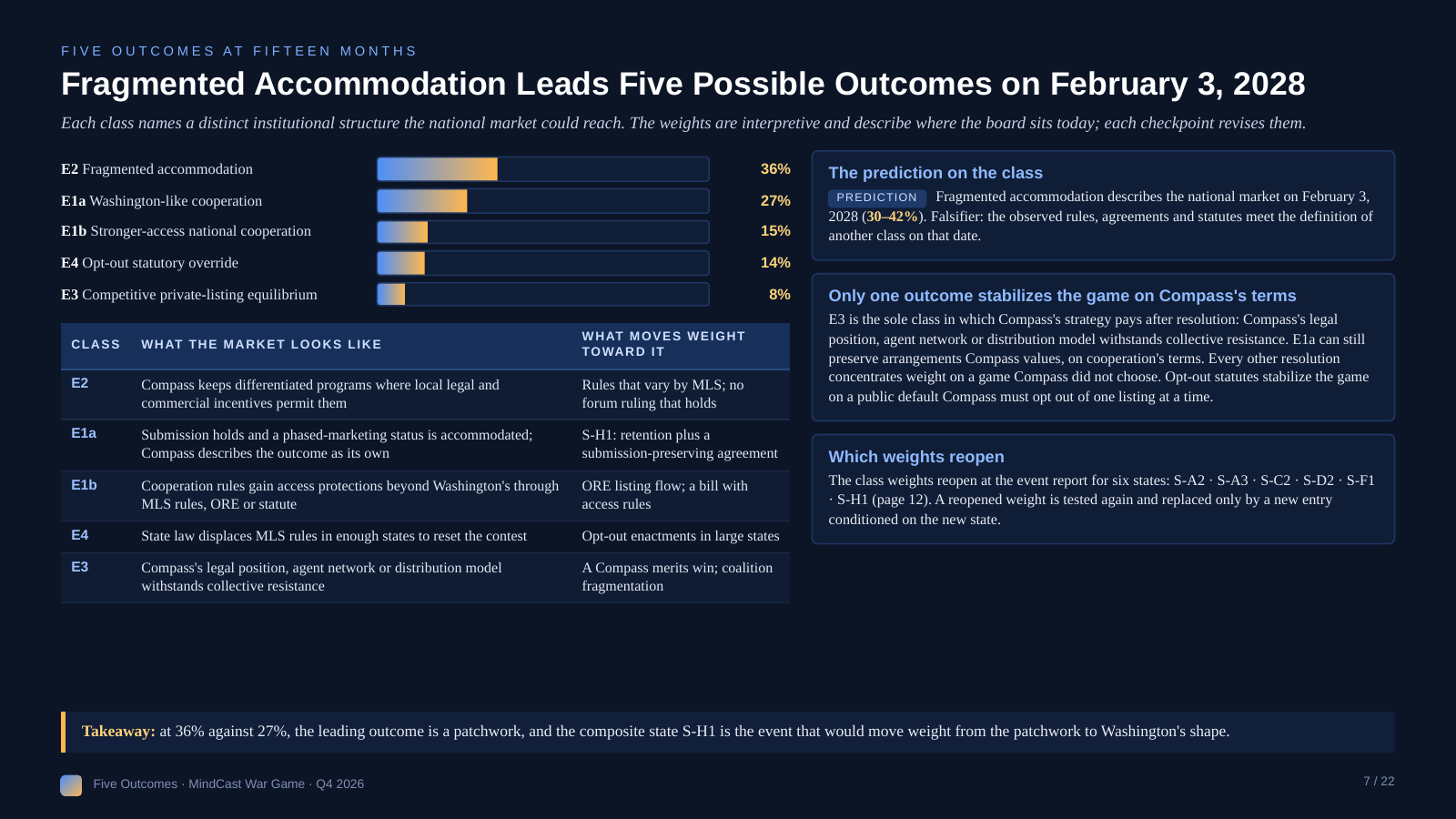
Figure 6. Five outcomes at fifteen months, with the published interpretive weights and what moves weight toward each. Source: MindCast Compass MLS War Game.
E. Two Forecasts Hold in Every Branch While the National Contest Waits on the Forum Ruling
The series names three tests: outcome robustness, action robustness and structural stability.
California S-4 (82–92%, CRMLS keeps its submission rule through its published window) and ORE P-6 hold in every branch the simulation maps, each within its own window. Preserving Compass’s statements pays MLS boards under every forum ruling. Compass’s own moves that would pay under every ruling, such as accepting a submission-preserving status early, lie outside the six operators it has used so far. Washington’s rules hold across branches, and the national contest waits on the forum ruling.
The bands hold whether Compass’s threats recruit MLSs or deter them. CE-P2 sits near even for that reason, and CE-S4 and CE-S6 rest on the brokerage level, which the direction of MLS response does not touch.
F. Nine of MindCast’s Ten General Game-Change Simulation Predictions Have a Compass Test
The Calculus published ten Simulation Predictions, each stated to the nearest ten percent. Each resolves through December 31, 2028 against dockets and enforcement records, renewal samples or resolved MindCast forecast cohorts. Compass becomes one case inside those cohorts, so Compass outcomes contribute evidence without resolving any of the ten alone.
Prediction 1. Calculus Simulation Prediction: Short horizon forecasts lose accuracy at the second and third fork faster than long horizon forecasts. Odds: 70%. Compass application: Forecasts past the forum ruling carry no band in this paper. Local test: H-C1.
Prediction 2. Calculus Simulation Prediction: A distant forecast holds in an unstable game when the outcome stays the same in every candidate game. Odds: 80%. Compass application: CRMLS keeping its submission rule and Compass staying outside ORE hold in every mapped branch. Local test: Section III.E.
Prediction 3. Calculus Simulation Prediction: Firms making moves that win in every candidate game face fewer adverse actions than firms that wait. Odds: 70%. Compass application: MLS boards preserving Compass’s statements versus Compass holding its observed operators. Local test: H-C7.
Prediction 4. Calculus Simulation Prediction: Actors whose payoff grows with ambiguity open new forums and invite new players at higher rates. Odds: 70%. Compass application: Compass plans to seek dismissal, severance and transfer while MLS plaintiffs consolidate. Local test: H-C3.
Prediction 5. Calculus Simulation Prediction: A faster rival makes firms commit sooner. Odds: 70%. Compass application: A new Compass suit should speed joinders; the court hedge should slow them. Local test: H-C4.
Prediction 6. Calculus Simulation Prediction: Changes that independent actors reuse persist longer than changes no one reuses. Odds: 80%. Compass application: First Look reuse outside Washington; opt-out statutes reused across Wisconsin, Connecticut and New York. Local test: H-C2, H-C10.
Prediction 7. Calculus Simulation Prediction: Firms with reversible moves commit to an emerging path before firms with irreversible capital. Odds: 70%. Compass application: Brokerages sign ORE letters before committing listings; MLSs join by amendment before filing alone. Local test: Channels B and D.
Prediction 8. Calculus Simulation Prediction: Once a game stabilizes, early committers capture more of the new payoffs than late movers. Odds: 60%. Compass application: MLS plaintiffs and ORE founders committed early; Compass holds options. Local test: H-C5.
Prediction 9. Calculus Simulation Prediction: Games held up by a single enforcer or a role with no successor revert to short horizon shape more often. Odds: 60%. Compass application: Compass’s alliances rest on single partners such as MRED and Bright. Local test: H-C6.
Prediction 10. Calculus Simulation Prediction: Insurance carriers do not converge on common agentic AI terms until a first reasoned ruling or coverage action. Odds: 80%. Compass application: No direct application; the analogue holds that MLS rule convergence waits for the first reasoned forum ruling. Local test: H-C5.
Calculus Predictions 6 and 5 test the coalition thesis directly. Prediction 6 predicts that opt-out statutes keep spreading because they are the changes being reused most, and that spread still leaves Compass on a public default it must opt out of. Prediction 5 implies that Compass’s softer court posture slows the coalition it faces.
The ten Calculus predictions become ten local tests here. Compass’s conduct to date already supplies evidence on Predictions 4 through 7.
G. The Continuation Scenario Runs Compass’s Six Operators Forward
The continuation scenario asks what happens over each checkpoint if Compass continues the conduct observed in Washington and the national campaign while its opponents adapt. Each operator enters as a testable behavioral hypothesis, not a permanent trait.
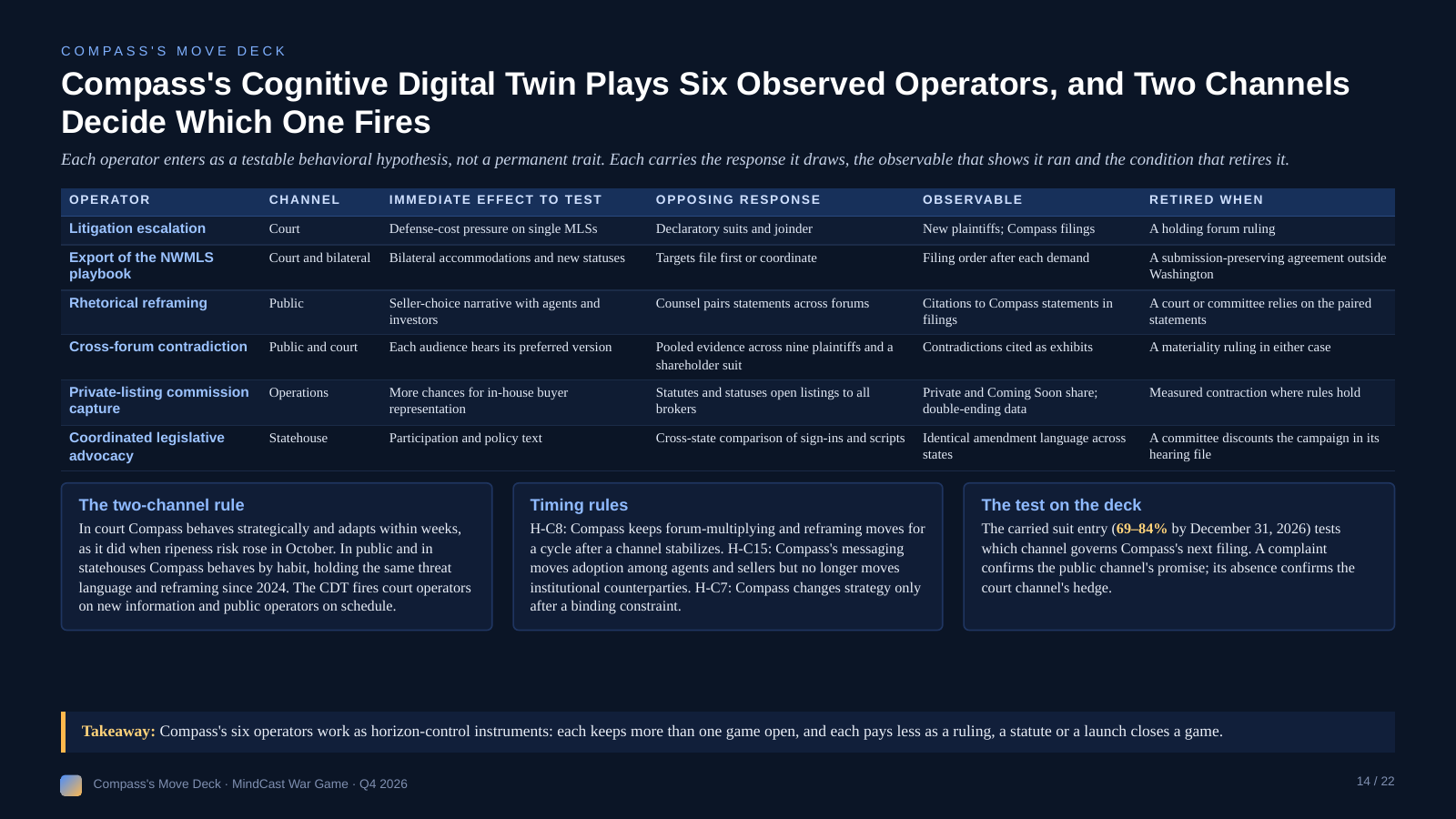
Figure 7. Compass’s move deck: six operators with the channel each fires in and the condition that retires it. Source: MindCast Compass MLS War Game.
Reffkin said Coming Soon listings approached 57% of new Compass brokerage listings in July and projected 80% by the end of the third quarter. Why Compass Needs Private Listings — The Inventory-Routing Premium set out the economics, and From Inventory Control to Attention Control — The Compass Commission-Consolidation Model After First Looktraced how First Look changed them. A sampled Seattle dataset found 16 of 130 transactions kept both sides in-house, an investigative starting point rather than a market estimate or causal measure.
Legislative advocacy enters on documented evidence only. HB 2512 and the Collapse of Compass’s Coordinated Opposition documented common messaging, sponsorship and participant affiliations in Washington without alleging unlawful conduct. The series applies the same evidentiary test in each state and imputes no motive.
The continuation scenario defines four Compass response policies against the same opponents and constraints: continued historical conduct, messaging alignment with unchanged conduct, selective adaptation and substantial revision of the operating model. Checkpoint 0 ran the first policy, and the messaging-only comparison runs at Checkpoint 1; matching outcomes would show Compass’s statements leave the equilibrium unchanged. Three routes competed under the first policy: slow conversion, successful adaptation and continued differentiation. Slow conversion emerges as the most likely route, which corresponds to fragmented accommodation: the strategy keeps paying where neither cooperation rules nor statutes hold and stops paying where either does (H-C11, H-C12).
Compass behaves differently in two channels. In court Compass behaves strategically, adapting its posture within weeks when ripeness risk rose. In public and in statehouses Compass behaves by habit, holding the same threat language and reframing since 2024.
The dual posture held through every simulated cycle. Lex S-3 tests at December 31, 2026 whether the court channel or the public channel governs Compass’s next filing.
H. MindCast Simulation Predictions Keep the Forum in New York and the Statehouses on Opt-Out Laws
The prediction set holds sixteen MindCast Simulation Predictions: two primary (P), six secondary (S) and eight conditional on a named event (C). Each entry opens with a bold headline carrying its band.
Event bands are probabilities, and interpretive bands are structural readings resolved by classifying observed rules, agreements and statutes against the definitions in Section III.D. CE-S2 carries a condition, an agreement outside Washington, and stays in the secondary class because the condition is not one of the six mapped events. Carried entries from earlier MindCast papers keep their original identifiers, wording and windows.
Each result in the paper carries one of seven labels, and each label answers a different question.
Simulation Prediction. What it establishes: A dated event with a band and a window that resolves true or false. In this paper: 16 issued; open entries carried from earlier papers.
Interpretive probability. What it establishes: A structural weight the simulation assigns to one equilibrium class or successor state; weights across a set sum to 100%. In this paper: 5 equilibrium classes; 10 of the 12 elementary successor states (S-E1 carries Lex S-3’s band, and S-F1 carries none); the composite state S-H1 carries no probability of its own.
Structural hypothesis. What it establishes: A mechanism with a falsifier and no band. In this paper: 17 (H-C1 to H-C17)
Analytical finding. What it establishes: A mechanism the simulation exposes, with a confidence range on the reading where one is stated. In this paper: 10 marked interpretive readings.
Established fact. What it establishes: A dated public event the simulation takes as given, with its source. In this paper: Sections II.A and II.I.
Resolved, true. What it establishes: A Simulation Prediction whose window closed with the stated outcome. In this paper: 7 earlier Compass entries.
Resolved, false. What it establishes: A Simulation Prediction whose window closed with the opposite outcome, stated with that outcome. In this paper: 1 earlier Compass entry.
MindCast’s earlier Compass Simulation Predictions
Mandatory listing submission survives Compass v. NWMLS. Band: 50–70%. Outcome: True: NWMLS kept submission in the August 31, 2026 agreement.
Four readings of one Zillow ruling: the conspiracy theory fails; the monopoly-power claim fails; the listing standards read as platform governance; Compass’s injury reads as self-inflicted. Band: No band issued. Outcome: True on all four: S.D.N.Y. ruling of February 6, 2026 (counted as four entries)
Compass files a federal antitrust complaint against CRMLS. Band: 70–80%. Outcome: True: filed October 16, 2026.
Compass pursues portal-partnership opacity. Band: No band issued. Outcome: True: Redfin alliance, February 2026.
NWMLS resistance would support Compass’s thesis. Band: No band issued. Outcome: Partial: NWMLS adopted rule changes under the agreement.
Lex S-1: Compass answers CRMLS first as New York counterclaims. Band: 66–76%. Outcome: False: Compass filed its own California suit on October 16, 2026.
Primary Simulation Predictions
CE-P1 · The CRMLS claims stay in the Southern District of New York through May 3, 2027 (66–78%)
Forecast statement: The CRMLS claims in S.D.N.Y. No. 1:26-cv-08796 remain pending in S.D.N.Y. and are neither dismissed nor transferred on May 3, 2027.
Confidence class: Event.
Confidence band: 66–78%.
Time window / gate: Through May 3, 2027.
Trigger conditions: Compass’s planned motion to dismiss, sever and transfer.
Explicit falsifier: S.D.N.Y. dismisses or transfers the CRMLS claims on or before May 3, 2027.
Verification source: PACER docket 1:26-cv-08796.
Stakeholder exposure: CRMLS and OneKey; Compass; holdout boards reading the forum.
Monitoring signal: Briefing schedule and any order; weekly.
The mechanism runs through first-filed status, a New York plaintiff in OneKey and Compass’s New York headquarters, set against the anticipatory-suit exception. A ruling may not arrive by May 3, and a pending case counts as retained. The prediction resolves on the forum alone and says nothing about the antitrust merits.
CE-P2 · At least 11 MLSs sue Compass across the two New York actions on May 3, 2027 (47–61%)
Forecast statement: At least 11 MLSs are plaintiffs across S.D.N.Y. Nos. 1:26-cv-08796 and 1:26-cv-09253 on May 3, 2027.
Confidence class: Event.
Confidence band: 47–61%.
Time window / gate: Through May 3, 2027.
Trigger conditions: A new Compass suit or demand; legal-fund commitments.
Explicit falsifier: Ten or fewer MLS plaintiffs across the two actions on May 3, 2027.
Verification source: PACER plaintiff counts in both dockets.
Stakeholder exposure: Holdout boards; coalition counsel; Compass.
Monitoring signal: Amended complaints; weekly.
The band sits near even because two mechanisms pull against each other. Joinder by amendment lowers entry cost, while Compass’s court hedge lowers the urgency of joining. A new Compass suit is the event most likely to tip the count. The count covers MLS plaintiffs only, so a slow count would not mean the opposition is losing ground at the brokerage level.
Secondary Simulation Predictions
CE-S1 · No state enacts a Washington-style public-marketing statute without a seller opt-out in a 2027 session by August 3, 2027 (62–77%). Class: event. Falsifier: a state enacts such a statute. Verification source: enacted session laws.
CE-S2 · A Compass–MLS rule-change agreement outside Washington keeps mandatory submission through November 3, 2027 (72–86% given an agreement). Class: event, conditional on an agreement. Falsifier: an agreement permits public marketing without submission. Verification source: agreement terms and MLS rule announcements.
CE-S3 · Compass keeps its CRMLS fine-payment program without announcing an end through May 3, 2027 (72–86%). Class: event. Falsifier: Compass announces or discloses termination. Verification source: Compass releases and filings.
CE-S4 · Cooperation-preserving arrangements gain more operating adopters than private-access arrangements through February 3, 2028, with no national tipping toward fragmented inventory (60–72%). Class: interpretive. Falsifier: private-access arrangements gain more adopters. Verification source: adopter counts at Checkpoint 5.
CE-S5 · Fragmented accommodation describes the national market on February 3, 2028 (30–42%). Class: interpretive. Falsifier: on February 3, 2028 the observed rules, agreements and statutes meet the definition of another class in Section III.D. Verification source: MLS rules, Compass–MLS agreements and enacted statutes classified against those definitions.
CE-S6 · Compass is not an Open Real Estate participating member bound by its one-business-day submission rule on August 3, 2027 (70–82%). Class: event. Falsifier: ORE or Compass announces membership under the rule. Verification source: ORE’s member list and Compass releases.
CE-S4 counts an adopter only when listings flow under a cooperation arrangement: an MLS submission rule, a First Look-type status with submission, or ORE’s one-business-day rule. Letters of support do not count.
One unit governs both sides of the comparison. Each MLS or multi-brokerage platform that adopts an arrangement inside the CE-S4 window counts as one adopter, whether the arrangement preserves cooperation or private access. Brokerage-level counts, including ORE participating members, appear separately as supporting evidence and do not enter the comparison. CE-S6 extends the carried ORE P-6 past ORE’s launch, and Compass entry through a tier exempt from the one-business-day rule counts as non-entry, reported separately.
Conditional Simulation Predictions
Each condition names a successor state defined in the event tables (Section IV.C).
CE-C1 · Given a New York retention order, at least 11 MLSs are plaintiffs within 90 days (54–70%).
CE-C2 · Given a dismissal order, Compass moves to dismiss the six-MLS action within 60 days (61–79%).
CE-C3 · Given a transfer or dismissal, CRMLS and Compass announce an agreement keeping submission by February 3, 2028 (22–38%).
CE-C4 · Given a new Compass suit against an MLS, at least one MLS not yet a plaintiff joins or files within 30 days (63–81%).
CE-C5 · Given ORE’s launch with listing flow, at least one MLS begins receiving or distributing ORE data within 90 days (51–69%).
CE-C6 · Given a visibility-only California bill, an access rule is added by amendment before the first policy committee hearing (22–39%).
CE-C7 · Given a veto of New York’s S10274, a New York private-listing bill is introduced by March 31, 2027 (62–82%).
CE-C8 · Given federal agency entry, Compass files no new MLS antitrust complaint in the following 180 days (72–88%).
Carried Simulation Prediction Tested Here
Lex S-3 · Compass files an antitrust complaint against at least one MLS other than CRMLS by December 31, 2026 (69–84%; carried). The entry comes from Compass Runs the Same MLS Playbook Against CRMLS That It Ran Against NWMLS in its original words: “Compass files an antitrust complaint against at least one MLS other than CRMLS by December 31, 2026. Falsifier: no such complaint on any docket by that date. Verification source: PACER and state dockets.”
Lex S-3 tests which of Compass’s two channels governs. Compass’s public channel keeps promising suits against any MLS that fines its agents, while its court channel has narrowed its stated intent since October 23. A complaint by December 31 confirms the public channel, and its absence confirms the court channel.
Three questions carry no Simulation Prediction yet, because the evidence they need does not exist. The three are a federal DOJ or FTC action, a 2027 hearing file that notes cross-state coordination and ORE listing flow from at least 100 brokerages within the August 2027 window. Each enters the prediction set when its evidence arrives.
I. Three Structural Hypotheses Test the Mechanisms Behind the Simulation Predictions
Three structural hypotheses carry the paper’s mechanisms. Each applies a published hypothesis from the Predictive Game Theory series, and the Simulation Predictions above supply their first tests.
H-C4 | The court hedge slows joinders while weakening Compass’s threats
Forecast statement: Holdout MLS joinder rates rise after events that raise the hazard of a Compass suit, such as a new Compass complaint, and fall after Compass hedging statements in court.
Confidence class: Interpretive.
Confidence band: Structural hypothesis, no band.
Time window / gate: Through May 2027.
Trigger conditions: A new Compass suit; a court statement narrowing Compass’s litigation intent.
Explicit falsifier: Joinder timing tracks board calendars or fund size rather than Compass’s litigation signals.
Verification source: Dated joinder filings matched against dated Compass statements and filings.
Stakeholder exposure: Holdout MLS boards; coalition counsel; Compass.
Monitoring signal: New amended complaints in either S.D.N.Y. action; weekly.
The mechanism comes from the commitment-timing module in The Calculus of Predictive Game Theory Evolution and Mutation. A holdout weighs falling commitment error against delay cost and the loss from Compass suing first in a forum Compass picks. Compass’s October 23 statement lowers that preemption hazard, so waiting pays more. A less threatening Compass can make resistance less urgent while making voluntary concessions less attractive.
H-C5 | The national contest moves toward Washington’s shape
Forecast statement: The national tree gains specified continuations at depth two once two events occur: a forum ruling that holds, and a submission-preserving agreement between Compass and an MLS outside Washington.
Confidence class: Interpretive.
Confidence band: Structural hypothesis, no band.
Time window / gate: Through February 2028.
Trigger conditions: Both named events occur.
Explicit falsifier: Both events occur and the reissued national tree still lacks specified continuations at depth two.
Verification source: Successive issues of the national tree, coded by whether each depth-two branch names the mechanism that would produce it.
Stakeholder exposure: Every institution planning beyond the first ruling.
Monitoring signal: S.D.N.Y. docket 1:26-cv-08796; MLS rule announcements; monthly.
H-C5 applies the depth-recovery and continuation-support hypotheses of Predictive Game Theory Evolution and Mutation — Long Horizon Games Resolve Deep Because Their Branches Hold. The crossing test tells planners when multi-step forecasts become defensible.
H-C9 | Simultaneous sessions expose coordinated opposition (watch condition)
H-C9 waits as a watch condition because no 2027 hearing has occurred. The entry below activates when hearings occur in two or more states.
Forecast statement: If Compass-affiliated sign-in or messaging campaigns appear in two or more 2027 sessions, at least one legislator, committee or staff report references cross-state coordination in a hearing transcript or committee report.
Confidence class: Interpretive.
Confidence band: Structural hypothesis, no band.
Time window / gate: 2027 regular sessions.
Trigger conditions: Hearings on private-listing bills in two or more states.
Explicit falsifier: Campaigns appear in two or more states and no hearing transcript, memo or committee statement references the pattern.
Verification source: Hearing video, sign-in lists, bill files and committee reports.
Stakeholder exposure: Legislators; committee staff; Compass; state associations.
Monitoring signal: Identical amendment language across states; per hearing.
The baseline comes from HB 2512 and the Collapse of Compass’s Coordinated Opposition, which counted 162 Compass-affiliated sign-ins at the Washington Senate hearing and 54 at the House hearing. The analysis traced VoterVoice messaging, a consumer-facing site and one twelve-word amendment repeated across both chambers. The characterizations are MindCast’s analytical terms, and the analysis made no allegation of unlawful conduct.
J. Fourteen Secondary Hypotheses Name the Mechanisms the Next Checkpoints Test
Fourteen secondary hypotheses tie to the primary set, the channels, the continuation scenario and the readings in Sections II.H and II.I. Each carries a falsifier.
H-C1. Hypothesis: No depth-two continuation on the national tree gains a mechanism before the forum ruling. Linked route: Channel A. Window: To the ruling. Falsifier: A statute or agreement supplies one first.
H-C2. Hypothesis: A First Look-type status adopted independently outside Washington persists longer than unreplicated accommodations. Linked route: H-C5. Window: Through February 2028. Falsifier: Persistence rates match.
H-C3. Hypothesis: Compass seeks to open or split more forums than the MLS plaintiffs. Linked route: Channel A. Window: Through May 2027. Falsifier: Forum moves show no relation to payoff gradient.
H-C6. Hypothesis: Dual alignment by a Compass-aligned MLS precedes realignment. Linked route: Channel D. Window: Two rule cycles. Falsifier: Dual-presence MLSs stay aligned with Compass.
H-C7. Hypothesis: MLS boards act on robust moves before the ruling; Compass changes strategy only after a binding constraint. Linked route: H-C4. Window: Through February 2028. Falsifier: Compass adopts a robust accommodation first.
H-C8. Hypothesis: Compass keeps forum-multiplying and reframing moves for a cycle after a channel stabilizes. Linked route: H-C5. Window: One cycle after stabilization. Falsifier: Compass shifts to commitment moves within the cycle.
H-C10. Hypothesis: Disclosure opt-out statutes outnumber no-opt-out statutes among 2027 enactments. Linked route: Channel F. Window: 2027 sessions. Falsifier: No-opt-out enactments equal or exceed opt-out enactments.
H-C11. Hypothesis: If Compass keeps all six operators through May 2027, at least two fronts move from hold to adapt. Linked route: Continuation scenario. Window: Through Checkpoint 2. Falsifier: All operators continue and every front still holds.
H-C12. Hypothesis: In-house double-ending on Compass listings falls where submission-preserving statuses or concurrent-marketing statutes hold, relative to markets without them. Linked route: Commission capture front. Window: Through February 2028. Falsifier: Double-ending rates match across the two market groups.
H-C13. Hypothesis: A Compass move that wins locally raises coalition or legislative participation by institutions not yet involved. Linked route: Section II.G. Window: Through February 2028. Falsifier: Local Compass wins leave later participation unchanged or lower.
H-C14. Hypothesis: Compass’s costly actions favor control of early access and listing-history information even where cooperative alternatives would satisfy its stated goals. Linked route: Section II.H. Window: Through February 2028. Falsifier: Comparable cooperative listings generate equal or greater incremental value for Compass after property and market controls; or Compass voluntarily gives up early access without an offsetting concession.
H-C15. Hypothesis: Compass’s messaging moves adoption among agents and sellers but no longer moves institutional counterparties. Linked route: Section II.H. Window: Through February 2028. Falsifier: Institutional counterparties change positions in response to Compass statements without a change in Compass conduct.
H-C16. Hypothesis: Open Real Estate letters and participating members keep growing across Checkpoints 1 and 2 whether Compass files a new suit or hedges further. Linked route: Section II.I. Window: Through May 2027. Falsifier: ORE growth stalls after a Compass hedge and resumes after a Compass suit, matching the MLS pattern.
H-C17. Hypothesis: A threatened MLS without access to a pooled vehicle defends alone or reaches a bilateral deal, while one with access joins or files within weeks. Linked route: Section II.I. Window: Through May 2027. Falsifier: Threatened MLSs with access to the New York actions reach bilateral deals or stay out at the pre-October 2026 rate.
H-C10 carries the counterweight to H-C9. Compass can lose credibility in hearings and still see the opt-out model spread, yet each opt-out enactment makes public marketing the legal default and private marketing a documented exception.
K. Four Open Questions Gain Forecasts Once Hearings, Rosters and Federal Action Arrive
Several conditions gate the hypotheses rather than resolve them. H-C9 activates with the first 2027 hearings, and federal enforcement returns as a candidate when evidence arrives. Anywhere franchise-brand engagement with ORE and the New York governor’s action on the opt-out bill stay watch conditions until participant lists and executive action exist. Compass entry into ORE through its participant-view tier is a watch condition as well, because that tier shares the listing with every member agent and would test whether Compass values the window or only its in-house reach.
L. Three Break Conditions Would Reset the Forecasts
A federal enforcement action would collapse the court channels into one enforcement game and trigger an event report before the next checkpoint. A Compass financing or control event would change the payoffs behind every Compass entry. An appellate antitrust ruling on MLS cooperation rules would decide the merits question the forecasts leave to the courts.
Compass’s November 5 results enter as a separately identified update. Litigation budgets, Compass’s incremental private-listing economics and ORE’s operating results enter the forecasts as each becomes public. H-C17 rests on seven dated pairs of threats and responses, and the weekly threat-response signal adds to them.
🗂️ MLS Leaders. CE-P2 sits near even at 47–61%, so each board’s own decision moves the coalition count.
💼 Executives. CE-S4 and CE-S6 rate cooperation gains that do not depend on Compass.
🏛 Policymakers. CE-S1 expects opt-out laws rather than Washington’s rule in 2027 at 62–77%.
⚖ Counsel. CE-P1 keeps the CRMLS claims in New York at 66–78%.
📊 Investors. CE-S3 makes Compass’s CRMLS fine payments a recurring cost through May 3, 2027 at 72–86%.
IV. How the Game Evolves From Here: Six Events and Twelve Successor States
Every Simulation Prediction holds only in the game that produced it. Six coming events will change that game, and each changes it differently. A ruling or a bill does more than resolve a fork. Each event opens some paths, closes others and hands some institutions moves they lacked before.
A. Six Events Decide Whether Compass’s Strategy Keeps Paying
Compass’s position rests on options, and options lose value as the game stabilizes. Six events decide how fast it stabilizes, and they differ in how much each costs Compass. The ranking below orders them by that cost and gives each one’s date and Simulation Predictions.
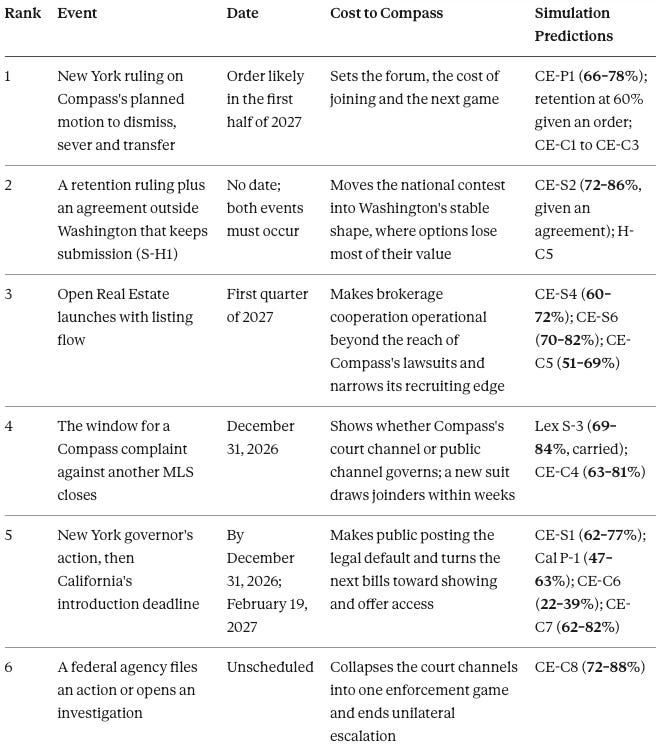
Two earlier dates run on the separate securities clock and leave the board unchanged. Compass files its third-quarter 10-Q on November 5 (Magloire P-1 at 70–82%), and lead-plaintiff motions fall due on December 8 (Magloire P-2 at 66–78%).
The second-ranked event joins two forks into one state, S-H1. A retention order (S-A1) activates the branch while CE-P1 still resolves on the May 3, 2027 docket, and the agreement resolves CE-S2 against its terms. H-C5 then meets its test: the national tree should gain continuations with a specified mechanism at depth two. CE-S5’s probabilities reopen at the event report, because S-H1 moves weight toward Washington-like cooperation.
S-H1 also marks the point at which Compass gains more from committing than from waiting. Before S-H1, each open forum and unsettled statute keeps an option alive, and waiting pays. After S-H1, a submission-preserving status negotiated early captures more of the stable game than a status accepted late. The Calculus’s early-committer result (60%) applies to Compass at that point (interpretive reading, 65–75% confidence).
H-C7 and H-C8 test whether Compass moves at that date or a cycle after it.
B. Most Coming Events Evolve the Game Rather Than Replace It
Events differ in how far they move the game. Continuation updates information or odds inside the current game. Equilibrium migration changes which outcome persists without replacing the game. Both count as game evolution, and every coming event is one or the other.
Mutation is reserved for an anomaly: a move through an option or a player the simulation classified as unavailable. Two anomalies would qualify. Compass could accept ORE’s one-business-day rule with no members-only window. A national portal or trade association could also end MLS-level cooperation rules on its own authority.
Either anomaly would reopen the simulation rather than activate a mapped state. The classification keeps every ruling from being read as a new game while leaving room for a real break.
C. Six Events Can Create Twelve Successor States
Six events of known type govern the next fifteen months. Four arrive on a calendar, and two can arrive at any time.
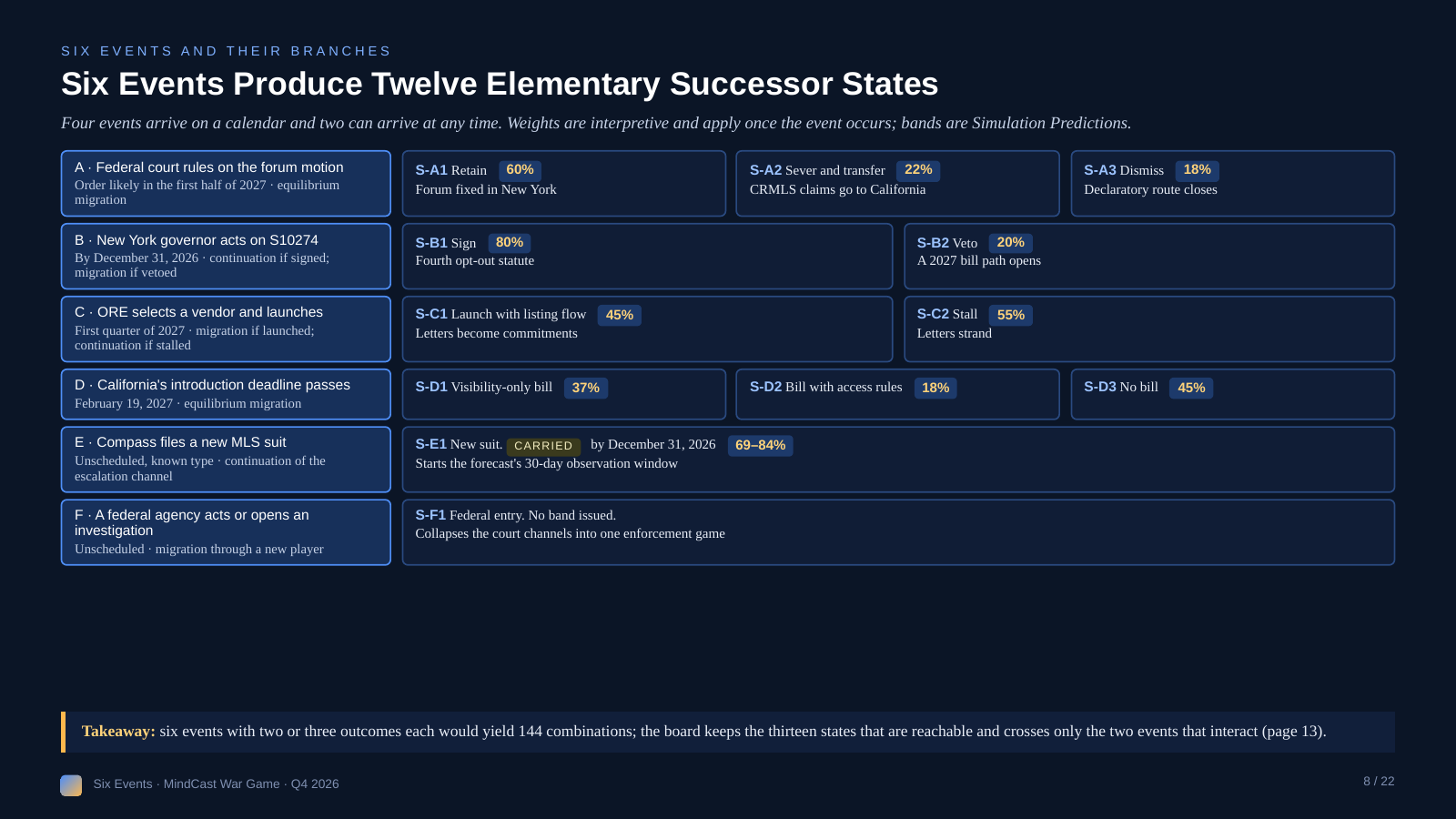
Figure 8. Six events and their twelve elementary successor states with the interpretive weights that apply once each event occurs. Source: MindCast Compass MLS War Game.
The Event A probabilities apply once an order issues. CE-P1 also counts a case still pending on May 3, 2027 as retained. The securities case runs on its own schedule and creates no successor state on the MLS board.
The board keeps reachable states rather than every combination. Six events with two or three outcomes each would yield 144 combinations if each varied independently. The New York governor’s action, ORE’s launch and California’s introduction each move a different front, so their states stand alone.
The forum ruling and a new Compass suit interact. Retention lowers the value of a new suit, while transfer or dismissal raises it. The board therefore crosses only those two events, and federal entry collapses the court channels into one enforcement game when it arrives.
D. Each Event Carries Five Entries for Every Affected Institution
Each event table carries five entries per successor state. The entries first name what changes and which paths open or close. The entries then name the positions that survive, convert or strand. Each table closes with the moves each institution gains or loses and the conditional Simulation Predictions that activate.
Event A. The forum ruling
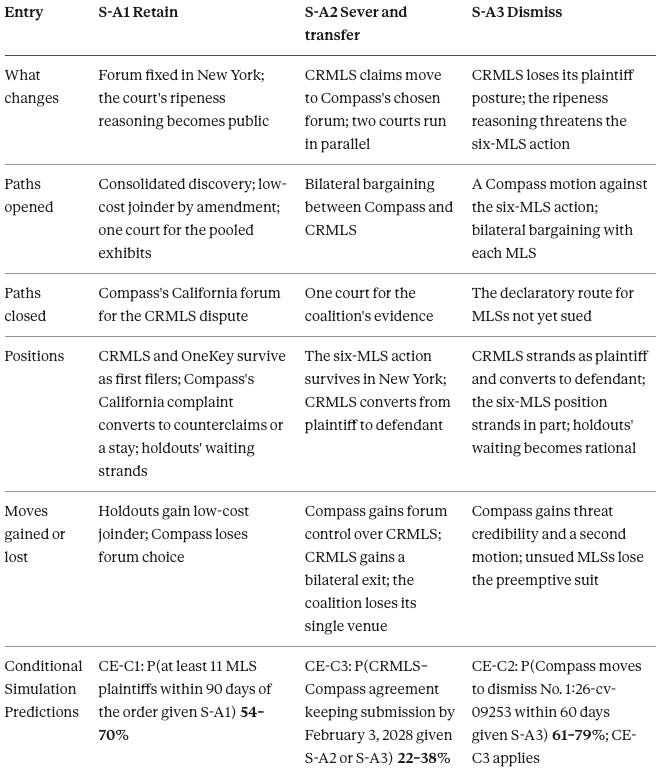
Event A leaves five institutions unchanged: independent brokerages, legislatures and the securities parties, plus Zillow and the National Association of Realtors.
Event B. The New York governor’s action
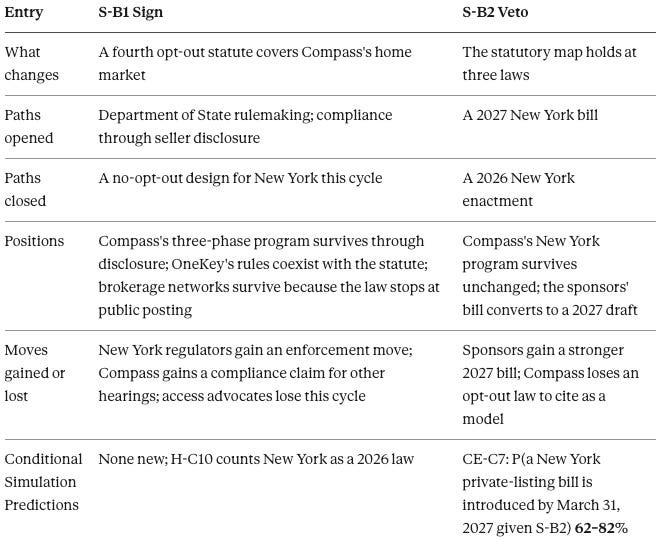
The courts, ORE and the MLS plaintiffs keep their positions and moves under both Event B states.
Event C. ORE’s launch
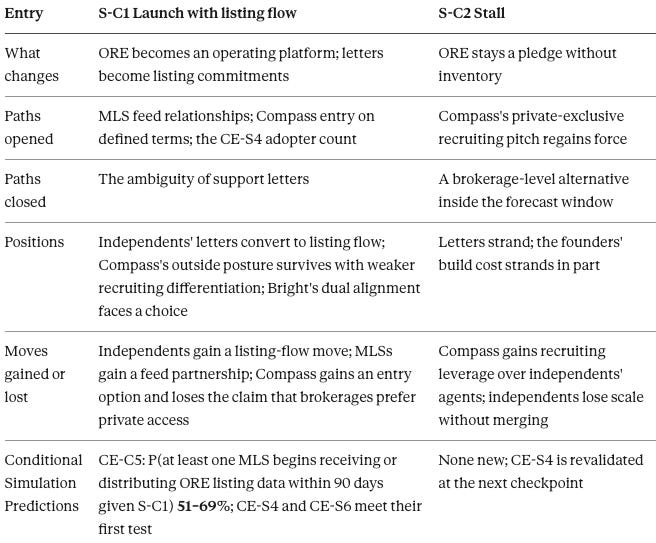
The courts, legislatures and securities parties keep their positions and moves under both Event C states.
Event D. California’s introduction deadline
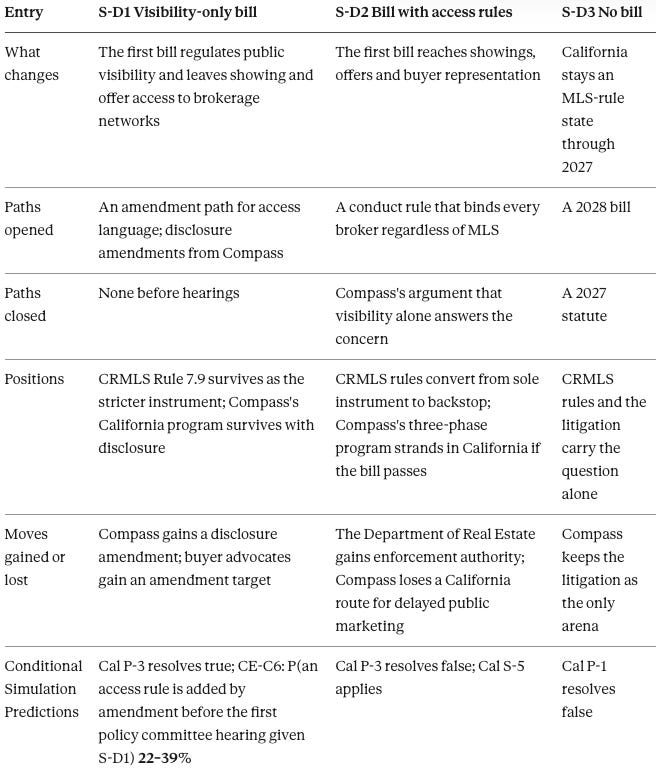
The New York actions, ORE and the securities parties keep their positions and moves under every Event D state.
Events E and F. A new Compass suit and federal entry
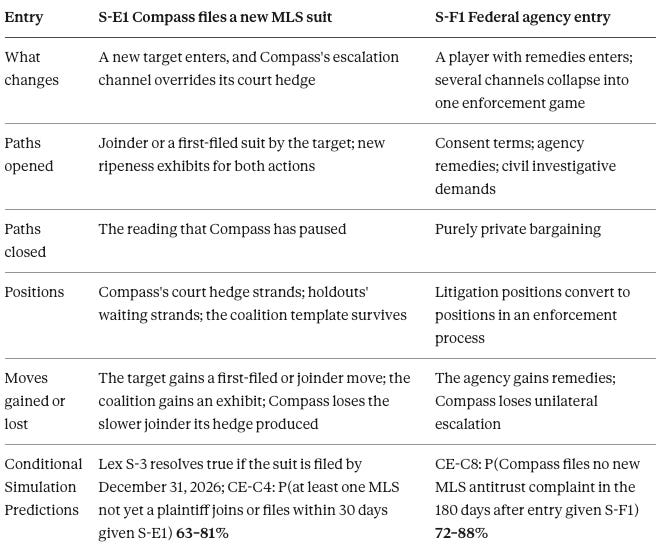
Lex S-3 tests a new Compass suit before the forum ruling, through December 31, 2026. After the ruling in 2027, S-E1 becomes more reachable from S-A2 or S-A3 than from S-A1. S-F1 can arrive in any state and reopens every forum prediction at its event report.
E. Each Successor State Inherits a Defined Prediction Set
Every successor state names the Simulation Predictions it resolves, keeps, activates and reopens. Explicit inheritance prevents two branches from assuming different authority or options for the same institution.
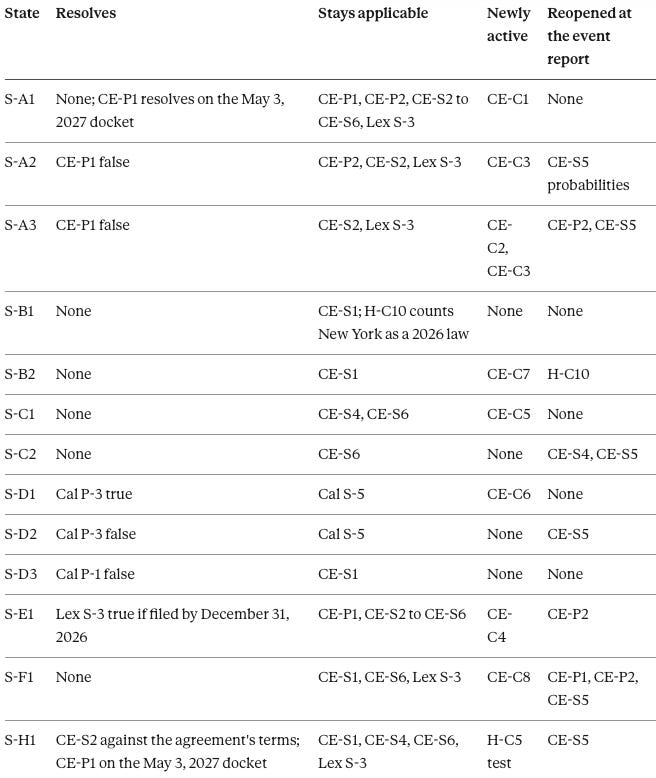
A reopened band is tested again at the event report and replaced only by a new Simulation Prediction conditioned on the new state.
F. The Mapped Board Runs as a War Game Because Compass Adapts to Each Move
Every successor state names the moves each affected institution gains or loses. A war-game seat for an MLS board, a brokerage, a legislature or Compass therefore enters each state with a defined option set. A move closed by an event stays unavailable until a later event reopens it, and each event table names the event that would reopen it.
Compass does not replay its history against every seat. Compass’s CDT chooses among its observed operators and strategically coherent alternatives, and each choice activates a mapped state or Simulation Prediction. The two tables below give the MLS board and the independent brokerage their four moves and Compass’s coherent answers to each.
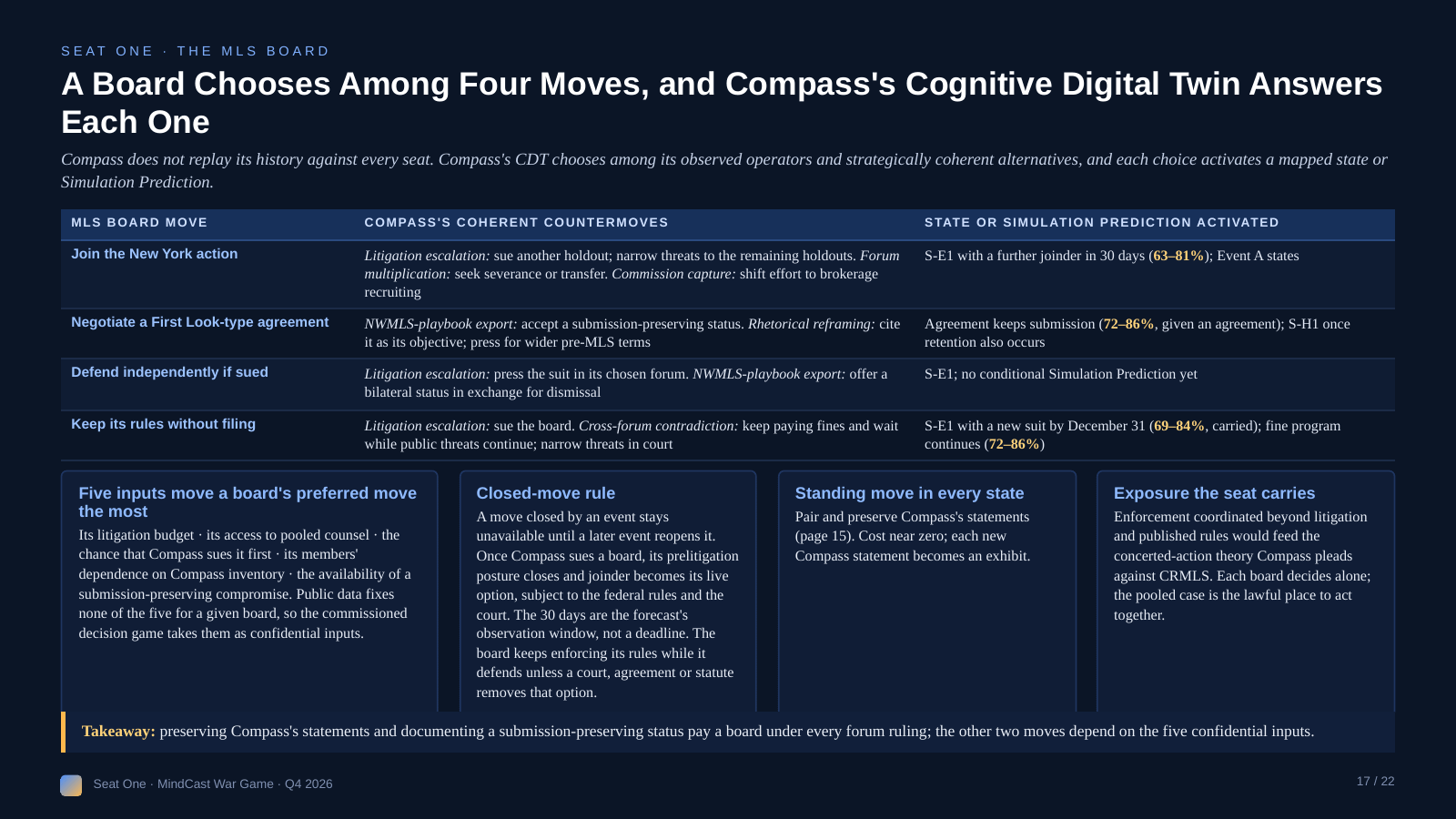
Figure 9. Seat one, the MLS board: four moves against Compass’s countermoves by operator and the state or Simulation Prediction each activates. Source: MindCast Compass MLS War Game.
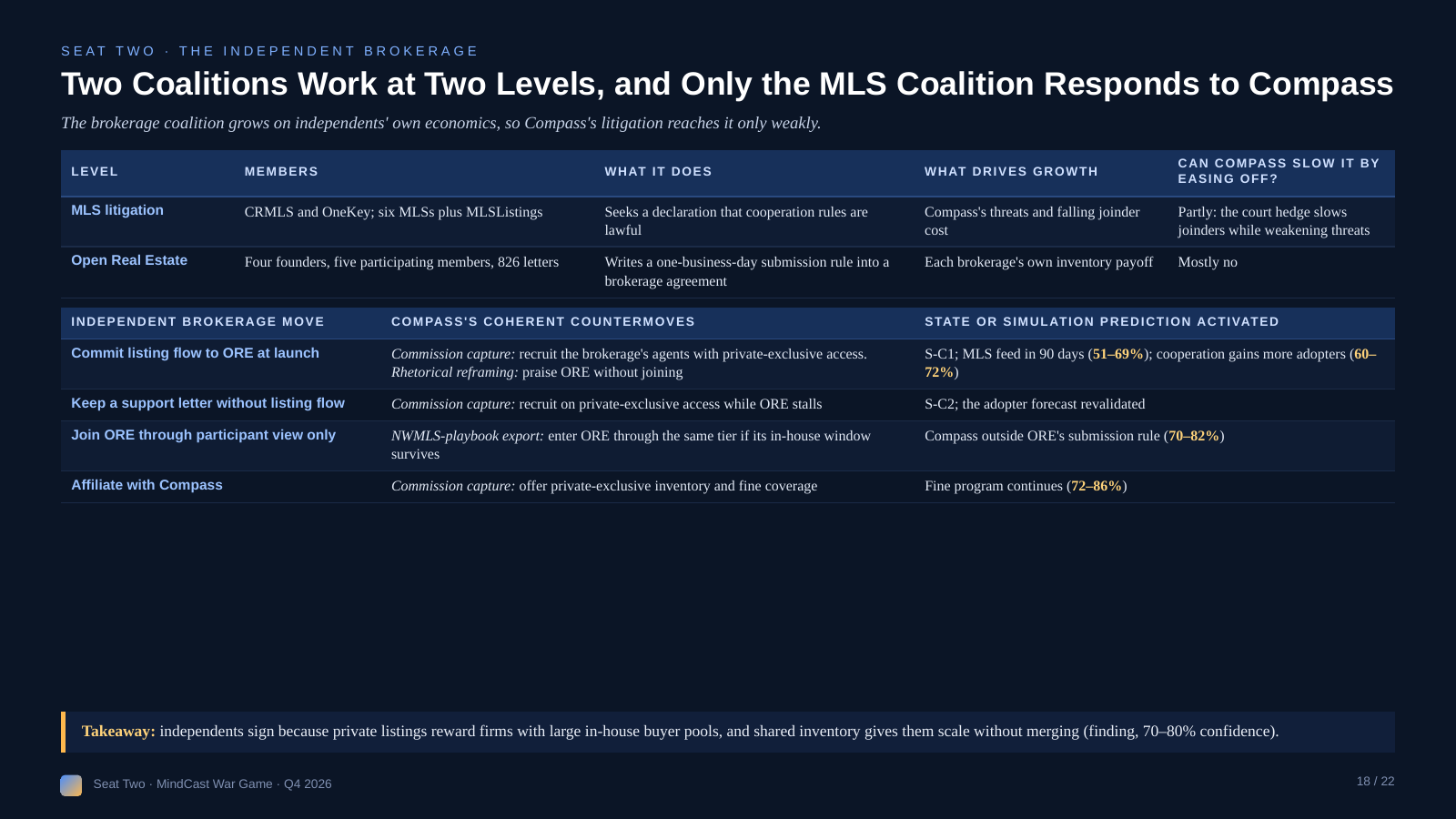
Figure 10. Seat two, the independent brokerage: the two coalitions beside four moves against Compass’s countermoves. Source: MindCast Compass MLS War Game.
Players choose among those moves while Compass’s CDT answers, and the next event table governs the result.
Five inputs move a board’s preferred move the most:
its litigation budget
its access to pooled counsel
the chance that Compass sues it first
its members’ dependence on Compass inventory
the availability of a submission-preserving compromise
Public data fixes none of the five for a given board. The commissioned decision game takes them as confidential inputs.
🏛 Policymakers read Events B and D. 💼 Executives read Event C. ⚖ Counsel read Events A, E and F, and 📊 Investors read Event F beside the separate securities clock.
G. Each Successor State Changes What an MLS Board and an Independent Brokerage Can Do
The map below reads every successor state from the two seats that face Compass most directly. Each row names the trigger, what changes for each seat and the conditional Simulation Predictions that apply.
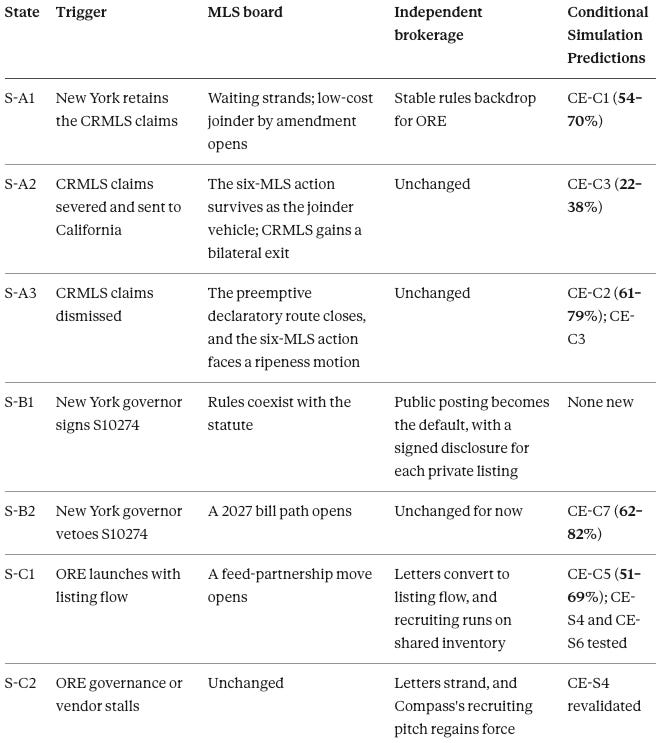
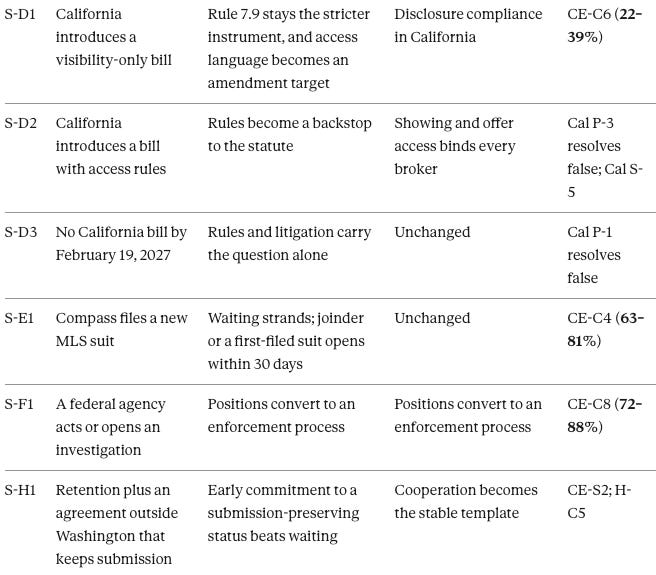
Each checkpoint redraws the event tables and this map from the state the events actually produced, so the war game always starts from the current board.
🗂️ MLS Leaders. Event A sets the forum, and Event E opens a 30-day joinder window.
💼 Executives. Event C decides whether support letters become listing flow.
🏛 Policymakers. Events B and D decide whether public posting becomes the legal default in New York and California.
⚖ Counsel. S-A2 gives CRMLS a bilateral exit, and S-A3 exposes the six-MLS action to a ripeness motion.
📊 Investors. Event F would convert regulatory positions into an enforcement process.
V. What the Simulation Means for Each Stakeholder Before the Forum Ruling
Each audience faces a different exposure before the New York court rules on the forum. The consequences below follow from the Simulation Predictions, and the actions that answer them sit in Section VII.
A. Each Stakeholder Faces a Different Exposure Before the Forum Ruling
MLS boards and counsel. Objective: Keep cooperation rules enforceable. What the findings mean: Compass’s threats now recruit plaintiffs more than they deter them, and access to the pooled New York action decides whether a threatened board fights alone. Linked entries: CE-P2, Lex S-3, H-C17.
Brokerage executives. Objective: Listing reach without lock-in. What the findings mean: Cooperation pays independents whatever Compass does in court, but support letters create no listing flow until ORE launches. Linked entries: CE-S4, CE-S6, H-C16.
State policymakers. Objective: Transparent markets with seller choice. What the findings mean: Opt-out laws already make public posting the default and document every private exception; the first 2027 bills regulate visibility and leave showing and offer access for the next round. Linked entries: CE-S1, Cal P-3, H-C10.
Compass. Objective: Preserve differentiated marketing. What the findings mean: Each local win raises participation by institutions not yet involved, and habits built against single targets persist after the targets pooled their defense. Linked entries: H-C7, H-C8, H-C13.
Investors. Objective: Separate legal clocks. What the findings mean: The Magloire case keeps a clock separate from the MLS litigation. Linked entries: CE-S3, Magloire P-2.
B. Listing-Service Boards Face Compass From a Stronger Position Than the Northwest Multiple Listing Service Held
MLS boards carry rule integrity as their reference point and face Compass’s demand letters as live evidence. Their leverage lies in pooled evidence: every Compass statement in one forum becomes usable in another. Their constraint lies in antitrust law itself, because agreements among MLSs on how to answer Compass carry group-boycott exposure, while joining a lawsuit and petitioning a legislature stay protected.
The court hedge also leaves holdouts exposed if Compass later sues them in a forum it picks. Dated filings show that access to the pooled New York action, more than the threat itself, decides whether a threatened board fights alone (H-C17). An MLS board now faces Compass with a shared venue that NWMLS never had.
C. Brokerages Gain From Cooperation Whatever Compass Does in Court
ORE entry is free and reversible at the support-letter stage, while listing-flow commitments depend on governance and vendor terms not yet written. Independents hold the strongest position in the agreement, because shared inventory gives them scale without merging and blunts the recruiting pitch built on Compass’s private exclusives (H-C16). Vendor selection in the first quarter of 2027 decides whether that position turns into listing flow.
D. Lawmakers Inherit a Map Tilted Toward Opt-Out Laws
Legislators enter 2027 with Washington’s hearing record and four enacted or passed statutes to compare. The disclosure opt-out is spreading faster than Washington’s no-opt-out rule (H-C10), and every version so far makes public posting the default. Simultaneous sessions also make coordinated sign-in campaigns easier to detect (H-C9). Washington’s grassroots lobbying disclosure statute (RCW 29B.50.100, effective January 1, 2026) offers one model for disclosure.
E. Investors Face Two Clocks That Do Not Merge
The Magloire case runs inside established securities rules, and the series classifies it as a boundary case that lengthens once lead counsel fixes the theory. The MLS litigation runs as a short horizon game and the securities case as a schedule-bound one, so their signals do not combine.
Every audience gains from treating the forum ruling as the dominant fork, because each exposure above changes shape once the court rules.
VI. Rule-Setting Authority, Strategic Advantage and Payoffs All Shift Away From Compass
Authority, interaction and distribution all shift away from Compass, and each falsifier names the strategy that changes.
A. Authority Shifts From the Initiator to the Forum and the Statehouse
The contest’s rule-setting authority has moved away from Compass. Courts now decide forum and justiciability (H-C1, H-C3), and legislatures decide which statutory model governs broker conduct (H-C10). Washington shows that a statute can constrain broker conduct whatever an MLS rule says, which gives legislatures a route around the litigation entirely.
B. Strategic Interaction Rewards the Side That Reads the Pooled Evidence
Compass’s court hedge and its public threats now coexist, and each audience can read both. Counterparties respond by pairing statements across forums, which raises the cost of every new contradiction.
Each ruling also changes which institutions take part in the game that follows. Under a retention ruling, MLSs holding demand letters move first because joinder by amendment costs little, and holdouts then choose between joining and waiting as each joinder lowers the next one’s cost. A dismissal ruling would produce the same procedural winner and a different board, with holdouts staying out and Compass regaining bilateral bargaining.
Albert Hirschman showed in Exit, Voice, and Loyalty (1970) that members of a declining organization choose between exit and voice. His 1993 World Politics essay on East Germany added the case that matters most for forecasting: mass flight and mass protest fed each other until the regime fell. MindCast applies the same logic to rulings and rules, because the institutions that stay, leave or switch sides after a decision decide which game actually gets played.
C. Distribution Favors Institutions That Commit Reversibly Now
MLS boards capture value by preserving Compass’s statements at almost no cost. Brokerages capture value by holding reversible ORE options. Compass absorbs the cost of fines it pays and of contradictions it creates, while its opponents absorb coordination burden. Option preservation beats commitment for every actor except where a holding ruling arrives, after which early commitment to the supported path tends to pay.
D. Falsifier Consequences Tell Each Reader How to Change Course
If H-C4 fails and joinders track board calendars rather than Compass’s signals, coalition growth rests on governance capacity, and Compass’s hedge loses its slowing effect. If H-C9 fails, coordinated campaigns remain effective across states, and legislators need verification tools before volume can be discounted. If H-C5 fails after both events occur, the national contest stays in short horizon shape longer than the Washington analogy implies, and planners should shorten horizons.
The implications show that a correct read of the board pays before any merits ruling, and that each falsifier names the strategy that changes.
🗂️ MLS Leaders. Authority now sits with the forum, so boards gain by reading the pooled evidence early.
💼 Executives. Reversible commitments made now pay more than late commitments after the game stabilizes.
🏛 Policymakers. Each statute sets a default that MLS rules and litigation must work around.
⚖ Counsel. If H-C4 fails, Compass’s court statements stop slowing joinders, and joinder advice should follow board calendars instead.
📊 Investors. Litigation and fine costs show the payoff shift before any merits ruling.
VII. Risk Mitigation: Each Audience Can Act Before Its Window Closes
Each audience holds unilateral moves that reduce its exposure before the dominant fork resolves. The time-gate list orders the moves by horizon, and the entries that follow route each Simulation Prediction to the audience it binds.
Now–30 days. Risk to contain: Statements lost or unpaired. Mitigation: Preserve and pair Compass court and public statements. Escalation trigger: Compass Q3 call on November 5.
30–90 days. Risk to contain: Holdouts exposed to a forum Compass picks. Mitigation: Board-level joinder review; documented phased-marketing option. Escalation trigger: New Compass suit; forum ruling (H-C4)
3–12 months. Risk to contain: Coalition coordination burden; legislative volume campaigns. Mitigation: Fund governance terms; cross-state sign-in comparison. Escalation trigger: Coalition withdrawal; identical amendment text (H-C9)
Beyond 12 months. Risk to contain: Equilibrium lock-in on the wrong template. Mitigation: Commit to the supported template once both crossing events occur. Escalation trigger: Holding ruling plus an agreement outside Washington (H-C5)
Each entry routes one Simulation Prediction to the audience it binds. Severity and probability appear as separate axes. Exposure states what the audience loses if the prediction resolves true and it did nothing.
CE-P1 · The CRMLS claims stay in New York · 66–78% · ⚖ MLS counsel
Exposure: discovery in New York reaches CRMLS and OneKey enforcement files from 2024 forward, scoped by a court the coalition chose but cannot narrow alone.
Mitigating actions: the general counsel issues litigation holds on enforcement files and Compass correspondence before the opposition brief is due. Outside counsel pairs each Compass public statement with the pleading position it contradicts before the first scheduling conference. The board approves a defense budget through May 3, 2027 before the order issues.
Expected Compass countermove: Compass seeks severance and transfer of the CRMLS claims to the Central District of California (S-A2).
Residual exposure: discovery runs both ways, and Compass gains access to the MLSs’ own rule history.
Severity: medium · Probability: the CE-P1 band.
CE-P2 · At least 11 MLS plaintiffs · 47–61% · 🗂️ Holdout MLS boards
Exposure: a board that waits and is later sued alone defends in a forum Compass picks, carrying the full cost of a single-party defense for a year or more.
Mitigating actions: board counsel prepares a joinder-ready amended-complaint insert by January 31, 2027, with the decision to file reserved to the board alone. The treasurer sets a reserve covering six months of defense before May 3, 2027. Staff document the board’s own rule rationale without consulting other boards on how to answer Compass.
Expected Compass countermove: Compass sues a holdout first in a forum it picks (S-E1).
Residual exposure: joining adds coordination burden and discovery exposure that a lone defense avoids.
Severity: high for a sued board · Probability: the CE-P2 band.
Lex S-3 · Compass files against another MLS by December 31, 2026 · 69–84% (carried) · 🗂️ MLSs fining Compass agents
Exposure: a suit in Compass’s chosen forum before year-end, with defense costs beginning before the board has a litigation plan.
Mitigating actions: the general counsel drafts a declaratory complaint by December 15, 2026, with any filing reserved to the board. Compliance staff document the rule basis of each Compass fine as it issues. The communications director limits public statements about Compass to the text of the rule.
Expected Compass countermove: Compass files before the board’s draft complaint is ready.
Residual exposure: a draft does not stop Compass from filing first.
Severity: high · Probability: the Lex S-3 band.
CE-S1 · No second Washington-style statute by August 3, 2027 · 62–77% · 🏛 State legislators and committee staff
Exposure: access questions stay with MLS rules and federal litigation for at least one more session calendar.
Mitigating actions: committee staff request bill drafting that defines public marketing and showing access before each state’s introduction deadline. Fiscal staff obtain an agency workload estimate before the first hearing. The chair’s office compares sign-in lists and amendment text across states before weighing testimony volume.
Expected Compass countermove: Compass presses opt-out amendment language, as it did in Washington.
Residual exposure: an opt-out statute can pass that leaves showing and offer access untouched.
Severity: medium · Probability: the CE-S1 band.
CE-S2 · An agreement outside Washington keeps submission · P(submission kept given an agreement) 72–86% · 💼 Brokerage operations executives
Exposure: brokerages that built workflows around unsubmitted private listings rebuild them around submission plus a status window, costing one to two quarters of rework.
Mitigating actions: the chief operating officer designs listing workflows that run under submission plus a delayed-status window by March 31, 2027. The technology lead confirms that listing feeds carry a First Look-type status before the first agreement outside Washington.
Expected Compass countermove: Compass negotiates terms that differ MLS by MLS.
Residual exposure: status rules will differ by MLS, so one workflow will not fit every market.
Severity: medium · Probability: the CE-S2 band, conditional on an agreement.
CE-S3 · Compass keeps paying CRMLS fines · 72–86% · 📊 Investors and analysts
Exposure: a recurring cost of undisclosed size runs through at least three more quarters, with its litigation value unmeasured.
Mitigating actions: analysts ask for quarterly fine-payment totals on each earnings call beginning November 5, 2026. Valuation models carry the payments as a recurring operating cost through May 3, 2027 rather than a one-time charge.
Expected Compass countermove: Compass keeps the payments unitemized in its filings.
Residual exposure: the payments also buy litigation claims, and no disclosure separates the two.
Severity: low to medium · Probability: the CE-S3 band.
CE-S4 · Cooperation arrangements gain more adopters · 60–72% · 💼 Independent brokerage owners
Exposure: brokerages that recruit on private access lose that differentiation, measured in agents lost per recruiting cycle.
Mitigating actions: the broker-owner decides an ORE listing-flow commitment at vendor selection in the first quarter of 2027. The recruiting lead removes private-access claims from recruiting materials before ORE launches.
Expected Compass countermove: Compass recruits on private exclusives during an ORE stall (S-C2).
Residual exposure: ORE may stall (S-C2), leaving the commitment without a working platform.
Severity: medium · Probability: the CE-S4 band.
CE-S5 · Fragmented accommodation describes the market at February 2028 · 30–42% · ⚖ Brokerage compliance counsel
Exposure: compliance runs rule by rule across MLSs and statute by statute across states, multiplying the rule sets each office must follow.
Mitigating actions: the compliance officer maps each MLS rule and state statute in the brokerage’s markets by March 31, 2027. The general counsel drafts state-specific seller disclosure forms before each statute’s effective date.
Expected Compass countermove: Compass runs differentiated programs market by market where local rules permit.
Residual exposure: the rule sets change at every checkpoint, so the map ages quickly.
Severity: medium · Probability: the CE-S5 band.
CE-S6 · Compass stays outside ORE’s submission rule · 70–82% · 💼 ORE founders
Exposure: ORE’s inventory excludes Compass listings, leaving coverage gaps in Compass-heavy metros.
Mitigating actions: the governance committee writes the one-business-day rule and participant-view terms into governance documents before launch, open to every brokerage on uniform terms. The partnerships lead secures MLS feed agreements in Compass-heavy markets before launch.
Expected Compass countermove: Compass seeks entry through ORE’s participant-view tier if its in-house window survives.
Residual exposure: Compass inventory stays outside in those metros until Compass accepts the rule.
Severity: medium · Probability: the CE-S6 band.
One Decision, Step by Step: A Board That Prepares Before a Compass Suit Joins the Pooled Action
The holdout board is the clearest case of an action that changes the path. The four steps below follow one board from Compass’s demand letter to its next move.
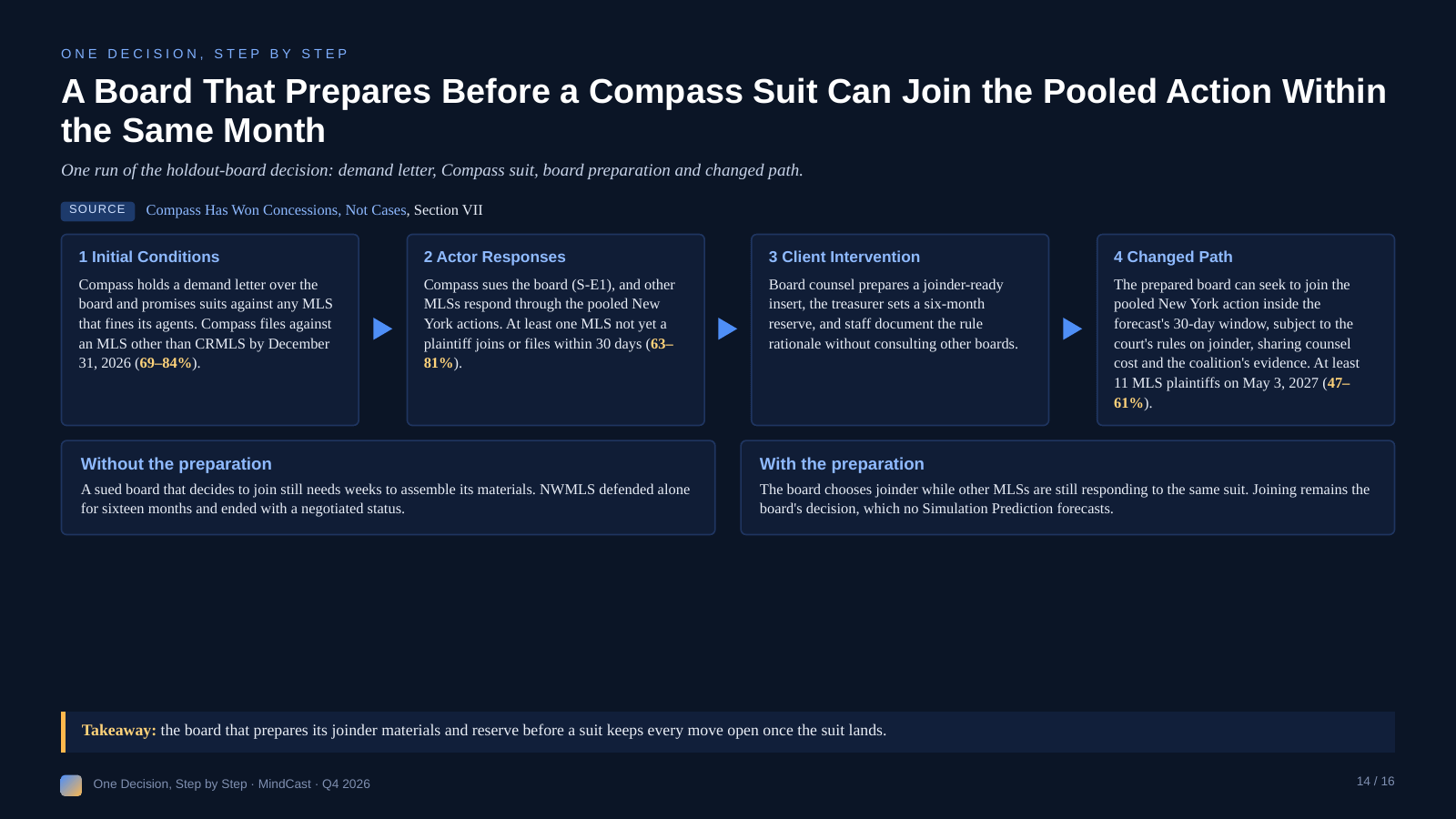
Figure 11. One decision, step by step: a holdout board from Compass’s demand letter to its next move. Source: MindCast Compass MLS Value Proposition.
Without the preparation, a sued board that decides to join still needs weeks to assemble its materials, and NWMLS defended alone for sixteen months. With it, the board can choose joinder while other MLSs are still responding to the same suit.
The conditional Simulation Predictions in Section IV inherit the entry of the Simulation Prediction they condition, and the moves listed in each event table serve as their state-specific mitigations.
What to Watch: The New York Forum Ruling Is the Dominant Fork
The New York ruling on Compass’s planned motion to dismiss, sever and transfer is the dominant fork. The ruling sets the forum, the joinder cost and the next game.
Developments from October 23 to November 4, 2026. Seven developments bear on the Simulation Predictions without changing any band.
The Council of MLSs is forming a legal action fund above $1 million for MLS-industry legal matters; grant applications are not yet open. Date: October 23. Linked ID: H-C4, H-C17. Reading: Lowers the cost of joining or defending for boards without their own fund.
Compass says seven of the top 25 MLSs allow office exclusives without fines, covering 340,000 agents in 12 states. Date: November 2. Linked ID: H-C17. Reading: Names the aligned bloc Compass cites against the plaintiffs.
Three Compass-affiliated Los Angeles agents will ask a court on November 20 to quash NAR subpoenas in NAR’s case against ThePLS.com. Date: October 30. Linked ID: H-C12. Reading: NAR seeks listing agreements that would show whether off-MLS marketing followed seller instruction.
ORE targets a first-quarter 2027 launch and reports talks with brokerages about joining, Compass among them. Date: November 2. Linked ID: CE-S6, CE-C5. Reading: Keeps the CE-S6 falsifier live.
No governor action on New York’s S10274 was found. Date: November 4. Linked ID: H-C10, Event B. Reading: Event B remains open.
No Compass complaint against Unlock MLS or another MLS was found; Compass said on October 7 that it plans to sue Unlock. Date: November 4. Linked ID: Lex S-3, CE-C4. Reading: The Lex S-3 window runs through December 31.
The filed Magloire complaint pleads Securities Act claims for former Anywhere holders; some law-firm notices describe a purchaser class or Exchange Act claims. Date: November 3. Linked ID: Magloire S-3. Reading: S-3 stays unresolved until an Exchange Act complaint appears on a docket.
The pattern since October 26 favors the coalition side. The MLS side added financing through the Council of MLSs and a discovery channel through NAR’s subpoenas, while Compass added public claims about an aligned bloc (interpretive reading, 60–70% confidence). Congressional and consumer-group pressure continues without an agency action. The Consumer Federation of America petitioned the DOJ and FTC on July 1, and a House Judiciary subcommittee requested a briefing from the Compass and MRED chief executives.
Each signal below names its linked Simulation Prediction or hypothesis, its source, its cadence and what it updates.
New amended complaints or standalone suits. Linked ID: H-C4, H-C1. Source: S.D.N.Y. dockets. Cadence: Weekly. Update consequence: Channel B state; H-C4 evidence.
Compass complaint against an MLS other than CRMLS. Linked ID: Lex S-3, CE-C4. Source: PACER and state dockets. Cadence: Weekly through December 31, 2026. Update consequence: Escalation channel; successor state S-E1.
Ruling on dismissal, severance or transfer. Linked ID: H-C5 · H-C3 · CE-C1 to CE-C3. Source: 1:26-cv-08796. Cadence: On entry. Update consequence: Channel A branch; tree reissue; successor state S-A1, S-A2 or S-A3.
Any Section IV event. Linked ID: CE-C1 to CE-C8. Source: Event tables in Section IV. Cadence: On entry. Update consequence: Activates the successor state and its inherited prediction set.
Federal antitrust complaint, FTC inquiry or state attorney general action. Linked ID: Magloire S-5, S-6. Source: Agency releases; dockets. Cadence: On entry. Update consequence: Channel G; event report; front ratings.
Private-marketing duration, buyer-representation origin and incremental in-house capture by listing cohort.Linked ID: H-C12, H-C14. Source: MLS data; commissioned datasets. Cadence: Quarterly. Update consequence: Listing-economics front.
Compass private-listing and Coming Soon share; same-brokerage double-ending rates. Linked ID: H-C12. Source: Earnings calls; MLS data. Cadence: Quarterly. Update consequence: Commission-capture front.
Compass Q3 call and 10-Q. Linked ID: Magloire P-1, H-C7, H-C12. Source: SEC filings. Cadence: November 5, 2026. Update consequence: Channel E; disclosure divergence; Coming Soon share against the 80% projection.
Lead plaintiff appointment. Linked ID: Magloire P-2. Source: 1:26-cv-08885. Cadence: After December 8. Update consequence: Channel E.
ORE vendor selection and participant list. Linked ID: ORE P-6, S-10, CE-S6. Source: ORE announcements. Cadence: Monthly. Update consequence: Channel D.
ORE letters by firm type; listing flow after launch. Linked ID: CE-S4, H-C16. Source: ORE announcements. Cadence: Monthly. Update consequence: Brokerage-level coalition.
Dated pairs of Compass threats and MLS responses. Linked ID: H-C17, H-C4. Source: Dockets; MLS and Compass releases. Cadence: Weekly. Update consequence: Direction of MLS response.
Sign-in lists and amendment text by state. Linked ID: H-C9, H-C10. Source: Legislative records. Cadence: Per hearing. Update consequence: Channel F.
New York governor’s action on the opt-out bill. Linked ID: H-C10. Source: New York legislative record. Cadence: On action. Update consequence: Channel F map.
Motion to quash NAR subpoenas to Compass-affiliated agents. Linked ID: H-C12. Source: NAR v. ThePLS.com docket. Cadence: November 20, 2026. Update consequence: Seller-instruction evidence.
Council of MLSs fund grants. Linked ID: H-C4, H-C17. Source: CMLS announcements. Cadence: Monthly. Update consequence: Joinder and defense cost.
State legislation is tracked in four stages: introduction, content, passage and implementation. Each stage resolves on its own date and source.
New York. Introduction: Passed both chambers June 1, 2026. Content: Seller opt-out with disclosure; no rule on marketing after public posting. Passage: Governor’s action on S10274 (H-C10 count) Implementation: Department of State rules; MLS and brokerage practice.
California. Introduction: Cal P-1 by the 2027 introduction deadline. Content: Cal P-3; Cal S-5. Passage: Signing season September to October 2027. Implementation: End-2027 weights: rules vary by MLS 52%.
Illinois and Hawaii. Introduction: Reintroduction after 2026 bills died. Content: Opt-out or no-opt-out model. Passage: CE-S1; H-C10. Implementation: MLS rule changes after enactment.
Other states. Introduction: New bills in the 2027 sessions. Content: Visibility only, or showing and offer access. Passage: CE-S1; H-C10. Implementation: MLS rule changes after enactment.
All hearings. Introduction: Sign-in lists and amendment text. Content: Identical language across states. Passage: H-C9 watch condition. Implementation: Committee findings in hearing files.
Checkpoint 1 in February 2027 covers the first forum rulings and the opening weeks of the 2027 sessions. Checkpoint 2 in May 2027 covers coalition durability, the FY2026 10-K and ORE vendor selection. Checkpoint 3 in August 2027 covers legislative outcomes and ORE adoption. Checkpoint 4 in November 2027 and Checkpoint 5 in February 2028 test whether a durable equilibrium has formed.
Each checkpoint reissues both trees and rates the seven fronts. Each also reports resolved hypotheses at full weight and states whether the usable horizon expanded, contracted or held.
The revision protocol keeps every original statement, class, window and falsifier. Each update states the new observation, the judgment on what caused the change, the field changed and the hypotheses affected. An update that alters a stakeholder’s action triggers a published revision note. An event report names the successor state reached and applies the inheritance table in Section IV.E.
Conclusion: The First Forum Ruling Decides How Far Any Forecast Can Reach
Compass’s NWMLS playbook required a lone target, and the target population no longer stands alone. Nine MLS plaintiffs in New York, a consortium Compass has not joined and simultaneous 2027 legislative sessions now set the forum, timing and evidence around Compass.
The consortium’s growth runs on independents’ own economics, so Compass’s litigation reaches it only weakly. Compass has won concessions and procedural rounds, never a merits judgment. Compass no longer sets the terms under which its disputes are decided, and its strategy pays most while the game those terms govern stays unresolved.
Stakeholders act now on moves that hold across branches: preserve and pair Compass’s statements, keep consortium commitments reversible, and test hearing testimony across states. Stakeholders then wait to learn which forum holds the CRMLS dispute, whether an agreement outside Washington preserves submission, and which statutory model the 2027 sessions choose.
The decisive signal is the ruling on Compass’s request to dismiss, sever and transfer the CRMLS and OneKey case. A holding ruling paired with a submission-preserving agreement outside Washington would move the national contest toward Washington’s shape. Neither event alone would.
Checkpoint 1 of the Compass Equilibrium Series in February 2027 will rate the seven fronts against the first rulings and the opening of the 2027 sessions.
Working With MindCast: Commissioned Runs Keyed to the Simulation Predictions
Every MLS board holding a Compass demand letter faces a decision the public paper cannot make for it. Each option depends on member economics, governance rules and litigation resources that only the board holds. The options run from joining a coalition or refusing without suing to building a phased-marketing status or negotiating alone. The same holds for a brokerage weighing ORE against its recruiting position, and for a legislative committee weighing testimony volume against its authenticity.
A commissioned run builds a Cognitive Digital Twin of the commissioning institution from its own rules, budget and history, then replays the contest against that institution’s actual options. The run models Compass’s likely responses with its observed operators and with strategically coherent alternatives, so the institution sees how each option performs if Compass adapts. The paper’s hypotheses become the institution’s own triggers.
The series runs as three connected layers: public intelligence, predictive simulation and an institutional war game. Commissioned scope adds two things. Complete probability distributions and P10/P50/P90 ranges come with organization-specific inputs. Complete scenario trees come with decision thresholds, trigger dashboards and red-team tests.
An interactive war game extends the run, seating the institution against Compass CDTs that move through their documented operators. Two companion decks carry this paper’s board: the MindCast Compass MLS Value Propositionand the MindCast Compass MLS War Game, which draws both horizon trees, the six events and the thirteen successor states. The interactive war game runs the turn sequence on the same board from three seats. The MindCast Prediction Scorecard dated November 1, 2026 shows 40 hits, 8 partials and 6 misses on material Simulation Predictions across all practice areas.
MLS board holding a demand letter. Decision a commissioned run tests: Join the New York action, negotiate a First Look-type agreement, defend independently if sued or keep its rules without filing. Linked Simulation Predictions: CE-P2 · CE-C1 · CE-C4 · Lex S-3.
Brokerage weighing ORE. Decision a commissioned run tests: Listing-flow commitment and recruiting position. Linked Simulation Predictions: CE-S4, CE-S6, CE-C5.
Legislative committee. Decision a commissioned run tests: Statutory model and review of testimony. Linked Simulation Predictions: CE-S1 · CE-C6 · CE-C7 · Cal P-1.
Counsel in either New York action. Decision a commissioned run tests: Forum strategy and pairing of statements. Linked Simulation Predictions: CE-P1, CE-C2, CE-C3.
Investors. Decision a commissioned run tests: Reading the securities clock apart from the MLS fight. Linked Simulation Predictions: CE-S3, Magloire P-2.
About MindCast. MindCast AI models how courts, listing services, brokerages and legislatures respond to one another. Each run shows both the opportunities a client can capture and the exposures it can reduce. Noel Le, Founder and Architect, studied law and economics with a focus on game theory. He holds a J.D. from John Marshall Law School and a B.A. from the University of Chicago, and he worked at Amazon, Boeing and Microsoft.
Le has testified before the Washington State Legislature and published in the CPI Antitrust Chronicle. MindCast holds a provisional patent application on its Cognitive Digital Twin architecture.
The MLS-board decision game is the first commissioned offering. It seats a board against an adapting Compass CDT and compares the four board moves in IV.F under the same Compass responses.
A complimentary pilot comes before any retainer. The pilot runs on public MLS rules, dockets, bills and filings. The pilot applies the simulation to one live decision the client chooses and delivers Simulation Predictions with bands, windows and falsifiers at no cost.
A retained engagement runs under a nondisclosure agreement on the client’s own rules, budgets, member data and listing data. The engagement models Compass and the other counterparties as CDTs and delivers scenario trees and decision thresholds tied to rulings, bills and launches. Monitoring continues as each event in Section IV arrives.
An engagement proceeds in four steps:
The client selects a live decision, rule or exposure.
MindCast runs the pilot on public information.
Both sides review the Simulation Predictions.
The work extends under retainer and nondisclosure agreement.
Should our board join the New York action, negotiate a First Look-type agreement, defend alone or keep its rules without filing?: MLS-board decision game.
Which Compass statements bear on our rules and our case?: Cross-forum statement pairing.
Does a First Look-type status protect our submission rule?: Phased-marketing template review.
Does committing listings to Open Real Estate beat private access for our brokerage?: Inventory-access economics review.
What will the 2027 bills in our state require of our members?: Legislative briefing.
The bounded next step is a diagnostic session on one live decision, scheduled before the first forum ruling. Contact mcai@mindcast-ai.com or visit mindcast-ai-simulation.com.
Appendix A. Selected MindCast Works
Companion decks to this paper
MindCast Compass MLS Value Proposition Q4 2026. The offering for MLS boards, associations, counsel and brokerages, sourced from this paper.
MindCast Compass MLS War Game Q4 2026. Short and long horizon branches, twelve successor states and their probabilities, playable from three seats.
MindCast Compass MLS Interactive War Game. Plays the turn sequence against an adapting Compass Cognitive Digital Twin, with inheritance applied at each successor state.
Frameworks and methods
The Calculus of Predictive Game Theory Evolution and Mutation. Supplies the horizon calculus, the robustness tests and the commitment-timing module.
Predictive Game Theory Evolution and Mutation — Short Horizon Games Branch Wide and Resolve Shallow. Supplies the concurrent-channel tree format and hypotheses H-1 to H-3.
Predictive Game Theory Evolution and Mutation — Long Horizon Games Resolve Deep Because Their Branches Hold. Supplies the stabilization condition and hypotheses H-6 to H-8.
How State Attorney General Coalitions Form, Grow, and Hold. Supplies the coalition-formation analogue.
Prior simulations and carried Simulation Predictions
Compass Praises Open Real Estate, but Its Rules Conflict With Compass’s Model. Source of ORE P-6, P-7, P-8 and S-10.
What the Private-Listing Economics Add to Magloire v. Compass. Source of Magloire P-1 to P-3, S-2, S-3, S-5 and S-6.
California Private Listing Law After Washington SSB 6091 — Broker Conduct Rules for Listing Visibility Showing Access and Buyer Representation. Source of the California entries: P-1 to P-3, S-1 to S-5 and the end-2027 weights.
Compass Runs the Same MLS Playbook Against CRMLS That It Ran Against NWMLS. Carried the California entries into the New York case analysis.
Compass Invoked Its Washington Lawsuit Against Six MLSs. They Answered Together in New York.. The coalition formation baseline.
Compass’s National MLS Campaign and the Economics of Local Resistance — Why Partnerships and Lawsuits Grow Together. The companion on local resistance economics.
Related analysis
Why Compass Needs Private Listings — The Inventory-Routing Premium. The economic rationale for the commission-capture front.
From Inventory Control to Attention Control — The Compass Commission-Consolidation Model After First Look. How First Look changed the capture window.
The Compass Commission Consolidation Strategy and Real Estate Marketing Transparency. The original commission-consolidation analysis.
HB 2512 and the Collapse of Compass’s Coordinated Opposition. The Washington hearing baseline for H-C9.
The Motion Compass Filed and the Architecture It Could Not Address. Documents Compass’s internal “negative insights” label for days-on-market and price data.
The Compass Narrative Inversion Playbook. Defines narrative inversion.
Compass’s Cross-Forum Contradictions. Traces divergent positions across forums.
How Compass’s State Legislative Testimony Undermined its Federal Antitrust Claims. Documents the Senate testimony that tied Compass’s model to an opt-out amendment.
Compass vs. Competition, The Case for SB 6091 / HB 2512 Without an Opt-Out Exception. MindCast’s case for the no-opt-out design Washington enacted.
SSB 6091 Has Passed. Here Is What It Now Reaches — and the Compass Enforcement Record It Inherits. The statute’s reach over pre-MLS networks and its use as a template for other states.
Compass Plan B, Structural Circumvention After Washington SSB 6091. The workarounds the Washington licensing channel tests.
The Compass–NWMLS Settlement Changed the Private Governor After Washington Changed the Governing Law. How the agreement left the statutory floor in place.
Brief of MindCast AI LLC as Amicus Curiae in Support of Defendant NWMLS. MindCast’s filed position in Compass v. NWMLS.
Mandatory MLS Submission Is the Rule NAR, Washington, and the NWMLS Settlement All Left Standing, and Compass v. CRMLS Is the Suit That Tests It. Frames the submission question.
MindCast Prediction Scorecard. Resolved and open MindCast Simulation Predictions, with hits, partials and misses.
Appendix B. Six Decisions the Simulation Informs
Each decision below names the client choice and the institutions simulated. Each entry then lists the Simulation Predictions and resolved results that bear on it, the finding and the value to the client.
Decision 1. Decision area: The New York forum. Client decision: Plan litigation posture around the forum ruling. Lead result: The CRMLS claims stay in New York through May 3, 2027 (66–78%).
Decision 2. Decision area: Compass’s next target. Client decision: Join, negotiate a status, defend alone or keep rules without filing. Lead result: Compass files against another MLS by December 31, 2026 (69–84%).
Decision 3. Decision area: The Washington template. Client decision: Adopt a phased-marketing status that keeps submission. Lead result: An agreement outside Washington keeps submission (72–86%, given an agreement)
Decision 4. Decision area: Open Real Estate and independents. Client decision: Commit listing flow and reset recruiting claims. Lead result: Cooperation arrangements gain more operating adopters (60–72%).
Decision 5. Decision area: The statehouses. Client decision: Shape what 2027 bills require of members. Lead result: No second Washington-style statute by August 3, 2027 (62–77%).
Decision 6. Decision area: The national equilibrium. Client decision: Build toward the arrangement most likely in 2028. Lead result: Fragmented accommodation leads (30–42%).
1. The New York Forum
Decision: how MLS counsel plan spending and posture around the ruling on Compass’s planned motion to dismiss, sever and transfer.
Institutions simulated: Compass, CRMLS with OneKey, the six-MLS group with MLSListings and the federal courts.
Simulation Predictions: CE-P1 (66–78%); CE-C1 given retention (54–70%); CE-C2 given dismissal (61–79%).
Resolved: Compass filed a federal antitrust complaint against CRMLS (70–80%, true). Lex S-1, a first answer by New York counterclaim (66–76%), resolved false when Compass filed in California.
Finding: Compass’s court hedge and its public threats now diverge on the same question.
Client value: counsel pairs each Compass court position with its public statement before briefing closes.
2. Compass’s Next Target
Decision: whether a board holding a Compass demand letter joins the New York action, negotiates a First Look-type agreement, defends alone if sued or keeps its rules without filing.
Institutions simulated: Compass and the six-MLS group, plus holdout or aligned MLSs (Unlock, MRED and Bright).
Simulation Predictions: Lex S-3 (69–84%, carried); CE-P2 (47–61%); CE-C4 given a new suit (63–81%).
Finding: access to the pooled New York action, more than the threat itself, decides whether a threatened board fights alone (H-C17).
Client value: a board that prepares its joinder materials and reserve before a suit enters the coalition inside the 30-day window.
3. The Washington Template
Decision: whether a submission-preserving phased-marketing status protects the board under any forum ruling.
Institutions simulated: NWMLS, Compass, the Washington Legislature and the federal court that held Compass v. NWMLS.
Simulation Predictions: CE-S2 given an agreement (72–86%); CE-C3 given transfer or dismissal (22–38%).
Resolved: mandatory submission survived Compass v. NWMLS (50–70%, true).
Finding: First Look delays a listing’s move to Active status without delaying its submission.
Client value: a board that documents a status option before any ruling holds a template whatever the court decides.
4. Open Real Estate and Independent Brokerages
Decision: whether an independent brokerage commits listing flow to ORE and drops private-access claims from its recruiting.
Institutions simulated: the ORE founders, independent brokerages, Compass and the MLSs weighing ORE feeds.
Simulation Predictions: CE-S4 (60–72%); CE-S6 (70–82%); CE-C5 given launch (51–69%); ORE P-6 (80–90%, carried).
Finding: cooperation pays independents whatever Compass does in court, because shared inventory gives them scale without merging (H-C16).
Client value: independents commit listing flow at vendor selection and compete for agents on shared inventory.
5. The Statehouses
Decision: what 2027 bills will require of MLS members and brokerages, and what access language reaches a bill before introduction.
Institutions simulated: Compass and state associations plus the legislatures in California, New York, Illinois and Hawaii.
Simulation Predictions: CE-S1 (62–77%); Cal P-1 (47–63%, carried); Cal P-3 given introduction (58–76%, carried); CE-C6 given a visibility-only bill (22–39%); CE-C7 given a New York veto (62–82%).
Finding: opt-out laws make public posting the default and attach a signed disclosure to every private listing.
Client value: government-affairs staff deliver access language to sponsors before each introduction deadline.
6. The National Equilibrium
Decision: which arrangement an MLS or brokerage builds toward for 2028.
Institutions simulated: all eleven CDTs.
Simulation Predictions: CE-S5 (30–42%); CE-S3 (72–86%).
Resolved: Compass’s conspiracy theory against Zillow failed (true), and Compass pursued portal-partnership opacity through its Redfin alliance (true).
Finding: Compass’s costly actions favor control of early access and listing history over its stated goals (H-C14).
Client value: compliance teams map each rule set and statute in their markets, and brokerages build workflows that run under submission plus a status window.
Appendix C. External Sources
Primary legal and legislative sources
CRMLS v. Compass complaint, S.D.N.Y. 1:26-cv-08796 The first-filed declaratory action and its Rule 7.9 enforcement counts.
Washington SSB 6091 Final Bill Report Statutory terms of Washington’s no-opt-out model.
Washington RCW 29B.50.100, grass roots lobbying campaigns Disclosure rule for grass-roots lobbying behind H-C9.
New York S10274, Fair and Transparent Real Estate Listings Act Text of New York’s opt-out bill in Event B.
CRMLS announcement of its declaratory action CRMLS’s stated grounds for suing first.
Compass to announce third quarter results on November 5 Date of the Magloire P-1 test.
Authoritative secondary reporting
RISMedia court report: NWMLS discovery stay denied (August 11, 2025) The August 2025 procedural round in the court-record table.
RISMedia: Compass wins first round in NWMLS legal showdown (motion to dismiss denied) (March 20, 2026) The March 2026 pleading-stage ruling.
Real Estate News: Zillow can continue enforcing private listing ban, judge rules (February 6, 2026) The February 6, 2026 Zillow ruling behind four earlier entries.
Real Estate News: September 15 ruling in Zillow v. MRED (September 15, 2026) The shared procedural win in the court-record table.
Real Estate News: MLSListings joins legal battle; Compass plans motion to dismiss, sever and transfer (November 2, 2026) The ninth plaintiff and Compass’s October 30 letter.
RISMedia: Compass asks to move CRMLS case, “not yet decided” on more lawsuits (October 23, 2026) Compass’s October 23 court hedge.
RISMedia: OneKey joins CRMLS’s lawsuit, citing months of emailed litigation threats (October 27, 2026) OneKey’s joinder and the March 21 email.
HousingWire: Compass sues CRMLS over cooperation rules (fines up to $2,500) Fine amounts and Compass’s California complaint.
Propmodo: Compass, Redfin and Rocket joint letter and the NWMLS agreement (August 31, 2026) The joint letter and the NWMLS agreement terms.
Real Estate News: OneKey joins CRMLS as plaintiff (October 27, 2026) Joinder date for the threat-response table.
Inman: OneKey MLS joins CRMLS lawsuit (October 28, 2026) Second report of the OneKey joinder.
Real Estate News: ARMLS and five other MLSs sue Compass (October 22, 2026) The six-MLS complaint of October 21.
Real Estate News: Compass follows through on vow to sue CRMLS (October 16, 2026) Compass’s October 16 California suit.
HousingWire: Open Real Estate launch and Compass invitation (October 26, 2026) ORE’s founders and launch terms.
Inman: Open Real Estate reports 826 brokerage letters of support (November 2, 2026) Letter counts, participating members and talks with Compass.
HousingWire: Independent brokerages lead early support for Open Real Estate (November 2, 2026) The independent share of ORE letters.
Business Wire via FinancialContent: More Than 820 Brokerage Leaders Back Open Real Estate (November 2, 2026) ORE’s own release of the letter count.
Real Estate News: New listings platform gaining buy-in from brokerages, MLSs (November 2, 2026) MLS statements on ORE.
BAM: Open Real Estate gets 826 letters of support in one week; Compass invited as founding member (November 2, 2026) Poleg’s statement that Compass was invited.
HousingWire: Open Real Estate one-business-day submission rule and early participants (October 2026) The rule CE-S6 measures.
Inman: Compass-NWMLS counterclaims (April 3, 2026) NWMLS’s April 2026 counterclaims.
Inman: Compass and NWMLS agreement and First Look (August 31, 2026) First Look terms behind S-H1.
Real Estate News: Connecticut private listings law; status of New York, Illinois and Hawaii bills (October 2, 2026) Status of the 2026 bills in four states.
The Real Deal: New York advances pocket listings crackdown (June 12, 2026) New York’s passage and penalty terms.
HousingWire: Compass results and MLS claims (Coming Soon share) Coming Soon share projections.
Real Estate News: CMLS forming $1M-plus legal action fund after Compass threats (October 23, 2026) The Council of MLSs fund.
RISMedia court report: NAR defends Compass-agent subpoenas; MLSListings joins (November 3, 2026) The subpoena dispute set for November 20.
CNBC: New national home listing database takes on Compass (November 3, 2026) Reffkin’s public response to ORE.
Real Estate News: Compass plans to sue after Unlock defies demand letter (October 7, 2026) Compass’s stated plan to sue Unlock.
GlobeNewswire: Robbins Geller, Girard Sharp and The Hall Firm file Magloire v. Compass (October 26, 2026) The claims pleaded in Magloire.
HousingWire: Consumer Federation urges DOJ and FTC probe of Compass MLS deals (July 2026) The July 1 petition in Channel G.
BAM: House subcommittee summons Compass and MRED chief executives (July 2026) The congressional briefing request in Channel G.
Real Estate News: Compass and NWMLS end 16-month legal battle (”fully realized”) (August 31, 2026) Compass’s “fully realized” statement.
RISMedia: Bright MLS announces nationwide partnership with Compass (May 13, 2026) Bright’s Compass partnership date.
HousingWire: New York joins states seeking to regulate private listing networks (April 13, 2026) Wisconsin’s January 1, 2027 effective date.
Inman: Connecticut restricts private listings (SB 340 signed May 27) (June 3, 2026) Connecticut’s May 27 enactment.
BAM: New York attorney general opens antitrust inquiry into Compass (June 2026) The state inquiry in the posture list.
Inman: Senator’s letter on the Compass–Anywhere approval (February 20, 2026) The February 2026 congressional letter in Channel G.
Real Estate News: Compass tops $4.3B in second-quarter revenue (August 4, 2026) Second-quarter operating results.
Scholarly sources
Albert O. Hirschman, Exit, Voice, and Loyalty (Harvard University Press, 1970)
Albert O. Hirschman, “Exit, Voice, and the Fate of the German Democratic Republic,” World Politics 45, no. 2 (1993)