

Related works: State AG Coalitions in the Landscape of Emerging Federalism | How State Attorney General Coalitions Form, Grow, and Hold
Executive Summary
On April 15 of this year a jury delivered the verdict a federal settlement was supposed to prevent, and the coalition that won it was one the settlement could not bind. The Department of Justice had exited the Live Nation trial after one week.
Thirty-three states and the District of Columbia stayed, tried the case in the same courtroom, and won full liability on every count. The core insight is stated flat: federal permission no longer ends a regulatory contest in the United States. Permission changes where the contest continues, which legal instrument carries it, and what it costs.
The thesis. Emerging federalism describes a system in which Washington increasingly controls national permission while states retain the authority that determines whether the permission becomes durable. Federal clearance, preemption, and acceleration look like three different policies. Each propagates the same result: state networks that reconstruct enforcement, contest the asserted boundary, or reprice the authorization federal actors tried to remove or bypass.
Federal withdrawal and federal expansion look opposite at the federal layer, and each can select the same state-network equilibrium. A merger cleared without review resurfaces as a state licensing statute.
An agency’s exclusivity claim resurfaces as a Supreme Court petition drafted by the state that won Murphy v. NCAA. A federal directive accelerating data centers resurfaces as a moratorium and a fifty-state authorization price.
What distinguishes the MindCast approach. Doctrinal commentary describes each conflict one forum at a time. MindCast models the system that connects them. Game theory supplies the payoff structure: who gains from delay, who pays for exit, and what a coalition’s clearing quantity reveals about the price of joining.
Behavioral economics supplies the decision rules: why agencies stop at procedural sufficiency, why states join when lead states have absorbed the fixed costs, and why an exclusivity claim makes fifty sovereigns perceive one injury at the same moment. Predictive behavior emerges from the combination, and the MP CDT FS converts it into Simulation Predictions with falsification conditions.
The September 4 run released nineteen banded Simulation Predictions and one structural finding across the two installments. Each carries a falsifier and a graded checkpoint schedule. Installment I holds the seven-prediction federalism route with the structural finding; Installment II holds the remaining twelve.
What the paper does and how it proceeds. Section I defines federalism as contestable authority across three sovereign layers. Section II states the propagation principle and the two-directional movement of federal power. Section III organizes the corpus into five federalism configurations, each pairing a federal move with the state response and network it produces.
Section IV introduces the Coalition Propagation Model: coalition size as the clearing quantity of an enforcement market, read through breadth and alignment and commitment. Section V tests the system against four domains: Live Nation and Compass, then Kalshi, data centers and Section 230.
Section VI names what has emerged: a distributed national regulator whose jurisdiction, membership, and commitment change from matter to matter. Section VII carries the released Simulation Predictions and stakeholder risk mitigation.
MindCast Simulation Prediction highlights. The September 4 run releases seven banded Simulation Predictions and one structural finding on the federalism route; the strongest entries follow, and Section VII carries the full slate with falsifiers and checkpoints.
State action raises residual exposure within 180 days of a structureless federal resolution (73–83%).
Twelve or more states adopt formal data-center authorization instruments within twelve months (72–84%).
A state-built evidentiary record becomes material in a national review proceeding (70–83%).
Coalitions grow faster after an express federal exclusivity claim than after nonenforcement (68–79%).
The Supreme Court grants review in the Kalshi vehicle contest within the October Term 2026 window (58–70%).
Stakeholders.
🏛️ Policymakers should read federal permission as the opening of a contest rather than the close of one. A preemption claim or acceleration order sets the opening bid; states set the clearing terms, and legislation drafted without accounting for the state response inherits the fragmentation it ignored.
💼 Executives should stop treating federal clearance as regulatory closure. The Live Nation record shows a federal settlement raising rather than retiring enforcement exposure, because the states a settlement cannot bind inherit the prosecution. National permission now requires a fifty-one-jurisdiction durability assessment before it can be relied on in any transaction.
⚖️ Counsel should track coalition vectors rather than coalition headcounts. A 38-state amicus and an eight-state complaint sit at opposite corners of the breadth-commitment matrix. The difference determines discovery exposure and settlement architecture, and which forum’s record reaches the Supreme Court first.
📊 Investors should price the gap between federal permission and state durability as its own risk factor. Regulatory events now reprice at the state-network layer while markets still quote the federal headline, and the assets most exposed are those whose value assumes national permission travels intact across fifty-one jurisdictions.
I. Federalism as Contestable Authority
Federalism is the constitutional allocation of governing authority between the national government and the states. The allocation includes the institutions through which each sovereign contests, supplements, or constrains the other. Modern federalism operates less as a static boundary than as a system of institutional adaptation: federal action changes state incentives, state responses alter the practical reach of federal policy, and courts determine which allocation survives.
Tribal sovereignty adds a distinct third sovereign layer in fields such as gaming. The tribal layer does not derive from the federal-state division itself.
One usage note serves readers outside the field. The word invites a wrong inference because it sounds like an exercise of federal power. Much of the doctrine in operation today runs the other way: states exercising sovereign authority in spaces Washington vacated, overreached into, or never occupied.
The paper tracks both directions. Preemption and acceleration are federalism as much as substitution and resistance are.
Contestability is the design’s point. A functioning federal system prevents any single institution from controlling both the governing rule and its enforcement.
When one sovereign declines to act or falls to capture, another can enforce the law and generate the evidentiary record. When one sovereign overreaches, another can write different rules or challenge the asserted boundary in court. Concentrated control of rule and enforcement together is the precondition for the Enforcement Capture Equilibrium the foundational corpus documents at the Department of Justice (DOJ) Antitrust Division, which makes contestability the antitrust condition applied to governance itself.
Takeaway. Federalism supplies the institutional competition that keeps governmental power contestable, and the rest of the paper shows that competition operating in real time.
II. The Federalism Propagation Principle
Federal permission does not eliminate state authority. Permission changes the forum in which state authority reappears, the legal instrument through which it operates, and the price at which it clears.
Every domain in the corpus fits the proposition. The Live Nation settlement shifted control of the remaining prosecution from a federal-state coalition to a state-led coalition that continued in the same court and obtained the liability verdict the settlement would have avoided. Compass merger clearance shifted the conduct question into state legislation and state enforcement.
Kalshi’s claimed federal permission generated state litigation in a dozen forums and ultimately a Supreme Court vehicle. Federal acceleration of data centers raised the value of the state and local authorization it could not remove. Federal statutory interpretation of Section 230 fragmented across state and federal forums.
Federal authority currently moves in two directions at once, and the simultaneity is the finding. In antitrust and consumer protection, federal enforcers withdrew from structural remedies and left the enforcement burden with the states. In prediction markets and AI infrastructure, federal agencies assert expansive preemption and acceleration authority against state regimes.
Neither movement alone would constitute a new configuration. Withdrawal alone is deregulation; expansion alone is centralization. Together they produce a system in which Washington claims control over national permission while states retain the authority that determines whether the permission becomes durable.
The symmetry compresses to one rule. Expansion raises the value of the narrowest surviving authorization; withdrawal raises the value of the nearest surviving enforcement instrument. Opposite federal moves can therefore select the same downstream equilibrium: stronger state networks.
None of the instruments involved is new. Multistate litigation reaches back through tobacco to Standard Oil; preemption fights are as old as the commerce power; local permitting has always priced development. The emerging configuration is new in combination: national permission, distributed consequences, and state networks capable of reconstructing enforcement or raising the cost of authorization after the federal decision.
A Note on Enforcement as a Vote Market
Landes and Posner modeled legislation as a market in which interest groups bid and an independent judiciary enforces the deals over time. Buchanan and Tullock modeled the vote-trading mechanics. MindCast extends the frame structurally rather than genealogically: enforcement is itself a market, capture is monopoly in it, and competitive federalism is its polycentric structure.
Fifty-plus attorney general offices constitute an enforcement market no single intermediary can corner. Coalition size is the market’s clearing quantity under a given price regime.
A jury is a unanimity-constrained decision market in which each remaining juror possesses blocking power. The continuing Live Nation coalition purchased those votes with six weeks of trial evidence after the federal plaintiff exited. The fuller vote-market treatment belongs to a companion paper; the propagation mechanics this paper needs appear in Section IV.
Takeaway. Game theory supplies the payoff structure of enforcement markets, behavioral economics supplies the decision rules of the actors inside them, and predictive behavior emerges from the combination.
III. Five Federalism Configurations
The corpus organizes into five configurations. Each pairs a federal move with the state response it produces and the network that response assembles, and each operates as a transition function in the dynamic-game-theory sense: the federal act replaces the governing game, and the analysis forecasts which game exists next and who stays coherent inside it.
Cause and response occupy separate columns because they occupy separate analytical levels. Withdrawal, routing, preemption and acceleration describe federal conduct.
Substitution, discovery, boundary enforcement and authorization pricing describe state responses. Interpretive fragmentation describes a judicial condition both sides litigate inside.
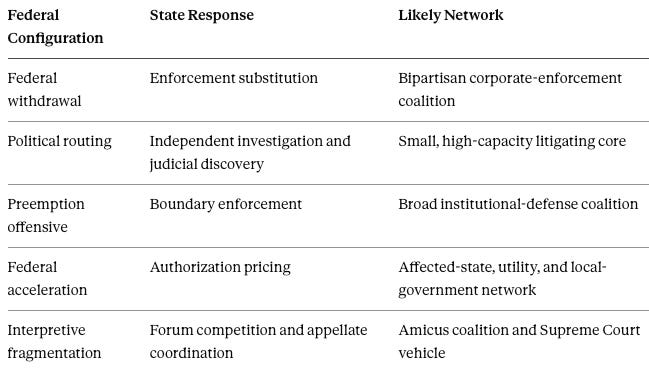
Federal withdrawal. The DOJ Antitrust Division settled Live Nation mid-trial, cleared Compass–Anywhere without a Second Request, and approved the HPE–Juniper consent decree over documented career-staff objection. Withdrawal transfers unpriced costs downstream through the Harm Clearinghouse mechanism, and the state response is enforcement substitution.
The Live Nation milestones run in a standardized sequence. The DOJ plus 39 states and the District of Columbia prosecuted the original action by the eve of trial. The DOJ exited by settlement after one week; six Republican-led states joined the federal settlement; 33 states and the District continued as the trial coalition and obtained full liability on April 15.
Washington’s SSB 6091 supplies the legislative variant of substitution by closing through licensing statute the conduct channel the cleared merger opened.
Political routing. Enforcement decisions across HPE–Juniper, Compass–Anywhere, and Live Nation ran through channels outside the Antitrust Division. The record presents indicators consistent with capture: intervention after enforcement began; altered escalation channels; displacement of career personnel; and settlements that reduced structural exposure.
Section V states the documented events, the structural inference, and the MindCast classification separately. The state response to routing is evidentiary: independent investigation plus judicial discovery, the fourth modality of competitive federalism, in which Tunney Act proceedings compel sworn testimony through the one channel the routing cannot reach.
Preemption offensive. The Commodity Futures Trading Commission (CFTC) asserts exclusive jurisdiction over prediction-market event contracts against state gambling law. The agency filed amicus briefs for the regulated platform, withdrew the constraining proposed rule, and joined federal-plaintiff suits beside the DOJ.
The state and tribal response is boundary enforcement. States sue individually under existing wagering statutes; remand motions strip the federal forum; consent-architecture injunctions propagate terms across jurisdictions; tribal claims run on the separate Indian Gaming Regulatory Act (IGRA) track; and a 38-to-39-state amicus wall forms at the appellate layer. Preemption offense produces the corpus’s fastest coalition propagation, because an express federal claim of exclusivity makes every state perceive the same loss of authority at the same moment.
Federal acceleration. The Department of Energy (DOE) Section 403 directive treats hyperscale computing as interstate grid infrastructure, and the Federal Energy Regulatory Commission (FERC) issued six Section 206 show cause orders reaching every FERC-jurisdictional grid operator. Acceleration collides with the inputs states and localities still control: generation siting, water allocation and county permitting alongside retail rates.
The state response is authorization pricing rather than prohibition. New York’s Executive Order 62 and Texas’s pause of the Electric Reliability Council of Texas (ERCOT) process express one logic, alongside the Cle Elum moratorium and the fifty-state divergence the Authorization Price baseline measures. Federal acceleration does not abolish local scarcity, and scarcity plus urgency raises the price of the permission local sovereigns sell.
Interpretive fragmentation. State high courts read federal statutes against federal circuits. The Massachusetts Supreme Judicial Court expressly declined to follow the Tenth Circuit decision the Ninth Circuit would adopt on Section 230’s procedural character, and state courts in the Kalshi litigation read the Commodity Exchange Act’s swap definition against the Third Circuit before Assad created the federal split.
Fragmentation is the configuration holding the corpus’s only live Supreme Court vehicle: Flaherty v. KalshiEX, filed September 2.
The Landes-Posner durability point explains its weight. If independent courts give durability to legislative deals, then state high courts reading federal statutes independently are competing enforcement venues that reopen the durability of the 1996 Section 230 bargain and the Dodd-Frank swap definition, and a deal whose meaning depends on the forum carries a risk premium a uniform reading does not.
Takeaway. Each configuration predicts a state response and a network form, which converts the corpus from five separate stories into one testable system.
IV. The Coalition Propagation Model
Coalition size is not a direct measure of legal conviction. Size records the state of a propagation process: lead states produce the legal and factual infrastructure, bridge states certify that the theory travels, and additional states join as uncertainty and marginal participation cost fall.
Lead states absorb the fixed costs of theory development. Absorption drops the joining price toward formatting cost, and the coalition clears at whatever quantity the price regime supports. Coalition size is therefore the clearing quantity of an enforcement market.
Each coalition is a vector rather than a label: C = (breadth, alignment, commitment). Breadth runs seed (2–8) through medium (9–24) and large (25–40) to near-universal (41+).
Alignment runs partisan, bipartisan, regional or subject-specific. Commitment runs signal, coordination, litigation or trial and remedy.
The mechanism runs seed, bridge, cascade. A small group of high-capacity offices seeds the matter and builds the record.
A credible cross-party bridge certifies portability and lowers the political-signaling cost of entry. The cascade follows as filing, allocation disclosure and irreversible events drop the reservation price of each remaining office.
Live Nation demonstrates the rare large-and-high-commitment vector: 33 states and the District holding trial-stage commitment after federal exit. The Kalshi amicus demonstrates the opposite corner: 38-state breadth at signal-level commitment. Reading the two identically is the error the vector exists to prevent.
The State Network Formation Model
The Coalition Propagation Model is one species of a broader formation process. Attorney general coalitions propagate enforcement; utility and regional networks propagate infrastructure conditions; legislatures propagate statutory templates as SSB 6091 analogues travel; localities propagate moratoria and authorization prices; courts propagate interpretive divergence. Each network type carries its own propagation mechanics, and the umbrella keeps the acceleration configuration inside the thesis rather than forcing it into the wrong network form.
The full coalition model belongs to Installment II. The companion carries the operating core and the joining economics, then the predictor set and historical trajectories, then the estimation program and the coalition-route Simulation Predictions.
Takeaway. Coalition size becomes a readable signal once breadth, alignment and commitment separate, and the companion installment converts the signal into a prediction engine.
V. Domain Tests
Four domains test the propagation principle against the record. Each pairs a configuration from Section III with its coalition vector from Section IV, and each narrative closes with what the domain proves.
Live Nation and Compass: Withdrawal, Routing and Substitution
The capture analysis observes a three-layer discipline throughout. Layer one states documented events: intervention after enforcement began; altered escalation channels; displacement of career personnel up to a Senate-confirmed Assistant Attorney General three weeks before trial; a consent decree without trial-attorney signatures; and settlements that reduced structural exposure. Layer two states the structural inference: the same routing pattern produced enforcement weakening across three unrelated matters in different industries, and structure explains what individual intent cannot.
Layer three states the MindCast classification. The pattern classifies as capture by commission because identifiable acts changed an enforcement trajectory already in motion. Commission generates a discoverable record, and the discoverable record makes judicial discovery the correction pathway.
The substitution narrative then runs the standardized milestones. The DOJ plus 39 states and the District of Columbia prosecuted the original action by the eve of trial; the DOJ exited by settlement after one week; six Republican-led states joined the federal settlement.
The 33-state coalition continued in the same courtroom and won full liability on April 15. The verdict converts the settlement from a closure event into the transfer of prosecutorial control.
Compass supplies the legislative variant. The merger cleared without a Second Request, and the conduct question the clearance left open resurfaced in Olympia. Washington’s SSB 6091 closed the exclusive-inventory channel by licensing statute, and the hearing record now travels to other legislatures as portable evidence.
The domain proves the exposure inversion, released as Simulation Prediction EF-1. A federal settlement without structural relief did not retire the defendant’s exposure; the settlement transferred operating control to the states it could not bind, and the remedies phase now sets the floor the federal instrument declined to set.
Kalshi: Preemption Offense and Boundary Enforcement
The CFTC pattern classifies as capture by omission: institutional inaction preserved accommodation while courts converted agency silence into evidence of approval. A single-commissioner agency operating far below the requisite variety of an elevenfold-grown market produces accommodation as its dominant output regardless of any individual’s intent.
Omission generates no discoverable record and survives personnel changes. Correction therefore routes through Congress or the Supreme Court rather than through discovery, which is why the boundary-enforcement response concentrated on building a reviewable record rather than seeking depositions.
The state toolkit ran every instrument the configuration predicts. Washington, Nevada, New York and New Jersey enforced individually under existing wagering statutes; remand motions stripped the federal forum; consent-architecture injunctions propagated terms across jurisdictions; and the amicus wall reached 38 to 39 states at the appellate layer. The propagation ran fastest in the corpus because the exclusivity claim made every state perceive the same loss of authority at the same moment.
The tribal track runs orthogonally to both axes. The compact layer under the Indian Gaming Regulatory Act neither derives from state police power nor yields to a state-directed preemption holding, so comprehensive foreclosure requires a court to reach two distinct sovereign theories. The 36-tribe amicus constitutes its own seed past viability on its own track.
Public filings verify the large-coalition endpoints; the earlier three-state and sixteen-office stages remain provisional and do not govern the released Simulation Predictions.
The vehicle contest now governs: New Jersey’s September 2 petition, drafted by the state that won Murphy v. NCAA, converts fragmentation into a selection game, released as Simulation Prediction EF-2.
The domain proves the forum-shift half of the propagation principle. Claimed federal permission did not end the contest; permission relocated the contest into state courts, tribal claims and a Supreme Court petition, at rising cost to the permission holder.
Data Centers: Acceleration and Authorization Pricing
Federal acceleration ran through two instruments. The DOE’s Section 403 directive treats hyperscale computing as interstate grid infrastructure, and FERC’s six Section 206 show cause orders reach every FERC-jurisdictional grid operator. Neither instrument reaches the inputs that convert permission into operation: generation siting, water allocation, retail rates and county permitting.
The state response priced rather than prohibited. New York’s Executive Order 62 conditioned siting; Texas paused the ERCOT process while recruiting the same projects; Cle Elum imposed the moratorium form.
The fifty-state divergence the Authorization Price baseline measures records the spread between recruiting and restricting jurisdictions. Scarcity plus federal urgency raised the price of the permission local sovereigns sell, which is the acceleration half of the symmetry rule from Section II.
The network here is not an attorney general coalition. Governors, commissions and legislatures form the binding nodes beside counties and utilities.
The State Network Formation Model governs the analysis. Simulation Prediction EF-3 forecasts the diffusion with an enumerated instrument denominator.
The domain proves that expansion and withdrawal select the same equilibrium. Federal acceleration strengthened the state layer it aimed to bypass, exactly as federal withdrawal strengthened the state layer it abandoned.
Meta and Section 230: Interpretive Fragmentation
The same statutory text now means different things in different sovereigns’ courts. The Massachusetts Supreme Judicial Court expressly declined to follow the Tenth Circuit decision the Ninth Circuit would adopt on Section 230’s procedural character, aligning instead with Texas and New Hampshire. The split is not dicta divergence; it determines whether platforms face discovery before the defense resolves.
The settlement geometry ran near-universal. The youth-safety litigation opened at 33 federal plaintiffs plus nine coordinated state suits and closed at 51 jurisdictions in the consent judgment.
Recovery allocation pulled late joinder exactly as the coalition model predicts. The AI carve-out entered as negotiated boundary-marking no court has ruled on, which leaves the next technology cycle to relitigate the perimeter.
The fragmentation carries a cost. A statutory defense whose procedural character depends on the forum imposes a risk premium a uniform reading would not, and the Landes-Posner durability point names the mechanism: independent courts give durability to legislative deals, and courts reading the deal differently reopen it. The register carries the forum-migration secondary at 52–66% for a certiorari petition within twelve months (Installment II, Section VIII).
The domain proves the instrument-shift half of the propagation principle. Federal statutory interpretation did not fix the 1996 bargain; interpretation fragmented it across forums, and the fragmentation itself became the pressure that moves the question toward national review.
Takeaway. Four domains and four configurations produced one result: the federal move changed the forum and the instrument and the price, and the state network formed at the vector the model predicts.
VI. The Distributed National Regulator
Federalism increasingly operates through temporary state enforcement networks rather than through fifty independent actors or a single Washington counterparty. The networks function as a distributed national regulator whose jurisdiction, membership, and commitment level change from matter to matter.
Emerging federalism describes the system in which Washington increasingly controls national permission while states retain the authority that determines whether the permission becomes durable. Federal clearance, preemption, or acceleration does not end the regulatory contest. Each propagates the contest into new forums, instruments, and prices.
State attorneys general convert dispersed sovereign authority into temporary national enforcement networks. Legislatures, courts and local governments join utility regulators in reconstructing the constraints federal actors attempted to remove or bypass.
Coalition size therefore reflects neither consensus nor conviction alone. Size records the clearing quantity produced by legal portability and shared exposure, by lead-state investment and cross-party validation, and by the declining marginal cost of joining.
Takeaway. The inversion explains how the system changed; the distributed national regulator names what emerged.
VII. Simulation Predictions and Stakeholder Risk Mitigation
The MP CDT FS run of September 4, 2026 released nineteen banded Simulation Predictions and one structural finding across the two installments. The federalism route sits here: seven banded Simulation Predictions and the structural finding below. Installment II’s Section VIII carries the remaining twelve on the coalition route.
The run organizes the scenario space into five weighted routes before the event-specific Simulation Predictions.

Route weights organize the tree; the bands below remain event-specific and govern each outcome. The register prints in numeral order under the P convention, P for Primary Simulation Prediction, and P-5 carries the structural finding. Each Simulation Prediction carries checkpoints at 30 and 60 and 90 days, then 12 and 24 months.
Each carries a named dispositive event where one exists, a falsifier and per-prediction mitigation with a named owner and deadline. Outcome sources are public dockets and official attorney general releases, plus the State Litigation and AG Activity Database, FERC eLibrary and enacted session laws.
Primary Simulation Predictions
P-1. Post-resolution exposure. 73–83%. A federal antitrust resolution lacking structural relief and state releases generates state action raising residual defendant exposure within 180 days. Dispositive: the Live Nation remedies order. Falsifier: no qualifying resolution draws state litigation, compulsory discovery or legislation within 180 days. Exposure: up to 180 additional days of discovery, injunction and remedy risk after a federal close. Mitigation: the General Counsel scores unreleased state claims before signing; the Chief Financial Officer reserves against state-side relief by day 30; the board risk committee requires separate federal and state closure tests at its next meeting. Residual: post-reserve state coordination.
P-2. Regime replacement. 58–70%. The Supreme Court grants review in Flaherty v. KalshiEX or a consolidated companion within the October Term 2026 window. Falsifier: denial without a call for the views of the Solicitor General and without a companion grant. Exposure: discovery-scope expansion and compliance-cost resets across every pending boundary matter within the term. Mitigation: appellate leads map any qualifying order against surviving state and tribal instruments within 15 days; product counsel maintains state-specific controls for unresolved jurisdictions before each launch; litigation chiefs preserve narrow fallback positions before merits briefing. Residual: vehicle substitution.
P-3. Constraint migration. 72–84%. Twelve or more additional states adopt formal data-center authorization instruments within twelve months. The denominator is enumerated: a moratorium or ordinance of six months or longer, a large-load tariff filed and approved, or an enacted siting statute; adoption means enactment or approval. Dispositive: the first FERC Section 206 final order. Falsifier: fewer than twelve qualifying adoptions at month twelve. Exposure: commercial operation dates slip by quarters as instruments spread. Mitigation: development chiefs secure power, water and siting pathways before site control; the Chief Financial Officer models 6-, 12- and 18-month authorization delays before final investment decision; state infrastructure leads publish a standard authorization bargain within 60 days of a major proposal. Residual: grid, hydrology and election variables outside any party’s control.
P-4. Boundary survival. 70–80%. No federal appellate holding at final judgment establishes Commodity Exchange Act field preemption over state gambling law as applied to sports event contracts within twelve months. The band floor reflects the tribal finding: foreclosure requires reaching two distinct sovereign theories. Falsifier: an en banc or panel holding of field preemption at final judgment. Exposure: operating plans built on a single preemption theory. Mitigation: tribal legal offices intervene with compact-specific records before dispositive filings; gaming authorities quantify diverted activity within 30 days and preserve the distinct sovereign theory; platform counsel maintains geofencing for unresolved jurisdictions. Residual: a broad holding despite a complete record.
P-5. Finality boundary. Structural finding, unbanded. Permission achieves finality only inside corridors combining express remedial exclusivity with appellate enforcement, or where coordination costs prevent lead-state absorption. The FERC wholesale-rate corridor is the live instance. Falsifier: a domain lacking both conditions in which permission terminates state response across a full cycle.
P-6. Exclusivity speed. 68–79%. Matters opening with an express federal exclusivity claim show faster median 90-day state-coalition growth than matched matters opening with federal nonenforcement alone. Falsifier: matched matters show equal or faster growth after nonenforcement. Exposure: multistate discovery scope opening within 90 days of the exclusivity assertion. Mitigation: agency counsel tests savings clauses and the likely cross-party response before asserting exclusivity; intergovernmental affairs publishes a state-authority matrix at announcement; defense litigation chiefs prepare for bridge entry and shared discovery by day 30. Residual: sovereignty politics outrunning explanation.
P-7. State record in national review. 70–83%. A record developed in state litigation or by a state coalition becomes material to federal appellate or Supreme Court review in the Kalshi or Section 230 conflicts. Falsifier: no state-created record is cited or materially relied upon in qualifying review. Exposure: factual concessions binding appellate scope and narrowing settlement optionality. Mitigation: trial leads litigate state records as potential appellate records from first filing; solicitors identify record gaps at the certiorari stage; policy leads prepare instrument-specific contingencies within 30 days of any review grant. Residual: narrow-grounds disposition.
P-8. Framing shift. 68–80%. A national firm publicly shifts from federal-clearance framing to multistate-resolution or federal-uniformity advocacy after a material state response. Falsifier: no covered firm makes the qualifying shift despite material state response. Exposure: disclosure revision plus one to two quarters of guidance compression at the next reporting cycle. Mitigation: the General Counsel approves clearance-versus-durability language before any federal close is announced; investor relations reconciles national guidance with state contingencies at the next earnings cycle. Residual: late state entry obsoleting careful language.
Stakeholder summary. 🏛️ Policymakers design federal acts for the state response they induce and map preserved authority before announcing national finality. 💼 Executives treat federal permission as an opening state and budget for multistate durability and local authorization. ⚖️ Counsel track vehicle and procedural stage alongside sovereign instrument and operating core, because caption size alone misstates exposure. 📊 Investors separate federal clearance from operating conversion and reprice state delay, remedy divergence and authorization scarcity.
Takeaway. The federalism route now stands as dated, falsifiable claims with named checkpoints, and the graded record will show hits and misses on a published schedule.
VIII. Conclusion: The Propagation Mechanism
The mechanism compresses to one sentence. Federal permission changes where a regulatory contest continues rather than whether it continues; states select the instrument, and the network sets the price. Withdrawal and expansion look opposite in Washington and land on the same state-network equilibrium.
The mechanism converts observation into anticipation. A structureless federal settlement forecasts state continuation and rising residual exposure; an exclusivity claim forecasts a fast broad coalition and a boundary contest; an acceleration directive forecasts authorization repricing at the state and local layer. Each forecast now sits in the Section VII register with a band, a falsifier and a dated checkpoint.
For stakeholders the implications run through every entry in Section VII. Policymakers design federal acts for the state response they induce; executives treat permission as an opening state; counsel track vehicle and stage; investors separate clearance from conversion. Installment II supplies the formation mechanics that make the state response calculable matter by matter.
Takeaway. Federal permission has become an opening bid in a contest states finish, and the register will prove or falsify that claim on a published schedule.
Appendix. Sources and Corpus
The corpus below assembles the MindCast publications underlying this paper’s argument. Each entry carries a hyperlinked title and a statement of its role.
A. Foundational Architecture
Chicago School Accelerated, with Part I: Coase, Part II: Becker and Part III: Posner. The series supplies the transaction-cost, incentive and judicial-economics primitives the propagation analysis runs on.
The Stigler Equilibrium. Establishes the capture equilibrium concept the DOJ analysis applies.
The Dual Nash–Stigler Equilibrium Architecture. Formalizes the paired strategic and capture equilibria used throughout the domain tests.
Federal Antitrust Breakdown as Nash–Stigler Equilibrium. Introduces the Harm Clearinghouse mechanism behind the withdrawal configuration.
Tirole Advocacy Arbitrage. Models the advocacy channels that political routing exploits.
The Geometry of Regulatory Capture at DOJ. Grounds the structural-inference layer of the capture analysis.
Field-Geometry Reasoning. Introduces the constraint-geometry framework behind the intent-outcome decoupling findings.
Runtime Geometry. Integrates the geometry framework with the equilibrium architecture.
Trump Administration Political Access Analysis. Documents the routing record the second configuration analyzes.
Federal Political Market Failure and State Substitution. States the substitution thesis this paper generalizes.
Comparative Externality Costs: Live Nation and Compass. Quantifies the downstream costs federal withdrawal transferred.
Competitive Federalism as Market Infrastructure. The series foundation this paper sits directly downstream of.
Federal Inaction Briefing for State AGs. Maps the enforcement vacuum state substitution filled.
Antitrust Enforcement Foundations. Supplies the doctrinal baseline for the enforcement analysis.
Emergent Game Theory Frameworks. Formalizes the segmentation and capture-correction designs the register applies.
How MindCast Evolves the Structural Gaps in Classical Nash Game Theory. Later methodological synthesis situating the equilibrium extensions.
The Cybernetics Umbrella, Predictive Institutional Cybernetics and Cybernetics Foundations. The control-theory suite behind the requisite-variety analysis of the CFTC.
MindCast Foresight Prediction Simulations, Synthesizing Behavioral Economics + Game Theory. The transition architecture the configurations instantiate, with federal permission events as institutional rule mutations.
MindCast Dynamic Game Theory. The state-replacement mechanics behind the regime-replacement Simulation Prediction class.
B. Antitrust: Substitution and Authority Routing
From Open Market to Private Governance. The pre-consummation record of the Compass clearance.
Compass–Anywhere, When Scale Becomes Liability. The post-close analysis the legislative substitution answered.
Shadow Antitrust Division. The routing record across three matters that grounds the commission classification.
The Assefi Test. The procedural-sufficiency standard the settlement analysis applies.
Shadow DOJ Credibility Threshold. Measures the credibility cost of routed enforcement.
How MindCast AI Predicted the Slater Ouster. The personnel-displacement record in the documented-events layer.
Judicial Process as Competitive Federalism. Establishes judicial discovery as the fourth modality the routing response uses.
Why the DOJ Banned Algorithms but Blessed a Mega-Brokerage. The enforcement-asymmetry record behind the withdrawal configuration.
State Power vs. Compass Private Exclusives. The state-authority analysis behind SSB 6091.
The Compass Astroturf Coefficient. The hearing-room evidence record the legislative narrative cites.
Compass vs. SB 6091, Narrative Pre-Installation. Documents the opposition-messaging record.
HB 2512 and the Collapse of Compass’s Coordinated Opposition. The companion-bill record in the legislative substitution arc.
Washington’s SB 6091 and Private Real Estate Market Control. The enacted statute closing the cleared merger’s conduct channel.
SSB 6091 Enforcement. The implementation record for the legislative variant of substitution.
C. Kalshi: Preemption Offense and the Vehicle Contest
The National Kalshi Prediction Market Litigation Map. The boundary-litigation record and the capture taxonomy this paper applies.
Prediction Markets Litigation Stack. The forum-by-forum inventory behind the fragmentation analysis.
The Prediction Markets Rule Architecture Series. The umbrella framework for the classification contest.
A Boundary Rule with a Functional Core. The proposed boundary rule the CFTC withdrew.
Competitive Federalism: A Field Guide for State and Tribal Regulators. The instrument menu the boundary-enforcement toolkit draws from.
Kalshi Loses Federal Forum: The Washington Remand Order. The remand record stripping the federal forum.
The CFTC NPRM Is a Litigation Brief. The rulemaking-as-advocacy record behind the omission analysis.
CFTC v. New Mexico: Kalshi, IGRA, and the Tribal Seam. The tribal-track record behind the two-sovereign finding.
How the CFTC’s Missing Gaming Definition Is Losing the Preemption War. The definitional gap driving interpretive fragmentation.
Prediction Markets and the Dual Nash-Stigler Trap. Applies the equilibrium architecture to the platform’s position.
New York’s $36 Billion Kalshi Case. The exposure quantification in the state enforcement layer.
The Order Kalshi Wrote. The consent-architecture injunction that propagated terms across jurisdictions.
Both a Swap and a Bet. The dual-classification analysis at the heart of the vehicle contest.
The Kalshi Circuit Split. The Assad record creating the federal split.
CFTC Takes On Nine States: Kalshi, Prediction Markets, and the Federal-Plaintiff Phase. The federal-plaintiff record completing the preemption offensive’s instrument set.
The Kalshi Vehicle Contest. The September 2 petition converting fragmentation into a selection game.
D. Data Centers: Federal Acceleration Meets Authorization Pricing
AI Computing Is Now Federal Infrastructure. The Section 403 directive record opening the acceleration configuration.
The Federal-State AI Infrastructure Collision. The FERC show-cause record the federal instrument analysis runs on.
The Two-Ledger Data Center Bargain. The public-bargain framework behind authorization pricing.
The Authorization Market. Names the market in which local sovereigns sell permission.
The Data Center Authorization Price: A 50-State Baseline. The divergence baseline the constraint-migration Simulation Prediction grades against.
Three Competing Governance Equilibria for AI Infrastructure. The equilibrium set the acceleration analysis selects among.
New York’s Data Center Moratorium. The Executive Order 62 record in the pricing response.
The MindCast AI Data Center Record. The consolidated evidentiary record for the domain.
AI Infrastructure Priority Under Scarcity. The scarcity-allocation analysis behind the bargaining-premium finding.
The Model AI Infrastructure Authorization Code. The template instrument the diffusion Simulation Prediction tracks.
The Data Center Authorization Market: A 50-State Regulatory Atlas. The state-by-state instrument atlas behind the enumerated denominator.
E. Platform Liability
Section 230 After the Meta Settlement: Federal Courts Removed Early Dismissal, State Courts Disagree, and Design Claims Survive Either Way. The interpretive-fragmentation record and the renewable-defense reading behind the fifth configuration.
Meta Settlement Validation Scorecard. The settlement-terms record behind the near-universal geometry.
Meta on Trial for Teen Social Media Harm. The registry record for the youth-safety litigation arc.
Working With MindCast
MindCast runs two service lines on one method: federalism foresight intelligence assesses where authority moves after a federal act and what the surviving state instruments cost the permission holder; coalition-formation intelligence maps which network assembles against a matter and how fast it grows.
💼 Executives facing federal resolution commission a fifty-one-jurisdiction durability assessment before signing: unreleased state claims, reserve assumptions and disclosure sequencing. The register places post-resolution state action at 73–83% and the clearance-to-multistate framing shift at 68–80%. Data-center developers commission an authorization-adjusted schedule review before final investment decision, against the twelve-state instrument diffusion at 72–84% and rising concession terms at 70–80%.
⚖️ Defense counsel commission a coalition-vector exposure map within days of first compulsory process: the operating core, what the caption overstates and what the full eligible pool costs. The register places the eight-or-fewer operating core at 80–90% and the post-allocation joinder wave at 76–88%. State attorney general offices commission a formation-design package at coalition seed, against pre-filing cross-party entry driving large breadth at 66–78% and bridge-driven joinder acceleration at 62–76%.
🏛️ Federal agency teams commission a pre-announcement state-response map: preserved state authorities, the coalition the action recruits and the savings-clause choices that dampen it. The register places faster growth after an exclusivity claim at 68–79% and partisan challenges clearing within two of the opposition ceiling at 84–93%. State legislative staff commission a template-diffusion review each session against the same twelve-state band.
📊 Investors and lenders commission a permission-durability repricing screen: federal clearance and state durability priced as separate events, and the commitment axis traded rather than the breadth axis. The register places review in the flagship vehicle contest at 58–70% and a state-built record becoming material in national review at 70–83%.
Every engagement runs on the same methodology with dated falsifiable outputs. Contact mcai@mindcast-ai.com.