

Coverage window: Mid-May – June 30, 2026 · 52 program publications across nine research programs · series that arose in May enter in full under the series-completeness rule
Visual Companion in MindCast Magazine (and PDF)
Introducing the MindCast Research Review
Welcome to the first MindCast AI Research Review — a new monthly publication, arriving in the first days of each month, that reports on the research platform the way an institution reports on an operating portfolio. MindCast publishes forty to fifty analyses in a typical month, organized into recurring research programs across law, economics, technology, sport, and culture, and a stream that dense needs an instrument that shows how the pieces cohere: which frameworks advanced, which predictions resolved, and which obligations the platform carries forward. The Review is also the Agent Governance Equilibrium applied reflexively: a platform publishing at this rate generates its own governance debt, and the ledger, the doctrine adoptions, and the carried question are the closed control loop that pays it down.
Three editorial rules govern every issue. The series-completeness rule sets the unit of coverage: when any part of a research series falls inside the month, the entire series enters — the series, not the calendar, defines the boundary. The resolution-date rule admits publications by when their predictions resolve, so a forecast graded in the first days of the next month still belongs to the month it scored. And every resolved prediction appears under a named forecast with its falsification terms stated, because the Review’s purpose is not to celebrate output but to keep score in public.
Each issue follows one architecture: a Spotlight on the publications that price the month, a Research Program Map and theme table for orientation, program-by-program reviews, the Foresight Record of resolved predictions, a numbers table with fixed metric definitions, and one research question carried forward. Twelve issues from now, the value sits in the accumulation — readers will trace how the questions evolved, which forecasts survived their windows, and how the research programs compounded into a body of work.
Executive Summary
Major thesis: Governance debt organizes the month — raw prediction commoditizes toward zero cost while accurate foresight under falsifiable mechanisms grows scarcer and more valuable, across all nine research programs.
Biggest validation: The Two-Gate Game — a January geopolitical forecast resolved at the May Beijing summit exactly as specified: roughly ten Chinese firms licensed for Nvidia H200 chips, zero deliveries, import acceptance governing capability flow.
Biggest surprise: Belgium–Senegal — both clauses of the published falsification contract fired verbatim, and Belgium advanced anyway through the extended path where the forecast located its true advantage.
Largest new doctrine: The Duty to Foresee and the Agentic Hand Formula — pre-deployment foresight simulation migrating from competitive edge to legal standard of care, committed on a falsification window through 2030 — alongside the Mechanism–Outcome Validation Doctrine that the Belgium split produced.
Most important open prediction: The 2030 standard-of-care migration carries the highest stakes; the nearest tests close August 9 and August 15 (state AG enforcement actions and the five Beijing-summit predictions).
The June Review
June established governance debt as MindCast AI’s organizing thesis. Raw prediction is becoming cheap. Accurate foresight under sophisticated, falsifiable mechanisms is becoming scarce — and MindCast operates on the right side of that divide.
Across artificial intelligence, real estate, college athletics, prediction markets, energy infrastructure, and live sports, the month’s work tracked one structural shift. Institutions no longer compete only by predicting what happens next. They compete by controlling whether action remains governable once scale, capital, litigation, and public scrutiny arrive.
During the period from mid-May through June 30, MindCast AI published 52 program publications spanning nine interconnected research series, with complete May-origin series included in full — the series, not the calendar, defines the unit of coverage. Rather than reacting to headlines, each series developed a governing framework, applied it across multiple domains, and publicly evaluated its predictions against subsequent events. The Review below presents the month by series, because the research series — not the individual paper — is MindCast’s unit of production: each publication serves as another observation that tests, refines, or validates a common framework.
Spotlight: Two Publications That Price the Month
Why AI Commoditizes Raw Prediction, Why Governance Stays Scarce
One theorem organizes everything June published, from a standalone flagship publication. Commodity prediction cost falls toward zero — prediction markets already supply the existence proof — while governance cost falls toward a positive floor set by the external-validation requirement, and the distance between the two widens monotonically. MindCast operates in that gap: less a forecasting shop than a governance-scarcity pricing system. Readers who open a single publication this month should open this one; every section below instantiates the theorem in a different vertical.
The Duty to Foresee — and the Agentic Hand Formula
Prospective governance arrives as doctrine in the capstone of the Agent Governance Equilibrium series. The Agentic Hand Formula reworks Judge Hand’s negligence calculus for autonomous deployments, determining when the duty to simulate attaches before an agent ships — and the Agent Governance Equilibrium, run in reverse, computes the governance a deployment owes, converting reasonable care from an adjective a jury supplies after harm into a quantity a simulation supplies before it.
The Duty of Care Vision runs the obligation as a closed cybernetic control loop, and a dated forecast (70–80% probability, window through 2030) commits the claim to the record. The Visual Companion renders the full architecture. The two spotlights run on separate tracks — one prices the economics of commodity prediction, the other installs the legal duty of foresight — and keeping the tracks distinct is itself a June finding.
Research Program Map
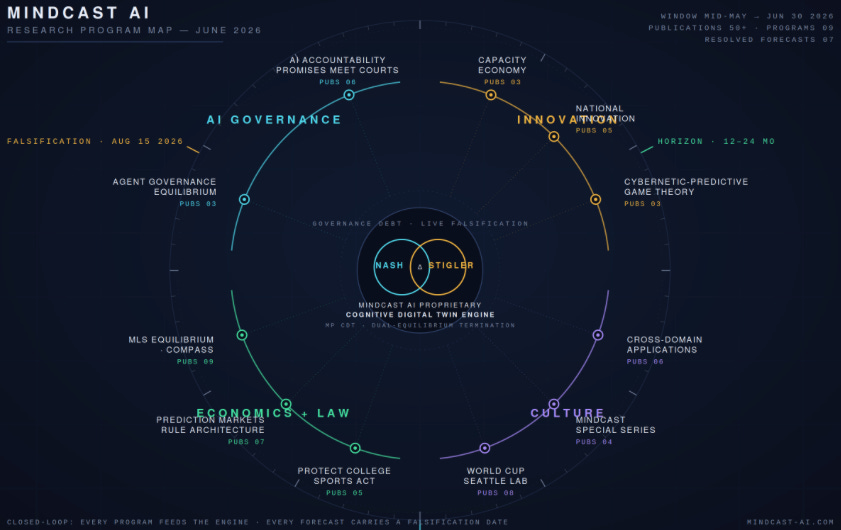
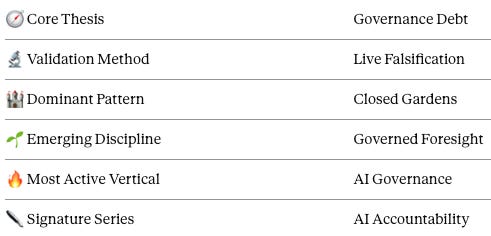
June Research Themes
Contact mcai@mindcast-ai.com to partner with us on Predictive Game Theory AI in Law and Behavioral Economics. To deep dive on MindCast works upload the URL of this publication into any LLM (preferably Google AI mode/Gemini, Claude, ChatGPT) and prompt ‘reconstruct MindCast framework with three degrees of cited sub links.’ See Live-Fire Game Theory Simulators, Runtime Predictive Infrastructure. We stress-tested our AI system for this publication by simulating the Super Bowl and the World Cup. Super Bowl LX — AI Simulation vs. Reality | Predictive Game Theory + Behavioral Economics Cognitive Digital Twin Foresight Simulations in the World Cup
I. ⚖️ The Agent Governance Equilibrium Series — Core Thesis (MCAI Lex Vision)
One standalone foundation and one complete series built the month’s intellectual spine.
Innovation Becomes Governance, a standalone foundation piece, set the stage: transformative technologies begin as products, then become coordination infrastructure before law and public debate catch up. Napster, Uber, TikTok, OpenAI, Compass, and Kalshi each traced the same trajectory — and dependency, not popularity, marks the threshold.
Why AI Commoditizes Raw Prediction, Why Governance Stays Scarce, the second standalone flagship, supplied the month’s anchor theorem. AI produces answers at collapsing marginal cost; the harder and more valuable question asks whether an institution can safely act on those answers. The Governance Gap Theorem formalizes the divergence — raw-prediction cost falls toward zero, governance cost falls toward a positive floor set by the external-validation requirement, and the distance widens monotonically.
Agent Governance Equilibrium opened the series that carries its name, introducing governance bandwidth as the limiting factor for autonomous organizations and shifting the question from “Can the agent act?” to “Can the institution still see, question, and steer the agent after deployment?” Governance Debt — the accumulating gap between the pressure an institution generates and the control it keeps — enters the corpus here.
The Duty to Foresee, the series capstone, formalized AI deployment readiness as prospective governance through the Duty of Care Vision — three layers working as one instrument. Foresight simulation generates the foreseeable harms; the Agentic Hand Formula determines when the duty to simulate attaches (simulate whenever expected harm exceeds the falling cost of simulating it, with a proof that the formula reduces exactly to classical Hand when the agent terms go neutral); and the Equilibrium, run in reverse, computes ΔGov — the quantified governance a deployment owes before it ships.
Reversing the Equilibrium is the paper’s sharpest move. Forward, the instrument reads as a thermometer measuring whether governance suffices today; backward, it becomes a controller sizing the governance a future deployment requires, converting the standard of care from an adjective a jury supplies after harm into a quantity a simulation supplies before it. A dated forecast (70–80% probability, measurement window through December 31, 2030) commits the doctrinal claim to the record, and the Visual Companion renders the full control-loop architecture.
One clean connection joins the two Lex Vision series without merging them: the same Governance Debt runs through three doctrinal channels — tort (developed here), securities (developed in Foresight Before Disclosure, the Microsoft installment of the courts series), and fiduciary oversight under the Caremark line. One debt, three coats; which court collects depends only on which gate the debt reaches first.
Program Publications (Agent Governance Equilibrium): Agent Governance Equilibrium · The Duty to Foresee · The Duty to Foresee Visual Companion Foundational Publications: Innovation Becomes Governance · Why AI Commoditizes Raw Prediction, Why Governance Stays Scarce
II. ⚖️ AI Accountability: When AI Promises Meet the Courts — Complete Series (MCAI Lex Vision)
The series umbrella states the unifying thesis in one sentence: an AI-related claim becomes a legal liability at the moment the gap between the claim and the substrate beneath it can no longer be hidden. Every installment studies that gap — a confident signal trusted past the substrate beneath it, concealment accruing Governance Debt, and a forcing function (a market correction, an earnings session, a judge) collecting the difference. Five installments run across two branches.
Branch One — Institutional Representation covers companies whose public AI claims outran the reality beneath them, sorted into four named accountability types. Apple’s AI Illusion anchors narrative arbitrage: the “Apple Intelligence” feature set presented as ready, then deferred, after roughly $900 billion in market value rode the timeline — surfacing in paired securities and false-advertising actions. Tesla’s Self-Driving Revolt anchors capability-to-substrate conversion, the series’ hinge: Full Self-Driving sold for years against Hardware 3 that Tesla’s own admission says cannot run it, converting a forward-looking promise into a present shortfall across roughly four million vehicles.
Two further installments move the exposure upmarket, from product claims to the largest operators. Oracle, OpenAI, and the Capacity Economy anchors capacity accountability: roughly $248 billion in off-balance-sheet lease commitments staked on a single counterparty’s ability to pay. The Microsoft Shareholder Suit anchors governance accountability, reading Azure capacity rationing behind a demand narrative as Governance Debt collapsing in a single corrective session.
Branch Two — Point-of-Use Reliability shifts the trusting party from issuer to user. The Legal Citation That Never Existed examines lawyers who filed AI-fabricated citations without verification and the escalating sanctions that answered, naming the failure Verification Debt — the individual-level twin of institutional Governance Debt.
Read in sequence, the four institutional cases document the series’ population-level finding: the docket’s center of gravity is shifting from capability disputes against product claims (Apple, Tesla) toward capacity and governance disputes against the largest operators (Oracle, Microsoft).
Program Publications: Series umbrella · Apple’s AI Illusion · Tesla’s Self-Driving Revolt · Oracle, OpenAI, and the Capacity Economy · The Microsoft Shareholder Suit and the Arrival of AI’s Third Phase · The Legal Citation That Never Existed
III. 📊 The MLS Equilibrium Series — Compass and the Closed-Garden Economy (MCAI Economics + Lex Vision)
Real estate gave the window its clearest market-structure storyline, and the MLS Equilibrium series — which arose in May and enters the Review in full under the series-completeness rule — supplies the architecture. The May arc built the framework; the June arc ran it against live enforcement.
The MLS Equilibrium Series umbrella opens the corpus, and three parts develop it: Part I documents how Compass, Zillow, and MLS governance broke the cooperative transparency equilibrium — distinguishing Compass’s capture-enabled defection (board seats and governance access at MRED) from Zillow’s unilateral defection (a display policy requiring no captured cooperation).
Part II maps Washington’s integrated defense architecture, where SSB 6091 at the licensing layer, NWMLS rules at the MLS layer, state consumer-protection authority, and the Zillow federal filing reinforce one another, and Part III, the Skillman Moment Rosetta, translates the framework into four capital-markets registers from due diligence to goodwill-impairment analysis.
Zillow v. MRED and Compass — Residential Real Estate Enters Infrastructure Sovereignty Conflict caps the May arc with the Transparency Equilibrium Vision. Residential real estate now runs as a four-actor infrastructure fight — brokerages seeking closed-loop economics, MLS systems defending legitimacy, portals seeking behavioral governance, legislatures treating transparency as public infrastructure — with the May 20 MRED feed cutoff as the visible surface.
Compass’s $3.14 billion debt load converts private-listing strategy from ambition into a time-bounded mandate: the Anywhere merger’s $400–800 million Layer 3 premium exists only if listings can be withheld long enough for internal capture, SSB 6091 legally extinguishes Layer 3 in Washington, and the MRED, Realtracs, CLAW, and Bright MLS partnerships rebuild it externally through MLS rule capture. Formal partnership with a dominant brokerage breaks the neutrality predicate that shields MLS rule-making from ordinary Sherman Act scrutiny under American Needle, expanding exposure across seven parallel legal theories.
A companion specimen piece, Compass’s Skillman Moment Reaches the C-Suite, documents the three-tier communications architecture — Reffkin carrying the framework at CEO altitude, the spokesperson tier reproducing it anonymously, regional executive Cris Nelson holding structural silence — and the Skillman Cascade across all three altitudes.
June’s arc then ran the framework against live enforcement, in strict sequence: visibility control, definitional control, closing-table extraction.
Why Compass Needs Private Listings — The Inventory-Routing Premium, the Anywhere Merger, and the Multi-State Enforcement Window opened the arc at the visibility layer. Private listings let Compass shape when inventory reaches public channels, and the January 9 Anywhere acquisition converted that routing capability into national scale — opening a multi-state enforcement window for attorneys general rather than a local MLS dispute.
Compass’s Interpretation of “Public Marketing” May Draw Antitrust Scrutiny from State Attorneys General fought the definitional layer: who decides what “public marketing” means when one national inventory model meets deliberately different state transparency regimes. Definitional control precedes market control — whoever fixes the term fixes the compliance boundary.
Compass Transaction Fees Convert a Private-Listing Dispute Into a State AG Platform-Control Case completed the arc at the closing table. A Florida class action documents a buyer-paid $475 “flat transaction commission” written into a purchase contract and collected at closing — while Compass’s own SEC filing recognizes flat transaction commission fees as owned-brokerage revenue, closing off the rogue-agent defense.
Skillman Moment doctrine receives its precise definition in the same publication: a category error in which a Compass actor answers a public market-design or regulatory question with private-choice framing — broker Moya Skillman applying seller-choice messaging to a state licensing statute at the regional tier, the corporate tier repeating the move when it defends an SEC-recognized revenue line as routine disclosed custom.
Batton v. Compass (Hunt, J., N.D. Ill., March 24, 2026) supplies the vector logic: buyer classes keep hitting standing ceilings and class-action bars that attorneys general acting parens patriae are built to clear. Six Vision Functions ran against the record, converging at an 80–85% combined band: consumer-protection and AG investigation first, antitrust evidence inside a platform-control and merger-scrutiny theory second.
Program Publications (May arc): MLS Equilibrium Series Umbrella · Part I — How Compass, Zillow, and MLS Governance Broke the Cooperative Transparency Equilibrium · Part II — Washington’s Integrated Defense Architecture · Part III — The Skillman Moment Rosetta · Zillow v. MRED and Compass: Infrastructure Sovereignty Companion Publications: Compass’s Skillman Moment Reaches the C-Suite (Compass Law and Behavioral Economics series)Program Publications (June arc): Why Compass Needs Private Listings — The Inventory-Routing Premium · Compass’s Interpretation of “Public Marketing” · Compass Transaction Fees Convert a Private-Listing Dispute Into a State AG Platform-Control Case
IV. 📊 The Prediction Markets Rule Architecture Series and the Sovereignty Phase (MCAI Economics Vision)
Prediction-markets work ran on the Rule Architecture series that arose in early May, entering the Review in full under the series-completeness rule, with June’s publications running the architecture against a live rulemaking.
The Prediction Markets Rule Architecture series umbrella states the system-level claim: prediction markets present a rule gap, not a novel economic problem. The Commodity Exchange Act already separates hedging from wagering; regulators never completed the implementing rule, and the missing standard — not the statutory line — produced the litigation convergence now running across federal, state, tribal, and criminal forums, including thirty-eight state attorneys general filing jointly in Commonwealth of Massachusetts v. KalshiEX against the federal preemption theory.
Two companion artifacts complete the three-audience architecture: A Boundary Rule with a Functional Core supplies the doctrinal layer — a contest-versus-consequence threshold sort, a conjunctive five-factor admissibility override where failure on any factor defeats listing, and per-se exclusions grounded in the five players associations’ joint comment — and the Competitive Federalism Field Guide with Event Contract Decision Sheet distills the system into a one-page tool for state AGs, tribal regulators, and judicial chambers. The series names its convergence state — Admissibility-Constrained Market Equilibrium — and commits four falsifiable predictions with 6-to-30-month windows.
Kalshi Loses Federal Forum supplies the series’ jurisdictional layer: Judge Coughenour’s remand of State of Washington v. KalshiEX to state court operationalized the exact allocation the architecture specifies — federal authority over the trade does not displace state authority over the activity.
Kalshi, the Ninth Circuit, and the Prediction Markets Forum Fight traces the consolidation pressure the remand set in motion. On May 21 a single Ninth Circuit panel issued three coordinated stay denials within hours — two Nevada cases and the Washington case, covering Kalshi and Polymarket — and the piece reads the set as one instrument: a circuit-wide posture statement foreclosing the consolidated federal forum the operators’ entire strategy depends on.
The Washington order is the one that travels, engaging Grable and Gunn to hold that a state gambling-law question does not necessarily raise a substantial federal issue. Kalshi’s genuine Third Circuit win in Flaherty does not offset the loss, because the two rulings occupy different layers — merits versus jurisdiction — and the pairing proves the forum thesis from the other side: the preemption argument works when Kalshi reaches a federal forum, and the Ninth Circuit just made reaching one materially harder.
The dominant variable sits outside every courtroom — the CFTC’s pending rulemaking can rewrite the preemption landscape in either direction before any state-court track reaches an appellate answer — and the analysis commits its forecasts on a 12-to-24-month falsification horizon.
June ran the architecture against events. Kalshi’s Institutional Push Is Building the Case Against Itself opened the sovereignty phase: Clear Street joining as the first institutional futures commission merchant, Marex building connectivity, Jump Trading routing flow — a build-out that strengthens the derivatives characterization platforms need while widening state-law exposure. Kalshi’s first bespoke block trade, hedging California’s carbon allowance auction, performs economic risk transfer rather than wagering — usable evidence under the screen MindCast proposed in its CFTC public comment on RIN 3038-AF65.
The CFTC NPRM Is a Litigation Brief read the Commission’s June 10 proposed rule as adverse interpretive authority in Kaiserman v. Kalshi and as the administrative record that courts — no longer deferring to agencies after Loper Bright — will scrutinize across nine state preemption campaigns. The same analysis scored MindCast’s own April 9 falsification condition on the record: the prediction survived on its stated terms, and the directional risk it hedged materialized 26 days after the window closed. Both facts entered the ledger, because foresight that cannot fail is not foresight.
Program Publications (May arc): Rule Architecture series umbrella · A Boundary Rule with a Functional Core · Competitive Federalism Field Guide + Event Contract Decision Sheet · Kalshi Loses Federal Forum — The Washington Remand Order · Kalshi Ninth Circuit Stay Denials Program Publications (June arc): Kalshi’s Institutional Push · The CFTC NPRM Is a Litigation Brief
V. ⚖️ The Protect College Sports Act Series — Compliance Infrastructure and the Capital Layer (MCAI Lex Vision)
College athletics supplied the window’s second major policy vertical, and the series runs on one distinction: Congress regulates the coordination layer while competitive advantage migrates into the capital layer beneath it.
The Protect College Sports Act of 2026 — Federal NIL Salary Cap, Antitrust Immunity, and the Private Equity Blind Spot states the June anchor claim. S. 4668’s core instruments — a federal revenue-share cap aligned with the House settlement’s $20.5 million ceiling, a Section 118 antitrust shield, mandatory name-image-likeness (NIL) disclosure with a fair-market-value clearinghouse, and a conference-consolidation bar — discipline coordination among schools while leaving the private-equity capital-formation channel untouched. The blind spot is the finding.
The Protect College Sports Act Becomes a Compliance-Infrastructure Bill tracks the June 30 hardening: the reported Senate text, advanced 19–9 by Senate Commerce on June 18 over Big Ten and SEC opposition, converts clean documentation into the competitive edge — the integrity of the record behind the check replaces the size of the check.
If the Protect College Sports Act Passes, Private Equity in College Sports Wins Differently (graded July 1 under the resolution-date rule; the underlying close occurred June 12, in-window) delivers the series’ validation entry. The University of Utah and its foundation closed the first private-equity-backed operating company built around a major public university’s athletics department: Crimson Brand Partners, formed with Otro Capital as minority partner, controlling the commercial surface — sponsorships, licensing, ticketing, digital media, venue events — while coaching, recruiting, and student-athlete support stay inside the university, with athletic director Mark Harlan chairing the board and a leadership team drawn from the NFL, NBA, and MLB.
Four structural calls from the January firm-formation analysis confirmed at close, and the analysis names its own tension rather than burying it: Utah’s state auditor warns the rights-holding foundation sits outside direct university control, and the same arm’s-length design that admits the capital draws the governance objection. Passage professionalizes the channel; failure makes the operating company a chaos hedge — both branches raise demand for the Utah model (overall confidence 80–85% per the publication’s own band). A Visual Companion renders the series architecture.
Program Publications: Federal NIL Salary Cap, Antitrust Immunity, and the Private Equity Blind Spot · The PCS Act Becomes a Compliance-Infrastructure Bill · If the PCS Act Passes, Private Equity Wins Differently · PCS Act Visual Companion Foundational Publications (January origin): Private Equity, NIL, Antitrust, and the Firm-Formation Phase of College Athletics — named Utah as the prototype and projected ten or more athletics operating companies within twenty-four months
VI. ⚽ World Cup 2026 — Two Series, One Live-Fire Validation Program (MCAI Cultural Innovation Vision)
World Cup coverage ran as June’s most ambitious production track, and the program divides into two deliberately different series. Every match piece in both publishes before kickoff, carrying time gates and falsification contracts committed in advance. The program lives in the Cultural | Legacy Innovation vertical on the platform — the World Cup is a global cultural event — while belonging methodologically to Cognitive Digital Twin AI, the engine every program runs; the platform permits one home per publication, and the Review records both.
Super Bowl LX — AI Simulation vs. Reality supplies the program’s authorizing validation. Across the 2025–26 Seahawks season and the Super Bowl, MindCast published time gates and a falsification contract before kickoff, self-corrected mid-season on the record — abandoning its compression-dominant thesis after the Rams game and rebuilding around multi-regime survivability — and then watched Seattle’s 29–13 win, built on a 47-minute shutout, clear every gate while triggering no falsification condition.
Head-to-head against Madden’s physics engine and SportsBook Review’s three-LLM narrative system, structural governance beat both: MindCast alone explained why the game broke, when control locked, and what would have disproved the thesis. Football proved the architecture as pure predictive game theory and behavioral economics; the World Cup extends it into cultural innovation — Cognitive Digital Twins of national footballing cultures under shared rules — and the Seattle Lab runs the expansion in the same building where the proof was earned.
Cultures Under Shared Rules — The Seattle Lab anchors the controlled track: the six-match Lumen Field program, with national-team Cognitive Digital Twins testing culture, pressure response, tactical adaptation, and institutional identity in a bounded environment with fast public outcomes. USA vs Australia modeled each team as a footballing operating system rather than a roster list; Belgium vs Egypt, the Qatar–Bosnia–Egypt–Iran slate, and Three Group Winners Enter the Round of 32 carried the program through the knockout gate.
The MindCast Special Series runs the second track — a deliberate stress test of the system beyond the Lab’s controlled venue. The World Cup Championship Index 2026 prices the full tournament field, the Moody’s comparison piece stakes MindCast’s France call against The Economist’s Argentina model in public, and Mexico vs South Korea plus Mexico and USA extend the Cognitive Digital Twin method past the Seattle slate.
Three validation reports graded the pre-committed forecasts against outcomes: Report I (USA, Belgium–Egypt, Mexico), Report II (validated system attributes across Bosnia, Egypt, Iran, Mexico, and Türkiye while diagnosing the US team as a calibration anomaly), and Report III (July 1, included under the resolution-date rule — it grades June’s Round of 32 forecasts).
Mechanism validation is what the program sells, and the Round of 32 delivered it. Mexico validated cleanest: the pre-committed Trap-to-Arena fork triggered at minute 22 inside the under-35 condition, the 2–0 landed on the projected score, and the run extended to four wins and four clean sheets — the first Concacaf side ever to eliminate a CONMEBOL team, and Mexico’s first knockout win in forty years. The United States performed its predicted control construct — a 0.73-to-0.04 halftime expected-goals margin quantified the mechanism operating — until Balogun’s 64th-minute red card exposed a variance channel the model never priced, an honest gap the report converts into a committed model improvement. Report III graded the slate A-minus overall — A-plus Mexico, A-minus United States, B-plus Belgium, upgraded for mechanism quality despite the score miss — with winners running 3-for-3.
Belgium supplied the analytically decisive result. Both clauses of the published falsification contract fired verbatim — Senegal scored first, Belgium reverted to the Egypt-and-Iran pattern, trailing 2–0 into the 86th minute — and Belgium still advanced 3–2 through Tielemans’ penalty at 124 minutes 44 seconds, the latest goal in men’s World Cup history. The deeper behavioral call hit exactly where the forecast placed it: Belgium’s advantage lived in the extended path, not regulation, and the extended path is where Belgium won. Mechanism falsified, outcome correct — a split the framework now scores honestly as the Mechanism–Outcome Validation Doctrine, adopted across all Cognitive Digital Twin publications from Report III forward, with full validation reserved for right answers reached for the right reasons.
Across ten public simulations the strict ledger stands at 7–3 — a composite calibration standard spanning winners, score direction, regime reads, fork resolution, and score precision — while the outcome record carries a single miss, the US–Türkiye result the calibration-anomaly diagnosis flagged in Report II. Report III also installs a running eight-row quantitative scorecard that Reports IV onward will carry unchanged, and commits three model improvements alongside the doctrine: a discipline-variance term for card risk, an extended-path gradient replacing the shootout-only edge, and standing knockout status for the cycle’s confirmed principle — construct robustness under shared rules outpredicts talent ranking, with match stress ordering itself in inverse relation to the pre-committed confidence hierarchy.
Sports matter because they compress the validation cycle: the model either tracks pressure, adaptation, and outcome friction, or it does not. Readers can run any simulation live by loading the publication URL into a browsing-enabled LLM against the live match state.
Program Publications (Cultures Under Shared Rules — The Seattle Lab): Series umbrella · Belgium vs Egypt · USA vs Australia · Qatar, Bosnia, Egypt, Iran · Three Group Winners Enter the Round of 32 · Validation Report I · Validation Report II · Validation Report III Program Publications (MindCast Special Series): World Cup Championship Index 2026 · When a FIFA World Cup Model Picks France and the Economist Picks Argentina · Mexico vs South Korea · Mexico and USA Companion Publications: Predictive Game Theory + Behavioral Economics CDT Foresight Simulations in the World Cup and Super Bowl Foundational Publications (NFL Vision, pre-window): Super Bowl LX — AI Simulation vs. Reality · MindCast AI NFL 2025–2026 Season Validation · Seahawks vs. Patriots, Super Bowl LX
VII. 💡 The Capacity Economy — Infrastructure as the New Moat (MCAI Innovation + National Innovation Vision)
While the courts debated liability, the market began pricing capacity. Three publications tracked the same move across three asset classes: energy, legal judgment, and sovereign compute.
How the Chevron–Microsoft Project Kilby Agreement Validated MindCast’s Firm-Power Forecast, from the MCAI Innovation Vision series, scored the energy leg. Microsoft bypassing the grid queue to buy dedicated gas power from Chevron proved the Energy-Compute Nexus constraint: the binding constraint on AI is no longer chips — it is firm power, and hyperscalers are exiting public infrastructure to build private capacity.
Kirkland & Ellis’s $500M AI Bet, also from the MCAI Innovation Vision series, found the same play in professional services. The world’s premier law firm is not buying commercial AI to replace attorneys — it is spending half a billion dollars institutionalizing the judgment of its own senior partners. Documents are commodities and lawyers retire, but judgment can become a firm asset: the private-sector mirror of the Agentic Hand Formula.
The NSA–Anthropic Mythos Shock Led to the Commerce Allowlist, from the MCAI National Innovation Vision series, completed the triptych at the sovereign layer. Commerce Secretary Lutnick’s reversal on the export restriction covering Claude Mythos 5, Anthropic’s restricted cybersecurity model — allowing it for trusted partners — confirmed that sovereign advantage overrides safety theater when national competitiveness is at stake, extending the National Innovation Vision series’ allocation thesis.
Across all three purchases, the asset is never the commodity — electricity, documents, or model weights — but the governed infrastructure delivering it. Whether the system involves AI agents, private listings, NIL capital, prediction markets, or data-center power, advantage migrates toward the actor that controls the bottleneck.
Program Publications (drawn from the Innovation Vision and National Innovation Vision series): Chevron–Microsoft Project Kilby / Firm-Power Forecast Validation · Kirkland & Ellis’s $500M AI Bet · The NSA–Anthropic Mythos Shock Led to the Commerce Allowlist
VIII. 🌐 National Innovation Vision — Geopolitical Risk Intelligence (MCAI National Innovation Vision)
Geopolitical risk intelligence runs as its own research program: national innovation capacity, export-control architecture, and sovereign technology allocation, tracked through falsifiable forecasts since January.
The Beijing Summit Validation — Geopolitical Ripples for the AI Industry Across the Three-Layer Equilibrium, from the MCAI National Innovation Vision series, scored the May 13–15 Trump–Xi summit against five months of prior forecasts. Commerce cleared roughly ten Chinese firms to buy up to 75,000 Nvidia H200 chips each; not one chip was delivered — confirming the January Two-Gate Game forecast that import acceptance, not export eligibility, determines capability flow.
The Beijing analysis reads the summit as a bounded-option preservation equilibrium across three layers — commercial, sovereignty, operational — with rhetorical stability uncorrelated with operational variables at every layer, and commits five new falsifiable predictions for the 90-day window ending August 15. A geopolitical prediction locked in January resolved on the record, extending the validation discipline beyond sports and litigation into statecraft.
The program’s June entry, The NSA–Anthropic Mythos Shock Led to the Commerce Allowlist, receives full treatment in Section VII, where it completes the Capacity Economy triptych at the sovereign layer — one publication serving two programs, cross-listed rather than duplicated.
Program Publications: The Beijing Summit Validation · The NSA–Anthropic Mythos Shock (cross-listed, Section VII)Foundational Publications (National Innovation Vision, pre-window): The Two-Gate Game · The TSMC China License · Venezuela’s Transition and China’s Advantage in the AI Supply Chain
IX. 🎭 Cross-Domain Applications
Five publications demonstrated that the framework generalizes beyond any single industry — flagship proofs of portability rather than miscellany.
Washington’s ‘Millionaire Tax’ — A State-Level Framework, from the MCAI Economics Vision series, applied the governance-debt lens to state fiscal policy, analyzing the tax not as revenue policy but as a test of Family Capital and Civic Capital continuity — and modeling how innovation flight converts a revenue instrument into ecosystem debt.
Sesame Street Science in the Algorithmic Age, from the MCAI Cultural Innovation Vision series, read the Children’s Television Workshop as a cybernetic system built decades before the vocabulary existed — formative testing as sensor, production revision as actuator, cohort outcomes as feedback — and named the Henson Inversion: modern platforms inherited CTW’s feedback architecture intact but redirected its objective from developmental advancement to engagement extraction. The architecture survives; the alignment is what changed. Cultural crystallization closes the piece, pairing Sesame Street’s encoding-through-science with Vietnamese composer Phạm Duy’s encoding-through-melody — two portable architectures that carry mind across conditions that would otherwise erase it.
What Goethe’s Faust Reveals About the AI Alignment Problem, from the MCAI Innovation Vision’s Liberal Arts series, carried the framework into its oldest source material. Goethe spent sixty years on the question alignment engineers now hold — whether a mind given unlimited power to pursue its goals can determine on its own which goals deserve pursuit — and the piece names the missing faculty objective validation. Faust’s blindness scene, reading the digging of his own grave as the building of his future, renders reward hacking and Goodhart’s law two centuries early.
Goethe’s drama independently justifies MindCast’s dual-equilibrium architecture: Faust clears the Nash gate completely — total behavioral coherence on his objective — and fails the Stigler gate entirely, because nothing ever validated the objective. The verdict lands as diagnosis rather than solution: intelligence cannot generate its own termination condition, every escape from endless striving rests on a commitment the system cannot prove, and the alignment problem may be permanent. A stated falsification condition closes the piece — one counterexample of a fully self-justifying system defeats the claim.
Why MindCast Is the Funniest Thing in Predictive Cybernetics, a standalone meta-analysis and the Review’s one deliberate register break, stepped back from the corpus itself: nobody at MindCast writes jokes, yet nearly 500 publications of flat clinical measurement aimed at institutions that do not want to be measured generate humor as a byproduct. The subjects supply every punchline themselves, on the record.
Run-Time Causation: Music as Installed Cognitive Grammar, from the Culture Vision series, pivoted the series into classical composition as training data — Mozart’s structural equilibrium and Chopin’s fluid memory adjustments converted into formal prompt architecture for cognitive digital twins.
Program Publications: Sesame Street Science in the Algorithmic Age (Cultural Innovation Vision) · What Goethe’s Faust Reveals About the AI Alignment Problem (Innovation Vision · Liberal Arts series) · Washington’s ‘Millionaire Tax’(Economics Vision) · Why MindCast Is the Funniest Thing in Predictive Cybernetics (standalone) · Run-Time Causation(Culture Vision)
X. 🤖 The Cybernetic-Predictive Game Theory Series — Doctrine and Runtime (MCAI Innovation Vision)
Every vertical above runs on one analytical engine, and the engine received its formal doctrine inside the window. Three publications state it at three altitudes: why the category exists, how it executes, and what it delivers to the people who allocate capital against it.
The Computational Era Operationalizes Cybernetics and Predictive Game Theory carries the doctrine. Cybernetics, predictive game theory, and behavioral economics each arrived decades early — held back respectively by operational substrate, institutional observability, and computational scale — and the 2020s supplied all three missing conditions at once, making the current environment the operational resumption of the Macy program Wiener and von Neumann ran out of compute to finish.
The doctrine piece publishes the Prediction Break Condition governing when classical forecasting fails: prediction breaks when the rules of a system change faster than the actors inside it can stabilize against them. Institutions now behave as recursive cybernetic game systems, and the governing thesis follows — computational civilization rewards institutions that model, adapt to, and shape recursive feedback faster than competing actors.
The Runtime Specification converts doctrine into executable infrastructure: twelve sequential operations on every incoming institutional signal, from Causal Signal Integrity filtering through Cognitive Digital Twin routing to a falsification contract attached before the outcome resolves, producing a standardized output taxonomy from Stable Equilibrium through Multi-Forum Cascade. A reader engages the vision statement; an operator invokes the module.
Cybernetic-Predictive Game Theory AI for Capital Allocators completes the series at the investor desk, translating the architecture into the question allocators actually price: how institutional change can be read before the market registers it.
Program Publications (Cybernetic-Predictive Game Theory): The Computational Era Operationalizes Cybernetics and Predictive Game Theory · Predictive Institutional Cybernetics Module — Runtime Specification · Cybernetic-Predictive Game Theory AI for Capital Allocators
XI. 🎯 The Foresight Record
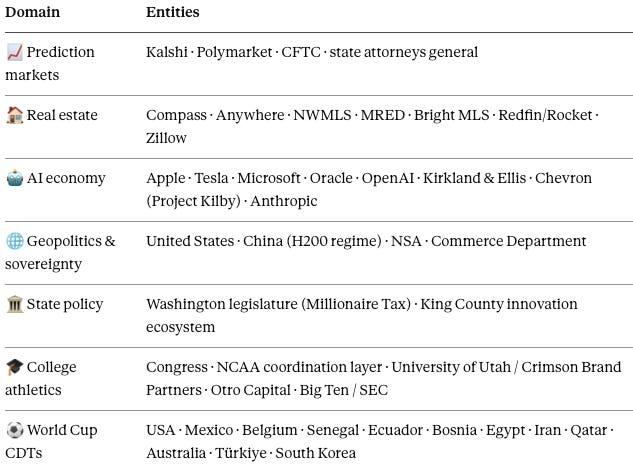
Every series above runs on the engine Section X documents — Cognitive Digital Twin simulations grounded in predictive game theory, behavioral economics, and cybernetics. The record below shows where the engine pointed in June: which entities entered simulation, which predictions resolved, and which questions each framework lens answered.
Entities Simulated
Predictions Resolved and Validations Scored
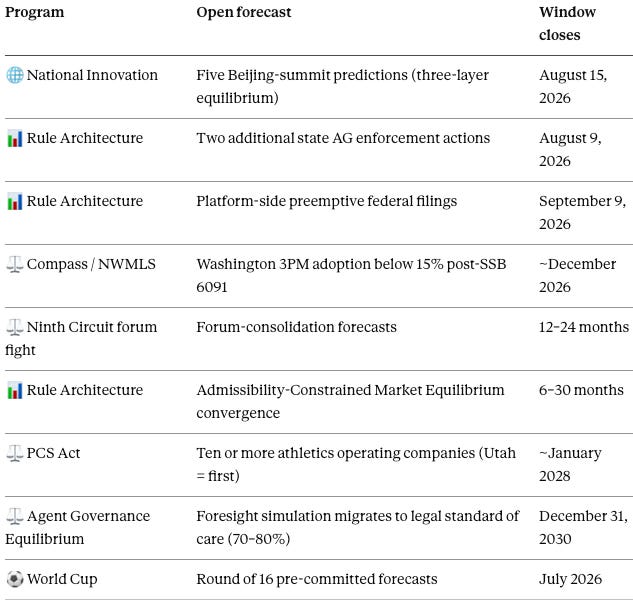
Seven predictions locked in prior months resolved on the record during the window, each scored against a named forecast. Favorable windows do not mean an unfalsifiable record: the dual sports ledger (one outcome miss across ten simulations; 7–3 on the composite strict standard), the reconciled April 9 near-miss, and the US calibration anomaly all sit in this issue, and the Live Exposure table below lists every claim that can still fail — some will.
Two-Gate Game forecast — The May 13–15 Beijing summit held the January prediction on every component: roughly ten Chinese firms licensed for up to 75,000 H200 chips each, zero deliveries, Beijing forcing domestic substitution through ecosystem discipline. Import acceptance, not export eligibility, determines capability flow.
Prediction Market Falsification Constraint — The April 9 falsification condition survived on its stated terms; the hedged directional risk materialized 26 days after the window closed, and both facts entered the ledger.
World Cup Validation Reports I, II & III — Pre-committed regime forecasts graded against group-stage and Round of 32 outcomes, with every match piece published before kickoff under falsification contracts; Report III graded the knockout slate A-minus, went 3-for-3 on winners, raised the strict public ledger to 7–3 across ten simulations, and adopted the Mechanism–Outcome Validation Doctrine across all Cognitive Digital Twin publications.
Functional Economic Purpose Test — Kalshi’s first bespoke block trade performed economic risk transfer usable under the screen MindCast proposed in its RIN 3038-AF65 public comment, converting a rulemaking proposal into live evidentiary architecture.
Firm-power forecast — The Chevron–Microsoft Project Kilby agreement confirmed the Energy-Compute Nexus prediction: hyperscalers would exit the grid queue to secure dedicated private power, making firm power rather than chips the binding constraint on AI capacity.
Sovereign Core Advantage Over Safety Theater forecast — Commerce’s allowlist for Anthropic’s restricted cybersecurity model resolved the National Innovation Vision series’ standing prediction that trusted-partner allocation would displace categorical export bans once national competitiveness pressure arrived, on schedule.
Firm-Formation Phase forecast — Utah’s Crimson Brand Partners close (June 12, graded in the July 1 publication) confirmed the January 2026 prediction that advantage would migrate from player coordination to the institutional-capital layer, with four structural calls from the original analysis — revenue concentration, retained institutional control, professional operating discipline, arm’s-length capital — confirmed in the finalized structure.
⏳ Live Exposure — Open Falsification Windows
Every resolved prediction above once sat in the table below. Readers auditing the Review should start here: these are the claims currently at risk.
Questions Asked, By Framework Lens
Predictive game theory — Which actors capture value when Congress regulates yesterday’s coordination layer while competitive advantage migrates into the capital layer — and does compliance infrastructure become the moat the statute never named?
Behavioral economics — Why did Redfin’s transparency pledge reverse when ownership changed — regulatory capture in George Stigler’s sense, priced in advance?
Cybernetics — Can an institution’s governance bandwidth match its agents’ autonomy growth, or does requisite variety fail exactly where the CFTC’s supervisory actuator runs slower than the process it governs?
The full question set for each lens runs in the internal research appendix.
One Phenomenon, Seven Industries
Although June covered artificial intelligence, litigation, sports, real estate, energy, geopolitics, and college athletics, every series examined the same underlying phenomenon: how institutions adapt when information becomes abundant but governance remains constrained. Different industries exhibited different symptoms, yet each revealed the same structural transition from prediction to governed execution.
Closing Pattern
June 2026 marked MindCast AI’s maturation from prediction analysis to governed foresight — the month the research platform’s recurring unit became visible as the series itself.
The common question across the month was not “What happens next?” The better question was: who controls the system when the next thing happens?
Governance debt accumulates at exactly that control point. Platform power hides there. Litigation begins there. MindCast AI is building its edge there.
Ahead in July
July extends the governance framework in three directions. The National Prediction Market Litigation Architecture series, opened with the federal-plaintiff phase on July 3, examines how federal and state authority reorganize around prediction markets. The Dual Nash-Stigler equilibrium-failure audit — introducing the Prediction-Market Harm Clearinghouse — applies the framework to institutional failure under competing strategic incentives. World Cup Round of 16 simulations continue the public validation program across the eight-match slate (July 4–7), publishing in a rolling wave as each tie’s feeders resolve — with Mexico hosting England at the Azteca July 5 and the USA–Belgium Seattle capstone at Lumen Field July 6 — where Balogun’s suspension converts the distributed-creation thesis from claim to live test. Readers should expect progression, not announcements: every July publication tests a framework June built.
MindCast by the Numbers — June 2026
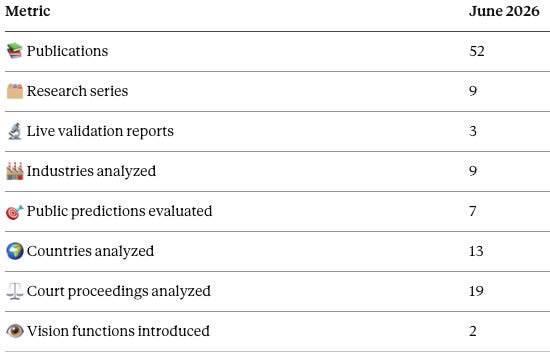
Definitions, fixed across issues: Publications counts unique in-window program publications (companions and pre-window foundations excluded, cross-listings deduplicated). Research series counts named series with in-window members. Live validation reports counts formally graded reports. Industries counts subject verticals holding a program section. Predictions evaluated counts Foresight Record resolutions. Countries counts nations simulated as Cognitive Digital Twins or sovereign actors in-window. Court proceedings counts dockets receiving substantive analysis. Vision functions counts named functions entering the corpus in-window.
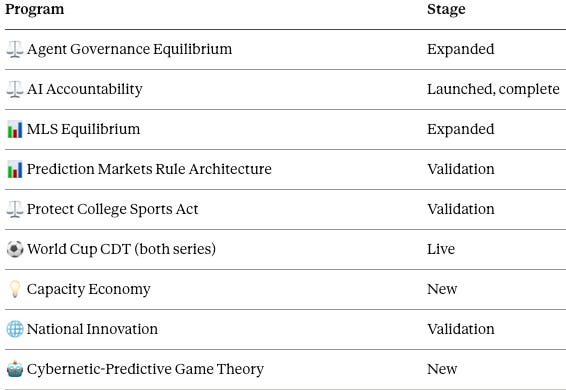
Program Status
Research Question of the Month
Question carried into July: Can institutions govern autonomous systems faster than autonomy improves itself?